







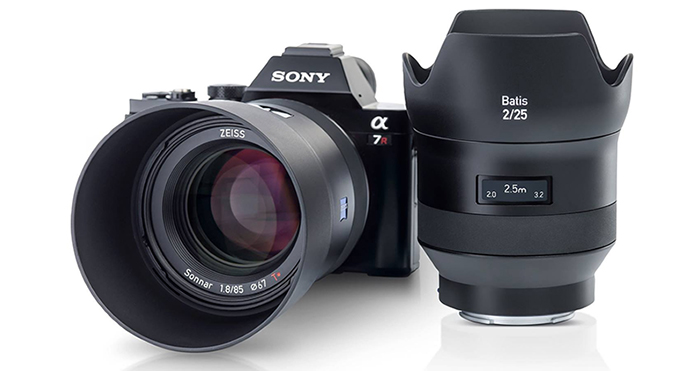
Ilovehatephoto interviewed Zeiss managers and got those interesting answers:
1) About future FE lenses: “we can expect about 5 new Full-Frame E-mount lenses, including 2 to 3 new ones in 2016.”
2) About macro and tilt shift lenses: “We are well aware of the lack of specialty lenses in the FE-mount system and we are working on developing some for this system. ”
3) About the Batis backorder issue: “We have to admit that we have been surprised by how popular the A7 markII series (A7II, A7rII and now the A7sII) has become over the past few months. The demand for the Batis lenses have been a lot higher than expected. We are working on this to reduce the waiting time as quickly as possible.”
4) About wide angle lens development: “The short flange distance between the sensor and the rear element is an engineering challenge for ultra wide-angle lenses.”
Furthermore Zeiss stressed to say that their focus is on the Full Frame E-mount system and they do not plan to release any new Touit lens for the ASP-C system any time soon.
Links to all Zeiss made FE Loxia and Batis lenses:
Zeiss Batis 85mm f/1.8 lens in US at Amazon, Adorama, Bhphoto. In Eu at Amazon DE, WexUK. In Asia at Digitalrev.
Zeiss Batis 25mm f/2.0 lens at Amazon, Adorama, Bhphoto. In EU at Amazon DE, WexUK. In Asia at Digitalrev.
Zeiss Loxia 50mm f/2 Planar T* Lens for Sony E Mount at Amazon, BHphoto, Adorama., WexUK, CameraPro.
Zeiss Loxia 35mm f/2 Biogon T* Lens for Sony E Mount at Amazon, BHphoto, Adorama, WexUK, CameraPro.
Zeiss Loxia 21mm f/2.8 FE lens at BHphoto and Adorama. In Europe at WexUK.
234 Responses
me gusta !!!
Kumbaya!!
Wonder how much overlap they will have with Zony & G lenses.
I really want a Batis 35. Not too keen on any native 35mm on the market at the moment.
Zeiss Surprise?
As an owner of Batis 25 & 85, I REALLY-REALLY want batis 135f2 and 200f2.8.
A Batis 135 sure does sound awesome.
Since I know Sony and Zeiss teams are likely reading. I will buy a 135 Batis if you make one. 😀
Batis 50mm f2 (macro) and Batis 100mm f2 (macro) = subscribed.
sign me in too on the 50M
the 50mm 1.2 Badass (though highly unlikely) would be very welcome
+100 for the 135 f/2 and 200 f/2.8! And Zeiss, please make a 14-15mm f/2 for astrophotography, it would be killer!
135 would be great!
Developing Tilt and Shift? That definitely would be putting the cart before the horse!
While there are very definite uses for them, they are extremely specialised and those who need them are adequately served with adapters.
Should Sony achieve their aim of attracting a very large following I would welcome the addition, but there are so many other needs first I hope they don’t waste too much time in this direction!
This is Zeiss talking not Sony.
Zeiss doesn’t have to fullfil the essential lenses selection for the FE system, that’s Sony’s job.
There is 8 FE to come for next year wich will make a total of 18 Sony’s lenses for a system that will be 3 years old by the end of 2016.
That’s 1 lens every 2 month pace, no other manufacturer have done that so far.
Unless Sony overlaped again focal lenght, there is a great chance that all the basic focals will be covered.
So if Zeiss wants to take care of niche market, why not?
Fair enough, I just hope that everyone gets the lens they are waiting for!
I’m happy with my Samyang TS 24mm, so bring on a nice 150-400 f4 and I’ll be over the moon…(I know, huge and not going to happen!).
I want a Batis 1.8/40
If Zeiss is devoting this much attention to the FE line, then they surely have had a look at the A7 Series road map and it’s a safe bet that there is a Pro model (a9) in the works. hope it’s a doosey!
I wouldn’t bet on it.
I suspect they know or knew that more FF mirrorless systems would be coming, develop now for Sony and have lenses designed and ready for Leica SL, Canon EF-M FF etc.
From my point of view it’s a curiosity – Sony put all the efforts in developing FE which cause troubles in lens developement while left behind A bayonet which is much less demanding. Strange logic. But I always ask myself another question – why switching to mirroless from was so sucesfull for Sony? Do A7 in SLT form factor was able to make such success?
Sorry, but you are wrong. Short flange distance is always a better solution – it gives more flexibility. You can think it this way – every single optical design for a A-mount could also be used for E-mount, but in addition to that E-mount can have designs that are only possibly for that particular mount.
The real difficulties arise because market wants as small lenses as possible. This can drive designers to place elements as close to the sensor as possible, just because they can now do that.
And actually with some current E-mount designs, Sony has been unable to put elements close to a sensor. Just look at the 70-200 f4: https://cdn.photographylife.com/wp-content/uploads/2013/10/Sony-FE-70-200-f4-G-OSS-Lens-Construction.jpg
That particular lens could be made for an A-mount, because the distance between the last element and the sensor is so big. This just emphasis the great flexibility within the E-mount.
4) About wide angle lens development: “The short flange distance between the sensor and the rear element is an engineering challenge for ultra wide-angle lenses.”
With this lens-design-drawing, is that a statement I really don’t understand.
I think Zeiss is saying they would feel bad to simply port old lenses designed for long flange distance into E-mount and call it a day.
They got some bad conscious after pulling off the first two Loxia and outsourcing the first two Batis to Tamron.
This time they probably intent to design them in-house. The “engineering challenge” they speak of means “to actually spending resources on design” rather than just use extension barrel to old designs.
So, there is no real advantage of E-mount if the size of the lens is similar to A-mount. The lens above looks like a-mount lens with an adapter. This cause me thinking that it’s not easy to put elements closer to the sensor. Moreover there is no fast zooms for E-mount (like 24-70/2.8) what is a second proof for difficulty. But of course I can be wrong – the question is do Zeiss is wrong as well?
Nope.
It’s not the strive for small lenses to place the rear element close to the sensor…It’s a necessity!
At least for wide-angle lenses, where the light comes at a wide-angle 😉
If it’s further away than the mount would obstruct the light path. Resulting in a considerably smaller image circle.
The problem is the narrow mount close to the sensor.
The closer to the sensor the extremer and more compromising a symetrical WA lens.
The solution are retrofocus lenses. (Like Leica M or Rodie)
But they come with their one problems. They require special sensors (special microlens-array and preferably big flat photosites).
Hence mirrorless WA requires either retrofocus lenses (with specialized sensors) or large mounts (with big telecentric lenses)
Regarding your last point… it’s been reported Sony was surprised at the success of E-mount. We voted with our money. They just ran with it.
It’s one of the reasons I don’t bash Sony for concentrating on it. They are a business, and will go where they think the sales are.
Is it me or soon will be more Zeiss lenses than Sony lenses?
It’s you. 🙂
But seriously, announcing lenses is not the same as supplying them. Most people are still awaiting their Batis lenses, and Loxia supply isn’t much better.
Loxia lenses are easy to get, just about everybody has them in stock and has for months – at least in the US. But I agree with your general point. They really missed on their volume projections, especially for Batis.
I guess Cosina can’t make them fast enough. 😉
Zeiss undercalled the market for the lenses and misjudged the popularity of the a7R II and simply do not have enough capacity at Cosina to meet demand.
More punch and surprises than all the noises made by Sony so far 🙂
Batis 35mm f/1.8, Loxia 17mm tilt-shift, Batis 50mm f/2 macro (1:2) and Batis 135 f/2 please.
All will easily find its place in my kit!
Loxia tilt-shift lol
Keep dreaming 😉
sure, dreaming doesn’t cost me anything, so why not 😉
They won’t be able to do that and keep true to the Loxia formula of 52mm filter threads on all lenses.
I think it’s very unlikely Zeiss will produce an E-mount tilt shift. I think you misinterpreted my comment.
I agree, they were referring to specialty lenses on the whole of which T/S lenses are just one category. It’s much more likely that it will be a macro lens of some sort.
perfect selection!
Exactly! The FE lens line lacks a real walk-around 35mm lens, the 1.4 is way too huge, the 2.8 is tiny but aperture is too slow, the Loxia f2 is manual, we need a moderate f1.8 or f2 AF lens, but there’s no such thing! damn it..
150mm Macro? 135F2!
What’s the problem with the short flange distance – just put the Lens in some distance to the sensor?
The guy answering the questions was not an optical engineer. Short flange distance gives always more flexibility in optical design over a longer flange distance. It’s not a problem – it’s an advantage. As you suggested, designer can always increase the distance between the last element and the sensor.
Possibly what he meant to say was that fully utilising the short flange distance is a challenge. Otherwise it’s just completely wrong as (optically speaking) modifying a DSLR UWA lens amounts to adding an extension tube.
No they can’t place the last element of a wide-angle lens further away!
The mount would obstruct the light path…
The problem is a relatively narrow mount close to the sensor. It forces wide-angle lenses to be very close to the sensor. In the case of symetrical WA lenses that’s a clear disadvantage. Since the extrem incident angle requires extrem lens designs and/or compromises.
Mirrorless either demands retrofocus lenses with specialized sensors or a large diameter mount (including large symetrical UWA lenses). E-Mount has neither. The mount is relatively small as it was designed for APS-C…
..the problem is the combination of the short flange distance with the small mount diameter!
Admin – where is the promised “surprise” on Sweden presentation?
The surprise is that there isn’t a surprise 😀
It’s a Sony surprise, not a real surprise
ordered the zeiss batis 85mm since July at B&H and still haven’t got it.
It took 5months for me. Ordered in May and both arrived in Oct. Highly recommend BW 3stop ND for both lenses to shoot wideopen day time – AWESOME
Do you need the 3stop when the A7 does 1/8000s? I was debating it but couldn’t convince myself
It’s not about the shutter speed. It’s more for colors and rendering.
Great, I ordered mine two weeks ago so I’ll get it in 2017 lol
Maybe in time for Christmas 2017 😉
Search around, after I wasn’t a part of the first wave from B&H, I started calling dealers listed on the Zeiss site. I found one that wasn’t sold in about 10 minutes. Got mine 3 days after they first shipped, my B&H order still hasn’t shipped and I ordered in early June IIRC.
i just got mine the other day and ordered around that same time.
should be soon.
great lens. although my ff camera is being rented out and ive used it on a6000 so far..
but def has the sony zeiss 55 feel to it but more dreamy.
A 35, a 50, and a Makro seem likely given their past with the ZF/ZE’s – now Milvus – and the R.I.P Touit’s.
T/S seems much less likely as they’re expensive and very much a specialty lens. It’d be tough to recoup development costs, that’s why we haven’t seen them from Sigma, Tamron and others.
I hope these are not part of the 8 new FE lenses promised by Sony, we have plenty of expensive lenses already.
This is Zeiss talking not Sony. Their releases are never included in Sony’s roadmap.
Sony-Zeiss are sony’s design and fabrication. Touit, Batis Loxia are Zeiss only work, Sony is not involved.
The 8 new FE are Sony (Sony, Sony-Zeiss or G) but it doesn’t prevent of overlaping in focal length with wathever Zeiss will release nor in expensive pricing.
To be accurate, the Touit, Batis and Loxia are Zeiss and Cosina’s work 😉
I know, but nobody mention Foxxcon when they talk about Apple product.
You just did. 😉
Zeiss only make photographic lenses in Japan. You can see this in their presentations. I see no issue if it is Japan or Germany that is manufacturing them.
Actually I have not seen mention of Cosina or other optical manufacturer. I doubt your assertion about Cosina bears any truth
Cosina absolutely manufactures Carl Zeiss camera lenses. This is not a secret.
I see no issue either. I was merely pointing out Cosina’s hand in their manufacture.
It’s pretty well known Cosina manufacture Zeiss still photography lenses, with the exception of the 15mm ZF/ZE, which is manufactured in Germany by Zeiss.
They are manufactured by Cosina but they are not designed by Cosina. It’s like calling the iPhone a FoxPhone.
I’ve seen that analogy before, and it was wrong then too. I didn’t say it was designed by Cosina. I said it was Zeiss and Cosina’s work. I think manufacturing comes under the generic title ‘work’.
I didn’t see Zeiss and Cosina’s work in your post earlier, I just saw Cosinas work, either I missed it or you edited it 😉
Not edited, I assure you.
how about making the tilt shift lenses A mount compatible too? cos A mount hasnt any and cant use adapted canon or nikon or a wide range of 3rd party adapters. shouldnt be too hard as they are all manual lenses anyways….
You can buy Samyang/Rokinon tilt and shift lenses for A mount. Though I would advise you to buy an A7 or A6000 for tilt and shift photography. DSLR is just pain for that type of thing.
what difference does it make? i guess tripoding with a center mount on lens would make a mirrorless slightly more attractive as its smaller and lighter, but maybe a heavier camera would balance better?
but slt cameras have evf with same stuff as mirrorless, and better rear screens, with the articulation
The cost a pretty penny but they do exist. Price from B&H.
Schneider PC-TS Super-Angulon 28mm f/4.5 HM Aspheric Lens (For Sony Alpha) $8,288.00
Schneider PC TS Super-Angulon 50mm f/2.8 Lens (For Sony Alpha) $3,365.00
Schneider PC TS Makro-Symmar 90mm f/4.5 Lens (For Sony Alpha) $3,180.00
Tilt-shift lens?
give us a T/S for DSLR-lenses (probably MF) and we have several focal ranges.
The $50 tilt adapters are actually working well on APS-C bodies, but they are not precise enough for someone who wants to spend > $1000
I bought a tilt and a shift adapter from Kipon and actually recently got a dedicated tilt adapter. These actually work. Perhaps worse than dedicated tilt and shift lens but is much cheaper and provides much wider range of focal lengths and apertures e.g. tillable 50/1.4 lenses are not many. I now have on Nikon mount 14, 28, 50 and 105mm which gives me some latitude.
The shift part mostly works on APS-C If I do not want to crop. Tilting pretty much works with any DSLR lens without trouble on A7 except the 14mm where the hood causes some trouble.
>The shift part mostly works on APS-C If I do not want to crop.
Do you mean a FF lens coupled with APS-C body, or are you speaking about a APS-C lens?
full frame nikon lenses work well with shift adapter on E mount crop bodies. They work on A7 too but require you to crop the darkened area/vignette.
Yes.
That’s why I thought for FF-bodies you may need shift-adapted MF glass. I own just a tilt adapter for Minolta SR mount. (Didn’t find this for Canon FD).
A lot of cheap lenses available and crazy freedom for the picture composition. If the lens is tilted I can focus by pitching my camera only 🙂
I have a Kipon Tilt-Shift adapter, which I have been using with a Tamron 15-30 on the A6000. I recently got an A7R, and the Tamron can still give decent shifts at 21mm and up. Like, 10mm shifts. Not bad at all. At 15mm, you can get horizontal shifts for like 3-4mm, but if you try to turn the lens for vertical shift, the integrated lens hood becomes visible.
When I was thinking of buying the used A7R, I was wondering what my cheap TS options would be, thinking that the Tamron wouldn’t do. But it ended up working well enough so that it wouldn’t be a problem. Even at 21mm, the field of view is still wider than 15mm on APS-C.
When a Japanese technology mix with German engineering, it become very exciting. Now I see the differences from the rest.
As long as it doesn’t emit CO2 we love German engineering!
Sure, as long as they don’t build a defeat device into the lens that detects when it’s on an MTF tester and fakes the results…
that’s AWESOME news 🙂 excited.
Despite the plethora of native 35mm lenses, there certainly is a gap for high performance 35/1.8(2) in the line-up. Something the size and performance of the new Tamron.
I would go for FE 35/1.4, but there is no easy “no questions asked” return policy where I live, and the reported sample variation on that lens is scary.
Yeah I really want that 35mm 1.4 but I’m not willing to gamble for that price.
One of them is a Batis 18mm coming in April. This is direct from the Zeiss UK boss last Wednesday when he said to me “I can’t tell you which new Batis will be next but it will be somewhere between 17&19mm at a guess” (with a cough and a wink).
Should be good
I have also been led to believe by Zeiss people in Germany that an 18mm was coming but I was assuming it would be a Milvus based on the conversation. Both would be nice 🙂
He said it’s definitely Batis
The boss of Zeiss UK just got sacked 😉
For sure there will be a Batis 50 or 55mm f1.8 for around $1000…
This is the lens we all missed so far
That´s an ironic statement, right? 😉
The intension was ironic – yes.
But nevertheless I believe this will happen. A lens lineup simply need one with 50-55mm. Probably it is the FE55 with a different shaped barrel and a Zeiss-Batis badge.
There will either be a 50/2 macro Batis or a 50/1.4, or both.
I hope that we won’t see another 50-55 in the line-up, it would be totally useless. A very AF wide angle (14, 16, 18?), a 135mm, or specific lenses (yep, macro, TS)
Yeah, I could believe they would make an other 50mm, but a faster one. If not, most people would probably just go for the most affordable one, since both would have ridiculous IQ anyway.
And I agree with Ayoul. Come up with a 135mm f/2 and a fast 14-15mm. Zeiss, please come up with a 14-15mm f/2, that would be AWESOME for astro landscapes. Actually, a design like that should be a Loxia I think. And I don’t think you’ve ever made a tilt-shift lens, but if would be really cool if you did.
I do hope so.
This does not make sense
Sonnar 1.8/55 is about as good as 50mm can ever get.
Since I own the Batis too they are very very similar in rendering and optics.
Batis is also closer to Sonnar than planar optics it seems. So no big difference at all…
What would make some sense may be is cheaper 50/1.8. Perhaps an update to the APS-C lens that just covers full frame.
As the FE55 is a Sony-Zeiss, I think that maybe there will be a Batis-version of it: Identical lens, but rounded barrel-shape + OLED display to look like Batis-family.
=> Little effort and Zeiss can say “there will be 5 lenses” instead of 4.
Yes Batis looks and feels much nicer than the older designs. In fact any lens design I have seen prior to Batis looks a bit inferior.
I doubt this, a lot.
It is just speculation…
But it’s worth a bet for a “I told you so!”
agree?
if another 50-55 mm lens comes out i’m going to kill myself.
And in 2017, they’ll roll out a 35mm.
there already is a 55 1.8 which is excellent. why the hell do you think there needs to be another?
All lens line ups should have a 50mm.
I also think and hope a Batis (Badass if you will) 50 will come.
Call it the Badass 50mm
With all this small camera hype soon “fast lens” will be a synonym of f/8 lens.
Going back to 80s, when zooms were f/4 and primes were f/1.8-f/2.
Bunk.
Fast lenses were more critical on film cameras. I’d rather have an excellent f/2 lens than a mediocre f/1.4. Batis = winners.
Yeah, slow lens users spend alot of time every day convincing themselves they don’t need “fast standart” 50mm 1.4 from 2000s. In 2015 we don’t need wide apertures. Right after that they take their good old A7whatever and put on a fast Canon glass via adapter.
You’re the only one trying to convince anyone of anything, and no one seems to be listening.
No time to listen, need to get that fast second-hand Canon glass.
Some are quite good, others not. Depends on the lens.
Most of the photographers using Canon glass on A7’s are Canon users looking for a better sensor.
That’s true but I’ve noticed a lot of Canon glass on Craigslist for very reasonable prices lately, I’m tempted to grab a few pieces.
The big difference is these modern lenses are sharp wide open, many of the older lenses not so much.
You are absolutely correct. Even f/1.4 designs from 10 years ago are crap until you get to f/2.8 on most of them. Today’s f/1.4 lenses like those that Sigma have been producing in the Art line and Zeiss in pretty much all of their lines, are pretty darn good wide open and exceptional at f/2.
Yes, we noticed that with the FE 1.8/55, it’s superb wide-open. Contrast it to the older Canon 50L at any aperture.
Sharpness is the same marketing bs as megapixels.
Now you sound like Ken Rockwell, hopefully you’re joking or in need of new glasses.
Most probably those Ebay prices for old fast lens are because many people have lost their glasses then.
The new lenses are better by a country mile, but some people have a weakness for nostalgia and money burning a hole in their pockets. As they say, a fool and his money are soon parted. All that’s left is an old not so sharp lens.
The only thing you don’t realise is that the “fool and his money” stuff relates to both sides, including the ones that are in photography for sharpness, and not artistic impression.
The photographer provides the artistic part, not the lens.
Yeah right, “tools doesn’t matter”. And in reality artist has to pick the right brush first.
I can’t paint worth a dam, no matter what brush is used. 🙂
Just get the most expensive one, marketing says.
I tried, didn’t work. 🙁
But to each his own, every person is looking for something different. I like sharpness, smooth bokeh and rich colors. Others (you perhaps) are looking for something different in terms of a lens, a camera, a film etc. No one way is the “right” way.
More likely because of the look and rendering of those old lenses.
Yep, here we come to rendering…
Well, of course, they offer different personalities. I could see why someone would like a lens with a dreamy feel for portraits. I bought my used A7R from a guy who did mostly portraits, but to him the A7R and Zeiss 55mm f/1.8 rendered way too much detail and reveal all the flaws on people’s face. Makes sense. I do more landscapes, night time photography and want to get more into architecture, so I’d rather having something really sharp and detailed, I find it shows textures better. Different needs for different people.
Nice… I could sell one of my kidneys for all those Zeiss lenses.
One kidney is probably not enough…
Better say goodbye to one of your lungs too.
21mm f/2.8 please. Would pickup the loxia but would like to have the AF for some situations…
I doubt that will happen just yet.
“The short flange distance between the sensor and the rear element is an engineering challenge for ultra wide-angle lenses.”
That’s a nice way to say: you fked up your mount (diameter), but chill the f out we got this!
What he didn’t say was: it’s hard, IF you want to keep those lenses small. Think about it. Nothing stops them from adding the wished for flange distance within the lens itself. (Adapters add the flange distance to lenses made for DSLR:s). What he is saying is basically: it’s hard to make wide angle lenses and keep the glass close to the sensor. But that difficulty is there regardless of the flange distance. Actually, it’s a good thing that distance is in the lens, rather than in the camera body, since a lot of other lenses could actually benefit a lot from the shorter flange distance. A large flange distance camera with a compact WA lens wouldn’t be smaller than a short flange distance camera and a larger lens. If you’re still not convinced, get yourself a dslr. There are lots of long flange distance cameras. Short flange distance is actually one of the main features of the e mount cameras.
Ah! Missed the “(diameter)”, comment. That could actually have a little to do with it. Still, Nikon for instance uses an even smaller mount diameter, but you’re probably correct Sony would have been even better off with a bigger mount.
Or maybe it’s because it requires lens manufactures to recalibrate their existing designs to match the short flange distance. In the past it was relatively easy to use the same designs across the board and just attach the appropriate lens mount. It’s a money saving thing for the most part.
Lmaoooo
Actually, its the sensor design, Sony have a mount that’s optimized for their (and they should know, they make ’em) future (in design) sensors. The only “fked” up thing here is your lack of logical analysis.
voigtlander is way ahead of them then, no? considering the 10, 12, 15mm heliar lenses coming out in the spring
YES!!!!!!! It’s coming!!!!!! A6100 and A7000!!!!!!! http://www.dpreview.com/forums/post/56742603
Yeah baby!
If he’s really right about the dual slot of the A7000, it will soon come in the A7 serie as well (A7Mk III?). And it’s a good news for pro photographers.
Hm, no Zeiss lenses for these cameras… but “the weather sealed lenses will come later”.
Yep, but on another thread he says that there will be a weather sealed 16-50 identical optically as the 16-50. It’s disappointing if there is no real new lens. A high quality 16mm (24 eq)? A 55 1.4 (for a better portrait lens than the 50 1.8)? A new standard zoom better than the 16-70? The A6000 is still a great camera : what Sony APS-C E-mount needs are great lenses, with acceptable sharpness on the edges at least stopped down, with no manufacturing issue like decentering or copy to copy variations…
If that’s true, having the same EVF in the A6100 as the A6000 is a disappointment. It was annoying when they lowered the resolution before. Now the RX100IV and RX10II have the better 2.4m EVF, it’s even more galling.
Look at A7000’s EVF though and it’s 0.85 magnification. It’s HUGE.
Where all the talks about a7000 and a6100 came from? Are they announced?
Look like we’ll have to wait another generation for IBIS?
Hmm, admin?? You can consider this guy in the dpreview forum as a lier if you want and if you think that it’s fake, but do you really have to delete that?
Dumb question: why is the flange distance a challenge for short (or very long) lenses when you can just add more distance in the lens housing? Or is it that with a very short lens, that will work, bit you get aberrations like those seen on some adapted wide lenses?
When you add “more distance in the lens housing”, you should see this as a kind of a tunnel. At the end of the tunnel, you still have to illuminate the whole sensor which is large. The main problem is not the short flange distance itself, it’s the short flange distance WITH a very narrow mount. Fuji X, Leica T also have a very short flange distance, but the mount itself is larger. It makes the optical designs easier.
It is a multi-design goal optimization as Zeiss said. You are picking only one. Least distortion with best sharpness and vignetting. Usually improving one can influence the others negatively. I am perfectly happy with the 85 Batis. Sharpness is just great even wide open.
I precise : personaly, I don’t care about distortion as long as the lens remains sharp when corrected (if needed…). Only the final result matters to me
They indeed talk about distortion AND vignetting but not at the beginning of the sentence : “One solution would be to accept a lot of distortions (which some other brands do). But this is not ZEISS’ conception of a lens” They said it, I didn’t.
Now, if I look at your point and the rest of the sentence : “ZEISS will release a lens when this issue is correctly treated with the least vignetting and distortion as possible and of course the best sharpness from corner to corner.” According to diglloyd, the batis has something like 2.2 EV of vignetting at wide aperture : it’s huge. It may be very sharp, but it has a lot of distortion AND vignetting. So it’s not the perfect balance that the guy tries to make us believe.
My Nikon 85 1.8, which is a very great lens (maybe slightly inferior to the batis regarding sharpness) has almost none distortion, and something like 1.5 – 1.6 EV of light fall-off at wide aperture. It’s more balanced.
I have the 85/1.8g, too and it is not in the same league. The Batis is sharper on the A7ii than my 85/1.8g on my D810. Then contrast when shooting against the sun is much better, CAs better controlled. So I can live with distortion and vignetting as the other parameters are more important to me and the Batis is a perfect balance for me. So regarding all parameters, it may still be the best package Zeiss could design given the size and weight. Don’t they incorporate camera correction into the design process?
I trust you if you own both, at least at wide aperture. (but i’m pretty sure that stopped down you retains more details with the 36 mpx than with the 24, no?).Yes, they incorporate camera correction into the design process… but this is exactly what they pretend not to do… They talk specifically about low vignetting and low distortion and this lens trade exactly theses 2 parameters for others (sharpness, CA and flare/ghosting if I follow you). This is not a very honest statement from this guy…
Yes, stopping down gives the advantage to the Nikon due to the higher MP. I meant wide open. I am fine with the compromise but I understand perfectly that you are not, which is your right of course. Probably only making stuff larger (Milvus, Otus) allows for true performance with as little compromise as possible.
No, I’m fine with compromises as well ^^ I don’t like too bulky lenses at all and will never buy some monsters like Milvus or Otus. It just annoys me to see a guy from Zeiss telling proudly that their lenses have minimal distortion and vignetting just after the release of a lens like the batis 85…
I agree with you it’s inconsistent. But I think I have the explanation.
The first two Loxia are ported from M-mount.
The first two Batis are outsourced to Tamron.
It wasn’t until the third Loxia that Zeiss decided to spend in-house engineering resources to create E-mount specific lenses.
So far, that they had typically done was designed lenses for Nikon flange, then ported them to Canon mount by adding a few mm to the barrel, etc.
When Zeiss reps. say “engineering challenge” it just means they have to start from scratch and properly design new lens in-house, instead of extending the lens barrel of old designs, or outsourcing lens design to Tamron and other companies.
What exactly do you mean by ‘ported’? Do you mean they use the same optical formula? Because if you do, that doesn’t mean the Loxias don’t have to be designed, in-house, by Zeiss.
As for your assertion BOTH Batis were outsourced, I’d love to see some evidence of that. I’ve seen the 85mm patent, but nothing for the 25mm.
You’re correct about the Loxia of course. I meant that they were not native FE designs.
There is info of the 25mm Batis here:
http://www.camerabeta.com/rumor/tamron/tamron-25mm-f2-vc-lens-patent/808
“Tamron 25mm F2”
Interesting… have we seen the optical design for the Batis though? Really need to compare them to be sure.
Batis diagram is shown in the same link I provided. Further down.
Ah… they certainly look like the same optical formula. Interesting that the Tamron is labelled VC, but the Batis forgoes it (although it’s not really necessary at 25mm).
Thanks for the info.
Probably to save some weight/width. You can also see the element furthest back is different as well. So the Batis is slightly altered for sure.
But it’s still a design that’s mostly designed by Tamron.
I think it was Rudolf Kingslake who said that cost is the most significant lens aberration.
Didn’t know this guy. Very interesting.
So FE is basically screwed from the start?
I’m not an optician and I don’t know very well how this can affect the designs of the lenses or their performances, but Sigma CEO said the same thing in an interview few years ago, I think that this 2 guys knows what they are talking about.
What is suspected (but never confirmed or denied by Sony) is that E-mount was designed only with APS-C in mind at the beginning… Maybe if they had started with the A7 line they would have chosen a slightly larger mount from the start…
But the only real “weak” lens in the line-up comparing to its DSLR counterparts seems to be the 24-70 f/4, so I guess that opticians can actually achieve great results with this mount. Maybe with more complex designs? Bulkier lenses? More vignetting and distortion maybe (E mount lenses seems to have often a great amount of distortion). I don’t know…
While your comment seems reasonable, there is one blaring mistake that makes me think the whole thing could be wrong or made up. The Fuji X mount is smaller the the Sony E mount and is widely documented that it is not wide enough to fit a full frame sensor.
Yep, my mistake about Fuji. I checked after your comment, the mount is even narrower than E-mount. I was pretty sure it was few mm larger. But I think that they don’t care, they’ve built a lot in APS-C and they deny since years every rumor about FF. Given the amount of lenses they already have it makes sense.
Leica T (or should we call it S now?) is for sure larger, it has been mentionned but I can not retrieve the review in which the diameter of the mount was described. And I remember a lot of people saying that Leica was thinking about a future FF T camera when the first T was released because of this larger diameter.
EDIT : it’s 51mm.
But “made up”, really? Interesting. What for? To “injure” Sony?
If you look at a tele zoom such as 70-200, you will notice the last glass element is very deep from mount, unlike any short lens. So the answer to your question is yes. I think different mount variants for sigma lens are just different in housing and distance from last element to cmos is the same under the same working condition.
you guys discussing in here, being concerned with wide angle, you do remember that voigtlander announced a 10mm lens for the e-mount right?
A short flange distances is theoretically prefered as it allows for more freedom in the lens design.
The problem is the diameter of the mount. It forces the rear element of a wide-angle lens to be close to the sensor. You can’t place it further away as the mount would obstruct the light path. Placing a symetrical WA lens close to the sensor isn’t clever. That’s where asymetrical (retro-focus) lenses come in play. Like Leica, Zeiss & Voigtlander M or Rodenstock Digaron.
Though they make trouble on modern sensors. They need sensors with special microlenses (or none) and preferably big photosites with short wells.
-> Mirrorless demands either a large diameter mount or retrofocus Lenses.
Independent of the strive for small lenses…
Sony E-Mount has neither. The mount is relatively small for full-frame because it was designed for APS-C.
Because it is not a Batis.
I don’t think the Batis will be different to the FE55. The guts can be produced in the same line – no additional R&D. Just the rounder barrel shape, an OLED display, a Zeiss badge and maybe 100 bucks more.
I don’t know man. It seems like a waste of resources to me but who knows what will happen.
Long long ago in a galaxy far far away we’ve been promised a smaller, cheaper (much less mechanics in mirrorless) cameras with a smaller lens. And then Sony Carl Zeiss Distagon T* FE 35 mm F1.4 came out…
Sony was not the cheapest even a mount was robust.
I find your lack of faith disturbing.
My camera is not powered by faith.
gumdrops and lollipops?
I don’t remember being promised smaller lenses. Who said that?
Since 2014 Sony re-positioned FE from ‘compact system’ to ‘new generation of DSLR’, phasing out A-Mount. So, if they intend to make it a full-featured replacement, much bigger lenses will have to be made.
I really do wish they would pump out the 25 and 85 faster. I’m sure there’s a good reason and qc being one of them which I do appreciate. But still ?
Oh my. I am really enjoining manual lenses in FE mount. Loxias are a pleasure. Lets keep it up please…
Here is my translation:
Zeiss: “Oops, we screwed up, we directed all our resources to make 6 new Milvus lenses which nobody wanted. The Touit series did not sell, so we crippled Batis production due to Touit and made Milvus instead. B-but don’t worry, we corrected our mistake now, expect some new lenses in 2017 or thereabout.
In the meantime, please buy some Milvus.“
Utter nonsense.
.
Zeiss probably isn’t introducing any more Touit lenses due to the advent of full frame mirrorless. Batis production isn’t suffering from Touit anything. Loxia lenses are doing well but are not available for SLR – hence Milvus (which will probably eventually replace much of the classic line).
Hmmm how do you make text bold in Disqus? I don’t see any options for editing the text here.
It’s just standard HTML tags.
bold = bold
italic = italic
Thanks!
In these early days, there’s this fanboy hoopla to support Sony over the frontrunners Canon and Nikon. But Sony is just a corporation. The more I see this focus on mega-expensive FE lenses, I simply cannot wait for Nikon and perhaps Canon to bring out their mirrorless line. Sony is blatantly treating its FF user base as a cash cow, with no attempt to provide budget-priced lenses like Nikon and Canon do. I am yearning for some competition for Sony. I count myself a Sony-fan — I read this website every day — but I am getting sick of this continual parade of announcements of new FE-mount lenses that are out of my budget.
There are some of you who will respond that FF lenses are for rich people, so deal with it. But back in the SLR film days, FF was the norm, and it was for all photographers.
Can’t see anything you say is incorrect. I think they’re expensive as hell. The only FE lens I own are the kit lens and the 16-35.
Every other lens I own are Minoltas for everrything using converters. The more I use it, the more I feel like I don’t need those expensive lens though. One day I can afford them. :-p
supply/demand, lack of competition, for profit businesses, niche markets… yadda yada
You can’t compare things to film. With film you could cut the sheet to any size or sensitise even a beach towel. Not so with sensors.
From all the film camera makers that once existed, guess who survived the longest? Leica. Why? Because they made products without cutting too many corners. There’s nothing wrong in Sony doing the same on this system. You can always buy Sigma lenses if you’re budget conscious.
I’m not saying you wrong. But putting few hundred dollars lens on $2-3K body method doesn’t make sense in my world. High quality lenses offer much more than just better IQ – AF speed, AF accuracy, build quality, more weather resistance, feel and of course the looks.
I would put more money into high quality lenses and less on bodies. Just like the olds saying “bodies come and go, but lenses will stay” 🙂
EXACTLY! You can’t really put a price on good glass. It’s taken me a long time to amass a collection of Canon L Glass and I learned the hard way early on that cheap glass is pretty much worthless. You can put great glass on an inexpensive body and make some beautiful pictures. After an almost 5 month wait my Batis 25 and 85 showed up yesterday. In the 30 minutes that I’ve played around with them I can already tell that they were worth every penny and they produce some spectacular images the likes of which cheap glass simply cannot approach.
Hit the road, troll!
Those old lenses look the best to me lol. Sharpness or resolution, lack of flare etc is not always what you want. Incidentally i saw an interview with the cinematographer of ( ex machine ) he specifically used lenses with less resolution and prone to flare to offset the sharpness of the camera (sony f65? or something ). Old lenses can/ will always have their place alongside high tech new, almost flawless lenses. Look at the reolution figures nowadays….some of my best lenses are put to shame by the likes of ottus. It is hard not to think how could i have thought this lens was superb few years back and now it is crap loool. But seriously build quality of old lenses is something else, they are almost assault weapons. Image quality is also so diverse and their flaws so numerous it gives them a life of their own ( character ). I use mostly the best lenses i have, but sometimes i treat myself to an old 10-20$ lens and enjoy its unpredictable answers to my queries
You mind to share real test data between your old lenses Vs today FE55, Batis and Otus etc…?
In term of sharpness, do you think he cinematographer of ( ex machine ) speaks for all Sony shooters?
If you’re a professional photographer and these lenses are beyond your budget, you’re one poor photographer.
FF was the norm, it was also the norm that all gear were expensive but made rock solid with aluminum and brass, and nobody was running around shooting with an SLR for fun. If you have to argue, it’s Sony and Zeiss sticking to the norm and Canon and Nikon who’s expanded business on the low end.
if you are a pro…and use e mount cameras wouldn’t that make you a poor photographer too? Ever seen the price of d4s or 1dx never mind mamiya and hasselblad. the pros who use sony ( actual pros, not the ones who make some money with it ) like doorhof use sony as gadgets and because they are sponsored by sony. For the rest they use medium format or canon nikon ( specially the sports or even wedding guys charging up to 30k $ ) I wouldn’t say thats thelower end would you?
Well when he was whining about how E mount lenses are expensive that’s obviously comparing it to the CN low end. Of course there are more expensive CN cameras.
with time there will be cheaper lenses for ff e mount. We already have some very good performing apsc lenses like 50/35mm 1.8 oss and the 10-18 oss which are btw great performers. FF lenses will follow if not by sony then by sigma or tamron
Tell that to him.
Really though- think about where FF was just a decade ago. The first consumer friendly priced FF DSLR was the 5D MK1 at a whopping 3299.00. An Olympus PEN camera can now do more and produce similar results. Sony still produces the A7 and on the used market it goes for around 700 dollars. That’s incredibly insane. The cost you’re saving can be rolled over into lenses. The 55 1.8 can now be had for about 700 dollars or less…for a Zeiss lens….a really good zeiss lens.
It takes a few years for the used market to grow with a new system. At least with Sony you can adapt. I was using a few Minolta MD lenses such as the 28 2.8, 50mm 1.7 and 135mm 3.5 on an A7. The total cost of those lenses was under 100 dollars. The bokeh certainly wasn’t very good but the sharpness stopped down a bit was actually….very good.
I don’t think it’s a fare comparison because Nikon and Canon’s super cheap options are just that- super cheap. If you are refering to the 50’s- they don’t perform all that well wide open where people want it. If that’s not your cup of tea then sure- they are a deal. I say give it another year and Sony’s FE will be like any other system. Ubiquitous with all types of lenses from cheap to expensive.
Lol I do’t understand either why anybody would be fan of a multinational, specially when they are not a shareholder …?
The sony e mount cameras are very appealing to a segment of the consumers and sooner or later they will have to make some cheap and good lenses…like 35/50/85mm 1.8 for 200-400$. It is a matter of time before sony makes them and it is a matter of time canon and nikon give us better specs. They are not willing to do that yet, but they will have to if sony goes on on this route…..the progress has been huge in the last few years, it is very promising. 4 years ago people would have laught at you if you thought a little camera would do slow mo, 4k etc. Who knows 4 years from now what will happen. ome little camera which also 3d prints or what lol
Older lenses are btw just fine, with the sony peaking manual focus is not a big problem and old lenses are very small and make a sony a7 camera almost a pocket camera, which is a huge deal sometimes
Yeah ok Zeiss, hurry up and pump these out so we can get back to what really matters – APSC lenses.
Nope. Rather shoot with my phone and carry a FF for decent shots.
No, Sony fked up. That’s also what Sigma said:
“We don’t know why Sony did this. Likely because the E-mount was meant for APS-C first and only after that they did use it for FF too”
It’s hard to make good AND small lenses. You can do large lenses that are larger than DSLR onces, but then what’s the point of mirrorless?
If it was up to me. Then i would released 14mm f.2,8. 18mm f.2,8. 50mm f.2,0. 135mm f.2,0 and a Tilt Shift lens. All Batis lenses
The FE 55mm design is not possible to port to A-mount. It’s short flange exclusive.
Is this easy enough explained? E-mount = superior felxibility
Same here… More I use the LA-EA4, the more I love it. Mostly shoot in Manual mode with the MF-AF button. And my precious plastico fantastico 50mm 1.7 !
Speaking of lenses. Love to hear others thoughts on this: http://yannickkhong.com/blog/
A lot of nonsense with a little truth here and there…
It’s true that there are “flat” lenses. It’s also true that modern highly corrected lenses tend to be “flat”. But for entirely different reasons!
First of all the nomenclature is dangerous as flatness is already used in optics for the absence of field-curvature (planarity). So let’s use the opposite “depth”.
The extinction of light in a lens is indeed one of the many parameters affecting “perceived depth” but not like the author thinks. Only because the light gets reflected and thus lowering contrast as stray-light.
Though modern lenses have a much greater transmission even with more elements!!! As coatings greatly improved over time. Contrast is the most important parameter for “depth rendition”. For “perceiving depth” in a face or bigger objects contrast levels of medium frequencies are important.
Even vintage lenses can have good global contrast even with bad coatings not because of little elements but the differentiation of the refracted and relfected light path (The stray-light is simply out-of-focus). They often have also great contrast in the med-frequencies (yesterday’s high-frequencies) because they were optimized for film resolutions. Modern lenses are designed to have the greatest contrast at higher levels (micro-contrast) for a great sharpness even at high resolutions.
A Sigma Art has an MTF optimized for sharpness even with high-res sensors.
(contrast at highest levels). It trades this in for the contrast at lower frequencies…missing the “pop”.
A Noctilux would be the opposite. This doesn’t mean it’s always a trade-off. Lenses can have high contrast at all levels (Apo-summicron, apo-makro-planar, apo-sonnar…) upps all apos 😉
Nice explanation. This argument has been coming up more and more on internet blogs yet I’ve failed to perceive a lot of the differences. So today I did a comparison between some of my Zeiss glass and older minolta lenses. Sure enough- the contrast on those older minolta lenses is surely not up to par. The fall off in the corners in terms of sharpness is more dramatic. You get this dull kind of nothing in low light situations. Maybe the “frenquencies” you mention have something to do with this. My older lenses seem to fall apart much more quickly in lower light.
With that said, I tried stopping down to F11 as the author mentioned to see if all of the inherent qualities of the older glass would shine. He seemed to indicate F11 was the sweet spot. No such luck- I mean, go ahead and try the minolta 24mm 2.8 at F11 and it…well, it kind of sucks (I tested the 100mm 2.8 macro as well). Even my 16-50mm 2.8 DT does better at the same exact settings in terms of sharpness corner to corner, contrast even stopped down.
I can kind of agree on this whole flat picture verses 3D pop but admit- I’m just not seeing it or at least it’s not enough to draw my attention to it unless it’s pointed out. I’ve seen enough tests and have used enough older lenses including MD’s to know they are capable of high levels of sharpness. My issue is they fall apart quickly in high contrast situations, often ghost wide open at even 2.8, lack contrast which isn’t as easy as adding in lightroom as some suggest and the bokeh….man, the bokeh often just sucks.
I’m going to keep trying so maybe I just haven’t been exposed to the best legacy glass out there. So far the data just isn’t materializing for me in my own shooting.
You have misunderstood me (same guy two accounts…deleted the other one)
I disagree with the author. I just explained what causes depth and why some vintage lenses have great depth even with otherwise inferior qualities.
This doesn’t mean that modern lenses are always flat…
Your Zeiss has very likely a better depth rendition than the Minolta.
Don’t think to much into the “frequencies” it just means resolution level. Ex: 80Lp/mm
I was describing the MTF of a lens. Contrast of highest resolution details (micro-contrast) is perceived as sharpness.
Contrast of med-high resolution detail as “clarity”
Contrast of medium resolution detail as “depth” or “pop” and also saturation
Global contrast as contrast & saturation
Yes your absolutely right that they fail in high contrast scenes. That’s because coatings have immensly improved. It’s especially evident with high dynamic range sensors. Now all that reflected light gets captured too. Hence larger DR sensors show more ghosting and glare. Resulting in less contrast and also less clarity. Besides the coatings, the advanced computer design (separating reflected from refracted light), baffling and darkened lens edges make modern lenses superior in this regard.
Global and macro-contrast is only one parameter.
Color is also important. A lens with little color differentiation appears also “flat” as for example all the nuances in a skin melt together. The main driver for tonal differentiation is again contrast but also color neutrality (coatings).
Another apsect with great impact in depth rendition is the tone difference of in-focus to out-of-focus. Coatings that have a different effect depending on the angle.
The smoothness of bokeh wich agains helps to seperate is in old lenses sometimes very good as they are spherical.
At the end the most important factor in depth creation is the photographer. With the clever use of lighting, color, structure, texture etc…
They shouldnt even talk about new lenses until they fulfill their Batis promise.
…. still waiting.
Whilst Batis availability isn’t great, I don’t think that’s a reason not to talk about new lenses.
Are you familiar with the expression ‘First World problem’?
Just saying, they should put more effort into meeting the demand. Zeiss says “ooops! We’ll get it out soon but let us tease you with a promise of even more new lenses that probably will have out in 3 years.” As a consumer who preordered half-a-year ago, that is really annoying to say the least. I’d rather them leak out info about how & what exactly they’re doing to get those lenses out for reassurance.
I’m pretty sure the people designing new lenses are not the same people who are manufacturing the current designs. There’s no point in lens designers standing around on the clock, doing nothing, just because the manufacturers have a backlog of work.
Loxia 75mm f/2.0 please
You mean 135mm F2 APO.
that one too!
can we add some macro abilities to this one?
more Zeiss for FE lenses
more money we spend
Understood. I don’t agree with the author either and I see what you mean by resolution in relation to clarity, pop, etc. Very interesting! Thanks.
Waiting…
I hope when they have finished their Loxia line they offer them all in a bundle. Just imagine, a full set of loxia lenses and in a padded box with silver lining and solid metal latch up front. Maybe even a glass view window for displaying. I never said I would use them. This would be a vanity set so I could stare at them and imagine the image quality. Easier than taking pictures by the way. Think along the lines of the golden Rolleiflexes and crazy stuff like that.