







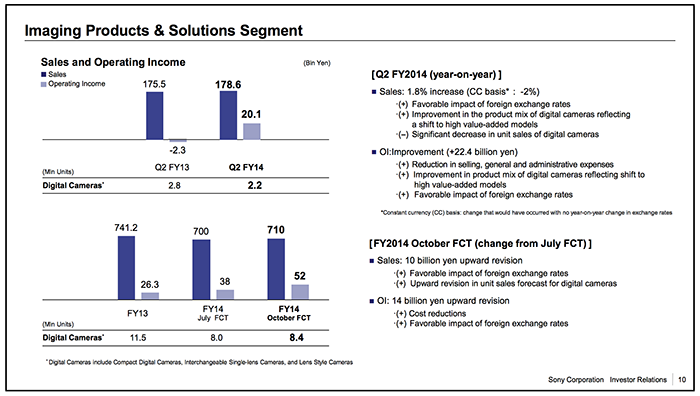
Sony is till facing a deep crisis and they reported a quarterly loss that was seven times greater than a year earlier as the company loses ground in the smartphone market to Apple Inc. and Chinese rivals (Source: Bloomberg). The full financial report can be downloaded here: sony.net/SonyInfo/IR/library/er.html. There are a couple of considerations to take here:
1) It’s only the mobile business that it’s really showing huge losses. All other Sony company segments are doing fine (games, imaging, financial services, music and so on).
2) Sony is selling less cameras but more high end and high revenue cameras. In short this means less “cheap” compacts” but more high end mirrorless and fixed lens (RX) cameras
3) Sony predicts to increase revenue in the Imaging Business.
In very short: If Sony would fix the mobile division by cutting costs or selling the whole segment problems would be solved (Just like they did with the selling of the PC business). And what matters for us the digital camera business is doing fine!
0 Responses
Speaking of good RX camera sales numbers. How much do you think a new RX20 would help RX sales figures?
Andrea, any world on that RX20 with 4k that you mentioned a couple of weeks ago?
Ready waiting on pins and needles for it. (Saved money is burning a hole in my pocket)
😉
You post this in every rumour… why not get a RX10? Anyway, you can expect a RX20 before the end of the year. Despite the talk about a big January announcement, there are still product refreshes to come this year.
Why not just buy a Panasonic FZ1000.In my experience, apart from build quality it’s better than the RX10 in almost every respect.
To Cliff and John,
Therein lies the issue! Almost certainly the development and production costs for the RX10 have not yet been realised, and customers are wanting an RX20 or will move to an FZ1000. Neither of those will achieve profit either and so it will go on.
If Sony and other technology companies go bust, we only have ourselves to blame!
but FZ1000 is without mic input socket (if i am not wrong), that really a deal breaker for me and also not weather sealed.
More telling is that the camera market as a whole is still shrinking and both Canon and Nikon showed large decreases in revenues and operational income (- 24% and -42% respectively) for their Imaging departments during the last quarters (available). Which makes the relatively stable revenues and significant increase op operational income for Sony Imaging quite impressive.
It means Imaging isn’t going the way of the dodo anytime soon and actually shows promise.
Mostly true. Sony shrank incredibly in unit volume before Canon and Nikon showed slides. Sony looks as if it has stabilized, which is good. It’s unclear where Canon and Nikon will stabilize, though Canon is forecasting growth next year. That means that from the peak of DSC sales, Sony will have lost market share, but is no longer losing market share. Not bad news, but also not great news, either.
More so than any of Sony’s other divisions, I think the imaging group has probably done the best job of rethinking their offerings, cutting costs out, and making products customers want. Now comes the challenge of re-growing the business.
Sony may not be perfect, but they actually have a good product mix and seem to be listening to customers. I wish the lenses for the full frame E mount were cheaper, but overall, they seem to be moving in a direction that can at least provide growth in the future.
So, who is going to by the Sony cellular business? Facebook? Some other large company with too much money?
Google bought Motorola Mobility in 2011 for $12.5 billion who I think is #3 in mobile phones (and losing money hand over fist to the tune of over $800 million). They just put a bow on a deal to sell Motorola Mobility to Lenovo for $2.9 billion. Google retains some patents (Lenovo gets a license to use them), their main reason for buying it, and the Advanced Technologies & Projects unit but you can see what also-rans in the cellphone business are worth. I assume any sucker who buys Sony’s epically failed mobility business would quickly rename the handsets Ericcson, the brand Sony purchased.
The problem with mobile phones is the market for high-margin flagship phones is saturated. The growth is in low-end, extremely low margin phones in developing nations. Not a marketing model I’d like to jump onboard as having a very profitable future.
The other problem with phones is that there is little other than the “shell” and hardware to differentiate between phones since all Android phones are essentially the same. So you choose a flavour of Android with the case you like the most (Moto, Sony, HTC) or Apple, or Windows Phone if you like the OS/design/camera or Blackberry if messaging and security are what you are after.
True, and the state of the art has reached the point you don’t need to trade them in like you used to and even the mid-range phones are good enough for most folks. I have a 2 year old Nokia and if they sealed battery wasn’t weak I wouldn’t even bother to ‘upgrade’ to a new one now that my contract is over.
More importantly: Sony increased their fiscal year unit volume forecast for digital cameras by 5% from their forecast three months ago. On the flip side, virtually all of the “profit” for the division came from favorable currency exchange (e.g. declining value of the yen).
Also, the movie business lost money. As with Canon’s report, the “profit” seems highly regional, as well (recovery in US and to some degree in Europe, less so elsewhere).
No, increased sales were mostly due to the Yen exchange rates. Profit was mostly up due to higher margins on higher end models (which were responsible for a much larger percentage of sales) and cost reduction.
Why do we care?? And why do you think any of people visiting this site can read or analyze or predict financial state of any company, let alone huge corporation like Sony.
What does it have to do with photography and overall update in imaging field, if they want, they will shut down any division they think is not profitable.
“discussing” about something we have no clue, doesn’t really make any sense
I wonder how they’re losing so much money in the mobile business. At least where I live, Sony has some very well featured and competitvely priced phones to offer.
In the U.S., T-Mobile is the only one who carries the z3 (their flagship). Verizon is selling a slightly watered down version (z3v). They need better market penetration in many areas of the world. Their top of the line phones are more than competitive with the likes of the S5 or iPhone 6. That’s why their mobile division chief was reassigned. In a world in which great cameras from HTC has to play second fiddle to Samsung’s latest iteration, it is not always clear that there is a market for multiple great mobile phones. Choice is good, but the consumers often have brain locks on what to buy.
Sony phones have the worst design ever. People want nice and pleasant looking phones not not rectangular boxes.
Define “pleasant looking”. Do you happen to speak for the masses? Cause plenty think that the current Z3 series phones look gorgeous.
The masses don’t like (and don’t buy) Sony phones and this is also what the article says.
the Sony high end phone actually sold a lot, the problem is their mid and entry level phone market share got eaten by cheap chinese/taiwan brand.
You mad bro ??? Sony brand is known for the best designs in the market and many of them just buy the phone on its physical appearance…. I own XZ and its wonderful device to hold !!!
Yee, this is why the have big problem selling them :))
Straw man.
Sony has problem in selling the low-mid end phone.
Because the new Chinese phone are cheaper & better.
IMO, Sony high end phone has the best design among others.
No, they sold the high-end models enough but Mid end seg is tough to beat. Even Samsung decline in that seg whre Chinese companies are on dominance. Again there is high marketing cost which is the culprit here…..
Sony needs to put out the A900II. That would fix all of this.
Indeed. It would “fix” the profitable imaging division and turn it back into a loss-making one. Hahahaha
I’m kidding of course.
It’s not gonna happen, that ship has already sailed. The A99II is probably the last SLT, Sony’s likely gonna launch a line of A-Mount MILC after they finally drop this light sucking transitional technology.
Yeah, I was being sarcastic…but it would be nice.
I’m keeping my A900, and I will use it until it’s shutter melts. It’s an outstanding camera. I skipped the A99, because the performance difference just large enough for the $3000.00 price tag. I’m waiting for the either a MILC A-Mount or a vastly improved A99II, plus a flash that doesn’t have a serious overheating problem.
I don’t think we are going to see the A99II. I think the A9 will take it’s place.
I think your right after looking at the FF mirror-less a-mount patent Willful posted last week. I wouldn’t be suprised if a A9, A9r, and A9s A-Mount MILC model are launched next year.
Sony will likely have three complete mirror-less lines cameras (E, FE, A), covering every conceivable interchangeable camera segment, and target audience.
A9 would seem to be E-mount base. Judging by Kenta and Sigma interview.
United States Patent Application 20130113982, they have already designed the SLR lens compatible on-sensor PDAF for a MILC A-Mount. Plus the A-Mount already comes a wide selection of pro lenses.
He actually was talking about a 100% mirror-less future not the mount they’d be using, which is also a strong indicator the MILC A-mount will be arriving sooner than later.
I guess it will be a A9 E-mount mirrorless and it come with the A-mount adapter. May be a new adapter with more focus point.
But I think there will be not IBIS, otherwise the camera will not able to take 4k video because of the heating issue.
Agreed. Let’s wait and see what a9 can do including the new adapter.
The problem facing the technology industry is that we, as consumers, have unrealistic and ridiculous expectations of products, which means that development costs can never be recovered.
Basically, a company will spend significantly on R&D to make the ‘next best thing’ on the market and people will certainly buy it. However, before a week has passed, another company releases their creation and attention (and sales) moves to that. Far too quickly the initial product has become stale and outmoded, even if this isn’t the reality, and sales fall off a cliff leaving a loss.
The only way the business can address it is to produce an updated version, which has its own R&D and new tooling costs, and the cycle happens all over again!
A reply I received to a thread earlier showed exactly how this manifests itself when I was told that the RX10 is ‘a nice little point and shoot’ which wouldn’t be capable of any professional work as the image quality was too poor! How short is our collective memory?!?
The truth is that I don’t know the answer and can only assume there will come some almighty upheaval in the future, when lots of these companies go to the wall and, when the dust clears, perhaps there might be a realistic pricing structure. Unfortunately, even if that were to be the case, I can only see the race beginning again immediately.
Companies are merging technologies as a means of innovation- what they call “intersectional ideas.” Well, that just leads to technological cannibalism. Our cameras pretty much have killed off camcorders. Cell phones are killing off camcorders and cameras and tablets are killing off computers. Stuff is just to good these days. I think I buy a computer every 5 years now. Although I have 3 IPADS, the first one still works over 4 years later without a problem.
What’s even more hilarious is the buzz around smart watches- like it’s going to be the next IPAD craze. Glad I don’t work in that industry…letting my future rest on mass adoption of an over glorified watch.
The only technology I see at this point really opening up the market is holographic technology. A reinvention of the media from the ground up. We don’t have the capabilities yet so there you go. But true holographic technology is very promising. If someone can get it right, it’ll make the rise of Apple look like a joke. All the really advanced technologies are very costly though…there’s no more low hanging fruit. For that reason I think consumers will continue to spend less, knowing the latest devices offer very little over what they currently have.
“I think consumers will continue to spend less, knowing the latest devices offer very little over what they currently have.”
I don’t think this is the case, as evidenced by the queues to get the first iphone6, which almost certainly is not much more capable than the previous iteration! Of course, Apple aren’t a good representative of a company, but their customers do demonstrate the modern attitude of people well.
What is happening is that the money is being spent over more products, each of which will rarely ever recoup the investment. If you can sell enough of each design then you can make lots of money (as with Apple!), but those examples are few and far between.
Don’t get me wrong, I’m as guilty as the next person and jumped for a couple of A7s when I already have A99s (and an RX10), because of their greater capability in low light. My excuse is that I can make them pay, as it’s how I earn my living, but I was earning money before too!
We are in a quandary of our own making and until we have the perfect device that can do all things perfectly then I don’t see it changing…
> tablets are killing off computers
Not really…
Otherwise, +1
That’s an interesting topic. I do think tablets are killing computers for many people and mobile computers are killing off desktops. We’ll end up with phones that we plug into big screens when we arrive home. that is what will happen with cameras too – now mirrorless, tomorrow some crazy compact with a liquid lens. Sure, some people will still use big cameras and computers, but those will be by far a minority.
Sometimes what you describe happens… sometimes there’s a different scenario: new products appear and take up market share off those that existed before – and everybody keeps screaming that A is going to replace B – but then the euphory subsides – and there’re just two devices, A and B, in their respective niches, with their respective advantages and disadvantages and target audiences.
Laptops haven’t replaced desktop PC (at least here in Russia, where desktop PC is the main gaming platform), tablets aren’t replacing laptops…. and more to the point, mirrorless may not replace DSLR. We shall see.
Tablets are killing computers “at home”.
Do you have a tablet at work? I don’t think so and it will not happen anytime soon. Different hardware, different use.
I am obviously generalizing and, yes, it would take time. But where are most computers used, at home or at work? And for many types of work, companies are switching to laptops from desktops. Just a bit more than 10 years ago I couldn’t even dream of using a laptop for my tasks, now I wonder if I really need anything more.
Yes you are generalizing 😉
Most are used at work (about a 2:1 ratio I think, tablets, laptops, computers, servers included). Once you have a computer at home, you don’t change/buy new one unless the old one is broken and/or infected with viruses/malwares.
Companies don’t switch to laptops, this is also a myth (unless for non-sedentary employees). A good laptop is costly, double of the cost of a good office computer, they are more difficult to change/repair than a computer (nothing to backup, everything is on the server) whereas on laptops all the data are on the harddrive generally.
10 years ago (I already had a laptop at work), we sold 1 laptop for 10 computers. 5 years ago we sold 3 laptops for 10 computers. This year it’s less (2 to 10, tough time for Europe economy 😉 ), but they are more specialized laptops (“toughened” or workstation laptops).
Until I see data backing that up (couldn’t find anything myself), allow me to doubt that more computers are bought by companies than for personal use. In my experience, which is obviously anecdotal, people change their machines way more often than companies. For example, banks change their hardware extremely slowly. Financial advisors and university teachers switch to laptops. Anyway though, it seems that you have experience in sales, what can you say about tablets and such?
There are plenty of data available (gartner, manufacturer sales, etc.).
I work in IT and we sold only 1 tablet this year, for 10 laptops, 55 computers and 14 servers.
Tablets are only for hardware geeks (Boss, I want the new iPad!!) or special use (architects on site meetings for example).
How much R&D is needed to take the A99 shell, put A7S sensor and A77-II AF in there and get the best camera on the market?
All tech is already developed.
I think you underestimate exactly what is involved in producing a new model, even borrowing components!
Also, the difficulty is not just spreading exisitng sales over more cameras, diluting the returns even more. I’m glad it’s not something I have to decide, even if lots of people think it easy.
“spreading exisitng sales over more cameras, diluting the returns even more” implies there’s a cap on sales of sony cameras and returns? why can’t existing sales grow with a new successful model?
By definition, there is a cap.
There is only so much available money around and only a certain number of cameras needed at any one time. Also, it is reasonable to deduce from the losses incurred and the falling sales numbers that we may have approached the cap already.
Okay, so I have no idea of where that cap actually is and there could be market share to gain, but I think the bean-counters at Sony and all the others will have a reasonable idea.
To add more cameras into such a market, even with relatively small extra costs, might well be a pointless exercise.
>There is only so much available money around and only a certain number of cameras needed at any one time.
Well yes, but Sony can take Canikon’s share of those, with a proper offering.
True, but they won’t take that share by simply putting a better AF in the a99.
At the very least they’ll stop losing it, with all those people selling their A-Mount gear and switching to Nikon…
All those people?If anybody is switching systems, I doubt it is over the AF.
Many people see Sony as a floundering Consumer Electronics company. An inept consumer electronics company that lost their huge Walkman market to Apple’s innovative iPod. Their High Priced Television sales are being eaten by low cost/good enough competitors.
Consumers have gotten out of the habit of buying Sony products.
Customers can go back to a brand too. Many left Apple and came back. I’ve watched Sony for awhile and think they are offering the highest level of quality products that they ever have. They have shifted in the past few years from low margin, cheaper and lower quality products to very high end. They have been restructuring for 3 or 4 years and from recent press releases it looks like this overestimate for the mobile business is the last of the surprises, maybe….. They do need to market and advertise more IMHO. With the economy improving I think their strategy is going to pay off soon.
You’re right, it’s because too many settle with “good enough”, with the so called “practicality”. Most people could get everything they’d ever need at Costco. It’s a vicious market where pushing boundaries hardly matters. Cost-reduction is king.
Dont forget adding UHS-2 memory too. Samsung did it with the NX1. Gave them 15 fps.
Sony dropped in the a77 AF system into the a99 and it’s lousy. So no thank you to that idea of recycling the a77-2 AF. Full frame cameras at such a price point should have full frame AF.
Agree. But given Sony’s current treatment of A-Mount, it’d be a good if they released the camera at all, even with no new technology.
“consumers, have unrealistic and ridiculous expectations of products”
That would be this here forum. Most consumers just go and buy without researching like us gearheads. The problem is, imho, that most equipment sold is good enough nowadays and differences are measured in niggles; just look at high ISO or SLT discussions, featured on SAR. Which means that until we have something really radically new in terms of technology, companies will try to focus and reduce their lineups, while giving a go to some more “lateral” products, such as the RX1.
Sony needs to partner with Blackberry to develop a new, innovative mobile line focusing on wear-able. They could call it Blueberry, or Sonic, or whatever (needs to be re-branded).
It should use the Blackberry OS, on Sony hardware, with a new jointly-developed interface.
It should launch with a number of wearable devices (watches, wristband, glasses, etc), and soon.
A partnership, innovation, and a focus on the emerging wearable market, is the only chance either have of surviving in the mobile market.
P.S. of course it needs to be voice activated / have (leading edge) voice response as well (better than Siri)
Blackberry?
+1
….a dying mobile line to partner with a dying mobile company. As much as I used to like blackberry back in ’06, its heydays are long gone. Partnering the two would result in a disaster. Might be better to sell off the line to HTC, at least they are capable of keeping up as well as understand what a properly designed phone is like.
Likely the only player open to a partnership (and still has a market with the military, and high security corporations).
Sony, Blackberry, Apple and Microsoft are already part of a consortium against Samsung and HTC over patent infringements (so some cooperation between them already).
if they can get more Americans to ditch the DSLRs…and go with mirrorless, they will be profitable once again
Actually Sony’s imaging division is actually doing extremely well as is, and that’s the whole point of the article.
Sony’s phone Division is dragging its entire company’s revenues down, they have zero chance of competing with the iPhone 6. They should exit before they embarrass themselves any further.
And mirror-less adoption is well underway. Sony’s next breakthrough, and next wave of mirror-less adopters will likely begin in the spring as the first A-Mount MILCs arrive, and Sony finally rids itself of that light sucking mirror once, and for all.
By the end of 2015 Sony’s Alpha system will have three mirror-less lines E, FE, and A. As the A-Mount (7-10% of the DSLR market) transitions to mirror-less they will become the worlds largest mirror-less Company. The A-Mount transition will actually double their mirror-less market share.
The A-Mount will leave the SLR market as a failure, and its arrival in the mirror-less market give Sony two truly professional lines of cameras (A, and FE), and hopefully they won’t screw it up.
It’s just marketing. The Sony phones are just fine but not well marketed.
I have an Experia Z Ultra and it kills. Strong, amazingly beautiful display, a killer Android phone. Waterproof and dustproof, it will be a companion device for my a7R.
Some people, before they need any marketing, they need EDUCATION. They need to be de-brainwashed of the “DSLR look-alike=professional” concept first.
That’s a very narrowed way of looking at it. Another way of looking at it is until a mirrorless camera is made big enough to comfortably use for those who want larger cameras, DSLR’s will always have a place in the market. That camera also still needs to give the option of an OVF for those who still want it. Different strokes for different folks.
Then you need to look at the folks who still want full frame cameras with telephoto lenses. Tiny camera and big lens doesn’t help usability.
If one is really clear about his needs, that’s fine, but some still think DSLRs are simply technologically more advanced, and come up with all sorts of good stuff to say about them that are not necessarily true.
Another group of people have knowledge about system cameras close to nil yet they go up to a counter asking for DSLRs and deny trying out mirrorless when recommended to.
They don’t need to drop their phones. They are quite nice. They just needed to have multi carrier support in the beginning. They were exclusive to bell until the z3 so it’s not surprizing that their mobile division was dragging.
Maybe they should do another Sony-Ericsson , Sony-Minolta thing , they are good at this