









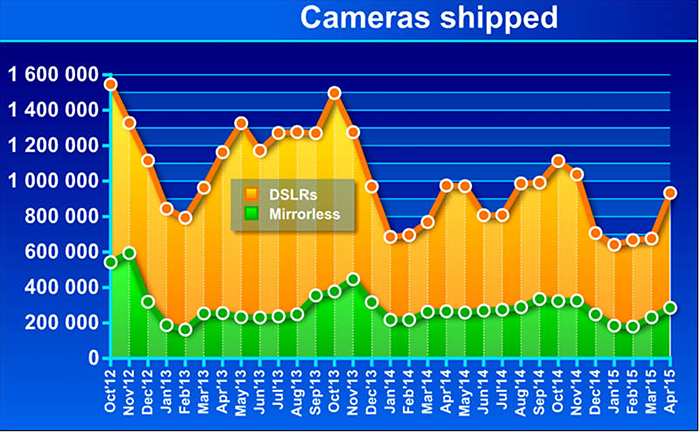
CIPA published the April camera shipment data and Personalview realized a set of updated graphs to show what’s going on. Compared to April 2014 Japanese manufacturer shipped 15% more mirrorless camera units. Finally a some small news after a quite non exciting performance. Let’s see if by end 2015 Mirrorless will finally shows some significant constant growth.
60 Responses
Yep Sony is doing a great job. Cheap and superb APSC and FF.
Yes, Sony are doing quite well and account for 66% of growth in the “mirrorless” market. Good for them. Maybe when they have more native lenses they’ll actually appeal to those of us who use M43.
And you sir, will always account for 100% of the reasons aliens won’t talk to us.
Seems like DSLR is growing too. All in all camera sales seem to follow each other across the formats, only difference happens when one or the other manufacturer brings out something that is heavily marketed or really unique. Basically this headline should be “camera sales are growing again”.
Don’t trust your eyes: Compare to April 2014 and 2013. DSLR is constantly loosing market share.
Yeah but it’s not like mirrorless is growing compared to last year.
Not really giving it that much attention. It’s not a race for me. I just don’t want my chosen system to go out of production any time soon 🙂
Right. As I note above, it’s not about market share that anyone should be worried at the moment, it’s about survival share. Every company probably has a floor that they can’t go through. What that is, no one knows until after the fact. But if you go back to the 90’s and look at what happened with serious cameras then, you can see maker after maker slowly extending iteration schedules, then eventually abandoning markets. The thing that concerns me about Olympus is that they have a long history of this. They abandoned Pen, they abandoned OM, they abandoned the ZSLR, they abandoned 4/3. They need some real wins in m4/3 or else I can’t see them doing anything other than abandoned it, too.
Before anyone gets overly upset at that last line, I don’t currently see that happening any time soon. But Olympus is stuck in the 400-500k a year shipment realm, and they are not currently capable of making a profit at that volume. So right now it’s a race: between no longer tolerating losses in cameras versus making cameras profitable. I don’t know how long that race lasts or how it ends, but I’m pretty sure that the race is being run.
If you’ll go through interviews with Olympus’ officials (e.g. at DPR) you’ll notice they’ve been “considering” going for a bigger sensor or going back to DSLR for at least a year. Of course only if that’s what their customers want (sure… :]).
But essentially you’re of course right. We might be approaching the end of MFT as the main system of Olympus.
Their not making money. They have a complete lens system. This is a good time to move some manpower into a new project.
FF or bigger is the obvious choice (Fuji is supposedly thinking about MF and they can easily afford the R&D).
Olympus might also try something more unique like a modular camera. AIR is a good start.
Why would they attempt to start from scratch in a smaller market than the one they currently compete in, against established rivals with a captive market due to the hundreds of lens and accessories in their catalogues.
That would be really stupid.
We can’t make money selling cameras in a huge market where a small lens catalogue and lack of professional accessories and support is not a handicap, yet we are going to make money selling cameras in a market one tenth the size where customers are far more demanding and are already tied in to the established players with thousands of dollars/euros/pounds of existing proprietary kit making them far less likely to move. Especially when you’d be starting from scratch with virtually no lenses.
Because they have done it earlier.:)
This is simply a business. Remember that their camera division is loosing money.
They had negative results when they were leading in the segment, so expecting a good profit now – with Sony FE and Fuji X in the game and 2 biggest companies planning to join soon – seems unrealistic.
They’ll have to rethink their MFT offer or try something else. At some point the losses from camera business will be too big to cover by medical equipment profits. 🙂
Good. Now: where is my Olympus 7-14mm f2.8?
I see nothing but periodical spikes during pre-Christmas period, obvious post-Christmas drops and then return to usual flat sales.
Yes, but when you actually count, the pre-Christmas spikes are getting lower and the post-Christmas drops are getting lower. What counts for the camera companies is year-to-year comparisons, as that’s how they’re evaluated by their shareholders. The reality is this: virtually all the camera companies are showing year-to-year flatness or declines in unit volume, and to a large degree sales (though going upscale has helped keep sales up). The two companies that have shown real growth in unit volume in the last 18 months are Fujifilm and Sony.
At least it’s weird, taking in account that in the world of Lumix G7, Olympus E-M5 II, Sony ILCE A6000 and Fuji XT 10 the so-called entry level (or even some midrange) DSLRs have no more advantages over mirrorless models. Only the professional lines, mostly FF ones have no mirrorless substitutes yet. (Sony A7x cannot be counted as a serious performer since the lens selection is simply outrageous and the focusing speed isn’t even close to best mirrorless models.)
they have… DSLR lenses are a lot cheaper
There are usually 2 types of (Canon) APS-C DSLR lenses.
1. one dedicated to APS-C format, unusable on FF and usually cheap quality, often need to be used on smaller aperture to get decent IQ.
2. the other for FF which is usually anything but cheap and you cannot get its full potential on APS-C.
Thanks, better use the slightly pricey but much better mirrorless lenses.
Do you really think small difference in IQ between SEL35F18 and Nikon 35/1.8 worth 3x the price?
is really canon ef-s 24/2.8 stm worse than olympus 17/2.8 ?
You miss the point.
This is not about comparing quality and price. The problem is the “cost of entry”.
You can get a decent DSLR – like the D5200 – at a price point where mirrorless don’t have an EVF or an aperture dial (and take 200 pictures per battery charge).
Basic Nikon lenses (18-55 and 55-200) are excellent value for money.
D5200 + 18-55 + 55-200: $700. Same as a6000 with the awful 16-50PZ.
Traditionally the third most popular lens: f/1.8 ~50mm standard.
Nikon 35/1.8 DX: $200
Sony 35/1.8: $450
Olympus 25/1.8: $350
Next lens many people buy: ultra wide angle zoom.
Nikon: a few decent lenses around $500 (most noticeably: Tokina 11-16).
Sony 10-18: $650
Panasonic 7-14: $800 (nothing cheaper beside the not-very-wide Olympus 9-18 – still costing $650).
Canon 10-18: $250 !
Furthermore: upgrading with DSLR is also much cheaper.
If you’ll decide that Nikkor 18-55 is not good enough, you have few F-mount lenses to choose from under $600.
If you’re into mirrorless you’ll have to go for the “standardized enthusiast zoom” which costs $1000:
Sony 16-70, Olympus 12-40, Panasonic 12-35
;-D
Sony shines here, because you can access a 3rd-party choice similar to F-mount’s with the A-mount adapter.
Not really sure whether the lack of EVF and aperture dial is worse than a really bad OVF with small magnification and far from 100% covering, just a few focus points, no possibility for calibrating lenses against front- and backfocusing, bulkiness etc.
And yes, you can also find not cutting edge mirrorlesses at ridiculous prices of EUR 150–200 with kit lens.
A6000 EVF gives bad IQ if you move eye a few mm from the best position. It’s a lot better in DSLRs.
OVFs in all these Rebels and Nikon D5xxx are junk too, even worse than a6000 (smaller and dimmer and not even covering 100% of the scene). And they constitute the meat of the market, something like 60-80% of all DSLR sales together.
can you give it in numbers? when i looked into D5xxx OVF i didn’t notice it being smaller.
I can do better:
http://2.static.img-dpreview.com/reviews/canon-eos-700d-rebel-t5i/images/vfcomp.jpg?v=3109
a6000 magnification is 0.7x, same VF as in a57.
Not exactly. Dmitry is correct: EVFs in small cameras usually demand the photographer to look precisely in the center (another good example: Panasonic G5).
This issue comes not from the EVF idea itself, but from the implementation (precisely: from the lenses inside the viewfinder).
In an optical viewfinder the amount of light is limited, but its source is quite big and far away. Lenses in the OVF are fairly neutral (small curvature). And of course they reduce the image size, which also helps here.
Electronic viewfinder is very different. You can control the amount of light produced by the LCD, so you can use a small and bright LCD and magnify the image. Furthermore, you have to move the virtual image away from the eye, if it is very close (if the whole EVF is small). You end up with large distortion and small margin for eye movement.
I couldn’t find a cutaway of a6000, but look how huge is the EVF in Olympus E-M10:
http://upload.wikimedia.org/wikipedia/commons/5/5b/Olympus_OM-D_E-M10_cutaway_2014_CP%2B.jpg
and a comparison of cameras:
http://camerasize.com/compact/#535,521,ha,t
EVF in E-M10 has to be twice as long as a6000’s.
“In an optical viewfinder the amount of light is limited, but its source is quite big and far away.”
In OVF the source of light you see is a focusing screen, a matte panel inside of your OVF:
http://www.focusingscreen.com/work/picture/500d/007.jpg
And everybody who actually compared the OVFs in Rebels etc to modern EVFs, even in cheap cameras (not as cheap as a3000 though) like E-M10 and a6000 knows that the EVFs are much better, bigger, brighter and even sharper somehow (all these mirrors in the pentamirror system are really cheap). Small size maybe masks the optical deficiencies, but they are still there.
And the image on the focusing screen is far away and quite big. Which part of my post are you disagreeing with? 🙂
As I said: it is much easier to make a big and bright EVF. I even explained why for people who demand more than slogans like “everyone who compared knows”.
That were the objective properties…
“Better” is relative and there are many aspects to consider.
Of course EVF is the future, as it has many advantages and can work (TTL) with mirrorless – surely the camera technology of the future.
But today EVF also has disadvantages and they are often of binary nature (some people will not buy a camera with poor EVF regardless of overall performance).
The viewing angle issue is a good example. So is eye strain (reported by a6000 users).
Main problem of EVF has been the price, but they’re getting cheaper and Fuji X-T10 is a great example. It costs $800 – similar to mainstream DSLRs (Nikon D5xxx, Canon xxxD). That means we might soon see an affordable Nikon/Canon DSLR-like mirrorless – something that wasn’t really possible 2 years ago.
Focusing screen is not far away, it is right there in the base of OVF.
You still don’t get it, do you?
The image in an SLR is few (5-10) cm away from the last lens (the one you look at).
The image in the a6000 is 1-2 cm from the last lens (as I said: I couldn’t find a cutaway).
Furthermore: the source (LCD) is smaller than the focusing screen in DSLRs, but the virtual image is larger than in many DSLRs. So the lenses have to do a lot more work than in OVFs. And that’s the source of problems that have been mentioned.
There is no “5-10 cm away” in DSLRs.
So how much is it? Some educated guess? 😀
2-3cm, judging from the size of OVF. But it simply does not matter.
Have you seen an SLR? Ever?
http://graphics.stanford.edu/courses/cs178/SLR-optical-path-annot.jpg
The “sensor” height is 24mm. You’re claiming that the light path between the focusing screen (green) and last viewfinder lens (red) is 2-3 cm. Do I understand correctly?
And it matters very much, indeed. It defines the scale of problems which were pointed out earlier.
Look like 2-3cm distance to me. 🙂 Of course you are adding the path through pentaprism, but it still far from 10cm, and still has nothing to do with EVF quality.
Rebels and D3xxx/D5xxx do not have the pentaprism in your picture at all.
They have 2 mirrors. The rest looks the same.
Path through the mirror is short. But it does not matter anyway, their OVFs are just jokes.
Path in pentamirror OVFs is identical to that in pentaprism. And it matters for the issues that started this discussion. I don’t think you’re reading carefully…
And the poorest OVFs are easily good enough for most things and most shooters. Best of all: they’re very cheap to make. How many mirrorless cameras under $500 have an EVF?
You know how many DSLRs priced under $500 have a viewfinder? All of them. You prefer a poor OVF or nothing? 😀
The Sony A6000 kit lens is far worse than the current Canon/Nikon DSLR kit lenses. Indeed, the latest variation of the Nikon 18-55mm is impressively good.
But you’re talking about this the wrong direction. At this level, price is the primary factor, with “safety of decision” a strong secondary factor. As I’ve pointed out for some time, the economies of scale of the DSLRs give Canon/Nikon strong pricing advantages. We’ve yet to see either have to push very hard on price yet, but I was struck by one Nikon executive’s comments a couple of years ago and since repeated that the camera companies had better be prepared to sell US$300 DSLRs and make a profit at that.
source about kit lens being worse?
ATM the cheapest ILC available new is A3500
Gee, my own testing ;~). You do know that I’ve been reviewing camera products for over 20 years, right?
Pretty much any test you’ll find. Example:
http://www.photozone.de/sony_nex/842-sony1650f3556oss?start=1
Optically, this is one of the worst lenses in production at the moment, but also one of the smallest zooms.
The latter fact is the key selling point among casual shooters upgrading from phones, who are the main client group for E-mount.
dear Thom,
buying an entry level DSLR in 2015 is regarded to anything but “safety of decision”. Just think about it. In year 2000 You still would have recommended a film camera instead of a digital one for safety reasons, wouldn’t you? Now take a look on the market, even the best film camera has almost zero commercial value by now.
I’m almost sure: entry level DSLRs will die in less than 10 years. Despite the fact that they are somewhat cheaper than mirrorlesses at this moment. Canikon plays a very risky game by pushing the entry level DSLRs: the market will collapse exactly like what happened to the film camera market 10 years ago.
Yes, the entry level DSLR market will die and probably be replaced by mirrorless. But I believe the top of the market will still likely stay DSLR, much as the tip-top of the market has stayed medium format.
Also, note that comparing the switch from film to digital to the switch from DSLR to mirrorless isn’t a perfect comparison. You could keep you old legacy glass with no penalty when you switched from film to digital. That is not true of mirrorless. Thus, the inertia of glass is playing a big part in what’s happening. Unfortunately for mirrorless, that inertia also played right into an overall slowdown in buying of cameras, period.
Agree, though it’s just partly true: even DSLRs do work better with specially designed lenses for digital cameras. However also legacy lenses can be used reasonably well.
Per that chart, mirrorless shipments are struggling to get back to where they were just since November, 2014, whereas DSLR shipments are up 25% since then. Why the huge spike in DSLR?
Glad to see mirrorless at least still staying in the game. The more choice the photographer has the better. Hopefully those belated price cuts we’ve been seeing over the last couple months will really help mirrorless even more. Although I fear what’s keeping the mirrorless numbers afloat is just one vendor- Sony.
You are misreading the chart. DSLRs are down compared to Nov’14 too, April can never compare to the Christmas sale season.
Now, why DSLR _shipments_ are growing in April compared to March? I bet it is because of the release of new Rebels (T6i and T6s) which comprise the lion share of all DSLR sales. It is more interesting why mirrorless grew this month, given nobody released anything interesting.
I think most people buy cameras during Christmas-season or before a larger vacation trip. April is a typical month to prepare the camrea gear for vacation.
For me there are two important areas in the linked datasheet.
1. The data for Jan-April worldwide shows that almost everything is below last year. Mirrorless has stronger production than shipment and DSLR better shipment than production. Mirrorless has growing value per camera.
2. The Americas are growing strong (Mirrorless and DSLR) while Europe is down.
The charts are not very granular, are they? Then let’s say December ’14, and it’s the same story- DSLR shipments up around 25% since then, whereas the mirrorless are below where they were Dec 14.
Given the sizeable price-off promotions for mirrorless, I’d have expected them to have gained even more… perhaps those numbers are deferred. Or perhaps those promotions just release retail inventory, inventory that had already been accounted for in previous CIPA shipment numbers (remember, CIPA figures are for wholesale shipments to distributors, not retail consumer sales).
They are granular enough. And there is ABSOLUTELY no point to comparing a single month to a single different month, unless it is the same month last year (and even then).
So, you have selected Dec’14 when DSLR shipments crashed abruptly from Nov’14, while mirrorless did not crash that much. What are you trying to prove? 😉 Everybody who seen the numbers sees right through your game.
You need to ratchet it back, partner.
Pretty sure I never said anything about a single month. Pretty sure the comparison was for four months, between the most recent third of a year, from Dec ’14 to the most recent numbers CIPA has available. Hence, the most recent short term trend.
What am I trying to prove? Dunno, I guess I’m trying the prove the simple question I asked: what accounts for the sudden spike in DSLR shipments over that period? A question you addressed by changing the subject.
You think those numbers in the chart are granular? Fine, look at the chart and tell me the exact number of units shipped for each of the last four months. Nope, the chart doesn’t show that.
You may not like the numbers, I get it. But instead of slobbering like someone insulted your mother, I’d suggest you just go out and buy more product. That’s the best thing you can do to juice the numbers.
Probably something around 40% of the mirrorless market is Sony at the moment. Using this month’s CIPA numbers, that would imply 114k Sony mirrorless versus 300k+ Nikon DSLRs and even more Canon DSLRs. Using the last known Olympus market share, the implied number would be 36k. However, because of product introduction variations, you can really only do this sort of calculation on a year’s worth of data. So for 2014 the calculations work out to:
Sony: 1.5m units
Nikon: 4.7m units
Olympus: 414k units
Note that CIPA doesn’t align with the camera companies’ fiscal years, which is why the Olympus and Nikon numbers look a bit off from what they reported for the fiscal year.
Regardless of how you look at it, the Canon/Nikon DSLRs still have fairly dominating numbers, and Sony E/FE is about triple what Olympus is doing. I don’t have good Panasonic numbers to get a perfect m4/3 market share, but I don’t think they’re doing better than Olympus. Call it 300k units and you’d end up with Sony E/FE doubling the m4/3 market share.
However, the real issue is no longer market share, it’s survival share. How many units do you need to sell in order to reliably stay in the camera business? One financial analyst is arguing that Olympus is below that threshold. That’s never stopped the Japanese before, but Olympus has this habit of changing the game they’re playing when they finally realize they can’t win (witness 4/3, but true also of the ZSLR and the original OM).
Sony sells FOUR times more than Olympus? um where’s the source for it?
Olympus claims just under 500K sold in their fiscal year. I had to go back and find when those were sold to get a 2014 number, and it could be off by 10% as Olympus is a little inconsistent in what they’ve claimed. The Sony number comes from using Sony’s 2014 market share claims in the Japanese business press calculated against CIPA numbers, which should be accurate.
I’m pretty confident that Sony is shipping 3-4x what Olympus is. Of course, the real issue is how many are actually selling. Both companies are having fire sales.
thanks
Thom, market shares in Japan is not the same as market shares worldwide, don’t substitute one for another.
But a6000 was obviously a huge hit for Sony. Correct spec and correct pricing will do it to your product. 🙂 Fuji, Olympus and even Panasonic (at least their incompetent US distributors) have a lot to learn.
I’m not. CIPA numbers are worldwide.
But you don’t take market share number from CIPA, they don’t have them. You take them from Japan-only survey.
I love it when people make assumptions about what I do and don’t do ;~).
My market share for Nikon is easy: Nikon publishes it in their quarterly report. Last quarter: 34% worldwide. The market share for Sony was a direct quote from a Sony executive for 2014 worldwide. My market share for Olympus worldwide was derived by taking the number of units Olympus said they sold during the period (worldwide) and aligning them with the appropriate CIPA data (Olympus and most other Japanese companies use a fiscal year offset by three months).
So I’ll stand by what I wrote. Please stop shooting the messenger.
More numerically, DSLR shipments Apr’15 over Apr’14, 95.7%.
Mirrorless shipments Apr’15 over Apr’14 107.4%.
But single month performance is meaningless.
For Jan-Apr, it is 93.4% and 91.6%.
Let me guess… Rebels as usual was a big hit (and D5500 helps), while E-M5 II is a dud, overpriced and lacking OSPDAF, J5 is a joke, A7 II is overweight non-update way above mass-market category…