









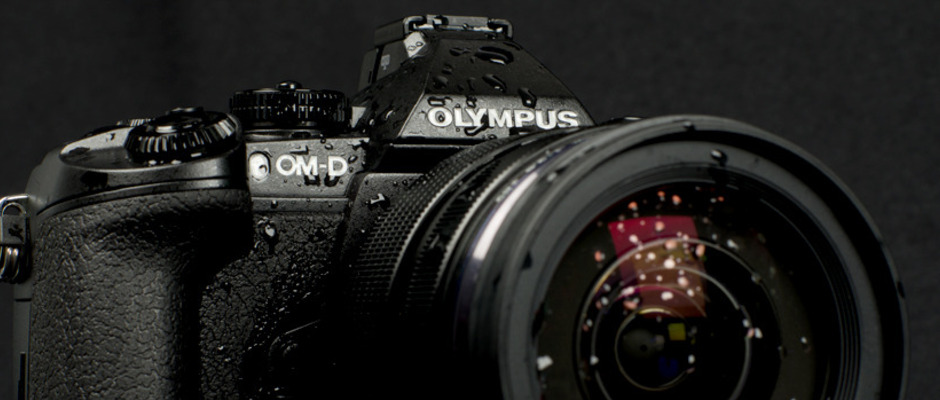
Our source Simon shared some tidbits about the E-M1 successor. I quote his exact words:
I was last week with a resp. guy from Olympus for some days in Ireland for holiday. He told me, that they not plan to update the videocap. of the EM-1. If the competitors will push hard they have to bring the EM-1 MK II in autumn. But they hope to concentrate on EM-1 suc. for fotokina 16 in Köln. There they will bring the so called Gamechanger. Olympus will NOT join the megapix. race. the new sensor will have 18 MP & a new “foil” on the sensor, they call it geomembrane (whatever this means), but the EM-DR will have a 10 step hires modus to make such fotos with 1/60 sec. out of hand. Great !!!
Well, if true that really sounds intriguing! I have no clue what a “geomembrane” sensor is. Will try to get some more info about it from other sources.
Thanks Simon for sharing the news. I hope you will keep adding precious comments on 43rumors in future 😉
—
For sources: Sources can send me anonymous info at 43rumors@gmail.com (create a fake gmail account) or via contact form you see on the right sidebar. Thanks!
For readers: Don’t miss any news. Join our group on facebook and follow our tweets.
Rumors classification explained (FT= FourThirds):
FT1=1-20% chance the rumor is correct
FT2=21-40% chance the rumor is correct
FT3=41-60% chance the rumor is correct
FT4=61-80% chance the rumor is correct
FT5=81-99% chance the rumor is correct
128 Responses
Insane in the (geo)membrane
Insane in the grain
Geomembrane sensor must mean that the camera will be fully functioning when buried beneath the groundwater table!
I hope they won’t rush with E-M1 successor. I think it really needs to be something that will up the game, not just a simple refresh.
Maybe its the same sensor as on Panasonics rumored new video camera.
Not the Simon from the E-Mdr rumor here but another Simon :-(. The other more informed Simon also spoke about the development of a 12mm f/1.0, a 25mm f/1.0 and a 50mm f/1.0 pro prime lenses from Olympus. Admin, do you have any additional information about theses?
Maybe this membrane (or foil as he also called it) will move around in front of the sensor, rather than the sensor moving? The word foil makes me think of an electric razor, i.e. a metal plate with holes in it.
Or this: http://www.imaging-resource.com/news/2013/02/05/bye-bye-bayer-panasonic-claims-new-sensor-tech-ends-color-filter-light-loss
How realistic can that be? 18 MP?! Just a simple calculation, with the existing 16 MP you already have a density comparable to 64 MP Fullframe. Such a resolution has not been developed neither by nikon (36 mp d810) nor by canon (50 mp 5dr, 5dsr). Even the 50 mp sensor from canon has a more limited iso range than the current omd sensor line.
It’s not that simple. Sony’s 1-inch 20 Mpx sensor beats Panasonic’s 16 Mpx sensor found in G6 in many measurments, and is not that far behind in noise performance as well.
And again, I’ll mention the color splitters technology from Panasonic. That’s something that increases light sensitivity of a sensor 2-3 fold. And the idea is simple. With normal Bayer filter array each photosite captures at most 1/3 of the light. Color splitters redirect light so that the “wasted” part is redirected and captured. No idea if that would actually work that well in practice (that would definitely require more work on software side to decode such RAW files). But it shows that there are ways to improve performance that do not require making the sensor and photosites larger.
Is what you’re talking about similar to the 3CCD camcorders Panasonic used to have? They were great, but I thought they had 3 sensors and a prism-like piece to split the light. Where would 3 sensors fit?
No, this is different technology. Splitting is done in the sensor’s filter layer. IR did a nice write up on it: http://www.imaging-resource.com/news/2013/02/05/bye-bye-bayer-panasonic-claims-new-sensor-tech-ends-color-filter-light-loss
“Just a simple calculation, with the existing 16 MP you already have a density comparable to 64 MP Fullframe.”
Your confusion is easy to understand.
Larger sensors do not need to be as efficient as small sensors. They compensate for it by the sheer size of the pixels.
But that also means that they generally stay somewhat behind the smaller sensors on the development curve. The fact that larger sensors are harder to manufacture doesn’t help.
“Even the 50 mp sensor from canon […]”
But that has more to do with the Canon and less to do with the modern sensor tech.
@Dummy00001, @tripper.
Thank you, these are interesting thoughts, which I didn’t take into considerations.
still happy with my em5 1st generation. Really curious about future innovations from olympus.
& Yun tells us this must be the prophesied Organic Sensor in 5..4..3..2…
See what I did there?
If the new sensor has great dynamic range and a very clean output, at low and high ISO, this would indeed be a game changer! Let’s hope so! E-M1 ergonomics are already almost perfect, a better sensor like this, better EVF, proper video frame rates etc., I’d buy one.
Hope the rumours of super fast native primes are also true. I’d hope for 35 and 50mm equivalent f/1 lenses first over a 12mm – not sure what that would really give on such a WA over the existing 12mm f/2 – hardly any need for bokeh on a 24mm equiv anyway, unlike a 35mm equiv.
Could the sensor be organic, or similar to the rumoured new Panny video sensor?
I agree! An E-M1 II with a new sensor with improved dr, noise performance, better evf (the current one is already amazing but can it be ever be too good?), e-m5II IBIS, video framerates (I don’t care if it’s 4k or not) and a new shutter. And of course improved c-af/tracking. All packed inside the current excellent chassis with maybe the strap lugs repositioned. Would be amazing! And if the 40 Mp mode is made possible for handheld shots it’s going to be an amazing combo with the zuiko 7-14 f2.8. And the lovely 300 f4 too…
Only if the screen would be tilted like current E-M1. Videoshooters can keep their unhandy screen in E-M5 II.
Maybe it will be an organic sensor, and grow 2 megapixels every year, but only if you water it, lol
goes well along with all those tillable screens around….
Could geomembrane mean geo as in geometry? A curved sensor that can also be turned to a regular flat with the press of a button? While curved sensors could negate some design issues and make brighter and simpler lenses they are not compatible with old lenses, hence the need for a revolutionary 2-in-1. One could dream. More on curved sensors: http://www.cnet.com/news/how-sonys-new-curved-sensor-brings-19th-century-technology-back-to-the-future/
I think something like fuji’s x-trans filter.
geometrically you can not shape a square sensor with square pixels to curved one.
The curved sensor would solve the vignetting problem (center of the sensor being closer to focus point than edges of the sensor).
I thought that was what caused distortion, not vignetting.
Pfff !!!
E-MDR…. really ? Let’s be serious here, Olympus would not call one of their device “MDR”, unless they targeting teenagers with that.
FT0 on that!
Are you a teenager or just simple, ever heard of project names?
Sometime, product in sell have funny name in other language. Like Audi e-tron (means poo in french), or Toyota MR2 (same meaning than Audi) 😉
EM-DR!?
This sounds so funny! 😀 😀 😀
The important thing about this geo xy membrane is that it will create some traffic.
EM-1 mk2 vs EM-DR? is the EM-DR supposed to be a even pro-er body? sorry im confused by all of it
This is on the heals of news of a new Panasonic 18MP sensor. Since the last EM1 had a Panasonic sensor, this may be the same one and the Olympus rep mght have leaked Panasonic’s secret.
I was thinking the same thing – new 18mp high DR sensor in the AF101 replacement will be making its way into other cameras as well. I would think GH5 would be the first recipient of the new tech.
or GX8 for that instance…
I hope so. Technically, GX is up for an update this year, and GH next year, but recently the advances in video tech have been so fast that Pana might be forced to release the next GH earlier, mainly depending on what Sony is doing.
I don’t think there are secret potions: engineers do their job. Likely it’s more a matter of agreements: Panasonic gives its sensor to Olympus but Olympus can’t use its video capabilities for one or two years.
I would give this rumor FT1 rating.
I’d rate it higher since there was just another rumor that Panasonic is planning a roll out of a new sensor. My guess would be that they both have new sensors but they are trying to run out inventory on all the old sensors before releasing the new one. That’s why we’ve seen 3 versions of the GM1 released from Panasonic and now a re-release of the EM5 by Olympus. Next year we’ll probably see real updates to all of these cameras instead of “mark” updates.
Foil? Membrane?
It sound more like a light-splitting layer, rather than an organic sensor. (Or both?)
Name E-Mdr is not a good name, it means LOL in french. 😉
Rumor sounds fake. I really hope Olympus would rather focus on improving their video spec especially since the E-M1 successor would have a larger body to dissipate the heat from 4k.
How are the “competitors” pushing hard? And if they are how will a rushed EM1 MKII without improved video going to help?
He (Simon) said that Olympus had almost no video engineers working on cameras, this until not long ago, and now they can also focus on video capabilities (em5II is just a first step).
By “competitors pushing hard” I think it refers to other Companies offering new products with good and bettered photo and video performances.
I assume we will get some surprises from Sony this year. Fuji is also rumored to release the X-Pro2 with new sensor tech, Panasonic apparently has a epic sensor for video / stills in the pipeline.
Simon gave some interesting news some threads ago, this sounds like it can come true: Em DR successor SHOULD come next year with this DR improvement (other sites see dynamic range as the next battlefield, after the megapickles race). If other Companies push forward with their new products, Olympus should release an Em1 II with improved video and IBIS.
For those missing our “chat” in that thread, the main reason Em1 had no good video is an agreement with Panasonic (Em1 sensor is from Pana), agreement that should end this year, following his friend/source.
And if that agreement is true, then I only hope that Olympus release firmware to E-M1 to open up framerates etc. As then I would not even consider anyone else when upgrading E-M1 to E-M1 II. Otherwise it is just consideration WHEN to upgrade.
It is just interesting that so many conclusions has been around, and then one person collects all of those in one message that sounds that everyone was correct etc.
It was mentioned that Olympus had almost finished a major video update to keep the E-M1 relevant and by implication, it would likely be made available when the 2 year agreement runs out, which would likely be in September.
Well, it still remains a rumor. 🙂 Other rumors were about the new “trinity” of fast f1.0 lenses, a 17, a 25 and a 50mm, something I’ll trust once I have seen it.
It makes some logic that Olympus had to stay behind the video department: Panasonic gives them its sensors and here’s the deal. It’s not that strange.
I find more strange that another line OMD cameras will born: em5II, em1/(em1II if needed), and this em1DR.
Well the “other Simon” actually wrote about 12mm, 25mm and 50mm f/1.0 primes and nothing about a 17mm if I am right. If these primes are kept at a reasonable size and all have weather sealing as well as the manual clutch mechanism that is found in the pro zoom, you can count me in.
My mistake! 12mm then. Anyway, that would be too good to be true, but as you wrote, if IQ is good even wide open, and price is not crazy, I’m in 🙂
Olympus have patents for a 12/1.0 and a 14/1.0
Probably another word for the organic sensor like Fuji and Panasonic are doing.
whatever happened to that organic sensor zzzz !!!
tech doesn’t happen overnight like magic.
overnight?….that sensor is in dev since 4 years :/
look at canon, they haven’t done anything new in sensors since 1995. 🙂
hahaha true that bro….
LOL. right?
Worth it to be waiting for it. Technology now is not advanced enough for me to justify an upgrade over my E-M5 right now, though the Mark 2 is tempting…
New E-M1 should have high res mode and 4k video without irritating moiré. The tech is all there.
No, the tech is not there. How many times it needs to be spelled out that the IBIS was changed? New more sensitive gyros to detect even smaller movement, new magnetic sensors to operate the sensor movements. Probably even a new CPU (with same TruePic VII name) to do better A/D conversion.
E-M5 -> E-M5 II is good upgrade. Especially if you want larger EVF and you want to record video and live elsewhere than USA or Japan.
E-M1 -> E-M5 II is brainer if you don’t need HR mode for studio work or you don’t need the video.
Since the Mark 2 has it, the tech is here. They have been working many months on this. Hardware development is slow.
Sensor of Mother Earth
admin: is it possible that your source meant to say “gyro” instead of “geo”?
Some type of a gyro system could stabilize the sensor for short periods of time.
Just a thought.
Maybe geomembrane is actually referring to hexagonal via a translation from geodesic.
I think its the Fuji/Panasonic organic sensor: http://www.extremetech.com/electronics/158209-organic-photo-sensor-dumps-silicon-promises-to-shatter-cmos-imaging-limits
Geomembrane foil may also refer to sensor technology that allows the sensor to filter out bad light, like IR/UV and allow for higher DR but may also allow much higher sensitivity with a cleaner image. Pair this with the Olympus multi-shot sensor feature, then you have the DLSR killer.
Yes, but what does that have to do with the word ‘geomembrane’.
Geomembrane and foil sounds like a switch to a different fabrication technique for the sensor replacing silicon with polymer-based. Probably the sensor would work in a similar way but the new substrates give new benefits, particularly around power/heat and therefore noise and DR. *shrugs*
The size of the E-M1 makes it a downgrade from E-M5 no matter what sensor it has. Any rumors on the E-M5 III?
Hah!
E-M1 is not downgrade from E-M5 and E-M5 III is coming out next 2-3 years so very good wishful thinking you have…
Somebody along the way told him smaller is better.
Modular is certainly better. Although I have an E-M1 right now(which is far better then the original E-M5 in terms of EVF and number of customizable buttons and dials), I mis the days that I just slapped the Pana 20mm on it and it would fit in my jackets pocket.
When I put on a bigger lens or just needed more grip or an extra battery, then I put the HLD-6 on(1 or 2 parts).
I still have nightmares after using 5D and 7D 🙂
I’m on the flip side like the em5ii feature but it looks and feels like a miniaturized device to me.
About time for a new sensor, its been over 3 years since the GX1 and EM5 ushered in the 16mp sensors. Its time for something new.
You should ask Sony for that… (Did you know the new Leica T has the old Nex5 Sony sensor? Also the old RicohGR)
Shhhhh! Do not mention Canon or Nikon cycling their sensors on “New cameras”.
😀 mouth sealed! : X
With the panny rumor I’d feel like a suckafool for buying the em5ii. Unless you need a cam, wait…
Totally different cameras. The upcoming Panasonic is a $3000 video camera.
Tech and sensor from the previous Panasonic video camera flowed down to the GH line. I imagine both Panasonic and Oly to continue to push prices higher. I imagine 1799 GH5, 1599 EM-DR
Many are taking this as a new improved sensor is developed and ready, and will be in panny’s new still cams. The em5ii looks like a stellar camera, but for owners of MFT gear post 2012, they may want to wait if IQ is the major factor for upgrading
Can someone please translate the following sentence to English?
” the EM-DR will have a 10 step hires modus to make such fotos with 1/60 sec. out of hand. ”
Thank you!
Hi Duarte,
As fare as i understood it right, that means the Sensor will make 10 fotos to one hiresolution picture. With the em-5 mkII You Need a trepod, with the nee em-1 you Fan Do it freehand.
Greets
Simon
I didn’t know what “hires” meant, reading your comments I figured out it meant “hi-res”
Like the E-M5 Mark II’s hi-res 40MP mode which requires a tripod and captures 8 pictures simultaneously through pixel shifting, the new EM-DR sensor will be able to do it handheld because it can do it within 1/60 of a second and take 10 pictures simultaneously. I assume this means electronic shutter?
This is the technology Oly has been waiting for as the DSLR killer. Time will tell if it works and how well.
Olympus told that 8 frames was best for HR mode, more didn’t improve quality at all and less didn’t offer the same quality.
The change would be just to get minimum of 1/60 shutter speed for the mode.
I would prefer to see a four-shot mode which just captures all three colour values at each location. The result doesn’t require any interpolation (neither of the sort that is required for the 40 MP image or the conventional de-mosaic) and will result in very sharp 16 MP image. And being only four shots it should only take half as long as the 8-shot mode which means instead of that projected 1/60 s option you’d get an even more useful 1/125 s option.
The current Hi-Res mode one has 8 shifts of the sensor and needs a tripod, the new one has 10 sensor shifts and can do it in 1/60th sec so can be done hand-held without a tripod.
Just wondering what happened to the Panasonic rumor with new a sensor with clean 12000 iso .?
was reading it last night but never had a chance too finish it.
It is still there. it is the 3rd post on the main page.
no its not there
What, this one?
http://www.43rumors.com/ft4-new-af101-successor-to-be-announced-at-nab-show-has-brand-new-mft-sensor/
No ,but thanks
It had a picture of an actual camera ,g4? And a story about how it would be the next major game changer for micro 4/3 with amazing iso and dynamic range
That might have been a different site, nothing like that was on here
and then, also long time night exposures possible for this hires-mode?
I don’t believe anything in this post.
Why not, it fits right in with the one about the sensor in the new Panasonic video camera?
And since when does Panasonic share its new sensor tech with Oly from the start?
Maybe Panasonic is releasing theirs this year 🙂
Since the EM-1.
How do you know it’s a Panasonic sensor?
Ah yes, The old question. Who fabs the FourThirds sensors in the OM-D cameras? Does it matter if the performance is identical? Or if it is identical, do we suspect they are all fabbed in one place and remarked to disguise the origin? Your question is fair. Panasonic withheld its best sensors from Olympus in the 12-megapixel era, so Olympus got a lift from Sony as soon as it was no longer contractually obligated to buy from Panasonic alone. Olympus and Fuji are in some respects, old pals anyway. I don’t really care. We end up with better cameras. We upgrade because we get enthused. The shift to great ISO 3200 performance was huge. With carbon membrane sensors, what is next? I think the objective is to further marginalize full frame.
Believe it or not. The same guy told me, as i had my E-5, that olympus is working on a pro Camera that combine FT & mFT. For me it was hard to believe. In August 2013 we had a foto trip to iceland. Me with my E-5 & he with something “small”. Guess what ? Yes, em-1 . So i’m happy with my EM-1 & Look forward the new lenses & the successor of my cam. The thing i know is, olympus is a company that works on innovation & bring its innovation to products.
I stay with olympus, guys, go out & make good pictures.
Greets
Simon
Okay, good to know. However, Oly said forever they would make 43 and m43 “one beautiful system”, so a camera like the E-M1 wasn’t really surprising – to me at least.
I really hope Oly has access to this sensor – but I’m just more than a bit sceptical. Oly does not make their own sensors, and even if they design them, this would be a major leap. If it’s Panasonic, I’d be surprised they’d share it with Oly from the start. If it’s Sony, why haven’t we heard rumors about them?
Anyway, before I get to pessimistic, let me tell you that you are totally right: go out and shoot, that’s where it’s at. Just when rumor season starts, all good resolutions go over board. 😉
Is it a coincidence or is it the same sensor as the rumored Panasonic 18MP sensor? Does the Geomembrane have anything to do with organic sensor? Although I still feel like organic sensor won’t come too soon.
maybe,because olympus is not image sensor company,
and all we knew panasonic sold all image sensor factories to Chinese company,
but still hold join vendor.
Like AMD sold semiconductor factory to Global Foundry.
I asked again to explain me what ment “Geomembrane”. He said, that this is a shortcut for “Gyro Electodes Organic Membran”. That means for non engeneers like me, that you can upgrade the “view angle”for the sensor from (EM-1)today 36 ° to the new sensor 58°. This leads to an increasing absorption capability. BUT again, this for the future System expecting announced in September 2016 !!
Greets
Simon
What only in September 2016 !!! and know already rumor about that ? are you sure ?
Because OLY want us to hold on till 09/16 before we upgrade. The problem will be if others come with new products in between, especially with IBIS.
If they do come out with a new EM-DR, will OLY be in limp-mode compared to Panasonic like the GH4/E-M1if they use their sensor.
This is the new organic sensor or CMOS MEMS from Fuji/Panasonic right. Should allow for 100% sensor coverage because of the chemical etching process versus the CMOS electrical interconnects. This would allow 100% of the light to hit the sensor. Also there appears to be better filtering of light which allows higher DR. This would also allow much higher ISO and allow it to resolve colors better at these high ISOs.
Read description on the fuji site:
http://www.fujifilm.com/news/n130611.html
http://www.fujifilm.com/news/img/news/n130611/pic_02.jpg
Engineering description? http://citeseerx.ist.psu.edu/viewdoc/download?doi=10.1.1.114.8031&rep=rep1&type=pdf
Geomembrane: a radically new and generic type of detector for photons, electrons and energetic charged particles: a stacked set of curved miniature dynodes in vacuum, created through MicroMechanical Electronic Systems (MEMS) fabrication techniques on top of a state-of-the-art CMOS pixel chip. This combination in itself is an extremely efficient electron detector. By capping the system with a traditional photocathode, a highly sensitive timed photon counter can be realized, outperform ing all existing photon detectors. By capping it with an Electron Emission Membrane, a timed particle tracking detector is realized with a time resolution far superior to current particle detectors.
http://www.nikhef.nl/~d90/MEMBrane/B1NCVB2.pdf
So the E-M1 II will run on valves?
Hope they don’t glow.
Cathode applies to solid state too, the negative side of a diode that emits electrons (hence “emitter” in a transistor).
And yes they can glow but mostly as heat rather than visible photon. Which is a problem.
I was also taking into consideration the mention of a vacuum. I know they can glow, which is why I mentioned it, and a lot would glow in the visible as well as IR. Mostly it was a joke.
Hope Simon is right. He has been right in the past, and this rumor jibes with the Panasonic rumor, so I’m kinda believing it a little. If Olympus and Panasonic do have such a sensor, then I will lose interest in bigger sensors completely. Especially if those f1.0 primes are also true.
Olysonic already have 13EV sensors which puts them on par with full frame sensor dynamic range. 21EV would cover the full gamut from pitch black to the heart of the sun. One can hope.
I suppose it will also have a flux capacitor?!?!?!?!
It’s what makes time travel possible!
Only with the interocitor attached to the hot shoe accessory port.
Geomembrane = waterproof without a lens.
This is why I keep with Olympus. They find ways to do wacky shiiit and I freaking LOVE it.
Both of the Graphene Sensor and the Fuji/Panasonic Organic Sensor technologies are carbon membrane types. Nikon was bragging about it last year, even though they are NOT a sensor technology producer. Like Nikon, Olympus is a sensor technology consumer, It has been an open question for a while, Is the Fuji/Panasonic collaboration a version of Graphene? GeoMembrane sounds like marketing department speak. One wonders where Sony sits. They are tossing their Audio and Video business, and investing in profitable sectors including photo-sensor semiconductors. If the silicon photo-diode is soon to go the way of the dodo bird, what is Sony working on? Is the Fuji/Panasonic collaboration a Sony/Graphene competitor? “The Game Changer.” I like that. Time to start saving up for 2016!
Nothing against Sony, but I hope that the Fuji/Panasonic alliance hits one out of the ball park!
Agreed.
Sony is the Loser Giant,Sony camera and sensor factory finally as same as
Smart Phone,LCD Tv/Monitor and Vaio NB PC,
How old are you? you don’t know Sony company like me,
i was stupid person who bought Mini-Disc ,do you know? Mini-Disc?
ha ha ha LOL
Panasonic have led the way with photosensors in the past, their Live-MOS has a lower noise floor than the Complimentary-MOS (see NMOS) by sweeping stray electrons (dark current) off the sensor.
That said, we are seeing very much quieter sensors of both types now, mainly due to much improved processors.
Nikon is (part) owned by Mitsubishi which owns a bit of Olympus.
Sony owns a larger part of Olympus, who have had money issues.
Probably explains Olympus’s switch to Sony sensors, not because Sony’s sensors are better.
Panasonic is a company even larger than Sony and Fujifilm is small in comparison, so I wonder who is doing the donkey work with their new organic sensor.
Geo=>Geometry,
Membrane => cell(Carbon Base)
Is this 18Mp like the GH2’s 18Mp (likewise G5 & G6) i.e. 16Mp out of 18Mp?
Because 16Mp on a small sensor like the 4/3 is already very high resolution, it’s like a 62Mp full frame sensor density; it is in danger of having too many pixels and losing out on sensitivity..
Number of pixels is just “how big can I print” and 12Mp can print A2/Poster size.