









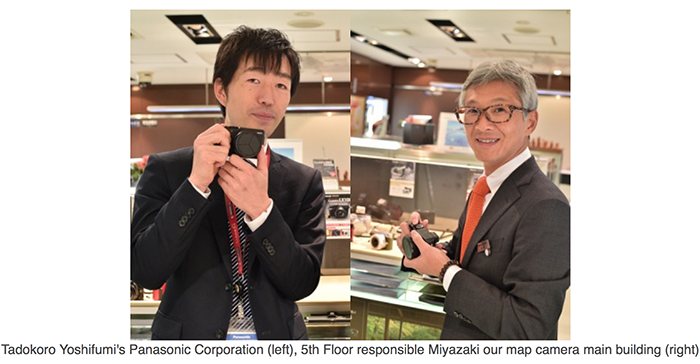
Mapcamera interviewed Mr.Tadokoro Yoshifumi from Panasonic. Asked about the features that could come in future cameras Mr.Yoshifumi said they are working on:
1) 4K 60fps recording
2) 8K recording
I guess the first feature will certainly make it into the GH5. But I am yet not sure if 8K will come that soon…
125 Responses
8k recording would require a 34 megapixel sensor wouldnt it? With the same pixel pitch as the current 1″ sensors (20 MP) this could work out with just shy of 36 MP on 4/3 size. So it is possible! But do we want it?
A7s is 12mp only and it record 4k.
Yes, because 4K is ‘only’ 8 MP. While 8K is not double but 4 times that.
4K is a 8Mpix and 5K is already 14.7Mpix and 8K is a 33.1Mpix.
So to get the 8K the sensor should have 34Mpix.
But that would require huge processing capability to capture and process the data and a VERY WIDE I/O throttle and SSD with 550MiB/s.
34MP if the sensor is 16×9 format, if they wont to keep 4×3 format it should be 44MP (7680×5760) right?
according to info 8k format is 7680×4320
thanks for the info.
something like that kind of sensor yes in MP. just read on wikipedia certain advantage of 8k for professional video productions (one of which being able to distinguish every pixel at 50 cm bigscreen distance……..)
I much rather see the GH5 give us the YAGH-like ability of 4:2:2 subsampling in-camera, without the need of tacking on a huge attachment. Instead, Panasonic should develop a normal-sized battery grip but with simple XLR ports and audio controls.
8k is really unnecessary right now. Panasonic should focus on improving it’s sensor technology first instead of trying to cram more pixels in it. I would like to see a true global shutter with IBIS during filming and greater dynamic range and less noise in low-light conditions. Adding the h.265 codec to all these features would be a dream camera for me!
Its coming in 2 years, all the major companies have been working on 8k before 4k was a thing.
anyway, i think to relase a 8k body is too early.
the cropping during editing will be appreciated in the pro world
Of course yes, it’s nice for cropping like from 4k to 1080p with the GH4.
2016 is te year a new GH body will come out.
8k is seriously unnecessary at this point and in the probable timeframe when the GH5 debuts. Instead, I would much rather see 4k at 120fps.
If you think about it, an 8k image produces four times as many pixels as a 4k image. Given that the GH4 can do 4k at 30fps, a GH5 that could do 8k at 30fps would be the same as 4k at (4 x 30) fps, which is 120 fps. This capability would be much more desirable to the majority of users.
maybe the GH5 too early but for movie or high end documentary productions, all the disadvantages you mention are very minor imo. For consumer use its ofcourse like demanding higher MP then we have now. I did a few sessions with 18mp camera and I noticed the effect of it on my average memory cards & processing in Lightroom on a standard laptop
Let me be frank here, 4k was never the point for these manufacturers. From the beginning, 8k was what everybody was aiming for, panasonic has all the tech for 8k already, its just that customers when they saw 4k went ”awww can you give it to us?? heres monehh!!” at that point both sony and panasonic looked at eachother and said ”uh…sure? I guess?”
I can’t even edit 4K. 8K??? Give me a break!!
my 3 yr old iMac can, how old is your computer?
More to the point I’d be interested to know what specs. your mac has, what software you are using etc. so I can check it out.
3.4 ghz i7, 12gb ram, FCPX
Thanks. More than I have, which is fine for HD but not for 4K.
Too many numbers to me. I pass. 🙂
Of course they are working on that, they should be ready for the future. However, 8K will not be in the GH5 if it’s released in the coming 2 years(impossible due to sensor and processing tech). 4k 60fps+ should of course be in the GH5.
Nope, wrong. With most foundries breaking the magic 20nm production line, expect a huge increase in power and efficiency in 2 years time. The major foundries will be producing 14nm and 16nm chips by 2016.
Pretty sure you’re wrong. 🙂 I think you’re familiar with More’s “law”? As 8k needs 4x the RAW processing power….it’s highly unlikely that they will make that kind of improvements in 2 year. Especially now when all mayor ship manufactures struggle with 20nm of smaller for complex designs…even More’s “law” is under pressure for the first time.
However, processing speed will not be the biggest problem…there will not be a 30MP+ Four Thirds sensor(needed for 8K) in the coming 2 years also.
Mark, you don’t need to break any laws of physics to double or quadruple the image processing power, you just chip in more silicon and take the hit on the battery, because this is a massively parallel task and scales linearly.
You are right however in that the bottlenecks will be in the sensor. Readout speed for example hasn’t increased significantly in years.
I believe Mark Lavrijsen is basically right. Given unlimited space you can certainly solve the processing problem, but there isn’t much/any free space in a GH4, and adding more processors would also generate more heat.
The GH4 gave a quantum leap in video resolution. I can’t see how they could do another leap in the next generation and keep the form factor and price. Also, the next step IMO would be a “iron out the errors” model with incremental improvements, maybe 4K at 60Hz, maybe RAW video in some form.
In a interview on Dpreview Panasonic talked about a 8K camera for the 2020 Olympics in Japan, which seems like a realistic timeframe. I’m sure they can do it before too, but the market is simply not ready for 8K when the GH5 comes out.
And lets not forget storage.
I’m not, moores law hasn’t worked since there was a dead lock with 28-20nm.
Also, cameras will move over to using GPUs instead of using CPUs since they will have more power for processing video.
No. Camera’s don’t use their CPU for video encoding. They have dedicated hardware for that, much faster and power efficient then a GPU(bad quality also) or CPU.
Maybe you should try to encode a video on your PC(using CPU and/or GPU) and see how long it takes and how hot it gets. Then you know why this won’t suffice for a camera.
Sorry to disappoint you, but they do. Especially the GH4, and the difference between encoding and decoding is massive. its the reason why Samsung for the first time in their history are using a dedicated GPU for their new NX camera.
You obviously know nothing of how this stuff works. Even on your PC you don’t really use your GPU to decode/encode video. Unless you use some OpenCL or something like that. Intel, AMD, nVidia have specific logic on their hardware to support video encoding/decoding for on specific codecs. Of course GPU will assist with for example post processing things, but for video encoding/decoding it won’t use the GPU cores.
Oh my god, Samsung said it themselves dummy, look it up.
Yeezz…. You can of course just admit you’re wrong.
Let me ask you something…do you really think the Samsung NX1 has a faster CPU/GPU combination then the fastest PC hardware you can buy at the moment? There isn’t a consumer available PC(CPU + GPU + all the software you want) that can live encode HEVC(h265) video at 30fps+ despite all the processing power in the GPU or CPU.
The fact that the Samsung NX1 can do this is because it has a specific hardware to do just that(h265 encoder/decoder)….this has nothing to do with the GPU. The GPU is used for other things, like DISPLAYING things and overlaying things over video and stuff like focus peaking.
Please Santa Claus, can I get this before Christmas! Thanks 🙂
8K sounds cool.
I’ll take a couple of extra stops of dynamic range instead.
you will get +2 usable stops in dynamic range compaired to the GH4 at least.
organic sensors allows about that, more megapixels and more DR/ISO performance
Should, but besides that one forum post a year or so ago, we have heard literally nothing about it since. For all we know its vaporware until the manufacturers start talking.
It still too early to talk about next GH .
GX should be next big thing for Pana to highlight .
Pana need to remember , STILL imaging quality is every camera’s priority than anything else .
60fps at 4K, 120fps at 1080p, please. That would be a Sony killer for sure. Not the Sony A7s — the FS100! I’m actually intrigued to see what is Panasonic’s plans for their video cams.
8K is coming from Sony in 2016…. ? 😮
http://www.sonyalpharumors.com/sr4-sony-working-on-8k-a99-alike-cameras-to-be-released-in-2016-at-best/
I am intrigued about an update to the design of the next-generation GH body. Looking back, the GH1 and GH2 followed an almost-identical design, as did the same for the GH3 and the GH4. For next year, the GH5 seems due for a complete revision. Hopefully, the body will evolve to be even more ergonomic and useful than it already is.
16K for me please.
In the interview Panasonic actually said “up to 8k”. So I could so them going to 5k/6k and 4k@60fps. 16mp would be enough for 5k while you would need 21mp for 6k. Jumping to 8k would require 33mp and 4 times the sensor readout speed of the GH4
Guys, im not satisfied unless i can shoot 24K. Who cares…
8K is pointless at this price point, and the biggest probability is of course for 4K p60.
There is not going to be media consumption devices with that resolution anytime soon.
I’d trade 1080p240 for 8K anytime (and that’s 2x lower bandwidth). That is where Panasonic should be setting the difference!
If we think about it, GH4 is already owing us 1080p120…
Yep! As a side point though, people seem very ready to understand that 4K30 should allow for 1080p120. Data rates are crystal clear there. But then you read all these comments about how the GH4 should do 200Mbps in 4K just like it does in 1080p.
When in reality, people should be crying for 400Mbps in 1080p!
IMO, the media costs would be unreasonably high to record 400mbps at anywhere near this price point, both in the amount of storage and necessary speed. And if using something like CFast 2.0 or SSD, it would require a much bulkier camera.
And at that data rate, you’d probably really want 10-12bit, 422 or 444 out. There really isn’t any notably visible benefit between the GH4’s 1080p 200mbps ALL-I and its 50mbps IBP (much less the 100mpbs IPB) at 8-bit, 420.
Sure it SEEMS too soon for 8K, but it seemed too soon for 4K too. Just 1 year ago nobody ever thought we would see a compact camera that shoots high quality 4K video internally for less than $2,000. Now Panasonic has released three of them! Canon could have easily released the same kind of camera, but they held back to protect the price points of the C500 and 1DC. Panasonic has a different philosophy. Panasonic never holds back technology and they are always on the cutting edge, that’s why I love them.
What media are you going to use to store this video? The bandwidth required would be insane. The power required to process this video would be insane.
Everyone said the same thing about 4K a few years ago, and the same thing about HD a decade ago. But as cameras evolved computers also became more powerful and media became way cheaper. Today, storing and editing 4K video is way easier than anyone thought it would be a few years ago. The same will happen with 8K.
Media’s not “way cheaper”. SD cards that can handle 4K video are still quite expensive – about the same price now as when I bought one a year or so ago (Extreme Pro). The SD card that can handle 8K video doesn’t exist, either in capacity or in bandwidth.
So you’re looking at SSD type solution with would be a) very bulky b) super duper expensive.
That’s not to mention the lack of a use for 8K video except for commercial purposes. And for commercial purposes pro videographers will use pro cameras with pro lenses and pro power sources, etc. They aren’t going to bother using a GH5.
It might happen, but it’s not going to happen anytime soon.
They *just* have to develop a 35mpix 4/3-sized sensor first to have enough pixels for 8k to be possible, cannot see the jump from 16 to 35mpix being that easy to develop.
If m4/3 camp manages to make a 34-35Mpix sensor, then to get better image quality APS-C/35mm camp needs to get over 135Mpix 🙂
Really? This is novel, teach us more. Really, it’s funny.
Try cropping a 135 image to the same degree M4/3 is, you’ll find the resolution will drop off pretty fast.
That’s why M4/3 lenses are more expensive, they have to be because of the greater pixel density. You should know this; in fact, I’m pretty sure I learned it from you!
True, but a larger sensor will always have better image quality, no need to put in more pixels.
I just ordered a Fujifilm X-100T and the Panasonic FZ 1000 simply because I want to wait until the GH5 comes. The FZ 1000 will hopefully be good enough for a year or so, do do some travel-documentaries, but then I want to upgrade definitely. I do 50/50 video- and fotography in SE-Asia(amateurlevel 🙂 and 4K should be good enough for the time beeing.
why is the GH4 not an option for you?
i want to wait then i by i wabnt to wait then i buy…
8K is coming from Sony in 2016…. ? 😮
http://www.sonyalpharumors.com/sr4-sony-working-on-8k-a99-alike-cameras-to-be-released-in-2016-at-best/
Will Sony still exist in 2016??? Wasting R&D money on a product consumers neither want-or-need is a good way to go bankrupt.
They will probably have 12 cameras, 7 mount systems and 5 lenses by then. Okay, that was a cheap shot. I still have my sights on the A7s purely for video, though. AFTER I get the LX100.
I agree with most here that 8K is unnecessary (and not desired). The resolution is so high that the low light noise performance would suffer horribly (VERY small photo sites).
The data throughput needed, even with h.265 (or Google’s VP10) would almost assuredly prohibit reasonable cost storage (probably requiring CFast or SSD). With a h.265-like codec, the in camera and editing CPU requirements would be at least 8 times 4K (4 times data X 2 times compression). The editing workflow would be a nightmare. 4K is already pushing what most people’s computers can handle.
They would probably HAVE to do an 8-bit 420 codec in camera again. It would REQUIRE SDI outputs to external recorders because HDMI just can’t handle the data rates. This would probably mean that the camera would have to be significantly bulkier.
Anyway, here is what I would like to see: (in rough order of MY priority, because some are related, most could shuffle up/down one place)
1. Better low light sensitivity (going back to the GH1’s 12MP (as Sony has with the A7S) would help with that, i.e. +25% in photo site size).
I am constantly fighting for more low light performance. I don’t want the larger lenses of APS-C, much less FF, but I DO want more light sensitivity out of the sensor!
I don’t need Sony A7S sensitivity, but 1/4 the A7S’s sensitivity would be nice! 1/2 would be even better! Currently, the Sony A7S has ~8+ times the low light sensitivity of the GH4. e.g. ISO 6400 on the GH4 has approximately the same noise levels as ISO 51200 on the A7S.
2. Full sensor readout (i.e. 12MP sensor rather than 16MP, so no additional crop, would help with sensor readout speeds).
Let’s face it, how many people REALLY NEED more than 12MP with their photos? Yeah, it can be nice to crop with more, but I had been using a Nikon D70 (6MP) camera until the GH3 came out and really have not noticed the need for more. I took some BEAUTIFUL pics with that camera. My daughter has it now and we share the lenses.
6MP can easily handle 8×10 pics. 12MP can easily handle 17×22. How many people really need more MP at normal viewing distances for even larger photos?
Ok, I understand that people who shoot anamorphic would lose some vertical resolution, based on the new GH4 firmware. But really how many people shoot anamorphic on the GH4? Still, with a 4:3 ratio and a 2x anamorphic lens, you are still at ~2.66:1 ratio which would allow for some in frame panning when cropped down to 2.39:1 (Cinemascope) or lower.
3. More dynamic range (full 13 stops, maybe up to 15 stops).
I think that BlackMagic has really shown that a real 13+ stops is where top of the line video should START at. The Sony A7S with its (theoretical) ~15 stops adds a new level of ability to capture the scene, though it is currently crippled by its 8-bit, 420 internal codec. I think we will see much better video from it once the production external recorders are available.
4. 10-bit, 422 (or 444) in camera with a REALLY GOOD *LOG* profile, and the option for RAW external output.
It just opens up SO MUCH MORE flexibility in post (at ~200mbps, a data rate already available from the GH4 @ 1080p).
5. Global shutter. Do I really need to explain this one? Pans and motion in frame would be FAR superior. No more having to pan slowly enough so that rolling shutter won’t rear its ugly head. At the very least a 4x readout speed (2x for twice the FPS times 2x to improve 4K rolling shutter to GH4 1080p rolling shutter levels).
6. 4K, 60fps. This is almost a no-brainer in the next generation, so it almost is not worth putting in here. Of course, this should mean 1080p equivalent data rate high FPS (i.e. 4k, 60fps = 1080p, 240fps (PLEASE!!!). 4 times the FPS of 4K due to 1/4 the resolution.).
Oh, and let’s make sure that is a real 240fps, not a soft 120fps sped up. If I want to do that, I’ll use something like Twixtor… and get a sharper picture to boot!
Sigh! At least I can dream.
Then again, I probably wouldn’t be able to afford the camera if it had all of this as I’m sure they would charge ~A7S money (~$2500) for it… But for many, this would be a dream camera.
Now, if the GH4 MkII had… 😀
I noticed someone else mentioned it below, but… IBIS! How could I forget?
I’d LOVE to be able to use all of my Nikon AIS (and other manual) glass, but stabilized. Sweet!
To those saying 8K is unnecessary, just remember… you can take a snapshot from it. There would literally be zero reason to use burst still shooting if this is truly something they are working on, just set your camera to video and take short, 10-20 second long video bursts. Pick out the good stills.
from a videopoint of view i think this HD video recording makes sense, also for actions, but many photographers would think it takes away the skill and maybe the way one captures something, without question it makes it alot of easier to get the right moment in such moments. I guess a highly advance image processor decides more in the IQ then the actual next gen sensor, but its just my opinion as i see more in processing then the hardware.
Do a lot of photographers think that autofocus takes away from the skill? PASM / priority modes? What about automatic white balance? Auto metering? Because photography sure takes a lot more skill when you need to know Sunny Sixteen, carry a grey card, and manually focus every shot you take. Maybe carry some Waterhouse Stops to change your aperture…
While I partly agree with you, I always think that arbitrary levels of photographic purism related to technology end up being quaint at best.
Depicting your vision is the art of photography. If a person’s claim to being a great photographer is their excellent ability as a photographic technician, I think there’s already something lost in the translation that’s much more important.
yes that was better put in the right words, such tech advancements plays sometimes a role in how its is perceived by certain photographers. what i tried to say is that working with lesser automated functions can force one self with such basic skills, and will see automated actions as either a bless or something below their level 🙂
Same could be said for 4K. You are able to pull 8+MP stills off it. For MOST purposes, that is plenty of resolution! At 60fps, I really can’t see NEEDING more.
The only people using 30+MP today stills are landscape and studio/product photographers, where composition and lighting are the most important considerations.
Sports photographers typically output for web and, at most magazine size prints, where 8MP is plenty of resolution and catching the moment is the primary consideration.
Agreed, though… it would be nice to have more MP from pulling stills from video simply because the fidelity of the still isn’t as good as what is taken from the camera when you shoot a still due to the compression of the video format.
But with all of the downsides of 8K (30+MP frames at 24FPS = HUGE file sizes), it would only be worth it for a very, very small percentage of the population. They would be far better off putting that effort into low light improvements!
8k resolution? 7680×4320? 36mp on a 4:3 sensor? do you believe thats logical or wanted?
its prob a nex gen sensor
Yes , next generation sensor .
Let’s count on it .
yes, it’s mean new gen sensor
Can any of the current m43 lenses resolve 33 megapixels?
I have a feeling that certain lenses cando
To deliver 8K on a m43 sensor, it would actually need to be a 48MP sensor (8K x 6K = 48MP)!!! I just cannot see that being done anytime soon (i.e. within the next 5 years).
And it isn’t just an issue of resolving 33MP. Even if it were softer, there would be framing benefits at 8K, just like there are with 4K and delivering in 1080p. You would have more flexibility in panning, tilting, and zooming, all in frame from 8K to 4K or 1080p.
In answer to your question, according to DxOMark, the best Panasonic lenses only resolve 9-13MP. With a 33MP (48MP) sensor, you might see that jump a bit, but nowhere near 33MP.
Especially since we probably won’t even see 8K capable cinema projectors, much less home TVs in that time frame. Not to mention that even cinema cameras aren’t delivering over 6K right now.
Eep. 6K seems a lot more reasonable than 8K.
I’m not even certain that my quad-core i7 with 16GB of RAM could even play back 8K footage, let alone edit it…
this is why you use proxies
Yeah, but then you have render times and even with a $10-20K computer (quad-SLI, 6-8 core, 32-64GB, etc.), that will take a long time with even slight to moderate post work…
5k at most would fit a 20mp 4:3 sensor (5120×3840)
the new imac has 5120×2880 27” = 5k = 14.74mp
stop stealing others posts and write your own
thats prob the original poster but the name got away because of Disquis
5k at most would fit a 20mp 4:3 sensor (5120×3840)
the new imac has 5120×2880 27” = 5k = 14.74mp
When AND what will be the next Olympus camera body to be released?? (Please no more selfie-cams!)
8k ! hopefully olympus will add 25 fps , olympus video spec looking very stone age , i really wish they would improve this , like their cameras very much
If Panasonic delivers, and I have no reason to think they won’t based on their amazing GH4, The GH5 is going to stellar. I gotta start looking at things to sell,… kidney anyone?
4K at 50p/60p would do nicely, as would 120+ for 1080p. I’d rather have more dynamic range than stuff the sensor to 30+MP. I’d also like a really waveform monitor and vectorscope built in rather than 8K right now.
So many numbers, so much ignorance, so little photography… N43? Yep, what else?
what else about you ? so small brained man like you !
So much ignorance… Check!
so no brain at all ? what a pity for you
Little photography… Check. Numbers? None, they might be too much for our eagle.
You don’t help your cause when you drink.
Come to think of it, you don’t help your cause when you’re sober. Might as well drink.
Standing up for your fellow imbeciles in a sleepless night?
It must be hard watching the market for your not so big toys shrinking shrinking shrinking by the year and seeing more and more people around using either smartphones or mirrorless. It’s okay, we don’t pity you.
We don’t mind average joes with smartphones and mirrorless. But you people sound funny when you praise your toys as if they were the real thing. And you should avoid the word “shrink” in an ailing format forum 🙂
When a new sensor with better low light capabilities ? The sensitivity of a sensor is not only for stills, personnaly I need better sensitity for a lot of scene.. After all, this is the only video territory where my 5D Mark III score better…
Personally, I don’t need bigger video resolution than 4K. It’s useless. So it would be nice, to have less resolution, to use bigger area on the sensor, to capture stunning 4K. Bigger dynamic range should be the next step (like Sony A7s), more/and better quality slow motion, in-camera RAW, or at least 10-bit recordings. More useable and more little external audio unit, and things like this should be the next stages of improvement.
this case to fight A7s,panny just make super35mm varicam sensor fill into GH5
and change to PL mount ,a simple possible 😉
IBIS
for f****s sake!
This THIS!!!
The higher frame rate at 4K is great but I rather have better lowlight, higher dynamic range, and great color and Olympus like IBIS than 8K.
ิีิbuy olympus sir,each brand had anything that special that others brand never had,
simple ,real
Rubbish. We want 12K. In fact even 24 or 36K. Don’t know why but marketologists told me so.
What data rate is needed for 8k? No-one will bother with it as you can’t store or transmit 8k files sensibly – even 4k takes forever to up/download and takes up loads of space.
My guess would be at least 400mbps. And at that data rate, the media would be hella expensive! Even with a h.265 codec (which would probably be a bear to edit with).
The GH5 need a lower mp count for better low light performance and the capability to capture RAW video. So it pawn the market!
It sounds like he just said they were working on it, which to me means it could come in two years or five years or even farther down the line. After all, Apple worked on its bulky, homely, ipod glued to a cheap rubber strap for three years before they called it a watch. With this in mind a lot of the concerns expressed may be moot points–data rates, compression, sensor sensitivity, storage will be two to five years cheaper. And the first usable 2.5k goggles are coming out from Samsung by the end of the year so just like audiophiles like to put on nice big headphones, cinephiles might have access to near-Imax (instead of Lie-Max) quality cinema by putting on a pair of glasses five years from now. I think all that’s great, don’t know why so many of us get so upset when a company announces a technological improvement. That said I also agree that in the short term I’d rather see a lower megapixel 4k low light monster.
the original Japanese text says “we promise that blah blah blah” but we, Japanese uses the word “promise” frequently, and it doesn’t mean “promise” actually, far from it. in this interview i’ve felt more like “we hope that blah blah”, instead of “we promise”.
4K60p, yes we hope that it will coming with next one. Panasonic really push their 4K(UHD)TV at the market here in Japan and “60P via HDMI 2.0” is the punch line.
8K, he just say “we are looking forward that”, nothing else.
The higher recording rates and resolution involves both processing power in the camera and keeping the sensor cool. If Panasonic feels that they have a handle on this, great. Improved sensor performance percolates throughout the industry.
BTW, to deliver 8K, a m43 sensor would need to be a 48MP sensor (8K x 6K)!!! Not gonna happen!
Now I guess we can record an entire movie with just a 24mm lens and the digital zoom…
GH5…4K at 200Mbs up to 120p? Better low light performance?
Make the sensor 4K dimensions so no crop factor.
Don’t need 8K beta…
why isn’t possible 48mp sensor in m43 sensor?
I would prefer 12MP and double the High ISO performance in a GH5 to more MegaPixels.
Also 1080P 120fps and 4k P60 would be very useful and could be done with two processors of a new one.
You only need 8.4 MP (4096×2160) for 4k Video
8k (7680 x 4320 = 33.2 MP) would cause way to many problems for me at this time.
A “4/3” Sensor would have to be 7680 x 5760 = 44.2 MP and cropped to this size for Video, so I think a completely new camera with bigger Sensor would have to be developed.
4K 120fps (or, at least, 4K 60fps and 240fps in 1080) and better low light. And i’m ordering it now.
Totally there with you!
Day one purchase.
4K60p @ 150mbps h.264 and 105mbps h.265 is great. Do 4k120p @ 150mbps h.264 and 105mbps h.265 and you have perfection. From there just keep increasing the frame rate for slow motion.
Better low light performance is a must. The GH5 should stun.
Still, the GH4 is an amazing camera — one I use as a video camera almost every day — that produces images challenging cameras costing thousands more.