









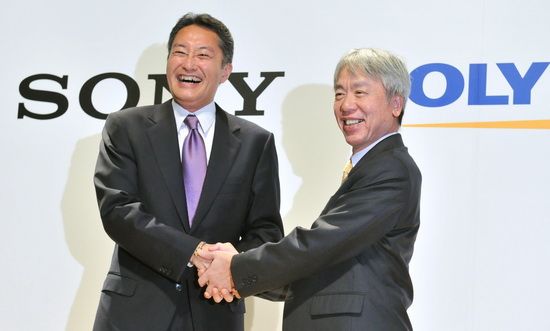
JP (Click here) published an interview with Olympus president Sasa. If google translation didn’t fool me this is what he says:
– Olympus and Sony are working together on the camera and lens front. This means “one-step” integration in the distribution network and camera parts purchases to reduce the costs.
– He confirms the low-end compact camera market is of no more interest for Olympus
– There is room for growth in the Mirrorless Interchangeable Lens market. Olympus expects annual sales number to increase from 75000-80000 to 90000-140000 units.
article found via Digicameinfo.
69 Responses
750000-800000 to 900000-1400000 or 75000-80000 to 90000-140000?
No no, it’s subtraction! The market is expected to grow from -50000 to -50000 units!
when i look at this picture, the expression of the guy next to the sony sign says to me: “if offered, i will happily eat your face in under 5 minutes”
This is how google has translated it, “On the other hand, we have seen small that omitted reflector “mirror interchangeable lens”, and there is room for market development, annual sales number of mirror-less next year 750000-800000 of 90000-140000 units increased term ratio I expect the table.”
It probably should read “annual sales number of mirror-less cameras next year I expect to be 750000-800000 which would be an increase of 90000-140000 units” but a Japanese speaker (reader) will hopefully translate it correctly for us.
75,000-80,000 to 90,000-140,000 count the 000s
It was corrected, that’s not what it said this morning.
The Japanese says that they expect to sell 90 000 – 140 000 cameras more than this year to a total of 750 000 – 800 000 units next year.
That’s correct. Olympus current projection is 660,000 units for this year, though some of us believe that’s not achievable without another new product introduction soon.
This is great news. Both companies are pushing the camera industry and innovating, both have strong suits in lens manufacturing and have produced great cameras. With Sony’s sensor technology and Olympus’s great IBIS technology, I foresee wonderful things for both m43 and full frame mirrorless :).
Oops, that’s a decrease.
3 words: brack friday bunduru
Wow…that photo is scary!
Yeah point and shoots have had their day any company that is still pumping them out needs their head examined!
Yes lots of room for mirrorless growth as long as the products and marketing are done right and the 2 big DSLR players keep carrying on as they are 🙂
I don’t know why we feel compelled to keep saying that mirrorless has lots of room for growth. I know of no other segment where we have to keep repeating that.
In reality, mirrorless sales are significantly down YoY, in a market dominated by DSLRs. And DSLRs are flat or a little down, not down as much as mirrorless.
Mirrorless is a segment invented by manufacturers who could not cut it in the DSLR market, and so retrenched. It was a brilliant marketing move, since it cut manufacturing costs, yet the price dropped was not passed to consumers. Rather, consumers were sold that the loss of direct viewing was an advantage of them.
Disclosure: I own and thoroughly enjoy an EM-5. I just believe we should have our eyes open and be intelligent consumers.
@ronin
In reality, micro four thirds sales are not significantly down YoY, maybe other mirrorless players are? DSLR sales are suffering from a mature market and lack of upgrading.
Mirrorless was really where Pansonic wanted to take the market and brought Olympus along to the party.
I don’t see DSLRs being sold at the price that accurately reflects the cost to manufacturer them (development costs for DSLRs have also long been recovered).
Direct viewing has next to no advantage, it tells you nothing about exposure, white balance, colour, choice of aspect ratio. EVF and LCDs more accurately reflect todays journey to final output.
I don’t know about m4/3, I haven’t seen figures broken out, other than Olympus stating that it’s m4/3 sales are down and below forecasts. Report was in NYT and US Today maybe 2-3 months ago, and cited in 43rumors
Mirrorless went through a growth spurt last year, then fell significantly the first part of this year. The next 6 months are probably sink or swim. I don’t know how you recover once circling the drain. Here’s hoping they survive.
Okay, let’s use reality. How many m4/3 cameras did Olympus say they sold in the first half of the year? 250k, of which apparently 50k were E-M5s. The only way we can believe that they will be up significantly for the whole year is to believe their projections, which have tended to be wrong for many years now. There forecast is also loose, as in: 400k Pen-type cameras, 100k OM-D E-M1 cameras, and the other 110k is a “swing factor,” whatever that means.
Ah yes. The Olympus + Sony alliance.
Expect this time next year to see a M43 NEX. APSC is dead.
Big Q. Will Oly jump to FF??
> Expect this time next year to see a M43 NEX. APSC is dead.
APSC is not dead and IMO it’s rather the FF which has more to fear. There is no real world advantage to FF anymore.
> Big Q. Will Oly jump to FF??
Why would it ever do that?
Current resurgence of FF is a fad. FF was pushed into the niche and the resurgence is simply a short lived pushback. There is no way FF would catch-up price-wise with smaller sensor cameras (esp in lens department); and price is what drives the mass market; and mass market is what guides the investments into the future developments.
>> Expect this time next year to see a M43 NEX. APSC is dead.
> APSC is not dead and IMO it’s rather the FF which has more to fear. There is no real world advantage to FF anymore.
Two parts to deal with here. First, would Sony move the old NEX down to m4/3? My bet is no, as they’ve invested far too much in getting it to where it is and where it is holds its own just fine against all comers in mirrorless. Moreover, if that were to happen, Olympus can just write off being in cameras completely, I think. Partnerships are always dangerous, but when you’re a small fish and align with a bigger fish, you need to watch out that the bigger fish just doesn’t eat you. Sony moving into m4/3 would likely mean Panasonic leaving, making Olympus the smaller fish in the m4/3 pond.
But there’s a simpler reason why Sony wouldn’t move to m4/3: neither m4/3 partner has shown they can make a profit in cameras. Sony is targeting Canon and Nikon, and they’re not going to move to a smaller sensor to do that in mirrorless, as it gives Canikon an easy out in marketing.
>> Big Q. Will Oly jump to FF??
> Why would it ever do that?
This one’s easier to guess, and the answer is yes, if Olympus manages to hold on in cameras, they’ll eventually have a full frame offering. Why? Because you want to send the message to your entry customers–which will be Pen users–that there’s cameras in the lineup that’ll take you all the way to the pro level in the lineup. Cameras that don’t force you to relearn menus and controls, cameras of the quality you came to expect.
Will this happen fast? Much more doubtful. Olympus has its hands full just trying to get cameras back to breakeven right now. A full frame offering won’t help with that, and actually may hurt, as it would take resources away from some projects that need to happen in m4/3.
Let me put it a different way. We’re pretty sure Canon, Nikon, and Sony will survive this camera downturn. Fujifilm and Ricoh are big enough that their camera problems are so small as to not require much information on the financial statements. Canon, Nikon, and Sony are already offering full frame products. Ricoh is known to have a prototype. Fujifilm is rumored to be coming to Photokina with one. So if the only other remaining Japanese camera company of note is Olympus, NOT having a full frame camera absolutely identifies them as a niche-only player. I sincerely doubt that’s the strategy (e.g. m4/3 only, now and forever).
this is crazy talk
If there are problems that are market wide, then every division of camera manufacture is affected, including FF. Olympus making a bid for FF will just add to their problems not fix any of the others, the problem is the market not the size of the sensor.
Other manufacturers also sliding into FF probably wont help them get any more traction in the same market conditions. And they, like Canon and Nikon will likely forgive their best and most expensive APS models like D300 and 7D to give their low end FF cameras a chance in the market. So if one is operating from the same songbook high end APS goes away to support sales of low end FF. It is yet to be determined if this formula is successful; I rather doubt this, and I think that ultimately they will have to re-enter with a high end APS.
As to niche manufacturers, the overwhelming balance of the market is with SLR cameras over a range of FF and APS models, this is even without recognising that any of the others like Sony Pentax Sigma exist. Competing with such an industry behemoth is always going to be problematic, OTOH you cant get the volume to support low prices to be able to ‘properly compete’, OTOH you wont have the range and prices the consumer side recognises to be vastly more desirable. As long as C&N stalk each other in APS FF models, making C&N clones is always going to be a failing proposition.
The only other way to go is to stay with the objectives that mirrorless can offer, which has already proved popular with consumers, has a deep foothold on the market and yet still has room to expand. And while this is truly a niche development, the niche will ultimately be cheaper and faster to produce, yet as it has be capable of pulling more price leverage which is another facet of niche manufacture.
Lastly, introducing FF to mirrorless wont necessarily work where all your lenses are for a smaller format, and where the key fundamental for mirrorless is size and where ultimately it will assure ‘small’ is going to always be more possible than for an SLR.
What mirrorless manufacturers need to do is to keep the pace of development, the continue to innovate new models and model ranges, and encourage as much weight behind them as they can with other partnerships such as Sigma lenses, Sony sensors etc. MFT is in the best position to capitalise on consolidation when the market returns, but they cant do that if they are distracted by returning to direct competition with C&N which has proven to be fruitless for all others.
Mirrorless guarantees cost competitiveness by its modular construction, yet it offers pricing premium because its a niche. But the core of mirrorless is a movement to more compactness, and in that FF is an anathema.
The Olympus + Sony alliance could work together on the resurrection of the Minolta brand in the form of m43 cameras (bodies). It could expand the usage of the fabulous Olympus lenses.
Minolta still exists, it just sold its camera business to Sony, EXCLUDING the right on the Minolta name. So nope, thats not going to work.
You are correct – the Minolta (including Konica-Minolta name in dSLRs) continues in the Sony family. Not sure where Tibor is coming from. When Sony bought the division (2005), they also obtained some of the designers and engineers, which was evidenced by the A700 and some other units.
You are aware that Minolta is still a major supplier of lenses, aren’t you? They help design and manufacturer lenses that come out under the Sony label.
Lol by by M43, hello Oly APSC an FF.
It would make more sense to say byebye to APS-C NEX’s and hello to M4/3 NEX’s. Lack of lenses as always been a con for the NEX system and M4/3 as plenty of them, even from third party companies. Plus, M4/3 lenses are more portable than APS-C ones. Go light with M4/3 NEX or go for broke with a FF Sony and it’s big lenses. As for Olympus FF… Would be nice but not vital I guess.
What would be Sony’s motivation for giving new life to a rival- Panasonic?
Despite early optimism, 4/3 involves only two manufacturers.
I believe Sony will allow Olympus to continue to lurch around draining cash, but will not compromise its own segment, or give new hope to rival Panasonic.
Panny join to Leica M Mount 😉 ,are you ok??
Having visited the Blackmagic booth at Japan’s primary broadcast trade show last week, I can assure you that there’s more than 2 parties with an investment in the system. At the Tokina booth, their cine lenses (some coupled with Oly and Blackmagic bodies) were their most prominent items on display.
Whoops apparently appeared in the wrong place…
I have no idea of whether Sony and Panasonic could co-operate in cameras or not, but these “enemies” (??) do co-operate in other areas, e.g http://news.cnet.com/8301-1023_3-57595903-93/sony-panasonic-team-up-to-develop-300gb-optical-disc/
Hey Viezevure troll, are you over 12 years old?
I hope if Oly is sharing parts they use only some of the a7 parts. It needs a longer flange distance to make small lenses shine. Maybe even a four thirds mount and distance.
So, camera shipment decrease across the board in 2013 big time, including Olympus m43, and every other camera makers are predicting lower sales next year, but Olympus is predicting a big up year? Hmm… Must be wonderful to be able to put arbitrary numbers in their financial statements.
I still don’t get why the internet thinks it’s possible to judge about the sales & success of Olympus, just by one shipping statistic…
I guess that the Olympus management got better and more exact business numbers… since I started buying Olympus cameras, there is always the same crap in discussion: sensor is to small, company almost broke and naturally ‘my toy is better than yours’ 😉
I’m quite impressed with the results of this company that does everything wrong 😉
And the best: even when all of a sudden mFT dies, everything I really need is already on sale & I don’t need better picture quality or features… So I could buy then cheap stuff and be happy shooting with a dead system.
One shipping statistic? The camera market, like the PC market, is in free fall. It’s not just P&S. That includes DSLRs and mirrorless. Canon, Nikon, Sony all predict further declines next year. Olympus predicts a glorious year next year, even as the trend is down and they’ve had a down year this year. What does Olympus see that the rest of the camera biz does not? Or better yet, what does the camera industry see that Olympus has not yet caught on to?
I still think it was a mistake that Olympus used the OM brand for micro four thirds.
The pen was half frame, hence the digital pen (although half of 135 i.s. 18×24, is still larger than m43). m43 could still have dslr style cameras, just not called OM.
The digital pens should have stayed m43, and OM should have returned with 135 format sensor and revised OM mount that could still take the legacy OM lenses.
Then Olympus would have 2 formats that complement, Pen and OM. Not some convoluted naming system that has little to do with the historical connotations.
I think OM-D could do with a G/GH style articulating screen that can be reversed for protection while stored. The reverse side could be leatherette, so whilst closed, the camera would resemble an original OM.
And whilst I’m at it, Oly should release a new flash grip to mount the FL-600R.
I don’t think they have made a mistake & I don’t think they do either. We now have E-M5 & E-M1 that is grabbing the attention more than the PENs did (with a little help from the Sony sensor 😉 ) & with another OM-D on the way next year, it looks pretty good to me. Also, the ‘look’ of the OM-D is being applied to the Stylist 1 camera & that should go well too.
Judging by the photo, the Sony guy seems happier than the Olympus exec. 😉
Nah. The Sony dude has the bigger fake smile. 😉
Yeah, but they both look like:
They just saw the pain of the Oly shareholders who lost due to the Oly accounting fraud, or
The Arizona blowing up.
Or both.
yeah guy ,they will eat olympus in future (less than 3 years)
So EVF will come from Sony, not from Epson any more.
No, they will both use Epson.
Sounds like more brand engineering.
Duplicate parts, distribution networks, support organizations.
Differences to be stylistic, maintaining brand name differences mainly.
Sounds like an exit strategy for the Olympus brand. Keep it alive if it sells, allow it to fade away if it does not, at no significant loss.
I don’t like it, I would like Olympus to stay around C’est la vie.
I don’t know if it is so bad for Olympus. Sharing logistics and parts to reduce costs is a good idea. Olympus will focus on m43 with possibly a stint or two in the FF world (for bodies, lenses are a given on both systems). What’s not to like. The quality and spirit we know and love/hate from Olympus will be exaclty the same.
Japanese companies collaborate and have cross holdings in each other all the time.
They rarely/never take each other over in a hostile action. Usually it is with agreements.
My Japanese car has components from at least one rival Japanese manufacturer. It does not mean they are going to be taken over by them.
Quite simply, why would Sony be interested in taking over (currently loss making) Olympus’s imaging division ?
They can get any Olympus expertise with these technolgy sharing agreements so why waste valuable money and resources and take on the risk of bringing the division back into profitability.
At the same time they get a customer for their own technology and the sum of the two companies’ sales is probably greater than a merged one.
Sony are more likely to be interested in Olympus’s main business of medical imaging and that is why they acquired 10% of Olympus.
Well, if Sony brings Olympus into their marketing and distribution sphere, it could be very good for the M4/3 system. If Olympus manages to get more display space, or ANY at all as we’ve all seen, it could be a big win for them.
Sharing technology could be a win-win, too.
pure feckin genius!
Sony gladly trash their investment in Olympus so they can lose their money. Will the next halfwit stand nearer the door please.
I read the Japanese. It says there will be an increase of about 90,000 to 140,000 units so they anticipate the total of 750,000 to 800,000 units.
yeah that makes sense Olympus is forecasting about 600,000+ for this year end.
There is room for growth for Micro Four Thirds in the video market (all segments: tough (like Go Pro with interchangeable lenses), indie and broadcast film makers, hybrid video), DSLR weight downgraders,connected/app cameras, make child/teen aimed cameras, strongly female orientated cameras….
“strongly female orientated cameras”
You mean usable once a month?
Seriously, don’t you see a kind a “deviance” in such categorization?
We need Oly FF with global shutter and 5-axis IBIS!
Dream on. The energy dissipation grows dramatically with sensor area both for global shutter and IBIS. We’ll therefore see GS in M43 long before FF. And also 5-axis IBIS will not be available for FF shortly, if ever.
Junge, warum hat du nichts gelernt…
Warum? Die Antwort ist Bier, Bier Bier. 😛
Mimicked Panasonic and moved away form the low-end P&S market.
When you buy in a company there must be complementarity. m4/3 and FF35 are such technlogies I believe. Expecting 800.000 cameras a year is enormous, considering that smart phones are constantly nibbling up market share, even into dSLR.
Perhaps the latter is stopping to be trendy even for the rednecks 🙂
So that leaves us with two small and beautifuls like m4/3 and FF35 mirrorless. As noted above the latter has heat dispersion problems, and probably processing speed too. See slow AF and fps.
Other advantage to m4/3 is video, half frame being optimal.
There is competition yet, because NEX is over only in name, and Oly let know the might issue a FF35. But because of the above I don’t fear for m4/3, although the trends might be dictated, say, by Asian women 😉
Sony sensor in future Olympus bodies (if not already). That can only be good news as then we would have two sensors to choose from, and Panasonic will have to keep upping their game. And not just joining forces in manufacturing, but in creating an effective distribution and promotion chain, too.
Here’s hoping Sony and Olympus could do a secret agreement whereby Sony ceases APS-C in NEX cameras to go all FF, positioning Olympus to fill up the smaller sensor market. Their cameras are beginning to look similar to consumers now, anyway. In exchange Olympus would share lens miniaturisation knowhow, which Sony dearly needs (and lacks).
A partnership of sorts between Olympus and Sony is not that crazy an idea.
With Sony providing the high-end-uber equipment for people who want the best and Olympus providing the middle-end equipment for those who want a small camera with as good a sensor as you can get in a almost pocketable camera coupled with fantastic small lenses, they will be able to share tech without stealing each others customers.
Sony electronic know how and Olympus lens and stability know how is a formidable combination.
Does that mean we will finaly see some usable video in olympus cameras!
how about fuji/pana? some news?
What is happening on the organic sensor front?
When are the new sensors coming with the promised better IQ and DR?
Olympus and Sony created the buzz this year : E-M1 and A7/7R are the most popular cameras of 2013. Olympus benefited not only from Sony sensor technology, but likely from Sony marketing strategies. Olympus had a lame marketing before, but the E-M5 and E-M1 are excellent cameras promoted by a very clever marketing strategy.
Sony made an OM-like FF camera, probalby partly designed by Olympus engineers, and the result seems great.
Until now, a successful collaboration, IMHO.
FF 4:3 ratio might be the way to go. The 4:3 ratio allows slightly smaller and compact lenses.
I looked at some online stores sales numbers for November, and even if E-M1 only has been available here for less than week, it still sell better than anything Nikon.
The image above tells me Olympus has been handed over on a tripod plate to the bigger player Sony.
Won’t be long till be witness Canik/Nican Cameras Canon buy out or merge with Nikon…..