







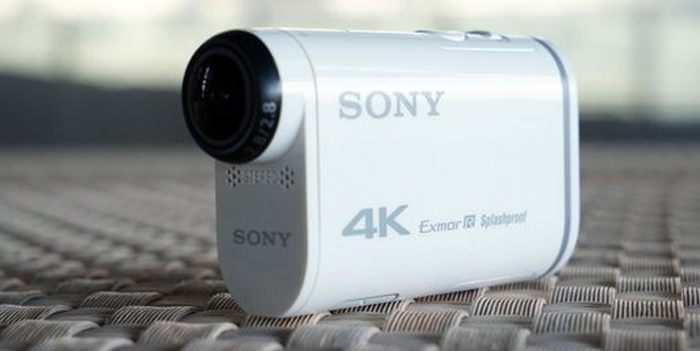
Dvinfo found images of the new Sony stuff. This is the first image of the Sony 4K Actioncamera. The $500 X100V is a 4K actioncamera with image stabilization which will be in Store by February. It costs $100 more than the GoPRO4 but unlike the GoPro the Sony comes with on lens stabilization. Keep in mind that the GoPRO Hero4 is the most sold overall(!) camera at Amazon US (ranking here). Let’s see if Sony can succeed to dethrone that hotseller!
There is also a new AX33 4K camcorder that will go on sale for $1,100 AX33 in February.
No E or E-mount stuff will be announced today. But we will not have to wait a long time. Only 4 weeks until the next Sony press announcement before CP+ 😉
–
Thanks Cliff!
67 Responses
Can that lens even handle 4k? I bet it will be nothing but a big blurry mess. C’mon Sony, just put 4k in a cheap emount body.
If anything can be taken from this, we can now feel quite confident that Sony should release at least one E mount camera with internal 4k capabilities. I am guessing hey will want to reserve it for its top models for APS-C and full frame, namely, the upcoming A7000 and A9. Anything less would br beyond conceivable at this point.
From a company that produces their own lenses?
4k is basically an 8mpx still. It should be OK.
With 1/30-1/60 shutter speed, from a moving and shaking platform (in case of an action cam – you know, “action”). Some stills you get.
if e-mount needs anything cheap, that’s not 4k.
I always wondered why the best action cameras don’t have stabilization. One possible reason is that they are mechanically abused (dropped) quite often and a fragile stabilization mechanism would be broken quite fast.
Good question, I hope they make a waterproof action cam with a nx30 style floating lens, that would be super cool.
beacuse it’s not really needed in action cam
What do you mean ? 90% of the GoPro footage on YouTube looks like someone had Parkinson’s disease.
Try to stabilize ~200mm roots and bumps on a mountain trail with 1mm (max) movement of a sensor or a lens element. It is not simple hand tremor.
See the new Sony action camera videos…they seem to manage to do it.
I quit believing promo videos long time ago. We’ll see independent tests at some point though.
The reason GOPRO is the camera of choice is the form factor…very difficult to mount the Sony on chest or head.
I would think headmounted the Sony would be better. The shape is way more aerodynamic.
You have to mount on top of helmet rather than the forehead.
I would think a camera strapped to the side of the head is more comfortable, besides its more eye-leveled on the side since forehead isnt actually flat(camera will angle slighly higher)
Yeah I like this, it fits my helmet side mount and I don’t have to fear having the camera crushed through my helmet when canyoning.
Sadly I don’t think specs or IQ will make a difference (or how you mount it). The real strength of GoPro is their marketing—though their cameras are pretty good for what they are. My friends and family who know NOTHING about photography (even the ones who are only vaguely aware that “Canon” and “Nikon” are the names of camera makers) know what a GOPRO is.
Go Pro became a hit and a marketing force after people discovered they produced the best action cam. You call the Go Pro ‘pretty good’ ok, so which one is better for about the same price? Or even double the price? Marketing only get’s you the attention of the customer, you have to deliver a good product to keep your customer.
Actually the Sony action cam is a very strong contender (not just my opinion there are many independent reviewers who thought so) for the last several generations. The Contour before that (relative to what was available). I’m not crazy about most action cam footage or action cam handling.
The contour was never really anything worth the trouble, we use a lot of Go Pro’s in our tv shows because of the quality, the 2.7k in cine mode is excellent and extremely versatile. now with the 4K and sensitivity it got even better.
By the time Sony showed up Go Pro was already releasing a next generation. Sony has always been behind GoPro. Like I said, name another camera that is better for the same price or even double 🙂
but we will see what Sony has to offer, I hope they lock into the play memories app with some go pro like features and build on a nice sony evo-verse, perhaps offer XAV and s-log hah that would be really cool, not sure micro SD can suffer the bitrates.
I will grant that the last generation had better picture profiles but I still think who is lagging depends on how you view release cycles. Sony never stayed ahead long but now XAVC and S-Log seems likely on the higher end model. I haven’t played with it but I’ve heard mixed things about 4K on the GoPro.
Micro SD vs SD doesn’t matter as long as the micro SD is rated high enough. I have at least one MicroSD card that I use in my A7S and it does fine (64GB microSDXC rated UHS-I).
Personally I think Sony should merge the QX & Action line up of cameras. Beef up the Playmemories app (not there but improving constantly) and you’ve got an eco system that starts to provide flexibility the GoPro doesn’t. QX is too niche and the Action Cam seems to much like a follower product.
oh ok.
Exmor R sensor…not a bebut of the Color Samplong Sensor.
You really believe there was some substance to that APCS rumour? Honestly? it made no sense at all.
The tech makes sense and there is a patent to support it.
Is the spec sheet real or hoax?
And will it be built?
And can the array withstand 16,000 cycle/ second movement?
There is not patent to support it. There is a rumour. Just try finding the original patent link.
I am apparently not able to track down the actual patent but there are many schematics available for the IMX189AEG SENSOR
That’s because there is no patent, and that datasheet is almost certainly a fake. There is no record of it on any official Sony site (or any of their agents). After trawling through endless websites that reference it, they all point back to Chinese rumour sites.
OK. It’s not unknown for data sheets to be leaked in advance, but something tangible normally appears very quickly. This is just a hoax. In an event, the specs weren’t credible and the whole method of working would have had lots of issues with little, if any, gains.
In adition to the data sheet…that would have tacken little effort to fake..
There is a detailed schematic and drawing that would have required substantially more effort.
Do you think that was faked also?
Any document can be faked or forged and unless the origin is known no verification can be made as to the authenticity.
Need you ask? That diagram could be produced in less than an hour with any of a number of drawing packages.
Will the new sensor be using alien technology from Area 51? Illegal Alien
Read the excellent book about Area 51 by Annie Jacobsen and find out.
As I have said I do not know if this rumor is hoax or real.
But in the unlikely event that Sony promo is actually true , how else will they achieve
Ultmate resolution,dynamic range, and speed in 2015?
Quite simply they won’t. The ultimate performance in those respects isn’t going to be achieved in 2015, or any time soon.
There are several patents around for sensors which provide three channel colour sensing at each photosite, but none have them have proved to be viable in production so far. For some time to come, we can expect incremental improvements on bayer pattern sensors. Personally, I think the highest priority is to perfect CMOS a global shutter. I think that’s far more likely to be achieved and, arguably, of more importance.
The fundamental issue with the APCS approach – if it could be achieved at all – is that it would actually capture fewer photons than the bayer filter approach, as it only captures one colour channel at a time and there will be “dead” periods between the different samples. As dynamic range is essentially limited by the total number of photons captured, it would actually be rather worse. The only benefit would be on eliminating colour artifacts from de-mosaicing, but it would be replaced by motion-induced colour artifacts on dynamic subjects.
The schematic in question would actually do everything advertised if sony cuould invent a wave discriminator and fit it on pixel.
Each color is a differrent wavelength.
As it strikes the pixel that wave energy is converted to electrical energy.
If a descriminator could detect the differrence in the elecrical enerygy based on the wavelength of the light that generated it…then split the signal into 3 channelels proportional to the respective wavelength that produced it, and lastly miniaturisr it to the the size of the on sensor processor in the scematic…then this desighn would be super.
The wave discriminator would replace the on pixel swotching defice illustated…the moving filter/microlens array would be reduced to a stationary microlens array only, and the sensor efficiency would improve by at least a factor of 4x.
Of course someone would then need to invent a miniature wave discrminator.
Well, of course a sensor that could directly produce well colour channel information at each photosite would be wonderful. Foveon does, of course, do that but it has inherently poor colour channel separation.
Unfortunately, nobody has succeeded in producing such a design with good colour separation. The most likely approach would be to use some form of prismatic separation.
As for directly measuring photon energy (which is really what that difference in wavelength means), then that would be nice, but I’m not sure of any technology that would allow it. I suppose you could conceive of a sensor that had three (transparent) layers that required photons of decreasing energy levels to excite electrons. The top layer would require blue, the middle green, the final layer would mop up the red-end spectrum photons. That makes it sound like Foveon, but that sensor works through difference in penetration distributions of different wavelength (energy) photons. It doesn’t work because electrons at the different layers require differing levels photon energy.
Heaven knows how such a thing might be designed. It would certainly required very different materials. There are many other issues too. The layers have to be very thin (for optical reasons, if no other). Channel separation would be a problem unless layer absorption was very high. The list goes on.
I’d advise not holding your breath on this.
nb. there is one sort of video camera that does this via a different mechanism. It uses three completely separate sensors and prismatic separation (which means no photons are lost). But it’s very bulky, and the disadvantages are such that it has been supplanted by single sensors with bayer filters.
My thougt on the wave discriminator is that it would not directly discriminate the light wavelength but rather discriminate the electric signals produced from them.
To figure this out engineers would subject 3 identical single pixel b&w sensors to red, green and blue light only.
Those elecrical signals would be tested and analized to determine in what way they are differrent from each other.
Once a differrence is detected a discriminator would be desighned to detect what percent of the white light generated electrical signal of a b&w sensor is of each of those 3 types and apportion the appropriate proportion of the overall signal strength to each of the 3 channels.
This would occur on each pixel of a b&w backlit sensor so the entire pixel surface could be used to detect light.
Not only would this eliminate the filter array, but if the entire sensor surface were used for dection the microlenses would be unnecessary and the pixels would be larger…further improving efficiency.
Barry, you need to read up on how sensors work, and not how you wish them to. The way a sensor works is that when a photon is absorbed and an electron is added to a charge capacitor. At the end of the exposure, the total charge (that is proportional to the number of electrons and hence the number of photons absorbed) is converted into a voltage. That voltage is then fed through an analogue-to-digital converter to produce a digital “raw” value, which is a direct representation of the light intensity.
In essence, the sensor photosite is colourblind. It doesn’t matter what wavelength the photon was, as long as it had enough energy for an electron to be displaced into the charge area. (Which will range from photons in the infra-red area up to those in the near ultra-violet, but filters generally confine sensitivity to visible light frequencies). There is no sense in which you get a different electrical signal from different wavelength photons. Camera sensors simply don’t work by processing the signal from each and every photon (which you’d have to do with your model), and even if they did, then there’s no way of them distinguishing the wavelength as all that happens is an electron has been added to a charge capacitor.
The one proviso to that is that sensors are not perfect absorbers of photons (in the sense of exciting electrons into the charge capacitor). The proportion detected is what’s called the “Quantum Efficiency”, or QE. The QE actually varies a little with wavelength in that some are more likely to be detected than others. In theory, if you shone the same number of “blue” photons onto a sensor as “red” photons, more of one or the other would be detected. So you’d get a slightly different reading. But that’s no help at all with a mixed wavelength light, and in any event, it would be impossible to tell whether any subtle charge difference was down to changes in intensity or wavelength.
Another thing to note is that the cones in our eyes are rather like a bayer pattern filter, albeit a randomly laid out one (no colour moire for us) in that each of the three types is tuned for a particular range of wavelengths (which overlap). This is pretty well precisely what bayer filtration does – they have overlapping spectral transmission curves. (We differ in the we have supplementary rods, which are sensitive to all visible frequencies). The upshot of this is that the human eye doesn’t detect a fully colour separated signal at any given location. What we see is a result of complex processing in the retina, visual cortex (and beyond). If the 500+ million years of evolution since eyes first appeared during the “cambrian explosion” haven’t solved the problem, we might have our work cut out.
nb. when talking about “blue” or “red” photons, all I’m just using a shorthand to refer to photons in the range of wavelengths (and therefore energies) that we would perceive to be of those colours. There is no such thing as “colour” in photons in physics.
And yes, there is something called “colour” in quantum chromodynamics (QCD), but it’s absolutely nothing to do with perceptual colour.
Yes that is how they currently work and the stored charges are indistinguishable regardles of the wavelength that produced them.
For my theory to be possible therefore we need to break the process down into smaller steps…in hopes that we can either find or induce some currently undiscovered differrence that we can now discriminate.
First…light approaches the sensor
Then light strikes the sensor
Then the energy is adsorbed
Then the energy is re emmited in another form
Then that electrcal energy is directed to the next step in the process.
So during the first stage the photons are detectably differrent…at later stages those differrences are lost.
The engineers can either detect those differences at some stage…or alter one of these steps to perform a dual function…both to perform thier current finction and to produce some detectable or measurable difference while still producing the electrc current we need to determine luminance.
I cannot say exactly how this will be done…but believe that extensive testing and altering of single pixel B&W sensors might yield some difference we can measure…
Mayby the electrons will spin in a different direction or speed, mayby at some stage there will be different magnetic or induced current..or most likely the answer is something I have not thought of…but I think this line of research might lead to something.
Another way to achive color seperation without color filters would de to use carrier waves to seprate the wavelengths.
The advantage to this approach is that a single 3 channel carrier wave signal can be generated for the entire sensor and each of 3 on sensor capaciters can be tuned to the appropriate channel.
Not only would all the signal be used but the signal may actually be able to be amplified.
I realize these ideas are half backed…but mayby they will start the gears turning and someone else can bake them the rest of the way.
The freqency of visible light (430-790THz) is between 500 and 1,000 times higher than the world’s fastest electronic switching device (800 Ghz). To do that it had to be cooled to 4.3 degrees above absolute zero.
There is simply no prospect of using electronic type processing at the frequency of visible light. In any event, the whole idea is questionable. You are considering light as a wave. That’s highly misleading at the quantum level. Yes, photons have wave-like properties, but down at that layer the behaviour is completely different. You can’t modulate an individual photon. You can only really work at the level where it interacts with individual charged particles (which really means electrons in practice).
So forget any idea that you can use the sort of techniques used in electronic circuits and radio waves. It’s simply the wrong model.
At one point there wast a patent for a 2 layer organic sensor using y c for first layer and all g for second layer.
Has anything been happening with that model?
I realize this model mixes pigment primary and light primary colors but thats what the patent said.
How abought somehow using cohrent light to act like a carrier and capturing the interferrence pattern instead of the actual light image.
there would be artifacts on still subjects too, in flickering light.
There are so many problems with the idea, that I’m simply amazed anybody took it seriously. But then I’ve seen so many people fall for the “next great thing” with some attached bit of terminology or a fancy acronym, I begin to think they’ll believe anything. For example, whatever happened to all those organic sensors that were going to kill of silicon sensors?
The boring truth is that silicon sensor technology is now fairly mature, and as the physical limits are approached, progress is likely to be incremental.
We are lucky Barry is not in charge of something important. Unfortunately, many politicians are dumber
500? Bad strategy. The Sony should sell this camera with a lower price than GOPRO, and with more features.
The as100v has more features and is $100 cheaper than gopro
You mean the autoblur lens feature?
Doesn’t matter how good it is, GoPro is an established brand. People get all giddy for the accessories. Sony has to look at the whole picture. Not sure they’re doing that with this one.
$100 more than the $500 GoPro? To beat GoPro you got to be better AND cheaper. Would you spend $600 on this camera?
If it has proper lens stabilisation and a great Sony image? Off course I would!
No in-camera stabilization can possibly fight the shake of what happens on a mountain bike etc – you’d need a big rig for that.
How is this going to stop me from buying it if it has proper lens stabilisation and great Sony image? You see I figured out a long time ago you can also mount a helmet cam on your helmet, solving the vibration problem.
I’d like to have at least 1″ sensor for such price.
I own the AS100V 1080p version and have to say that the weakness is the lens. It is too strong of a fish-eye and even at the non-cropped mode, the distortion is still very severe. The GoPro is superior in this respect, although if Sony make a 4K Action Camera that was simply wide-angle without fisheye, and good stabilization – yes I would pay more, but if it’s just a 4K version of the AS100V, then I would say no, I would not buy it.
X100V? Do you mean the AS200V, or did you get the model designation wrong yesterday?
Looks like USA Today has taken the page down. It’s still indexed by Google but… Gone.
Still cached though! So Google Sony X100V and selected ‘Cached’.
I quite like the idea of a 4K action cam like this, but only if it does 4K at a decent bit rate.
My Sony Z3 camera-phone uses XAVC-S at 50Mbps for 4K, and while it’s better than 1080p there’s no way you’d want to pull still frames from it – Too many compression artifacts. 100Mbps would be required to make this a useful tool for me.
Thermals are the limiting factor here
Thermals on the sensor or the Bionz processor?
This statement has been repeated many times, is there any test data or other technical information to support this claim? Thanks.
Shape looks like the old Contour. I hope that lens is up to the task. I’d rather 1080p of awesomeness than full on 4K mediocrity.
For me it would need the following,
Ability to mount it on the side, so it doesn’t stick up. Dislike the form factor of the Go pro, and Sony is not any better if it can’t be mounted on the side.
Rotatable lens, and decent audio. Built in screen and two way remote.
The Drift Ghost-S has this, but waiting for a new release and see how this Sony pans out.
$100 more than GoPro4 with its established brand and ecosystem? Good luck, Sony. With yen like this, it should have been $200 LESS.