







Preorders:
Sony Alpha a7II (Body Only) for $1,698 at Amazon (Click here), BHphoto (Click here), Adorama (Click here), SonyStore (Click here).
Sony Alpha a7II with FE 28-70mm OSS Lens for $1,998 at Amazon (Click here), BHphoto (Click here), Adorama (Click here), SonyStore (Click here).
Sony 70-300mm f/4.5-5.6 G SSM II Lens for $1,148 at BHphoto (Click here).
AV.watch, DC.watch and Digitalcamera followed the Sony A7m2 presenattion in Japan. And there are a couple of interesting additional informations to report:
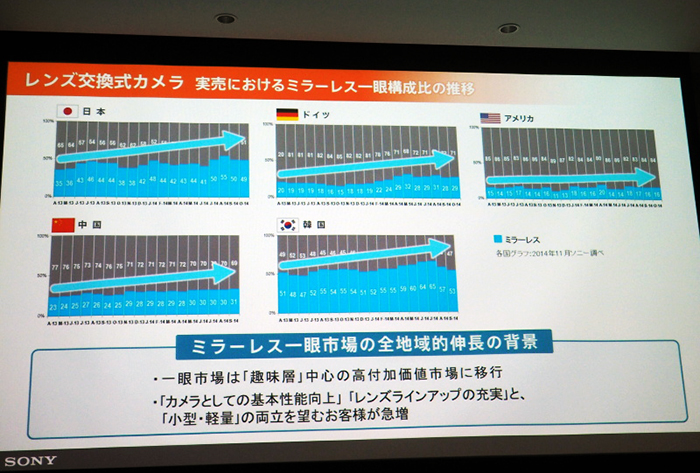
About the mirrorless market:
– The mirrorless system camera market is growing everywhere (althaugh very slowly in US).
– Half of the system cameras sold in Japan and Korea are mirrorless (see blue bars on the image on top)
– In Germany the share now is 29%
About the A7m2 and future products:
– The A7m2 is ealsed against water drops and dust.
– 5 axis stabilization is very likely to be implemented on future models too because.
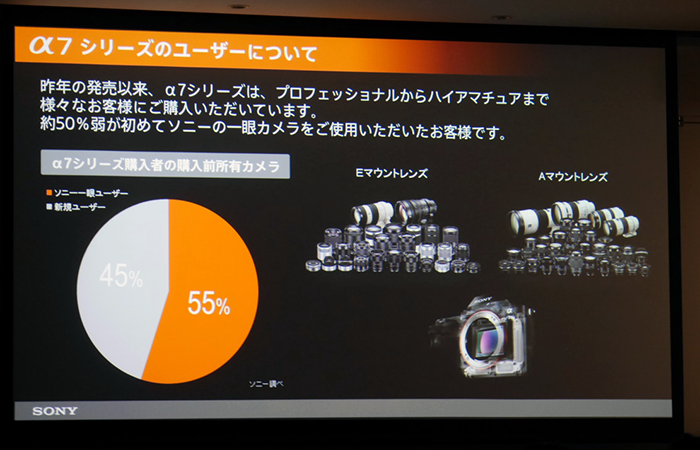
And also interesting: Half of the A7/r/s camera owners never owned a Sony camera before that camera
More images here (Click on it to enlarge).
0 Responses
@Admin
Unfortunality this is a stopgap post.
Last week i recommended a sneak peak for all rumors and you agreed.
So do it plz. 😉
“– 5 axis stabilization is very likely to be implemented on future models too because.”
Because…?
where does it say that?
Err… in that article type thing above.
because reasons!
…because user demographics show that majority of buyers wealthy enough to afford it are of older age group and have shaky hands :-p
i did a demo day with someone with shakey hands… d800 or d810, with a sigma 1.4 art 🙁
as for a mount, its quite possible ibis 5 axis was made for it, but then diverted to the a7 series, thats my suspicion.
if it doesnt come to a mount then thatll really stupid tbh, plus a might be able to have more sensor travel, so gain even more.
I’m waiting for 8 axis stabilization.
Because… Of the next item: Half the buyers of the A7 series are new to Sony
eg, Sony is making inroads into new market share, and by incorporating new innovations like 5-axis IBIS in a FF mirrorless camera will only help them further.
More Sony Engrish
The doctor says to the man; sir you have a cataract. The man responds; no doctor, I drive a Rincoln.
No rush then! By the time 7ii starts shipping we will have rumors about other models too.
Is it really water and dust resistant? I didn’t see it on the specifications page.
Yes, waterproof to 10,000 meters.
Please put ibis in the next aps-c e-mount camera 🙂
Once you add tilt screen, EVF, ibis, additionals wheels, its already more bulky so better go for FF
In my case FF is to expensive, I can afford only midlevel cameras. Also FF lenses are expensive as hell and I dont like the look of A7. A7m2 would be better but the price make this camera a dream which will never come true. And I’m not the only one here…
And then you’re in the ballpark of a DSLR from a company that has lenses all ready to go, better frame rates, more support, uncompressed RAW files, all for the same price, or less!
I see Arrow significantly climbing up than Histogram, lol
Could you/someone else please add descriptions to the last 2 slides? I’m not that fluent in Japanese…
-edit- never mind, figured it out.
This is very good information, I wait for A-Mount with PDAF and change the mount to E 🙂
Uhm. How can an A-Mount be chanted to E-Mount without is ceasing to be A-Mount. Colour me confused.
IBIS is a welcome and long overdue feature on E mount cameras.
There is certainly no reason not to include it in most new E mount cameras moving forward.
In the unlikely case that enough people really object to it…a very compact model can continue to be made without IBIS…but I totally expect most customers to want IBIS.
There are obviously 2 possible reasons not to include it in all models:
– size and weight
– cost
In other words, the cheapest ($200-$300?)/ lowest end models *could* omit IBIS for those respective reasons, same for the smallest ones.
Well said animalsbybarry. 🙂
I would really love to see IBIS in the A6000 successor and the coming A7000.
No One cares about APS-C anymore, it’s a dead format.
Right, keep telling that to the sales numbers.
Tell me something: if you stop designing new lenses for a camera, do you intend to continue supporting that camera, or would you push to sell off your line, get people into your brand, and then upsell to your higher end camera?
Tell me something; do you ever post a response that makes sense?
Hmmm, let’s break this down: Has Sony announced any plans for new APS-C emount lenses? (Can i answer for you?) No.
Is the current stable of APS-C lenses well-rounded and sustainable, keeping APS-C shooters happy for 3-5 years? (That’s a personal choice – for me, no.)
Are the FE lenses suitable for all applications in APS-C format? No. (Wide angle, size, weight, cost.)
Would Sony rather sell A6000s for ~$500 and then sell only a few lenses, or sell A7s at $1500+ and lenses that run $500 and up? What makes more business sense?
Is the compact camera market dying? Yes.
What’s your conclusion?
High end compact camera is a (fast) growing market, mid and low end is dying.
APS-C cameras have overlap with the high end compact cameras and sit inbetween that and the FF. Sony has stated that they will bring out new APS-C lenses, only that their priority is with FF now for obvious (just starting) reasons.
Can you point me to where they stated that they will bring out new APS-C lenses?
One of the interviews with their managers recently. Can’t be bothered to look for it again as there were many.
Either way, the most glaring holes were higher quality tele lenses (zoom, prime) and possibly very large ( f/1.4 or larger) aperture lenses. And this is where the FE lenses are helping to fill gaps for the APS-C cameras too.
Both types of lenses tend to be FF in general (if there’s a FF format option…), for the simple reason that there is little to gain for just making them APS-C. Tele lenses would be similar in size and weight, large aperture lenses tend to be large either way. Hence why Canon and Nikon usually don’t have 70-200mm lenses for APS-C only, nor f/1.4 lenses for APS-C only.
“Hence why Canon and Nikon usually don’t have 70-200mm lenses for APS-C only, nor f/1.4 lenses for APS-C only.”
http://www.bhphotovideo.com/c/search?atclk=Zoom+Focal+Lengths_50-150mm&ci=274&N=4288584247+4108103566+4108103536+4261208163+4261208165+4261208168
http://egami.blog.so-net.ne.jp/2014-11-21
http://egami.blog.so-net.ne.jp/2014-11-21
Looks to be a possible new Macro for APS-C E Mount sometime in the future.
While I would applaud such a move, and readily buy it were I still committed to my Nex 7, a patent is a long way away from an actual lens. And it’s only one – but great!
If you look deeper into that blog, the patent was file in May, 2013, over 18 months ago. And then this comment below rings true to me:
Perhaps APS-C lens of this patent application first is planning, but then, I think that it might be was planned change to 90mm macro lens G in the roadmap
What’s missing from the APSC lineup? I think the gaps are filled now with the FE lenses as the same lenses on APSC won’t be too much different to the FE lenses. Look at the missing 85 equivalent when compared with the closest competitor, the Fuji 56/1.2. It’s a stop faster so expected to be heavier but that’s the only difference to the Sony 55/1.8 is what is needed for the extra stop.
Fuji 56/1.2:
Weight: 405g
Dimension diameter x length: 73.2mm x 69.7mm
Sony 55/1.8:
Weight: 281g
Dimension diameter x length: 64.4mm x 70.5mm
What is missing is continued development. All new lenses from Sony are FE and (to a lesser extent) A mount. FE lenses are necessarily larger and heavier overall, and the point of buying a Sony APS-C camera is to avoid the weight and size of the A7 series and DSLRs. FE lenses on a Nex 7 defeat the main advantage of the Nex7, which is to be small and easy to carry. Any camera manufacturer that intends to maintain a camera body line continues to develop new lenses for that body to maintain interest and excitement, and consequently, sales.
Sony’s plans for their entire APS-C lineup are hazy at best, and it is my opinion that they are choosing to eventually drop the line altogether and focus on larger sensor cameras, specifically FE Mount, since even hardcore Sony aficionados seem to agree DSLRs like the A-mount are dinosaurs (with which I disagree, but that’s another conversation.) Sony Corp. seems to agree with them as well.
You’re entirely right, but you don’t go far enough. This is 2014. People don’t use cameras anymore. Photography is a dead medium. The new hot thing is braiding your beard into beard sculptures that represent what you see.
So is M43.
That may be true on DSLRs and higher end mirrorless, but not for those that want a small format camera. After all, nobody is predicting the end of MFT and APS-C is a direct competitor. It allows for a similar form factor for both camera body and lenses.
Many ILCE cameras used with 16-50PZ, it would be silly to put IBIS in them
Actully this IBIS actually provides additional stabilization to already stabilized E mount lenses.
The lens provides 2 axis of stabilization and the camera provides the other 3 axis.
For non stabilized lenses or non supported lenses the camera provides all 5 axis of stabilization and oss is tirned off.
If you had thought about it for more than 0.3 seconds you would have realised that is a very silly thing to say.
There are two reasons why it might not feature on all E-mount cameras. The first one is cost of course.
However, that apart, a more important issue for the small format cameras is size. IBIS increases the camera thickness to a significant enough extent that it will be noticable. So, like articulated screens, IBIS may be omitted on some models simply because of the extra bulk.
Yes
Sony could easily offer a compact model without IBIS, articulated screen or viewfinder for customers who’s primary concern is compact size, and IBIS for everyone else.
Kid: “Mommy, why is IBIS likely to show up in future models?”
Mommy: “Because!”
Kid: “Because, why Mommy?”
Mommy: “BECAUSE!”
anything on new Amount? new LEA4? 5?
If there are to be future a mount models, will the 5 axis ibis be included in those too, I wonder.
I’d guess so. Big if though…
I have answered this in recent post 😀 this is redundant.
Try to translate:
1st Slide: (Orange title) Lens interchangeable Camera, ratio-transition of sales volume of Mirrorless versus DSLR
(Blue description) growing market of mirrorless lens interchangeable of regions
(Black description) 1. High-end market is what enthusiastists tend to. 2.Aggressively growing in consumers who orginally considered between “High performance camera” “complete lens lineup” and “small/light-weights”
This blog has really become the king of stating the obvious.
What else is Sony gonna do? Implement IBIS for one single model and then never ever use this technology again?!
Yes and they promote digitalrevs with a “stellar” reputation. 😉
Sell the tech and develop something new instead 😀
sony and new? really? like SAR and new? really?
Barry = Captain Obvious
It’s so funny… Why did they make 16-35/4 with OIS just months before IBIS? The lens could be quite smaller…
When a OIS lens(SONY) is used, the IBIS works in tandem with it.
That sounds like super smooth footage…
Double whammy.
дам.. и един мармот завива шоколада в станиол…
please use English
i have no idea how is “дам.. и един мармот завива шоколада в станиол…” in english 🙂
something like: and a marmot foils a chocolate.. hmf.. obviously i know 🙂
https://www.youtube.com/watch?v=V0pN1PpfIag
This add is very popular in France even tho it’s not on screens for years. I’m curious if it’s known in other countries as well
Yo Dawg I heard you like IBIS,
so we got you IBIS for your OIS so you can IBIS while you OIS!
The best way to hide ignorance is to say nothing, are you listening Dmitry.
The important question is not when it was made, but when the project was approved for development. That was quite probably before the A7 II development was confirmed.
In any event, there are all the existing E-mount owners to consider.
2nd Slide: (Orange title) a7-series’ user
(white description) It is appreaciated that the professionals and amateurs bought a7-series since last year. About 45% of consumers bought Sony’s lens interchangeable camera in the first time. 55% are the orignal users of Sony’s DSLR/DSLT/mirrorless.
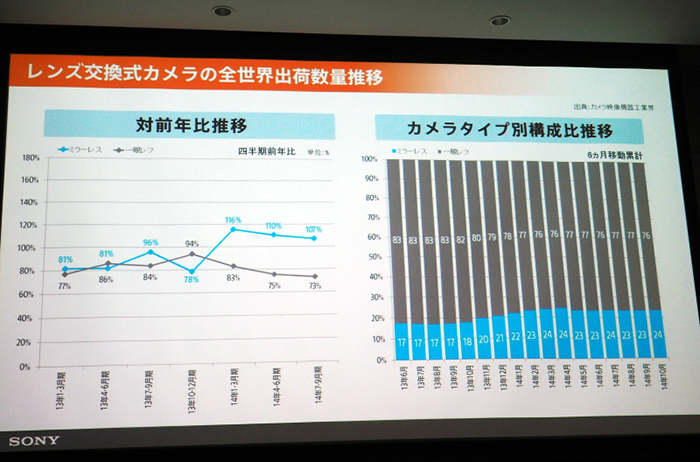
3rd Slide: (Orange title) Transition of worldwide markets of Lens interchangeable cameras
(light-blue title) left: Year over year. right: transition of market of DSLR-versus-Mirrorless
It’s funny how people in North America haven’t realized that small mirror-less cameras are far superior to those large antiquated boat anchors they are carrying around. Mind you, it took them an extra 15 years to catch on to Japanese cars as well. In America, some people still drive Cadillacs today. I guess in another 15 years they might catch on to camera tech as well. They are a little slow on the uptake over there!!
The same reason that the Ford F150 is the best selling vehicle in the USA for like 30 years and the vast majority are sold to people that live in cities. We have this absurd belief that bigger is always better.
HULK heard your mom say that, though…not tell you?
Yet there are other equally large trucks from other at least five other manufacturers. There goes your argument.
Perhaps it’s simply that better is better.
That’s nonsensical. The top selling vehicle for GM is their truck as well and like the F150, the majority of sales are to urban and suburban dwellers that never use them for what they were intended to be used for. Like I said in the other reply, of course for those that need them, those vehicles are necessary but the majority of those that purchase them do so not because they need them to haul things.
I would love to see a Prius pull a load of lumber!
Totally misses the point. Of course if you need to do that kind of work you need the appropriate vehicle. the point is that the majority of pickups are sold in urban areas of the US and are used as cars never hauling much of anything.
That’s a load of crap! I live in a Urban area and most of the one’s I see are carrying or pulling stuff that won’t fit in a car!
yawn
But it doesn’t look Pro man!
HULK thinks your mom does! Not at photo making…
You are right on with this comment. I live in Chicago and I’m the ONLY one of my photographer friends that even know that Sony is making mirrorless cameras and that Micro 4/3 even exists. It’s kind of crazy.
Because most photographers buy and use a camera for a number of years 5-10 before considering something new. They are happy with their current kit and know how to use it so why upgrade just for the sake of upgrading.
It’s only the internet bloggers who spend more time complaining about lack of new features than taking pictures that care about the latest offerings. But it seems they will never buy because there is always something new coming out in a few months. And it’s good he never heard of M43 because they suck and his current kit is probably much better anyway.
What’s crazy is that you keep these uninformed “friends”. Just kidding.
Your friends smart..their cameras less likely to be SMASHED by HULK
They seem to be well informed. A trick question: do they rather discuss photography or gadgets?
Umm, the A7 is bigger than a Nikon D5300 – weighs more, wider (barely, but still). Fewer lenses, fewer accessories. So it’s got an APS-C sensor – if you want small, go with an A6000. Oh wait, they’re not making new lenses for that anymore….
Awesome, thanks for the heads up.
How do you get a ‘heads up’ from someone with his head up his a$$.
Sarcasm has always been difficult to recognize over the internet.
Typical nonsense post by CI Sales, both the A6000 and A7 are much better cameras. D5300 is a POS with POS lenses.
Actually, the D5300 holds it’s own against the A7 according to DxO, in everything except low light as one would expect from a smaller sensor.
http://www.dxomark.com/Cameras/Compare/Side-by-side/Nikon-D5300-versus-Sony-A7___919_916
In fact, Nikon does a better job with Sony’s sensors than Sony does, as they have 6 of the top 7 spots, and the APS-C 5300, 7100 and 5200 all beat the A6000.
POS is measurable in this case.
but who cares, it’s still a DSLR with it’s many other prehistoric downsides.
Tell me them. Mirror? Prism? Generally larger, by a little bit?
the workflow of getting a picture and reviewing it, I don’t enjoy a DSLR. Larger yes, if there is a mirror nor not I wouldn’t care, I don’t see it.
Are you sure? camerasize comparison said otherwise http://j.mp/1vJM1ky. Beside, what is the point of comparing an apsc with a ff? A P&S is even smaller than any of these. Sony mirrorless is definitely smaller than any equivalent dslr. Depending on one’s needs, a mirrorless can be way better than a sale despite of limited lens and accessories selection.
Sorry – A7II. And the discussion was size, not capability. The 5300 is a DSLR. The A7II is similar in size. There is no appreciable difference.
http://camerasize.com/compare/#490,579
This comment is nonsenseical. It is obvious to any person with photographic savy or even normal intellect that the discussion is about professional quality photos in smaller body. If you are going to just comment on size why not just compare it to the smallest point and shoot or your cel phone.
The fact is the IQ on a 5300 is garbage. ANd no it is not a DSLR same as the a7 series are not DSLRs. Unlike the a7 seriues, the 5300 is not a professional camera and it is nowhere near the capabilities of any of the a7 series for a professional or enthusiast photographer. Its good for a soccor mom. And you.
You are wasting people’s time. The a7r competes for the highest resoulution low light camera in the world, the a7s LEADS the low light cameras of the world in performance and the a7 II will bring stabalization that no other DSLR can compete with. People marvel at this line of cameras because with a single stroke Sony has goose stepped all over the big fat “pro” (snicker) DSLRs.
To compare their progress to some 5300 nikon piece of afterbirth is non-sensical..
However, the original discussion was “Is the A7II smaller than a DSLR?” I agree, the quality is closer to the D600 than the D5300, but the fact remains the D5300 is a DSLR by definition, and the A7II is within those parameters, and therefore fits the description “big [and] fat.” If you disagree with the definition Digital Single Lens Reflex camera, then I have few options but to disagree.
No one is required to reply or even read my opinions. If you consider the time reading and replying a waste, I suggest you no longer do either. The power is yours. I consider this time posting my opinions to be fun and interesting.
Here’s the original statement by Jimmy Goodwood:
“It’s funny how people in North America haven’t realized that small mirror-less cameras are far superior to those large antiquated boat anchors they are carrying around.”
I interpreted this as “smaller is better.” How would you interpret it?
HULK thinks, smaller does not hurt Aaron as much…
You are right, good for soccor mum. Your mum soccor on HULK 70-200.
They are making lenses, they are in the shops.
Can you show me any proof of that? Considering that SAR can’t even dig up a rumor worth posting tells me that they’re not.
You should not edit your messages after someone’s reply.
You can use the FE lenses on the A6000 you know.
FE lenses are necessarily larger and heavier overall, and the point of buying a Sony APS-C camera is to avoid the weight and size of the A7 series and DSLRs. FE lenses on a Nex 7 defeat the main advantage of the Nex7, which is to be small and easy to carry.
A majority of Americans have become more uneducated and stupid frankly over the last two or three decades and are proud and patriotic of that fact. We’ve become a society controlled by know nothing media and crazy religious bigots. Fewer and fewer people are able to use their own intelligence to make judgments and decisions and prefer to be told what to think and do.
Quite an accurate observation. Seems like who is on Facebook & what dress did Taylor Swift wear to the awards, is far more important than understanding the latest technology & how it is being used to either control or improve their lives.
Sony is not the only company pushing technology on the camera front. There is also Panasonic, Olympus, Samsung & Fuji, but I suppose that none of these companies are doing a good enough job of marketing their products in the USA. Maybe they all need to re-think their marketing campaigns in order to grow their market share at the same levels as they are in the rest of the world. Seems like Europe has embraced mirror-less quite well. What will it take to get America to start buying?
Seriously? What do you care. Got stock? If so, too bad because DSLR still outsells mirrorless. I don’t care what camera Europeans buy because I’m not European. Many are not and couldn’t care less. Even if I were, I would still buy what was best for me. Gosh that was simple, but probably beyond your comprehension. If you are a mindless cult-baby following “in” crowd, and spend your days worrying what others buy, I have a suggestion. Maybe you should just get a life. One of your very owny.
Good marketing technique: blame the customer.
Our products are not selling, but it’s not our fault we are peddling something people don’t want, or don’t want at our price. Let’s blame the consumer, since we are so much smarter than them. This would be a great business if it wasn’t for those idiot consumers.
Actually, I take the opposite view: all these mirrorless companies are flogging crap for gold. They are miles behind Nikon and Canon, and the American consumer seems (oddly if you will) well aware of that.
LOL
“crap for gold”, isn’t that exactly why people leave Canon? At least that’s what I read in the forums.
Which forums? The Sony forums? Or the m43 forums?
Judging by your barely comprehensible opening sentence you’re one of them. Generalizations like that are no less offensive than any other form of stereotyping. There are unquestionably a number of Americans who match your description, but it certainly doesn’t apply to the majority.
Look up, HULK forwarded comment to Obama, expect SMASH! by drone soon!
Thank God “We The People” is so much superior to all those inferior lowlifes.
Tinyness doesn’t really matter if you go by car wherever you go. That’s all. In Asia, you go by train and they’re always packed. Which makes it a lot more convenient to carry less bulky things around.there’s real logic behind all of this.
>The majority of Americans have become more uneducated and stupid frankly over
the last two or three decades and are proud and patriotic of that fact.
Citation please.
True but… if i had a big houses, big cars and wide lands, I wouldn’t care about portability and tinyness. Mirrorless works well in japan tho..
It’s also funny how wanna-be scholars continue to make such a blatanly stupid statements.
Its funny how people make stupid generalizations that are based on ridiculous and subjective factors like camera size – especially given the inferior AF performance of mirrorless or lens selection compared to DSLR’s. I own the A7 and the A7s, but in some situations I wish I still had my 5d3. Sony just isn’t as popular or widely available in the U.S. compared to other countries.
Shhh, someone is making baseless generalizations about Americans. Don’t spoil it by replying with facts and common sense.
Oh, but that’s half the fun!
“popular”
Why does a camera brand need to be popular? I couldn’t care less what my neighbours and colleagues use. I check the market, compare, think and decide for myself what suites me best.
Sorry for the generalisation, but in America it’s “bigger is better” that counts. They are afraid when their neighbour comes over and they don’t have the biggest car to show in the garage, biggest camera with biggest lenses, biggest pen*s, biggest fridge and biggest king size bed. Who cares about quality, Americans are still okay with their cars that are around 10-20 years behind German and Japanese.
I know that doesn’t count for every single person, but for the majority of the society.
its always struck me that people are measuring the wrong thing here.
Personally..
Image size > Camera size
No. You check the forums, which are full of marketing shills. Since you have no photographic experience, you fall for the bait. Be careful throwing away your money.
no, I take pictures, with many cameras, since 2 years mostly with Sony’s. Is that a problem for you? It’s a Sony rumors site, you come here to tell me I should buy a DSLR?
Some people just prefer those muscle cars.
HULK prefer muscle. SMASH! weak Sony fgts!
You like small things, Japanese have small things…HULK see pattern there…
US is the last one to catch up with EMV credit card LOL
And they know shit about the rest of the world. Hardly ever seen any American traveling here in Asia. Close minded people only know their own country, their XXXL Burger and their DSLR
Cadillac CTS-V…pure freaking bliss.
Try to translate:
1st Slide: (Orange title) Lens interchangeable Camera, ratio-transition of sales volume of Mirrorless versus DSLR
(Blue description) growing market of mirrorless lens interchangeable of regions
(Black description) 1. High-end market is what enthusiastists tend to. 2.Aggressively growing in consumers who orginally considered between “High performance camera” “complete lens lineup” and “small/light-weights”
2nd Slide: (Orange title) a7-series’ user
(white description) It is appreaciated that the professionals and amateurs bought a7-series since last year. About 45% of consumers bought Sony’s lens interchangeable camera in the first time. 55% are the orignal users of Sony’s DSLR/DSLT/mirrorless.
3rd Slide: (Orange title) Transition of worldwide markets of Lens interchangeable cameras
(light-blue title) left: Year over year. right: transition of market of DSLR-versus-Mirrorless
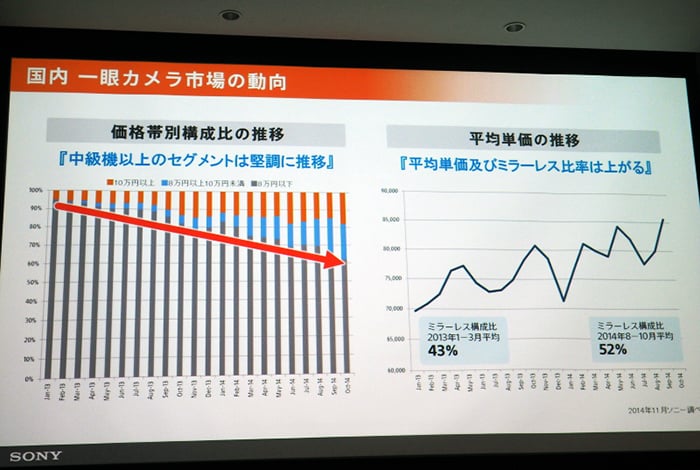
4th Slide: (Orange title): In Japan, market of DSLR/Mirrorless
(gray title, left) transition of structure of market. (gray title, right) transition of single price of sale
(blue title, left) Steady growing on mid-end and high-end cameras. (blue title, right) Growing of single price and ratio of mirrorless cameras
Thanks.
Full lens line-up 😀 Sony invent self-troll.
Hulk don’t understand this sentence, troll-self-smash
Dont want to hijack the thread but I thought this was interesting:
https://www.change.org/p/sony-firmware-update-for-dsc-rx1-and-rx1r
Nice review!
It’s very uninteresting.
Thank you Hendrick. I’ve been looking at the RX-1 due to its unique lens-sensor-combo, as well as A7 cameras – needless to say, this does not make SONY appear more attractive. I hope they do show more commitment to their products, and by extension, their customers.
maybe it would be better to have petition to demand firmware updates for all Sony cameras? e.g. as A99 user I’d also like my camera in Auto ISO mode go down to ISO50 or have settable minimum shutter speed
Do it.
You knew what you were getting when you purchased the RX1 – at least you should have. Yes, I would love to have a few of those features but this concept of firmware Kaizen is something that the manufacturer needs to actively promote as a feature if they are expected to be held accountable to it. Sony does not, Fuji does.
My RX1 takes beautiful images as is but if I needed the features listed in the firmware wish list on this petition, I would have maybe looked elsewhere.
The sense of entitlement is getting out of hand.
Kaizen is a marketing term from Fuji. They use it, its their strategy, good for them.
But Fuji isn’t the only one updating firmware including new features in cameras that have shipped already. Canon did 3 major updates to the 5D2 (I had two of those cameras) and Sony did 1 major update to my NEX 7, another major update to the NEX 5n (faster AF), and a major update to the A7r, and A7 cameras.
“My RX1 takes beautiful images as is but if I needed the features listed
in the firmware wish list on this petition, I would have maybe looked
elsewhere.”
Shed your humble tears somewhere else. I own 2 RX1s so I do appreciate the camera and I work with it. By work, I mean to make a living with it.
No, I did not expect to have what is listed in that site when I bought the camera, but I know it can be possible to add those improvements so I find its not a bad thing to voice a request.
No sense of entitlement. Get off your high horse.
I am sorry but this is what you get when you buy from second or third tier manufacturers. I have never seen this sloppiness in Canon or Nikon products.
Sloppiness on what?
Watch soon as our pre-ordered A7II yes its A7II orders ship Sony will announce a new gotcha about the A7RII with IBIS. WHammy!
The gotcha is Sony will share IBIS with Nikon and sensors with Canon.
Why does that matter?
Just because the mark I came in different flavours, doesn’t automatically follow the mark II will. It looks to me like Sony are going to separate out the product line. The A7II obviously replaces the A7, the all round model. I think the A9 will be the high res monster, with a new chip and possibly more than 36mp. My guess is they will follow it up with an A9 model with an A7S-like chip. It makes more sense from Sony’s point of view to make the specialist high res and low light models their pro A9 cameras.
I think the A7II, A9R and A9S would be a very seductive line up. Just need the FE lens range to broaden, which seems highly likely now Sony are throwing serious weight behind FE. I just hope we start seeing lower pricing on the lenses as they sell more units.
I actually think that this one will last a little while. Sony appeared to go big with their ‘testers,’ 7/r/s but I think they had a few irreconcilable issues which couldn’t be ‘fixed.’ I knew this going in and my 7r’s box is still sitting in the box amazon shipped it in, ready for eBay when the a9 is released. Particularly if it has sexy time AF, DR, and ISO performance. Through in a quick shutter release like the 7s(or better if you can do it!! 🙂 ) and Ill be on the preorder list as fast as my fingers can type.
The blue arrows give the impression of large growth, which isn’t there. In Germany there is a plateau, as is in the US and China over the last couple of months. We should wait for longer time spans to get to conclusions.
I’m glad I held off on the A7s…
A7SII with 10 axis stabilization…6MP, ISO to 2 million.
10 axis stabilisation would be a bit difficult, as there are only 6 degrees of freedom.
There is only 1 axis that Sony are not controlling forward/backward, and this is because it is fixed as the flange distance and determines where you have focused.
Once they master this last axis, they will be able to AF any old manual focus lens out there.
There are actually 4 more degree’s of freedom regulated to the unseen metaphysical realm. Once Sony masters this we will be able to take stabilized pictures in both the land of the living and the dead. Chances are it will be prohibitively expensive thus requiring you pay with your very own soul:)
Yep, and people are complaining with sensor ‘flare’, its not flare, they just ‘caught’ a glimpse of another dimension 🙂
IBIS is as old as the a900 (for FF), it would not be too hard to add one more sensor to detect the in ‘n out. Even Paris Hilton knows that.
Perhaps the person would settle for 5-axis IBIS and the ability to use a stabilized Lens, also with 5-axis, for a total of 10 axis (in two different items).
That should buy you _some_ increase in smoothness (stops), you may not get 2 x 4.5 more stops but 1.5 x 4.5 more stops is still better.
Also ILIS is better than IBIS since it actually “corrects” the problem rather than using ‘micro pan and scan’; which simply fools the eye into thinking the Image is not jumpy.
We might get 1M ISO, but I’m betting we get more than 21 stops of Dynamic Range first (Sony’s newly rumored Sensor).
We wait and wait, then, we wait … Sometimes it works out OK, it sure costs less and allows you to save for something you would never have bought, (do (did) not need).
I don’t agree that Lens-based stabilisation is better than In-body stabilisation and it is actually less effective. Thats why Lens-based OS usually compensates 1 to 2 stops, while in-body 5 axis stabilisation in the order of 4 stops.
Lens based stabilisation works by moving one of the lens elements horizontally and vertically, affecting where the image circle is projected and trying to move it where it should have been if the camera has not moved. Still using continuous scanning for movement and adjustment, but the camera, lens and sensor are still moving, so it is NOT correcting the actual problem! And it only does it in two axis (horizontal & vertical)!
In addition by de-centering one of the lens elements the optical quality is affected as well!
In-body stabilisation moves the sensor instead to a place it should have been and in Sony’s case moves it along all possible 5 axis (the 6th is for focusing). So it is much more effective.
Actually, Canon IS gets you 4 stops. I tried it, it’s true.
Its not impossible for a specific lens, after all for Lens-based OS every lens is different, but its much more efficient to invest in expensive stabilisation and put it in the body to use with all lenses, as opposed to only one lens.
Yes it may sound more efficient, but do you know how expensive it is? Canon says they managed to make it cheap. And then, I want the better tech, not the cheaper one in my toys.
> “I don’t agree that Lens-based stabilisation is better than
> In-body stabilisation and it is actually less effective. Thats why
> Lens-based OS usually compensates 1 to 2 stops, while in-body
> 5 axis stabilisation in the order of 4 stops. ”
Canon claims 4 stops with their ILIS, Fujifilm says they have 5-axis Hybrid with “2-Axis Optical Image Stabilization (Pitch, Yaw) and 3-Axis Electronic Image Stabilization (Roll, Vertical shift, Horizontal shift)”: http://www.fujifilm.com/products/digital_cameras/s/finepix_s1/features/ so combining the two is possible (and they get 3 stops, on that 50x Zoom Bridge Camera).
Can you find a Post by someone (that everyone has heard of) to support your position ?
Here are some that support what I said:
1. http://web.canon.jp/imaging/lens/index.html
2. https://photographylife.com/lens-stabilization-vs-in-camera-stabilization
3. http://www.usa.canon.com/cusa/consumer/standard_display/Lens_Advantage_IS
4. http://www.fujifilm.com/products/digital_cameras/xf_lens/about/optical_image_stabilization/
5. https://nikoneurope-en.custhelp.com/app/answers/detail/a_id/23997/session/L3RpbWUvMTMxMDM4MzY2Mi9zaWQvUlV6Y3ZJeWs%3D
6. http://www.digitalrev.com/article/lens-vs-sensor-shift-image/MzU4Mg_A_A
1) First, I notice that all of the information you rely on is marketing material, from companies trying to sell you systems with lens-based stabilisation, this is their job, so don’t expect to read the opposite there!
2) When you talk about lens-based stabilisation, EVERY lens is different, one can compensate you 1 stop, a $20k Canon tele lens might compensate 4 stops.
3) If you read carefully, all statements there are only claims, little facts, and always worded with many ifs, specific conditions, focal lengths, etc.
4) The articles are referring exclusively DSLR technology and with the transition to mirror-less cameras the two main advantages of lens-based stabilisation is no longer existing, namely:
– stabilised OVF
– stabilised PDAF sensor
With mirror-less cameras only the disadvantages of lens-based stabilisation remain. Perhaps, one exception in favour of lens-based IS focal lengths above 200-300mm, but these are special cases.
5) Better look at the facts and think for yourself, lens-based IS works by de-centering one lens element up/down and left/right (2 axis) trying to compensate for shifting camera left/right, up/down and rotating to left/right and up/down. This with all the affects on quality due to the de-centering or increased price for additional correction.
6) In lens-stabilisation does not even try to compensate for camera rotation around its main axis (like a driving wheel)!
7) I am not even going to comment the FACT that in-body stabilisation applies to all lenses, even old legacy ones, adapted ones, etc at no extra cost, so it is 5 axis in-body or no compensation at all for 90% of lenses out there.
In conclusion: Yes, perhaps in the past (for DSLRs) in-lens stabilisation had good advantages, but nowadays for legacy lenses, for current and future mirror-less systems in-body stabilisation makes much more sense! For specific tele lenses its not a problem to have them specifically stabilised.
Sony IBIS 70-200 VS Canon 70-200 ILIS Stabilization;
http://www.slrgear.com/articles/ISV2_tests/canon70-200f28is2/is_canon70-200f28ISII_200_ON.gif
http://www.slrgear.com/articles/ISV2_tests/sony_a55/sony_a55_200mm_ON.png
Couldn’t you pick some serious camera bodies if making this test?
$2k – $3k lenses tested on a $200 Sony camera, Einstein!
Plus, as I said below lens-stabilisation had its biggest benefits in DSLR/SLT age and tele focal lengths (exactly what you are testing)
Also, how was the test done, was each camera put on a stand mechanically repeating the same movements (shake) and photos taken at the same time?
http://www.slrgear.com/articles/ISWP2/ismethods_v2.html
Sony claims that the SteadyShot Inside anti-shake system in the A55 provides anywhere from a 2.5 to 4-stop reduction which is the same as A77 & A77ii.
A900 IBIS 70-200 VS A900 with Sigma 70-200 OS:
http://kurtmunger.com/steady_shot_vs_sigma_osid165.html
“SteadyShot is giving about a 1.5-2 stop improvement. Sigma’s OS1 gave about 2-2.5. Sony and Sigma both claim (marketing fluff) about 4 stops of improvement.”
Repeated
Repeated
It seems in line with my experience. As I often said, new is not always better. Cheaper to produce, probably; but better is a different kettle of fish. C & N are technologically way ahead of these mirrorless toys, for now. Yes, technologically.
All this advancing, developing and evolution in tech is great. But I feel it’s devolving the notion of ‘mastering’ your skill. Everyone wants perfect focus pin sharp images while they’re dancing around in the dark. They just want to press the shutter and have the camera do everything for them. These “advances” in tech should be a tool, not a replacement for your own skills and creativity.
Will reduce rolling shutter a little when doing handheld work 😀
meh I’d still pick an a7s over the a7ii for video.
I’m interested to find out whether we’ll get IBIS and some new APS-C e-mount lenses in the Ax000 series soon. Not all of us want the inevitable size/weight increase of FF.
Exactly 🙂
I think it’s only a matter of time before Sony releases an APS-C with IBIS and hopefully a more robust build. I love the a6000 but it could really benefit from stabilization and an all-weather body.
Agreed, would like to see the return of tri-nav and xga viewfinder too – I love the A7 series, but it’s starting to gradually gain weight and size (especially zoom lenses) so the Ax000 series still has appeal for me, even as a second system for when I don’t want/need to lug a backpack. I’m a little concerned there has been no news on aps-c e-mount lens roadmap for a long while. Need a good, sharp, smaller 70-200 equivalent, too, the existing one is lovely IQ but a monster size for the system. Better low-light AF would be the cherry on top.
HULK been annoyed by stalky photographers lately. Hope many will buy Sony wobble sensor, will make blurry photos when sensor wobbly because of fear of mighty HULK SMASH!
You really need an avitar if your going to pull that off Hulk. PUNY HULK avatar!!
Hulk silly little cartoon character without cartoon.
Hulk cannot smash anything without good picture.
Hulk afraid to show face..that why no picture.
Do you think the A7II is still palm sized? Maybe for Hulk?
:))
“- The mirrorless system camera market is growing everywhere (althaugh very slowly in US).”
That’s funny, because in the graphs depicted above, the last two vertical bars (units of time) shows that mirrorless market share is falling and DSLR growing.
It’s also funny because the sales of mirrorless seems to have peaked in number and is declining (together with the entire camera market as a whole).
It’s funny that you can obviously not speek japanese.
It’s also funny that you can also not read graphs.
What’s very funny is that US market is very conservative with usually the slowest adaption rate of new technology. The worst indicator for the success of a new product.
Now that’s funny!
It can be extra funny. Zeiss = Germany + Chen = Japan .
Halfway between there IS his “Center of Technology”: “Shyganak, Sarysu District, Jambyl Province, Kazakhstan” — https://www.google.ca/maps/place/Shyganak,+Kazakhstan/@44.8283833,70.0059772,11z/data=!4m2!3m1!1s0x420f1a13c52db2bf:0x1690a1a937188015?hl=en
Did the ‘conservative US’ send a Lander to Mars, did it land close to where they wanted, did it work … There are other countries that adopt Technology quite well compared to the US, but that does not make the US the slowest.
Their so-called conservatism (how much do they have?) has not been demonstrated as a great downfall for the country, and made them third world (or puny and weak).
If anything they have been previously described as both pioneers and bullies (surely by non-conservative people). There are people who dislike US Technology, not because it does not work but because it does work effectively.
That said there certainly are some small countries that are very advanced and, comparatively, do extremely well for their size, Halfway between Germany and Japan not being an area of faster Technology adoption than the US is just one example.
he’s obviously talking about the masses of US citizens and the countries infrastructure being very slow to adapt new technology, and after first hand experience in other countries I agree 100% with that statement.
If we were to say the ‘USA’ started in 1492 (which it did not) then the USA would be 522 years old.
Japan is somewhere around 35K years old (Source: http://www.answers.com/Q/How_old_is_Japan ).
Wikipedia says “A region named Germania was documented by the Romans before AD 100”. (Source: http://en.wikipedia.org/wiki/Germany ).
So the “USA” is fairly new on the World Stage. They do not live in Tents or Mud Huts unless they choose to do so (like for Camping (with electrical sockets in the Campground), or for a Sweatlodge (which is aboriginal, and unpopular).
“… about the masses of US citizens”, not everyone there lacks creativity or fails to adopt new Technology. I would not judge the entire Country on the basis of recent TV Events (that shows people looting and burning their neighbors, their jobs and their Town) to paint the whole Country as a land of Luddites.
The TV Shows “The Simple Life”, “Gator Boys”, etc. are not fair characterizations of the Country as a whole.
Everywhere in the US is not “Podunk Hollow”.
“The countries infrastructure” as you typed (did you mean the US roads, and underground pipes as a few examples) definitely need a bit of work but there are Countries with dirt roads and poor water distribution.
The short of it was that the person typed “… US market is very conservative with usually the slowest adaption rate of new technology …”. I disagree and do not know how he came up with that.
Yup, there are stupid people in North America; and I’d just as soon be rid of them. It’s those ‘modern’ Laws messing things up.
When you paint a whole Country with the same brush, when you say everyone from a particular Country possesses a particular Characteristic, that is called prejudice or racism.
I’m not going that far as to accuse the person of being that way, I am only trying to say he is not particularly well informed and has not come across as someone without some sort of an axe to grind.
It is not my fault if someone over here has bad judgement, don’t blame me if people buy new Guns over 4K TVs.
As for “buying Mirrorless” (supposedly the non-sidetracked Subject of this diversion) I think US Citizens do not shy away from adopting it. Some are poor because the wages are low and people need to speak up more about fair pay (to have more $ for Technology).
Many have bought a new Phone (but not as many, percentage wise, as Japan, for example) and are using the Camera in that. THAT was their “Technology Adoption” and the rest of the money may have gone for food, rent, and a Car (that is not as advanced as yet another small Country’s Cars are).
But, “over there” has had 1000’s of years to develop an Infrastructure (and Technology better than an exploding Rocket) whereas the USA is still new, and some people are still trying to learn just how to get along with their neighbors — an “advance” that any Civilization must make, prior to greater “progress”.
On that Front, the US does not do poorly either.
Right because thousands of years ago in Japan they were prepping their cities for the internet. The age of a country is completely irrelevant to how long it takes for mass adoption of new technology even in urban areas. And after first hand experience in Tokyo u can say without a doubt Japanese cities are significantly faster at adopting new technology than US cities. Let’s just leave the rural population out as being on the bleeding edge of technology isn’t exactly a priority anywhere outside of urban areas
Have you noticed car technology.. or lack thereof? not to mention the glacial rate dpi on monitors have evolved? I’m not saying we’re at the back of the pack but certainly not the front either.
The most recent sales do appear to have declined for mirrorless.
The big blue arrows that indicate sales are increasing are not generated by actual data …they are an interpolated projection from the real data and clearly do not match the real data…..the arrows continue upward even though actual sales vary all over the place.
Statistics can be interpreted to say whatever you want them to and clearly the data on these graphs do not match the arrows.
Yes you can make them say whatever that voice in your tiny brain says Barry.
The thing is, mirrorless are still way behind dslrs because they fail in many situations where dslrs get you the result, and not viceversa. I don’t know what “technology” means here, probably “electronics instead of mechanics”, or simply “new”. Both definitions are obviously wrong.
The fact is, dslr technology is still way ahead of the new toys because it gets you the picture in many situations where mirrorless throws in the towel. American consumers seem to be shopping wisely.
For shiiits and giggles. 15 dollar 50mm 1.7 rokkor verses 1500.00 dollar 50mm 1.4 Sony Zeiss wide open- JPEG…just slight adjustment with exposure and temp. to try and match.
The Zeiss blows it away at the 100 percent crop level of course, but at ususal web sizes the differences are quite minor. Gotta love being able to use 35mm glass on a full frame mirrorless camera. I love my rokkor lenses too 😀
Ha, no contest! Thanks for sharing.
Of course the Zeiss wins, but for 15 bucks this is good enough for me!
Just hope they launch cheap lenses for this system. I’d be all over this camera.
a few seconds ago
Haha, I can see more and more CANON and NIKON fanboys commenting in these discussions. Which begs the thinking: “You must be truly desperate to come to me for help(SONY)”. – All hail loki from avengers 😉 hahaha 😀 it seems to me like sony just got your attention after a decade without inovation from canikon. Or will you just keep telling us that lenses,pro suppprt, making impossible possible and all this bulls*** is what matters 😀 ? “Peace”
Man, stop advertising to me these SLR/SLTs, they will soon be history, look ahead, not back, I don’t want to go back to these bulky, heavy bodies ever again.
I’m highly interested in Sony FE system but I want my future A7R II / A9 to have uncompressed RAW option. It’s totally irrelevant to me how much less buffer or FPS I have. There is no excuse for letting the camera user to choose between compressed raw and uncompressed. HOW can 14bit compressed RAW be called 14bit RAW in the first place. It’s false advertising in my book.
your photo still look bad no matter how many bits of raw you shooting.
skill matters. that extra raw detail will not help.