







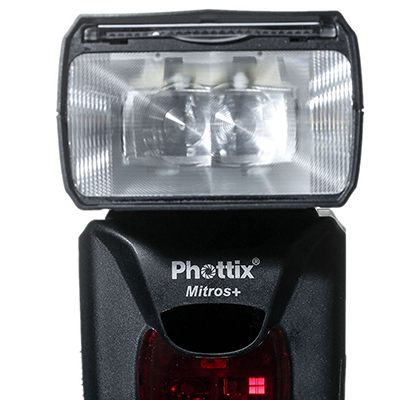
Phottix Introduces Two New Mitros TTL Flash Units for Photographers Using the Sony Multi-Interface Hotshoe
Powerful, reliable and affordable Mitros and Mitros+ Electronic Flash units now available for use with newer Sony cameras, which use the Sony multi-interface hotshoe
Hampstead, MD (November 12, 2014) – Phottix announces the worldwide introduction of two new Mitros TTL Flash units for use with the proprietary Sony multi-interface hotshoe. Following more than three years in development, the two new Phottix flash units not only fit the multi-interface hotshoe found on newer Sony cameras but electronics in the flash units readily communicate with the cameras’ own expanded capabilities to operate as one smooth system. The new Phottix Mitros is now available for $299 (USD) and the Mitros+ is also now available for $399 (USD).
Both Mitros models share many significant features including a guide number of 58, full TTL functionality as well as manual and multi modes, Auto/Manual Flash Head Zoom with 180 degree rotation and 97 degree tilt, High Speed Sync and Rear Curtain Sync, Manual and bracketed Flash Exposure Compensation, and a Quick Flash Mode: with 0.1-2.5 second recharge times and much more including a USB port for future firmware upgrades and a 3.5mm sync port.
The Phottix Mitros+ adds significant functionality, allowing photographers to not only use the Mitros on or off camera for lighting, but to also control and trigger remote flash by radio signal. The Mitros+ is an industry landmark and was developed with input from wedding and event photographers.
“The introduction of these new Sony-mount flash units recognizes the popularity enjoyed by Sony with digital cameras, not just in the United States but across the world,” said Phottix CEO Steve Peer. “Sony continues to produce innovative solutions for photographers and with the introduction of these new flashes, Phottix is underscoring its commitment to supporting Sony users as well.”
Photographers can use the versatile Mitros+ on-camera as a key- or fill-light, as well as control and trigger other Mitros+ flashes or compatible flashes using Phottix Odin Receivers. The Mitros+ also offers a built-in Phottix Odin Receiver and Strato II Receiver. Existing Phottix triggers, like the Phottix Odin or Strato II can be used to trigger the Mitros+ without extra receivers.
About Phottix
Launched in 2007, Phottix (http://www.phottix.com/index.php/en/) is a leading international supplier of photo accessories. All Phottix products are created to assist with the daily challenges photographers face. The company has established a high level of brand name recognition with retailers and customers because of the design, quality and pricing of their unique accessories.
About OmegaBrandess
OmegaBrandess has manufactured and distributed photographic and imaging products for over 75 years. A privately held company, OmegaBrandess supplies the photography industry with over ten thousand products from dozens of branded lines. For more information about OmegaBrandess and its represented brands, call 410-374-3250 or visit http://www.omegabrandess.com. Phottix products are marketed exclusively in the U.S.A. by OmegaBrandess.
0 Responses
Can Mitros+ do Wireless HSS?
Why yes it can sir. It certainly can do that.
“Existing Phottix triggers, like the Phottix Odin or Strato II can be used to trigger the Mitros+ without extra receivers.”
If I understood it correctly, the Strato II does not allow wireless TTL.
Good to see some movement on this, but still not listed on their web store here:
http://www.phottixstore.com/store/catalogsearch/result/?q=phottix+mitros
The Sony model is still listed as the iISO Minolta shoe. I want to see the new MIS shoe product shot for real. I want to see how those little front pins are protected on a flash stand adapter. Did they use a full sled, metal, or did they use four plastic toes like the Sony flashes do? Our CaNikon friends get Mitros with full metal sleds like their native units. But they are the pros after all. I guess plastic toes should be good enough for Sony shooters.
I want to see the real product shots of MIS foot. Is it full metal sleds like Mitros for CaNikon? Or is it four plastic toes with front pins exposed like Sony makes? How does it mount on flash stand adapter? How are the front pins protected when on a light stand adapter? Better research the peripherals before jumping in to purchase.
Good to see some movement on this, but still not listed on their web store.
Only the Minolta iISO shoe is listed.
This could be the system I have waited so long for.
I don’t like IR remote controll as it won’t work in many situations. Thats what holds me back from buying the Metz flashed and the Sony flashed.
Now this thing seems to be the first flash for Sony’s System that provides radio controll and you can use the Odin equipment.
This makes it very interesting! After a so long wait this could finaly be it!
I’m a little bit confused… They only have triggers for the old hotshoe right? Am I supposed to use a adapter or did I miss something here?
Nothing is clear except the price!
Old or new shoe, the Strato II can do no TTL and is no better than the much cheaper options available from China.
The Odin seems to do TTL?
The new products use the new shoe.
Still some open questions but some things are explained in this video:
https://www.youtube.com/watch?v=TSatAk4dPVc
These are for the new multi interface hot shoe.
I think you are right, the Odin trigger seems only available for the Minolta shoe. So if you want to trigger these new flashes from MIS you’ll need an adapter and the Odin or a Mitros+ flash.
So from what I have found out is that it won’t trigger Odin Receiver that are for Canon or Nikon.
Understandable since they propably use different protocols, but would it trigger them in manual mode? Anyone here with any experience on that?
It seems a bit pointless to release a new flash for an old shoe…
So the advantage over the Sony wireless flash system is that you don’t need a direct line of sight with the radio control. But since you need a radio for that, why not jus buy a hotshoe transmitter and receiver for your Sony flashes? Are the setting limited with such a transmitter?
If Pixel could release a King version with the new hotshoes with compatible protocol to the old Pixel Kings, so that you can mix up old and new flashes within a system – that would be my dream come true.
But Phottix system seems to be interesting, too. Like that idea of transceivers within the flash. Sony should do that…
I don’t understand how a company can issue a press release and not update their website or give a link to where it can be purchased. Especially when the release claims immediate availability. Their website is awful. Makes you wonder how professional they are in dealing with the inevitable issues that will crop up.
And I just checked their “Internet Store” http://www.phottixstore.com/ and they don’t have it listed either.
This is good, but I’d rather the Odin got the new foot before switching flash systems. I don’t really need TTL, but Remote ratio control would speed things up for me.
My A7 cameras have significant delay when in wireless mode, while the a900 does not. After some research, I found the reason is that the a900 supports ADI when in wireless, while the new sony cameras only allow “pre flash TTL.” Why Sony decided to eliminate ADI wireles, I do not know, but the pre-flash causes me to miss almost every shot at a wedding reception.
If these Phottix flashes are using Sony’s protocol, are they using “pre flash TTL,” ADI, or tricking the camera into thinking it is only using an on camera flash -so it can use straight TTL without a pre-flash? If the last option is true, then how does it manage TTL of the remote flashes?
The implications of the above question are huge for photographers that do not tolerate a half second delay. I bet most people interested in radio functionality would fall into this group.
shoot manual dude wow! no pre flash. who the heck shoot off camera flash in TL in wedding? you’ll get inconsistent lights in every shot. learn your flash. it takes 10mins of your time and lifetime of headache free
I find your reply a bit presumptuous and insulting: “learn your flash. it takes 10mins of your time…”
You are making assumptions, so allow me to clear them up: I shoot manual all the time. Manual shutter, aperture, WB, and flash. The problem with the A7 is that it does NOT allow one to shoot wireless AND manual. It only supports P-TTL when triggering remote flashes. Even with all flashes to manual, the on-camera still emits a pre-flash, creating a half second delay. You clearly are unaware of this, and your response shows this ignorance.
Additionally, I prefer to use ADI on camera and manual on the remotes. Why? Because at weddings, I am constantly changing my distance to the subject, which changes the intensity needed from the flash. I prefer not to change flash settings between each shot. Doing so would be even more problematic than a half second flash delay! This is why Minolta invented ADI, or “Advance Distance Integration.” This protocol is different from TTL, as it does not require a pre-flash, and uses distance from subject to regulate flash output. They would not invest millions into this technology, implementation, and marketing of it, if all one needs to do in order to get consistent light in every shot is to shoot manual – as you claim.
Finally, if you like to critique and insult people, please do so with a real identity rather than an anonymous one. I am a working pro. Check out my work at http://www.jasonhicksphotography.com, and see for yourself our ability to use flash. I haven’t updated the site in a while, but if you click “Beth and Brian” near the bottom under recent work, you will see examples of a wedding. This wedding was shot 100% manual, even with manual focusing, as I was using the legendary Minolta 58mm f/1.2 lens for most of the wedding.
I had the privilege to have tested out these flash units and I have to say the Phottix Odin and Phottix Mitros combo is the answer to the strobist needs of Sony users. I did a short demo video on how I used these flash units and triggers which you can view here:
https://www.youtube.com/watch?v=2UvsN7fmo78
Thank you for this video. I was on the wall weather to purchase this strobe system and youv helped me decide to take the plunge, Also i really like your work. I’ve added an example of a recent shoot…what do you think? Its my first time working with a strobe and my first time attempting the Brenizer Method.
Sony SLT A-65, Tamron 28-75mm 2.8, Sigma DG610 super, Cokin CPL
It looks like my attached photo did not load. Hear is a link.
https://500px.com/photo/89683133/brenizer-method-self-portrait-finished-by-david-grano-de-oro?from=user_library
I will check it out 🙂
Nicely done! 🙂
Beautiful.
Thanks
Marvellous. U r great!
Thank you 🙂
Hi Jiggie, excellent video! I would like to use the Mitros+ on my camera as a minimal fill flash, with additional Mitros units as remote flashes at weddings. This is ideal for me during fluid situations such as dancing, toasts, etc. With this configuration, do the A7 series cameras default to P-TTL, or can you do this with TTL and no pre-flash? I would like to set the on-camera flash to TTL, and the remote flashes controlled manually by the Mitros on the camera.
My biggest complaint about Sony’s IR wireless system is that it is P-TTL only.
Here’s some examples of how I use flash (scroll to the reception portion in each):
https://www.facebook.com/media/set/?set=a.10152144833588564.1073741861.54087743563&type=1
https://www.facebook.com/media/set/?set=a.10151873879438564.1073741854.54087743563&type=1
One PCB E640 $500 + Cyber Commander $180 + $240 Vangabond Battery ($920) is cheaper than 3 Mitros+ flashes ($1200) and easily outperform probably a combination of 5 Mitros+. Nice marketing video, but pointless.
How high can that sync? Can you also split it and place it in different areas?
Admin, where did you say it is available now?
I contacted the Phottix distributor here in the USA and they said that they expect to begin receiving the new multi interface versions of both the Mitros + as well as the Odin triggers “in late November or early December.”
Wait, so they are gonna release a multi-interface shoe Odin transmitter as well? That’s great! I’ll pass on the Yongnuo wireless kit I was thinking about and wait for the Odin/Mitros, that way I can get wireless HSS!
good question. Wait for Odin II? suppose to be Q1 2015.
Been waiting forever for B&H to get the Metz Mecablitz 64 in stock, and now see the announcement about the new Phottix Mitros+ compatible with the new Sony multi-interface shoe. Obviously the Mitros+ integrated radio control is a significant advantage over the Metz, so I am wondering whether to ditch the Metz and order the Mitros+. Has anyone had any experience with Metz or Phottix flash products that they would be willing to share, e.g., quality of build, ease of use, performance, etc. The Metz seems to have a higher GN & a fancier interface, but it also appears that the theoretically more robust metal shoe they use on other versions of the Mecablitz is not used on the Sony multi-interface version.