








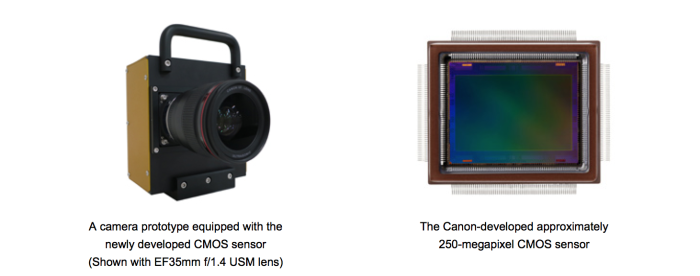
We got some additional technical details about that crazy Canon 250 Megapixel APS-H sensor presented by Canon on September 7. Harvest Imaging reports from the ISSCC meeting:
Hirofumi Totsuka of Canon presented a 250 Mpixel APS-H size imager : 1.5 um pixel pitch (4 sharing) made in 0.13 um technology node. The device is consuming 1.97 W at full resolution 5fps. An interesting build-in feature of this sensor is the following : ALL pixel signals are converted by column SS-ADCs with a single ramp, but in front of the ADC, each column has its own PGA that can be switched to 4x or 1x gain, depending on the signal level. So when the pixels are sampled, a first check is done to look whether the signal is above or below a particular reference level, and then the right gain of the PGA is set to 1x or 4x. Simple method, but I think that the issues pop up in the reconstruction of the signal at the cross-over point between the two settings of the PGA.
The camera prototype used to fit the new sensor was a mirrorless box. Wondering if Canon is going to use that sensor in a future “serious” mirrorless camera.
8 Responses
The “champion ” of this presentstion was the CMOSIS 391mp sensor.
Thats right, and it is impressive but Its actually a 3 x 6 array of 21,7 Mp sensors, making a total sensor raft that is 100 x 58 mm. I don’t know how wide the stitching seam is, but I would guess in the order of 2-8 pixel rows.
Conon is the leader???
Who’s Conon?
Conon the Boobarian
sorry?Canon, lol
1.5µm isnt that much.. most smartphones have sensors with 1.1 – 1.4µm. So even smaller sensor.. with an f1.8 – f2 aperture .. i think for apsh sensors the apertures will be the the same.. so you get a big smartphone picture.. wow..
There are small camera sensors with 0,95 µm on the way.
I don’t see the point of having that small pixels on a sensor that big. I doubt even the 4500 $ Zeiss Otus 85mm f/1,4 is sharp enough corner to corner to justify that. With more modest optics it probably wont make much sense with smaller then 2 µm pixels. Small pixels make SNR in each pixel small, resulting in small dynamic range. Thats the reason mobile phone cameras struggles so hard in contrasty situations, not their small sensor size or optics. Its the small pixels.
This is one of the reasons I hope the phone industry doubles up the cameras. One with small pixels for highest resolution in bright overcast daylight, one for contrasty situations like clear sky + shadows in daylight and evening/night shots.