








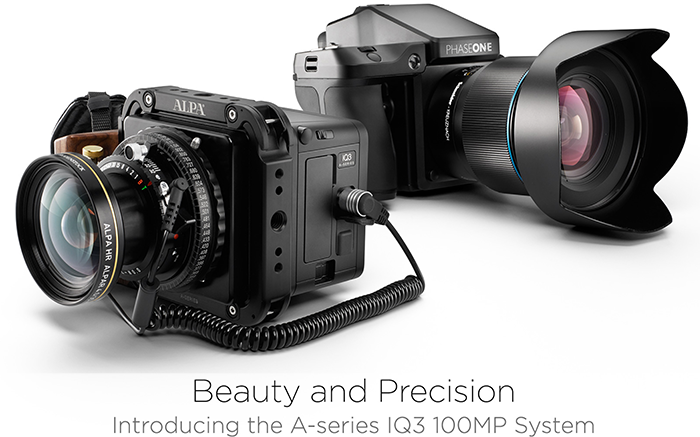
Phase One and Alpa once again joinced forced and launched the A-series IQ3 100MP System. This is the world’s first 100+ megapixel mirrorless camera. Prepare to spend $50,000 to get both, the Alpa camera and the Phase One back!
Full details at phaseone.com/en/Products/A-Series/Introduction.aspx
15 Responses
Just waiting for comments like : ” and I thought mirrorless cameras was about being small and light”
I agree!That ish drives me nuts! Mirrorless is not about the size. Size is a byproduct of not needing a mirror it’s not the reason for mirrorless. I like to refer people to this video showing what size cameras, jibs, cranes, and cable cam’s used to look like 20 years ago https://fstoppers.com/video/1990s-video-camera-innovations-promo-goodness-featuring-jean-claude-van-damme-8108
well yes and no. there are 2 different ways of thinking.
1. you are correct. there is simply no mirror. means it has little influence on body weight and almost none for lenses.
2, many mirrorless have a smaller sensor (not talking about the apsc or ff models) and for this crowd, body and lenses of mirrorless are smaler.
personally, I had a Nikon 1 system for exactly this reason: smaller equipment.
Except that this camera is an example where mirrorless really is smaller (which is generally the case for mirrorless when relatively slow wide-angle lenses are used). If you take the 23 mm (15 mm FF equiv.) and compare its closest equivalent the 28 mm f/4.5 for the Phase One XF (ie, DSLR), the 23 mm wins clearly by size (and is wider to boot) and the Alpa body is also noticeably smaller than the XF.
For stills, I sometimes used an 8×10″ studio camera in the field, carrying a heavy tripod, several lenses, film holders, etc. The Alpa/Phase One setup can produce similar quality without the backache afterward.
I’m just glad Alpa is still around. I have 2 of the SLRs.
What is the coiled cable for? It seems to connect the body to the lens(?)
Shutter synchronization with the digital back, I’m guessing, though I don’t know what it does. I think this is a tripod-mount camera mainly.
Steampunk cap-keeper.
To actuate the leaf shutter inside the lens.
It’s connected to the flash sync. It uses 4×5 lenses and much like using a 500c with a Phase Back, the back has to know when the lens is actuated. The easiest way to do that is to connect it to the sync post. The back does not actuate the shutter which is on the other side of the lens
There are two cables (of which only is actually coiled). One cable connects the shutter release button with the shutter in the lens and the second cable connects the shutter with the back. My first response was based on a different photo (on the Phase One site linked in this article) where only the cable from the shutter release button to the lens was visible.
You were mistaken. Just say that. Your explanation of why you were wrong just makes it worse.
Yes, I was mistakingly looking at/thinking of a different picture than the one Mikity was referring to. When Mikity said ‘cable connecting body with lens’, I mistakingly took that to mean the cable from coming from the camera body (not the camera back) leading to the lens. I had totally overlooked the word ‘coiled’.
The reason I did not say I was totally wrong and that one should disregard my answer was that the reason for both cables is the shutter is in the lens, that it is mechanically actuated and there is no provision in the lens mount to transfer the shutter button action to the lens. Once you know this, the reason for both cables becomes clear. Thus even if I did not provide the correct answer, my action still resulted in Mikity arriving at the correct answer to his question.
So, yes, I was mistaken because I had misunderstood Mikity’s question. My second post was to re-inforce that the reason for both cables is the same: that the shutter is in the lens and cannot be actuated via the lens mount.
That is 100 Mega Bucks.