








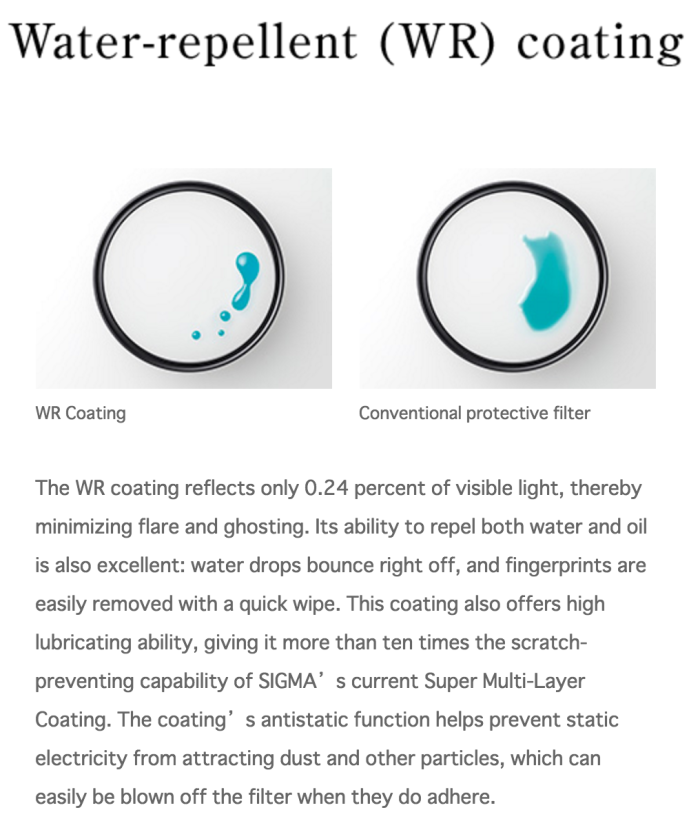
Sigma launched a new water-repellent and scratch resistant Ceramic Glass filter. This is the official press text:
Interchangeable lenses are the most important element of photographic expression, and to the photographer they are a valuable personal asset. To help photographers continue to use for many years the lens systems in which they have invested their time, knowledge, and budgets, SIGMA has developed original lens filters that meet the company’s high standards of excellence. In developing its new protective lens filter, SIGMA has leveraged an unprecedented cooperative relationship with a glass manufacturer, resulting in a completely new type of glass called Clear Glass Ceramic. Featuring this advanced material, the SIGMA WR CERAMIC PROTECTOR is a highly reliable filter with outstanding protective capability.
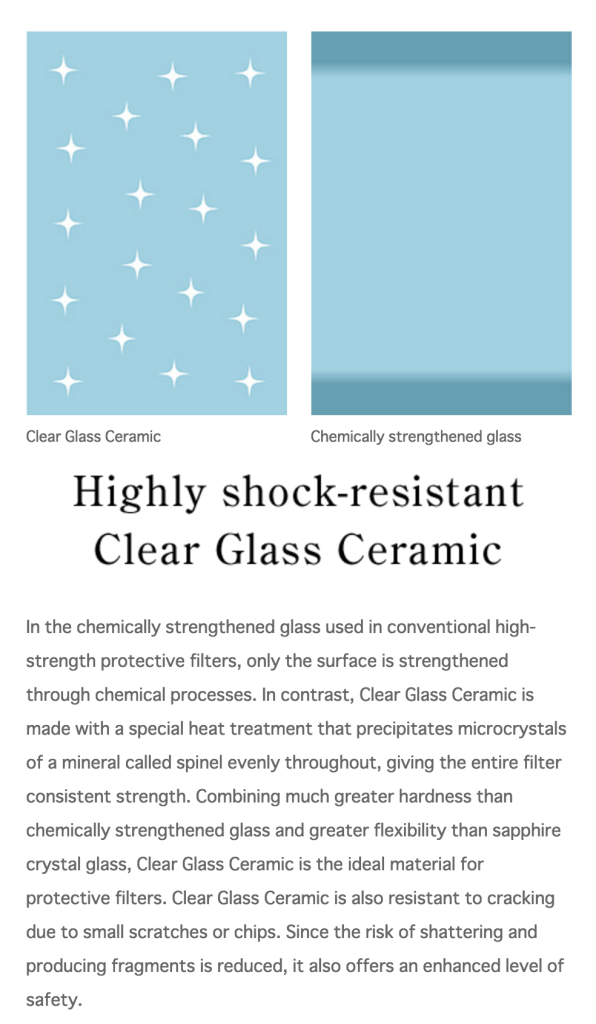
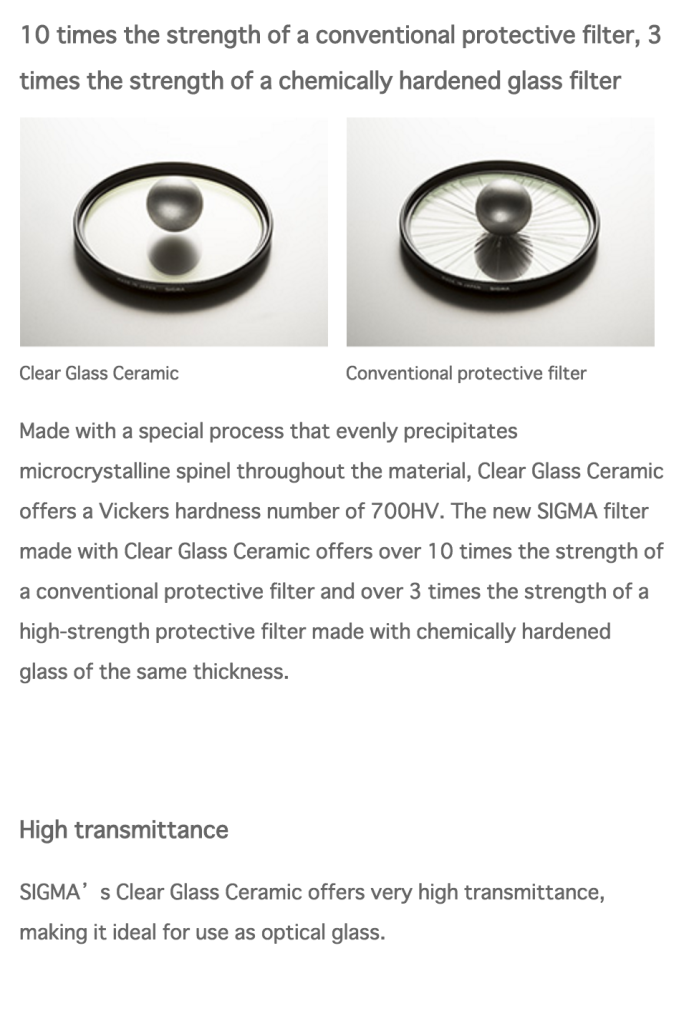
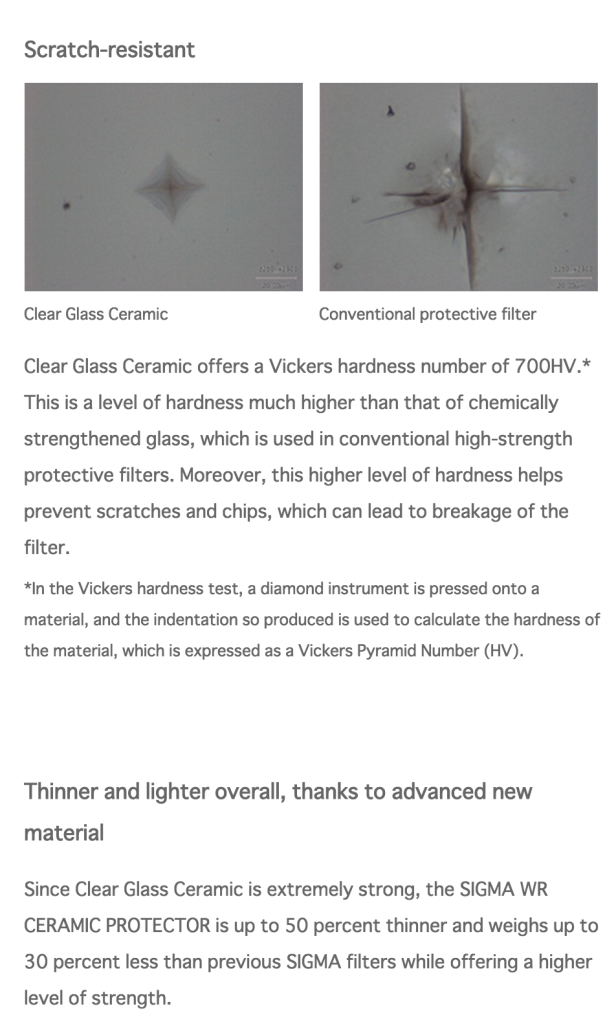
With many applications in aerospace and other industries, glass ceramic is an extremely tough type of crystallized glass that serves as the foundation for Clear Glass Ceramic. While featuring the high transmittance required of optical devices, this advanced new material combines greater hardness than chemically strengthened glass and greater flexibility than sapphire crystal glass. These qualities make Clear Glass Ceramic the ideal material for protective lens filters.
Source: Sigma Japan.

6 Responses
When it does break, how does it break?
Not into Vickers hardness numbers eh?
Err, not really? Does the Vickers Hardness number of 700 explain how it will break when it does?
There are infinite ways to break a filter. The vickers hardware number creates a mathematical control, so that breakage can be measured in a consistent way. Science much?
Uh-oh, looks like iPhone case theory has made its way to camera lens filters (‘protectors’). Now instead of a $30-$50 plastic or glass one, you can get a $199 ceramic glass piece for ALL of your lenses!
I am sure blazing Lazers did not know much about it either… Anyway, the Vickers number expresses the hardness of a material which translates in how much scratchproof it will be or its resistance to indentation. The failure mode i.e. breaking pattern of ceramics is very much similar to glass.