








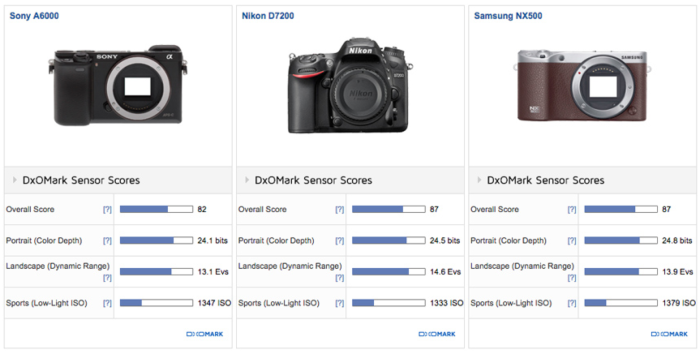
DxOmark tested the NX500 sensor and the results are impressive! It beats the previous leader the Sony A6000 by 5 points! Samsung really achieved some great results with their latest generation sensor. Beating Sony means beating the best sensor maker to date. I am now wondering if a performance like that will be enough to make the NX system attractive. Seems like Samsung has an “image problem” among the photographers community.
23 Responses
Looks like dxo is being stupid again. So, they all have the same ISO performance, which means the difference must lie within the Dynamic Range and Color Depth scores.
-Samsung is 0.8 points better than Sony and Nikon is 0.7 better than Samsung in Dynamic Range score
-Nikon is 0.3 points better than Sony and Samsung is 0.3 points better than Nikon in Color Depth score.
dxo itself says a difference below 1 point is barely noticable in color depth. So one being 0.3 points better than the other shouldn’t do much difference.
dxo also says a difference below 0.5 points in dynamic range is also not noticable.
So, Nikon should have a noticably better dynamic range than that Samsung and it shouldn’t be percievably behind Samsung in any other are. Yet they have the same score.
Also, the difference between Sony and other cameras would be the same in this case since it’s only 0.8 points behind them where it matters. Yet it has 5 points less in overall score.
Are they scoring simply randomly?
I agree with you 100%. The Nikon D7200 is the real winner here, with dynamic range that matches or exceeds full frame cameras. The others are nothing special.
It’s not an image problem…it’s an usability one… Samsung are the opposite of a Leica….which is the way it should be made every camera. Straight, simple, quick, direct, enjoyable…
The philosophy…less is more. It’s that they’re missing.
What are you talking about? Have you used a Samsung before? Samsungs are very enjoyable to use – menus are quick and laid out well (unlike Sony).
Samsung does have an image problem. They are probably the best value for the money unless you need a lot of lenses. But their NX system has plenty of lenses for an average nonprofessional. How many lenses does a nonprofessional need? Most people who buy a Canon rebel for example probably get only one or two more lenses.
I don’t know is they are enjoyable to use and if their menus are better, I confess that I’ve never used a samsung NX camera. Because i’m not interested in any model in the line-up… NX-1 is a technological flagship, but DSLR sized. NX500 is nice with the key features of his older brother, but expensive and without EVF (cf A6000), NX10/20 line shows average specs and are still bulky.
They have a very interesting lens line up, a wonderful sensor, a great AF, but they need to release a simple camera, really enjoyable for advanced users : something compact with an EVF. Otherwise, getting rid of the mirror is a little bit useless…Every other mirrorless brand has one or several cameras like that. Everyone except Samsung…
Something like a NX500 with an EVF in the corner (A6000) or in the center (XT10) :
http://camerasize.com/compact/#627,535,620,497,572,ha,f
I have to agree with Jake on this one. I’ve used cameras from every manufacturer (though, I confess, not Leica), and Samsung makes some of the best from a usability standpoint, at least in my opinion. Menus are among the best as well. I also agree they have an image problem, which is too bad. But they are starting to do firmware updates ala Fuji, so perhaps they can turn it around from a customer faith standpoint. I don’t shoot Samsung anymore, but I have really loved all the Samsungs I’ve tried/owned (NX300, NX500, NX Mini).
Canon still has the largest market share in interchangeable lens cameras. Sensor performance isn’t top priority for most people.
Because most people(or photographers in general) are locked in Canon ecosystem. If most people has to start from 0 right now, I don’t know how many people will buy Canon body. Their lenses are top notch though.
Bunk.
It is because Canon files look good no matter the bad DxO score.
Yes, dxo means nothing to me at time to decide my purchase. That org or whatever surely owns a very sophisticated sci base and blah, blah. But at the same time I find it’s a sophisticated marketing tool to give praise some brands. A good gear goes very far beyond those numbers and scores.
When I bought the Olympus E-P5 it was the last time I trusted DxO scores.
According to its score it was supposed to have a spectacularly better sensor than my beloved E-P2 at the time.
Instead, the files were impressively worse than the E-P2. Sure, there was less noise, but it is as if the later generation of M43 sensors are color blind. Engineers are just tweaking these sensors to cheat the benchmarks, and it is detrimental to the real-world functioning of the cameras.
I like the Sony approach where the sensor output isn’t really tweaked at all. Sure the A7II scores a lot less than the Nikon D750 on DxO, but I prefer the files like that. More color. Less digital look.
Sony fails on body design, now they fail on sensor design. Get yo @ss beat, Sony!
You know that if DXOsonyMark marks down a Sony sensor, Sony are in deep deep sheet
Or Samsung simply paid more. DxO is not a non-profit.
In the old days, Nikon had the image problem, of being a cheaper knock-off. Pentax was the department store brand. Canon… well… they were always second fiddle to Nikon. Only through decades of hard work did they become reputable brands. Samsung’s reputation of being the cheap brand is not unique to their cameras, and their corporate strategy of equating market share with success, even at the expense of profit, contributes to this. If the keep up the good work, still, they will earn our respect.
For instance, Volkswagen… wait… ummm…
People see Samsung as cheap brand because their sell good product for cheaper price. And it works. They dethrone Sony in TV business, sells more phones than Apple.
why doesn’t samsung rebrand the brand? seems like to begin with they could change the name or add a name like ” ____________cameras by Samsung”? They could license the name of a long-passed photographic system or make up a name that sounds more like photography and less like an air conditioner company who makes cameras. that would be a start
I’ve had the chance to work with some Samsung engineers and some of the management, and lets just say the ignorance of those management people reflects in their products.
They have no interest in using a better brand.
When making strategic decisions they usually miss half the point (or ignore it on purpose). It is like a rudderless ship.
Samsung is a company to buy equipment from if you don’t care too much and want to save a few bucks. You would have to be insane to invest in Samsung cameras or lenses for professional photography.
I’ve never worked with Samsung, but after living in South Korea for a couple of years, I trust Samsung a lot less that I previously had. It’s hard to pin down…
They may make a good product here or there, but I wouldn’t buy into their system.
After copying Sony’s NEX to become NX, could they possibly brand their camera line Lumitz or something?
They don’t care enough.
They have a design flaw, the flange distance is so big that it can’t take m-mount lenses.
I don’t think it is an image problem with Samsung. I think the main problem is a lack of system accessories including lens options that puts many photographers off. People don’t even have the choice of independent lens options like Sigma, Tamron or Tokina. This is what makes the Samsung system very restrictive for enthusiast photographers. For instance if you use long lenses, or longer macro lenses, there isn’t any dedicated option.
This is the primary problem for anyone considering a Samsung system, no matter how capable the sensor or camera. The primary mistake Samsung made was having their own propriety lens mount and flash interface.This meant that if they wanted to compete with the more established system, then they needed a massive array of lenses and system accessories.
I think the main mistake made, not just by Samsung, but by other manufacturers, say m4/3, is that they think they can just get away with catering for the most popular lens options, and system accessories, and ignore the less in demand other options until later. This restricts the amount of enthusiasts that will show interest in the system. Enthusiasts, either pros or amateurs, are the ones that take the impressive photographs, which influence other buyers. In other words, buyers say I want to take photographs like that guy. This is why Nikon and Canon sell so many cameras. If you look at the majority of impressive photographs taken by expert photographers, they will usually be taken with a Canon or Nikon. This is not to say impressive photographs are not taken or cannot be taken with other brands, but it is the majority which count. Look at any international photographic competition, and then look at the camera systems the winners use.
What I am saying, is that sure, many buyers will not be interested in many of the rmore specialist lens options. But unfortunately, the influential photographers, who take spectacular photographs, which other photographers aspire to, are often taken with more specialist lenses. This is why the influential photographers use the systems with most specialist options. There is no short cut to get around this.
I have NX300 and I have tested NX500 for a week. I can say NX500 have great sensor and it’s very capable camera. It’s a good step ahead and now it’s about 500 Euro with compact 16-50 lens. Oh yes – with good tilting screen I don’t really need EVF. Lenses like 30/2, 45/1.8, 85/1.4 have very good quality and value. What I need is good super telephoto and NX50.