







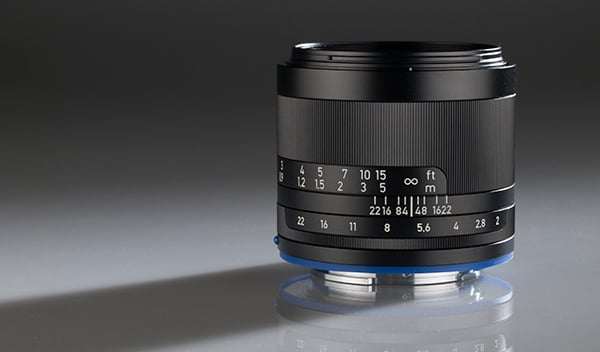
Image courtesy: DSLRmagazine
DSLRmagazine (google tranlsation here) posted the MTF graph along other test images. The Loxia 50mm shows “superb resolution” straight form the maximum f/2.0 aperture:
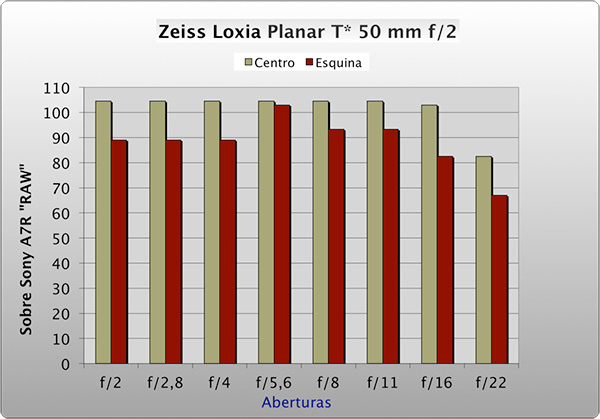
Interestingly DSLRmagazine noted there is chromatic aberration correction on RAW files.
Also Vignetting and Distortions are well controlled. The conclusion is:
The lab test not only confirms the good results on the field, but certifies the superb technical performance of this light, both in itself, and especially in combination with the firmware of the Sony A7 R
The next short review comes from Dirk de Paepe on Flickr:
I took this shot to demonstrate the detail rendering power of the new Zeiss Loxia Planar 2/50. IMHO, this comes very close to Otus (really, I see no difference with my A7r), although the Otus 55 is of course the superior lens, with virtually no flaws at no matter what aperture. The Loxia has some flaws, although only very slight ones that in most cases are very easy to correct in Photoshop.
This was shot at the minimal focal distance of 45cm (the ZM Planar has 70cm mfd), to see how much enlargement one can generate, when looking at 100% (next picture).
Regarding its price, size, weight and extra functionality, I can only say: the Loxia Planar is without any doubt a stunning lens! Once this line will be complete, I expect the Sony A7x/Loxia combination to outclass the Leica M system on (almost) all fronts – all that really matter (to me) anyway.
When looking at full size, this picture doubles the real life size of this money on my 27″ iMac monitor (surface x4) – this is to give you an idea of the detail enlargement in the 100% crop of the next picture. When you click on “View all sizes” and choose “large 1024”, this picture pretty much shows the actual size of the €50 banknote (140x77mm).
Zeiss Loxia preorders:
Zeiss Loxia 50mm f/2 Planar T* Lens for Sony E Mount at BHphoto, Adorama., WexUK, CameraPro.
Zeiss Loxia 35mm f/2 Biogon T* Lens for Sony E Mount at BHphoto, Adorama, WexUK, CameraPro.
Zeiss Lens Hood for Loxia 50mm f/2 Planar T* Lens at BHphoto and Adorama.
Zeiss Lens Hood for Loxia 35mm f/2 Biogon T* Lens at BHphoto and Adorama.
Zeiss 52mm Front Lens Cap for Touit and Loxia Lenses at BHphoto and Adorama.
Zeiss De-Click Key for Loxia Lenses (5-Piece Set) at BHphoto and Adorama.
Zeiss Rear Lens Cap for Loxia E-Mount Lenses at BHphoto and Adorama.
0 Responses
How come that a lens with only 6, all spherical, elements gets so good IQ?
Probably cause each elements gets extra attention
Smart engineering, better glass, more accurate grinding and polishing. Does it really matter if the end result is excellence.
Smart engineering?? That’s usual 6 elements planar just like ones produced 70 years ago.
it might have the same design but manufacturing has evolved dramatically over the past 70 years.
By your logic, the A7s should perform the same like a Nikon D700 but it’s not.
Nah, D700 and A7S sensors are even of different types: CCD and CMOS. Their pixel layout and elements are totally different.
Nope, It’s CMOS
http://en.m.wikipedia.org/wiki/Nikon_D700
still there is no reason they are so much similar
So if they’re similar, why is the A7s sensor much better then the D700?
they are not, except for pixel count. sensor in a7s uses finer fabrication process, at least.
whereas polish & grinding quality on spherical surfaces in lenses doesn’t really afffect sharpness
I guess you didn’t take account of modern day manufacturing allow tighter tolerances and better polish and grinding.
nah, the a7s is CMOS and d700 is ccd. their pixel layouts are not even remotely similar
probably better glass raw material and better glass extra ingredient
A very good lens indeed!
Fantastic lens!
Those test charts are incredible! Constant center sharpness from F2 to F16! That’s an awesome achievement and also a videographers dream!
Not have autofocus! HUlk smash!
Not have auto-aperture either (because ring on lens), so you can’t quickly focus at f/2 and shoot at f/5.6 or whatever.
aperture control is electronic.
you can actually choose between manual and automatic aperture
sorry bullshit it’s manual only, I mixed it up with the Zeiss Touit for Fuji.
Sorry, but it’s mechanical aperture. You can de-click it, and it sends EXIF to the body, and focussing auto-starts magnification. But the A7 cannot set the aperture on the Loxia.
According to Zeiss, the A7 family just don’t have the protocols to mix an aperture ring on the lens with an aperture set by the camera. Which makes me wonder how the upcoming 35/1.4 will work, since that has an aperture ring as well.
Sony will either update the firmware if the protocol can be achieved using a firmware or it will have it in the next gen (let’s call it A8…)
Not in the Loxia case as it’s mechanical aperture, so electronic won’t be able to move it.
From what I’ve read, apparently there’s a difference between electronic vs mechanical control aperture. Electronic would be something like the upcoming Sony Zeiss 35 1.4 and Fuji X lenses and mechanical will be like Loxia and manual lenses, though admittedly the biggest difference I find is related to the feel of the aperture click stops.
What is your source for A7 not being able to communicate aperture? Just interested, I didn’t hear that before.
One of the Zeiss guys at Photokina. Also…
http://www.dxomark.com/Reviews/Zeiss-Loxia-2-35-2-50-E-mount-Preview-Two-fast-full-frame-prime-lenses-for-the-Sony-a7-series
http://www.dpreview.com/forums/post/54319699
Also, think about it… If you set the lens ring to 5.6, then dial in 2.8 on the body, what happens? Does a motor in the lens move the ring? Do you have one device saying to 5.6 and another to 2.8, and if so how do you know which is right? If there was a position on the lens ring for “auto” or “controlled by camera” or some such, it would make sense.
The 28-135mm also has aperture control on the lens and that is an officially announced lens.
the upcoming 35/1.4 will likely have electronic aperture ring, similar to how Fuji X lenses work. Apparently some people hate those faux manual aperture ring feels, so they’re very happy with the direction Zeiss is going with the Loxia lenses.
I just hope the Loxia 2/35 is as good as the 2/50. Then I don’t have to worry about needing that enormous Sony 35/1.4. I will gladly sacrifice 1 stop of light for the compactness and stunning rendering of the Loxia.
I’m into A7 to get an affordable Leica-style experience. With the Loxias, Zeiss is delivering.
I agree with them about the feel of the ring. But sometimes on my Nex-6 and 35/1.8 I like to change the “effects in viewfinder” setting to turn off permanent DoF preview. Then I can set the shooting aperture to say f/4 and manual focus at f/1.8 for speed and accuracy, and the camera stops down when I half-press the shutter, pretty much like a DSLR. The Loxias won’t do that.
A lot of people won’t ever want to do that, they’ll prefer to see the stopped down version all the time. But it’s something to be aware of, if you’re thinking of a Loxia.
HUMK lacks brains! HUMK slash HUMK!
Hulk not slash, but smash your puny smartness about Hulk! Also smash autofocus-less lenses!
DSLRmagazine admits they apply corrections so their resolution results are somewhat boosted and more optimistic. I’d love to see their raw data myself. From what I have seen in Viktor’s arw files (at his dropbox, not verybiglobo site), the lens is truely sharp between f/4 and f/16 with the peak at f/8. This is more realistic, I think, more classical, in a good way.
How much was the resolution boosted? Also the correction was applied during raw processing so how are Viktor’s arw files any different?
I don’t think any correction is applied to arw-files in the camera. A7 routinely sets flags “Vignetting Correction” and “Lateral Chromatic Aberration” to “Auto”. This means that image processing software is recommended to apply it when opening the files IMO. I don’t know what ACR does by default but darktable, for example, ignores those instructions and always applies default sharpening. Since we don’t have DSLRmag’s original files, neither description of their development procedure, we are free to guess.
What kind of corrections can be applied that are going to boost resolution? You would have to make up missing data, or simply record incorrect results.
Corrections exist for things like vignetting and chromatic abberation, but not resolution, as far as I know… not without stacking frames and interpolating the missing data.
Depending on how they define resolution, CA correction may increase it. I got suspicious because there is an obvious change of overall contrast in loxia 50 between f/2 and 2.8 which is not shown in the test results so something is different with interpretations. The only guy who does it properly is Roger from lensrentals who tests optics, not software, and even his results are relative to his setup and batch of lenses.
How close you can focus with these lens ???
45cm
With the camera cooking the raws and the “reviewers” post-processing the images, this test is about as laughable as it gets. Lens tests now including the Photoshop skills of the tester. What a joke.
Spot on John but the Sony boys will either ignore your post or attack you for pointing out reality to them .
He was attacked by upvoting, right. We’re not blind, BobTB.
What does that have to see with “Sony boys” (whatever that means)?
who cares if the result is good. Mdern cameras apply ll kinds of corrections, noise reductions and other stuff to raws.
By the way the review says the lens is good with and without corrections, so there is no problem.
I’m curious to know which modern camera does NOT apply corrections to RAW. Cause the last I check, even Leica has build in correction for their lenses.
Yes Leica has as well, and that’s great! The result is all that counts for me. We’re having digital cameras and do digital post processing, so why not improve the output in the camera itself where the process belongs? I’m not willing to do all the stuff in post processing, got no time and patience for that.
Before the Loxia I still wasn’t impressed with the A7x but this may well be what pushed me over the top.
My wallet would advise caution- lens buying gets exciting again if you buy an a7x…
Tell me about it! I’m tapped out so I don’t have to worry about making the wrong decision.
I would so buy this if it was at f1.4 at the least. For being over a thousand, I just can’st justify buying an F2. Not to mention its manual.
And another speed junky with no clue. Just get the mitakon speedmaster 50 0.95 then, choice is yours and it’t also cheaper than 1000
I don’t need it. I already have a MF 50, I don’t need another one.
If you’ll pardon me, I’ve been shooting a project in the British Museum for 15 years. It gets down to -5 EV in there. Some people do really have a reason to want fast lenses.
Exactly
Would you still buy it if it’s larger, heavier and more expensive?
Yes I would. I buy alpha a mount lines for the camera at the moment. and you know how expensive those are.
Well probably you’ll have to wait till Zeiss completes the Loxia lineup and then only maybe they’ll create fast lenses for it (1.4 and such), though it’ll likely be manual focus only.
I’m waiting for native lens right now. The A-mounts on my camera are a pain to use. They look cool on the camera, but all the AF don’t work well on it.
Then why are you complaining?
You would not buy because you would find another flaw… It doesn’t come in pink.
Then get the ZA Planar
I WAS planning to get it, but after using the 16-35 2.8 on my A7 with the adapter, you lose out on a lot of the AF features. You’re stuck with what the adapter allows you, which is mostly all center point focusing. So in the end, why can’t I just wait until they release a fast one? I don’t even need a 50 right now as I’ve got a few different versions, but if there is a need reason I will upgrade and that reason is to have a fast AF version of the 50 on the E mount.
Well, considering Sony is coming out with a gigantic 35/1.4, I’m going to assume that a similar 50/1.4 or even 50/1.2 is among the remaining items on the road map.
You buy the Loxia for the way it renders, not because of fast aperture or price.
I would really prefer buying the Sigma 50mm f1.4 Art. 2nd best lens in the world for FF next to the Otus and not that much more expensive then the Loxia. But f1.4 and aperture control by the camera. And every A7x user should already have a LA-EA3 adapter or the Metabones for Canon EF mount… MF is the Loxia anyway, so no disadvantage for the Sigma…
Pretty sure the FE 55 is better in every regard other than AF than the Sigma, and it’s bokeh is kind of ugly. Also those lenses are HUGE. I’d never want to use that with an a7x
I use Nikon 50-1.4 and 50-1.8 with adapter and it performs the way I want, I do not think or believe that this Loxia will perform better. And, I paid less than 100$ for each of those lenses. If you have to focus manually, better seek for a 50-1.8, 1.4, or 1.2 in ancient lenses you can use with adapter. For a Grant you get a 1.2 and a free meal at the restaurant included in the price.
To Dan:
Me too! There is the A7 and the A7 after Loxia! I will sell my Fuji X-Pro and switch to A7 + Loxia Planar!
This morning my new Zeiss Loxia 50mm has arrived form Germany. I am not smashed by enthusiastic vibration to see this lens in my hand however I like to report, that this lens feels very solid and definitely as a pro-quality product.
Looks very dandy on my A7 cams and frankly I am going buy 35mm Loxia as well no question about it.
Next week I will test it on location and in studio as well with my Elinchrom lighting system.
This is a ridiculous notion and idea of testing. (simple shot of banknotes) Test the lens for flare, against high contrast situations, field curvature and a host of other situations tell the real value of a lens. Even the very high performing (resolution) Zony FE55 does not perform like an Otus when the conditions are against the lens. The Otus is spectacular and worth the size, weight and price because it can do what other lenses can’t do in the same set of conditions. The same goes for the Otus 85 and Apo-Sonnar 135mm.
Wow! Finally a 1000$ manual lens for Sony!! (sarcastic)