







Note: The following is a review from Cinoflex (cinoflex.com and Facebook) and T M Camera Solutions. And it has been first published on SAR. Images copyright from Cinoflex (please do not reause them without permission).
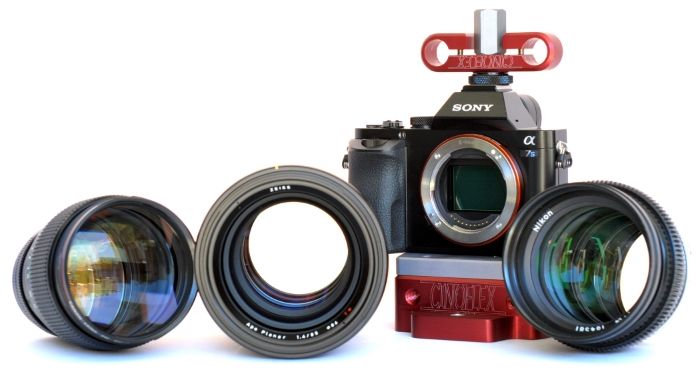
Cinoflex tested three 85mm lenses on the Sony A7s.
Cameras and Lenses used:
Sony A7s (here on [shopcountry 29368])
Cinoflex Camera
Zeiss Otus 85mm (here on Adorama, BHphoto, CameraPro.)
Nikkor AIS 85mm (here on [shoplink 29369 ebay]eBay[/shoplink])
Canon FD 85mm (here on [shoplink 29370 ebay]eBay[/shoplink])
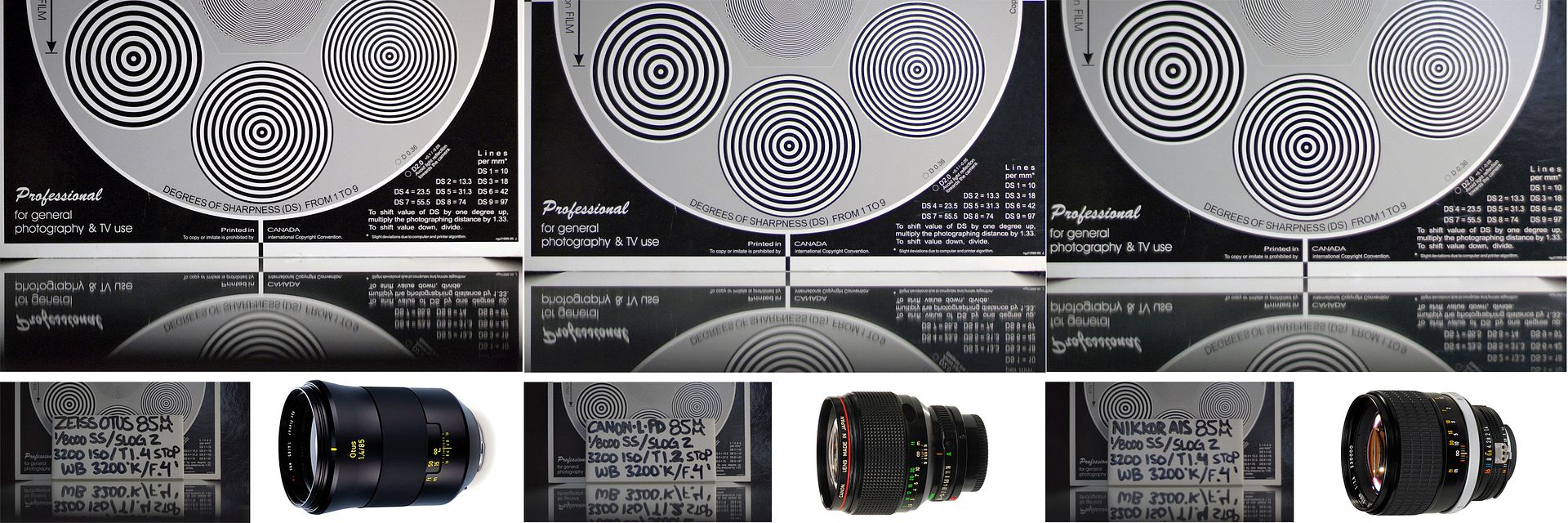
Here is a first comparison showing the performance at full aperture (Click on image to enlarge).
Here is the reviewers text:
This lens really is as good or better than you have heard. The technical aspects live up to all the specifications and quality touted, but the real impressive element is the pure characteristic and personality.
The fall-off is truly magnificent. Just a beautiful immediacy to the range and fall-off when shooting at T1.4, sharp images in focus, and very gentle images out of focus.
The Otus 85mm T1.4 is built to a supreme standard, and you can feel that throughout each contour of the barrel, the elements, and the highly precise mechanics.
The most astonishingly, and obvious factor for the Otus vs. the Nikkor AIS and Canon FD “L” – 85mm – lenses, is the CLARITY. The Otus 85mm is so clear and precise. The glass really blooms under bad conditions. The reproduction is so accurate hat you be surprised, even by the Zeiss standards.
The Zeiss Otus 85mm T1.4 lens presents qualities and elements that combine some of the factors most desirable in today’s cinematography culture, all in one tightly machined and perfectly presented package.
Look at the tests below. See for yourself!
Links to the three larger images:
Otus chart JPG (Click here)
Canon chart JPG (Click here)
Nikkor chart JPG (Click here)


Bokeh with the Otus and A7s
Cineflex note:
Lenses are designed by different manufactures, for different uses, and different markets. To label one lens better than another is silly. Each lens displays characteristics in line with the intention of the manufacturer. At CINOFLEX we test lenses to create an analysis of character and personality into which each lens fits the creative design of a project. The 85mm OTUS is a great lens, period. But the Nikkor AIS, or CANON FD L lens is not inferior, the Panavision Primo lens is not better, they are simply different. When reading reviews that constantly profess the absolute “FACT” that one lens is better than the next, this could not be further from the truth. Keep in mind, most tests and endorsements are created by individuals who are not professional camera technicians, nor IATSE 600 ICG members, making their qualifications very suspect. Respect the tools of cinematography and use tests to find the lens that you think is best!
Any questions or comments please contact us @ INFO@CINOFLEX.COM
CINOFLEX and T M CAMERA SOLUTIONS in all publications and social media.
0 Responses
I love Cineflex’s note! Fabulous! 🙂
Hello from Cinoflex
Thank you Vivek
We just believe that comparing one lens to the exact function of another is somewhat fruitless. Each lens serves a function. We love the Canon “L” FD 85mm 1.2 lens, but we believe it has certain characteristics that we find pleasing. The OTUS, is also very pleasing, in a different way. We can say that we’ve probably shot every feasible 85mm lens on a
production (PANAVISION / ZEISS / COOKE / CANON / NIKON / ETC / ETC /
ETC) so we have a good idea of what each does. IN-N-OUT has great burgers ($2.65), but so does Comme CA ($28.00), which is better? They are different!
SEE MORE TESTS ON OUR FACEBOOK PAGE:
https://www.facebook.com/pages/Cinoflex/151047361682392
Why are they not comparing the Sony lens? Oh wait…they don’t have one!
All they have is a good sensor… they should stick to just making sensors!!!
They have a complete DSLR system like all big boys, and there they have the perfect Zeiss 85 f/1.4
You can buy a complete photography kit for the price of that one lens!!!
Canon’s is more expensive
Which they tested those lenses on my eos-m. My eos-m beats down the a7. My nikon j camera would pair nicely with that otus . People act like canon and nikon dont have awesome mirrorless but they do.
Please stop that nonsense …
Dude… you’re embarrassing yourself… please get some help…
Or use it as a first payment on the Otus…
I wonder why too. But they do have one. I have one. It’s the SAL85F14Z. It’s arguably the best bokeh in 85mm lenses, well, before the Otis.
None of these lenses do T1.4, it’s f/1.4 and they all have transmission loss. I assume the word THIS refers to the Otus but that isn’t clear above. The whole thing seems very haphazzard. Are we missing some text?
Equally well this could be a review of adapters.
There is a reason why none of the serious photography reviewers make tests like that one.
Hello from Cinoflex
This was a review for the Otus lens, and some different options in the same focal length. The adapters that were used were Fotodiox. An adapter needs no review, by the pure fact that you are seeing an image of an OTUS lens from a Sony A7s Camera, proves the function and utilization of the adapter. Flange is set by the measurement of image-sensor to the rear element, thus an adapter is purely a mechanical tool to facilitate the exchange of lens mounts. At Cinoflex we take all lens and shooting tests SERIOUS, and have performed this task on more than 140 feature film (PREPS) for the last 16 years, without compromise. We believe that our tests are SERIOUS and quite proficient in all aspects of lens and manufacturer specifications.
SEE MORE TESTS ON OUR FACEBOOK PAGE:
https://www.facebook.com/pages/Cinoflex/151047361682392
“Otis”?
Redding.
and samyang??????
Who buys the Canon 85 f1.2 to shoot at f4?
Hello from Cinoflex
All lenses were shot at maximum aperture, the Canon “L” FD 85mm 1.2 lens was shot at 1.2. At Cinoflex we shoot all lens tests at maximum aperture to see the true character and personality of the glass. You may be reading the slate incorrect, the focus point of convergence is 4 FEET = F 4′, not aperture F4, but focus at 4′.
SEE MORE TESTS ON OUR FACEBOOK PAGE:
https://www.facebook.com/pages/Cinoflex/151047361682392
Alpha Happiness is a Minolta Maxxum 85/1.4. Always makes the client smile.
Don’t be Sony… Be Happy!
How about the Minolta G D Limited …… That thing is a beast !!! only like 700 made but still someone should compare I bet its a worthy otis rival.
Well it’s not readily available for purchase or available period so comparing it is more academic than useful.
Actually that Bokeh sample was pretty disappointing. Am I the only one that Onion rings and weird shaped bokeh balls?
they compare the Otus with a more than 30 years old Canon FD85mmL……….
Because it holds up very well, even by today’s standards.
As a Canon FD 85mmL’s owner, I need not save money for this new expensive heavy lenses. Cheers.
Hello from Cinoflex
We compared the Otus, yes, to a 30 year old lens, as well as a Panavision Primo, that is 17 years old and a 48 year old Cooke I Speed pancro lens. The age of the lens is irrelevant, the image the lens produces is the only factor to be discussed or examined. As a side note, we have shot the Canon “L” FD 85mm 1.2 Lens on many a network television show, and big budget features, it is a wonderful image making device. Again a lens is a tool, and every project needs the right tool. Aside from all that, we personally love the Canon “L” FD 85mm 1.2 lens!!!!
SEE MORE TESTS ON OUR FACEBOOK PAGE:
https://www.facebook.com/pages/Cinoflex/151047361682392
Yes, finaly!
Age of a lens defines nothing, it is irrelevant and totally ambivalent to any test and or comparison. The Panavision Auto Panatar 50mm T1.4 HS Anamorphic lens And 55mm Auto Panatar T2.5 Anamorphic Lens were produced almost 45 years ago. This lens has been on more than 400 critically acclaimed motion pictures, and shot the most powerful actors on the planet. Less than 4 exist, and it is easily one of the most sought after lenses used by cinematographers in the digital cinema culture. It is old and vintage, but the glass renders an image that is unmistakeably gorgeous!!!
Panavision lenses pictured below, used by Cinoflex staff for the last 35 years.
Age of the lens means nothing. Stanley Kubrick shot nearly every film with the Cooke Series I Panchro lenses. They were produced within a gamut of 60 to 40 years ago. Today in 2014 those images stand up on a 40 foot screen without compromise ! ! !
RESPECT——————————————————————————-
Just shot a wedding with an A77II and an EP5. So like, first off- the pics were awesome. I mean, after a few weddings I”m starting to nail it. A77II performed admirably. Only problem is I’m a prime guy. Weddings and primes don’t mix to well man. I had 4 bodies on me and used the 135mm 1.8 the most- cause like it’s gold. Total pleasure to use the A77II. I chose it over the A99 as well. Now it was outside on a beach around 5pm. If it was inside- well, another story for another day. You can’t take it above 800 IMO anymore than the A77 could go above that. I shot at 100 ISO the whole day. Ok, maybe 400 one time. Anyhow, I’m really enjoying the camera as a rental since Sony didn’t come out with my A99II this month. Oh well.
What’s the purpose of putting a 35Mpx-resolving lens on 12Mpx camera?
Also, Otis is an elevator brand.
That’s what I asked myself as well. By the way: The Otus resolves much higher than “only” 35 MP (about 100 MP according to other measurements, where a 200 MP sensor was used instead a 36 MP sensor…).
I can follow the point of view of Cinoflex in terms of lens characteristics. In cinematic applications, the lens’s individual character is an important parameter. And in that case it is adequate to test on an A7S.
If maximum resolution at open aperture, neutral bokeh, consistent sharpness accross the frame, apochromatic correction, smooth focus operation etc. are important, the Otus simply blows away all other 85ers.
“About 100 MP according to other measurements” – are you talking about your colleagues from Switzerland lenscore.org? I was always wondering what kind of sensor are they using… It should be some kind of a scanner-based “digital back” most likely. I also like their website, but I can’t find anywhere across internet any kind of information about them, and they don’t seem to be very popular, so I can’t tell anything if their scores are credible or not. Their sharpness ratings are somewhat different from the DxO ones. I understand 200Mpx is a much higher res than 36Mpx, but it’s a logical assumption a sharper lens on a 36Mpx sensor should be also sharper on a 200Mpx one, unless they measure the optical characteristics on a different aperture (they claim ~100Mpx @ f/3.7 for the 55mm Otus).
For cinema use, resolving 12mp is more than enough.
Not necessarily. Very few productions are shot on FF35 sensors, so something in the neighborhood of 12mp (or greater) on an S35 or APS-C sensor is needed for a 4K finish. For wildlife (especially birds), it’s nice to have the resolution and detail to crop in post when your longest lens doesn’t get you close enough. The sharpness needed really depends on your personal tastes as a filmmaker and the subject matter you’re shooting.
12Mp on FF sensor is just not enough to judge lens performance. The Canon looks as good (except slightly noticeable CA) as Otus for much lower price, weight and dimensions.
what is not clear is which canon 85 mm lend it is ?
there are 2 of them 85 mm 1.2 and 85 mm 1.2
the link above points at a canon 85 1.8 though we see 85 L on the picture,
all this is confusing so which one is it ?
The photo shows the FD 85 1.2 L. So ists this lens for shure.
Thank you!! A very interesting comparison, I have been waiting exactly for this! I am pretty impressed (and happy, because I own one) that the 30 years old Canon stands up so well against the Zeiss. The Zeiss is the clear winner and seems amazingly sharp. I suspect that Canon’s slight falloff is partly caused by the thicker lenses due to the larger opening that costs some sharpness and causes some more purple fringing. But then again: Hey, you’ve got f1.2 with the Canon 🙂 And the price difference…. 😮
I see f’n onion rings in that bokeh pic. Wake up tester! or get some new glasses man!!
nFDs and FD Ls do seem to have a better reputation than old FDs and the newer EFs. Something about the hand ground aspherics…
Canon “L” FD Lenses, great review by Ken Rockwell, before these lenses were discovered by 99% of video shooters. At Cinoflex, we have 8 sets of these Canon FD “L” lenses in every mount, We are currently out of stock, because they are so pleasing to some people.
This post confuses me.. is it Otis or Otus? Because I see it written both ways in this post..
Otus
This is Otis. http://wac.450f.edgecastcdn.net/80450F/kxrb.com/files/2014/01/Hal-Smith.jpg
What a ridiculous post.
Comparing 3 lenses – one new, two old.
None of the lenses tested on native mount, and the Sony lens isn’t compared.
Half way through a panavision lens is suddenly mentioned, but doesn’t appear anywhere else!
The side-by-side comparison image is super tiny – worthless.
Apparently it’s a review for video purposes, but no sample videos provided!
Again, supposedly a video review but no mention of t stops, and mistakes f stops for t stops.
“Each lens displays characteristics in line with the intention of the manufacturer” – but doesn’t tell us what those characteristics are!
I could go on for a lot longer. What a pointless pile of ****. It’s junk like this that makes me consider taking this site off my adblock whitelist.
How many breath mints does one need to get rid of the onion ring bokeh of the Otus. This is an embarrassment for a $4500 lens. Perfection paid for Zeiss. Perfection expected.
Yeah, not sure why that’s the case too. Although, I’ve read a lot of Zeiss reviews and it seems like a lot of their lenses have that onion Bokeh there… not sure why…
Because they don’t use a process like Panasonic to finish the ASPH elements. If it can be done for cheap lenses surely Zeiss can erode their margins to fix this. http://www.imaging-resource.com/news/2014/05/02/the-end-of-onion-ring-bokeh-panasonic-beats-the-curse-of-aspheric-lenses
Let’s wait a new competitor to come end of this year. Meyer Görlitz is in business again, they showed at Fotokina the new 80/1.8 and 85/1.4 lenses to be sold end of this year and both are lower than 1000 euros, (950 and 985). We will then see how they perform against the high priced challengers. Andrea, try to contact them and see what’s about, they have a contact link on their site. I have no idea about mounts, there was no information so far.
Lenses
are designed by different manufactures, for different uses, and
different markets. To label one lens better than another is silly. Each
lens displays characteristics in line with the intention of the
manufacturer. At CINOFLEX we test lenses to create
an analysis of character and personality into which each lens fits the
creative design of a project. The 85mm OTUS is a great lens, period. But
the Nikkor AIS, or CANON FD L lens is not inferior, the Panavision
Primo lens is not better, they are simply different. When reading
reviews that constantly profess the absolute “FACT” that one lens is
better than the next, this could not be further from the truth. Keep in
mind, most tests and endorsements are created by individuals who are not
professional camera technicians, nor IATSE 600 ICG members, making
their qualifications very suspect. Respect the tools of cinematography
and use tests to find the lens that you think is best! CINOFLEX ULTIMATE
85MM Tests will be coming soon. thank you.
If it is the way to make conclusion, fail to see the value or the so called “tests”, “review” or comparison by your team. Everyone know every lenses are different.
I got my OTUS 85 two days ago.
you find first images in my flikr album with the OTUS on the A7R
https://www.flickr.com/photos/dierktopp/sets/72157648057411871
including shots with the Leica APO-Summicron-M 75/2
The less than full size images are irrelevant.
try it again, I just loaded some full res images
BTW: I know terms, that sound a bit more polite, but that is not my problem