








No guys, Megapixel madness will never be over. Hasselblad just announced a new H5D 200c camera which is an improved version of the H5D 200ms which sells for $44,000 at BHphoto (Click here…if you are rich). The camera uses the Sony 50MP medium format sensor and has a unique feature which allows to take 200 megapixel pictures! This is how it works according to Hasselblad:
The H5D-200c MS camera uses a 50Mpix CMOS sensor mounted onto the Hasselblad patented symmetrical multi-shot frame, which accurately positions the sensor with a sub-micron accuracy using piezo-electrical actuators. It can capture 6 shots with the sensor positioned accurately at a sequence of quadrants of the pixel and takes color information from the Bayer-patterned pixels to create a 200Mpix capture. This results in a leap in resolution that has to be seen to fully appreciate the tremendous difference it makes. Be prepared to be impressed beyond your expectations.
The sensor moves 1 and 1/2 pixel at the time, to create a 50 or 200 megapixel capture. Here is an image that shows the difference between the different shooting modes (Click on image to enlarge):
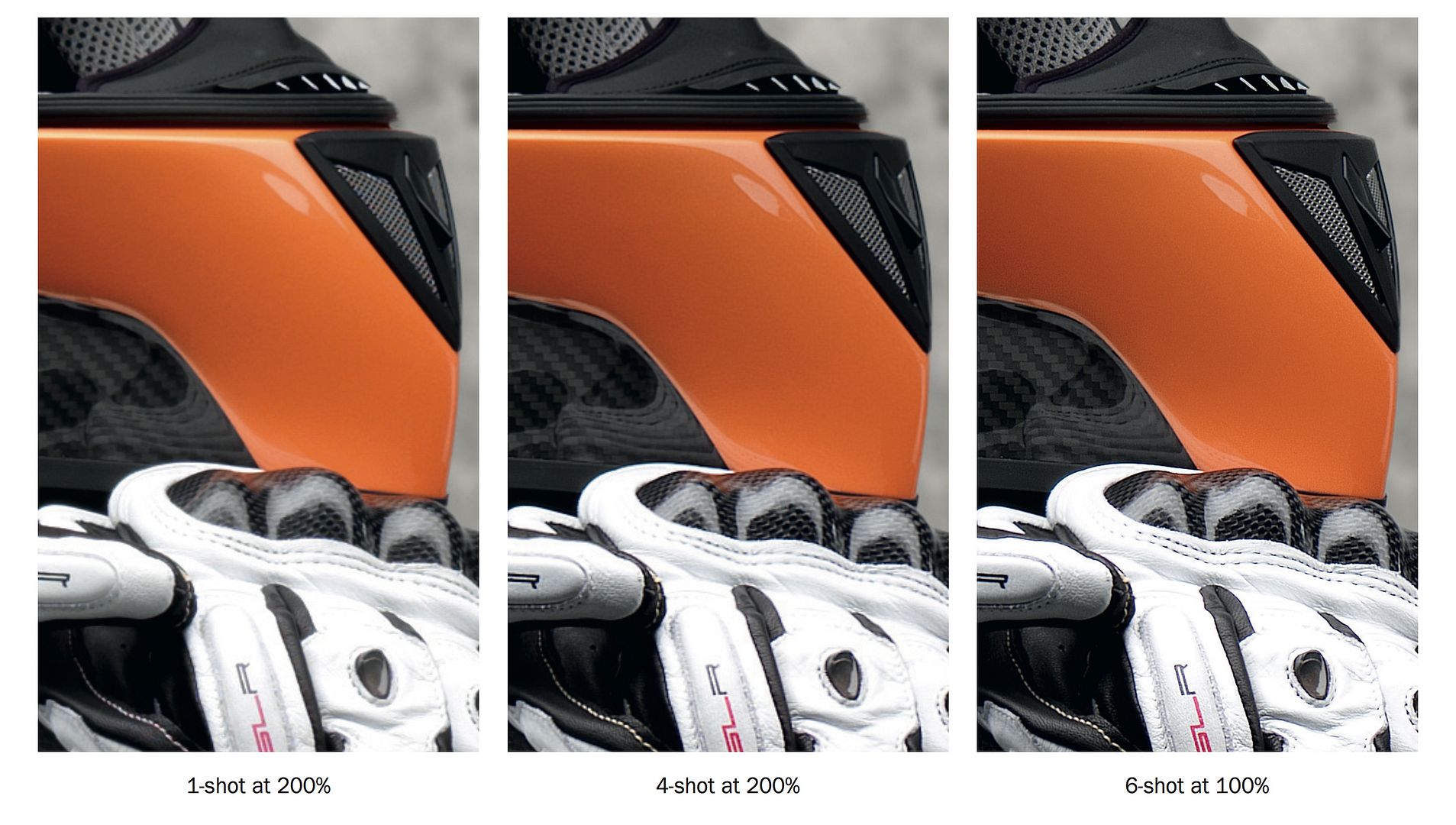
The full technical info can be read at Hasselblad site.
—
Hey Sony, just for fun, why don’t make a 20-shooting mode to give us 1 million megapixel images? 🙂
0 Responses
I saw this on peta pixel the other day, many were complaint that the 200mp photo files are only 8-bit. It’s never enough.
As long as people who have no idea what they are taking about are able to type and operate a web browser, you will be right.
Oh that would be enough for me, never enough – for some people (with a camera they will never use).
“Based on the 50 Megapixel sensor (6200 x 8272 pixels with a dimension of 32.9 x 43.8mm), the H5D-200c MS offers 1, 4 and 6-shot capability. 6-shot will produce 8 bit TIFF files at 600MB each resulting in the most accurate colour rendering and resolution available on the market today in the medium format. Versatile capture with up to 12 minute exposure time. 100 to 6400 ISO. Image raw size is from 75MB with a 16 bit colour depth. Colour display is a 3 inch TFT type, 24 bit colour with 460 x 320 pixels resolution.”
It looks smart but it will work for static subjects only. But it is goint to be usefull still.
I wonder how DxO is going to fake-analyze this one, so fake experts can argue about it?
Sony should acquire the pixel shift tech from Hasselblad and build their sensors in strong enough bodies to make use of it.
Unsharp Mark +200% Done~
This idea was discussed the best part of a decade ago by a bunch of us on the dpreview forums when Minolta produced the 7D with IBIS. Could you use the Minolta IBIS system for sub-pixel shifting and multiple image capture – basically the answer was yes but sadly minolta weren’t reading…apparently. In essence sony already have this tech and its more likely that they (or minolta..whichever’s got the patent rights) licensed it to Hasselblad .
This isn’t first time Hassy released MS camera. They’ve had several MS backs – so no, it isn’t Sony’s tech
Thank you.
Yes, This is not Sony’s tech. Sony just makes the sensor. All else (the shift) may be made by Hasselblad, formerly Imacon.
I believe Phase One and Leaf also had similar backs not too long ago (making 16mp into 40something mp captures or something like that)
I believe it was actually Sinar.
Reverse to AA filter using sensor shift? Smart!
This should work best with lenses which outresolve sensors.
How could they patent this? Aaton already did this on the Penelope Delta.
It’s the technical implementation that is patented, not the general idea (you cannot patent ideas). That’s why we often see posts here about a new patent for e.g. a 18-50 zoom lens.
What difference does that make, they have built a digital cinema camera using that technology obviously there has been a technical implementation before.
“Why make trillions when we can make … BILLIONS?”
Here you go Barry!
Do I want it? Wooow, for sure! Do I need it? No… 🙁
I’m stumped – which camera did they reskin this time?
You’re not stumped, you’re stupid.
Sense of humour transplant required….
Order immediately ;)….stocks will be soon empty…..will be a legendary Hassy……H5D the last generation of Hasselblad Digital Backs…only Phase One and Pentax are surviving…the latter the phase one for the poors;)…..like fuji it is for leica…;)
Always smile…..;)
Um isn’t this possible by every camera that can shoot multiple exposures? I do this when I scan my slides!
Isn’t is possible that your analogy is completely non nonsensical and only serves to display your total lack of comprehension!
http://blog.almalence.com/tag/superresolution/
Ignore the idiot below. Yes, even more alarming is the fact that you could use an A7R, buy a “multistitch” plate and a cheap toyo large format 4×5 camera and have 130MP files. The cost would be 30 times less. Cheaper options are out there.
But a A7r with this tech combined with multistitch plate will give you 520 mp files! If you need it…
I don’t need it but I sure as heck want it.
Neg – That would just allow you to increase your field of view at a given focal length.
Keep up.
🙂
I’m not following dude. Your increasing resolution when using a LF and multistitch- not field of view. Explain your math.
You’re increasing your resolution AND your field of view. Stitching would be like using MF instead of FF whereas the Hasselblad would be more like using a D800 instead of a D3.
and if one doesn’t care about bokeh, they may use just regular stichted panorama.
errr admin… 20 shot mode on a 50mpx cam would 1,000 megapixels, not a million… so a gigapixel.
I can only imagine how awesome cat pics would be with this one.
CatsByBarry
its the moving sensor by such a tiny amount, wonder how quick it does it.
can’t see it anywhere on their webpage. I would assume the multi-shot mode works up to the highest 1/800 s shutter speed. This means 1/133 s for 6-shot series and 1/200 s for a 4-shot mode. Not very exciting.
Hey! I am sure A77m2 can move it’s sensor the same way! Sony! Give us ultra-megapixel mode for A77m2!!!
Give us the XAVCS codec via firmware update first!
Well, I am totally happy even with MP4.
Bit of a strange view this post: moving sensor is not Sony technology, as this post tries to imply.
Besides those who say Hasselblad is inferiour to P1,
check on http://www.thephoblographer.com/2014/04/22/review-phase-one-iq250/ to see a miserable review with mostly unsharp pictures. I think the reason is because P1 still is not able to provide a proper autofocus. The best sensor and all the super features are just crap if it’s not focused perfectly, especially in this class of resolution. Hasselblad Truefocus alone is worth to buy this camera.
You mean the 645DF. There are Phase backs being used on other bodies, you know. Like Hasselblad H4Xs.
50000 ahahahaha thieves thieves folly folly
Real value of this is 1500$ aahaha folly and thieves
As an owner of a simple 50 megapixel H5D, seeing the results is beleiving, sharpness, resolution and dynamic range are awesome – there’s so much to work with. If anyone remembers moving from 35mm to medium format, its much like that, issues that drove me crazy, finest grain film – best fine grain dev – increasing tonal range etc, became irrelevant. This particular camera will only be useful for still photography – fantastic for shooting artwork or product that needs incredible sharpness and colour fidelity. The other point is that for all the dough spent on the camera, its actually a very simple design, controls are basic, only whats needed, it only shoots RAW, the lesson being that no amount of distracting electro bling will make a better photo, its the, sensor, camera optics and the photographer that makes the difference.
Just another point re the H5D, Hasselblad make their own photo finishing software for the camera called Phocus, the equivalent of lightroom only better as its keyed into the camera (it can be used on most camera RAW files). The interesting thing is that Hasselblad recognises that a to use a contemporary digital camera properly, the software that processes the image is equally as important as the camera.
The idea is well known and is called superresolution.
http://en.wikipedia.org/wiki/Superresolution
And you’re going to see similar ideas on cellphones too (turning camera shake into higher res images by taking several images then determining which ones are close to half a pixel apart and using those to make a superresolution image).
And as others say it has nothing to do with the sensor or it’s maker.
200 Mp!
BarrybyAnimals, where are you! 🙂
it’s not a 200 mp sensor, the method used won’t resolve as good as it was 200 mp sensor. BTW the method used is already available for Android phones (misalignment is due to be handheld, not sensor-shift):
http://en.wikipedia.org/wiki/Superresolution
Didn’t you see my Smiley? 🙂
And why do you assume I don’t know that Hassy is using the Sony 50 Mp CMOS sensor? That’s written on the second line in the article!
Still, 200 Mp achieved with this technique is of interest for some. How do you know that AnimalsbyBarry isn’t one of them? BTW, such techniques have been used long before Android.
Finally, the link you gave is already provided by Kevin Purcell.
However, the good thing with your post was that I discovered I had misspelled the nick of Barry, which should have been AnimalsbyBarry (hope I got it right this time).
Sorry for that, Barry!
.
Or you can have multi-stitch plate with Pentax Q mounted on it, which would give you 500 megapixels
Completely different.
Why? Just because big & expensive is always better?
No. Completely different because you seem to be incapable of grasping how the 200MS actually works.
The difference is like having a 12MP D700 and a 36MP D800. No change in framing. If you stitch, sure – you can take 12->36, but only because you’re increasing the field of view at that focal length.
Surely the concept isn’t THAT difficult to wrap your head around.
I know how it works. It is a form of deconvolution. All small details from 4 subpixel shiftx12 mp picture will be a lot noiser than from picture taken with 36 mp sensor, because the math involved amplifies noise.
When stitching frames taken with smaller pixels, no such math involved.
Would this ki d of sensor moving tech be useful for combating difraction offects on smaller sensros that are already difraction limited?
If so, than maybe waiting for the global shutters and combining it with this tech would produce high MP pictures at shorter effective exposure times.