







BCN (found via Dicahub) posted the market share data for the camera sales in Japan during the first half of the current year. There is only the info about the market leader of each category (not info yet about the 2nd or 3rd place and so on). Here are the leaders:
fixed lens: canon (25.8%)
dslr: canon (56.9%)
mirrorless: sony (36.4%)
video camera: sony (39.8%)
photo frame: sony (38.2%)
As you know in Japan the Mirrorless market is just as big as the DSLR market. And it’s likely to growth faster than the DSLR market the coming years. So it may will happen one day: Sony surpassing Canon in the system camera world?
0 Responses
They already did in Korea didn’t they? Or was that for total market share?
Yes, sony has around 50% market share of mirrorless cams in s Korea and China, at least in 2013. No reports of 2014 yet.
This is what I was talking about:
http://www.sonyalpharumors.com/korea-sony-sells-more-system-cameras-than-canon/
They are not “leading” the camera market they are leading the mirrorless market in Japan. To put the numbers into perspective till the end of May this year Sony has shipped 114,479 units { 36.4% of mirrorless sales in Japan} meanwhile Canon has shipped 297,692 units { 58.9% of DSLR sales in Japan}
Yes, but what has that got to do with what I was talking about?
Also puts another figure I read recently into perspective, Panasonic have ‘ramped up’ their supposedly ridiculously popular GH4 to 5,000 units per month being manufactured, that is for world wide distribution…. and clearly a drop in the ocean compared to what Sony Canon and Nikon are moving.
The numbers posted are for all Sony mirrorless cameras in their entirety the GH4 is Panasonic’s top tier model and lower down models such as the GM1 GX7 etc will sell in far higher numbers. What do you think will sell more the A7S or the A6000
Yes, lower tier models sell better… what is your point? GH4 has been a big hit for Panasonic yet still only moving 5k a month globally compared to what, 115k units Sony mirrorless sell in their domestic market. It is interesting, that the current ‘darling’ of Internet talk around mirrorless is moving such small numbers is the point. I only mention the GH4 because there is lots of talk about it currently and that figure (as a point of reference) was recently touted. Goes to prove that for all the internet talk the high end is still not what moves units, for all the complaints whenever a ‘low end’ model is released and everyone decrys that whatever company releasing it isn’t listening…
Actually, according to BCNRanking, GH4 is selling less than A7s weekly base. Consider A7s is newer than GH4, but not much newer, the sales figure between GH4 and A7s would be more or less same in long run.
Looking at the chart for the last couple of weeks neither the A7s nor GH4 even feature in the top 80 selling cameras in Japan. This is no real surprises as these are basically video orientated devices and both are niche products.
http://dslrphoto.com/dslr/space.php?do=jranking
In the USA while the A7S is 4th on the CSC list , the GH4 is listed in the DSLR category and when you actually look at the overall all digital camera list the GH4 is 34th on the list with the A7s is in 67th position
http://www.amazon.com/s/ref=sr_pg_1?rh=n%3A172282%2Cn%3A!493964%2Cn%3A502394%2Cn%3A281052&ie=UTF8&qid=1406060071&ajr=2
what is PhotoFrame ?
It’s a digital frame for pictures.
Do people still use them?!
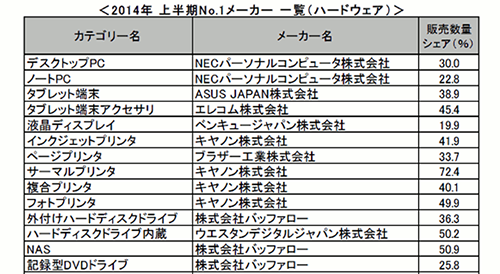
According to the original BCN article yes. However, the pasted table is the wrong one.
Another mildly interesting fact: Sony leads in the 4k TV category (64.9%). Seems like their high end strategy is actually working.
“As you know in Japan the Mirrorless market is just as big as the DSLR market. ” umm according to CIPA 62% DSLR, 38% MILC – not sure how that translates into “just as big”.
Now , lets not let facts interfere with a good story lol Sony’s 36.4% of mirrorless is only 13.8% of the overall interchangeable lens market. I think the reasons that Canon & Nikon are the only camera divisions making money are down to 2 reasons Firstly DSLR sales are still very dominant worldwide { between 75-80% of interchangeable camera market} secondly with the decline of Sony DSLR sales , the end of Olympus FT, Pentax no making any real inroads the market is basically owned by Nikon and Canon
The fact is that mirror-less cameras have appeared only 6 years ago and they have began being competitive only in the last 2 or 3 years. So, I am not sure what is expected here to be able to say that mirror-less are doing well.
Also, I think Canon and Nikon having most of the market doesn’t have much to see with the-mirror less vs DSLR argument, i.e. it doesn’t necessarily reflect interest (or lack thereof) in either DSLR or mirror-less.
Because it’s quite possible comparing “mirrorless” vs DSLR is a misleading segmentation, fostered by many of the manufacturers themselves who failed in the DSLR market (Olympus, Sony, Fuji).
True, the original mirrorless vendors, skunked as they were in DSLR sales, tried to proclaim the sour grapes self-aggrandizing marketing meme that mirrorless is the future.
These are all just digital cameras with interchangeable lenses, more similar than they are different. Consumer response has been mixed, so there is no clear market segmentation for that matter.
I think this is becoming manufacturer vs manufacturer. Who will survive? The established players have a broad product mix (Nikon, Canon, are right in the mix with mirrorless and DSLR, whereas all the other vendors are basically all-in on a sink or swim segment they created on their own).
Internet people like to fight over silly differences. Big end or little end. This is more about brand and market survival of high end enthusiast cameras than it is about less important marketing differences such as format or viewing. They all take fine shots. Yeah, I said it.
I think the segmentation does exist in the eyes of the users. If you want a smaller camera, a camera to adapt lenses on, an EVF etc. the only way is going mirror-less (with a few exceptions).
Can’t really disagree with you though. However, if we do assume that segmentation, then I am sticking to my previous post.
My main point: We like to say “DSLR” vs “mirrorless,” when what we are really saying is “Canon and Nikon” vs “everybody else.” My question is, is the distinction in the market more on the brand side than it is on the “Am I using reflex viewing or a tv to see my subject.”
No doubt individuals and readers of this site have their finer distinctions. But my speculation was on the consumer market as a whole, not on the discriminating expert.
Hmm, that was pretty much my point too. To answer your question, I believe both distinctions exist, but they shouldn’t be mixed up, which is what is happening, hence my first post above. Basically, we can’t judge how well mirror-less is doing overall vs DSLR (the level of interest it sparks) based on the market share data we have. Because the latter is simply number, which don’t really take into account brand awareness, previous investments in the system, time elapsed, feature differences etc.
Growth percentage? DSLR 80%, mirrorless 120% (same period last vs previous year)
When you start from selling 1 item per year, selling 3 the next year gives you a 200% growth increase. But you still only sold 3 units. You don’t make money on growth percentage, you make money on unit sales x margin.
It’s the unit sales (volume) percentage for May 2014.
Call me confused- first you compared growth percentage, now you are saying unit sales percentage.
Yes : 120% of unit sales of May 2013 for May2014. Isn’t it a growth?
growth percentage of nothing is still nothing. each month DSLR’s dramatically increase their installed base over MILC variants. in every region and every country. that means more potential for lenses, accessories, used and refurbished items, etc,etc and also repeat business. 99% of the users using cameras don’t decide to “switch to something new” every year if they see a new shiney.
1.2mil unit for 5.4mil global is nothing for you? (Jan-May 2014, only for ILC).
DSLR is losing ground to mirrorless cameras every year.
That is only for ILC. Does camera with built-in lens count as mirrorless? (I don’t think there is a mirror in a bridge or compact :/ ) If it does, mirrorless are 2 times the volume of DSLR (10mil units vs 4.2mil).
compact cameras have never been considered MILC cameras. go bark up another tree with that one. camera phones don’t have mirrors either – want to include them?
DLSR may be losing round (so far this season) however keep in mind that both nikon and canon have yet to do their big releases for DSLR’s this year, with sony and other’s already blowing their load already. nikon and canon aren’t shipping a vast amount of new cameras into the supply chain, Most MILC’s have been as they have done significant refreshes this year.
I’m only looking at the numbers, I’m not a pro-MILC ou pro-DSLR. I only want to take good pictures with my cameras 😉
And FYI, A7 family is a compact full frame camera according to Sony and CIPA 😉
To answer your initial post, yes MILC market in Japan is as big as DSLR market:
Shipment Japan (May 2014):
DSLR : 58,694 (51% of May 2013)
MILC : 47,845 (108.9% of May 2013)
shipment worldwide (without Japan, May 2014)
DSLR : 912,670 (75.2% of May 2013)
MILC : 210,725 (111.6% of May 2013)
The only region we see a shipment decrease in MILC and DSLR is Americas, all others have about +110% increase in MILC sales/shipment and about -25% decrease on DSLR sales/shipment vs last year.
That said, the trend seems to have switch from “change DSLR” to “change lenses”. The only market growing is the lens market.
DSC (ILC/DSLR/compact) sales are diving every year (more than 50% less every year !! that’s a lot! ). And in this category, the MILC are the only one that progresses (see the numbers above).
I’m not saying “DSLR ARE DEAD!11!!!11” or “BUY MILC!!11!1!!”, it’s just a change of trend in the use of the cameras, like you said : people buying more lens and stuff.
lol .. you look at one month to determine a market? oooookay.
CIPA considers it a Camera with Interchangeable Lens – non Reflex. one month cannot set a trend. MILC has been pumping this tire for the last three years and has yet to make significant global inroads.
It’s the same trend for Jan-May 2013-2014, I was only comparing vs previous year, not the may 2014 numbers alone. And the year is not finished, I can’t compare the whole year yet 🙂
Want to compare 2012/2013/2014? You will see that MILC share is increasing and DSLR one is decreasing.
In japan, MILC sales are nearly 45% of all ILC sales/shipment. Previous years it wasn’t even a 1/3rd of the sales/shipment.
In Europe/Americas, it was 1/10th of the sales/shipment (2012/2013). This year it’s about 1/5th or 1/4th.
The biggest user of MILC is the Asia region : nearly 50% of the production is shipped to Asia.
But I will stop here, it’s boring now 🙂
If you look at just numbers – in May 2014 DSLR – 58694 Mirrorless – 47845 or mirrorless selling 81% of DSLR sales
Yeah Japan has a thing for the same and portable.
Great stuff Sony. You are on the right track…
Oh noes all teh Sony mounts are dead!
Does this mean we will get more good value lenses etc.?
There were an awful lot of pull-ahead sales in Japan just prior to the big sales/consumption tax increase, and increase that will continue to add on.
Let’s see the numbers for the second half of this year.
Also, I question that the mirrorless market is just as big at the DSLR market.
Would really like to see the second through fourth place manufacturers in each category, and their percentage. That Canon and Sony dominate in their segments is hardly surprising, would like to see who is coming up and how close (or far) the competitors are.
I would be interested to see all the numbers for mirrorless too. Its interesting Sony is now above Olympus who were around the 100k mark last year. In other comments Panasonic might be derided a bit but they have never been too far behind in 3rd. While Fuji has never made enough sales to make the charts it would be interesting to see if they have grown and eaten into the mirrorless share of either the nikon 1 or eos-m.
the table image shown has absolutely nothing to do with this article. It is showing market shares for computers and computer peripherals.