







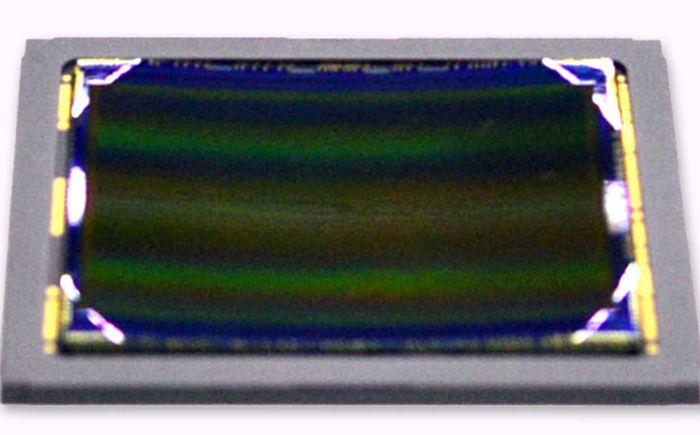
Image courtesy: Sony via Spectrum.
What you see here is the first image of the Sony CMOS curved sensor! Sony says they create a unique bending machine to curve it and after that they use ceramic to stabilize the sensor. Interesting: The sensor has the same level of curvature found in the human eye!
On a curved sensor light rays will hit the corner pixels straight on instead of obliquely. The lens doesn’t have to use extra lenses to correct for distortions, vignetting, aberrations in corners and other issues. Therefore you can pair the sensor with flatter and larger aperture lenses. Curved sensors are 1,4 times more sensitive in the center and 2 times more sensitive in the corners.
Sony showed a 43mm (Full Frame) and 11mm (for mobile devices) curved sensor at the 2014 Symposia on VLSI Technology and Circuits. And as we reported earlier on SAR the Full Frame curved sensor is likely to come on the new RX2 paired with a 35mm f/1.8 Zeiss lens! Exciting tech!
0 Responses
If the rx2 had a 50mm 1.4, I’d have a hard time saying no…
I expect we’ll have to change all the lenses we own once That new tech coming in next cameras 2015 /18
Make me think twice before buying new gears
the ironic thing is maybe lower quality lense will perform better, I mean those which had soft border haha while high quality lense with high sharpness everywere accross the frame will suffer from soft border 😀
Well, I think at the moment, it will be limited to fixed lenses, but maybe in the future there will be an adaptative curvation of the sensor according to the lense ?
wow, thats a good news. Does it use same lens as plane sensor?
did you read the article or just the headline?
It uses a much smaller lens.
“The lens doesn’t have to use extra lenses to correct for distortions, vignetting, aberrations”
Curved sensor to match your curved phone, curved TV, and of course, the curved Banana~!!!
Well, in the short term it will probably mean almost nothing for us consumers. Even when the lens designs become cheaper, they’ll still have to sell the camera for a high price to collect the R&D costs.
It’s an exciting development nevertheless.
but maybe it will mean a faster lens, better lowlight, smaller size and less weight?
Yeah probably. But I wouldn’t expect any quality jumps. The cited values for improvements are definitely best-case results that can only be obtained in the lab. I’d expect something about 50% of what they claim so maybe 0.2 stop advantage in the center and 0.5 stop advantage in the corners in a real camera.
In 25 years we will say, “do you remember ……”
It will mean a lot to “us consumers” if it produces a truly pocketable RX-2.
I always thought that this is another of those “patent-only” things which will never be built, but stay on paper forever… I’m impressed!
Well, actually everything that gets patented normally gets built at least once. Otherwise the patent might not work at all.
Sony built an Curved Sensor, but they dont have any lense who fits this sensor and dont have any proof that it actually works the way you expect it to work.
For me its the same like all thos other crazy patents like flip-up mirror on SLTs and so on.
you really think they can’t calculate and simulate this with computers?
You didn’t read the source did you?
Yes they do..the patent is for a special 4 element.35mm f 1.8 apochromat lens…a variation of the old symetrical apoc uhh romatic desighn.
The patent also describes this as a BSI sensor therefor this could possibly be an extremely high res sensor as the first ff exmor T.
Oh wow. Let it have MPix, the AF of the Alpha 6000, a good framerate (5 fps) and I will forget about any E-mount camera.
Sadly, I don’t think global shutter will make it’s way to such a product yet. Hence, I already see myself buying another camera two years later…
WTF is an Exmor T?
And yet someone still invented the light bulb…Go figure….
I have a strong feeling we’ll see it in the RX2.
Ummmm what if this new tech allows Sony to put a f/1.8 lens on a even smaller package compared to the RX1? Omg…or imagine a 35mm f/1.4 lens on a sensor capable of at least ISO204K or even ISO409K???? Hello new low light street photography fullframe ultra compact champion. If it does have same price or even lower price compared to RX1, I’m In. No need (at least for me) Sony to update the 35mm F1.4 G or even release a Zeiss 35mm for A-mount.
I’m also in if it is a Zeiss 35mm f1.4 FF compact.
So you shoot street photography now with a 35/1.4?
I believe 24mm is too wide and 50mm is too long. Have found myself using 35mm (from the SAL2470Z) more than my Zeiss 24 distagon and zeiss 50 planar on my a850 (that’s a big camera). F/2 is okay in the RX1 but sometimes you want to freeze a certain moment without pushing ISO too high… So yes, I would shoot street photography with a 35mm f/1.4.
I’d love to see a 40mm f1.7 (ala the Minolta Hi-Matic rangefinder)
I already love my new curved tv flatscreen from samsung bought for the WM Football Cup Brasil…highely recommended love it much better than common flats….
Sony RX 2 is highely preodered if it will be announced will replace my m43 portable system/travel camera…..
Excited…..;)
Please at photokina 2014…….???
I don’t understand this curved TV thing (fad?).
It’s all very well if you’re directly in front of the TV, but what about people who are seated a little but off to the side? Surely the picture looks an absolute mess to them.
This and even right in front of the screen it looks a bit odd. The image in the corners is slightly closer to you than the rest of the image, which is not something we are used to. Things get bend out of shape a bit on a curved screen.
Theoretically, a curved panel mitigates differences in viewing angles because even when you’re ‘off axis’, your line of sight will still be perpendicular to the screen. That means that you might use cheaper technologies which are inherently more viewing-angle dependent (no idea if it makes sense given that adding curvature to a panel probably adds considerably to the price as well).
I can’t say if it practically makes much sense as i haven’t seen one yet…
Had a look at one. It only seems to work properly if you are positioned at the radius of the curve. If you are left or right. Or forward or back. It starts looking weird. great if you are a gamer sitting in one position..Not so much if you live with other people… Think it will end up like 3D TVs…
My brother had a set of electrostatic speakers. By far the best sound I have ever heard from a speaker if you sat in the exact right spot, Otherwise they were good but nothing special. He eventually got a very good pair of conventional speakers that had a much wider good area. Curved screens seem to be a similar tech. One great spot.
Great for guys who are all alone because they spent all of the families money on anything they market to them.
It’s just Korean companies (LG+Samsung) found a new way to sell new and more expensive existing product, that are now inconvenient for watching movies with your familly. Seems that the trend is to curved things, like the curved Korean smartphone wtf? Maybe they’ll make camera with curved LCD haha.
Well only curved sensor makes sense!
curved things you say? That is as old as humanity, as much as I know. Do not hink bad now, I mean bananas. 🙂
My Banana is curved too…
Not just a mess, Slightly blocked. But the cattle buy anything they market. Its why mcdonalds food actually sells and people even feed it to their kids.
Too bad they are curved opposite directions… You better not look at images you take with your curved Sensor RX2 on your Overpriced Curved screen Samsung (That only has a good view if you watch TV Alone in the center of it but marketing works well on cattle like you). It will suck you into a vortex or black whole or something.
THIS is the future. For all digital sensors.
OK thanks Nostradamus.
human evolutions isn’t proof enough? If a flat sensor would be better we probaby had flat eyes with very thick lenses 😉
Different thing entirely. Human eye has a “simple” one
element optical design. (actually far from simple, but still with limitations).
Much greater optical corrections are built into camera lenses.
Don’t worry, if the lens loses strengh, we will buy monoculars to rectify, hahaha
That is because the computer in our brain corrects for all the distortions the eye records. And that is the future of digital photography undoubtedly.
LOL it doesn’t 🙂 look how many people have focusing problems and wear glasses/contact lenses (well, brain does correct SOME aberrations)
Of course, no amount of processing will properly compensate for an out-of focus image. An out of focus image is not distortion, but something else.
The brain has some very powerful corrections. Firstly, it compensates for the inverted image on the retina. That could, of course, by hard-wired, but it turns out it isn’t. Experiments have been carried out with people wearing lenses which invert the image again (so it’s now “the right way up”). Remarkably the brain will compensate after a week or two. Also, the brain compensates for curved lines at the periphery. That’s a natural feature of the eye, but anybody (like me) who has had a major change in prescription for myopia will, for a day or two, note that door frames look curved. After a while, things are returned to normal. Then there’s that other remarkable feature of the brain’s optical processing whereby we get the impression that we have sharp focus across a whole field of view when, in fact, we only have sharp focus over a small part of our vision.
To this, you can add the eye’s ability to detect movement in the periphery, automatic colour correction, edge detection, auto-focus and much else.
LOL it does since focusing problems are not distortion corrections. Brain corrects a dramatic amount of aberrations (first off, we see upside down and the brains corrects for that; second we seen falling verticals just as the wide angles do but the brain corrects for that, third – the brain acts like a automatic white balance and corrects for all the faulty colour lighting we have in our homes). Focusing is done by the eye muscles itself and cannot be corrected by the brain just as the sensor and processor inside a camera cannot fix a non focusing lens.
If you could see, and if they showed you all about what the future will bring us, they have 30 years advance on what we know and see.
That’s nice and all, but will it have an integrated viewfinder? Should be no reason why a “lower-end” fuji x100 has a viewfinder, but “high-end sony rx full frame” doesn’t..
Possible, RX1 is anyway not a superstar when i comes to pocketability, so making is a bit more voluminous and including a viewfinder must be possible. For sure an external EVF at a reasonable pricing would do the job as well if it helps to make the camera smaller. Where I have doubts is doing a 35-1.8 lens, the one we had on RX1 was not a small thing, what handicaped pocketability. We will than have to buy low down jeans with monster pockets to carry that thing, 🙂
There is an external viewfinder available, it connects to the hotshoe.
that articulating viewfinder is amazing though
Ironic the photo of it is so, so poor
The curved sensor would have improved it.
What s the advantage to the adjusted microlenses featured in the RX1? One way or the other you are ‘bending’ light – and why should a curved sensor be more light sensitive? Because less lenses are needed to correct incoming light rays – or what? Marketing gimmick like the supposedly more light sensitive BSI sensor technology (never seen a proof of that)?
You also didn’t read the source did you?
The whole idea of a curved sensor is to correct for the field curvature of the lens. The problem is that in some lens designs (Zeiss 16 70 f4) if you focus in the center, the borders may be out of focus due to field curvature. And, if you focus on the borders, the center may be out of focus.
This slight OOF issues is what results in corner softness. The curved sensors are supposed to clean that up. No level of adjusting micro-lenses will fix field curvature issues.
Having the light hit the sensor at less of an angle will help sensor performance but this is more about making it easier to design a good lens than improving sensor performance. A lens design has to trade off size, cost and how well it corrects for distortions, CA and vignetting. A curved sensor will greatly improve the corner performance of the lens and reduce distortion without increasing size, weight and cost. The optical design can concentrate on improving resolution instead of correcting for distortion, coma and curvature of field.
“The sensor has the same level of curvature found in the human eye!”
If this is a 24 x 36mm sensor it seems to have considerably less curvature than the retina of an eye. It also appears to be only curved in one plane.
No I would say that it is about right by the looks (I guess it depends how large a portion of the curvature they are mimicking)…. Also looks to be curved in both directions to my eye..excuse the pun..
It is probably a part of the curbature of an eye, do not forget that our eye has an angle of sight of +190 degrees from which we see about 90 degrees in clear all time and 11 dimensions of the 26 dimensions that form our matrix of perception inside the cube of dimensions. All other dimensions do not exist as long as we do not turn our head. I think much more that we have here a simple adaptation of the sensor to the curbature of the lens to get all over sharpness from edge to edge and corner to corner.
I asked often at exhibitions why they do not curb the sensors. They answered that this could only be achieved with a fixed lens or complete individual lens parks matching this kind of sensor. Such a technology could pierce the market if all manufacturers do the same, build sensors to a basic curbaure and precise specs. But, since every manufacturer has his own mount and his own technology, this could be used in the future to make lenses that fit only one system and will make it much more difficult for hybrid lens makers like Sigma or Tamron to cover the market. If every camera company choses to use this technology with a different angle, we are sucked in some way. On the other side, if we see how fast Canikon are to invent and introduce something new, we will probably stay with one single innovative company for a long time.
No, we most certainly do not see 90 degrees clearly. That’s an illusion. The area of acute vision is that covered by the macula, which cover about 15 degrees. The rest is “peripheral vision” and of much lower resolution and optimised for different things (like movement detection).
What we perceive as our relatively wide angle of acute vision is just an impression formed by the brain.
The very first camera I used had a curved film plane – a
Kodak Brownie with roll film running in a curved track. I think it was designed
that way for better performance from a very basic one element plastic lens.
Ok .. Since I consider myself as a tech lover more than photography lover.
I think by the end of 2015 I will be sitting next to a trash can in NY
Interesting. You’ll be, all of the sudden, the subject of countless crappy amateurs thinking they are doing a story on the city but actually they got no balls to photograph anything but people they feel they got power over.
“My Story: How I went from photographer to the one being photographed.”
by ViRuS X
So one future day such amateur decides to make a photo of a poor dirty homeless man sitting next to trash can, but SUDDENLY that man takes out curved sensor camera, shoots him instead and then proceeds to upload it to internets with that new intel superthin tablet.
Amateur dies from fatal lower back pains.
Lol .. Yes 😉
Sounds like a better story
Sounds plausible.
I already have A99 – A77II – A7 – A7R with ton of lenses.
If someone took a photo of me sitting next to my new home (the trash can) I will hit him with one of my cameras in the head.
Since I’m broke with no electricity and I can’t recharge battery :/
No A900?? Anyhow, would you consider that A7R you have to produce better pictures than that A99? Have you used it with say- with the 135mm? If it isn’t to awkward I might pick up one.
Yes , A7R produces sharper images with less noise in higher ISO settings, but I get more keepers in A99 because of better AF system and tracking (since I mainly photograph birds).
For landscap, portrait and still life photography A7R would be a better choice.
And Yes again, A7R with 135mm looks bulky and not balanced, it’s a matter of taste anyway.
I’m fine with the bulky look of A7R with FE 24-70mm F4, my friend didn’t like the size of this lens and he keep the FE 35mm F2.8 attached to his camera only.
I don’t see why curved sensors are 1,4 times more sensitive in the center? Shouldn’t be any difference in the center, right? Here and there it is flat and angles 90° to the light beam
I was about to post the same thing. From the description it sounds like Sony is not planning to put microlenses over each pixel. That might make the sensor a little more sensitive but not 1.4 times as sensitive. Maybe the 1.4 number is just the usual marketing hype.
Still, good news for people want a fixed focal length camera. I would never buy a camera with a permanently attached prime lens but do resort to using my cell phone when it is all I have. The real market for this is cell phones. And they need all the help they can get.
Correct. If–and that’s a big if that I’ll get to in a moment–you have a matching lens over a curved sensor, telecentricity of light into the sensels should be good enough that you don’t need microlenses. However, note that microlenses don’t just deal with telecentricity, they also deal with light that would fall on non-light gathering parts of the sensor. The Sony sensors are good, but they don’t have a 100% fill factor (e.g. all light gets to a light gathering area).
Now, for the if: when you match a lens with field curvature to a curved sensor, you need perfect alignment, lest you reintroduce non-telecentricty. Most of the camera companies have been doing one-axis alignment (center only; Nikon does multi axis alignment) on both lenses and cameras with built-in lenses. You really need to know that not only is the center of your curved lens/sensor combo is aligned, but you also need the lens curvature of field to be aligned to the sensor’s curve, which means you need at least two more axes of alignment in manufacturing.
The RX1 lenses and bodies were already adjusted for at least 2 axes down to less than a micrometer.
It is explained in the original Spectrum article:
“the strain induced on a CMOS sensor by bending it alters the band gap of the silicon devices in the sensor region, lowering the noise created by “dark current” — the current that flows through a pixel even when it is receiving no external light.”
So basically bending the sensor makes each pixel 40% more efficient at converting light into electricity. In addition the pixels near the edges will be bent towards the centre, making light rays hit them straight, making them just as efficient as pixels in the centre.
And “Itonaga said. Because of the geometry, it can be paired with a flatter lens and a larger aperture, which lets in more light.”
So this has the potential for an RX1 successor which has a more efficient sensor (better high iso performance), larger aperture lens and a shorter lens. If this all pans out, it could be a very impressive camera.
Dark current noise is not the same as efficiency. And dark current noise is not all that much of a problem in modern sensors; reducing it isn’t going to gain you 40%.
The key is in Itonaga’s remark about lenses: bigger aperture lets in more light.
So you get an RX2 with a 35mm f/1.4 lens, and the lens itself is slimmer than the current model.
no, no, no ! you get it wrong again !
it is made for everybody who wants to pay more for a limited camera !
(not just for rx2)
Limited cameras….You mean like in smart phones…They are literally going to sell millions!
limited like you can’t have 4k in camera for $1000. you must buy the other one for a $3000… and why not get them both? you’ll have camera for 4k and camera for stills.. but if you want auto ISO in all modes you can buy one more camera! and so on… you got my point..
Pro stills, pro video, pocketability
Right now, you can only pick one.
What has that got to do with a curved sensor??…Are you moaning because Sony has invented something new? If you want a camera company that doesn’t make something new you should have moved to Canon.. If you just having a tantrum because a camera manufacture doesn’t put your dream list of desires in your $100 point and shoot…your in the wrong topic…
I will (pay) and buy it. Great stuff from Sony! 🙂
of course 🙂 and how many cameras you’ll have then ?
Only 3 x 12. 😉 One for actual use and the rest as back ups.
Are you a single camera owner?! bah!
I saw the picture elsewhere before SAR picked it up. Bodes well for the RX2! 🙂
I am really looking forward to that cam. 🙂
Now you need specialized lens to pair it…
no worries… 3 new comes and will be cheap… the price for each starts at $2999 😉 and they will have all you need: f4 + small package (something like 300 2.8, but LIGHT) and of course as a bonus: no stabilisation but nice blue logo that does nothing 😉
The worst thing is that each company will create sensors with different curvature, and the curvature of the focal plane differs from brand to brand…ouch…headache…
Don’t worry metabones will release an adapter to optically correct different curatures
I’m sure that’s sarcasm, but you’re not far from the truth. We’re long been moving towards software corrections. They’re simpler and less expensive, assuming you have the computing power.
Software correction regardless of how powerful has limitations. This correction is at the physical level and therefore much better.
For now that is.
Once opon a time the worlds best chess player could beat the worlds best computer.
John Henry defeated the steam hammer just before he collapsed and died from the effort.
Celestron already maked flat field correctors for thier telescopes.
yes you can correct for field curvature… it’s called deconvolution and no camera does in-jpeg, and in best case, deconvolution multiplies noise a lot, in worst case, it doesn’t work at all.
It’s the “good enough” problem in yet a different form.
Most of the sales action is in the US$500 to US$1000 realm. The real problem with all these high-end solutions that cost more to produce is that there probably isn’t a big enough market to save the camera companies, especially given that software correction will get many people into their “good enough” range.
Not to say it shouldn’t be done, just to say that I don’t think it will change the market in any significant way.
No other company will attempt this so don’t worry about it.
Which is perfect for each company locking out the competition. Something that is a serious blow in terms of third party lenses right now. It makes business sense even if it doesn’t benefit the consumer monetarily.
This will go with a special fixed 35mm lens.
Yea, no sh**. That’s why it’s camera specific. Daaaaaaaa
$$$$$$$
Yes, it’s called concurrent engineering. The lens and sensor are designed as a system, the result is a better image.
And more Money for them.
If one day Sony puts this sensor in the A7 line, you will have to change all your lenses…
That is where the problem lies, they will have to make one single full lens park to match the sensor, what will end A7 system versatility, unless all camera makers adopt this system and the same mount and curvature angle. They do not realize, but one common mount for mirror and another for mirrorless would make them all earn more money. All they have then to do is produce lenses. 4/3 system shows this clearly.
If we follow your logic….do you realize that the 4/3 mount would have to go? To have a universal mirrorless mount it would need to be capable of full frame and 4/3 is not. Time to sell those lenses and move to emount I guess.
I thought I read somewhere that very few A7 adopters actually end up buying adaptors and taking advantage of versatility. If they do, it’s in the ballpark of like one or two lenses tops. I don’t see that killing a Sony mirrorless system built around this sensor and I don’t see it happening anytime soon. The fixed lens market will determine the potential development of an ILC system. I think we’re talking a ways down the road here.
That shouldn’t be a problem since you don’t own any lenses.
We might buy lensors instead of lenses?
Well, even if they managed to find away around it- why would you not want to switch lenses. That’s half the equation- better lenses- less elements needing less corrections, etc.
You’ll never see that sensor in A7 line, or for that matter – any E-mount camera. Curved sensors are not compatible with a lenses build for flat sensors. If Sony would ever build an interchangeable lens camera – it’d become a completely new system.
Sony might as well make a (Another) new line to sell to the new gear techies. You know, the ones who talk about Taking pictures here on SAR instead of Making images in real life.
if they ever introduce mount with curved sensor, it will have to be a new mount. its flange will be concentric in regards to sensor, so some wobbling in mount won’t affect image quality.
What is the resolution of this sensor?
Now that we actually have a picture of the real thing shouldnt we know the resolution?
This sensor like every other will not be designed for your specific needs, no matter how many times you repeat yourself.
Maybe they should use this on the allegedly planned ‘FZ-Mount’ or something like that camera.
And makes every lens made useless other then the new ones they put out. But if it works well why not ?
The rx series has only 1 lens per camera and it’s fixed.
It’s not an interchangeable lens design, nor would it work for one. It’s specifically for high end compacts and mobile phones.
goodbye 5 – axis stabilization….
Never had it in the first place, so how is it goodbye?
If a curved sensor like this were used with a flat field lens the result would be a subject in focus closer in the center and further away on the edges.
The perspective distortion cold be corrected in the firmware..even lens specific correction..especially if this is a high resolution bayer sensor that requires interpolation anyhow…demosaicing.
Although I expect for now to only see this in fixed lens cameras, and there would be a few problems to overcome..this sensor could eventually be used for a hybrid A-E mount camera.
This sensor has an added ceramic layer for stabilizing the curve.
Therefore it is unlikelyvto have IBIS due both to the added bulk and the difficulty of shifting the sensor without alteringcthe focus.
Why shifting the sensor when you can shift the lens for image stabilization ?
Because then you get the ray non-telecentricity problem back.
The notion of a curved sensor is to allow simple, probably non-aspheric lens designs. Essentially, all those mid-range optics with curvature of field problems become “flat”. What I think we’re likely to see paired with such a sensor is some very old simple lens designs in the 35-50mm range.
Personally, I’m not sure a curved sensor solves a real problem. I can’t tell you how often I’m applying vignetting to images after the fact ;~).
The new 35mm f1.8 4 element lens is essentially a 4 element symetrical apochromat but made assumetrical.
This allows good IQ at magnification ratios other than 1/1 while introducing field curvature which the curved sensor compensates for.
A brilliant but very simple inexpensive lens desighn sure to have superb resolution.
Other lenses of this type should be pssible.
Since this will be exmor R and BSI what is your guess as to resolution.
Also how do you think curved sensors will perform with various current lenses including telephoto and macro.
Will the FF one be BSI as well? Seems like that tech hasn’t made it into FF very regularly.
Yes..
This is the first ff BSI.
The patent says so.
Still more noise with “built in” vignetting. 😉
If the IS element is in front of aperture, there is no changes in “non-telecentrity” *AT ALL*.
Moreover, IS elements are shifted only by very small distances so it’s irrelevant.
What about curved stabilizing cams?
Sounds possibl but the creamic materiel used to stabilize the curve adds bulk to the sensor..that means IBIS would be much less responsive.
Pure speculation, and definitely wrong.
I think it is possible to stabilize image by tilting lens, not shifting, for curved sensor.
Nope 🙂
Consider the extreme case: lens has rotational symmetry. Rotation would do nothing, save subtle changes in bokeh
Pure speculation, and likely wrong.
What part do you think is wrong and why…
The ceramic layer is stated in this rumor and visible in the picture.
Everything.
Sorry I responted..I mistook you for someone with a brain…Obviosly wrong.
Are you making personally insulting comments, Barry?
I just reported you to my local authorities for internet harrasement. So rude. I never said anything to warrent that.
Are you sure the entire gray layer is the ceramic? Maybe in real use they could shrink it to a smaller size, possibly even thinner. Right now the rim part is doing nothing and adding bulk, and it looks too thick considering how rigid ceramic could be.
I do not know if the production model will look like this prototype..my comments are based on what I am currently seeing and reading.
The only thing that can go wrong now is Sony doing this to their 24MP sensor.
Sure it will be 24MP on the RX2… 36MP on the RX2.5 6 months later….
Improvements are always good
You could take the radius of the human eye, do some maths on the perspective, and figure out the size of the sensor… anyone feeling adventurous?
This is only an estimation, but I found the sensor width to be approximately 15.1mm and the arc segment to be approx. 16.6mm. Cheers! lets see if I’m close!
You didn’t read the source article did you? 🙂
“Two chips were reported. One, which measured some 43 millimeters along the diagonal, is a full-size chip for digital cameras. The other is a smaller chip, more suitable for mobile phones, which measured 11 mm along the diagonal and boasts smaller pixels”
Hopefully this sensor creates an RX2 the size of RX100 🙂
Very exciting. I wonder- can we eventually expect a whole system of lenses around a curved FF sensor at some point? Hopefully this addresses the issue with fast lenses and light loss (T-Stop) common among digital sensors.
How reliable is this rumour, SR3-4-5?
This is not a rumor, this is news.
How good will the lenses be? I’d like to see the RX2’s lens compete with the Leica Summicron F2 ASPH 50mm. That would be impressive.
I doubt if a RX2 lens (or any other, even it is named OTUS or whatever…) could compete closely against the Summicron ASPH 50mm. It is absolutely unsurpassable at this time.
The OTUS is already a better lens than the 50mm Summicron APO in many ways, as it should be, considering the size difference.
Dyxo scored the OTUS very close to the Sigma Art. (The Summicron still has a significant lead over both of them) However, the sigma’s trick is using less precise elements and increasing the number of corrections within the lens. 12 elements and 8 groups is A LOT. Every correction affects bokeh, micro contrast, etc. That’s why Zeiss chooses to use less more high precision elements and allow for certain imperfections. There is no perfect lens- just trade offs. With this curved sensor I would imagine even less elements needed and thus better performance beyond corner to corner sharpness.
A number of people here do not seem to understand what this new lens can do qualitywise.
Check out the old symetrical apochromatic lenses to understand.
I agree, but wouldn’t that be the point of a curved sensor? No point if we can’t see a massive step up in optically corrected lens designs.
Sensitivity and corner performance are major advantages of a curved sensor. As for everything else – it depends. Challenging lenses as good as Summicron certainly won’t be easy, even with an advantage of a curved sensor.
What you are seeing is a simple 4 element lens…see my comment above..this lens will probably substatially outperform any other lens made
That is not true. Zeiss OTUS already is a lens that beats Summy 50mm in every aspect except portability.
These guys tested both the Otus and summy apo at optical bench, and
summy beats Otus:
http://www.lensrentals.com/blog/2014/06/comparing-rangefinder-and-slr-50mm-lenses-version-0-7
but there’s a problem with Leica lenses when they get mounted on Sony A7R, which Summy wasn’t designed for. Summy’s exit pupil is closer to image plane and thick Sony cover glass adds aberrations (in native E-mount lenses cover glass is taken into account). In Leicas cover glass is very thin.
The 35mm f1.8 lens sony patented when combined with this curved sensor may very well be the sharpest lens ever made.
Read about symetrica apochromatic lens to understand why this desighn is so special.
Its a very good idea to use this sensor in a RX type camera since:
– it will need a dedicated lens design and lens system that are not available right now, and all of this will be solved by pairing with a dedicated fixed lens;
– a lens for this sensor will require very little corrections, so less elements, more light transmission, more contrast, and can be very compact which is the main feature of the RX line;
Actually the corrections made to traditional lenses might be counter-productive here. I am sure that Zeiss would be right company to design the first such lenses.
If this improves the state of the art in imaging then I’m all for it.
Over the years I’ve moved from Minolta to Nikon back to Sony and then back to Nikon last year with a D800E and last week a D4s. If you do it right, and keep the boxes, and take care of your gear then sell it you can get about 80% back to reinvest in a different mount if needed.
That’s the way it goes…get over it!
The A-Mount is dead
And as the state of the art changes I bet that the current Nikon and Canon mounts will also change…..that’s the way it goes.
If image quality is key to what you do then be ready to change and stop complaining.
You’re the dream customer for all manufactures, constantly changing your mind and insecure about your decisions. This generates the highest profit and turnover, if only everyone was like you. Fact is you change manufacturers so often you never fully comprehend the unique layout and control scheme of each, so you spend time fumbling and miss picture taking opportunities. Change you handle to Stupidpants.
You are so wise … How many lenses do you own smartpants?
He’s a troll. Don’t feed him please!!!
80% if you buy used, keep for a limited amount of time and have all the boxes, low shutter count, no scratches. Still hard to do. Glass? Sure, that is completely possible. A- mount isn’t dead yet. However, technology like this tells us something. No ecosystem of lenses and gear is safe from future advances.
The A-Mount just kicked the @$$ of its competition with it’s A77II launchdumb @$$. All hail the King of APS-C DSLRs.
I’m pretty sure the A-Mount has a great future, its users base small but unlike the competition its growing.
The A, and E-mount together represent 15% of the interchangable lens camera market, and together they’ll likely dominate the market in the years to come.
Unlike their less inovative money losing competition.
15%, where you got it from?
You must not understand what the word “dead” means.
I think he meant “the A-Mount is a deadly piece of gear”. Its already managed to launch the best APS-C camera money can buy.
It’ll likely launch the best FF camera (A99II, or A1X) money can buy in the fall, and he doesn’t have the confidence to obviously use the best.
D800’s are really dinosaurs meant for elderly people who don’t get modern technology. The same kind of people hoping for a record player/8-track revival.
or use PCs instead of Macs
Now sony, PLEASE make the af faster and more reliable than the rx1. Its great for stationary subjects but would be really great for something moving a little. I love this camera and if they af is any faster will be first in line for a rx2
Do you know what the concept of “On Topic” means?
do you know what “Democracy” means?
This is awesome, and its probable that this technology will trickel drow to the A, and E mounts. Probably just enough to ehance the great mounts, and lenses we already own, while maintaining complete compatibility with what we already own.
As soon as you put a curved sensor into an A- or E-mount body existing lenses won’t be compatible anymore. It’s not gonna happen ever.
It would have to be a semi-curved sensor. A curved sensor wouldn’t operate in existing mounts. Just enough to reduce vignetting, and sharpen the corners. I’d probably give a increase in low light usage as well.
We may be seeing the beginning of the rx revelution.
If the concect of matching a lens field curve to a sensor curve can produce higher qualiy we may end up buying fixed focal lengths of many sizes rather than ilc.
I do however wonder if there would be much advantage for long lenses and macro lenses where the non corrected focal plane is closer to flat.
Betamax was awesome too…you sony fanboys are so incredibly brainwashed there is no saving you all. When you buy the curved sensors you can put that next to your Betamax which I know you all still have.
Betamax was a distribution medium. This is just a standalone product by itself. There’s no need to win over movie studios.
dont worry, there will be plenty for canicon to copy later, like they they were second out with everything else …
You mad bro? You are so afraid of this Sony technology. Are you realizing that Canikon’s days are numbered? Don’t fight it; just join us. 🙂
why would it end CaNikon days… this curved sensor doesn’t work with DSLRs, and people like DSLRs. so most the sensor will do is to make lenses smaller…
many people will buy the larger lens/camera before they would feel what they have paid for
In my opinion, Canikon’s days are numbered unless they start adopting this same innovative mentality that so many criticize Sony for. Yes, sometimes innovations flop (betamax), but without this mentality there can be no successes either. You bring up a good point, and I should be more specific, however; the days of conventional DSLR’s are numbered.
I’d be a really dumb move to invest in a conventional Canon or Nikon DSLR platform in for the foreseeable future. Canon might have gotten the hint and is only now developing a pellicle mirror camera like the A99.
However by the time they can get it to market Sony will be selling SLT cameras featuring semi-curved sensors.
Its likely that future SLT cameras like the A7x, A77III, and A99III will all feature this kind of technology, and if they do they’ll be really no reason to buy anything other than a Sony.
The “flop” you call the betamax platform was due to the massive embrasing of porno production by vhs platform in illo tempore!
Sony will likely develop sensors optimized for mirror-less or SLT cameras featuring this technology, and when they do, any technological lead Nikon or Canon might have had will simply vanish.
Sony has a much larger R&D department than either Nikon, and Canon. They bring more advanced products to the market fast, and develop newer technologies at a scale Nikon or Canon can only dream of.
Every year the technological gap between Canon/Nikon, and Sony grows wider.
Every year plenty of Canon or Nikon users give up on those archaic/nera-obsolete platforms, and switch to Sony.
Canon is much larger than Nikon, in fact roughly the same size as Sony in terms of number of employees. So I’d like to see a source confirming that Sony has a much larger R&D department.
Canon actually spends huge resources on R&D, including sensor technology. They have made the world’s largest CMOS sensor, they developed the Dual Pixel AF, which solves some of the problems with regular OSPDAF, and just like Sony they experiment with stacked sensors.
The difference between the two companies is in their philosophy regarding when to bring their innovations to market in consumer products. Canon is more conservative, preferring to wait until the tech is fully mature, whereas Sony wants to amaze us with something new every six months.
Anyway, there is no evidence to suggest that a technological lead necessarily leads to a market lead. After all, the conservative Canon has been the market leader for many years, while Sony have introduced innovation after innovation without really gaining any substantial market share. I wish Sony all the success in the world, but I doubt that their strategy will pay off any more in the future than it has in the past.
No one is going to provide anything to a guest speaker who doesn’t identify himself. I agree with LU, Canon is beginning to only now realize the threat posed by Sony.
If Canon is spending huge resources on R&D please give us an example of a product that doesn’t use dated technology.
Sony is inovative, and a true leader in every sense of the word.
The A7r, and A7s are exceptional full frame cameras that plenty of ex Canon users are buying.
The A6000 performance puts the entire Canon Rebel line-up to shame, and fits easily in a purse or pocket.
To make matters worse a NEX styled Full Frame is being developed. It’ll probably outperform the entire line-up of Canon’s cameras, for under a thousand.
The A77II is easily the best camera in its class, and Canon cannot match its performance levels. Should they try they’ll be squeezed for time because the A77III will likely launch 23 months from now.
And then there is the A99, other wise known as the “Flagship” its performance already surpasses the 5D MKIII, and we all know its replacement the A99II is only going to get better.
At least they still make decent printers.
The identity of the speaker has nothing to do with the point he is making. Judge my post based on its content instead.
As I said, Canon spends a lot on R&D, and they file large numbers of photography-related patents. But they don’t implement them in actual products as quickly as Sony does. It’s well known that Canon has done extensive research into stacked sensors, for example, and we’ll probably see the results when the tech is fully developed.
They did introduce the Dual Pixel AF in the 70D, though, and it’s hardly dated technology considering that no one else has done it before. If it works well or not is another matter entirely; all of Sony’s innovations aren’t unqualified successes either.
Sony is not a leader in every sense of the word. They are not the market leader in cameras; that title goes to Canon.
Sony is a technological leader, but as I said, that doesn’t necessarily lead to the largest market share. Innovation and sales are two different things, because the large mass of general consumers aren’t very interested or knowledgeable when it comes to the inner workings of the products they buy. That’s why a conservative company with a strong brand name like Canon can outsell more innovative competitors.
I don’t dispute the greatness of Sony’s cameras. I just don’t think that it matters what kind of revolutionary technology they introduce; if people mainly bought cameras for their innovative technology, then Sony would have outselled Canon and Nikon already several years ago.
Evf + fast silent phase detect af + curved 36mpix sensor = last camera I would ever buy.
Dang, They might have produced it if you didn’t say that, Now they will have to do what they normally do, “Remix” a 2 or 3 year old camera and add a II…
Or they will make a ‘perfect’ camera with a fixed focal length lens but offer it in many different focal lengths… RX2-24mm, RX2-35mm, RX2-50mm, RX2-85mm, RX2-135mm, RX2-300mm…. Got to keep their pockets and stockholders happy… Oh, and to make sure they don’t step on Nikon, or Canons toes…
Oh I think they do want to step on Nikon and Canons toes. They want to take of the imaging market that Canikon seem to be ignoring.
Usually I am enthusiastic about stacked sensor..but in the cas of curved sensors a actually think bayer is better for this application…heres why.
My assumption here is that we are talking abut a BSI exmor R of high resolution.
In the process of curving a flat sensor and matching it to a curved field while the curves will probably be very carefully matched the parrelel lines of pixels are unlikely to precisely match parrelel lines in the image..resulting in barrel distortion or pincushioning.
Bayer sensors reguire interpolation to demosaic the image therefore these distortions can also be corrected without a loss of image quality.
Stacked sensors on the other hand will produce perfect pixels yhat do not require any interpolation.
Correcting a stacked sensor image for this distortion would rquire interpolation therefore negate the advantages of the stacked sensor.
interesting tech…..this would mark the new generation of digital camera sensors….can’t wait to see the end products planned with this tech!
minipixels.net | Automotive Photography + Design
Not really. This technology is only really suitable for fixed lens cameras. As soon as you start varying the distance between the rear lens element and sensor (by changing lenses), you’re back to square one.
This could make the RX2 (or whatever it’s called) a fantastic camera though.
I know the technology doesn’t exist yet, but imagine a sensor that can be slightly bent on command to match the lens ID you attach.
That’s a long way off, if at all. Not sure how they would get around the potentially disastrous fatigue problem such a sensor made with silicon would have.
My comment is aimed at this sensor, at it’s current level of development. You can dream though. 🙂
Graphene is super flexible super strong and is the only materiel known with absolutely no fatigue
I am familiar with your thoughts on graphene technology Barry, but my comment was aimed specifically at KevinKukla’s reply to my comment, and refers to the technology talked about in this post.
Graphene sensors are not a reality. Even if graphene can be utilized in camera sensors at some point, it is many, many years away. I stand by what I said.
I’m sorry Barry, you’re WAY out of your element on this one. I saw you neither at the conference in Santa Clara nor in San Diego, and nobody knows who you are. You talk like somebody who gets their information from Scientific American.
Please stop with your simplistic “factoids” and the vast ocean of technical ignorance on which they float.
Yeah, I agree. My thought was “why pair it only to one lens” when you could make it infintiely variable? But yes, far future at that.
Graphene is a one atom thick superconductor , flexible a nd does no suffer from fatigue.
We can also coat materiels with one atom thick insulators.
Graphene is also full compatable with current sensor production methods.
By utilizing an ultrathin flexible base like this the technology does existto make your variable curve sensor.
Since graphene is also transparent and 100x stronger than steel a variable curve scratch proof lens could also be made…it would incur a 20% light loss…
According to E. Fossum, graphene comes with its own set of problems to make it suitable as a consumer imaging sensor.
Recent propositions such as the one from the Singapore University provide a quantum efficiency of about 3%, almost 30 times lower than the top sillicon sensors found in our cameras. The small bandgap found sofar will introduce huge amounts of dark current noise unless insane cooling systems are applied. The provided literature suggested 12 Kelvin…..
Graphene has pros and cons but it is fully compatIble with current stuff.
The idea is not to make a pure graphene sensor but rather utilze both graphene and silicon to get the advsntages of each.
I am not familiar with the properties of these materials to really agree or disagree, but if true, that would be the way to go!
Graphene won’t be production ready for 20 years. Silicon will rule this sector for years to come
I agree graphene is still a long way from practical production…how longvis a total guess.
The RX1 was soft as pillows in the corners so they had to do something to justify the price tag the RX2 will be.
who cares about the extreme corners! this new camera will be pocketable!
Maybe for people with cargo shorts.
The 11mm for mobile ones seems to be more interesting (I am not interested in any fixed lens premiums/FFs). Can this debut into this years’ Z3 or next years Z4 or Z5? Time will tell and it’s hopefully going to be some interesting times.
I want the RX2 but please include a built-in EVF this time.
+10000000000000 🙂
A short write up on POPhoto on this sensor:
http://www.popphoto.com/gear/2014/06/have-peak-sonys-first-curved-sensor
Very sexy technology. Cant wait to see what this allows when it comes to lens design simplifications!
From the pictures, it looks like it only curves horizontally. Wouldn’t the sensor have to curve spherically or rounded to match the spherical shape of the lens to capture all the light at the optimum angles? Looks like this would only be great only at horizontal axis near the center across the sensor. I’m no engineer or physicist, just my observation.
Ops an engineer somewhere on the design team just remember what they were supposed to do after they calculated the horizontal curve… Oh well…. they can add that curve in a firmware upgrade.
I disagree. It looks like it curves horizontally and vertically to me.
if they curve it on one axis, it can be done more consistently, then they only need to focus on correcting the other axis in the lens designs. Sort of like how software corrections are usually done in one axis, while the lens corrections are in the other.
wow, amazing, looks like i’ll be holding off on buying a new camera a bit longer.
yeah.. me to… i’m waiting for the iPhone 6 🙂
LOL.
looking to the sensor shape and a very tiny curvative of it
seems like
the promice of twice more sensitivity on the border
and even more – 1.4 times more sensitivity in the center (where there should be almost no difference)
looks more like a complete marketing BS.
But why not 3 or 10 times? It would be In-credible anyway. But much more exciting.
You forgot to mention the BS about it being the same curvature of the human eye…. based on the tiny amount of curvature a spherical eye should be be the size of a beach ball according to whoever wrote that line.
In the retina, not of the whole damn eye!
The eye is basically a ball so that same curvature would be constant and if that is a 1/1.7 size sensor the you have much less curve than a human eye. Maybe the curve from a blue whale eye.
The eyeball and the retina don’t have the same curvature. Please familiarise yourself with the anatomy of the human eye before making a fool of yourself.
You obviously don’t understand the physics, if you did you would realized how stupid you sound.
I think this sensor will be in A99 II as well, together with RX2
This technology is only really suitable for fixed lens cameras. As soon as you start varying the distance between the rear lens element and sensor (by changing lenses), you’re back to square one.
Does that mean better, small and easier to make wide adapters? The RX1 really missed one.
It’s so sad when folks showing off some new photography thing cannot even shoot a in focus and sharp photo. If this is all the better focus and sharpness Sony can do it’s an ad not to buy their stuff. It’s bad enough to see photos in ebay auctions so awful.
still attacking Sony, Walt?
If everyone finds blurry photos ok that’s fine. It makes my in focus photos more unique.
Maybe we should ask sonyalpharumors why they are posting such poor photos. Is this what they think of photography?
Photos of bad apple parts are often taken by non photograpers. You saying this photo was taken by someone not interested in photography? I don’t think so. It represents the quality of the photographer, anyone who edited it before posting and so on. Far more than the actual camera used. I expect the photo in question could have been taken properly with the camera used.
It’s about photographers and the state of photography in general.
I hope you are making a poor joke, otherwise it speaks very poorly for you. Your statement’s line of reasoning is thus: someone took a poor spy shot of unreleased sony technology thus you should not buy Sony cameras.
A) where did you read that the person used a sony camera to grab his spy shot (tell which camera it is)?
B) there are an endless supply of bad spy shots of unreleased apple parts, does your “theory” extend to them?
So if the curved sensor has to be mated to a particular lens, maybe they can go the Ricoh-GXR route and sell lens/sensor modules that you can swap out of some new camera body.
I don’t understand why this can’t work for dslr, when you have a curved sensor, you still could have new lens get optical correction just for the new curved sensor. less glass component and better result.
The image on ground glass of DSLR will be different from what the sensor will record.
Sony cameras do not have that problem.
current lenses are designed to create perfectly flat images on flat sensors. They would have to design a new line of lenses. Maybe this is why they are making so few for the current FE lineup
“few”
Yes
Okay
i hope its for the rx2
Just a thought:
Might Sony have been so hesitant with their lens development because they knew that they had this sensor in the making and therefor their new lenses would be completely different from the current ones?
Th
i was thinking the same
doesn’t this make the camera incompatible with all legacy lenses?
This technology is only really suitable for fixed lens cameras. As soon as you start varying the distance between the rear lens element and sensor (by changing lenses), you’re back to square one.
This could make the RX2 (or whatever it’s called) a fantastic camera though.
You must think with different logic. Everything is possible.
Not when it comes to the precise matching of lens/sensor this approach requires… or a considerable number of other things for that matter.
Get back to me when you have something constructive or intelligent to say.
I agree it is mostly for fixed lens cameras, but you can also design any lens with a fixed rear element group, so should be able to design a series of lenses that would work with curved sensor interchangeable camera, but they would have to be all new lenses designed with that in mind. Or you could do something like one of the old film cameras, Canon maybe?, where you had a fixed lens on the body which was only the rear group of an interchangeable front lens, so the rear group was fixed, but the front and focus group interchangeable.
Next rev, adjustable curvature sensor to match the focal length!
If the next revision is in 10 years, maybe.
The lens/sensor curves that match a regular subject distances will no longer match at macro focusing distances.
Nor will curved sensors be very usefull for very long telephoto lenses.
This sensor is not suitable for interchangeable lens cameras, so this isn’t really an issue.
Please elaborate with respect to macro: where does “regular distance” end? What is meant by “match”? What is the magnitude and progression of the “mismatch” with decreasing distance? Is there a ready correction implementation such as focus stacking? Does any of this matter, with the crop-zooming permitted by super-high-res?
Feel free to share all of your technical knowledge on this issue, I am all ears. Don’t be afraid to go as deeply into the physics of optics as is required, I can handle it. Also, don’t be afraid to cite references where required.
Thanks.
You talk as if this is complicated but its really simple basic lens 101 stuff.
Look up Symetricsl apochromatic lens.
This is the simple 4 element flat field apochromatic desighn used in the industry for over 100 years..and still in some ways the finest lens ever desighned.
A front and rear achromatic pair in reverse automatically correct for the third color for 1/1 images and create a flat field.
No better lens has ever been desighned for that purpose.
Once we get to 1/5 or lesser magnifications however the quality deteriorates.
The next step was to produce an asymetrical version of the desighn…this provides similar geometry and works better for normal cameras however field curvature and other abberrations are introduced.No longer apochromatic.
This is essentially the new 4 element 35mm lens sony is making. By curving the sensor to match the abberations the appochromatic qualities are restored.
This lens sensor combination however is no longer optimized for 1/1 macro therefore does not perform well as macr or at long focal lengths where the focal plane is naturally flatter.
This is the most basic first thing anyone learns about lenses. It is not at all complicated.
This is e
This is actually animalsbybarry but discus will not let me log in.
I sm not deliberately using multiple names.
If they really max out the RX2’s potential- it could be a real game changer. New sensor design and a lens to exploit it all. Put that in a modest sized packaged. I’d buy that. In fact, I would even consider giving up all of my Olympus gear for that. One camera, one lens for street photography. One and done- sounds good to me.
If they really max out the RX2’s potential- it could be a real game changer. New sensor design and a lens to exploit it all. Put that in a modest sized packaged. I’d buy that. In fact, I would even consider giving up all of my Olympus gear for that. One camera, one lens for street photography. One and done- sounds good to me.
So after curving TV, We have curving sensor 🙂
So…. 2x better light intake, along with 4x better ISO tech from the A7s, means this in the RX2 will have up to 8 times better ISO capabilities than the RX1. RX2 should have the new AF speed update and all the wifi gadgets from Sony. The big issue for the RX2 is since the lens can match the sensor, and these lenses will be very very tiny, do we miss out on that Ziess image style? As an owner of an RX1, i really like that Ziess touch!
this would be much more exciting with a 28mm lens.
Highly possible. Maybe with 35mm f1.4