







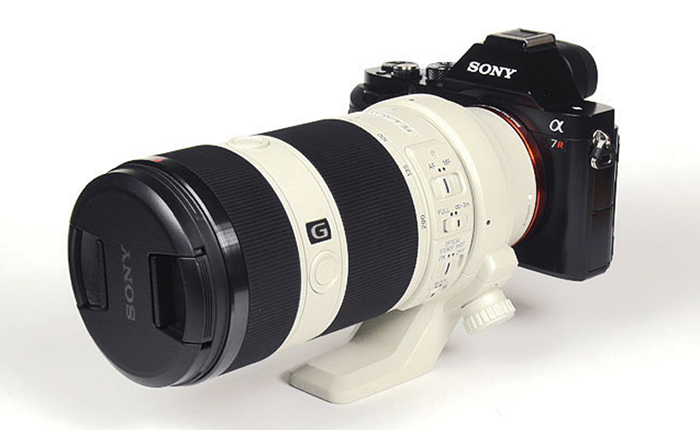
Image sourtesy: Photozone.de.
Our friend Klaus from Photozone is known to be a very sever reviewer. Unlike so many other reviewer sites he rarely marks lenses with the “highly recommended” badge. So it’s a nice to read that the new Sony FE 70-200mm “survived” his detailed tests and made a very favorable impression:
The Sony FE 70-200mm f/4 G OSS is, undoubtedly, a high quality with just a few weaknesses. The Sony lens is not only a looker but the mechanical quality is also truly impressive. It feels exceptionally solid and the control rings feel silky smooth. The weather sealing as well as the supplied tripod mount are also a nice bonus.
He also added that interesting note:
The A7R creates rather massive shutter vibrations that are a game spoilers when using tele-lenses – even with activated OSS. However, the A7 and A7s should be able to exploit the really high potential of the Sony FE 70-200mm f/4 G OSS. Therefore highly recommended.
Full review at Photozone.de.
Sony 70-200mm FE at Amazon (CLick here), BHphoto (Click here), SonyStore (Click here). In Europe at Sony DE, UK, FR, IT, ES, AT, NL, BE, CH, FI, SE, PT
0 Responses
Good now where’s the FE 70-300G for 999$ 🙂 ?
I have one and it’s an exceptional lens. It’s usually the second lens that gets tossed into the camera bag when I’m on the road. You can pick it up on sale for $799.99, plus it’s probably 1/2 the weight.
Indeed the G with the adapter makes more sense than this, unless one really wants stabilization.
There is no way the 70-300mm is only 400g. Saying that, the older 100-300mm APO IS only around 400g and quite small. I have used the beer can on my A7 which is about the same weight as this and with grip it isn’t too bad a size for the body, but this looks a bit more solidly attached.
If you want a smallish tele on A7 the 100-200mm f4.5 or 100-300mm APO are probably your best bet. Sigma 70-300mm OS is also quite a good option if you can find one still as it is the only x-300mm with OSS for A-Mount.
highly recommended for spending a lot of money for nothing?
Too heavy…
lets see it against a beer can
I like the lens, but I miss having a TC for FE mount.
Not as good as I’d actually like it to be. After seeing the test, I might buy just the LA-EA4 and a beercan.
Good call – mine gives consistently pleasing results on my A77 (much better than the 55-300 and the Tamron 70-300 USD).
The minolta 100-200 f4.5 is also a great choice, much smaller & lighter than the 70-210 f4 (I have both).
Can someone pls explain to me why people shooting at f4? aren’t we supposed to be shooting at the lowest ISO possible for cleaner image and better dynamic range shadow drag for post processing? who shoots at f4 and can u pls link a sample of your work?
I’ve spent money buying wide aperture lenses for its pleasing bokeh and low light performance yet I see so many f4s and it just making me a little curious why
Creating a lens like this at F2.8 or F2 would result in a MASSIVE thing. They exist, they’re just not very practical anymore.
the sigma 70-200mm f2.8 with OSS is a perfect match for A7 series cameras. It has four stop of vibration reduction and its not of a size difference than this FE 70200F4. and with an LAEA4 adapter you’ll get phase detect and and continuous autofocus.
size wise, seriously its not much of a difference. I think the benefit of having a good low light lens is better than having an f4
Not much of a difference? The Sigma weighs more than half a kilo more than this Sony.
There’s no end to it if you keep going a bit heavier and/or larger for better.
You should get your Sigma if you really want it.
Because F4 is not that huge on a A7/r/s body 😉
Usually there’s not a huge difference in transmission between f/2.8 and f/4 zooms. The aperture might be f/2.8 but the transmission can be closer to T/3.5.
But indeed, for the best quality you need to be looking at primes, not zooms. I’m hoping for a nice FE 135mm.
If you’re looking for a good 135 option and you don’t mind manual focus, you can get the Leica Elmarit-R (f/2.8) 135mm and a Leica R adapter for about $400 total. it’s probably one of the best medium long primes I’ve ever used.
It’s not that difficult to make a 135/2.8. On that note the STF 135 seems to be really sharp too.
The best option for any alpha camera is the 135mm f/1.8 ZA. Its expensive, but its performance speaks for itself.
Thanks for the great tip!
How would you say this lens compares to the Canon 135 f/2L or the Sony 135 f/1.8 ?
In terms of sharpness, my copy is mind-blowing, but as someone else pointed out, making a good 135 2.8 prime isn’t too hard. By the time you get down to 2.8 on the Sony/Zeiss, you’re looking pretty darn amazing, though, plus you get autofocus.
Plenty of work at F4 can be found all over the web, don’t be obtuse. In any case, given that you are apparently willing to lug heavy gear, faster options do exist, even from Sony.
I mean you should also consider how impractical 2.8 can often be in portraiture and similar activities. At f/2.8 and 200mm with a subject 2 meters away, you are getting around 2 centimeters of depth of field, which is not really much to work with if you want a sharp subject in a portrait. Even when I’m working with the massive and expensive Canon 70-200 f/2.8 IS II, I tend to stop down to around f/4 or f/5.6 for portrait or candid work becuase of this. When 2.8 comes in real handy is sports photography when the subjects are super far away and you’re in a dim arena. If you’re doing that kind of work, the FE bodies will disappoint anyway because of their autofocus performance.
It’s also worth pointing out that while Sony may be giving us a lens that is a stop below what our expectations might be, they are also giving us a new body with low light performance that is well over a stop better than we’re used to.
As I switch to the A7S and FE / Leica R lenses, I will be giving up the Canon 70-200 f/4 IS as my primary telephoto. I have had no problems using it professionally whatsoever and this Sony equivalent looks even better. F/4 telephoto lenses are just easier to make, easier to carry around as a photographer, and significantly cheaper. For someone who runs around while photographing as much as I do, they seem like no-brainers.
Sample attached. Shot at f/4 on a crop body. Plenty of Bokeh, very little noise.
Well I can’t see my image. Maybe I did something wrong. Sorry.
Trey Ratcliff will routinely shoot above f4. But typically a 2.8 lens is gets sharper stopped down to F4 , then a F4 lens at F4 not almost but more times then not.
The A7r issues are disappointing – to be honest I’m surprised we’ve not heard rumours of a mk ii yet…
A one year release cycle is pretty unrealistic.
Sounds like you’ve never used one
I have used the A7r with a Tele & without any shutter vibration issue. The lens is without an OSS. I’m very surprise. How can he recommend on one side the use with the A7r if he’s experiencing shutter vibrations issues?
I have the A7r and the FE 70-200. Without tripod I get shutter shock between 1/60 and 1/200 sec above 135mm. At lower or higher shutter speed it’s gone. A tripod makes it a bit better. For it can be worked around. In good light I will use higher shutter speeds and in low light I won’t use use it for moving subjects anyways, so 1/30 is still okay and can even be handheld at 200mm. I will keep the lens as it’s really great, but I’m sure I will upgrade to a high resolution A7r II some day with electronic shutter.
I just bought the FE 70-200 f/4 OSS last week and it is a perfect for my a7 and the a6000 … feels light and looks great … it is INCREDIBLY fast to auto focus accurately on the a6000 … worth the money.
Your post begs the question: How fast and accurate is autofocus with the A7? Should I purchase the lens to shoot sports with my A7? The limited PDAF area is not a problem with my shooting style.
The frame rate on a7 is slow for fast sporting action (so some critical frames might be missed), also (as you may already know) even on fast SD cards, the a7 buffer is not very good, so I wouldn’t use FE 70-200 f/4 OSS on a7 for sports (however, whatever frames you capture will be accurate and sharp).
The FE 70-200 f/4 lens on a6000 is great for sports … having said that, one has to remember that it’s not meant for professional sports photography, but it (a6000+FE 70-200) does make a great combo for a casual sports photographer like me. Check out the youtube video by CameraStore.com, they compared the a6000+FE 70-200 with a few other fast mirriorless cameras and the Nikon D4S.
Lets say Ill buy the makro lens thats supposed to be announced soon. Is there a way I could teleconvert it? Havent seen anything like it for FE lenses so far… Thanks.
Don’t you have any crop sensor or smaller sensor camera for shooting macro? I find it hard to use a macro lens on full frame format because of the shallower depth of field. I’m currently using Sony 30mm f2.8 + crop sensor for macro and its the best macro lens I’ve used so far. I think is better than the 100mm since I can get really really really close to my subject with it. talk about an inch gap from you lens. that close lol
Why buy a Sony FE 70-200mm f4 if you can get a Sigma 70-200mm f2.8 with four stop of vibration reduction? with an LAEA4 adapter you can have phase detect and continuous autofocus. You can have better low light performance indoor. You can have a smoother and pleasing bokeh. It has a black finish so you wont be a distraction when shooting events.
Seriously sony, stop making white finish lenses. You don’t have to be like Canon, Just stay as Sony that we love and support. So please support us by making your professional lenses BLACK! because having a discrete black color is a requirement for us.
White is to reduce heat absorption for tele-lenses when shooting outdoor.
I always wandered about that. Nikon’s lenses are black, aren’t they? Do they have any problem with heat? Just wandering.
Wondered not wandered.
They don’t have a problem with that but they look better. the white Sony is pretty ugly. Why would you go white for a new system?
Minolta made white lenses long before Sony.
Sigma image stabilization does not work on Sony.
Also: Have you seen the Minolta white lenses? Its nothing new to Sony.
Also “better low light”. With the E4 adapter, youre shooting at about f3.5. so where is the difference?
Do you have any proof that the sigma 70-200mm f2.8 does not work on Sony a7? because we recently tested it at B&H in New York City and everything works fine and sharp. and with an LAEA4 adapter we can shoot in autofocus at its widest aperture f2.8. I might have to double check the OS thing again.
The white finish is imply a branding brag. White colored lenses can capture others attention which is good for advertisement and bragging rights. But for us who shoots serious stuff in an events its no good because it is very distracting. The birds, the bees and all types of animals outdoor wont get distracted with white finish and can’t even read which brand of lens you are using
Buy Nikon gear if you don’t like white tele lenses. Or Fuji/Olympus/Panasonic if you are keen to mirrorless. There are so many options 🙂
I will never ever go back using an optical viewfinder after using an EVF for almost 2 years now. And I just recently invested on Sony’s full frame mirrorless. The dynamic range I get from my A7 is phenomenal compare to Canon’s sensor. I strongly believe Sony will take over Nikon and Canon and what a day it will be.
When the QC will be good I’m sure Sony can take on the big two. But for now, QC is crap (maybe Fuji has a worst one).
Try an optical viewfinder on a medium format camera. That’ll change your mind.
” With the E4 adapter, youre shooting at about f3.5.”
That is not how it works. 2.8 = 2.8 with or without the slt.
The light lost to the slt is automatically compensated for by boosting the signal by the sensor / processor. At high ISO, this means 1/3 stop more noise than without it (compare a99 images to rx1 images or a7 images).
Shooting at f2.8 + la-ea4 adapter will still result in less noise than f4 and no adapter if the ISO is boosted a stop to get the same exposure.
Minolta also made great tele white lenses, so Sony is not copying Canon. And also the Sony lens has 4 stop stabilization just like the Canon/Nikon or third party.
I’ve read that that Sigma is slow to focus. What is your experience?
it depends on what type of shooting you’re doing. If you are doing sports or wildlife then it is too slow to focus on your subject but if you’re doing a typical type of shooting like moving people in events then it is more than enough speed. with an LAEA4 adapter the focus is sharp and the continuous AF mode is always on target. It is also very hard to use without the vertical grip for A7 so having it on is a must for using heavy tele lens.
Hello. The FE 70-200 is my first white finish tele-lens ( I didn’t like the white finish initially either). I can tell you however that the white finish makes the lens very cool to the touch in the hot sun–compared to my other all black finished telephoto lenses which can really heat up under the same conditions. Not sure if this was the design intention or not but definitely noticiable along with the quality = a keeper for me.
You really aren’t following, are you? The Sony also has stabilization. The LAEA4 features a translucent mirror which kills some of your precious light (not to mention that the difference between the two lenses is probably less than a stop to begin with, as someone pointed out). The Sigma with the adapter is twice as heavy and more expensive. The white color has been used by Minolta and has nothing to see with Canon.
at 200mm focal length the bokeh difference from f2.8 and f4 is big. If you do a sample shot side by side. the bokeh from 2.8 is much pleasing and the bokeh from f4 is busy. Maybe it is just my preference that having smoother bokeh is better therefore I don’t buy any f4 lens.
I am not denying the usefulness of a faster lens. I am answering your question why would someone shoot at F4. You are carrying twice as much for less than a stop improvement, price being the same. Both are valid options, depending on one’s needs.
A great FE zoom! Finally! Good luck with the Zeiss FE 16-35 f4 OSS.
photobyandrei.wordpress.com
Yep, this lens is aweful on the A7r – ruined by severe (not the e on the end of severe, admin) shutter shock
issues.
Shame, I’ll be sticking with my Canon 70-300 L and Metabones – no shuttershock on that combo…
I don’t believe any other lens above 200mm doesn’t suffer from shutter shock. Can you prove it? Post some pictures free hand at 1/160 sec.
Bull…
”
Unlike so many other reviewer sites he rarely marks lenses with the “highly recommended” badge.”
He would not do that if he had bought the lens in Germany with his his own money! This conclusion is unacceptable. I am not buying it (or the lens).
I stopped reading Photozone a while ago. They really run double, even triple standards with their ratings. Sony is heavily disfavored there.
what proof do you have?
You are joking, right?
“blitzangebot” from amaxn.de is my friend. Will evaluate it myself when a lens is available myself (like the 24-70/4 OSS). If it is below my expectations, it is return for full refund. photozone, etc can say whatever they want. Dealsrunner/SAR gets helped in this process. It is a win-win situation. 🙂
I also got a chance to (briefly) try it this weekend. Very impressed!
Some quick thoughts here at my blog:
http://marsweekly.wordpress.com/
The reviewer missed the point. Photozone raved over the Canon 70-200mm F4 IS USM when it was released here: http://www.photozone.de/Reviews/196-canon-ef-70-200mm-f4-usm-l-is-test-report–review. And the Canon is some 80 grams lighter than the FE 70-200 and $350 cheaper. However when used with the Metabones III adapter on the A7r, the weight advantage largely disappears, and so does the cost advantage IF you don’t already have a Metabones III ( all A7r/A7 owners should buy one.) Still the Canon is an Outstanding lens, with much lower distortion than the FE. I’ve used the Canon 24-70mm F4 IS with the A7r with outstanding results, but the Metabones III does not accommodate 2 focus modes: DMF & AF-C which I never have the need for in Landscape and slow moving subjects. So if this is not a problem, use the Canon + Metabones, else go with the new FE. The resolution of the 24-70 Canon is outstanding; much much better than the FE 24-70 in the corners, and I would expect the same thing with the Canon 70-200mm. Summary if IQ is the no. 1 goal, and most users of A7r’s bought them for the IQ and ability to “crop the hell out of the image”, then go with the Canon not the new FE.
Klaus mentioned in the article that he suggests to keep the shutter speed at 1/500 or faster in order to overcome the vibro issue in any case.
What a brilliant discovery!
From that “highly recommended” review:
“A7R users should try to stay faster than 1/500sec when using this or any
other tele lens in this range. That being said, the situation should be
much better on the A7 or A7s. Their electronic shutter option should do
the trick (which is why we would clearly recommend the A7 or A7s over
the A7R).”
He did not try it on an A7 or an A7s and speculates that the lens should do better on those and makes the recommendation based on that speculation.
It is a joke not a review.
why is it a joke? The A7r has schütter shock and its visible ob that lens at 200mm between 1/60 and 1/200. I own the lens and tested a lot for the shutter shock. To get good free hand results one has to be below 1/30 (very good stabilisation in bad light even at 200mm) or above 1/250 in my experience. 1/500 makes it slightly better but 1/250 should be sufficient imho.
The A7 and A7s don’t suffer from shutter shock, so it’s a non issue there. The comment is no joke Sir.
If the statement is made after checking it on an A7 (available) and or an A7s (not yet available not even a price) then it would make sense. Conclusions based on unknowns definitely is a joke especially when it is rife with speculation.
The A7 and the A7s may have EFC shutter but they also have AA filters and larger pixels. How can one speculate that a lens would do “better” on those without actually testing it?
The “review” is about a lens and not the A7r or its shutter. All the FE lens “reviews” there were all done using an A7r.
Yes because that site mostly tests the optical capabilities of lenses, most anything else is just a side note. That’s why they only test on the A7R to test it’s highest capabilities optically, when a higher resolution camera comes out they test lenses on that instead.
The shutter vibration issue is not an issue with the lens. It is like saying a lens is no good because Canon sensors have banding in the shadows.
So get over yourself. If you can do better reviews go and do them and then show them to the world so we can sit around and call them a joke.
I buy lenses to use them for photography and not write speculative “reviews”. To test the “optical capabilities” of a lens one needs an optical bench and not a camera.
If this lens performs poorly on the A7R (and the lens isn’t tested on anything else) then the “highly recommended” rating makes no sense at all.
Because the issue is with the A7R, not the lens. It’s pretty simple to understand. The reviews are written to serve as a review of the lens, not of the lens + camera combo. If Sony released a 0-shock update or released an A7R with EFCS (I know, same thing) then that doesn’t make the lens itself any better now does it? Yes it is speculation, but it is based on good solid fact.
It’s like saying the AF is slow because they tested it on a NEX-3.
Without actually testing it you can speculate but you can’t give it a better rating.
Well considering the OSS is a ‘passing comment’ it doesn’t seem to play into their ratings either. All they can say is ‘shutter shock with A7R wasn’t good’… But again this is not to do with the lens. I mean otherwise they would have to mark down ALL lenses used on this camera because it gets shutter shock? Really? Hey better mark down every Canon and Nikon and Pentax and Sigma and Tamron and Tokina and Sony A-Mount lens because they will get shutter too when used on an A7R! It is nonsense.
If they can’t validate better results with any of their equipment they have to mark it down of course. What kind of test is that to say in theory you might get great results but we can’t show you how good it might look because we haven’t seen it ourselves? 😉
No, one doesn’t. I use this lens with the a7R for about four weeks now. No problems. May it really be true that some a7R’s have a bigger problem with schütter shock (love that spelling 🙂 than others?
What a brilliant misunderstanding on your side, on your re-replies below too.
I like guys like you not reading and understanding properly and shooting wild.
Klaus is owning an A7R, and he tested the lens on the A7R. On tripod usage he encountered motion blur from 1/10 to 1/400, therefore he mentioned the sentence with 1/500s.
He is mentioning that users of the A7 or later an A7S will not have that issue due to those cameras having EFC. That’s a very logical assumption.
Problems caused by a systems camera may not lead in downrating a very good performing lens. So there is nothing to critisize on his judgement, too.
If I try this zoom on my A7R and find it problematic, I will not keep it and cherish it, rather return it for a refund. If I find it exceptionally good on an A7, I will use it. Very simple. Speculation does not yield photos for me. May be it does for some.
The hood make the lenses look like a loudhailer… Could Sony make it less ugly and more professional? : )
It should have been launched for the A-Mount. It would have made an ideal lens for the A77II, which is one of the few cameras designed to date that can take advantage of this lenses advanced capabilities.
The 70-200 F2.8 mark II for A-mount is still superior to this
compare peanuts to peanuts. this is F4.
Price aside, Why would you want an F4 lens when you can get F2.8?
size. weight. have you compared those? f4 is about 850gr. f2.8 weights twice, about 1.5kg.
it’s a very big difference.
Yeah? I don’t think so. It doesn’t even have an optimal motor for PDAF.
I believe the more important issue is if the lens shade is effective at preventing flare, if so than the design is a success. If the lens hood doesn’t match your clothing accessories then that’s your problem.
Well the 70-400 G hood blends nicely with the lens, I love its design simply the best looking hood for a white colored telephoto lens
I own this lens and a A7R. I cannot really recommend this combination. The shutter shock issue at focal lenghts over 135-150 mm becomes REALLY annoying, it forces me to use shutter times at 1/1000 or shorter. Also there is a BIG performance drop at 200 mm and subject distances above ca. 100 metres. While the lens performs really outstanding at lower distances it is merely not possible to get a shot that is sharp across the entire frame at 150…200 mm and very far distances. Even at f/11 the borders are unsharp. I have tried two lenses and both are the same in this respect. Overall, if you are in the market for a lens like this and want to use it on a 36 MP body, I would recommend to also have a look at the Nikon D800 / D800E and Nikkor lens. With the Nikon, you’d get a more sophisticated stabiliser as well as a much better C-AF. Myself, I am going to keep the 70-200FE *despite* this problems. I am probably going to use it much more on a A6000 than the A7R. But I can’t recommend it to anyone as the DSLR alternatives are probably still giving better overall performance.
Good to know and now I’m turned off. Well, maybe the next a7 will fix these problems. I’d use it exclusively at 200mm too, so what a waste of cash. What a shame.
Pls make this Lens available without this white Elements. Thats so ugly.
aren’t this lenses suppose to be smaller? cause this is about the same size and weight -10gr than nikon 70-200mm F4 VR.
no advantage to use a mirrorless with such a mamoth lens.
This is something most people don’t understand – covering the full frame circle will take a certain amount of glass. Laws of physics. Short flange distance won’t change this a bit (or you can get some really marginal size reduction at best).
That’s the FE mount trap. To keep the form factor and good ergonomics SONY is doing relatively slow lenses at normal zoom ranges at the moment. A 24-70 F/4 still balances well on an A7 type body. But go to 70-200mm even at F/4, and well, just look at the photo in the post. Now the 70-200mm F/4 NIkkor comes without a tripod collar. Although this is just Nikon being “cheap”, to some degree it’s OK. A lot of people would use this lens handheld – all you need is a substantial grip and a sizeable body for optimal balance and ergonomics. An 7A style body is not it.
Keep in mind, lens size is mostly determined by the size of the sensor – if you want fast F/2.8 zooms, they won’t come any smaller than the Canikon version, not in any significant way. And now people demand equivalence, want the same DoF options they get with fast zooms on a traditional DSLR. However, once you get to 70-200mm F/2.8, the size/portability advantage evaporates. The A7 is what – 400 grams lighter than a pro DSLR body? That’s basically nothing when you factor in the size of typical fast lenses or even f/4 constant zooms such as this 70-200mm lens. Add to this the compromises that have to be made in terms of ergonomics, and you get a rather limited system. Except if you’re OK with slowish or limited zoom lenses (basically, the current FE lineup) in which case, the A7 is a very nice camera.
Let’s just be clear with Sony, the shutter you put on the A7r is a pain. Everyday I can feel it when I take a picture and hear it even more. Street photography is a pain, people get scared when you shoot them with this. Anyway.
Thank you for the nice review. I want to buy one at a local photo store in Cologne. They showed me the Lens mounted on a Sony A7. The lens mount was so loosen that I was able to turn it about 3mm without any force, just manual focussing. Has anybody made the same experiences, or was this just a outlier???
//Andreas