







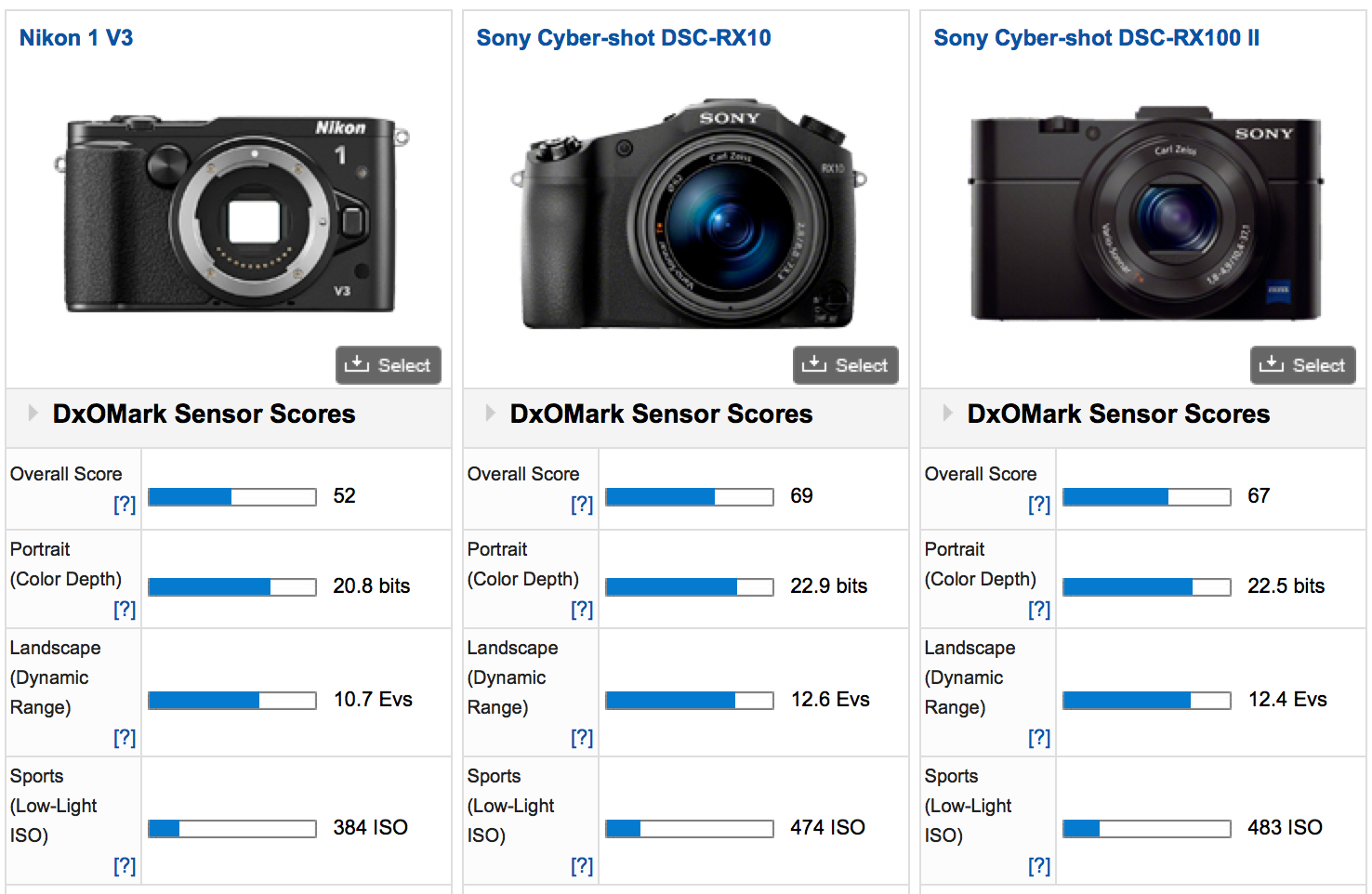
The RX10 outclasses the newly announced Nikon 1 V3!
The superb Sony RX10 just got the Gold Award at Dpreview.
While it takes quite a bit of head-scratching to figure out where the Sony Cyber-shot DSC-RX10 fits in the market, a few things are clear. First, in image quality terms, it’s the best big zoom camera on the market. Second, its video quality is top-notch, and Sony provides tools that work very well in most respects. Finally – and unfortunately – it’s very expensive, especially for a fixed lens camera.
And DxOmark tested the newly announced Nikon 1 V3 camera. Well, the 1 inch Aptina sensor used by the Nikon is quantum leaps behind the Sony 1 inch sensor used by the RX10 or RX100II.
RX10 store links:
Sony RX10 at Amazon, Adorama, BHphoto, SonystoreUS.
Sony RX10 at Sony DE, UK, FR, IT, ES, NL, BE, CH, AT, SE, FI, NO, PT, WexUK, WexDE.
0 Responses
‘Very expensive for a fixed-lens camera’. Generalizations like this are both amusing and irritating. Same like ‘pocketable’.
I ought to admit, however, that the price is a valid but not entirely sustainable point. If you are looking for a super zoom with the quality and speed of that lens, in any size, the price is understandable. It’s the lens that makes that camera, really.
For video, you can get a GM1 and even if the lens will be half a stop slower (3.5 vs 2.8) the quality of the video and the larger sensor compensate for the lens’ lack of light. The kit lens of the GM1 very good as well and the size is very comparable.
That being said, you still don’t get the super zoom capability and yet again you ought to think that the RX10’s most outstanding feature is, without par, the lens and that’s what you are really paying for.
For everything else, there is mastercard.
i dont think gm1 can equal this video quality
http://www.dpreview.com/reviews/sony-cybershot-dsc-rx10/7
Of course it can!
GM1 video is close to GH3.
The difference becomes more prominent in the higher ISO ranges after 800, where smaller sensors have a harder time adjusting.
While the RX10 video is fantastic, it is not the best.
It is still AVCHD, sadly enough, so a GH3 (which body only costs the same as RX10) can do considerably better.
“Very expensive” is hardly a generalization. It is a very specific observation.
Which is why it’s hard to accept any review that doesn’t take into account one of the primary measurements of any engineering endeavor or of any business endeavor. What’s the price performance ratio? What’s the ROI?
Dpreview never met a terrible price/performance it didn’t like.
It’s ‘fixed-lens camera’ that is actually the problem. It’s simply too vast of a term.
Sorry, we are not all as clever as you master.
Like many cameras, it takes a little while to adjust to its ‘foibles’, but it is a truly outstanding camera.
My only real gripes are that the aperture ring is not ‘obvious’ enough by feel, especially when using different cameras, so you can find yourself hunting for it, and the switch to change between smooth and click aperture settings is in the wrong place and/or the wrong orientation: if it was elsewhere or slid 90′ to the motion of the aperture ring it wouldn’t be so easy to change by accident.
Minor details, though, and I’m otherwise delighted even at the price.
“quantum leaps behind” = zero knowledge in quantum physics! 😛
Alright, if Nikon take this DxO scores seriously, may be they will buy Sony’s sensor for their next iteration of their 1 series cams.
More sales for Sony sensors! 🙂
Personally, I am avoiding both and am curious about the Samsung NX mini. Sometimes they throw in the cams when purchasing their Samsung Galaxy (or is it the other way around?) type tablets.
with the backlit 1″ Sony sensor, and Schneider lenses, it will certainly perform better than Nikon, maybe close to RX10.
sensor in nikon 1 has phase detection pixels, sony’s doesn’t
There’s no reason for a manufacturer to take DxO seriously – with the exception of the marketing department. It’s a house of cards. If camera makers engineered cameras specifically to score well on DxO – we wouldn’t necessarily get better cameras.
RX10 could satisfy a lot of so called pros as well. Get your hands on it and you’ll know why its more expensive than the others. Just a great all around camera.
This is what disturbs me the most. When we compare the above with the likes of the Nex 5N we see a world of difference. Now I know I’m not comparing apples, that’s not my point. What I really want to drive home is that my Nex 5N is an amazing camera, yet like many of Sony’s gadget approaches, it is no long supported. Meaning that lenses released today will not function as intended on the Nex 5N, although there are probably countless Sony costumes using the thing. How can I take seriously a ca,era company that fails to support its system, even in the short term. Oh, if you are wondering, I have the Nex 5 too, but in order to get a functional compact 16-50 I had to upgrade cameras. As Sony moves towards software correction of its lackluster lenses, I will need to insure my system remains compatible by upgrading cameras, even though they are perfectly fine, should they support the system. So now not only do we have to worry about what mount will be supported, we also have to be keenly aware that a perfectly good camera may not function with the same mount lens because Sony decided to stop support of its customers, often within years! Lastly, as a Nex 5 series user, I have no upgrade option.
I have a 5n too. If I was using it with more lenses or interested in using the newer lenses, I would definitively be complaining like you do. I completely understand your point and I do believe Sony should address this issue. However, I would expect the company to come back with a “The NEX 5n is a couple of generations behind our current model support program.” since the 5T, 5R and now the A6000 and A5000 have been released.
I’ve had my 5n since 2012 and it is frustrating to have a camera that will not work with newer lenses as intended. It is not that old and its potential is nowhere near sub-par compared to anything today. It’s firmware should be updated to accept new lenses and/or accessories as they are released.
Short answer is that they have already classified the likes of 5N, etc in the “gadget” category.
My C3, 5N, etc get used as they never were intended to be used with any of the Sony AF lenses (I tried but gave up). Enjoy what you have for what they are.
I’m not sure what makes you think new E mount lenses won’t work satisfactorily on the 5N. It may be that it won’t support the latest software corrections for in-camera JPEGs, but it surely will when using RAW converters. It should also be noted that the sort of aberrations which are corrected for in software are hardly a new thing. Compact zooms exhibit geometric distortions for instance. Indeed, the very drive to more compact lenses makes this inevitable. The difference is now that much of this can be software corrected, whilst in the past we had to put up with it. With the growth of easy-to-use RAW converters, there’s really not much reason to use JPEGs save for a few of the more specialist features (like stacking, panoramic and so on).
To expect companies just to freeze developments on new camera features to maintain optimal compatibility to older models is to ask them to commit commercial suicide. The 5N has not been left unsupported. It’s merely been surpassed by features in newer models. Until such time as technology stabilises, this will happen.
iirc the last 5n firmware update was to support for 16-50PZ. very likely that there will be no more.
Please name easy-to-use RAW converters.
If you don’t like Sony’s Image Data Converter (free but slow), DxO Optics Pro does a great ‘one touch’ conversion, although it’s very slow on exporting files, and can’t beat Lightroom for post processing.
Sony’s isn’t easy-to-use. It didn’t install to my PC because of some Windows quirks. And, it is available only for 2 OSes.
I use Lightroom. There is literally no difference between using JPEGs and RAW using that program. On a half-decent modern computer, it’s fast and easy to use and is a great way of managing photos. It will correct for lens aberrations, including a lot of third party ones (whether it is automatic or not depends on the lens and metadata). Some manufacturers are embedding the correction metadata into the RAW files so a database isn’t required.
If anyone cares about IQ, I can’t imagine why you would use OOC JPEGs as, by doing so, you throw away part of the image data and freeze in decisions made by the camera’s converted at the time. It’s the equivalent of relying on prints from a processing lab and throwing away the negatives.
Anyway, the only high performance item in the Nikon V3 its its price. I have doned full sized images from it and you do not need to be a DXO expert to see that the sensor is nuts. I was disappointed by the IQ.
just to rectify; I have downed the images in full size from Nikon site, thus probably the best one can do.
FYI: DPREVIEW just released their review, the DSC RX10 received a gold award.
http://www.dpreview.com/reviews/sony-cybershot-dsc-rx10
Thats pretty much what Admin wrote in the first line of the article… And in the Headline…
Completely unrelated to this topic (sorry) but… I was leafing though the current issue of Pop Photography and noticed they have a lab test of both the Fuji X-T1 and Sony A7 in this same issue (two cameras destined to be compared despite the difference in sensor size)??
I won’t give away all the detail, but 2 key metrics:
IMAGE QUALITY: Fuji-extremely high / Sony Excellent
COLOR ACCURACY: Fuji-excellent-6.2 / Sony-excellent-7.9
Full details in the mag (and possibly website?)
Nikon obviously thinks the 1 sensor is good enough, and keeps investing in the bodies and lenses for the mirrorless future, unlike, say, Canon. I say good for them.
Sony RX10 just a huge body with small sensor camera. For it’s USD1300 crazy pricing, I’d rather to have a entry level DSLR or APS-C mirrorless (much larger image sensor), with kit lens and other telephoto lenses!
I think this depends on the zoom range. If it is supposed to be RX10 compatible then a APS-C zoom would be considerably bulkier. m43 would offer a better margin than the RX10 but does not quite offer the sheer resolution of a APS-C camera (if a zoom lens is used).
Yes, you may, but there are people around who don’t want to change lenses. In addition it is just a great allround package, unobtainable with any APS-C CSC or DSLR.
Example: If you goes to Nikon D5200 + AF-s 18-140mm VR, it just USD950 according to Bhphotovideo.com. The camera kit lens also a great allround package.
What I emphasize here is for the bulkier body size, small image sensor, and crazy pricing, there are a lot better options rather than Sony RX10.
Of course, the fascinating here is ‘Zeiss brand’ 24-200 mm f/2.8
If you’re going to compare the prices of a fixed-lens camera and a system camera, you have to equip the latter with a lens of similar zoom range, brightness and optical quality. By all accounts, the RX10 lens is of considerably higher quality than your usual kit zoom or consumer telephoto zoom. You have to pay much more for a zoom lens with that quality, and with a constant max aperture, plus an entry-level DSLR or mirrorless camera, than you have to pay for the RX10. And let’s not forget the video specs; how many consumer DSLRs or mirrorless cameras does full sensor read-out instead of line skipping?
I still disagree; the combo you described is larger and around the same weight as the RX10, albeit cheaper. In addition, I wouldn’t call it an allround package.
To mention, with all nikon lenses in that range, you don’t get a 24 equiv. wide angle. And those lenses aren’t constant f2.8 so your shutter speed is always lower or your ISO is always higher. For the crazy pricing, you also get much better ergonomics (aperture ring, exp comp dial, top LCD, magnesium build and weather sealing etc etc). Basically, for the extra money you get more reach, more versatility, wider aperture, better ergonomics and better build, but the trade-off is it comes at a cost and has a smaller sensor.
With that in mind, it is a unique high end product, which is difficult to compare.
You’re not paying for the camera, but for 200mm f2.8
It’s not 200mm f2.8. It’s 73.3mm f2.8. Or 200mm f/7.6 FF equiv.
In terms of depth of field, yes – it’s f/7.6. In terms of available light it’s still f/2.8
bahahaha
How is the available light the same if FF f/2.8 lens collects seven times more photons than 1″ f/2.8 lens?
OK. Let’s take any p&s where lens start at 5mm f/2.8, use only central 1% portion of sensor and call it 200/2.8 equiv.With FF 200mm f/2.8 lens, you can attach a focal reducer to it and get, say, 85mm f/1.2
If you desperately need that magic “f/2.8”, it can be had for less money (e.g. Panasonic FZ200)
More precisely the $$ goes to ‘Zeiss brand’.
They call this the best ‘big zoom’ on the market. It’s unclear what other ‘big zooms’ have mere 24-200 lenses.
I think they meant best in terms of IQ, not in terms of zoom range. The RX10, and also the Olympus Stylus 1, represent a new breed of bridge cameras, that sacrifices the extreme telephoto reach for larger sensors and faster, constant aperture lenses. If you don’t need the zoom range, this is a better option than the Panasonic FZ200 (fast lens, small sensor), Fuji X-S1 (no constant max aperture, but fairly large sensor), or all the other superzooms with small sensors and slow lenses. You still get a slightly longer zoom range than with enthusiast compacts like Nikon P7800, Olympus XZ-2, Panasonic LX7 and Canon G16/G1 X MkII.
Well Nikon should have put a Sony sensor in it…..
The Aptina sensors are optimised for speed, i.e. fast read-out. Apparently, burst rate and AF speed were more important design objectives for Nikon, than image quality, which is still quite good, although not up to the class-leading Sony standard.
Yeah I have certainly heard that… But I don’t think that the marketing matches reality here….If you compare the Nikon specs with the Sony A6000’s frame rate of 11fps with faster autofocus with an APS-C sensor..Which is only one step away from full frame and almost twice the size of the CX sensor…CX format sensor on the nikon is seriously tiny!!! I am not surprised it can claim a high frame rate with a sensor the size of your thumb nail…Then you get all the other issues of dynamic range, ISO performance, lack of d.o.f….I think this maybe a case of smoke and mirrors…
Nikon 1 and M43 have dumb prices. Sony and Samsung have sensible prices but many issues with details and quality. Fuji has their issues too. We are still left with Canon and Nikon DSLRs + some old Ricoh.
Nothing changed, in all these years: let’s boycott those dumb multinationals until they come up with innovation and quality.
DXO instead, they are the true scientists and innovators 🙂
Dynamic range 2 stop better in Sony? Nikon has done something wrong or Sony something quite well.
Ok.. Nikons biggest mistake was when they decided to select tiny 1″ sensor.
? What’s the sensor of the Rx10? Looking at the curves SN-ratio is equal, Sony offers some extended/smoothed modes as they call it. But Sony’s RX10 has better dynamic range at lower ISO values. Similar to Canon sensors who trail behind Sony sensors.
I wouldn’t call that quantum leaps away, but the sensor has it’s advantages.
FULLSENSORREADOUT is nice but NOT WITH THIS CODEC!
the RX-10 would be a glance, if the CODEC would be something.. okay.
the Lense. a smaler zoomrange…more clearence and some other things
and yes, as some said it would be a masterpice ( not forgeht how big is
sensor in 2010 red scarlet?)-you get much for your money-and MORE YOU
GET FROM OTHER SONY MODELS you SHOULD FORGET..for now.
The aps-c part is hold like an unwanted child.. noboy knows, why the
SENSORREADOUT is not IN a nEW 2014 A-6000??
wait for what? waht?
hm?
see it from Fs-700 with extern recorder..yes it is expensive.
and yes rx-10 comes closer. but first the 4k-joker-lasvegas-show must go…
its bitzness
I tried google translator but that didn’t work. Can someone please interpret this for me?
Sleep it off dude, and come back when you’re sober. 😉
Just illustrates how far out Nikon is to charge $1200 for their V3 – and now rumor is that they have a V4 coming soon. What is Nikon thinking – $1200, that is more than the nice Sony a6000 and Panasonic GX7 and nice Olympus OMD-em5 and OMD-em10 all with lenses and nicer viewfinder and larger sensor – I guess the die hard Nikon fans will still buy it
I am surprised that the RX10 gets better score than the RX10 yet the RX100m2 does better in low light –
I still think that the Sony RX10 is a bit steep in price – for example I have the Olympus Stylus 1 which has also a constant F2.8 lens but goes from 28-300 vs the 24-200 so the RX10 is a bit wider but not nearly as long.
The Olympus Stylus 1 has a smaller sensor but it is back-lit and goes for $699 vs the $1299 so $600 more then the Stylus 1 – no doubt the RX10 is a bit better than the Stylus 1 but is it $600 better ?
The RX10 is quite a bit larger than the Stylus 1 so not as pocket able –
I do think that the RX100m2 is priced closer to reality and I think the sales prove that point –
The RX100m2 is a jewel of a camera due to it’s size and nice IQ – if only it had a faster lens and if Sony came out with a $150 decent EVF that would fit in the hot-shoe – and Touch LCD – that would just make the RX100m2 the most awesome small camera