







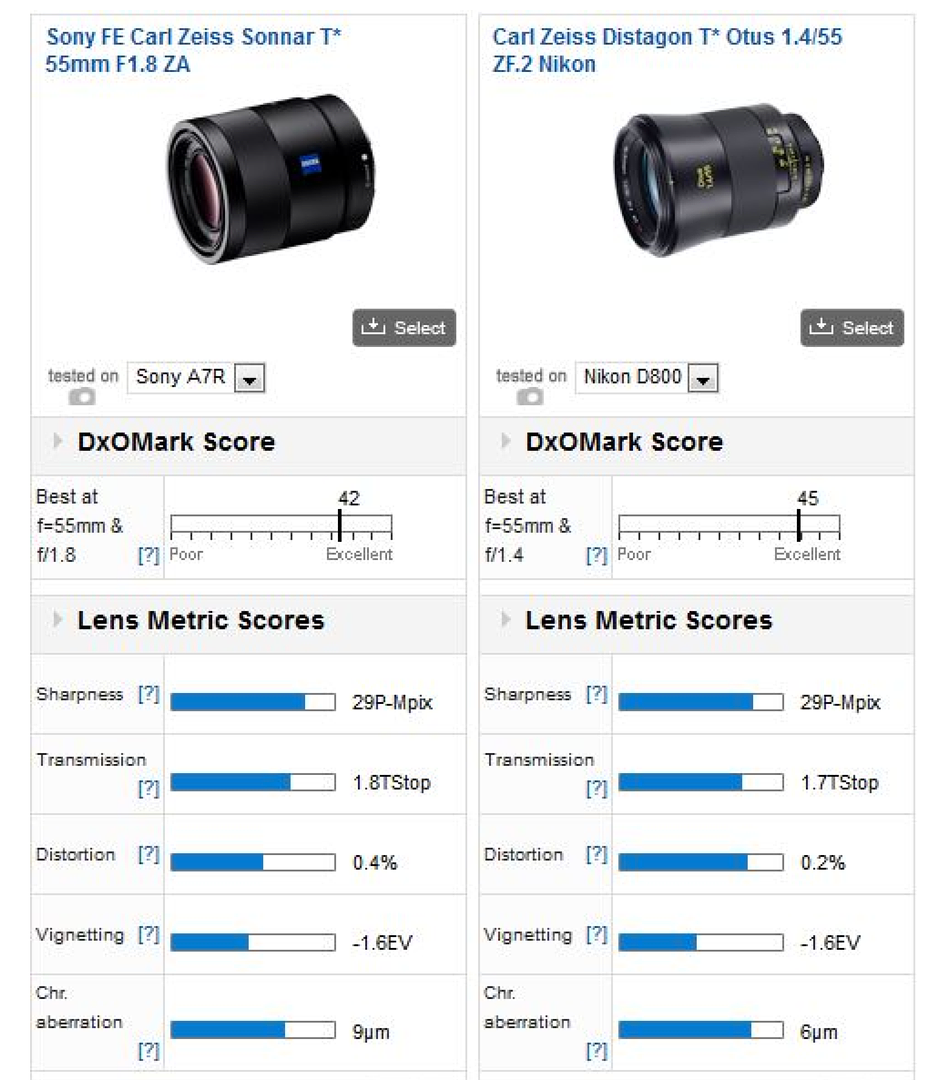
DXOmark (Click here) published the full Zeiss 55mm f/1.8 FE lens test and the results are extraordinary! It’s the best autofocus lens ever tested at DxO and the second best lens ever tested at DxOmark (full ranking here) after the manual focusing and 4 times more expensive $3999 Zeiss Otus.This is what DxO writes about the lens:
In fact, the Zeiss Sonnar has similarly high peak sharpness and outstanding uniformity with less than 5% loss in sharpness across the field at any given aperture value. Transmission is outstanding but while both distortion and chromatic aberration are quite well controlled, some slight CA is evident throughout the aperture range though it decreases when stopping down.
On paper at least the Zeiss Sonnar T* FE 55mm f1.8 ZA may seem somewhat unadventurous and over-priced given the f1.8 maximum aperture. In reality the lens is a bright 1.8TStops, and image quality is outstanding. Even the $1,000 price seems quite reasonable.
Yes, compared to the Zeiss Otus there FE version has 2/3 stop less. But damn, it costs 4 times less and gives you an almost “Otus” performance! Well done, Sony-Zeiss. We need more lenses like that for the new FE system!
If you don’t own the lens these are the directs tore links to grab one:
USA/Canada: Amazon, Adorama, BHphoto, SonyStore US and Sonystore Canada.
Europe: Sony DE, UK, FR, IT, ES, NL, BE, CH, AT, SE, FI, NO, PT
0 Responses
Hey website guide, they finally have a price for the zeiss touit e-mount macro 50mm lens on B&H. Is that news worthy?
(yes)
Quite expensive as expected. Imo 75mm equiv. are a little short for macro. I’d prefer at least 90mm or more.
I’d definitely be reluctant to buy a 50mm apsc macro… Sure, grab a Minolta 50mm for a-mount if you’re just starting out, but I’d never invest serious money in one.
Yea, esp. given that most macros are ridiculously sharp anyways. You remain much more flexible getting a FF macro even if you use APS. Esp. at this price, there are ton’s of good macros out there.
And if you just want a really good standard prime for your NEX, just get the FE 55 1.8…
I have the original e-mount 30mm f/3.5 Macro Lens 1:1 for NEX and it’s not sharp at all. The reason you would get a macro lens instead of the 55 1.8 FE is mainly for the focusing distances. The Zeiss Touit specs seem great.
DXO got the NEX7 and FE55 test scores wrong for sharpness – http://oi59.tinypic.com/2b5kbo.jpg
Perhaps the most surprising result in this test is that it’s T-stop value equals it’s stated f-stop value at 1.8. Since a transmission loss-less lens with glass lens elements is impossible, it means that that the lens is actually a bit faster than the stated f/1.8.
I wonder how it compares to the A-mount zeiss 50mm. It appears they haven’t tested that yet.
My point exactly. How long ago was that? Really! What’s the freaking reason you can’t test alpha lenses, still no Zeiss 135mm 1.8 review either. It’s like they refuse to have anything to do with Alpha mount.
They don’t have to because everyone already knows it’s rocking. It’s the best prime available for the A-Mount, and priced accordingly. The 135mm F2 scored 38 so the135 F/1.4 would be north of 40.
But I feel if you own the A-Mount you should try to take advantage of the 135mm STF while Sony still sells them. Wow is the only description that can accurately convey the STF’s performance.
On top of the Zeiss 50mm I own the 135mm 1.8. I’ve considered the STF but didn’t really “get it.” There is also a comparable minolta offering if I’m not mistaken. Maybe I should revist that one.
Its the same lens different paint. I tried hunting one down second hand but the price is the same. I rented the STF from last month, and after spending a weekend with it decided it was a keeper. Manually focusing it is easy and fast. The pictures really pop, and your portraits/still photos will really stand out.
I still want the 135mm Zeiss but that’s a really big budget item.
I’ve ordered the STF for $1299.99 on sale which is manageable.
Damn, you shouldn’t have mentioned it. Now I’m reading the reviews, looking at pics and wanting one. Not good, there goes another grand.
The Zeiss A-mount 50mm is definitely worse than that new FE lens. All existing tests of the A-mount Zeiss show little above average quality.
LOLWAT?
Yep. I wanted to buy that lens, but after reading the tests at KurtMunger.com and some of the leading camera magazines in Germany I stopped it. The A-mount Zeiss 50mm is quite on par with the 2008 Sigma HSM 1.4/50mm. That means it is quite good, but far from being perfect. The Sigma has a price tag of 500 EUR the Zeiss 1.500 EUR….
That is just ridiculous, no value for the money.
The new FE lens seems to be a very different breed. I really would like to go for that one, if it would be available for A-mount….. which it is not….
Could care less about Dxomark and their stupid scores. However, I do look over the fence so to speak every once in awhile. Hey Dxo…why no review of the sony alpha 50mm 1.4? How long ago was that? Alpha is so freaking dead it’s not even funny anymore. It’s like it doesn’t exist to either Sony or anyone else at this point.
A-mount system is hardly interesting for anyone except one and a half fanboy over the world
I don’t even use A-mount, but I got to say it: yo sho is one dumb ass mothafuker. Just sit yo sorry ass down and shut the fuk up!
Nice to see you too bro 😉
^ Everything he said
No it isn’t. The FE Mount lenses need their time in the sun. I think the A7r makes an exceptional compact FF camera with no peer in its segment. The FE Cameras and Lenses maybe the breakout product that mirror-less segment needs.
The A-mount is being redesigned, and refocused for the demographic that actually buys them (enthusiasts, Semi-pro, professional). The new cameras (A79, A88) will likely be launching with 4K, and possibly the new 32mp APS-C /40+ mp FF sensors.
Let’s not be greedy we can share Zeiss with others. We already have a our share of Zeiss lenses that are all best category (24, 50, 85, 135, 16-35, and 24-70). Though a new 35mm would be nice.
So be patient the new A-Mounts are coming.
The big gripe I have with FE is the lens selection – a ropey kit zoom and 2 fairly pricey primes for an affordable ff body. I know it’s the premium FE body, but where are the affordable Sony branded primes with oss?
Give them time. They started their FF mirrorless range with some great lenses (you pay for quality) just like Fuji did, Fuji got praised for that, Sony gets no praise, whatever they do…
Maybe there are not many “FE” lenses yet, but there are another 200 that you can use on the A7 and A7R. How many other systems can accomplish this feat?
Usually I’m pretty nonchalant but for whatever reason the lack of information on whether my investment in a Sony camera system was the most brilliant move I ever or made or my biggest blunder has me a bit on edge. 😉
I get Sony wants to keep secrets about new products to keep the competition guessing. But what Sony seems to be missing is by not dribbling out the outline of a coherent roadmap they’re not freezing the marketplace and customers are wandering off to the other shiny new toy.
A perfect example is the Fuji XT-1. It’s not only creating a frenzy here – even with some Sony fans – but preorders have already sent it in body and kit form to #1 and #2 on the sales charts for compact cameras at Amazon. The body alone is #16 overall in cameras.
I realize the Sony a5000 is a lower end system so it isn’t a direct competitor but its preorders rank is at #1,982 in cameras, #50 in compact cameras. I want to emphasize I don’t think the a5000 is better or that I’d expect it to beat the more enthusiast targeted XT-1 in preorder sales. Just that the gap shouldn’t be *that* wide. 🙁
Given the frenzy over the XT-1 I know there has to be something to it I’m missing. But I’m mostly about IQ so I did some pixel peeping. At 100-200 ISO between my humble, out-of-production a65 (1/2 the cost of the XT-1 new) I’d go with the a65 easily. I’m sure Sony’s new generation leapfrogs my a65 and I’m sticking my neck out the a7000/a79 leave the XT-1 in their wake IQ-wise. So can we please have some hype and hoopla from Sony? Their CES show, IMHO, sucked. Post-CES Sony’s marketing arm appears to have taken a long siesta.
One thing I noticed in my casual wanderings is Fuji seems to have a coherent lens roadmap fans can rally around. What has people here gnashing their teeth half the time at Sony? Where’s the stinking lens roadmap?
No offense to admin, but riding the Sony rumor roller-coaster is mostly frustrating. Sony needs to get the memo on that and clean up their act!
I don’t get it. Sony has some magnificent engineering talent. Their marketing guys are incompetent.
ZA 24mm/2 – Not better than various 24mm f/1.4 offerings, not even when compared to Samyang LOL
ZA 50/1.4 – Otus 55/1.4 got it beat
ZA 85/1.4 – Not better than Canon 85 1.2L II… compare it and see, like I have.
ZA 135/1.8 – Nice lens but the ZE/ZF 135/2 APO is cleaner and the Canon 135/2L USM actually focuses… not a clear cut win for the CA-ridden slow-focusing dinosaur.
As for ZA 16-35/2.8 and ZA 24-70/2.8… ROFL what? We might as well talk about the Zeiss lens in my Logitech webcam too 😀
prove it :p
Genotypewriter. Prove it.
It’s late night in Australia right now, but genotypewriter is always right, he can’t be wrong by definition. I was pretty impressed today by lenscore tests, and they confirm what he genotypewriter said.
If it’s too difficult to get your hands on the lenses and test things for yourselves, how about try and use a search engine to see comparisons? 🙂
I’m always happy to share what I know but don’t expect me to sit down and do everyone’s homework too 😉
You say you don’t care about DxO’s tests… and then proceed to ask for a DxO test of the Sony Alpha 50mm 1.4. Contradict yourself much? 😉
I will say the A-mount is dead when I see an E-mount lens that would have 70-200 f/2.8 and an E-mount camera that would match AF performance and burst rate of the A99. Until then it’s a total BS. Not sure what’s Sony’s policy about refreshing their flagship models, but I’m pretty sure that we’ll see an A99 successor by the end of the year. The E-mount cameras are nice toys, thinking about getting one for myself to complement the A99 and RX100m2.
Only two things known so far about the A99 successor is that it has a 54mp sensor, and 4K.
+1
If Sony evens threatens to EOL the A-Mount they’ll lose 10% of the global DSLR market immediately, or approx. 8.2% of the interchangeable lens market to either Canon, or Nikon. That’s twice the market of the NEX, and A7r combined (22% of 18%).
A-Mount users are self identified DSLR users (not mirror less users), and they’ll just move to another DSLR platform.
That one mistake would kill off both the A, and E mount.
Sony needs both mounts to survive.
It’s very common for any camera manufacturer to make more consumer models since the general audience does’t care much about overall camera performance, usability in different, sometimes tough situations, glitches, etc… Only megapixels matter for those folks and nowdays the sensor size has also came to light. How often does Canon update their 1D? How long did we wait until Sony built the A99 after A900 release? I’m not sure how good will be the A9x but I believe Sony won’t disappoint. Even if it’s gonna be a 24Mpx but more accurate and faster AF – it will worth the upgrade. I would even buy it if only the AF pattern will be wider. I do care about resolution, but resolution is not everything – if you can’t catch your subject in focus – who cares if it’s a 36Mpx blurry picture or 24? 😉
My solution for almost every problem is to buy better lenses. A mediocre camera and a good lens will always trump a good camera with a crap lens.
But your right most consumers just want something to click, and a high MP count. Maybe they should launch a A59 with a 41mp APS-C sensor, and just keep dumping a new version every six months to keep the A-Mount in the news.
Yeah, I don’t know what to say, other than they chose an E-mount to give the single number designation. It’s an A7 as in Ax, and the A99 is an Axx, the APS-C E-mount are Axxxx. Also note, the A7 was not an A9. Makes you wonder what Sony has in store for the A8 and A9. Seems to me the FF E-mount IS THE FLAGSHIP line. The line hasn’t been fully fleshed out yet. In time, it will become clear. I’m sure the A9 will be a match for any DSLR when they build it.
@Oleg:
“I will say the A-mount is dead when I see an E-mount lens that would have 70-200 f/2.8 and an E-mount camera that would match AF performance and burst rate of the A99. Until then it’s a total BS.”
Well put. Sony’s announced FE lineup so far shows that they are careful in not creating overlap between FE and A-mount lenses. FE gets a 24-70/4 and 70-200/4 while the coveted 2.8 versions of these lenses are reserved for the A-mount.
It’s clear, to me at least, that FE is slotting in below A-mount – the optics will be high quality but the specs will be just short of what’s available on the A-mount. FE gets a 55/1.8 Zeiss while the A-mount gets the 50/1.4 Zeiss, and so on.
i want to know how it performed against ziess 50 1.4 alpha lens
:/ nothing on that lens witch cost 1500$
They will have to test it on the A7R thru the adapter, since on the A99 it won’t give resolution higher than the sensor size. I doubt DxO will ever do it unless the next A-mount will have 36Mpx sensor. Who cares, the 50mm f/1.4 is a great lens and it couldn’t be worse than the FE version. The Sigma 50mm supposedly to be even better. And screw DxO, IMHO PhotoZone.de is a more reliable resource.
I think Sigma is simply building hype with their 50mm art claims. Good luck, but you won’t recreate the Zeiss look. I don’t care what anyone says but it’s real. The sigma will also have the body of a Tonka toy truck with some minor quirks I’m sure of it. Weather sealing? Doubtful but not absolutely necessary. May not work with Sony’s advanced AF either. I’ll pay the extra at this point but Sony please show your dedicate to Alpha!
Quite possible about Sigma 🙂
Don’t forget the FE has a blue badge but it’s designed by Sony. And it’s not necessary bad of course – the 50mm 1.4 ZA is also designed and made by Sony and I really like the lens, the image and build quality matches to the 85 and 135mm ZA. The only two complains about the 50mm (not related to quality) – no pouch and a plastic hood 🙂
Another interesting thing – DxO tested the 55mm on the NEX7 as well, and the lens scored average, like 25 or something. So the sensor matters and the A7r does have a good one! That’s why I’m pretty sure if you put the 135mm ZA or the 50mm ZA on the 36Mpx sensor – the result won’t be any worse.
Can you show me proof that they’re only blue badge that designed and made both by sony?
http://dl.dropbox.com/u/12196364/gallery/different/55vs55vs50.png
In fact, the FE 55 is only good WO on FF, not on the APS-C, where it has lower resolution in the center compared to SEL 50.
@Ihur – dude, I don’t need to prove anything to anybody, it’s a well known fact. Google and Wikipedia are your two best friends 🙂 “ZA lenses are designed and manufactured by Sony in Japan, once the designs get approval by Carl Zeiss AG to meet their quality standards.” You can also find related posts here on SAR or DPReview.
Yeah, the plastic hood really pissed me off when I got it. The build is superb though, but I want the pouch I’ll never use with a solid metal hood for this kind of money. I’m going to buy the 85mm metal hood and call it a day- just need to find one used.
I would put the wide open performance on the NEX 7 down to a small misfocus, since SLRgear showed the opposite results with the FE being sharper in center and corners wide open.
So Wikipedia huh? A very good source indeed
2 emacs:
according to DXO (which is the graph taken from) FE 55/1.8 is significantly sharper in edges of APS-C area than E 50/1.8 at aperture and has much less vignetting (at least on NEX-7… yes, it might be due to flawed NEX 7 sensor). Also, E 50/1.8 is plagued by longitudinal chromatism (e.g. dark branches around bright sky)
So there are some rational reasons to prefer FE 55 to E 50.
No wait, are these results even legit? The Sonnar was tested on the A7r while the Distagon was on the D800…DxO always claims that cross-platform results are not compareable, even with the same sensor on the D800 and A7r, they use different processors and render different RAWs, and even with that put aside, the A7r’s without the AA filter so the Sonnar’s got an edge.
It’s not exactly a fair fight.
Otus is much better lens optically. Just check how they compares at APS-C cameras.
No one is willing to lend them one. Sony won’t, and why would they? DxO is a highly biased website that favours Canon or Nikon, their reviews are not objective.
Would you loan DxO your 50mm Zeiss lens if you owned one? I didn’t think so.
If you think DxO favors Canon, you obviously haven’t been to the site in the last several years.
Oh so they just pro Nikon now. I stopped listening to them years ago. The anti A-Mount rhetoric back then was pathetic.
exactly my thoughts after first using that little thingy…easily blows all my red ringed canon L primes out of the water. no need to ever stop it down in terms of sharpness. i hope sony is able to continue this high quality standard with later lenses. a compact 105 2.0 with the same capabillitys would be awesome!
Yup, it is brilliant.
Hoping this is an indication of the direction Sony is taking the FE line.
At this point one has to wonder how good these upcoming manual focus Zeiss lenses are going to be.
Yup. I fear my initial plan with my A7R is going to fail. I love manual focusing, and I intendeded to only use my sweet Contax Carl Zeiss C/Y and G lenses exclusively. But if those new manual Zeiss lenses are able to perform at this level, and be a bit smaller to boot, I fear my bank account is in for a severe beating in the future. :-S
Could you please specify which Canon L primes your Zeiss lenses blow out of the water? Thank you.
Well, for a start, it blows one of its direct competitors out of the water – the 50/1.2 L.
Well, to be honest, Canon 50L has never been considered a very sharp lens. It was more for a dreamy look. And it has 1.2 aperture vs. 1.8 in Zeiss. This is a huge difference. I’m sure Canon will replace it within the next few years. Also rumors say that Canon will release the IS version of 50mm lens.
The reason I actually have asked this question is to choose which Sony system to invest to in addition to my Canon for portraits. I tend to think it should be a successor of a99 plus Zeiss 135 f1.8. And I’m not considering Sony for lenses being sharper, I just like the color rendition of Zeiss lenses.
But nothing compares to Canon 85 1.2L, 200 2.0L or 70-200 2.8 IS II zoom lenses. Not even close.
Zeiss 85/1.4 bests the Canon 85/1.2 with a DXO score of 33 to 28 (A99 vs 5D Mark III). Would love to see the Zeiss on the A7r sensor.
Comparing first gen 70-200 IS 2.8 to the 70-200 G results in a tie score of 21. They haven’t tested the new G yet so the jury is out but it should be close to current gen Canon.
Of course these are just DXO scores but they are about all we have to compare between systems today. Having used Canon for over ten years, with many hours behind the 70-200 IS 2.8, I am just as satisfied, if not more with the G. And the 200 APO/2.8 is just spectacular (and relatively cheap).
I haven’t used the Canon 200/2 so couldn’t comment on that one.
@Chad
“… with a DXO score of …”
Hush. Re-enroll in school… you don’t get a 85mm f/1.2 lens to shoot it at some DxO determined mystery metric… you shoot it wide open. That’s where that lens shines. It’s better than the ZA 85 1.4… if the ZA was better, I’d have one too, wouldn’t I? 😉
“Comparing first gen 70-200 IS 2.8 to the 70-200 G results in a tie…”
Again, I’ve used both of these lenses as well as the exceptional 70-200/2.8L IS II. Even against the Mk I of the Canon IS lens, the 70-200/2.8G was crap when you actually came to use it. The focus is dog slow and the lack of optical stabilisation in a tele lens means PDAF is naturally thrown off. Also why not talk about the 70-200/2.8L IS II? Are people prohibited from buying that lens?
“And the 200 APO/2.8 is just spectacular (and relatively cheap).”
That’s probably when the whole fake APO thing started. Now there are Sigma lenses with better APO correction than the Minolta 200/2.8 “APO”.
“I haven’t used the Canon 200/2 so couldn’t comment on that one.”
ROFL… what were you thinking of comparing it against? I’ve got to hear this 😀
” Re-enroll in school… you don’t get a 85mm f/1.2 lens to shoot it at some DxO determined mystery metric… you shoot it wide open. That’s where that lens shines. It’s better than the ZA 85 1.4″
Using the Canon on my mkII and the ZA on the A99, I can safely say that the ZA handily beats it wide open. Unless all you ever look at is the center 10-20% of the frame (boring…) and don’t care about the ugly blur outside the center that resembles subject movement/camera shake, or the glare that plagues in general until about f/2. Or the fact that it suffers a bit more from focus shift wide open and has more noticeable (especially the purple really jumps out) LoCA between f/1.4 and f/2.8.
My results show the opposite to be true, the Canon shows some small (mostly resolution) benefits when stopped down.
I sold my M9P body to buy the A7R but kept my 2 year old 50mm f2 (non ASPH) summicron which had seemed very sharp indeed on the M9P.
But making 100 cm wide prints with that lens on the A7R I could see the centre was sharp even wide open, but the corners smeared, and even at f5.6 I could see that the M9P had been modifying the raw files effectively, maintaining corner sharpness.
So I bit the bullet, and sold the 50mm summicron and bought the 55mm f1.8 FE lens. I’ve worked with everything from 5×4 Linhof Tecknicas to Mamiya 7s to Hasselblads and this lens on the A7R blew me away. 100cm wide prints at f1.8 bitingly sharp right into the actually corners! And at f5.6 it’s 5″ x 4″ resolution. Incredible.
It is impossible to improve smeared corners, just no way. Leica firmware improves vignetting and color cast (not a case for 50mm).
Blame sony sensor for this smearing.
Are saying that there is no smearing with the 55mm FE lens a7r (only with the Leica lenses)?
I was about leica lenses performance with Leica bodies is quite a bit better. For instance, APO-Cron 50 has higher resolution with 24Mp Type 240′ sensor than with 36Mp sensor of A7r.
http://petapixel.com/2013/12/16/sony-a7r-rising-tide-lifts-boats/
Test with APO-Cron 50 + 7r and Type 240.
Based on the article, it seems that it’s more that the Sony sensor is not optimized for Leica lenses but it is for it’s lenses. Naturally, this makes sense given that Sony designed the lenses & sensor at the same time. So long as there isn’t smearing on the Sony FE and FA lenses than Sony cannot be faulted for 3rd party lens performance.
Sony sensor has too thick IR filter and/or cover glass. Someone needs to that with IR filter removed (IR filter could be placed before lens, if needed).
Sony sensor is hardly optimized for anything. If it were, the FE 55 was 2/3 size of what it has now, and 35/f2.8 would be 35/f2.0 in same package.
Sorry it is not 5×4 quality and not Phase One. It’s good with that lens but not ‘that’ good.
Yabut DPR complained about distortion on this lens that makes it worthless!!
yeah, completely useless – hahahah
If you look at the scores, distortion *is* rather high for this class…
It’s got less distortion than the $1,700 58/1.4 G Nikon, and the same as Canon 50/1.2L so lol?
It wouldn’t matter anyway if they did the alpha Zeiss 50mm 1.4. The camera affects the overall score and the a99 at this point is outclassed image quality wise by the A7R. You won’t get a fair and equal comparison until Sony when I finally retire and am half dead releases the long awaited but way to late FF 36 MP no mirror a-mount successor at nose bleed prices we are being starved for.
I really feel sorry for current A99 users if Sony replaces it with a new model after two years of sales. If a new model is launched, would it be incremental (new mirror, and sensor) or a complete replacement. Does anyone have any current info?
I’ve got the FE55 and I can tell you it is not at all overpriced. Besides the sharpness/color performance it also has lovely bokeh, and wide-open the modest vignetting helps to work with the bokeh and lens sharpness to create a wonderful 3D effect. To have that kind of performance on my A7r AND to have auto aperture/AF is simply great! Price tag is just fine (especially when you consider it’s size and low weight + good/metal build quality)
I still think 50mm lenses should not cost this much when you consider how common and how long they have been around. It is pretty hard to find a 50mm that is really bad. I do think in the end I may get it anyway but I was really hoping for a FF version of the 50mm 1.8 oss. That lens was a very good lens and I would have been fine with that.How is the AF work for you in low light?
I really think the 50F14 does an excellent job for day to day work. I’m not willing to drop $1649.99 CDN for the Zeiss.
Its a shame Sony couldn’t design a 50mm F/1.4 G-Series that could be priced between the regular lens, and the Zeiss, which would be $1064.99 in Canada.
F1.8 is totally fine for a “normal” prime. If I want more bokeh I’ll use tele lenses.
But we don’t want /more/ bokeh. We want /better/ bokeh.
Then buy a 135mm ST, and a M-Type focusing screen.
“STF”
So it is the best DxO-rated autofocus lens.
we need more lenses like this for the alpha mount too!
Pfffft! But this lens is soooo sloooooow! 😉
(Great job, Sony. You made a nice little lens here – even if DxO scores are nonsense)
I’m a proud owner of this lens. It does seem pretty damn good so far.
I best get that A7 to go with it.
But it won’t score as good on the A7 🙂 Why you don’t like your r?
I don’t have an A7R, just NEX-6. A7 next week.
Congrats buddy! I’m also thinking about buying one of those since they seem to start getting some decent optics.
More interesting comparison as the 55mm FE -lens is also tested with NEX7: http://www.dxomark.com/Lenses/Compare/Side-by-side/Sony-FE-Carl-Zeiss-Sonnar-T-STAR-55mm-F18-on-Sony-NEX-7-versus-Sigma-60mm-F28-DN-A-Sony-E-on-Sony-NEX-7-versus-Sony-E-50mm-F18-OSS-on-Sony-NEX-7___1252_736_1104_736_745_736
Surprise – cheap 50mm f1.8 nex lens have better central sharpness, but 55FE have more uniformal sharpness. Even when stopped down to 2.8f sigma 60mm is sharper than 55mm FE lens
If you need sharper go buy a razor lens,
Its not all about sharp, boleh, corner, its about colour rendering, 3d feel, tone, thats what all about zeiss that no G lens ever achieved
You’ve got to stop reading those junk books and articles where people talk about “pop” and all kinds of repressed feelings they summon when using camera 😀 If what they’re saying isn’t explainable through quantifiable means, there’s no guarantee that you’re going to experience the same things as someone else anyway. If it’s all about how you feel then it has nothing to do with the lens anyway.
A btw, “bokeh” is one of those subjective things. I’m sure you’re confusing the difference between bokeh and DOF. And “colour rendition” and “tone” are virtually the same and they’re things that can be measured just like resolution can be measured. The “3D pop” doesn’t come unless the lens has low levels of CA correction and again, the latter can be measured.
Learn the subject, it won’t hurt 😉
@EcoR1
Ergo: making a good crop lens is cheaper and easier. Every sensor size has it’s pros and cons. Just pick your poison.
@abi
+1!
Wrong way, bro. SEL 50 is ≈75mm FOV lens, 55 is 55. It is much harder task if impossible to design 36mm/1.2 lens for APS-C that will match 55/1.8, especially such a good one.
I have this Sigma and I’m not surprised at all.
Some talk about Zeiss or Leica with superlatives, But optics is physics- it is measured by numbers and it seams that when mounted on a nex-7, the 240$ Sigma is slightly better than the 1000$ holy Zeiss in daylight and slightly worse in dim light.
It’s because lenses for smaller formats are generally sharper. If you just compare simple L/mm then a m43 lens or a lens for Nikon 1 series 1 inch sensor will always be sharper than a FF or a medium format lens? Why? Because it has to!
Lenses are made for their specific format and every format it’s resolution.
The 55 spreads it’s sharpness over a bigger sensor than the 50 OSS for APS-C. It would only be fair to compare them both on a 24 MP sensor on their format, so the A7 and the NEX7
Hans, I could have say that you’re right and of course FF lenses have to cover about 2.35 times bigger area than APS-C…
BUT, with the increase of resolution on both formats, the pixel pitch of the 36MP FF is about the same as of a 16MP APS-C and the 24mp pitch is even smaller (3.9 micro meter) and had serious difficulties with many lenses but gives phenomenal results with the Sigma 60/2.8 althought the problematic NEX-7 sensor; Better than any ZEISS for APS-C E-mount.
I wish Sigma would make such a great lens for the FE format.
Sony, dont ever ever let zeiss go thats blue logo r the most reason we believe in alpha line
It is interesting how much it seemed to struggle on the NEX-7 wide open. Makes you appreciate how demanding that sensor really is. I wish they’d tested an A7 as well since that sensor seems much more flexible than the A7R.
Yeah, definitely interesting. Wish DxO would post test scores with more E-mount cameras, hopefully they at least test the upcoming NEX-6/7 successor.
*yawn* more cool lenses for E-Mount. Meanwhile, top A-Mount lenses don’t even have WR and SSM. Come on, Sony!
Thinking of putting some of my amount lens and cameras on ebay what the best way to sale. Start at a penny or have a reserve or buy now option.
Tell us what you got, no need to go to greedy ebay, they fees are outrageous.
The problem with the DxO scores is that there is no traceable reference of comparison. The scores are limited by the body the lens is tested on, so in effect they are testing a body lens combination. What DxO needs to do is build calibrated fixtures for each lens mount with super high resolution special purpose sensors that exceed the lens resolution by 10 times or as close as is the state of the art will allow. The fixtures will give consistent accurate results for all mounts and will truly show the actual resolution of the lens. Each generation of sensor keeps improving, so testing the lens as a separate entity will indicate it’s future capability when a new improved sensor is released.
+1
You mean they are limited by what we can actually buy, rather than giving is speculation of what we can achieve when/if certain cameras will be released? 😉
Not going to happen (those specialized sensors), simply because of cost alone.
Do you know for a fact that they are limited to consumer grade sensors? I doubt it. The cost of any laboratory grade equipment is expensive,but that’s the cost of doing business. Until they invest in laboratory grade equipment and calibrated fixtures they are not really testing lenses, and the data is almost useless when a better consumer grade camera and sensor comes along.
When newer bodies come along, they tend to add them to their database. Having results from a universal >100MP camera would be useless for real world performance with existing bodies, using different filters in front of their sensors too.
What you’re describing already exists. It’s called Lenscore and uses a 200MP sensor. (www.lenscore.org)
Wow! Pretty impressive and seem to be realistic scores. I saw the 55mm in their todo list, so hopefully we’ll see how it really performs soon. I’m wondering why DxO is a more popular resource than LensCore?
Difference in actual T stops between the Otus and the FE is actually closer to a quarter of a stop (!). The only reason is should be called baby Otus, is because of baby measurements, weight and price. Performance appears to be very close indeed.
I don’t really get the ‘DxO is useless’ comments.
The sharpness thingy is really some magical fantasy number but the other parameters such as transmission, geometric distortion, vignetting, (and to some extent CA) don’t have a heavy dependence on the base sensor and are directly observable when developing raws.
How would you directly compare a Canon L lens mounted to a 5DM3, to an equivalent size Zeiss lens mounted on a A7r? There is no way using their test methods to do that,the lens needs to be tested as a separate entity on a calibrated fixture and compared to a standard that is traceable to NBS. Otherwize is data is just relative and cannot be used for comparison.
I’m not saying that DxO data is useless, just that it’s not traceable to any standards and cannot be used to directly compare two different lenses made for two different mounts.
+1
Actually they are comparable. Maybe indirectly, like you said, but still. DxO tests lens AND camera combination. They clearly stated this on the snapshot above. So the correct way to interpret DxO lens score is “On AA camera, BB lens scores better than CC on DD”.
Awesome now make a 21mm and fast 85mm FE ok bye
Really nice lens, apparently. Sony is on the right track.
http://www.flickr.com/photos/davidsafier/12195073854/
850, 580, nex-5 and my crop lens 18-200 and tamron 200-500 to start and not sure if I am going to sell my good stuff yet , I got a bad back thinking of the a7 and the and the mirror less amount adapter I have the old one for the nex camera’ s
Man, this is impressive! I didn’t even bother to count all your lenses – just too many 🙂 Which nex-5 do you have? I was looking for a 5t one day. Why wouldn’t you wait for the next ff a-mount or simply buy an A99?
Do you think the old Nex adapter will work for the A7? You may possibly need the 4th gen.
If you are talking about the regular nex adapters then yes it works on the A7 all my adapters are from my nex-6 and they all work fine on my A7. If you are talking about the sony adapter then it will only work in crop mode unless you get the newest version.
Holy cow…that’s serious coin. I don’t see the 500mm or the classy 200mm 2.8 minolta. Maybe I missed it. Very nice indeed.
Why would anyone buy the Sony 500mm F/4 when you an buy a second hand Minolta 600mm F/4 in mint condition for between for$6000 to $7000 less, or the SAL500F80) reflex for $500.
That would be awesome, but Sony would make it out of plastic in China, and the overcharge for it.
I actually meant the 500 reflex. I had it but sold it. The best Minolta glass IMO is the 200mm 2.8, 85mm G series 1.4…maaaaybe the 85mm 1.4 G series with the special front element they supposedly only made a few hundred of and gave to employees.
Legend says the 200mm 2.8 was bestowed mystical fairy powers by the Minolta demi-gods of the underworld. I hear it’s so sharp it can see into men’s souls. But seriously, They do say it’s even sharper than the 300mm 2.8 Minolta even with a 1.4 tele on it. LEGEND.
The 200mm is a good lens indeed:http://www.photozone.de/sonyalphaff/660-minolta200f28.
Yeah, I’ve heard about 200 2.8 being a fantastic lens too. Dare to ask a silly question, as I’m not very familiar with Sony/Minolta system very well. Can I use Minolta 200 2.8 on alpha-mount Sony cameras?
Yes. If you can actually find one.
They are readily available from Japan on eBay. I got a gorgeous one for around $900.
Regardless of what genotypewriter says, the lens is worthy of the hype on both the A900 and A7.
Saw the tests of the Minolta 200/2.8 and yuck… there’s no need to take sides with Minolta and what not when we have cameras like the A7/A7R. They have the best sensors you can get in the format (at least the A7R does) and you can put virtually any lens on it from any manufacturer. The Minolta 200/2.8’s image quality is not even close to the image quality of the Sigma 180/2.8 OS plus you can do macro and benefit from OS with the Sigma. The Minolta isn’t even the fastest, because there are lenses like the 200/2 IS and VR, both of which have a faster aperture, stabilisation and much better IQ at f/2 than the Minolta has at f/2.8.
As for the Minolta AF 500/8… it’s probably the best general photographic mirror lens give or take the AF but it’s no match to a refractor/regular lens when it comes to overall IQ.
Heresy- complete heresy with no supported data. Speed? We were talking about optical quality here- and the APO version is fast enough for most purposes.
I think Sony is really on the right track these days. First launch the A7/A7r with excellent Zeiss, and G-Series to generate the marketing buzz, and excellent reviews allowing them to dominate the mirror-less high end for years to come.
Then use that opportunity to launch a stellar DSLR (SLT) that will generate the same kind of attention. Send it to reviewers with new Zeiss glass attached generate the marketing buzz, and excellent reviews. Maybe 35mm f/1.4 glass.
Then launch the A8, and keep this cycle going, because the high end cameras stay in the news longer, and draw more attention of prospective buyers. If consumers continually hear that Sony is the greatest/best long enough in the news or reviews they’ll buy into Sony with a FE of FF Alpha purchase, and all us will reap the rewards (Zeiss G-Series rewards)
Sony could easily gain another 7 or 9% DSLR market share this year alone if they launch, something really innovative (and capitalize on the A7r marketing spin), and probably move up to 40% of mirror-less.
If you interested my review of the Sony Zeiss 55mm f/1.8
http://danielecuccia.com/sony-carl-zeiss-sonnar-t-fe-55mm-f1-8-za-review/
Sigma 60mm f2.8 is even sharper on Nex7!
Sigma really made an impressive 19mm/30mm/60mm combination of lenses for NEX cameras.
http://www.dxomark.com/Lenses/Compare/Side-by-side/Sony-E-50mm-F18-OSS-on-Sony-NEX-7-versus-Sony-FE-Carl-Zeiss-Sonnar-T-STAR-55mm-F18-on-Sony-NEX-7-versus-Sigma-60mm-F28-DN-A-Sony-E___745_736_1252_736_1104_0
It’s a lot easier to make good f/2.8 lens than a f/1.8 one. We could have lots of ultrasharp and compact f/6 primes unless lots of photographers yelling ‘slow! slow!’.
Right, if people need sharpness above everything else the way to go would be to adapt apo-grade enlarger lenses or industrial lenses optimized for infinity. They go pretty cheap on ebay.
It’s a sharp lens for regular photography but in terms of CA correction, it was pretty rubbish at f/1.8 in full-spectrum. Doesn’t matter to most people but I have an ancient WW-era Russian copy of a Zeiss Sonnar 50/2 (KMZ Jupiter-8 50/2) with barely any coatings and it has better CA-correction than the FE 55 1.8.
Again, my statements can’t ruin anyone’s photos made with this lens but just saying what DxO tests can and can’t capture. So don’t put all your money in to the DxO egg basket 😉
Oh and “best auto-focus lens ever tested”? LOL please… maybe best AF ~50mm lens but that’s all.
Which lens did you measure (FE 55 or E 50) and how? Sony doesn’t do any full-spectrum cameras with E mount xD the 50 is widely known to be bad even in violet.
Also, in the 50, the stabilized (or focusing?) element drops and de-centers once the lens have been detached.
Jupiter-8 is a cute small lens, but *NOT* sharp. Would you please example on which scene J8 would make more sense than FE 55?
presence of genotypewriter on this site suggests Sony now makes serious cameras, lol
I was talking about the FE 55. As I said, my comment was about its full-spectrum performance and it doesn’t take much to see how bad it is. Just pop the lens on the camera and point the edge of the frame towards a green tree in good light and that’s more than enough to come to a quick conclusion. The issue with the FE 55, when used this way, is the appearance of well separated “doubles” as a result of visible green focus not falling on the same point as deep red/near infrared. It’s actually worse than the typical “smear” (that you’d see from a lens like a Jupiter-8 50/2) of the green to infrared because it’s more distracting. I suspect the separation is maybe partly due to the coatings used. I’ve observed a similar type of doubles effect with the lowly E 16mm f/2.8 (on my modified Nex-5R) and here’s an example (right click on image to get larger size):
http://www.flickr.com/photos/genotypewriter/11271585465
If you want examples of times when a Jupiter 8 makes more sense than a FE 55 then you should also have a FS converted camera. Otherwise, the FE 55 is much better on a regular setup, hands down. If you have a FS converted camera, the Jupiter will:
1. Not show the annoying hard ghosting between green and infrared but instead will show a more manageable smear.
2. The older coatings of the Jupiter also means about 1 stop more IR transmission, making FS images look more FS in addition to helping IR-only shots. I don’t have a side by side example but you can get an idea of the difference in the infrared to visible ratios between the earlier link (E 16 2.8 with typical modern coatings) and the Jupiter 8 on the same camera (5R):
http://www.flickr.com/photos/genotypewriter/11461734913/
3. The step-less aperture is also cool 🙂
“presence of genotypewriter on this site suggests Sony now makes serious cameras, lol”
haha well-observed there! I’ve been using Sony Nex cameras from the start (since Nex-5)and the A7R my second converted Nex (the other being a 5R) so, Sony has been doing well for a while now 🙂
I’m surprised how much light the Otus lost to glass!
Doesn’t matter though since I’m not putting up with the loss of an aperture ring on a MF lens or Nikon’s backwards turn direction so I’m never considering one even if I had the money.
loss->lack
What’s gotten into me these days…
The DxO tests are as good as rubbish… they’re trying to go with a “feel good” and “reachable” approach than expecting the readers to have the necessary knowledge in science and maths. At the same time they’re trying to show numbers to set themselves apart as a more credible source from other plain “feel good”/”warm feelings” camera reviewers out there. The “megapixel rating” system is just plain hilarious when you actually know how lenses and cameras work.
The FE 55 1.8 is a good lens but the Otus is a f/1.4 lens. People who’re running after shallow DOF will prefer the Otus or even a Noctilux 50/0.95 or a Canon 7 50 0.95 over the FE 55 1.8. If you want a super sharp lens such as for typical landscapes without hitting diffraction or you want to do architecture, a lens like a Schneider PC-TS 50 2.8 will be even better than an Otus, forget the FE 55 1.8. If size is the concern then a good M mount ~50mm lens from Leica/Zeiss/Voigtlander will be smaller. So that leaves the FE 55 with just AF as its strength… if AF is that important, especially at around 50mm, it’s likely going to be used as a point and shoot. There’s nothing wrong with that but it’s wrong to think that this is the best lens this and that 🙂
Its best strenght is that it’s arguably the best “50” allrounder. Light, compact, almost benchmark sharpness at any aperture, good transmission values, reasonable DOF control, sealed, AF.
Every lens has a set of weaknesses or a limited set of strengths. AF is clearly not its only strength.
If you want to bash DXO figures, concentrate on their subjective weighing of measurements or their often useless writings. If you want to bash their measurements, prove them wrong and show your own relevant measurements and comparisons, or look silly instead, possibly even accept “Canon fanboy sour grapes” comments.
good morning,
does anybody know why the 55 mm lense is not available in the sony store any more?
you can’t buy it in the germany sony store anymore?
WHAT IS MAGNIFICATION 55 ??? How close you can focus ?
Answer myself
The Carl Zeiss Sonnar T* FE 55mm F1.8 ZA isn’t claimed to be a macro lens, offering a minimum focusing distance of 50cm
So 55 with f 1.8 what it is ok . But not macro , why not magnification at least 1:4 ?
50 f2.8 macro , offer f2.8 too dark . Sorry Zeiss I wish to get one of them but as you see too dark or not at least magnification 1:4
I have to confess that for all it’s sharpness and these great results, I’m still that that excited by the 55mm f1.8
What I want from a 50mm is a lens for operating in low light and often indoors and isolating subjects in close quarters.
So in that regard, my old Minolta 50mm f1.4 gains about 3or4 stops of ISO when at the slowest usable shutter speeds and that swallows up any sharpness benefit the Zeiss might have had and gives me better isolation too (although not the greatest bokeh)
Whatever happened to “no anti-shake in the body, because we’re putting it in the lenses instead”? we have no stabilised primes yet 🙁
If the 55mm had been stabilised it would have been a complete no-brainer for me,but add my obsession with shallow DOF and I’m just not as enthusaistic as I was expecting to be, despite these results.
(p.s. sony usa are still reporting the 55mm as a mid-range zoom, but have now stopped reporting the lens as stabilised)
I’m confused by your comment. By transmission the FE 55mm has 1/3 of a stop less than the Minolta/Sony 50mm (T1.8 vs T1.6). If you add on the extra 5mm focal length the depth of field is basically equal unless your shooting vertical sheets of paper.
Now the lack of stabilization and the price I understand. I see those as draw backs but the depth of field is the same. You loose more light with the SLT mirror and Sony’s older SLRs were at least a stop behind the A7 in low-light and dynamic range.
Fair points and I was overstating the case a little.
I suppose I was looking forward to a native prime adding the anti-shake for those times when you really need it.
But I also already have other 50s at f1.2 that I can fit on the a7 and I’m happy focussing manually.
So without the anti-shake; I had a choice between a manual 50/58mm f1.2 that I already own, which won against an autofocus 55mm f1.8 that I’d have to buy.
The anti-shake would have completely changed that equation for me.
DXO got the NEX7 test with this lens flat out wrong. The FE55 scores within 5-8% in sharpness on the NEX7 as it does it on the A7r. DXO has it scoring 50% less. There is no way in the realm of possibility this could be correct.
[IMG]http://i59.tinypic.com/2b5kbo.jpg[/IMG]
http://i59.tinypic.com/2b5kbo.jpg