







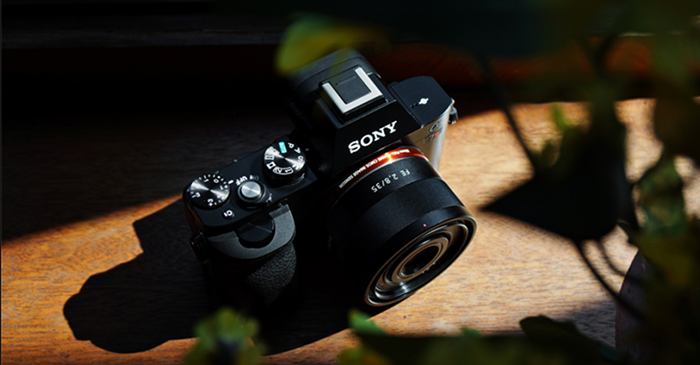
Image source: SLRclub.
We have three sites with interesting test on the new Zeiss 35mm f/2.8 FE lens.
Leica Boss is the first site mentioning an important flaw of the otherwise great Zeiss 35mm f/2.8 FE lens:
“That problem is some significant color shifts that are in a bizarro “target” pattern that can make correction an absolute nightmare.” It can be fixed “with some effort by using Adobe Labs “Flat Field” plugin for Lightroom“. But overall you shouldn’t be worried because “In the vast majority of images, this color shift will not be visible.“
Photographyblog writes:
At f/2.8 it may not be as bright as some people might wish, but at a mere 120g and 3.6cms in length, it makes for a very portable full-frame package when mounted on the A7/A7R, delivering great image quality with the minimum of fuss, including some lovely bokeh effects when shooting wide-open.
Dearsusans writes:
Although much of the Zeiss DNA is present (fantastic optics, crappy lens cap

SAR note: I own the that lens and had little time for testing yet. I actually like the lens performance and havent’ noticed the flaw mentioned by Leica Boss on any of my (few) pictures. But I still think the lens price is too high for what it does. Hope third party lens makers will soon give us cheaper FE lens alternatives.
—————————————————
Specs and Preorders in US and Canada:
Dedicated Sony announcement page at Amazon US (Click here).
Sony A7r body at Amazon, Adorama, BHphoto, SonystoreUS. TheCameraStore Canada.
Sony A7 body at Amazon, Adorama, BHphoto, SonystoreUS. TheCameraStore Canada.
Sony A7 with 28-70mm kit lens at Amazon, Adorama, BHphoto, SonystoreUS. TheCameraStore Canada.
Sony RX10 at Amazon, Adorama, BHphoto, SonystoreUS.
Zeiss 24-70mm at Amazon, Adorama, BHphoto, SonystoreUS.
Zeiss 35mm at Amazon, Adorama, BHphoto, SonystoreUS.
Zeiss 55mm at Amazon, Adorama, BHphoto, SonystoreUS.
70-200mm A-mount at Amazon, Adorama, BHphoto, SonystoreUS.
Sony A-Mount to E-Mount Lens Adapter at Amazon, Adorama, BHphoto.
Sony A to E adapter with mirror at Amazon, Adorama, BHphoto.
A7/A7r leather case at Amazon, Adorama, BHphoto, SonystoreUS.
A7/A7r vertical grip at Amazon, BHphoto, SonystoreUS.
Sony W Series Battery Charger at Amazon, BHphoto.
Sony FA-CS1M Off-Camera Shoe at BHphoto.
Semi-Hard LCD Screen Protector for A7-A7r at Amazon, BHphoto.
Specs and Preorders in Europe:
Sony A7r body at Sony DE, UK, FR, IT, ES, NL, BE, CH, AT, SE, FI, NO, PT, WexUK, WexDE.
Sony A7 body at Sony DE, UK, FR, IT, ES, NL, BE, CH, AT, SE, FI, NO, PT, WexUK, WexDE, Amazon UK, Amazon DE, Amazon FR.
Sony A7 with 28-70mm kit Sony DE, UK, FR, IT, ES, NL, BE, CH, AT, SE, FI, NO, PT, WexUK, WexDE, Amazon UK, Amazon DE, Amazon FR.
Sony RX10 at Sony DE, UK, FR, IT, ES, NL, BE, CH, AT, SE, FI, NO, PT, WexUK, WexDE.
Zeiss 35mm at Sony DE, UK, FR, IT, ES, NL, BE, CH, AT, SE, FI, NO, PT,
Zeiss 55mm at Sony DE, UK, FR, IT, ES, NL, BE, CH, AT, SE, FI, NO, PT
Zeiss 24-70mm at Sony DE, UK, FR, IT, ES, NL, BE, SE, PT
Sony G 28-70mm lens at Sony DE, FR, IT, ES, NL, BE, CH, AT, SE, FI, NO.
Asia:
A7r at Digitalrev.
A7 at Digitalrev, Amazon Cina.
A7 with 28-70mm lens at Digitalrev.
61 Responses
I’m very curious to see a comparison between the Zeiss 24mm f/1.8 on APS-C and this one on FF !
I own the 24mm 1.8 and A7R (before NEX7) and tested the 35mm in the store. Sorry for not having any side by side pixel peeper shots, but here my impressions.
The 24 is sharper in the edges at F2.8 than the 35. Bokeh is smoother on the 24 and DOF around the same on both wide open. Color and contrast are superb on both, no difference. Close focussing is much better (around 10cm vs 35cm) on the 24 making it much more versatile. Focus speed is about the same on A7R. Yes 24 is a bit bigger, but it balances better on the A7 imho and it’s might help to hold it more steady. Also 1.8 vs 2.8 aperture is 1.5 stops advantage, 24mm will be better in low light.
If you own the 24mm and can live with 15MP crop vs 36MP in your pictures I would not recommend to “upgrade” from the 24mm to the 35mm. Pictures won’t “look” better.
One thing I couldn’t test was: Does this tiny lens hood fit on the 24mm??
“Also 1.8 vs 2.8 aperture is 1.5 stops advantage, 24mm will be better in low light.”
There is no low light advantage when comparing 35/2.8 on full frame to 24/1.8 on crop frame, is there?
1.5 stop advantage – it’s got nothin to do with cropping 😉
Sure there is. Use both lenses on the same sensor (only possible on A7r or A7) and you will get 1.5 times shorter shutter speeds or 1.5 times lower ISO with same exposure on the 24 1.8. Focal length has nothing to do with that as well as sensor size doesn’t.
If the sensor area is smaller, then you got more noise. To make the noise equal you have to lover ISO when using 24mm F1.8. The result is: no advantage over 35mm F2.8. This is the theory. Sensor technology is the thing that matters in this case.
@ Magnus
But if you use them both on the same sensor (A7r)? That’s what I’m talking about, 24 as alternative to the 35. Per pixel sensitivity stays the same, no matter how much your lens covers. So end result is less Megapixel but better low light performance by still 1.5 stops.
@Hans:
You can’t measure the noise at 100% on your screen, it has to be on paper at the same size. You will then enlarge the noise with the same amount of F-stops as you crop the sensor. 1.5 steps…
Hans – in crop mode the pixels are effectively larger and so is the visible noise.
@Magnus – I think we’re mixing apples and oranges here. You are essentially talking about pixel resolution for print where the topic is about light gathering ability of two lenses, one is f/2.8 and the other one is f/1.8.
These two have nothing to do with each other.
They have everything to do with each other if the f/2.8 lens uses the full sensor while the f/1.8 uses crop only. This makes them exactly equivalent.
OK, Lotus Eater, I’ll leave you there with it 😉
From the third paragraph in dpreview’s Sigma 18-35mm f/1.8 review. It explains this issue very clearly:
“Sigma’s choice of F1.8 as maximum aperture isn’t a coincidence; it means that the lens will offer the same control over depth of field as an F2.8 zoom does on full frame. What’s more, it will also offer effectively the same light-gathering capability as an F2.8 lens on full frame. By this we mean that it will be able to project an image that’s just over twice as bright onto a sensor that’s slightly less than half the area, meaning the same total amount of light is used to capture the image. This is important as it’s a major determinant of image quality. Essentially it means that APS-C shooters will be able to use lower ISOs when shooting wide open in low light and get similar levels of image noise, substantially negating one of the key advantages of switching to full frame.”
OK Lotus Eater, so how’s that relevant to cropping?
@hexx:
I’m not mixing anything here, I promise. Think this way: a very small sensor is noisier than a very big, even if it has more pixels than the big. The conclusion of this is that the sensor area is all that matters. Therefore the smaller sensor the bigger F-stop you need to compensate. (Or lower ISO)
Sorry, AND lower ISO!
I’m struggling to see how it can be explained any more clearly.
The 24/1.8 is a crop lens that has to be used in crop mode on the A7(R).
The 35/2.8 is a FF lens that uses the entire FF sensor.
The 24/1.8 by its very nature is relevant to cropping. When cropping, weather in PP or because of the fact lens you are using a crop lens on a FF sensor, you increase the image noise as a whole. Yes, the 24/1.8 has a faster aperture compared to the 35/2.8, but that only serves to compensate for disadvantage it has in being able to project only an APS-C image.
Nice “theory”, but in practice at same ISO the shutter speed will be still higher or at same shutter speed ISO will be lower on the 1.8 lens. Now you show me the picture that scaled down from 36 MP at ISO 20.000 to 15 MP looks like 6400 ISO in 15 MP. I prefer to take the 15 MP straight out of the camera.
Oh yes, and I know I’ll keep my 24 1.8, it focuses closer and bokeh looks better 😉
Not sure where you got 20,000 from.
It is interesting how we differ though. I prefer to shoot RAW. 😉
ISO 6400 + 1.5 stops = around ISO 20.000
Who said I shoot JPEG? I get 15 MP RAW out of the A7R in crop mode and these files look great.
This is hard work.
The difference between f/1.8 and f/2.8 is 1 1/3 stops. To get the same shutter speed on f/2.8 as f/1.8, you would need ISO 16000 if the f/1.8 is at ISO 6400.
Besides 1.5 stops is ISO 17600.
fyr,
a comparison between A7+24/1.8 and Nex 6 + 24/1.8 http://www.mobile01.com/topicdetail.php?f=254&t=3656877&r=3&last=47564753
the tester’s summary: Nex 6 + 24/1.8 is better than A7 + 24/1.8
And more importantly, SEL35F28Z with the A7 is better than SEL24F18Z with NEX6
I do hope Sigma will release their ART series for ZE mount.
Oops..FE mount
The 35 is much too expensive, the 55 in comparison is a complete bargain.
In comparison, that is.
I have absolutely no problem paying $1000 for a fast lens. 2.8 is not very fast…
I too hope Sigma will releases their awesome lenses for the FE mount.
I am so tired of reading about the same A7 or A7r, Please admin, can we move on?
here is your link:
http://www.sonyalpharumors.com/category/rumors/
Please ignore the rest and let us others read it peacefully. Thank you!
That’s a pretty significant flaw, but it’s also the first time I heard it.
Either way, the 35 is overpriced. For what it does 500USD is the most i can justify.
May be a flaw in his lens, would need to have more people test their lenses to find out. He also had to use a lot of adjustments to make it visible. Looks like an interference fringe, might be due to a slightly less then ideal mating between two lens elements.
Doubt it’s just my copy. I’ve got reports from two friends on the same issue – and Lloyd Chambers has similar findings.
You really need to be shooting an overcast sky, fog, or neutral toned walls, etc. to see it.
The real problem is when you start post-processing images, the shifts come out and it’s irritating for images you care about.
I’ve just noticed the weird bullseye colour shift on mine, pointing it at an off white wall. I haven’t noticed it in any real world pictures, and I’m otherwise really happy with the lens…
Pardon me if this gets posted twice. IE crashed when I hit submit the last time!
So, out of curiosity, I put the lens on our NEX-6 and then our NEX-7. After turning Vibrance and Saturation all the way up in LR, the NEX-7 showed the rings all the way into the middle of the image. The 6, on the other hand, showed no rings at all.
I suspect (and this is purely speculation) what we are seeing is the result of interference patterns caused by the coatings and the sensors. In the case of the NEX-6, either the sensor layout or the AA filtering keeps it from happening.
If this is true, perhaps Zeiss can change the coatings so that there is not a uniform pattern that can interfere with the sensors.
??
Kim
If you can only choose one, would you buy this 35mm f2.8 or 55mm f1.8?
If you can only choose one, you shouldn’t invest in an interchangeable lens camera system 😉 RX1 is there for you!
I’d get the 55/1.8 and then wait for Zeiss to announce their FE primes…
I’m quite sure they made the 35/2.8 in order to make a 35/1.4 more marketable in the near future.
…and ask more for it
I have the 35mm now. It’s fine, focuses fast, sharp, and has no such problems as what the Leica Boss guys see. Maybe they have a lens with uneven coatings or something.
Anyway, I will be sending it back and getting the 55/1.8. I used to have a lot of love for 35mm focal length and somehow it is lost. While there is nothing actually wrong with this lens, it’s also nothing very special for a 35mm lens. This focal length… the way it’s typically used, it does not NEED to be sharp corner to corner, it NEEDS to be faster. f/2 minimum.
At any rate, the 55/1.8 will be great, i’ve been shooting with something similar for the last 7 months but with about 1 stop less shallow DOF, the 55/1.8 samples are much better IQ and a stop better DoF control. I can’t wait. Until then, I will stick with Canon FD 24/2 and 100/2, RMC Tokina 17/3.5 (not super sharp but super small and fun to use) and PC-Nikkor 28/3.5. All great lenses on this camera (A7).
have you ever used the olympus om 24mm 2.8? The reason I ask is I read some place that the canon 24mm f2 that you have is better and I am considering picking up a copy of the canon.
Update:
Now I’m looking for this problem and two very serious issues have come up:
1) I am able to detect it vaguely on the 35mm if all the color in the frame is pretty much the same (not just white, I have no white walls)
2) EVERY LENS I PUT ON THIS CAMERA SHOWS THIS SAME PROBLEM which means it is not the lenses. It’s the camera.
I have an a7. This is very disappointing.
I still dont suffer from amyasthenia, sorry Zeiss, Next try.
@Vamp898
“I still dont suffer from amyasthenia, sorry Zeiss, Next try.”
Are you sure?, your finger muscles may not be working quite as well as you think , assuming you mean Myasthenia 🙂
Seems like im not strong enough to hit the space bar properly 😀 i really should consider buying an A7 😀
And by “this problem” I mean the colored concentric circles of magenta/cyan or green.
..here came the great Sony show:cheap body, and overpriced& and not so good lens..;)…they know how to do lots of money!
Chapou Sony!
Oh yeah, better buy the F1.4 Sigma and enjoy slightly better performance in a 5 times bigger and 5 times heavier package. Understand the difference?
…slightly better???…you don’t know what you are talkin about..
performance has nothing to do with speed. Sure 1.4 lens has advantage above 2.8. But the disadvantage is that it’s much heavier. People wouldn’t dump their DSLR for a fat lens like this on a small body and that’s what Sony wants. But who am I, I don’t know what I’m talking about…
The 35mm Sigma is an excellent performer while obviously heavier it is also a full 2 stops faster.At F2.8 the Sigma is excellent from corner to corner { based on use on my D800} .Size is not the only appeal of the A7r, for Canon users in particular access to a high MP sensor { that is better than their alternatives} is reason enough to want it.
I will certainly use a small selection of my Nikon lenses on the A7r body when I want a certain feature/speed or quality regardless of size.The fact that I can mount a smaller slower prime like the 35mm F2.8 is a bonus for when I need it.
There does seem to be a bit of a price premium on some of the lenses for the Sony system { UK} the FE35mm is £700 here that is almost a £100 more than the Sigma. The excellent and equally diminutive Canon 40mm F2.8 is only £144
A7’s body is not cheap. It is study, on very high quality. Very pleasant handling and touch. It is only not on the unbeatable RX1-Leica level.
sturdy : )
A7 not cheao????…the chepest FF body on the market…
He means it doesn’t feel cheap.
35mm crappy in the corners? No thanks. 55 1.8 looking better every day. What’s even looking better than any of this is Olympus OMD. Sorry, it’s just the way it is. Must…wait…for…better….lenses.
you’re seriously comparing a mft to a ff sensir and saying it is better?!
There was a time when I only shot a FF for a wedding shoot. This year I shoot the FF for the important portrait shots. But the reception and even group shots I have migrated to an EM5 and now to the EM1. But I do miss Sony colors in the images. The FE system interests me but I will wait a year see how things play out. Right now I am happy with the a77, a99 and the EM1. I don’t think I will be shooting with Oly primes in the range of the 12-40mm f2.8 it is that good (I had 4 days of shooting at two events this last week and I am impressed). With the EM1 I will only need three lens. The Panny 25mm f1.4, 12-40mm f2.8 and the Oly 75mm f1.8. I decided not to go with higher end lenses for my Nex 6 and 7. I love the choices we have.
At the rediculous price point and slow f2.8, this lens should be flawless. One more nail in the coffin of zeiss’ reputation. Guess they just sold themselves out.
The comments here don’t make much sense. What a waste of time.
So sad news. I have found this bizarre target pattern problem appears with all lenses I put on the Sony A7. It appears on the RAW files. It also seems to be directly related to the shadows in the image. I say this because in my tests the target pattern is not centered on the center of the frame. Due to the way I lit the wall, with a bounce flash, the brightest spot is nearer the top of the frame and the circle radiate from there with most strength as the exposure falls off away from that point.
The upside to this is that it is almost certainly a firmware-fixable problem. It’s obviously an attempt by Sony to cook the RAWs to try to deal with peripheral shading and score better benchmark tests. They made a similar change to the NEX-7 to deal with the color shifts from the 10-18mm lens.
And this is probably also why “normal” images don’t show the problem. Whatever algorithm they are using is probably tripped up by large fields of consistent color. This could really screw someone over who was shooting some snowy landscape scenes or something, though.
Anyway, I’ve tested with an RMC Tokina 17mm f/3.5 lens adapted, a PC-Nikkor 28mm f/3.5 lens (0 shift, adapted), and the 35mm f/2.8 all at f/8, 1/100th shutter, 100 ISO, AWB set to flash, lens compensations off, EFCS off, and checked the RAW files (and the JPEGs) and the problem appears with slightly varying patterns, related directly to the shading, on every lens. Tomorrow I should receive two more lenses that I can test out for the same issue.
I’ve taken some time to do closer investigations into my existing images since identifying this odd problem. The interesting thing is that I was only able to find certain evidence of this behavior in one image out of a few over a hundred. That image also had a similar bright middle and faded periphery lighting pattern.
It seems like the issue is isolated to images that resemble vignette test images.