







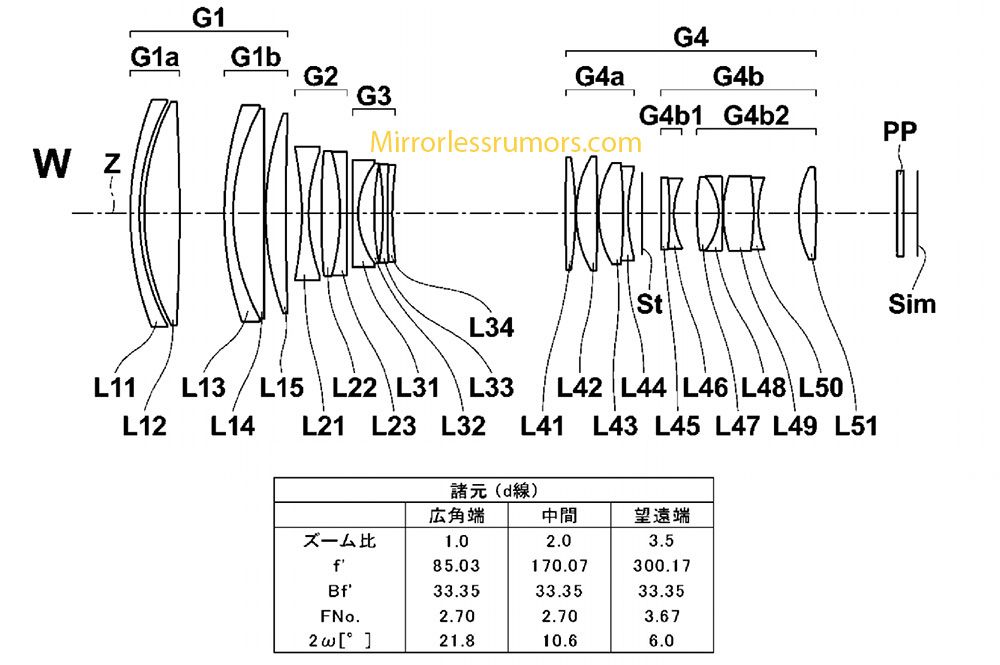
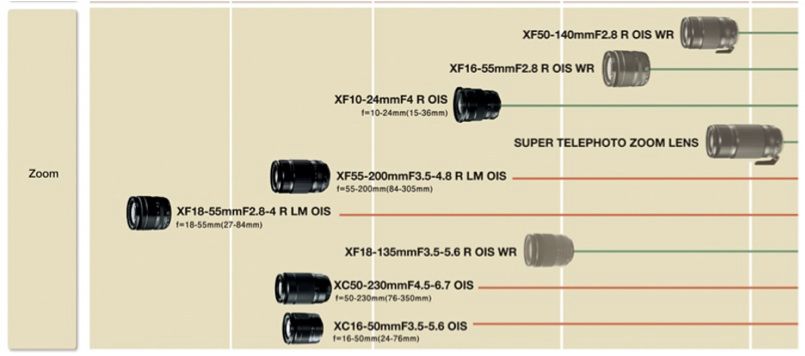
Mirrorlessrumors spotted a new Fuji patent. The Fuji patent, published here, shows a fast super telephoto zoom lens, the XF 85-300 f/2.7-3.7. It’s a patent, so the figures could change. Also the XF 56mm (best seller at AmazonUS) changed from f1.4 to f/1.2 on my birthday last year (April 17th).
A new source told us previously here that the lens would be a 120-400 lens (equivalent or not, the source did not specify).
cheers
 facebook, google+ and twitter
XF lens deals
BHphoto: New Benefits for International Customers: PayPal now open to all countries!
XF 14mm: $200 off (price $700) at BHphoto / Adorama / AmazonUS / Pictureline
XF 18mm: $200 off (price $400) at BHphoto / Adorama / AmazonUS / Pictureline
XF 23mm: $150 off (price $750) at BHphoto / Adorama / AmazonUS / Pictureline
XF 27mm: $250 off (price $200) at BHphoto / Adorama / AmazonUS / Pictureline
XF 35mm: $150 off (price $450) at BHphoto / Adorama / AmazonUS / Pictureline
XF 60mm: $250 off (price $400) at BHphoto / Adorama / AmazonUS / Pictureline
XF 55-200: $200 off (price $500) at BHphoto / Adorama / AmazonUS / Pictureline
EU-ORDERS: Luzu: “Choose UPS for international delivery, their option “UPS Super Saver” for around 45$ is the cheapest anyways. If you “pay on delivery”, UPS will handle all the customs work for you and deliver the item home to you where you pay the customs costs directly to the mailman. No going to customs office needed! Declaration of the deliveries from B&H is made very professionally by them and UPS, so I guess German customs are seldom stopping them. I already ordered two lenses this way (the 27mm and the 55-200mm) without problems! Btw.: The delivery is by plane and super fast … around two days only!”
64 Responses
A fast telephoto and a true 1:1 100mm macro lens is all that is really missing for my fuji. 100 – 400pm, even if it is f4, would be great too.
Now, I just wish Fuji would provide us with a firmware update to provide us with the ability to save in-camera conversions as tiffs, or as the new lossless 14-bit jpegs. Billy, the Fuji Guy, was talking about it last year, but they didn’t follow through with it.
That new lossless JPEG format is 12 bit. Still a lot better than standard JPEG. I wish TIFF was an output format for the Fuji cameras and not just from manual raw conversions. Higher end Nikon DSLRs can be set to store images as TIFF as opposed to RAW, for example. For me, that would take care of any RAW converter issues. I usually like the JPEG output anyway. TIFF would allow for better color correction when that’s necessary.
Also, there is a 1:1 macro coming for this system from Zeiss. 50mm f/2.8 Macro, supposedly coming in April or May.
Yes, I would love to have TIFF as an output format as well. Hopefully they introduce it soon. I have found that the in-camera converter is better than Capture One, which, in my opinion, is the best option for external raw converters for Fuji files. Thus, if we had Tiff output with and without the in-camera converter, that would be great.
By the way, 50mm is a little to short for macro, in my opinion. But, who knows, it may turn out to be a good lens.
I believe Billy can only make ‘suggestions’ just like us.
Interesting. Looks like a better lens than the 55-200 but not enough length and subject isolation for wildlife. Hopefully just the first step. They really need something like a 400mm f5.6 prime out there. Or maybe f4 or f4.5. That would really be awesome and very needed. The Nikon 400 f5.6 AIS is quite slim compared to the f2.8 brethren. They could easily add AF and IS to a 400 f5.6 and it would still be easy to handle.
You realize 300/3.7 is better than 400/5.6, right? 81mm aperture vs 71mm?
Better is subjective. To me the longer focal length is better than the theoretical objective lens size. A wildlife photographer needs longer lenses. And a prime 400 f5.6 can be optimized to be sharp wide open and likely much sharper than what will likely be an f4 at tele end zoom.
The 300mm translates into 450mm on a cropped sensor. Should be enough for most wildlife.
Not even close, especially for medium sized or smaller birds. 600mm is about the minimum required for those. Also many subjects are very shy or inaccessible. It’s generally considered that 300-400 is about the bare minimum. Otherwise why would there be a 400, 500, 600, and 800 prime out there? Or the SigMonster? Or similar. You can never get enough focal length as a wildlife photographer.
Really seems like you need a different system. I have not known anyone who actually uses a 600mm lens. But if that is what you need, Canon and Nikon both make them. So does Sigma.
Or maybe I can want something for the system of my choice? I have known quite a few people who have 500+ lenses.
Then wait…like I give a crap!
And here I thought my needs were your top priority.
Looks like disqus swallowed my reply. 300-400 is considered the bare minimum for wildlife. That focal length is only useful for large game or very approachable wildlife.
Sweet mama!
I wish the super telephoto zoom would have 400 mm at the tele end for wildlife photography. If the lens really is this 85-300, I hope it has the compact size and at least the quality of the Canon 70-300 L.
IT actually translates into a 450mm on the long end with a cropped sensor camera. If it is a 3.7 on the long end then I would expect it to be about the same size as the 70-300 L
I meant 600 mm on the full-frame format. I don’t also think the super telephoto zoom will be as compact as the 70-300 L, as the Fuji lens looks like it will be at least 20-30% longer than the Fuji 50-140 f/2.8. (Lens length: Canon 70-300 L 14.3 mm, Fuji 56 f/1.2 69.7 mm)
Just a small correction of the length to make sure that people don’t think the Fuji lens would be longer than the Canon one.
Length of the Canon lens is 143 mm, so twice as long.
Thanks for the correction. It seems that the Fuji super telephoto lens will be roughly 20 cm long.
It will be nearly as compact as the 70-300 if you take into consideration the extra space in the optical path that is provided by the mirrorbox in an SLR.
It may be slightly longer, but, it will also likely be a better performing lens. Since Fuji’s roadmap indicates it will have a tripod foot, they are probably designing under the assumption that it’s just a big ol’ lens, taking full advantage of this and making it really shine as opposed to the 70-300mm lenses of Canon and friends that are only just okay, but, light and easy to handhold. They also don’t include a tripod foot.
I think the lens to compare to will be the 100-400 class, in all aspects except the absolute focal lengths. Use cases, build quality, performance expectations, and even subject isolation should be comparable. Also price, most likely.
I very much doubt that fuji will be making a 600mm equivalent for the X system any time soon. $$$. 400mm is about as far as most people really want to go, so the sales would be very low I think.
The math doesn’t work for it being the same size as the Canon. The Canon is f/5.6 at 300mm so the front element must be 54mm in diameter at minimum. This lens is f/3.7 at 300mm so the front element has to be at least 81mm in diameter. The Fuji has to be significantly thicker resulting in a heavier lens since the front element is a lot bigger.
f3.7 at 300mm is good.
But 300mm is not long enough for wildlife, even on APS-C.
But if there is a matching 1.4X Teleconverter it would be OK, provided IQ did not suffer.
Great. Before long we’ll have fuji cam / lens combos that look like a nikon 400mm mounted on a mirrorless nikon J1 body. I remember not too long ago the laughs the Sony NEX cams were getting for the disproportionate ratio of lens-to-body size. The 55-200 is already pushing the envelope but I guess they think there’s enough wildlife / birders out there with X-series cameras to continue developing super-telescope. Weird.
Supertele is a dream lens of many amateurs; it’s a promise that you can get close without actually getting close. A lot of photographers use their camera as a shield; long lenses help.
Even for wildlife photographers it takes quite a lot of time (and money) to realize that 400-600mm range is for the birds, not for big mammals.
Maybe there is not ” enough wildlife / birders out there with X-series cameras” precisely because there are no lenses for them to use? FL range is the first thing which has to be covered, lenses like 27/2.8 is just a distraction which should have been postponed AFTER both UWA and long tele zooms are there, and after constant aperture pro zooms are there.
It is possible to own more than one camera in more than one system, you know…
Yes, it is, but it’s unlikely if you’re a reasonably sane amateur :). Translation: if I don’t make money from photography I won’t own two different systems – mounts, lenses, chargers, batteries, cards etc – irrespective of how much available income I’ve got. Yes, I know the soccer moms with 2 5D Mkiiis and 1Dx, but those are not the vast majority of customers, I would assume.
Fuji is aiming to make a complete system. Calling 450mm equivalent a “super telescope” is some ridiculously extreme exaggeration. Fuji has said in interviews they are looking to compete with professional photography gear from Canon and Nikon. Both of those systems offer a 80-400/100-400 type of lens. It’s considered a standard offering and only incomplete camera systems lack it.
And whining about camera size versus lens size? What is this, fashion school? You couldn’t possibly think of anything legitimate to complain about so you invent this non-issue.
Fact: Fuji has all short focal length concerns covered as of the currently announced lens lineup. There is no legitimate reason to be concerned that Fuji will offer a longer lens for those who want it. You can’t even whine that it’s slowing down releases of more conventional lenses as those are already coming out ahead of the super telephoto.
Awww….look — Moose Peterson Jr. is upset.
There are some who think that Fuji’s development of super-tele lenses (over 450mm) is desirable, justified by the competition, or useful for more than just the weekend wildlife shooter. I’m not one of those, but you’re entitled to your opinion. If nothing else, its you that’s been whining about the lack of these mega lenses and now you get what you want and you expect everyone to agree with your zeal.
The one inescapable fact you conveniently overlook is the premise behind MILC is, and ALWAYS has been, smaller / lighter than traditional DSLR systems. In case you missed it, one of the most flaunted raves on this and other MILC forums come from those “ditching” their FF / DSLR systems for MILCs. When you start adding fast telephoto zooms (or primes) to the mix, you ARE adding a lot in size / weight and DEFINITELY cost, and not everyone agrees with you that this is the way to go.
Given the state of the camera economy globally, I think Fuji should continue to focus on evolutionary improvements in their cameras and lenses in the 10-300mm range and forego worrying about “rounding out” the lens lineup by competing with Nikon and Canon in the “wildlife” shooter segment.
I’m not sure if you are aware of this, but, *all* of Fuji’s lenses so far, and all the way until this very last lens on their roadmap fit into your stated 10-300mm range.
Also, stating that the the premise behind a mirrorless camera is one thing or another is pretty obtuse thinking. Perhaps you are unaware of the industry as it is today, but, the only other fairly complete mirrorless offering is actively targeting the same broader range of photographers and foregoing pure size benefit in favor of covering more total capabilities. Easily the most popular mirrorless camera right now, at least among mirrorless enthusiasts, is the Olympus E-M1. And, the next “pro” lenses advertised by Olympus includes a 300mm f/4 that is anything but compact. The E-M1 is larger than the X-T1.
Mirrorless camera design offers more benefits than simply size. Eliminating the extremely complex and expensive flipping mirror mechanism and associated pentaprism, which has pretty much hit its maximum peak in terms of technology years ago, is of far more overall benefit than simply reducing size. For one, it opens the possibility of full time focus tracking even during exposure which is impossible in an SLR design without incorporating the same components introduced primarily by mirrorless cameras which would be redundant.
Also, you can make small SLR cameras. Have you not seen the Olympus PEN series, the original, not the mirrorless digital cameras? It’s a half frame camera with a sideways moving mirror that is as small or smaller than most mirrorless cameras, even the very small ones. This model could easily be used as the basis of a digital camera with only a small amount of bulk added. But why? It’s complex, it adds moving parts, expense, and is merely representative of the past limits of film shooting.
And besides, the true curiosity here is to think that somehow producing one large lens suddenly makes all the other lenses larger. If all you care about is size, I’m pretty sure you can still buy a Pentax Q somewhere. Or just stick with the Fuji primes while the rest of us are happy to see more options in the same system. Do you make the same questionable criticism of Fuji producing the 10-24mm ultrawide zoom? It’s actually quite heavy and large! Does that anger you too?
10-24 in APSC = 15 – 36 = a perfectly appropriate range for a wide-angle zoom. This isn’t the subject of this thread. I am specifically referring to this perception that Fuji should be vested in the super-tele lens side of the business in excess of a focal-length equivalent of 450mm (300mm lenses) when that isn’t the target market for 95% of the type of consumer who’d buy into the X-system. There are INFINITELY more shooters who’d go for a wide-angle zoom or prime compared to a tele in the 500mm+ range – vastly more. So much so I think the 10-24 is brilliant.
Once again, read my postings above. I’m talking about lenses in excess of 300mm (450mm FL). Maybe YOU haven’t noticed, but you don’t see a bunch of OLY PEN shooters out there with 400mm lenses hiding in bushes shooting moose from a 1/4-mile away.
NO CLUE what you’re talking about: “…somehow producing one large lens suddenly makes all the other lenses larger.” I said nothing of the sort, so stop reaching.
Here’s something you can’t argue Zach, and that is that for a whole helluva lot less money than Fuji would want for the same outfit, one can buy a Nikon 24mp D3200 / 5200 / 7000 / 7100 and a 70-300mm VR zoom lens. THIS is why Nikon (and Canon, in their respective lineup) continue to be the choice for consumers worldwide. I have an XE-1 and 3 Fuji lenses and it’s great. Still, I shoot portraiture for money and use Nikon FF and 24 – 200mm glass. I have a Sony RX100 that’s terrific for what it does best, and that’s a go-anywhere indiscreetly camera that takes incredible photos.
I’m not angry at all. I don’t see the business sense in making 500mm equivalent lenses at tremendous cost for what is undoubtedly a mega-minority of Fuji X- shooters. You do. You can search every internet forum online and you’ll find thousands of posts from people like myself who wonder what the benefits are in investing in MILC systems as they grow larger and heavier and more expensive compared to the DSLRs that do every bit the same job for a fraction of the cost now. I care more about seeing Fuji hang in the market than I do them catering to every whimsical fantasy product that amateur photographers can dream up, yet would sell in micro-volumes. If you don’t get that then you don’t.
Ciao.
Yes you are adding bulk, no doubt. The win for us is the option. I can use a light X-E2 and some light primes/zooms for things I need. I also can get a longer telephoto, put it on a tripod (as it should be) and shoot away with something heavier. Options, that’s what a system is about.
If Fuji wish to expand body sales they need more lens options. 50-140 f2.8 & a 120-400 f5.6 would pull in many enthusiast sports/wildlife shooters (especially as Canikon do not have this combination for APS-C format). A 120-400mm f5.6 Fuji X lens would mean I could finally sell my remaining Nikon gear, and have more money to spend on Fuji X-pro2, X-T2, improved Fuji flash system………..
Calking “The one inescapable fact you conveniently overlook is the premise behind MILC is, and ALWAYS has been, smaller / lighter than traditional DSLR systems.”
And they are. I used to use Canon’s 100-400L f/4.5 – 5.6. That was a terrific lens but was massive and weighed in at 1380g. The 55-200 weighs in at 580g but is not quite the 400mm equivalent but I can’t see any future lens being a further 800g more!
The problem a lot of people have is they see “MILC is smaller than DSLR” and think it means it’s MILC is small. They apply their own realistic unexpectations on how big these lenses will be. Well, short focal lengths can be but when you go for longer lenses, it won’t. What it will be is a lot lighter & smaller than the DSLR equivalent.
I personally think they should offer a full range of lenses, including ones that would appeal to “wildlife” shooters. Why not?!? Yes they may be big but they won’t be as big as DSLR lenses and the cameras won’t be either. Let’s share the Fuji joy to all types of photography.
If the min/max focal length and apertures are correct then the lens doesn’t seem to make sense, given the planned introduction of the 50-140 and 18-135 and the existing 55-200, as there is a large overlap of focal lengths with these lenses.
A 120-400 would be a 180-600 equivalent and would make a good pairing with the 50-140. However, given the quoted apertures, one possibility is that Fuji are looking at the lens as a pairing with the 16-55 f2.8 and accepting the gap between 55 and 85 mm.
Agreed. Makes sense to me.
yes, photographers still have their feet to cover that gap, or enough money to indulge in an overlap 🙂
Sad, that fuji doese not planning 90mm lense 🙁
Do I count correctly 24 lens elements? Is that normal?
Look at Sigma lens constructions sometime.
I would like to see a longer lens, but, will definitely buy this if it is what we get for our super telephoto zoom. Some think this isn’t long enough for wildlife, some think it’s more than long enough.
You are all correct.
Whether this is long enough depends not only on what kind of animal, but, the kind of shot you want to make and the method of approach you use. Most amateur, even serious amateur photographers are not willing to use blinds and hunter techniques to get within close range of their “prey.” There are definitely methods that make 400mm equivalent more than sufficient for anything.
However, on some creatures, your safety trumps these options and pushes you towards longer lenses. Safety is one reason to want a long lens even with all options available. Another reason is conservation. Some animals are rather sensitive to human presence and it is the “right thing to do” to stay back and use a longer lens.
Also, sometimes, it’s just a huge pain to get close. Recently I was photographing birds on a lake, thousands and thousands of snow geese, and frankly, there was no good way to get close to them unless I was going to scuba dive in a drysuit or something, never mind that half the lake was iced over and it was 44ºF out there. I had a 750mm equivalent lens and it was not even close to long enough to get any nice landing/takeoff shots of individuals. It took hours of waiting just to get a handful of flyovers.
So yes, often a 85-300 on APS-C will be totally sufficient for wildlife (and sports, and racing, and whatever) but sometimes there simply isn’t a long enough lens and you will happily take every extra mm you can get. Of course, in these situations, you can always rent a Nikon D7000 and Nikkor 800mm with the fluorite glass. Not cheap, but, then you get to see how much you care about getting your shot.
One other note I would mention. When I last spoke with a Fujifilm representative, this lens came up and his first statement was that landscape photographers had been requesting it. Landscape photographers. It’s entirely possible that the super telephoto Fuji has planned isn’t even geared towards wildlife photography. Imagine that.
If this lens has been targeted for landscape photographers, it should be very lightweight and incredibly sharp.
I wouldn’t necessarily think so. It should have a very good tripod collar with integrated arca swiss dovetail.
An integrated arca plate is just the kind of awesome thing I could believe Fujifilm would do, especially with the new grips including arca dovetails.
Lightweight? That tends to cause more problems than it solves for image sharpness. That said, I am far more likely to believe that while landscape photographers might be a primary source for the demand, that the actual lens will attempt to appease as broad a range of long lens shooting as possible so that Fuji can further increase their appeal to more photographers.
Also, in all this discussion, it’s important to remember that this is just a patent. Patents like this often represent lenses that are never produced.
There’s no mirror flop and no inner resonance inside of the lens with the mirrorless, so I don’t see any problem with the landscape tele being lightweight.
With all the glass on the patent file, I think we can forget about lightweight…
If its a landscape lens the AF may not be very fast 🙁
120-400, or 128-450, what’s the difference really? haha I too was looking forward to a hair more reach BUT if the size is reasonable and its that fast of a lens, I’ll take it!
Any word on whether it is a WR lens?
No, cause it’s not a lens, it’s a patent application (not even a patent as it is not granted yet). And WR is patented (filed) separately. Yet, I hope that they will combine these two filed technologies in one product 🙂
I wonder if this lens design will be based on the premium Fujinon Cabrio 85-300mm T2.9-T4 for PL mount shown here: http://www.fujifilmusa.com/shared/bin/PL%2085-300%20Cut%20Sheet%20HiRes.pdf
Costs about 1399$???
Are you all sure this lens is for the x system? I cant read japanese, but in the english text parts I can not find something like x mount or xf lens.
The X-mount has already been patented and they would be stupid to limit the use of this lens design to a certain mount (whether or not they intend to use it for any other (future) mount).
I don’t speak Japanese so could be wrong but does the patent description really state that this lens would remain the F2.7 aperture at 170mm!?
If yes, this would basically be the 50-140mm F2.8 AND a 450mm FF equivalent all in one lens.
AWESOME!
blarp
or this is already in 35mm eqv term?
85mm makes it 56.6mm which kind of matches the 56mm we already have. and going to 200mm? but we have two lens in 55-200mm range already.
Still holding out for my 100,000-1,000,000mm F 0.85
you probably misstyped: you mean 10-1,000,000mm at f0.85, right?
Now, things become really interesting as to how to compose the ideal photo-bag on X-mount!
I am definitely sold on the 10-24mm (I love landscapes at the wide end), and this 85-300 (f2.8-4?) would be perfect for long ranges. Now, how to build the missing range?
The 50mm equivalent adapter on my X100s could cover one spot and maybe the new 56mm to bridge?
That much choice is a nice problem to have!