







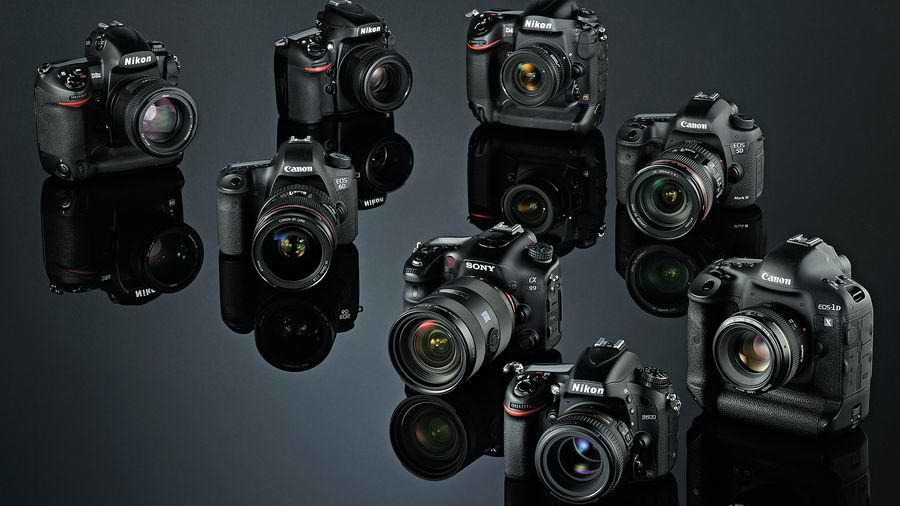
Image courtesy: techradar.
–
SAR reader Amit Zinman (http://amitzinman.com/) wrote this post for SonyAlphaRumors. If you want to write an article for SAR just drop me a message at sonyalpharumors@gmail.com. Thanks!
—-
The future of Sony (and other) SLR style cameras by Amit Zinman (http://amitzinman.com/):
I’ve decided to write this article, not really as anticipation to what’s coming right away from Sony. Though Sony did promise to revolutionize digital cameras in upcoming high end models, I am sure that some of what I will specify here will NOT find itself into these models. The idea was to write what I thought ought to be the future of professional stills/video cameras as I see them rather than a prediction of what will actually come from camera manufacturers who have have proven to be conservative, lacking a kind of a Steve Jobs type driven revolution. At this point it is kind of funny to me that a lot of the innovations are actually coming from low end mass market devices such as cellphones. Canon, another example for this lack of innovation, has the ever useful swivel LCD screens only in their mid level cameras while the seriously expensive high end models lack this obvious innovation. Sony, has really tried to be different from Canon and Nikon in that since, but there is much more to be done, some of it, as we already heard, will find it’s way into the new FF models.
So, what would I like to see in future models?
1. New sensor technology
we’ve heard of brave new patents for sensors. It seems that there now sensors that can see as well or even better than the human eye. There was much discussion here on the science of upcoming sensor technologies which went over my head. That said, it seems like that breakthrough technologies such as organic photo sensors are coming soon unless camera manufacturers fear making all of their current cameras obsolete. As Apple have shown with their iPhones, such revolution can really change a market is someone is brave enough to do it, regardless of costs. So, it’s quite simply, if Sony can deliver a camera with double the dynamic range of current Canon 5d mkIII, people will buy it, regardless of dependance on lenses and other accessories.
2. Processor
As an owner of current flagship A99 I can definitely say that it’s processing abilities are seriously weak. Take a long exposure photo and then wait a few seconds for it to process. Why? For the amount of money spent on it one should wonder. New cellphones now come with quad core CPUs, even Sony Xperia ones. You think the marketing name “BIONZ” impresses us? Not really. Maybe if you had two of those and a dedicated CPU just for apps (more about that later), now that could be impressive, especially if it would allow to take a photo while shooting video.
3. Battery
I own a few NP-FM500H batteries, and would hate buying new ones, but that might be unavoidable as the digital parts of the camera ask for more juice. Do moving parts take a lot of power? If you remove all of them as Sony is rumored to do with its future models, maybe you could fit in two batteries without the need to bulk up the camera with a vertical group as is done today.
4. RAW processing
I still can’t figure out why each camera model has it’s own RAW format. Is this a secret deal with software companies to make sure new versions of photo editing and processing suites are sold?
Adobe has a single format, DNG, which seem to work well. Can’t all manufacturers just switch to that format, or at least allow to option to shoot to DNG?
Other than that it is quite obvious that Sony should let you decide the RAW size of photos unlike the A99 which just provides the maximum size, falling (a few models) behind the competition.
5. The camera as a computer
Many of the photos you see today are taken by iPhones, and Samsung already has an entry level camera with the Android OS. You might say, so what? Who needs all these unnecessary apps on your pro camera? Things are far from being that simple. At this day and age being able to process a photo without the use of a bulky laptop and upload it to the Internet can be really useful and profitable. Sure, you can use your phone for that, but it does put a layer of things that could go wrong between you and the things that you need to do.
Also, the Canon hacking projects showed what a determined community can achieve with available camera technology. Sure, it would mean loosening the control that Sony has over it’s product, but it’s a great way of keeping your camera users happy. Say, I write an app that lets the camera write video files to the format used by my editing suite. Now that could turn some heads.
6. Video
Sony did well with the A99 1080p/50 AVCHD 2.0 video format but surely we can move beyond that to more professional format for a professional camera, such as Adobe Cinema DNG or other less compressed formats.
The separate Modes controls for video and stills on the A99 and other models is really confusing and unnecessary. It’s a part of the growing pains for camera manufactures realizing that they are making a camera that has two role, with varying importance to different users.
7. Connectivity
USB 3 is seriously needed now that cameras write more information than ever. A proper Wi-Fi option is fast becoming a useful tool for connecting your camera to the Internet, cellphone, laptop and/or monitor.
As for 3G/4G connectivity, maybe it could be an add-on. I’m all for Sony making extra bucks on some accessories.
I’m sure that Mac users will like to have a Thunderolt/Lightning interface but I doubt any camera will ever have that port if it’s not made by Apple itself.
8. Storage
SD cards seem to be too slow for the requirements of future cameras. Sony itself has two pro memory card formats, SxS used by some of its video cameras and XQD, currently used only by Nikon D4 and no Sony camera at all.
Future Sony cameras might offer a XQD option, perhaps along with SD, but I have a completely different idea.
As the removal of moving parts leaves more room inside the camera you could definitely have a fast internal 256GB drive. The drive could offload in the background to a slow and cheaper SD cards thus allowing shooters to leverage their existing cards without the need to buy new and seriously more expensive cards. It might seem weird at first but I think that many people will like not having to use cards at all ever again, as you could also backup your drive to a remote laptop in the background.
9. Remote operations
Sony has already promised this to be a feature of its future models. You should be able to control your camera from your cellphone or laptop and use them as external cheap monitors. Consider having your Sony camera mounted on a helicopter and being able to control and watch what it is doing on your cellphone while riding in the back.
This can be done using advanced Wi-Fi/Bluetooth standards. It should also offer tetheing using USB 3.0 (or other connectors) connectivity that will transfer files straight from the camera to a computer for processing.
10. Flash photography
That is one of the areas that is probably most in need of an update for those who use it.
I use radio controlled flashes a lot, because I never did like the way photos look when using an on camera flash, even a fancy one. But the options for really controlling them remotely are kind of limited.
Sony should work on a new flash system, maybe one that operates on a dedicated Wi-Fi network. That way you could setup your flashes from your camera without the need for any additional hardware. You could manually control them without the need to go and do so by hand, or let some sophisticated software decide how they are setup.
I’m sure someone could also figure out a way to change the color of flashes without needing to use actual color filters.
Also, can’t anyone invent some batteries that don’t heat as much and expunge really quickly? How about NP-FM500H? I wouldn’t mind spending a little bit more on batteries that I could trust to work through the night. Actually the price for a NP-FM500H clone and professional grade AA battery packs are not that dissimilar, especially considering the times I had to buy non-rechargeable ones when the rechargeable ones failed me.
As long Sony is working in my imagination on such a new system it should also provide remote Wi-Fi controllers for its existing line of flashes.
11. Things that do not need much improvement
The optical viewfinder is not coming back, at least not for Sony cameras, which is fine by me. I like the A99 OLED viewfinder and use it for things like shooting video on bright days. Sure, it can always be improved upon, but not by much.
The rotating LCD is also great. My only wish is that it would extend a little bit more on the top, beyond the ISO hot shoe converter.
Amit
(http://amitzinman.com/)
94 Responses
12. 2.5K video
We will have to get rid of another thing from the past: the shutter. A good non-mechanical global shutter will really open new futures!
Why all the RAW. Its simple. Every chip is different in the way the pixels are laid out. spacing and so on. They make their raw file based on that design. To have that in DNG would mean that its in the wild long before manufacture wants it out. OR they dont’ release it and you have a camera with no DNG support. DNG isn’t as wonderful as it sounds. Its a one size fits all hat instead of a tailored suite. I dont’ spend thousands of dollars to get a generic one size fits implementation of a camera. I want it tailored. I don’t know about you but I don’t really trust adobe to manage everything like DNG. This is adobe after all. The company that decided it didn’t like an international unit of measure that was 500 years old so they changed it.
If every camera can turn RAW to JPEG, why not also DNG?
Because DNG is a standard, even if it’s acceptance is relatively low it’s a standard and manufacturers avoid that whenever possible as they believe that it reduces profit.
Just like most of them have incompatible mounts they cultivate their own special RAW variants with different compression schemes and other things thrown in like focus points etc. most of the users don’t need anyway.
The Raw Converter with the best demosaicing algorithm out there is still Rawtherapee and that one is totally free.
Most people just use Adobe because Adobe is shouting the loudest, they are not best in Raw Processing anyway.
So as RawTherapee is free and can read all RAW Formats out now (except for stupid Sigma) i doubt that money is the reason.
JPEG Conversion is done really fast+bad in most cameras. Also image processors are optimised.
As there is absolutely no problem with every vendor having its own RAW-Converter, why should waste time on image processor optimizing for DNG if they can just use there own format?
“The Raw Converter with the best demosaicing algorithm out there is still Rawtherapee and that one is totally free.”
Modern RAW processing consists of more than just demosaicing. Sharpening, noise reduction, lens corrections, dodge&burn in various ways etc. are all part of it now.
“Most people just use Adobe because Adobe is shouting the loudest, they are not best in Raw Processing anyway.”
No. Most people use Lightroom or ACR in combination with Photoshop because they have other reasons than simply “I’m stupid and I automatically buy the product with the biggest advertising!”.
If I pay my hard earned money for expensive software I make sure that it meets my demands. I doubt that other people don’t have the same or a similar approach.
“So as RawTherapee is free and can read all RAW Formats out now (except for stupid Sigma) i doubt that money is the reason.”
Well, ACR/LR can read Sigma RAW files and process them. Race finished at the starting line, I’d say (at least for Sigma owners).
For some camera makers it’s absolutely about the money:
http://imaging.nikon.com/lineup/software/capturenx2/)…
“JPEG Conversion is done really fast+bad in most cameras. Also image processors are optimised.”
I mostly agree but there are manufacturers that have usable JPG conversion (Fuji).
But that’s beside the point as a JPG file doesn’t serve the same function as a RAW file.
“As there is absolutely no problem with every vendor having its own RAW-Converter, why should waste time on image processor optimizing for DNG if they can just use there own format?”
Counter question: Why do camera makers like Nikon change their RAW formats with every new camera instead of making their software architecture modular?
That way software companies that produce RAW converters wouldn’t have problems – and the users of the software would automatically have it work with their new camera.
I would put capture one V7 against anything. It blows away lightroom. Its just not a catalog tool like LR. I end up using both.
The DNG format allows the companies to specify how the sensor looks like (how the Bayer sensor is laid out, if it’s Foveon-like or Fuji-like, etc.)
In fact, modern RAW formats and DNG have many things in common: they are all based on TIFF. TIFF is a very flexible format, you can write anything in it.
“quite simply, if Sony can deliver a camera with double the dynamic range of current Canon 5d mkIII, people will buy it”
Sony already released a camera with over 4 times the dynamic range of the 5d mkIII – the A99 (14 stops vs, 11.7), whilst people did buy it, it didn’t exactly take over the world.
That is not 4 times the dynamic range, however you try to twist it. Dynamic range is the difference between the lowest and highest possible value.
“Dynamic range is the difference between the lowest and highest possible value”
No, dynamic range is the ratio between the lowest and highest possible values, which is why it is generally expressed in stops or decibels (units of proportionality). The difference between 100 cents and 1 cent is 99 cents. The ratio between 100 cents and 1 cent is 100:1
When converted from stops into a ratio, Canon 5D3 DR is 3327:1 and the A99 DR is 16384:1, which as fraction is over 4 times greater. However you try and spin it 😉
No.
When Amit Zinman mentioned “double the dynamic range”, he did not mean your interpretation (ratio) he meant the spectrum being double it’s size.
Sony a99 does not even double the DR of canon 5dm3. As expected.
Do not confuse yourself.
You’re referring to what is essentially contrast ratio, and while the technical definition of dynamic range means it is expressed as a ratio, nobody in the camera world expresses a sensor’s dynamic range as a ratio, they express it in units of EV, as it is a more useful and meaningful measurement for a photographer.
The expression of the ratio might be mathematically correct, but it would be pretty misleading when considering the merits of a camera. You don’t see DXO expressing DR as a ratio, they do it in EV units. TV manufacturers love the contrast ratio, as it gives an overblown measurement of the display’s capabilities, but it is generally laughed off as meaningless by anyone with even moderate knowledge of display technology.
The article clearly referred to a doubling of the dynamic range as measured in EV units, and I’m sure you know that.
Go into a Canon forum and tell them the A99 has 4 times the DR of the 5D MkIII, I dare you.
It’s exactly the same thing whether the units are given as EV or stops, saying the DR is 14 stops is exactly the same as saying the DR is 14EV. From wikipedia:
“Each increment of 1 in exposure value corresponds to a change of one “step” (or, more commonly, one “stop”)”
A 2-stop ND filter changes the EV by 2, which requires an exposure time that is 4 times longer. So if a difference of 2EV means a factor of four change in exposure time, thus a difference of 2EV also means a factor of four change in dynamic range.
The huge difference in dynamic range has already been discussed to death on Canon forums, by people who understand what a difference of 2 stops means. If you don’t understand stops then there’s no point in me continuing this discussion.
Sorry lotus, but you’re still wrong. A stop is a stop is a stop. And a stop is exponential step. Exposure values (EV unis) are measures in terms of those stop, I.e. One EV unit corresponds to one stop. Therefore a measurement of +2.3 EV of dynamic range gives 2.3 steps of exposure value, equating to 2.3 stops of added dynamic range. Dynamic range isn’t expressed as a ratio because the value itself would be lost in a sea of numbers, and while useless to most, it would be even less usefully as a ratio. Also comparing a ratio to logarithm is silly and you may need a lesson is camera math, cause its obviously over your head. And tell your canon buddies that their 4 year old camera camera has lower dynamic range than a brand spanking new camera right off the production line. But don’t worry, at least they still have their optical viewfinder.
“Dynamic range isn’t expressed as a ratio because the value itself would be lost in a sea of numbers, and while useless to most, it would be even less usefully as a ratio.”
That is precisely what I was trying to say, yet there appears to be a view I don’t understand EV or stops. I’m pretty rubbish as maths, admittedly, but stops are pretty easy to understand.
Oh, and Canon buddies? Yeah, right. I have clearly been misunderstood more than I first thought, as defending Canon would be the last of my objectives.
Sorry bro but A99 doesnt have 14 EV and 5D Mark III doenst have 11,7 EV
Dont just read stupidly read DxO Mark Scales.
Why are all people so insane about DxO? Did you ever read how they tested and what there ciriterium for dynmic is? It have nothing to do with real world shooting.
When they say “Sony A99 have 14 EV Dynamic” it means “Your image will look like shot with ISO 25’600 if you really use 14 EV Dynamic and you _may_ still get some information after insane noise reduction”
The Overall dynamic is quite useless and uninteresting, much more interesting is the Noise-Free or Medium Noise Dynamic Range a Camera can get.
The A99 is _maximum_ 2 EV over the 5D Mark III there, lemme check
A99 have 9,7 EV Noise Free Dynamic
5D3 have 7,87 EV Noise Free Dynamic.
But lets have a look at Low to medium noise dynamic
A99 have 11,2 EV
5D3 have 9,23 EV
Neither the A99 is having 14 EV nor the 5D Mark III is 4 EV worse
The Complete dynamic (with full noise) is both about 12,5 so please dont just recall DxO if you dont have any knowledge about sensor technic.
quad core CPUs…It’s really hard to cool down them… Just watch temperature of thoses CPUs on an active cellphone (37-39°c) and imagine it on a camera.
That would create a lot of problem in the camera, especially if you use it a lot in a row.
An A99 is significantly bigger than a cellphone.
Exactly, if a quad core already have a high temperature in a cellphone, what will it be in a camera which is larger and have a less cooling down because of the volume.
BIONZ is an Image processor something kinda like a GPU not really an CPU.
Quad core cpu for cellphone doesn’t have the same purpose.
Honami have both, a cellphone cpu + Bionz processor but I believe it’s not done to be use all of the time.
And by my experience of Android programs, I believe that when you use camera apps on Honami, CPU power is decreased to avoid temperature problem.
(Many android programs have system control for CPU powering)
What do you mean by “have a less cooling down because of the volume”? It will cool down quicker, precisely because you have space. And, for the same reason, i.e. space, you will also be able to introduce better cooling.
+1
Long post-processing time after a long exposure is for dark frame noise cancellation…
Is dark frame NR applied to the RAW file (if turned on)
I believe it is, or at least any DSLRs I’ve used have done so.
Yes, can’t think of any way of doing dark frame substitution without tying up the sensor, adding extra CPUs will not help.
There is almost certainly an option to turn off long exposure noise reduction (“processing”) in the Alphas as there is in the NEX cameras. For many uses, it is not worth the wait.
Ive stopped reading exactly there, after ignorant nonsense about long exposure 😀 😀 guy doesnt have a clue and plays a “predictoooor”
Seems Mr. Zinman doesn’t know what darkframe subtraction is. And that it doesn’t come from slow processing and that it isn’t something that could get any faster. Other than that, an interesting read.
So, noise cancellation. Heard of it, I don’t think I turned that on, but it might be on by default. So just to get it clear, as that didn’t happen with my Canon/Nikon shoots, is it a Sony specific technology? Does other brands simply not have that option turned on by default and when you do you also get such a delay?
A99 Manual- Long Exposure NR: When you set the shutter speed to 1 second or longer (Long exposureshooting), noise reduction is turned on for the same duration that the shutteris open. This is to reduce the grainy noise typical in a long exposure. Whennoise reduction is in progress, a message appears and you cannot takeanother picture. Select [On] to prioritize the image quality. Select [Off] toprioritize the timing of shooting.MENU button tdesired settingNotes• When the exposure mode is set to Sweep Panorama or Tele-zoom Continuous Priority AE, or continuous shooting, continuous bracketing, [Sports Action] or[Hand-held Twilight] in Scene Selection, or ISO is set to [Multi Frame NoiseReduct.], noise reduction is not performed even when it is set to [On].• When the exposure mode is set to Auto Mode or Scene Selection, you cannot turnoff noise reduction.• Even when the shutter speed is set to 1 second or longer, noise reduction may not work, depending on the shooting conditions.
And here some info about Nikon and long exposure NR: http://darrellyoung.blogspot.co.at/2011/09/using-long-exposure-noise-reduction.html
“… over 4 times the dynamic range of the 5d mkIII – the A99 (14 stops vs, 11.7)…”
A basic math lesson should be in order.
Why? 2 stops is actually 4 times.
14 stops DR is ratio of brightest to darkest intensity of 1:16384, 11.7 stops is 1:3327
So when both cameras are set to produce a certain noise level in the shadows, the A99 can record highlights that are 4.9 times brighter than the 5D3, which in any sensible interpretation would make the dynamic range 4.9 times greater. And 4.9 is certainly “over 4”.
You could try and argue that since dynamic range is a ratio multiplying it by nonzero factor means the ratio is unchanged, which still makes the original statement of doubling dynamic range wrong, otherwise I patiently await my mathematics lesson.
Nobody needs a maths lesson – you just need to look up what dynamic range actually means.
Going by the what you posted above, it appears you need to look up the definition of dynamic range. Anyway, from wikipedia:
“Dynamic range, abbreviated DR or DNR,[1] is the ratio between the largest and smallest possible values”
also from wikipedia:
“some of the latest CMOS image sensors now have measured dynamic ranges of about 11,000:1 (reported as 13.5 stops, or doublings, equivalent to binary bits)”
so 13.5 stops is dynamic range of 11000:1 thus 14 stops is 13684:1 and 11.7 stops is 3327:1
also from wikipedia:
“The 4:7 ratio can be further converted to a fraction of 4/7”
13684:1 is equivalent is 13684/1 and 3327:1 is equivalent to 3327/1, now as none of use are in need of any “basic math lessons”, it should follow that 13684 is over 4 times greater than 3327, hence the A99 DR is over four times greater than the 5D3 DR
QED
I’ll refer you to my reply above.
Your post serves as an impressively pedantic reply, but its use to a photographer is approximately 127% of f**k all.
You need more than a math lesson, you need to take enough algebra to understand basic logarithms. EV values are logarithmic. Subtracting one logarithmic value from another is the same as dividing two linear numbers and you end up with a ratio. It’s how slide rules work.
Turn the dark frame subtraction off. With this feature camera takes another long exposure with shutter closed and captures the sensor noise and then subtract this frame from the original image. So if you take a 20s exposure camera will take another 20s exposure with shutter closed. If you don’t need this feature, turn it off and gain 20s 🙂
Long exposure NR is always going to take time…but I agree, today’s cameras could use faster processors. Without a flapping mirror, Sony should be offering 12 or even 18fps with continuous AF using the secondary sensor, a buffer that can take over 100 raw images, and support for XQD cards. How about having a mechanism to tuck away the SLT for maximum high iso performance?
I’m frustrated that they have such an awesome idea, but isn’t tapping into it at all.
“Take a long exposure photo and then wait a few seconds for it to process.”
Remarks on long exposure are simply ignorance. Long exposure noise reduction is basically two exposures (one image, one dark frame to cancel out the noise of the electronics). That’s why it takes a long time after the initial exposure. It has nothing to do with processing.
I don’t see any interesting points otherwise, from a photographers view.
Also text about batteries is silly. There a many excellent batteries for flash, GP is a well known manufacturer. Flash batteries need to provide a lot of power quickly. Those are completely different requirements from a camera battery like NP-FM500H. It would do a lousy job inside a flash.
Why do I spend my precious time reading this article? Please no more boring text. Rumors only!
I am with you on this one Maria – why did I bother to read this article? SR5’s are what peaks my interest
Amit,
“Why do I spend my precious time reading this article?” is really the right question. Some personal rants are welcome when they are rooted in a good understanding of the technology and the market. None is present here.
Organic photo sensors: you must be kidding.
Long exposure photo: please, look at the manual and you’ll understand why it takes not “a few seconds” but exactly the same amount as the exposure itself.
Batteries: a mix of weird ideas with misunderstood statements.
RAW processing: It has been explained elsehwere and DNG is more a container than a real format (just put the same extension onto different formats). As for compressed RAW, this is somethign that Sony could easily adapt (even if this is just a way to get another update for software packages :-).
Camera as a computer: does not lead to anything apart from “Who needs all these unnecessary apps”.
Video: no information here.
Connectivity: you are only speaking of the past technologies after an introductory “So, what would I like to see in future models?” So, what are you looking for here?
Storage: I don’t follow this idea (I would have plenty of counter argumetns) but others may appreciate it.
Remote operation: is what SR4/SR5 rumors are already announcing for the VERY NEAR future.
Flash: this is a real mix of unrelated topics and they really lack any kind of precision to comment.
OVF/EVF: no information here.
Amit, please, if you take time to produce a guest post, be sure to bring your best.
SAR, please, apply some selection process before publishing this. Rumors are always at risk of being false or imprecise. But here, this is supposed to bring another level of post. Why should I spend this time commenting? I get the feeling that I’m proof-reading the students paper copy.
+1
Might have been better to send this wishlist to Santa rather than posting it here…
Well, about the flash he has a point
I always wondered why YongNuo can make a flash with integrated radio control, 560III and all the other manufacturers don’t. Why not build a radio controller in camera, I’ve seen the yongnuo RF-603 trigger internally, and really its nothing in terms of size.
Lighting a scene isn’t really a photographer’s business, is it?
I disagree regarding the SD cards.
The current UHS-I standard supports up to 104 MB/s, the upcoming UHS-II up to 312 MB/s.
This is fast enough , if the interfaces of the camera would support it.
The concept of in-camera processing needs to be re-considered in order to get rid of this problem. It needs to work in the “background”, without affecting the operation of the camera.
I guess the real problem the manufacturers have with it is simply heat.
Easy calc: A 36MP camera could shoot series 5 seconds with 10 images per second raw/jpeg mode; roughly 5GB data…
I assume a camera would become a little bit warmer than just “hand-warm”…
well,always those wanna-be look like a pro hates the SD and worship for the stupid CF shit.
The real bottleneck is the processing stage – we need a large buffer, fast write performance and a high end arm chip driving things. Eg even with a fast sd card, the a77 is bottlenecked by the small buffer, so burst performance is limited.
The real question is how much processing power is needed… If you’re factoring in apps, post processing is either going to take longer need or need more juice. Equally with an evf to drive and 5 axis ibis, shooting is going to be more demanding in the hardware. Can’t see it packing less than a quad core arm.
Then there’s the battery life to think about…
If a smart phone with a small battery can drive a quad core CPU, multiple radio chips and a hi-res display then a larger camera should be able to do that as well.
Comments are gold. These comments just reminds me of the general opinions about “smart phones” sans iPhone; Must have a keyboard, WAP, Adobe Flash Lite. Touchscreen is a gimmick and external antenna is the way to go etc.
If the iPhone can have a powerful CPU then why not a much larger camera? Connectivity options are a joke. Wi-Fi, Bluetooth, GPS and USB 3.0 should be the minimal standard. I also agree with the build-in flash storage. Multiple RAW and video formats is a no-brainer too.
But most improvements could be done with the software. The iPhone wouldn’t be the iPhone without the iOS. Camera firmware is still stuck in the 90s. Same goes for the TV; some people are just so stuck in the past that they can’t even imagine that the UX could be done much better. Talk about audio engineers going on and on about how analog is superior to digital. I say keep your vinyls while the rest of the world moves on.
People seem to forget that Apple is successful because they make the technological innovations easy to use and approachable. Sony makes a camera lens and calls it a day. Just wait for the fingerprint sensor in the next iPhone. It’s done before, but not well enough. Software again, is going to be a main differentatior.
I don’t expect the pro camera users to agree with me obviously, but they are a dying breed representing 5% of the potntial market. They can keep their vinyls.
How much money do you think Apple spent developing IOS, compared to how much Sony spend on camera firmware? Would you rather they diverted the resources from, say, developing the world leading Exmor sensor into a more full functioned camera operating system? Many wouldn’t.
The camera has an application specific processor whereas the iPhone as a general purpose CPU. There are some tasks the camera will perform more quickly than an iPhone. Switching over would be a considerable effort and would introduce a lot of issues unless a lot of resources are allocated. At the end of the day more software complexity leads to a greater incidence of bugs. If Sony want to make inroads in the professional space dominated by Canon and Nikon, a buggy camera OS is probably not the way forward…
Perhaps Sony could give up making lenses and redirect the resources toward interface design software.
But very likely the problem is not money but the particular staff involved.
” Would you rather they diverted the resources from, say, developing the world leading Exmor sensor into a more full functioned camera operating system? ”
These would be two completely different divisions of Sony, so no resources will be diverted.
I don’t know who you are but damn, are you the only level headed on here? lmao.
Not sure apple’s necessarily the best example to follow – they’re the reason for muppets trying to take holiday photos with ipads…
Arguably more needs to be done on the software side, but not at the cost of usability. The last thing anyone wants is the nex ui. Apps are the obvious solution – install them if you want them but don’t force them on people who won’t use them.
I’m in 2 minds about connectivity – wifi, bluetooth hs and 4G all appeal, but I won’t pay a premium for them (on balance I’ll work from a 350g 7″ tablet and not a 1.5kg camera with a 3″ screen thanks).
I’d really like to see Sony do some joined up thinking and release a decent raw editor/viewer for android (with tethering).
Thanks for all the replies!
First of all I’m not saying that cameras should be smart phones with lenses. Apple didn’t port OS X to ARM processors and call it a day. They designed an interface for mobile devices and Sony should do the same for cameras.
I agree with Don Cox. It’s not just about money. And if you want to be a leader in the camera market you would need to spend some time to get your shit together. They could start with unifying Alpha, NEX and to some extent CyberShot firmwares to save engineering resources – which I doubt is the same people designing the sensors.
Cameras could easily have two CPUs. One dedicated and one general. Overheating is just bad engineering and lame excuse. Again, look at the smart phones.
What comes to connectivity, according to iSuppli iPhone 5 BOM for all the wireless chips is $5. Yes f-i-v-e dollars.
The 16 GB NAND is $10.40 while the display assembly and the screen is $44.00. I think many people don’t realize that the price differences between models are mostly made up.
So why on earth they would use build-in flash as the primary storage. SD and other cards should be for backup/additional storage. Time to think outside the box.
“They could start with unifying Alpha, NEX and to some extent CyberShot firmwares to save engineering resources”
Alpha, NEX and CyberShot RX/HX/WX/… use the very same base firmware since mid 2010. Only the GUI is different, and some options are not present in every device. Alpha up to the 2009/spring 2010 models are different and based on Minolta firmware.
“Cameras could easily have two CPUs. One dedicated and one general. Overheating is just bad engineering and lame excuse.”
Alpha use at least four “CPU”s, and some of them are dual core or multicore. The ARM (dual)core runs CElinux for GUI, filesystem, USB, … and is a small part of the BIONZ called custom chip(set), the main part is a massive parallel DSP somewhat like a GPU. The power mangement and button interface is driven by a mips16 cpu, and AS(IBIS) uses its own cpu and companion analog calculator. The video codec has its own RAM and DSP and controlling cpu. Most of the main board of actual SLT/NEX is power management, and this IS the limiting factor, for heat and “juice”.
“The 16 GB NAND is $10.40 … So why on earth they would use build-in flash as the primary storage. SD and other cards should be for backup/additional storage.”
But you need not (slow) flash, but fast(!) RAM. Most devices use 0.5G of DDR-RAM, and that allows for only ~250..300M buffer (the older a900 with 0.5G RAM may use up to ~400M buffer). Memory cards are cheap, and prices drop while capacities and speed rises. Why should they build-in this mass storage into the device? 16GB is too small for 24MPix+ RAW+JPEG shooting of action …
@nobody So you basically agree with me 😉
Firmware or UI, that’s just semantics. Make and unified UI for the cameras then, that’s what people are complaining about their NEX cameras.
There’s other NAND capacities than 16 GB. 32, 64, 128, 256. You name it. I assume NAND is faster than external cards. Add more RAM if that’s the bottleneck.
So more CPUs are doable? That’s what I thought as well. So what was the problem stated by others here?
Your article reads more like a wish list. For what it’s worth, all camera companies are going in a similar direction.
Your points:
1. What was Apple’s revolution that camera companies can have a look at? Iphone and ipad? If so, then Panasonic beat everyone to the punch with the mirrorless introduction. Do you believe Samsung was aiming at something similar with the Android camera? What would be a game changer for you? FF in a body and lens combo the size of a phone? Running an OS inside the camera with Lightroom? In any case, it was Apple who wanted to be more like Sony. It is just now that Sony has begun to have a real feel of its roots with the introduction of products that no other company has.
2. Bionz has never been the best of the imaging processors. Expeed shows what can be had with Sony sensors with different cameras (a99, RX1, D600) I’m sure this will get better in the future.
3. New batteries allow for smaller sizes, more power, etc. Sony is actually very smart to keep the NEX batteries same since the original NEX’s and although the RX1 battery could have been a new one to provide more photos per charge, I appreciate the fact I can exchange them between my RX100 and RX1. That way I don’t have two sets of batteries.
4. Proprietary RAW formats are a fact of life. Whilst Leica uses the more friendly DNG, I read once that a specialist in RAW decoding said that most RAW formats are 95% same. That extra 5% is tweaked by the manufacturer to showcase the new sensor improvements. You may also want to think about image processing software relationship between new camera models and lack of backward support for old software.
Now, Sony’s RAW compression is a very clever one. Unlike Nikon and Canon which provide you with variable file sizes, Sony files manage to give you exactly the same size give or take a few kb without noticeable compromise. All manufacturers compress their RAW files in one way or another, just that some are efficient at it whilst others are not.
5. I don’t like this idea. It is bound to come with a compromise so lets not compromise. I want a camera, not a gadget.
6. RAW video for DSLRs wont happen until the dedicated camcorders have something better to offer beyond RAW video. A less compressed bitrate beyond AVCHD is needed, however.
7. Why you want USB 3.0 when you have card readers? As a back up? Sure, but you are better off with two card readers because even with the 2.0 USB no camera I have ever owned transfers photos as fast as a dedicated reader. For all else, I don’t want my camera to have unnecessary gadgetry. I don’t think 3G/4G helps with anything except maybe for stringers, killing the job of a runner.
8. XQD was a faux pas. Too expensive at introduction and other companies launched very fast cards in current shape formats to make people think of a compelling reason to switch to XQD. Besides, if you can record DNG video to a CF card today (5D3 hack) I don’t see where your need for speed is lacking.
9. Comnig.
10. Thanks to the dickery of many readers, with more mouth than sense, wanting a switch back to the archaic ISO hotshoe, most of Sony/Minolta’s flash advances went down the toilet. Thanks a lot for that guys, really. Now one must use an adapter to adapt that which used to be standard. Super clever. This is what happens when Sony listens to the wrong people.
11. On the contrary. EVF needs to evolve faster. Why would this not need much improvement? It is the thing that can make others consider EVF more seriously if it gives them greater clarity, dynamic range, color accuracy, etc.
Your last comment got kind of lost in the long post. It’s the most important thing, and the biggest problem. Your comment deserves repeating.
10. Thanks to the dickery of many readers, with more mouth than sense, wanting a switch back to the archaic ISO hotshoe, most of Sony/Minolta’s flash advances went down the toilet. Thanks a lot for that guys, really. Now one must use an adapter to adapt that which used to be standard. Super clever. This is what happens when Sony listens to the wrong people.
I agree. Sony listened to the wrong people… Themselves.
Interesting article – but I would go much further in a my vision of a what I would
like to see particularly in a high-end professional photographic tool. A revolution
is beginning that will change the way we even view images, video and all kind of
media content (the technology is beginning to emerge now – see ‘Viewmaster’:) Occulus Rift, Sony personal 3D viewer). Manufacturers have been guilty far too long and wasted millions in extolling the virtues of the flat screen display. The future is immersive, true 3D.
So to create this new content just some new camera specs:
Super high-resolution angle-sensitive pixel design CMOS sensor
(successor to current lightfield camera design such as Lytro, Pelican, Raytrix)
Interchangeable lens (compatibility with existing lenses)
Unlimited and total control over exposure, bracketing, no. of shots, timing etc. (see Promote Control)
Shoot both uncompressed RAW and compressed image/video formats.
Full-frame mirrorless.
…..
A revolution in cameras changes the way we view images?
You need to read John Berger, “About Looking” and “Ways of Seeing”
Did I say a revolution in cameras ?? No..
Steve
I am just putting the cat amongst the pigeons! Maybe you did not fully understand what I meant by ‘angle-sensitive pixel design CMOS sensor’.
Steve
Am all for the super high resolution(possibly xmor r cmos) However I think we are ready for a new type type of sensor.
Sony has lot of new patents sitting on the shelf to tease us with.
” We have the new super sensor but you can’t have it…na na na na na na.)
So got your point people about NR. Still wondering about this though. As far as I can understand this feature it does comparison with information gathered by the camera over time. Still, this is surely done AFTER the shot is over, so can anyone explain why this cannot be done in the background? Also, I guess that the preview for such an image on the LCD would not be much different even once noise is cancelled which would only be noticeable on a large screen when zoomed.
Sony have yet to even make an LCD screen on their cameras that doesn’t de-laminate or scratch, yet we have a big long ask list for other stuff!
Ok I agree with some points, but I seriously doubt Sony will deliver on most of them. They can’t even keep their model range consistent and keep changing things like hot shoes and button locations. So dream on is what I say, Sony need to fire their Alpha team and get some real photographers involved
A99 single processor, well we know Sony made the model at a price it’s not half as solid as the A900 was, and it’s more expensive. Go figure that dudes!
The heavy lifting in a camera is done by an ASIC which does many things in parallel. If you think cameras have weak processors compare how long it takes a camera to convert raw data into a JPEG compared to the fastest PC using Lightroom. The camera wins every time. Relying on a general purpose CPU for image processing would be a huge step backwards.
I would like to see new sensor tech come off the shelf and into the camera.
Not just for dynamic range nut also to see more detail.
Trees with leaves Buildings houses with bricks.
Detail and structure.
For many people a photo is just an atractive thing to look at. But a photo is also a reference tool.
A photo shows a thing or event that is no longer in front of you to look at.
What is the structure of that item? How does it work?
Things we need to determine from a reference tool.
When we take the picture we think pretty bird.
Whenwe look at that picture i would like to know what that bird actually looked like. See the feathers. See what i missed the first time
I actually use ohotos as reference tools and need to see the details.
This is what I read now from you.
http://www.youtube.com/watch?v=pA6155YveK0
Interesting broken record analogy. I’ve known for a while that obsessive thoughts are often linked to bipolar disorder.
http://natashatracy.com/bipolar-disorder/bipolar-disorder-obsessive-thoughts/
Interesting. I know someone with bipolar disorder but have not paid attention to repetitive thought. Over analysis was one feature but his reasoning throughout this analysis showed he was capable of understanding his train of thought and decision making very well.
I am unsure whether you suggest that Barry may have OCD or BPD, but the writing of, practically, the same comment every post in SAR makes me wonder whether he realizes he is actually being repetitive.
Barry, if you do have something going on, just say so. This way at least I would not be compelled to tell you that you are being repetitive.
I agree, I think sometimes we are being sold short. Hendrick is missing the point.. There is new technology that is and will change the way we view not just images but many kinds of media content. If you have ever looked through a 50 year old viewmaster rather than at a flat screen you’ll know what I mean.
Steve
Hi animalsbybarry,
Apologies I posted reply to Hendrick by mistake. Yes I agree with you – when you are talking about ‘more structure and detail’, this is how we naturally view the world in three dimensions. To view something as it really had appeared we need that image projected into our eyes as two separate images.
Steve
same post in every thread animalsbarry? If your photos aren’t good enough, you’re not close enough 😉
“SD cards seem to be too slow for the requirements of future cameras.”
Wrong, UHS II SD cards have maximum write speeds of 312MB/s and Toshiba will have their UHS II SD cards out in October with 260MB/s read and 240MB/s write.
http://www.dpreview.com/news/2013/07/16/Toshiba-Exceria-Pro-fastest-SD-cards-UHS-II-up-to-240MBs-write
http://farm8.staticflickr.com/7411/9314888126_7581c8afd9_o.jpg
I’m glad to hear about the new SD cards. However, even current fast SD cards are way expensive. That’s why an internal drive with backup to SD cards will allow everyone to leverage existing slow cards. Looking to the future, you could concurrently write to both and have a backup right inside your camera, assuring you that your data is safe.
I paid $18.95 with free shipping for two fast 16GB Sony UHS-1 SDHC cards rated at 94MB/s read and 45MB/s write so forget about matching that price with a 32GB internal flash drive. Go price a camcorder with 32GB internal drive and you will see it cost much more than $18.95 over the cost of a version without internal storage. There is no shortage of low cost fast SD cards.
Someone here asked why USB 3 is necessary. I know some high end cameras use firewire for tethering, they shoot and immediately get results on their computers. IMHO USB 3 is a much better technology and is a wider standard. Now imagine offloading from your camera’s internal drive to a USB 3 external drive, and never using cards at all. The speed of offloading will be really great, and surely cost effective.
I used Minoltas in the film days… MD/MC mount. I still have my XD-11 and SRT-102 and a couple of lenses. But I didn’t follow Minolta into the AF world. I didn’t feel the need for AF at the time. By the time digital came about, since my lenses were not good for too many adaptations, I looked at every option. I ended up with Canon EOS. A 20D was my first DSLR. Why? Because it felt the best in my hands. I have friends with other brands, and they all take good pics, nevermind the specs. DR and other things are overrated.
It’s all about the light guys. Get out and take pics.
Gods Speed!!
Too right about everything! In many cases i feel let down by most of the corporate giants (including Sony and Apple) as their offering is always too little compared to the frequency of model releases.
With such a massive global market and distribution networks nowadays i believe they could revise the marketing policy of stinginess in features and tech.
George I read somewhere about this. It seems that corporations are averse to taking risks. It is the public sector, funded by governments that usually takes risks and then the private sector swoops in and reaps the benefits. There are a few private sector weirdos out there who didn’t care about playing it safe, like Jobs (who was for all intents and purposes, a little bit crazy). Let’s hope that Sony wants to be the crazy player in the face of naysayers (like some shareholders) who think it stupid and a sure way of losing money. Let’s also hope that it’s not too little too late like some people say of Nokia.
Also, a usable ISO 6400 would be really nice.
A lot a talk, still no Sony release rumors.
We have alot of free space in a mirrorless camera.
So i hope for a moveable sensor, which is connected to a gyro compass.
Tilt-shift lenses are no longer necessary to have parallel lines in Architecture Photography….
Some comments
1. New sensor technology
As several people already have pointed out, Sony sensors (if you belive DxO) alreade have around 4 times the dynamic range. Sensors don’t sell cameras alone, but sure – better senors would be nice.
2. Processor
We always need faster processors, Sony have one of the faster ones already. The problem describes is because of dark frame subtraction used which doubles the exposure time when enabled. Processing time is negible in comparision.
3. Battery
DSLRs have better battery life than SLTs. That’s because of the OLED viewfinder which consumes a lot of energy, a lot more than an OVF and a flapping mirror. Look up CIPA battery life and you’ll see that the Sony cameras (I checked the NEX-7) have better battery life with the LCD-screen than with the viewfinder. I’d like to see better batteries, but fix the energy consumption of the EVF and LCD first.
4. RAW
DNG certainly have some advantages, Pentax and some others use it. I wish more would, agree on that. But DNG don’t solve all problems by itself. Sensors have (slightly) different color filters and sensitivity carcteristics and all need to be “calibrated” with color tables. If Canon or Nikon or Sony do that, would they give the same results as when Adobe does by themselves? Probably close, but maybe not exactly the same. And they also have their own software that would need DNG-support. Not a big issue, but I can see that having full control over their own format has some advantages.
5. The camera as a computer
I think apps have some uses in cameras, but I mainly want a stable camera. Third party software on a camera would also make it more vulnerable. I’m not sure I want that even if it add usesful functionality, maybe som kind of certification would work.
6. Video
Sony has been pretty good with video so far. I’d expect them to support better format and higher resolutions when they understand that someone else will get a camera sale if they dont.
7. Connectivity
Agree that USB3 would be nice. Looks like USB3 is rare on low power devices so far, but I’m sure that will change. However, I always use a card reader and the number of people doing tethered shooting is fairly low compared to total sales. WiFi is IMO more important, and it can be is usesful when combined with a good app. The Panasonic one is nice, haven’t tried Sony’s yet.
8. Storage
If CF or SD isn’t fast enough then make them fast enough. We’ve already got two standards, we don’t need more.
9. Remote operation
Pretty much the same as #7
10. Flash
No idea
11. Don’t need improvement?
EVFs certainly do, even OLEDs need more dynamic range, better resoltion, faster refresh and a larger color space.
Mr Amit Zinman… Your comment about radio slaves is all wrong…
“But the options for really controlling them remotely are kind of limited.”
Never in history have photographers had so many choices for remote triggering. The problem is not the remotes. The problem is that Sony changed our Mino iISO 25 year standard. iISO had two smart radio slaves and dozens of non dedicated radio slaves available. iISO had dozens of 3rd party flash units to choose from too. iISO had plenty of dedicated off camera cables too. The new Sony MIS has nothing except overheating and wireless flash delay. No support of any kind… and not even one dedicated native cable for bracket work. Inexcusable.
___________
Mr Amit Zinman… Your comment about the LCD is jaded…
“My only wish is that it would extend a little bit more on the top, beyond the ISO hot shoe converter.”
Had Sony not changed our 25 year iISO Standard, then you wouldn’t need the converter.
___________
Sony could have, and should have, improved iISO with the same pins up front with all the same accessories but better with quick snap lock like iISO enjoys above all others. Sony destroyed the flash shoe and made a mockery out of the accessory line. The XLR microphone adapter is on a bracket, which should have a smart port on the side or bottom, without taking over the hot shoe. It’s absurd what Sony has done with the lighting system.
Two things overlooked preventing EVF from being all it can be.
Extra large viewfinders with no prism to interfere with TS lenses. The finder should have super high quality optic with no distortion or edge smearing. It should be extra large and round, with extra nose relief for us togs with big shnopppers and eyeglasses.
There should be option for stop down aperture shooting mode in manual focus. This way EVF can show true depth of field during shooting, and focus shift can be accounted for live view. Focus shift is a problem for us togs who shoot close up head shots needing eyelash sharp. Stop down shooting manual focus would accommodate this.
No OVF could compete with these two pro features. Do it Sony.
And fix our freaking flash system you morons!
I’d like to see a sensor that’s either 7680×5760 (8k at 3/4), or 7680 squared. Sure, that’s 44.2, or 59 megapixels but if we’re dreaming that Sony will make great advances, and do sensible things, why not work towards a unified format? The problem I agree with in the story is that the processing, and caching are lagging behind sensor technology already. The processing advances have to be done through bringing both the memory, and processor to the 14nm manufacturing process. I would think that would be a big step in heat, and power use reduction.
I guess I envision something like the FS700, where you can have a great still camera, and if you need the bandwidth for video, there’s some sort of add on that will record either 4k, or even 8k. (It would be a different form factor, maybe a body like a medium format camera.)
Also, if Yongnuo can make a pair of transceivers for $30, and flashes with receivers for $70, what in the world is Sony doing with their flash system? It’s shamefully poor. TTL is great, but it isn’t everything, and the group ratios in the WL control is counter intuitive. Not to mention the new foot doesn’t work with anything…. oh yeah, I just mentioned that. $550 flash that only works on camera….grumble grumble…I feel like a chump for purchasing one, especially since Sony has shown that they’re willing to give them away.
Sony can’t compete with Canikon for full frame or at least they’re not trying to. More expensive, and EVF lover or not the OP needs to talk to photographers as most don’t want an EVF at all.
If you can’t make a product that people want (esp fussy FF users) they won’t buy it.
As many have said the only way EVF can make any impact at all in the market is if it’s more cost effective (cheaper) than OVF DSLR’s.
As for the A99 note how it’s overstating it’s ISO values so it’s not anywhere near as impressive for high ISO as some suggest, shooting at ISO 3200 is fine on APS-C, ISO 6400 on the A99 is really ISO 3200, not a big enough step up for most crop sensor users. Sony make their FF bodies too expensive and compel users to either look at other makers or stick with APS-C
They really missed the FF sales band wagon, and they will miss it again with the next new cameras, as Sony mistakenly think they can charge more for their products.
I know this posting has finished but one thing that Sony ABSOLUTELY MUST implement in its next generation of cameras aimed at serious users and professionals is full support for USB based camera control. Because Sony and others camera makers don’t think that photographers need full control over how we want to record images, devices such as the Promote Control are increasingly being used. For many Nikon and Canon cameras full USB based communication is supported, but no Sony Alpha models allow this.. So I would say to Sony allow us to fully control how we want a scene to be recorded by giving us the necessary onboard built-in control and/or allow the same control via the USB connector. If you serious about competing with Nikon/Canon it’s essential..