







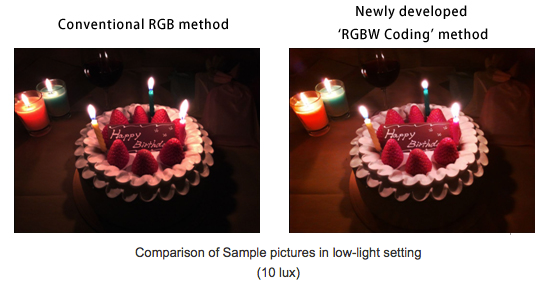
My guess is that to bring some real major image quality jump you have to abandon the classic Bayer sensor design. Fuji has shown us what’s possible by a “simple” re-arrangement of the pixel array. And today Sony (Click here) announced a new sensor technology for small sensors that improves the dynamic range. The past months I posted some Sony patents disclosing a sensor with RGB and White pixels. That new pixel allows to capture images with a much greater dynamic range for both images and videos. Sony plans the mass production of these sensors for compact and phone cameras within summer 2012. And maybe one day the new technology will be used on APS-C and FF sensors too!

34 Responses
I’ve been waiting for dDLRs to abandon the Bayer Pattern for 15 years… Here’s hoping! (Humm, intermixed multi-layer and illuminance (white) pixels? humm….)
15 years, huh?
What happened to Kodak’s Panchromatic sensor? http://www.dpreview.com/news/2007/6/14/kodakhighsens
And when Sony tried an RGBE sensor with the F828, was it so bad (or not really worth it) to abandon after only one usage?
http://www.dpreview.com/reviews/sonydscf828/
Good points, Neo. The wheel is being “reinvented”. 🙂
The F828 was amazing when it came to color reproduction. Some of my best pics were taken with that camera.
I don’t understand why they ever abandoned it.
I’m a little puzzled when i saw this 8years old camera on dpreview. 520shots, modern camera don’t do more. 235000 evf, here again, it’s a common current value nowday, not all superbridge camera have megapixels evf. 28-200 f2-2.8 zoom. There is no bridge camera with such a big zoom. There is some progress in noise reduction, but sensors with more megapixels are almost noisier than the f828 one, camera are faster but there is not so much progress in 8years. Why Sony don’t make a modern f828 ? Keeping same zoom, or a better 24mm start, had new high res lcd/evf, good modern sensor and all the button and knobs.
Or better, use the Konica Minolta DiMAGE A2 as a basis. Equipe this camera with a latest generation 2/3″ sensor, modern processor, a good high resolution LCD and fix the design flaw in the tiltable EVF. Everything else was perfect on this camera.
Hasn’t Kodak sold a bunch of patents few months ago to avoid bankrupcy (well… they failed)? This one might have been part of it…
This is only for smartphone cameras…for now
What exactly do you mean by HDR video ? Blended multiple frames, a new codec or a wide range (say 11 stops) compressed (to say 8.5 stops) ?
Example:
http://youtu.be/fM2xYCcbV5U
That video doesn’t explain what they are doing to avoid the burned out background – to me it looks like they are compressing the dynamic range because it doesn’t look natural, so that’s why I’m asking – how is it done ? I think they need to develop a new codec with a wider dr.
That’s basically what HDR does. That is, to compres an extremely wide (almost infinite) range to a narrow range to avoid clipping on either end. This preserves data, but the data points from the original range are close together in the narrow (e.g. black/white -> dark-grey/light-grey); hence, the image is flatter looking.
That is not as good as it seems. Making some pixels white will increase their dynamic range, but in trade for color information. That is like using not so strict color filters for bayer pattern and it results in bad colors.
Not necessarily — if done right, in both arrangement and processing (which would be tightly integrated.) As I suggested, integrate it with “Foveon” multi-spectral pixels, and you would be ahead of Bayer in color information.
I think there’s a very good reason this is going in smartphones and not dslr and I expect that is color accuracy.
I wonder why just a different pattern should increase dynamic range or lowlight capability of a sensor?
The only difference for me is that a different pattern like recently shown by Fuji helps to avoid or at least reduce moiré if the sensor comes without AA-filter. But cameras like the Leica M9 and now the NEX-7 are delivered already without or at least with a very thin AA-filter.
The cake is a lie.
Exactly! While the darker areas are significantly brighter, brighter areas (around the candle) are just awfully burnt-out.
shouldn’t judge a sensor by only 1 photo (on top of the fact that we aren’t even sure if this is a real photo out of said sensor, or just a mockup/concept which of course would be a gain in exposure in what is capable today)
It’s a mock-up IMO.
because the luma of the image is calculated properly instead of calculation based on the average amont of Green signal mixed with the r and b signal to sort of get the luma data. LIke try this. Find separate R G B cards that are 18% then take meter reading off of each card. OOPPS not the same. So this white pixel is collecting MUCH better brightness values since its not filtering out any light in its measurement.
a 2-layer foveon like sensor would be even better than a 3 layer foveon, because a 3 layer has much more light loss. while having double the resolution of a traditional bayer sensor. topmost layer is green, bottom layer evenly red and blue.
And between the two layers, you could possibly add phase detect inversion on the readout and post processing. Could be the data that you need for fast AF?
Topmost layer would be blue, blue light is absorbed first in silicon.
So you would need a filter array that blocks green for half of the pixels and red for the other half.
I don’t like the RGBW coding method. Your presents get cropped out on you birthday. Thats terrible, no more presents, at least that wine glass comes into view.
RGBW has worse colour quality, as 1/4 of the sensels aren’t capturing colour information. The white sensel is used to reduce luma noise, but chroma noise will actually increase.
not true if you are doing a fuji like photo site with 2 receptors. Also color information is much easier to interpolate vs Luma. ie YUV CIE color space XYZ color space YIQ and on. The diffuse color just isn’t that hard a solve vs the precise Luma in regards to the way the human eye perceives the result.
Will this new array be used only on small sensors? The new FF will have to have more going for it than just more pixels and suspect most photographers want lower noise/higher iso performance to go along with greater detail.
I do not actually want lower noise I Like grain. As it stands now its also impossible to create grainy images with digital in normal iso ranges and now they are even starting to have no grain at all at hi iso. This is why I love my Leaf Aptus back. at iso 50 it still kills the newest 35mm stuff but as i go up I get similar grain to films of those iso’s . adding grain in post yuk, is not the same as senor noise and reciprocity failure
You’re really in the minority, so I don’t think any camera manufacturer will be meeting your needs in the future. Instead, you can pick up any of a number of older cameras for a song, and knock yourself out!
Not to forget that Sony has already an APS-C HD 20Mpix 16:9 sensor in the F65 video camera, with better light sensitivity and use no AA-filter. So why do this sensor not find its way into Sony DSLR/SLT technology?
Im not really willing to have my NEX cost 2x or more as much so it can use the same chip as the f65.
so basically they made a smaller version of the normal exmor r sensors into smaller ones having same or better image quality and performance called stacked cmos for phones, how about doing the same with aps-c sensors and making a stacked smaller version of it for point and shoots, and stacked full frame for the alpha or nex cameras.