







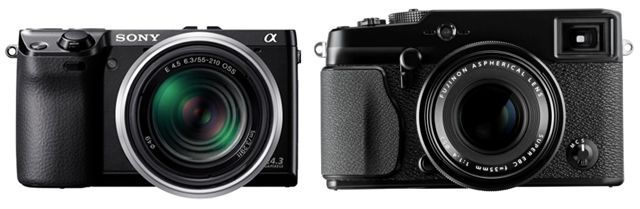
The probably most popular Sony camera of the moment, the NEX-7 got a serious contender which is the Fuji X PRO 1. I share you some of my quick thoughts about the two cameras and you let me know if you agree or disagree with my short comparison:
Body quality (Fuji more solid, Nex lighter):
Top body quality is a characteristic I liked a lot back in the film camera age. Now on digital cameras this is becoming a tiny bit less important as your camera will not last for generation like film cameras. Highly electronic stuff will last for a couple of years or not survive your buyer instinct to buy a new much better camera after some time. While the Fuji X PRO 1 has a more solid feeling body the NX-7 is absolutely well made for being so much more lighter.
Usability (NEX wins):
I am surprised to say that, the Fuji X PRO 1 has absolutely beautiful looking controls but I think Sony TRI NAVI solution is far more faster and useful. You can customize it, it’s faster to use (I shot a while on the digital [shoplink 11073 ebay]Leica MP[/shoplink] and know how to use the dials that Fuji “copied”).
Viewfinder (Fuji wins, but not sure yet):
It looks like Fuji’s hybrid viewfinder is a real winner. You can have both, optical and electronic view of the scene. But the NEX-7 electronic viewfinder is surprisingly good and looking at the specs also better than the Fuji electronic viewfinder. I really have to test the Fuji to see if it is really a good solution.
Minor Features (NEX wins):
I like the Fuji film modes, but guys, the NEX-7 can do almost everything! Panorama mode, 3D and other stuff like that.
Image Quality (Fuj wins):
On paper it looks like Fuji made a step forward but I have to check a real photo comparison to be sure of it. My guess is that the difference between S PRO 1 and NEX-7 will be small with an edge for Fuji.
Video Quality (NEX wins):
There is no discussion, NEX-7 wins. Much better and advanced Codec!
Lens choice (Fuji wins if you look for prime lenses, but future is NEX):
It all depends from what you need. If you like me are a prime lens shooter than Fuji clearly made it right. I wish I could see those three lenses for NEX too:
Fuji 18mm f/2.0 lens.
Fuji 35mm f/1.4 lens.
Fuji 60mm f/2.4 macro lens.
But I think in long term Sony could have the edge when it comes to video dedicated lenses and when you will see the new NEX roadmap 🙂
Price (NEX wins):
NEX-7 costs $1199 at Adorama (Click here).
Fuji X PRO 1 costs $1699 (price was dipslayed here at Amazon).
UPDATE: Is there a price change? Expansys USA (Click here) and Expansys UK (Click here to see the preorder page)
Overall….NEX wins:
I am not a fanboy, and I am saying here that Fuji made a superb camera! But when it comes to balance price, features and usability the NEX-7 has still an edge. But that’s just my opinion based on the reviews I read and not on real world experience. And that is what counts at the end. So I am looking forward to get my hands on the Fuji.
P.S.: This is the NEX-7 full in Stock status check:
[shoplist 8454]
146 Responses
Hummm. the choice will be difficult to do. Anyway, camera features won’t make the difference. As for me, the most important criteria, as former professional photographer are :
– Do you feel in love with your camera ? That’s a very important point ! Even a camera has some disavantages on another one, when we love our camera, we make beautiful pictures. I used to work with a Mamyia RZ67 for more than 20 years. I broke my shoulder for 20 years to bring my gear around the world. I didn’t care, even the sound of the camera was delightful for me…! And still is.
– What are your habits ? The Fuji has speed wheel, aperture ring at the right place. Even TriNavi is a super concept, I fell more comfortable and not confused with my settings. No questions, then go straigh on composition, and photos.
– What do you feel is the most important for the final result ? As for me, it’s the capability I have to produce my own expected result (in my mind), with the expected quality. I mean, the lenses are the first criteria. Nex system really sucks in that way ! I used to work with Fujinon large format lenses on my Sinar for long long time. These lenses are just suberb ! Then, to lauch a system without to provide a minimum lenses range, as Sony, is just stupid. I don’t have any doubt about the quality of the native Fuji lenses, probably better than M-Mount lenses, even if the pics from the 18mm i saw seem to have a strong barrel distorsion…
Soooo, This year will be the time for me to buy a new gear. Until now, in the waiting to see lenses tests, the features of the Fuji are the best (“micro-features” are gadgets) , the Fuji X-Pro1 has been built by prof. camera makers. In my opinion, it will be the gear I will buy.
I just wonder if this 6×6 random pixel scattering on the sensor actually will perform as well as a FF sensor (what Fuji claims). If only it had decent video capabilities… (I don’t consider h.264 at 1080/24p enough, sorry)
But then I also have to remember this is really just a serious CAMERA, not a camcorder.
I also fail to see why people are comparing the two. The Fuji is meant to go after the Leica, just look at their presentation and the side by side pictures with the M9. It’s ridiculous how close they are. The NEX-7 OTOH, is just trying to be the best Mirrorless ILC full-featured system it can, being as compact as possible.
I can understand that 24p isn’t enough for most people (somewhat disappointing, should at least have 30p for NTSC crowds).
However, you also seem to be reflecting the author of the comparison that the codec isn’t good enough either – that Sony has a far more “advanced” codec. This is a common misconception – H.264 and AVC are the same thing.. It’s the most advanced mpeg codec out there.
Few years ago the most advaced camcorders had the capacity to record in 24p. That was really great because it was like movies. Today is not enough. The crowd is not easy.
Hmm, no way is the Nex-7 that big?
You are right: http://camerasize.com/compare/#33,258
Dang, if you put the Nex 5n next to the Fuji on that site, it makes the Fuji look ridiculously huge- its footprint looks bigger than Sony’s mid-rage SLTs. Is that accurate?
umm Fujinon makes all the H series Hasselblad lenses. If fuji wants lenses then they will just make them unlike sony that has to wait for Tamron to make them.
Dude, Tamron may make a few pieces for Sony, it’s true… but “waiting on Tamron for their lenses” is a bit much. Sony has plenty of optical manufacturing ability without Tamron’s assistance, I would say. And if you think Fuji isn’t borrowing glass blanks or formulas from other manufacturers as well, you’re sorely mistaken.
Never said other wise. But the article makes some bizzaro assertion that Fujinon lenses might be bad. I think Hasselblad would not agree. Personally Mamiya 645 D lenses are freaking awesome.
Sony doesnt make lens only via Tamron, neither Tamron design all Sony lens, just few of them.
Fuji and Fuji lens for Hasselblad are very different things. Hell will sooner froze then you get same quality lens for X Pro 1 (unless you adapt Hassie lens ofc :D).
Really!!! Nex wins?!?!? What a surprise! What a great comparison! Fuji camera is not even out and all Sony and m4/3 fan boys are all defensive… It only means that Fuji did a great job!
A different topic… I’m dying to see the Nex lenses roadmap!!! Can’t wait to put some new glasses on my Nex-5N
nah The fujinon lenses on the hassi aren’t even in the same class as the C lenses. I have a fujinon for my 8×10 and its pretty good. Rodenstock good? meh. but Fujinon makes some good good glass as long as the QC is good on the production end. I doubt there is any way the fujinon is worse then the kit lens or the 16mm. Those are both totally soft. My g10 takes sharper picture then my c3 at native iso. And that can’t be a senor thing. So worring about the glass is just a non starter to complain about until they MAKE THE LENSES and you test them.
Price: NEX wins. At $1700 for the Fuji, only retro-posers with extra pocket cash would be so silly as to part with that much moolah for this type of camera.
Have you handled the Fuji? How can you say body quality is better? What’s it built in? Magnesium like the Sony? ‘Made in Japan’ might be a hint at higher standard, but who really knows just yet?
Sensor/ lenses: sample shots posted at this point are not impressive with the Fuji, I think that’s the consensus at the moment. Looks good on paper with that filter configuration but we need to see better samples apart from their poor marketing material (did anybody else see that amateurish video commercial on the Fuji website?).
Viewfinder: Fuji’s approach reminds me of what Corvette did with the heads-up display on the C5: it was innovative but few owners ever used it (overlaying dashboard data on the windshield). It offers 2 (two!) magnifications, so what about other lenses? To me that’s useless but I guess the nostalgic rangefinder guys will like it. They may also like the NEX optical 16mm viewfinder accessory hahaha…
Personally I find the new Fuji a disappointment and Andrea I think you surrender to it, too easy and to early. It’s really pretty but that’s about it.
If the X-Pro1 had an EVF instead of the hybrid finder, I’d have already placed my order. Now I’ll have to do a test shoot before I make a decision.
I don’t like retro or rangefinder cameras, if I did I’d own a Leica M3 instead of my Canon Elan 7n and my Nikon F100.
BTW the more I see of the new digital cameras, the more film I shoot. Not interested in sweep panoramas and the rest of the Bells & Whistles.
I have handled the X100 and the viewfinder is fantastic. I have also handled the A77 and used its viewfinder. Although the A77 has a great EVF you’ll never mistake it for an OVF. The X100 and now X Pro 1 gives you the best of both worlds. The clarity of an OVF with the convenience of an EVF. I was pleasantly surprised by how well it works. Go an handle an X100 to give yourself an idea of the viewfinder and whether you like it.
Rangefinders suffer from parallax error(That’s why they invented SLR). Some argue that it has EVF overlay, so why don’t just use 100% EVF?
Because parallax error isn’t a very big problem. Having an OVF can be quite important to connecting with the subject and forgetting about the camera.
Your comparison seems about right.
Fuji and Sony have two very different philosophies, both very good. Fuji’s offering will appeal more to M users and the like. I have no doubt their optics are superb, but so are Zeiss’s for Sony A and E mount. Sony has to produce some more nice lenses in 2012-2013, possibly Zeiss designed to compete with the Fuji. I think they will. Time will tell, but I do believe both systems will have very nice lens sets by 2013. Fuji was a bit more prepared for the advanced users, Sony started with consumers and is now producing advanced stuff (NEX-7 + 24mm f/1.8 Zeiss).
The mirrorless cameras have a very, very bright future in my opinion. Sony and Fuji seems to be the leaders right now, with very different approaches. Sony went rogue, totally redesigning the concept of interchangeable lens camera (honestly, the NEX-5 design was quite revolutionary, so is the NEX-7’s). Fuji has the opposite approach, very classic, appealing to good old times, but with cutting-edge sensor and viewfinder technology. Both are nice, both will sell as hell (even if, price-wise, the compete with mid-range, semi-pro DSLRs, especially the Fuji) and will appeal to different audiences. Geeks will use Sony, classicists will use Fuji. Nice split (do their CEOs have each other’s cell on their speed dial by any chance?). They compete, but also complete each other.
The 2000’s were a boring time to be a photographer. Companies disappearing, DSLRs with new specs, but almost no new real feature (except for video), zillions of shitty, 6-months-lifespan compacts, almost no palpable innovation. The 2010’s seem far more promising. In only three years, we’ve seen Panasonic/Olympus, Samsung, Ricoh, Sony, Nikon (the 1 system does exist…) and Fuji re-imagining the way we make and use cameras. This means we’re only at the beginning of an era of constant innovation, flow of ideas and interesting concepts. It’s like being back in 1960!
c. d. Embrey …I’m surprised you have internet access.
I can totally agree with your comparison Andrea, I have the same conclusions on both systems.
When will you be able to share the new lens roadmap with us ?
1 thing that I really love about the Fuji is the apt ring in the lens, even though its not the real thing.
I wish sony would at least put the “in focus” scale on the lenses and have a little window showing the apt on the lens.
Certain shooting styles would really be appriciate it
Why, when you have an LCD screen that you can turn every and each way (you can see your stop at almost any angle)? Maybe I misunderstand what you mean by ‘certain shooting styles’ and if so, please forgive me.
You’re right for almost all situations but there are some that the angle of the camera is so odd that the only thing i can
See is the lens, cos the lcd screen does not tilt turn enough
Oops double posting
the more I read this review the more disturbed I am. Really pano is a great feature? making a pano in post is usually just as good if not better and way easier then the get the timing down and speed down and get it right thing. I have used the sweep pano a lot. They are great but if I was serious I would do it all in post. other wise I would just get a c3. The whole review is so fan boyish that you have almost made me think about canceling my order to look at this camera and I WORK for a division of Sony. (imageworks) image stabilization is a much bigger deal and there is ZERO mention of that. weather sealed or not? quality of Native glass? Price of that glass? Fujinon makes Zeiss quality glass. Thats why Hasselblad used then for all the H lenses. AND THEY COST LESS? More? what?
Coming from an P&S to NEX upgrader, I can say I adore the pano feature. It’s not perfect, but it’s still pretty cool and it means I dont have to learn how to do it in PP, lets not forget that the NEX is definately targetting the geeks and techies who love gadgets.
It’s a great feature, but it’s also a matter of perspective.
I know a guy who had hands on with the Fuji
He said the autofocus is terrible. Slow and crappy. Worse than the x100, which is already sluggish
I know a guy that knows a guy that… etc… bs! Try by yourself!
Actually, just one guy. And yes the AF is bad.
Stop the bs, dude or I will tell a friend who knows a friend who knows a guy that knows shit.
I’ve been enjoying my NEX-5N without any thought to get NEX-7. I used to, but having known about the color shifting issue with wide angle legacy RF lenses, I turned away from it. With the advent of X-Pro 1, which seems to have a body like a real pro Cam, I’m ready to have a new toy.
“pro cam body” doesn’t preclude the fact that it, too, could have the same color shift issues with legacy RF lenses. In fact, with modern sensor technology leaving older analog optics in its dust at an increasing daily rate, the myth and glamor of older lenses are really starting to fade, at least to me.
I love the older glass. I’m a garage sale and pawn shop junkie but the facts are facts: a lot of those older lenses just don’t cut it any more, even (and often especially) the really high end specialty pieces.
I agree with Andrea in this particular instance: the NEX-7 is the more versatile tool. I have no doubt the Fuji will win at high iso but that’s only one of hundreds of boxes to check when considering a camera, no matter what you read in today’s asinine forum conversation.
I’ll take a system built for the future instead of one obviously painted as an homage to the past, thanks.
There is nothing old about my ZM lenses that I use on my Nex-5N, and I’m very disappointed that the Nex-7 doesn’t do a good job with these lenses at the edges, in terms of both color shift and resolution. Getting rid of the AA filter in the Fuji will decrease astigmatism with highly angled light rays, and it’ll likely perform as well as the GXR M module with M lenses, which means better than the 5N and much better than the 7.
You made it sound that NEX7 has sinned for not able to mount a Leica M series lens for which it was not designed for.
Perhaps in NEX7N , you will find the micro lens array on the camera.
And you made a lot of assumptions on IQ to that extent that the AA filter is the final determinant of image quality. If only it was that simple
The NEX system—5N or 7—towers above the Fuji X Pro 1 in terms of usability and versatility. The appeal of the X Pro 1 is to a small segment of the market—that’s why the price is steeper.
For those who own legacy glass—be it Leica or otherwise, the user experience will be better on the NEX. How will you manually focus on the Pro 1? With a 1.4MP EVF? Does the Pro 1 have any kind of focus assist?
Someone on Dpreview said it well: “The Nex-7 is a modern camera with fresh ideas”, the Pro 1 is using, to paraphrase Michael Reichmann, “an antiquated approach to composing and focusing.” You can read what he has to say about this design here: http://luminous-landscape.com/essays/leica-open-letter.shtml>
The Pro 1 is not a game-changer, it’s a niche system and will remain such until they release a body that is for today’s modern photographer.
+1 I agree
Umm you will focus with the fuji just like you focus with the 5n and c3. with the lcd.
Couldn’t say it better.
The main problem for me, is that the Fuji body is HUGE !
I wouldn’t call the NEX 5N very usable, its control system is woeful. This has been thankfully rectified with the NEX 7. I wouldn’t say either of them tower above the X Pro 1 is usability or versatility. You are confusing the X Pro 1 with the Leica M9 which it is not. The Leica M9 is a fully manual camera, with manual focusing lenses that are focused via a rangefinder patch in the viewfinder. No EVF, no liveview and no autofocus. When Michael Reichmann said “antiquated approach to composing and focusing” he was talking about the Leica M9. The XPro 1 has autofocus, liveview and an EVF. This makes it a substantially more advanced and easier to use camera than the M9. It may have a retro body but it is a very modern and advanced camera.
I wouldnt call the NEX-5n control system woeful either. I can tweak ISO , Aperture ,Shutter speed without taking my eyes from the EVF when composing. While doing all these changes, I only have to push down and right buttons and turning the control dials.
The XPRO-1 is a great tool, fulfiling the desire of photogs for a long time.
Fuji is telling the world that XPRO-1 is a DSLR replacement , a serious photographers tool.
Whether it is , remains to be seen.
For me , I am happy with NEX-7 offering because it gives me option to mount my Alpha lens, perhaps not the perfect camera, but enough for my needs.
Don’t be affraid a Nex Full Frame will come !
$1700(if it is true)for a APS-C sensor camera (body only) is too much to ask.. furthermore the NEX-7 has some better video capabillities like the 60 fps in 1080p resolution and the others mentioned above.. this (and the price) is why i prefer the NEX-7 to the X-pro1
The Nikon D300s MSRP is $1,699.95. They sell a lot of them. I expect the upcoming D400 will cost more
Here is My pick:-
Body quality (Fuji wins)
Usability (NEX wins)
Viewfinder (tie)
Image Quality (tie)
Video Quality (NEX wins)
Lens choice (Fuji wins)
Price(NEX wins)
Colors of the images (Fuji wins)
meh, and I say, meh again, with tongue firmly in cheek:
Aren’t RAW and photoshop supposedly the great equalizers?
🙂
how do you know the built quality is better then a nex?
have you tried or anyone else, the viewfinder?
lens choice fuji wins?? hows that? fuji has 3 primes, Nex has 16/2.8, Sigma 19/2.8, zeiss 24/1,8, 30/3.5 macro, Sigma 30/2.8, 50/1.8, 16-55, Sony 18-200, tamron 18-200, and new lenses to be released this year, at least is a tie!
colours of the images?? wtf is that? the only camera that has a bigger colour depht then the Nex-7 are the Nikon D3X (DXO) and some Medium format cameras, is that what you are talking about?
If the sensor is really a Fuji sensor, not sure why the thought that Fuji will be slightly better IQ. I have owned and worked extensively with Fuji cameras over the years (including some early digital marketing shot for them on their cameras), and though I like the products, they are odd, and there’s always some quirk or flaw that’s a deal-breaker (I really wanted the X10, but the blooming, ugh). I suspect the X1p will have many quirks and issues that will be a barrier to any serious use, but the lens line-up at launch will guarantee lots of interest. Fuji has learned from Sony’s problems with NEX (lens line-up) – we can only hope that Sony has learned the lesson too.
I see that one of those Fuji quirks is that there is no built-in diopter: you need to find one that matches your vision, purchase it, and install in manually. As someone mentions, this is old school technology, and goes against Sony’s new school technology. It’s not a deal-breaker, but if I spend $1700, I do want the newest technology.
Also, I am surprised no one has mentioned it yet, but is there someone in Singapore working on an adapter for Fuji Pro to Sony lenses?
the Fuji is an awesome looking camera and the menu system seems very nice.. but they made it 20% too big for my taste and i have a few Nex`s already 😉
also what i totally don`t get is this hybrid viewfinder hype.. its essentially a hole with a translucent mirror inside to see the evf over the scene.. whats so amazing about that??
Watching this video made it clear which camera is more functional:
http://www.youtube.com/watch?v=Vk8A3Bc8R4g&feature=plcp&context=C385f228UDOEgsToPDskLzhph_bG0FznNIUlSp5Cxj
and indeed.. this is SAR, and then it is all about: ´noblesse oblige´..LMAO!
ofcourse the nex is better for all the fanboys, even if this new fuji camera is not yet tested at all..what a joke..next please!
well this is a Sony site.. what do you expect? that we all surrender to Fuji`s superiority? 😉
Where do you thin you are? Reuters? It’s a blog:
“I share you some of my quick thoughts about the two cameras and you let me know if you agree or disagree with my short comparison:”
God forbid someone shares their thoughts.
i don´t surrender to anything..i use 2 alpha bodies and a nex-5, i just do not understand why a NEX should win or loose from a new fuji what is even not on sale yet….and what about winning or loosing? this is purely about specs, and has nothing to do with real life..for me, this is an absurd post..it is the same with the new nikon d4, the camera is not yet even available for shipping, and internet is loaded with opinions from people who never saw the camera or used it in real life.. this is getting crazy..let´s wait for the full comparison between nex-7 and this new fuji..and last but not least, the photographer who uses this camera-stuff can be a good one or a bad one.. specs don´t make better pics..that´s all..
Of course, specs don’t make better pics. But this post isn’t about that. It is about someone’s personal speculation on an upcoming camera, because he is interested in it. Nothing more. I, personally, like speculating. You, meanwhile, are completely free to skip the post. It is easy.
fuji will win in:
– image quality
– lenses
– sensor
– advanced mount design that allows for smaller lenses
– more professional looking and usable menu system
Sony takes everything else
I’m still waiting for my nex 7
mhh i`d say, wait and see.. why would it win? i yet have to see images.. and what makes a 0.3 mm shorter flange distance a more advanced mount?
Pretty much everything you compare is subjective. I haven’t had a chance to test either camera out in person yet, however, on paper the Fuji wins hands down. Just the fact that Fuji has smaller lenses is a huge advantage. I really want to know what Sony’s excuse is now that Fuji has shown that the Zeiss 24mm is indeed oversized.
Plus, after getting a look at Fuji’s lens road map it is clear they are focusing in on enthusiasts/pros where as Sony is all over the place designing a few nice lens, but also a whole lot of junk. Heck, just the fact that Fuji has aperture rings on their lenses is a huge bonus to me.
Sony, Olympus, and Panasonic have all been trying to figure out how to make manual control better on small bodies; why none of them thought to put the aperture ring back on the lens, a place it resided for 50 years pre-Canon EOS, is beyond me. You don’t need two thumb dials if the aperture ring is back on the lens, where it belongs.
Eric
What good are the smaller lenses if you have to hang them on a larger body?
And actually the m4/3 has the ability to control aperture from the lens. On my GH1 with the Leica Vario-Elmarit 14-50mm which has the aperture ring on the lens and it works just fine.
I think the Fuji body is a fine size. IMO most of the NEX bodies are too small. They’re not really small enough to be pocket cameras, and not large enough to be all that comfortable to use. I think the the NEX-7 is a decent size, but that is the absolute smallest body I would want. A camera the size of the Fuji + smaller lenses is far less unwieldy then a camera the size of the NEX-7 with a giant snout on the front. The bottom line is the Fuji won’t be a problem to carry. It only weighs 450g/15.9oz after all. It’s not exactly a 2lb DSLR.
Like everything else, just personal preference, I prefer old school build and control, you clearly don’t. I’m glad there are options for everyone.
Finally, the Panasonic Elmarit 14-50mm lens is not a m4/3’s lens, but that is the design they should be using for their native lenses.
After a trip to Spain with the Sony NEX-5n with viewfinder, Zeiss 24mm 1.8 and my Leica glass resulting in the best/most consistent photos i’ve taken on a trip, i’m anxiously awaiting my pre-ordered Sony NEX-7. The only thing missing on my trip was fill-flash when using a viewfinder which I will have with the NEX-7. While the Fuji looks very promising, the NEX is here any day now for me, highly reviewed with almost no negatives comments, has fantastic manual focus with legacy lenses, more native lenses are coming and it is less expensive. I’m getting off of the merry-go-round and looking forward to enjoying having two NEX bodies for travel/street photography and just taking photos. Having a NEX 7 with a 35mm or 50mm summicron and my NEX 5n with the 15mm voigt mounted is a great, light weight, flexible package.
“Image Quality (Fuj wins):
On paper it looks like Fuji made a step forward but I have to check a real photo comparison to be sure of it. My guess is that the difference between S PRO 1 and NEX-7 will be small with an edge for Fuji.”
You cannot possibly judge this until some tests have been performed. Among other things, it’s going to take a while before proper RAW support is available for the rather unusual filter matrix which we no know is not random, but a type of pseudo-random. We also know that it doesn’t use 6 different colour channels, but a6 x 6 matrix.
So we have to hold judgement on this one.
Steve Jones,
I’ve downloaded a couple of the Pro 1’s images and my 5N looks just as good in the area of resolving power.
I suspect that after all is said and done, the disparity in image quality between the NEX and Pro 1 will not be a deal maker.
One advantage of the Fuji sensor approach is the ability to remove some of the glass layers between the lens and the sensor. It looks like some of the Fuji lenses have very short rear lens to sensor distances. This means a symmetric lens design is more feasible and would make working with old RF glass much better. This assumes very complex expensive adaptors are not required, the adaptor is going to have to have the electronic aperture selector I assume. A m-mount adaptor has been mentioned but not the cost. It also allows for much shorter wide-angle lenses. Due to corner issues the new E-mount Zeiss had to be big and long, if they could have used a symmetric design instead of the retro-focus design they could have made a much smaller lighter lens.
Aside from the AA filter and less than 1mm of space what is so innovative about the Fuji mount? I’m not flaming here I’m asking. Their lens design of getting a large rear element as close as possible to the sensor seems so obvious I’m curious why Sony isn’t doing it.
I agree that it seems like the Fuji lenses are symmetric with a kind of corrective lens to alter the incident angle as the last element.
The removal of the AA filter is a Big Deal for me. But until I see some test photos of exactly what I shoot (not kids, dogs, backyards or cereal boxes ;)). I need to shoot some tests myself to really be able to form an educated opinion.
Why wont Zeiss/Sony give us a prime faster than 1.8? There’s nothing even on the roadmap that comes close. Fuji got this right with the 35 f1.4, Fuji “gets it” I guess…hopefully the lens lives up to expectations.
I was previously coveting an NEX7, I really wanted one…badly. But now the Fuji is everything I’m looking for in terms of functionality and primes. If the real world reviews meet expectations, I’m getting the Fuji over the NEX.
Given the unique layout of the color filter array on the Fuji sensor, I’ll be interested to see what the colors look like on demosaiced images taken with the Fuji. With a traditional Bayer configuration, each R, G, or B pixel is only 1 pixel away from a pixel of the same color. That’s not the case for the Fuji sensor, where the layout leaves uneven and larger gaps between photosites of the same color on the sensor. I’m not a sensor expert, but this suggests to me that the algorithm needed to demosaic the Fuji raw images may have much more work to do to achieve the same color fidelity as the more uniform arrangement of the Bayer filter.
Sorry for the duplication. I just noticed that another reader posted a similar comment just a tad earlier.
Unless this comparison is based upon hand-on, real world experience, I don’t see the point of this discussion. Until the X Pro-1 is out in the world, this is all just speculation.
The point is to speculate because it can be fun.
Admin:
Both lose.
Why?
Not available yet.
Perhaps there will be alternatives available to potential buyers in the next few weeks.
The Ricoh A16. The Olympus whatever.
Pentax with its full frame mirrorless cam? Well, that will end the game for many, won’t it? 🙂
PS: Sorry (Sony fans), I do have a NEX-7. I will probably get one more once it is widely available. 😉
Hahaha.. +10.
No diopter adjustment on any camera makes it a no-no for me.
The press release mentions a bit about skin tone, this is one area that would make me lean one way or te other if IQ is equiv. I think fuji did a great job though on look. I also wonder about the speed of the camera for settings and AF, I know the x100 was plagued by laggy sub screens and controls. This would be a huge deal breaker, the nex5n has been very good at quick settings, not the fastest I’m sure, but I don’t notice my camera getting in the way. I think the nex-7 with tri-nav will do even better its seems like a winner. only time will tell
I’m keeping my pre-order for the NEX-7
Good decision! You will not regret it! 😉
+1
++1 The NEX-7 is an absolute dream to use and a perfect companion camera to my a850.
The Fuji “Q Menu” is a winner for those of us who despise menu digging. The 5n menu is a disaster for working quickly. It’s OK to have both Consumer and Pro feature in the same camera, but please, please, please have separate menus!!
Repeat after me: Competition is good, competition is good, competition is good….
You shouldn’t read too much into a pre-order link from one company (and yes, all 3 of those Expansys links are from the same company.)
Fuji announced that the price is US$1700 body only in their official press conference. It’s HIGHLY unlikely they will be going for so much less before they’re even widely available.
Scotty
The X Pro 1 is a niche camera, Fuji did the right thing in setting the price at $1700—there will always be an opportunity to bring the price down.
Fuji X pro 1 + 35mm 1.4 lens: $1384 I think for me Fuji wins!
The price looks much better now $1300 for 35mm f1.4 kit.
It will fly!
The Fuji isn’t out yet and your already crowning it in multiple categories where its merits is completly unknown.
To me the fuji is way to limited, it’ll be a blast to the retro crowd, hipsters and those with fond memories of the golden age of rangefinders – and of course to people who find the image quality appealing. But the NEX-7 is not in the same ballpark, game or what you call it as the X-pro1.
Even though I’ll be selling off most of my camera equipment to get the NEX-7 I’m not even considering the fuji because it is too different from my needs.
Viewfinder wins on Fuji ? Really ? Did you even see it ? You know that it will work properly ONLY with a very few lenses made by Fujy and can not work with any zoom type lens ? Not in hybrid mode.
“Not in hybrid mode” What do you mean? I don’t use zooms but I understand that if u want to use a zoom in the Fuji you use EVF mode… as u use the EVF in Nex 7… Besides, Fuji announced an adaptor for M lenses. And if you see the menus there are support for adapting the magnification to different focals. So how can you say this is going to work properly only with Fuji lenses? You seems to be one of those rares persons that have seen this viewfinder, so explain more please.
Read here:
http://www.fujifilm.ca/products/digital_cameras/x/fujifilm_x_pro1/features/page_06.html
Alos from Fuji PR:
”
Changing between the two viewfinders is simple, thanks to the switch on the front of the X-Pro1 body. When attaching a FUJINON XF-series lens on the X-Pro1, both the viewfinder magnification and bright frame size automatically switch to support the lens focal length. Viewfinder magnification switches to 0.37x for the 18mm lens, and to 0.60x when the 35mm or 60mm lens is mounted, letting you compose your shot with the bright, crystal clarity of an optical image. The X-Pro1 also gives you the freedom to manually set a focal distance and switch between viewfinder magnifications.
”
Fixed magnification based on the lens type (which works only for Fuji lenses).
Even a Fuji made zoom will not work as the magnification needs to change. I doubt Fuji will ever make a zoom lens anyway for this camera.
Read here also:
”
Fuji first introduced the concept of a hybrid viewfinder that combines an electronic and an optical viewfinder with the X100, and it has managed to develop a similar finder for the X-Pro1 that can cope with interchangeable prime (fixed focal length) lenses. However, if Fuji introduces zoom lenses with the XF mount in the future, the camera will only allow the electronic viewfinder (EVF) to be used.
”
http://www.techradar.com/news/photography-video-capture/cameras/hands-on-fuji-x-pro1-review-1051503
Sony NEX7 EVF:
Type : 0.50″ XGA OLED EVF (Electronic viewfinder) (2,359k dots)
Fuji EVF:
0.47-in., approx.1,440,000-dots colour LCD viewfinder
Sony A55 EVF:
Type : 0.46″ Xtra Fine EVF (Electronic viewfinder) (1,440,000 dots)
Which comes to … ?
The Sony NEX 7 & A77 has an 1024 x 768 resolution viewfinder
The Fuji x100, X Pro 1 & Sony A55 has an 800 x 600 resolution viewfinder
Thanks for the help, it was a rethorical question :). Don’t forget OLED vs LCD (OLED much faster refresh rate). Also Fuji does not have any diopter correction which makes it totaly unusufull for me (I need glasses but not when walking).
So at the end we have a hibrid VF which works in opto or hybrid mode with only 2 lenses and EVF in any other mode, with lower res, slower refresh and no diopter correction.What does it make it better than NEX7 one ? Except if you use only 2 prime lenses.
Yes, thanks, but I knew that. It´s exactly what I was trying to explain. You can use other lenses. The magnification is not automatic but you can still change it via menu. It seems pretty easy and it’s a great feature, even Leica doen’t have something like that.
It’s clear the EVF doesn’t have the resolution of a the Nex EVF but for me it doen’t mean that it’s a bad EVF. Resolution in an EVF is not so critical in most cases. For years I shot video with EVFs that have even less resolution and I never complain about that. However the possibility to still have an OVF for primes is a very cool feature. I don’t feel that this aspect about viewfinder is a not go for me, and I pretty sure many people will see that in the same way.
Resolution on the EVF would be critical for Manual Focusing. If a camera design is to enable use with manufal leica – M mount lens, the body should have features to make manual focusing easy.
Two key questions remains critical in the XPro-1: Is there peaking features or similar functions to make MF easy ? Is MF improved from X100 ?
If the answer is yes to both , the lower EVF resolution wouldnt matter that much on legacy lens.
It’s far too early to compare, as we have no actual comparison shots from the Fuji. It is probably similar to the nex-7, unless this sensor is some how revolutionary. The lenses are significantly more expensive, but if they perform better then it will be worth it for some people. if $1600 is the real price point then they are almost in different categories.
In fact Fuji is using the sensor (silicon) made by Sony (same as NEX5N sensor). They add the filter layers, which are developed by them. So the sensor can be evolutionary but for sure not revolutionary as the base silicon is the same.
I don;t know how one can properly compare a camera that has had lengthy reviews doe by top pros with a camera for which we do not even have adequate specs.
Some thoughts, however:
It looks to me like Fuji is very serious here, having seen an opening in the new field of mirrorless compacts, with Canon hesitating to enter the race, so far, and Nikon stumbling out of the starting blocks, Within that field, they have established themselves, almost by default, as the leader of the niche of retro-rangefinder-styled mirrorless compact system cameras. Olympus launched this genre with its original PEN EP1, but has since drifted away from an aggressive retro look, and Panasonic has adopted a retro look only for its mirrorless cameras with an evf, which have an slr rather than a rangefinder look. Sony has taken a different tack, designing aggressively modernist and, I believe, truly beautiful cameras, but I would not call them rogue. They are, I believe, not only the future, but the future that is here already. Fuji has stepped in with an aggressively retro look, so they win that niche hands down. If you like that look, I believe they will be the only choice. They will have a considerable following, I am sure, but contemporary always wins, not retro. But the Fuji following will be a niche following, unless they can establish superiority in another aspect of camera design.
The new Fuji sensor might well be the ticket, and it better be, because paying this much for a non-weather-sealed camera seems absurd on the face of it. However, as far as I can tell, we so far have only the Fuji press release to go on as to how good the sensor is, so the jury is certainly still out on this.
By all reports, the NEX-7 controls and its ergonomics are absolutely terrific. Unless the new Fuji has overcome the many serious issues reported in reviews of the X-100, I cannot see the Fuji gaining much traction other than the retro niche. Unless one is stuck on retro systems of controls, why would you prefer the new Fuji’s controls over a well-conceived, well-executed modern system such as that of the NEX-7? I cannot imagine.
Finally, the viewfinder system, which has drawn praise from many. Without having used the X-100 to say nothing of the new camera, my sense is that it is not a fusion of the two types of viewfinder, but rather a cobbling together of the two. Neither their ovf nor their evf is as good as cameras costing less than half as much, unless they have a great evf in the new camera about which they just haven’t bothered to boast, which would not be characteristic behavior of any camera company. And the ovf on this camera appears to be not through-the-lens, but rangefinder-style without the parallax control coupler. Am I wrong? If I am right, that sounds like the worst of both worlds. The partial bow to ovf is part of the retro theme. I just don’t get this either. Why choose an inferior product because it works kind of like products did forty years ago?
I didn’t think just two years ago that I would be saying this, but evfs are the future; the ovf on the Fujis proves to me primarily that the ovf is on life support.
I am an old codger who loves all old things for what they are, and have spent much of my life as the champion of preserving and restoring old buildings and neighborhoods and cities. And I an clear that one of the best ways forward is to learn from the old, in the ways that modernist architects did. But the appeal of the retro, designing new things to look like old things that worked entirely differently? I just don;t get it, and believe it is always a dead end.
On the plus side, the Fuji does look like it may have a great lcd screen, although it is not a touchscreen and is not articulated. And the flange distance is slightly less even than the NEX flange distance, so the Fuji mirrorless cameras ought to be able to take virtually any lens out there, with adapters. I am sure it is also well-built, albeit without weather sealing. And I am very sure that Fuji is a very serious company and will be a player in the mirrorless market, even after they abandon the retro niche (as they will). It all depends, I believe, on that sensor.
“Without having used the X-100”, that says it all. I am not a Fuji fanboy (I own a NEX 5) but must sound like it defending Fuji from all the B.S. on this forum. The Fuji X100/X Pro 1 has a very large and bright OVF that has parallax correction. The EVF is a 800 x 600 resolution LCD. That is the same resolution as the excellent Sony A55 viewfinder. It is only surpassed by the NEX 7 and A77 which has a 1024 x 768 viewfinder. It is certainly not a “cobbling together” of the two technologies. Did you ever think why it has drawn praise from many? Maybe it is a great viewfinder? Maybe you should go have a look at the X100 in a shop. I think you’ll be very impressed with this cobbled together viewfinder.
The x100 has an ovf with electronic overlays . When composing through the ovf, you can see the frame lines of the actual composition.
It is indeed very pleasing to be able to see through an OVF and compose. The feeling is mechnical and brings back the good old days memory.
The EVF is decent, but no where near the oled EVF from A77/65.
The image is wrong! The Nex 7 is much smaller than the Fuji – only two thirds as tall and only half as deep.
And we shouldn’t compare image quality based on marketing bla-bla about a supposed miracle breakthrough… Had all the problems related to high detail artifacts been solved by a simple rearrangement/regrouping of the photo detectors, Sony, Nikon and Canon would have done it and saved on fabrication costs of AA filters. A good AA filter such as the one in the Nex 7 will not degrade effective resolution as much as Fuji would like you beleive, and the 50% advantage of sensor resolution will take care of the balance.
Lets just wait for side-by-side shots before declaring that one wins and the other looses.
Yes, the real sizes are here:
http://imageshack.us/photo/my-images/585/sbsnex7.jpg/
http://imageshack.us/photo/my-images/441/66731365218d8db20a0ao.jpg/
Fuji is not alone in this…Leica doesn’t use AA filters either in their digital M models, also Ricoh’s A12 M mount module is free of AA glass …..so the lens characteristics stay intact regarding to image rendering.
I have a hard time accepting a camera that attempts to force modern digital technology into a form that mimics an antique. The rangefinder shape was designed for a wholly mechanical and optical system with the various components probably cast, machined and assembled by hand. Today we have a lot more possibilities and I think camera designs should not only reflect this but aggressively exploit it. Just like Sony is doing, even if they don’t always get everything right.
They’re not competitors from the way they’re priced.
I think that both cameras lose,
The Fuji body is too big to be jacket pocketable, and the most important lens of the NEX line up, the Zeiss, is too long.
IMO the game changer will be the FF Nex, and I’m sure that its body will be smaller than the X-Pro1.
When I go out for taking pictures my camera is on hand ready to be used not in my jacket.
+1
Sorry, but I prefer to not look weird by walking around everywhere, a camera glued to my hand.
For sure. When I don’t shoot I put it in a little bag that I hang on my shoulder because rarely I use jackets. This matter of size is very relative. If you find it big its ok. For me is the good size.
I find both cameras interesting. I work with a Ricoh GXR & Leica M mount module, which gives great
results. I miss a few things from my prev camera (Olympus E-P2): IBIS and good buffer for continuous shooting.
I consider a future switch to one of those new cameras. Since i only use MF lenses, some features are not important for me. The main thing I like about the Fuji is its bigger size, so it feels better balanced with heavier lenses like the Nokton 50 1.1
The Sony’s high tech style is very impressive. I guess upgraders can only be happy to have the choice between those two.
good thing you didn’t get a degree in photography where some professors even for studio majors would downgrade you if you where caught without your camera ANYWHERE. I always have a camera unless is a place where its not appropriate. But I also have the appropriate camera for all situations.
enlighten me please….this is too deep for me……
This will be like a repetition of many great comments made above.
One of the best things about Fuji X1 system, depicted with the lenses is the combination of the mount and the no AA sensor. Despite having a flange distance close to the E-mount, removal of the AA filter must have given enough flexibility on the incidence angles so that the lens design can be simpler and physically shorter/smaller (even with the extra aperture dial).We can expect it to perform nicely on legacy lenses as well.
The X1 itself may not be that small yet, but it is very likely they can reduce the camera size dramatically in the future. That will give some compact combination.
I am really concerned that the NEX lenses will never meet the best IQ –compactness expectations.
+1
I think your right about the NEX lens problem.
You would think that somebody (Sony or Sigma) would be offering the “pancake lenses” many here are demanding by now.
Is it possible that it can’t be done at a price customers would pay?
and fuji will be releasing a m-mount adapter, so that implies fuji has already made this sensor compatible to m-mount lenses. unlike the nex7 color shifts.
Agree . NEX-7 probably didnt take M mount lens into consideration seriously . But take note, it is only the ultra wides and wides of the m-mount lens that has this problem. Unless you are an avid 15mm or 21mmm lens shooter, the 35mm, 40, 50mm lens will have no issues on the NEX-7.
Plus, it remains to be seen whether XPRO-1 gives a better manual focusing experience than the NEX.
I think a serious MF camera needs to have peaking features
Agree about peaking feature. In fact (asuming the fuji does not have it) I think that will be the downfall of the camera for me. It might (we are yet to see) do better with the wide angles lenses, but usability in terms of focus is a big issue.
I would take a NEX-7 with 5N sensor. Maybe even if they took away one of the dials so that it didn’t compete against the NEX-7 I would be happy.
If you criteria is a big sensor in a small body with advanced features/controls the NEX-7 seems like the current winner.
Fuji X Pro much larger and no flash, Canon G1x too ugly with slow lens, Fuji X100 limited to one lens, Leica X1 rather limited, Samsung equivalent no flash and rather unknown.
Only other well styled camera I would consider is the Panasonic GX1 but still, the NEX-7 has a bigger sensor and better features I believe.
Too bad about those NEX lenses though.
all this buzz about fuji xpro1 being better than the nex7… but in 6 months the pentax fullframe mirrorless will be out. and end of the year the pentax MEDIUM FORMAT 645 mirrorless will be announced, taking the mirrorless world by storm!!
You sound so convinced in that… care to share with the rest of the class? 🙂
I am one who is NOT complaining about the size of the Fuji! I want a camera not built for children-sized hands… If only I could grip the Nex 7 with more than 2 1/2 fingers!!!!! So, for some, the added size is a good thing! The perfect camera by Sony would be if they style the A99 as a larger version of the Nex 7!
Why don’t you get A77 then ? I was ready to buy it, but the size made me chose NEX7 instead.
The nex-7 wins?
Wow, you’re a fucking idiot.
How does it win against something not yet released or tested?
Most NEX-7 orders are still pending by the way, so I think it’s a fair comparison.
how can it not be tested if its already in the production line??? … LOL
So it seems everyone that has a differing opinion from you is a sinner nowadays…
Name-calling reveals the true idiot.
In any event, next wins exactly because it IS released and tested.
It is exciting news that Fuji is also having an additional unique direction of producing this awesome X-Pro1. Like the Sony NEX7, photographers and camera lovers, welcome these enthusiast products.
I placed an early order for the NEX7, but very closly looking at all the upcoming official info on this new Fuji. I do like this feeling of having options choosing the “best of two evils”, instead of having to settle for the “worst of two evils”.
At first, the Fuji seems like they have only Prime lenses (which is great), and now with some more info that they will be also coming out with zooms (for travel convinience) is a welcome. Hope NEX lens roadmap will have some good pancakes to compete.
Although i am still on the NEX7 side (has awesome video), i will be waiting for more Fuji info. Decisions Descisions…
i wish people like this guy up here that offends others so easily without any reason will have his comments deleted, please go back to the hole you just came out, and get a life.
NEX is crap, and will continue to be haunted by its terrible mount design, born from Sony’s obsession to be the smallest. Not sure if Fuji is the “it” camera, but NEX is a flash in the pan, and destined to be a roadbump in the history of cameras.
Sorry, but someone has to speak truth to this crowd.
The NEX 7 should mate with the Fuji X PRO 1 to give birth to something more awesome and beyond comprehension~!!! XD
+1
Fuji: Hybrid Viewfinder, 3 primes.
Sony: EVF a lot of 2nd grade lenses, prime
I think I will cancel my Nex 7 order.
should be great with legacy lenses, except for the wide m mount lenses maybe(the color cast as mentioned in some tests, like at luminous landscape)
As a semi-pro, Sony-using photographer, l care most about the resultant picture quality from a camera. The NEX 7 appeals greatly as a quality “carry anywhere” camera. However, my compact of choice is the Fujifilm X100. If the X Pro-1 gives me that image quality – or even better – with great prime lenses, l will find it hard to resist. Yes, it is more money but, in life, you get what you pay for. In addition, it does have a solid, cool, retro look with lenses in proportion to the camera body. The NEX 7 does not have that balance although it has been designed to look more “serious” than the NEX 5. Image is everything, on every level.
Nex-7 is smaller?
really?
Body size is nothing without lenses.
And here we see that nex7+zeiss 24/1.8 huge enough.
In contrast fuji x-pro1 + 18/2 really compact.
nex 50/1.8 is not small too…
Small fast Lenses is the very big Nex system problem.
The only one Fuji system weakness is price. 1700 USD body + 650 lens… many users prefer sony.
But if it will be 1300-1400 for kit with 35/1.4 it will be great.
I’m pretty new in this field since my camera passion only started 7 months ago, but here is my opinion:
1) To some of the remarks on build quality: It seems to be a common perception on the web that Fuji X PRO 1 is better build. But why? Because it is heavier? I have played around with the Nex-7 and that is truly well build in my opinion. Metal alloy finish along with high grade rubber. Even the fragile looking flash hinge is extremely well build and durable from what I got demoed. I do like the old cameras but the plastic that is wrapped around the X100 at least is NOT my cup of tea. My dad’s old Konica T2 from ’72 has that plastic ‘wrapping’ around it and although I like the old style cameras and the widely used metal alloys be it SLR’s or range finders I do admire Sony to go along a completely new path and new design concept almost using nice materialsand put together in a hich tech way (NEX-3 is very plasticky, but certainly not the NEX-7 apart from the battery trapdoor). Just remember out there good build quality does not necessary mean heavy either physically or in the design expression. The Fuji may however surprise when I get to play with it one day.
2) Lenses: I like the launched prime lenses from Fuji, but why this perception out there that the Sony lenses are bad? When it comes to the pancake and zoom lenses there will always be compromises and with that in mind the Sony lenses are GOOD quality, then it’s a matter of taste whether you like the specs or not. For example there are only good reports on the ‘Non compromise primes’ 24/1.8, 30/3.5 and the 50/1.8, being sharp, nice mechanical build quality and good AF performance. Then you may disagree on the sizes. Yes I do not like the size of the Zeiss but I suppose that is the best Zeiss could do given the speed of the lens and that it needed an AF motor inside as well (more innovation could be asked from Zeiss however like Tamron has shown with their 18-200 for the NEX system).
3) Fuji’s RF/EVF Vs Sony’s EVF: Personally I prefer that what I see through a view finder is exactly what I get. A range finder performance is not on par with a SLR OVF and the Fuji EVF is not on par with the best EVF out there which is the Sony OLED one (1.4mill. dots LCD vs 2.4 mill. OLED). I personally prefer ONE view finder with the least compromises, and with the Sony approach you get the best compromise between compactness and quality. Essentially a view finder is for picture composition and a range finder OVF is displaced why it will never be as efficient as a SLR OVF when it comes to picture composition, but you may like it more as it is almost an art to get used to and beautiful to look at for some.
For Leica fans and people who like the retro style of photography then Fuji hit a soft spot in an amazing way.
4) Leagacy lenses: I think both will be equally great. Sony having the advantage for me at least because of the EVF and peaking combo. However for very WA legacy lenses Fuji probably will be better then Nex-7 like NEX-5N and Ricoh GXR reportedly are.
5) Sensors: I cannot imagine Fuji will significantly outresolve the NEX-5N sensor let alone the 24Mpix NEX-7 sensor. Especially when Sony has put the greatest effort in devoloping the ultimate APS-C sensors on the market being the company with most experience in photo.sensor of what I know. So it will likely be slighty better ISO perf. (Fuji) vs slighty better resolution (NEX-7)
6) Batteri performance: I hope for Fuji that XPRO will be better than the NEX-7. For a camera of that size though it is slighty disapointing that it is only 1200 m.amps., as Sony can hold a 980 m.amps. batteri in such a small casing. So if Sony has done a better job in energy management then they could be on par here.
7) Menu system: It is a matter of taste but I like the Fuji more ‘nerdy/pro’ approach. Controlwise however I think Fuji will be on par with NEX-7 with a little plus to Sony because of better preview-layer feature in combination of the amazing EVF.
Just my thought. Hey, I hope Fuji will revolutionize the photo world as that would move the entire industry but I think not they will, a nice evolution in many areas is nice too though.
Concerning the size of the camera+lens, have you noticed the strap hinges of NEX-5? They are positioned vertically, so when you hang the camera around your shoulder or neck, the camera will point downwards.
What does this mean?
If you think about it, most lenses I put in front of my NEX-5 do not have a larger diameter than the lens mount itself. Some SLR lenses are larger, such as fast-wide angle lenses and fast zooms. But majority of NEX users use normal prime lenses(SLR and Rangefinder) on their cameras, so what I said is true for almost all lenses we use.
If you use, let’s say a Canon FD 85/1.8, and you look at your camera from behind, you’ll barely see the lens. Which matters a lot when you’re carrying it with a strap. Even if you put a moderately large Canon FD 70-210/4 zoom, it won’t change the camera’s profile. The lens will be pointing down, it won’t bother you at all. It will be a bit tricker when you’re shooting, but that tele-zoom is an extreme. Even the 85/1.8 is not problematic to shoot with.
Whatever you do to your NEX, the only pocket you can shove it into is your jacket’s pocket anyway.
I don’t know about NEX-7’s strap lugs, does it point down like its smaller siblings? If that’s the case, the size of the Zeiss lens wouldn’t matter much at all.
It is about the same story with the Fuji. It will hang from your neck like a normal camera, facing forwards, but its contours will be about the same as the NEX, so it won’t be a problem to carry around either. It will be easier to use than the NEX, probably, due to weight distribution caused by the shorter lens and heavier body.
I have to congratulate the writers of this site for creating such a popular topic out of what initially looked like a very desperate grasp at a news story.
I have played with he Fuji X100 viewers. I did not like either of them.
I have played with the Sony EVF. I was very impressed and did not see a need for optical viewing any more. Especially when you get focus-peeking and live exposure-preview in the EVF.
Sony wins on EVF, controls and features.
Fuji wins on sensor IQ. The Fuji sample shots are OUTSTANDING.
you should be more careful when you come up with these stories – first Fuji is at least 20% bigger than what could be concluded from your photo – check other sites that have them actually sitting next to each other.
Also, in terms of image quality: at lower ISO NEX-7 will be quite ahead – even DPreview declared that NEX-7 provides the highest image quality of all APS-C cameras. So why is that? Simple answer – amount of pixels – so Fuji will of course have less details and hence lower quality. In extremely high ISO they will be comparable.
Finally – how can you make the claim that Fuji has a better EVF??? it won;t go wider than 21mm FF equivalent so it is so crippled from day 1! you can only use it within VERY limited range. I am not sure what is the limit on tele side but it is definitely there as well, due to its design. And I wouldnever go back to ANY optical viewfinder anyways!
But you do want to maximize your sales and you do not really care about the real information. So NEX 7 train has left the station let’s push Fuji for a while. Poor dishonest reporting.
i heard non anti alliance filter from fuji can make a result photo better and sharp, is that true? is the anti alliance filter remove have a weakness for our camera or photo result? thanks 🙂
anti alliance filter…wow that sounds ….wow!
How did you write a comparison of these two, and NOT mention one of the most important differences? The built-in flash! Why Fuji left that off is a mystery to me, considering the built-in one on the X100 is considered to be a fantastic fill unit.
If these were true pro full-sized DSLR units, then it wouldn’t be much of a discussion, but for small enthusiast cameras (again, small) then omitting a flash, however small, is a major mistake.
No point in comparing apples with bananas, they are from different lines. yes they are both fruit but you will always have fans from both camps who say this is better than that. It comes down to different choices and two distinct types of photographers.
I’m a GXR M mount user. I’ve just got the chance to test out the NEX7 with the Zeiss 24/1.8 and my own contax G2 lens. See some initial observations for those interested in the “Cons” of NEX7:
Body stiffness is good but GXR is much better. You can feel the difference when comparing the two side-by-side.
The viewfinder is big but not good for eye-glass wearer. I think the eye-relieve point is quite short. The viewfinder OLED flickers a lot expecially at all the sharp edges in an image.
The design of the handgrip is not comfortable and I feel a bit tired after holding the camera for a while.
The pop-up flash is rather fragile and could easily be damaged.
The dials are a bit too loose and could accidentally be turned.
I’m not going to comment on the UI and I jsut think the GXR is much better than SONY in the UI department.
IMHO the above “Cons” are important for me if I really want to choose a serious camera.
Hello there, You’ve done a great job. I will definitely digg it and personally recommend to my friends. I’m sure they’ll be benefited from this site.