









Image courtesy: ePhotozine.
Nikkei.com reports a very good news:
Panasonic will once again develop image sensors after freezing such operations for the last few years, aiming for applications including 8K ultrahigh-definition technology.
The will invest up to 10b yen ($80.8 million) to develop the next-generation 8K sensors which they plan to launch in 2018. At first the company plans to use the new sensors in its own consumer and broadcasting cameras.
Panasonic had frozen image sensor development since its disastrous fiscal 2011. As earnings sharply picked up, Panasonic apparently decided that developing its own key image-processing components is essential to gaining a competitive in edge in imaging products. Production will likely be outsourced. Panasonic had frozen image sensor development since hemorrhaging red ink in fiscal 2011.
This is very good news! Although it means the GH5 will not have 8K. We will have to wait for the GH6 🙂
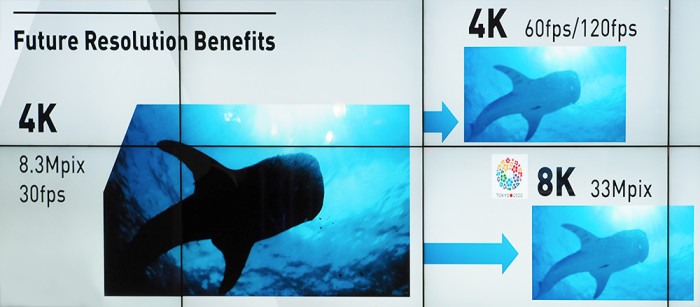
P.S:: Why does 8K matter for photographers? Because every single frame is a 33MP pictures. It means in the future you will shoot more videos than take single photos
88 Responses
10 BIT .. is it in 10 BIT INTERN?
RAW
if not real flat S_LOG?
if not– for what is that lowimagequality Camera?
DYNAMIC and IMAGEQUALITY not Pixxi ! Pixxi is for littel boylies somewhere in
the wide slumms of china,to make a smokephoto of massslavery and nofuture..
another pice of crap!
That just shows how old the sensor is now that was used in the E-M1, or in other words, how long it takes to get a design into production.
E-M1 is not new either, more than 2 years. Worse it is used in brand new 2015 cameras like G7 and GF7. Sony 16mpix in E-M5 II and E-M10 II is about the same age, and the CPU in them also more than 2 y/o.
8K is idiotic.
i find idiotic this way of taking photos.. But I understand some might be lazy and find this method useful. Spray and pray 2.0.
Absolutely. Imagine sitting down after a days shoot trying to find a handful of usable frames out of possibly tens of thousands? I think it would result in a lot more work rather than be a savior for the lazy.
I wouldn’t have the patience.
Spray and pray is right.
Good, there is still hope for you on the Canon side. They offer HD resolution in almost all DSLR’s (except 1DC) and don’t have any plans in offering more video resolution any time soon (according to CR). 🙂
I am only peripherally interested in the topic as i shoot stills, so what Canon or Panasonic have to offer is of no concern to me.
I have a 50″ TV. To begin to see any improvement with 4K given my viewing distance I would need an 80″ screen. To fully get the benefit I would need a 100″ screen.
Actually, I was being too reserved – 8K is barking mad.
And so is anything over 3 megapixels.
I still don’t believe that taking stills from a video feed is going to result in good photo quality in the near future, too many issues still:
– no high shutter speed
– enormous video file size
– no RAW (or humongous file size :-))
– probably descreased DR
– etc.
Just my two cents
I wouldn’t mind lossy. The real issue with JPEG is being 8bit. Same goes for h264 even though some higher profiles (such as Hi444PP) could go up to 14bit, but HW support is still null.
JPEG is not quite 8 bit. It is 8bit PER CHANNEL. If every channel would have resolution 1:1 (as JPEG allows in principle), it is 24 bits per pixel, or more than any RAW allows. Usual high-quality JPEGs though have 1:1 resolution only in luma channel, and 2:1 (linear) resolution in red and blue diff channels (which actually better reflects Bayer output), resulting in 12bits per pixel.
Yes I know and perhaps it’s OK with Bayer, but in practice it’s still limiting us to 8bit of DR, and that’s the real issue.
The encoding of levels in JPEG is not linear either, it is slightly different for sRGB and AdobeRGB, sRGB having a small linear range near black and AdobeRGB using the whole range of available numbers for extended value representation, but not linear in either. And DR as usually defined for pictures is the ratio of highest represented tone to the level of noise floor, the latter being defined arbitrarily depending on a tester. JPEG does not raise the noise floor, in fact it might crush the noise to 0.
Basically it is color space conversion, but practically lossless for Bayer, and about the same per pixel as 12bit RAW (if JPEG is not overcompressed).
Sure, I understand it’s not linear, but that’s still a big limitation for PP even when JPEG compression is minimal. There is no magic that can resolve 12bit out of 8bit JPEG, because even if you crush the noise floor and you flatten so much the curve that you keep the highlights from clipping, you’ll end up losing detail somewhere, probably by compressing the middle tones.
If you check personal-view forums you’ll see how the LOG enabling firmware on the GH4 has been a double edged sword, with some people praising miracles on highlight retention but cursing either their shadow noise or struggling their skin tones…
Again, neither in RAW nor in JPEG Bayer sensor cannot produce full color information in every pixel. There is simply none. Full color information exists only for groups of 4 pixels, and JPEG encodes 48 bits per such group (just like 12-bit RAW), 48/4=12 bits per pixel, no “magic that can resolve 12bit out of 8bit JPEG” necessary. With Bayer sensor, full color and luminance information in every pixel is interpolated, both from RAW and from JPEG, using the same exact amount of information per pixel (in case of 12-bit RAW and normal high-quality 4:2:2 JPEG). 48=48.
So you are telling me that JPEG compression (at its highest quality setting) pretty much removes exactly the information that was interpolated during the de-mosaic (assuming basically no tone curve is applied that would compress the tonal information in the middle)?
I know that viewed at 100% a Bayer-based (uncompressed) bitmap image will show artefacts in fine detail, in particular fine colour detail. The same way a JPEG image when viewed at 100% will show artefacts in fine colour detail. I am just not sure that these are the same kind of artefacts. A test image for this could be digitally rendered image (that does have real colour detail in every pixel).
And if we go to extreme test cases, eg, a pure green brightness gradient that only is registered by the green pixels (which probably isn’t 100% possible as the spectral sensitivity curves of the three Bayer filters overlap, but let’s assume it is possible as it is very much possible to imagine a Bayer filtering which has wavelength where the red and blue pixels essentially register zero). If said gradient had a dynamic range of 12 stops, then the green pixels of sensor with 12 bit raw files (and low enough noise that it can record a 12 stop dynamic range) would be able to record that. A Bayer interpolation into a 12-bit bitmap would maintain that bit depth.
Now, are you claiming that running a JPEG compression on that 12-bit bitmap image could retain 2^12 different brightness levels of green? And that the JPEG compression is actually starting with the 12-bit bitmap image and not with an 8-bit bitmap image? How would I get a 12-bit (or 16-bit for that matter) image file out of a 8-bit JPEG file? Is this happening when I open a JPEG in Photoshop and save the result as a 16-bit TIFF?
12-bit RAW from Bayer sensor does not retain 2^12 different levels of green in each pixel, simply because each pixel does not capture green to begin with. For half of the pixels green is interpolated, and for 3/4 of the pixels red is interpolated, as well as blue.
Again, 48 bit is 48 bit, and 4:2:2 encoding (from which JPEG normally starts, but which does not define JPEG) is perfectly enough to capture everything Bayer can give.
” And that the JPEG compression is actually starting with the 12-bit bitmap image and not with an 8-bit bitmap image?”
JPEG in your camera starts from RAW, the same RAW you would get, only before encoding (Nikon has somewhat compressed RAW, and Sony ARW2 is more compressed than good JPEG, and unlike JPEG, very crudely).
I am not talking about spatial resolution or colour resolution, I am talking about luminance resolution. Just because a lossy ‘capture’ (Bayer or JPEG compression) throws out the same percentage of data, doesn’t mean it throws out the same data.
JPEG compression starts after the de-mosaic process, after which you don’t have a raw anymore (it even starts after the tone curve and white balance plus a few other minor things are applied). It starts from an intermediate bitmap (which if written to disk would look like a TIFF).
In RAW from Bayer sensor, luminance and color information is mixed in the same pixel data. Color space conversion just splits it mathematically and stores in JPEG, in the same amount of bits, so no information is theoretically lost (with small caveats of rounding etc). The same way as your RAW editor will have to split the information and convert color spaces if you want to do some adjustments, for example, if you want to make the image redder (“warmer”), it cannot just increase value in the red channel – such simple adjustment would also make the image brighter, it has to also decrease green and blue channels, and by how much it has to calculate, using the same formulas. And that leads to bigger minimum steps in redness than 12 bits would allow by themselves (because increasing Red channel value increase value and then decrease in green and/or blue increases redness again).
I bet most RAW editors do not even store image in RAW internally, instead converting it to Lab or similar color space and then manipulating it.
And all what you just said has nothing to do with JPEG compression. JPEG compression comes after all of that.
And JPEG compression level is variable, the last stage of it is actually lossless, and the middle stage (throwing out high frequencies) is optional.
But the problem starts when you want to change the tone curve of an image stored as a JPEG. Wherever in the tonal range the JPEG compression (or the raw conversion in general or the transformation into the sRGB colour space) has compressed the tonal resolution that lost tonal resolution is gone forever.
Again, in Bayer array there is no tonal per pixel information to begin with. 12 bits per pixel is 12 bits per pixel, unless you did something drastic with the picture to get rid of the information to begin with. Yes, sRGB can posterize shadows a little bit, if you need to drastically raise the shadows, you might notice and might need dithering or some other techniques (does not matter for Canon and older Panasonics with high read noise, matters more to Sony). Various effects applied to JPEG can also lose information. But generally, AdobeRGB with flat profile will be very close to 12-bit RAW in terms of information retained. 14-bit RAW does not exist in m43 or lower, and would not make any sense anyway. Effects is not JPEGs fault, of course you will lose information if you apply high contrast or god forbid Pop Art. 😉
Also, some cameras might not have low-compression JPEG available, and might lose fine detail due to DCT applied even on highest quality setting. I know for a fact that Olympus does not have such problems with Superfine, with other JPEG engines YMMV.
Why no high shutter speed? Video is produced with electronic shutter, shutter speed (exposure time more precisely) can be whatever.
The rule of thumb when shooting video is a 180 degree shutter (a terminology that goes back to the mechanical shutter in the film days), which means that the exposure time is half as long as the frame rate would allow for. Meaning for a 30 fps frame rate, the shutter speed would be 1/60 s. There obviously is an upper limit on the exposure time of 1/30 s at that frame rate (and in reality for technical reasons that might be 1/40 s or 270 degree).
The reason why you normally wouldn’t want to go below 1/60 s (when shooting 30 fps) is that for fast moving objects (or fast moving camera movements), you’d get a result that is very staccato. Take a fast moving ball, if you film at 30 fps but only have 1/300 s exposure time, you’d get a ball that is jumping 10x its size from frame to frame (because you don’t record anything during the 1/30 s – 1/300 s interlude). You loose the impression of a smooth movement.
Very much related to this is that for fast moving objects our eyes don’t record a sharp object, what you brain gets is a blurred object or even just a streak of colour. Take a helicopter, in normal operation our eyes cannot discern the individual blades. If you could crank up the frame rate to 150 fps, you’d get back to the 180 degree shutter. But I am not 100% sure if this would still look somewhat off to what our eyes would record.
If you make video to extract stills from it, your “rule of thumb” does not apply. It is not good rule for digital video either, 360 degrees would be even smoother and produce lower noise in low light (it is just mechanical shutters could not do it, electronic can).
Sure, ‘more degrees’ make things smoother. But as you say, if you want to extract stills you need a shorter exposure time which very quickly makes things significantly less smooth than even 180 degrees.
But the problem remains, either you have smooth video or unblurred stills. You cannot have both (if there is any significant movement in the scene) unless you got to very high frame rates. Thus 8K won’t replace still photography for most subjects (unless you actually want video as the output).
That is why the mode is called 4k Photo, separate from 4K video. It is for photo, using photo shutter speed settings.
Sure, but this 4K Photo mode is then useless for anything but being a source to extract stills. It still is: Either you shoot for stills or you shoot for video.
Yes, it is almost useless for video (you can always use interpolation to smooth video though). It is for photo, the same way as sequential shooting is for photo – only at faster sequential speed at the price of resolution.
Behold JPEG the Great.
Pay homage to your future lord.
😛
Only if you let it! 😉
Nah. Don’t count me in. My cameras are set to RAW, sometimes RAW+JPEG (when speed is not an issue) so I can delete faster.
Not enough. I want 16 K! How am I supposed to take a good photo?! (Sarcasm here)
Going out with some 400TMax and Ilford 3200: I’m sure I’ll be back more happy and satisfied. 🙂
When will this BS end? want a 24K sensor? get real….and be CONTENT with what you have ungrateful people…..
“Panasonic had frozen image sensor development since its disastrous fiscal 2011.”
I think somebody thought that a Pana 16mpix sensor in the last 16mpix cameras (G7, GH4, G7 etc) are somehow not the same 16mpix sensor in their older cameras. Like it makes any sense to spend tens of millions of $$$ to develop and produce yet another 16mpix. When it was just faster CPU and faster readout.
Somebody thought that 20mpix sensor in GX8 is not Sony IMX269, like it makes any sense to develop another one just like already available for sale and not beating all the 24-28mpix competition.
Pretty strange that they should have frozen all development. Photorumors writes they froze 8k development, not all development. And don’t pretend you knew all along that the sensors aren’t from Panasonic. Because there’s zero evidence for that, just a few indicators.
Economic laws is a very strong evidence. Companies almost never make huge fixed cost investments which they cannot recoup on large volumes of products sold.
The assertion remains wrong; we know from a conference paper that Panasonic has been developing the organic sensor. By that very fact, image sensor development cannot have stopped completely.
8K are 33Mpix. This pixels will have to be in the 16:9 area of the sensor. How many pixels will then the 4/3 sized sensor have? 40? 50? This will lead to quite a jump i the number of pixels for us m4/3-shooters when shooting stills.
See my post here: https://disqus.com/home/discussion/photorumors/panasonic_will_have_8k_video_sensor_by_2018/#comment-2397923307
(It’ll be 44 MP, maybe even 50 MP)
The readout speed for 8k must be 4 times the speed needed for 4k. Fast readout means faster auto focus and high fps in lower resolutions.
and
if you don’t like 44MP in 4:3 you can reduce the resolution. Averaging several pixel to one new pixel gives less noise and better color information.
You forget 4x the required bandwidth, 4x the processing power, 4x the heat, 4x the battery draw (ok, probably less considering processor improvements over time). Faster auto focus will only come if you can process the data and higher fps would only happen with simple pixel binning tech, which has its own limitations.
A 4/3 sensor would require a 48MP sensor, minimum (8K x 6K = 48MP). Also, you will only get better color information if you can record it (most internal codecs are 8-bit, 420). Trying to approximate the combined pixels with a color value that kind of represents that of those being combined is not simple, especially with a limited codec.
The resolution would be 7680×5760 (44,236,800).
If a multi aspect sensor is used, the resolution at 4:3 might be 7112×5334 (37,935,408).
The pixel density is approximately the same as in Sony’s 1″ 20MP sensors.
The hardest thing will be the codec for 8k. Reducing to 4k or FHD is easy. It might be possible to get very high quality FHD at 30fps or normal quality with pixel binning at 120fps or more.
Of course we will have room for digital zoom in lower resolutions and digital IS.
“P.S: Why does 8K matter for photographers? Because every single frame is a 33MP pictures. It means in the future you will shoot more videos than take single photos.”
Because every photographer wants to spend less time taking pictures and more time sitting in front of a computer selecting the best frames. Naah, who am I kidding?… all we’ll do is post 6-second Vine clips of everything, and let the viewers frame-grab the ones they like.
Why wouldn’t you select the frame in-camera while you’re standing there?
24+ frames per second (240 for 10 seconds) on a tiny 3.5″ screen which wouldn’t show out-of-focus due to size and pixel density?
Frames which you can freely flip through by swipe? With up to 16x enlargement with focus peaking enabled for precise focus? On an LCD monitor with 2.36m dots resolution?
You’re failing the common sense test there my friend. Time to change that name to GlueSnifferBJJ 🙂
Say you’re shooting a group of 20 people and you set your camera to 8K video mode, then shoot for one minute. Afterwards you have 1,800 33Mpx photos of the group to try and find a good frame where all 20 people have a good expression on their face. So out of the 1,800 frames you might find 10 frames where everyone looks good.
It would be very difficult to try and do this with a still photo camera, and most likely you would be forced to clone different heads from different shots to try and create one shot where all 20 people looked great. Add kids into the mix and the group shot becomes a nightmare to shoot.
Not saying it can’t be helpful at times, but I think for most situations it’s really not necessary and just complicates your selection process. Besides, waiting for the perfect moment is part of the fun, right?
I think there’s a huge problem with waiting for the “perfect moment” with a complex shot, where you won’t be able to notice if everything is in the “perfect” position. I know that I can’t keep track of 20 people in a group shot if they are constantly moving around or talking to each other. So having a 30 fps frame-rate would make the capture process much much easier, even if it means sifting through a ton of images to find the “perfect” ones.
…Way back in the mid 80’s I was part of the lighting crew for a big fashion shoot where the client wanted the entire shoot shot at 14 fps which required a special version of the Canon F-1 camera, about 40 Speedotron 2400 watt Black-line strobe units, and a specialized flash sync unit that kept switching which strobe units would fire so the flash packs could keep up with the F-1 camera.
The client had already shot a series of TV ads, and they felt that the models looked far more natural when shot at 24 fps, so we were trying to match this as closely as possible.
The end result was absolutely gorgeous, with the 14 fps shooting rate definitely helping to make things look more “natural” as the models moved around the set.
Having a camera that could shoot 8K video would have greatly simplified the whole production process, where we could have just used standard film-lighting instead of a very complex mess of strobe units.
Good news. This probably means GH5 (or whatever the name) will come in
2016 with probably 6K video and 60p 4K, followed two years later by the
next GH camera with organic sensor and 8K video.
When will this BS end? want a 24K sensor? get real….and be CONTENT with what you have ungrateful people….
On CR I’ve read that Canon plans to keep the crappy HD resolution on their DSLR cameras until 5D mark 5 (2020 or so). You should be grateful and thank them for that. LOL
This is pretty funny considering that the two most significant criticisms of video on the GH4 is that it is “way too sharp” and that it “struggles in low light situations.” Both of which would be an even greater concern in 8K, especially if we’re still talking about m43!
Way too sharp is not a criticism, it is a veiled praise. Low light performance does not depend on the size of the pixel, only on the size of the sensor.
“Way too sharp is not a criticism, it is a veiled praise.”
Maybe on a strictly technological/scientific view? Certainly not always the case in an aesthetic view. There is such a thing as “too harsh” especially when filming human subjects. Consider the film industry for a moment. Why do you think the industry standard is the Alexa at 2880×2160 even though 4K has been around for several years now? It’s because cinematographers say over and over again that digital capture is becoming way too sharp. It’s not the most important thing!
You’re confusing sharpness with resolution. They’re not necessarily the same thing.
Also if you’re concerned that 8K is too much for what you want then go into the menu and switch rec quality to a lower resolution. Even the latest 4K cameras still give the option for 1080p, 720p or even 480p recording.
I know the difference between sharpness and resolution, but in the case of the GH4 it’s a mute argument. Even with the sharpness turned all the way down, DP’s like Shane Hurlbut confirm that it’s too “digital” for the “cinematic look.” I can only imagine that the 8K upgrade will just add to the digital harshness he’s pointing out. (thankfully V-Log has helped break down some of the perceived sharpness by reducing contrast)
As far as having other resolution options, your dismissing the second part of what I said. In order to have the 8K option, you have to reduce the pixel size on the sensor, thus crippling the low light capabilities in ALL of the modes you shoot in. Low light capabilities are far more important to me than 8K, and I am definitely not alone on this stance. In fact, that’s why the Sony A7S has been so tremendously successful. It’s because most people know that 4K (8MP) is more than enough resolution-wise, and now the real concern is low light capabilities, solid codecs, slow-mo, dynamic range, etc…
I would not trust Shane Hurlbut’s word on anything Micro 4/3, as the m43 lens tests he published on his website had tons of operational errors, where it was clear that the people performing the test did not understand the technology they were evaluating.
I agree that many electronic Micro 4/3 lenses suffer from over sharpening when it comes to shooting video ( which is why I shoot with Nikon AI-S lenses most of the time ), but m43 lenses are a good match for still photo work.
Specific to the GH4, I, personally, believe that even with sharpness turned down to -5, -5 does NOT mean that sharpness is turned off. Regardless, in some personal experimentation I have done with the GH4’s 4K footage and, with the judicious use of gaussian blur, I have been able to, to my eye, “soften” the video to create a “cinematic look”.
Then again, some people think that Canon’s video is “cinematic” while looking so soft as to look “SD-ish”. But my personal take on Canon is that they HATE any noise so their anti-noise algorithm is the culprit. I’ll take the overly detailed (i.e. sharp) video over overly softened any day.
Personally, I would prefer something close to an “off” setting with sharpness so that I can add back in exactly the sharpness I think is needed in post. IMO, there are very simple work arounds for this particular problem.
When I go and watch a video in my town’s cinema, it’s 4K(digital IMAX).
There is a need for even higher resolution, and yes the difference should be noticeable in a cinema with a huge screen.
I agree with you that it’s not the most important thing(not even in terms of IQ, let alone aesthetic). But if processing power and storage space was no issue: the higher the resolution the better, period. You can always soften and/or resize an image in post, depending on needs. We’re lucky that for example NASA did record on IMAX film format(still out resolving anything that is digital), so that those footages still looks fabulous on our 4K TV’s.
Anything digitally filmed in “HD” will look crap in 5 years. It will look like crap even compared to old “film” productions remastered in 4k.
I don’t think that anyone is arguing that Hollywood (and other “big budget” operations, such as sports, etc.) couldn’t use and/or don’t want/need 8K. They can afford the cost of sensors, hardware, storage, and processing. Also, they are projecting to 20++ foot screens.
On the pro-sumer/indie scale, I don’t think that the cost of the supporting infrastructure will be low enough until sometime well after 2020. Can you imagine how large 8K RAW and/or ProRes HQ (or equivalent) would be and the monster(!!!) system you would need to process/edit it? Higher compression only (dramatically) increases the processing power requirements, though it can save on storage.
As for HD looking like “crap”. I don’t think it will ever (OK, next 10+ years) look as relatively bad as the jump between SD and HD. This is because of the difficulty in perceiving pixels at normal viewing distances and screen sizes. It will take some pretty major drops in cost of 4K display devices at much larger screen sizes (say 80+ inches) before there will be a really notable (i.e. objectionable) difference. And how long will it take before those screen sizes become common?
After all, most cable programming is still being delivered at 720p and “hyper compressed”, so, IMO, there is still a lot of life left in (full) HD. Do I WANT the ability to record 4K? Absolutely, if for no reason than to crop/stabilize when needed. Do I NEED it right now? Not as much. But then again, when did NEED ever factor into these kind of purchases? ;-D
You can always smooth a sharp picture, but you cannot restore information which is lost or not captured in the first place.
> Although it means the GH5 will not have 8K. We will have to wait for the GH6 🙂
Let me prophecise: after the GH5 would come the GH8 with the 8K.
8k is not coming to M4/3 on account of the 33 MP requirement.
I have to agree, at least, IMO, not before 2020. On a 4/3 sensor, that would require a 48MP sensor, which would be the pixel density FF equivalent of a 150MP+ sensor (due to differences in FF’s aspect ratio). We may see sensors with pixel densities that high before then, but, IMO, they will be in VERY specialty cameras, not prosumer cameras like the G-series (G, GH, GX, etc.).
IMO, 8K capable cameras would be a disaster for the M43 system without an order of magnitude increase in low light sensitivity. Improving low light and dynamic range should be the M43 consortium’s #1 priority.
GH7 is a very appealing name, won’t be skipped ?
zzzzzzzzzzzzzzzzzzzzzzzzzzzzzzzzzzzzzz
Current sensor tech can do 33 megapixels on a FourThirds sensor at a loss of about 1-1/2 stops of clean ISO sensitivity. Where as we have a decent 3200 ISO now, we would get only 1200 ISO, which would be plenty for video, but well short on the stills side. 8K will have to bank on the organic sensor collaboration with Fuji, or 8K will stay in dedicated video products.
A Speedbooster will add back 1+ stop w/ larger FF or APS-C glass. Olympus is also working on ultra fast native mount glass.
You are right about the role that fast glass plays in reducing the need for deep ISO’s. Fast glass DOES add back. I think we will see more of native f1.2 μ4/3 glass (one whole stop better than f1.7) in the next few years, but not beyond because the sharpness gets very difficult. I DO hope that SpeedBooster type technologies will be perfected so that the one-shot focus motors on made-for-phase-detect lenses will seem native. That would favor Olympus because Panasonic is messing with DFD instead, avoiding PD altogether so far.
this is very misleading. smaller pixels are more efficient, so if you take a 33MP sensor and downscale the image to 16MP, it will have less noise than a native 16MP sensor. Also we’ll be looking 1 or 2 generations of sensors ahead so we can expect even greater efficiency gains. a 33MP sensor in 2018 may still be slightly noisier than a 16MP sensor in 2016 when looking at pixel level detail, but not in overall image noise and the idea of having to shoot at 1200 ISO where we shoot at 3200 ISO now is just wrong.
you are right, your anonymous comment is very misleading. on silicon photodiodes, the smaller the pixel the worse the noise. efficiency? what is that? huge pixels have huge dynamic range, small pixels overload quickly. the point was, on current technology a 33 megapixel FourThirds sensor would have about the same noise characteristics as a one-inch 20 megapixel sensor without the benefit of BSI, clean noise out to about 1200 ISO. 1600 on one-inch is poor.
8k video in 16:9 would mean a considerably higher resolution resolution in 4:3. Such high pixel density would in turn require new, bigger, heavier and expensive m4/3 lenses. For specialized video application, this will likely be par for the course. It may not necessarily be so for stills photography.
Because the m4/3 system serves as my alternate smaller and lighter stills camera system, I would like to maintain the current size and weight advantage of the m4/3 system. I am not keen on the manufacturers increasing the m4/3 sensor resolution due to the resulting need for even higher-resolution lenses which will consequently be bigger, heavier and much more expensive. This will possibly make the size, weight and price for the Panasonic 42.5mm f/1.2 be the norm for prime lenses in the f/1.8 to f/2.0 range.
For high-resolution still images, I am hoping that Olympus (and Panasonic) can improve the pixel-shift multi-shot feature of the E-M5 Mk II which will make this more usable and suitable for general use stills photography.
If all m43 cameras by that time would have this high resolution, you could still downsample your pics to 16mpx and would still have a better IQ using your same old lenses. So what is the problem?
Most lens designed to work with 12-24mp sensor will not perform well when used with a 48mp+ sensor. This is the rationale behind Zeiss introducing the big, heavy and expensive Otus series of lenses to proper resolve high-resolution sensors. Even then, I am not sure whether the Otus can handle 150mp+ 35mm “fullframe” sensors. For m4/3, as good as my Panasonic 42.5mm f/1.2 and Olympus 75mm f/1.8 are, I do not think these can handle a 48mp m4/3 sensor.
Your suggestion to downsample high-resolution images taken with old lenses to get better IQ at lower resolution … are you serious and do you really not see a problem in your suggesting this? = )
“Panasonic will once again develop image sensors after freezing such operations for the last few years”
Highly doubt it. You can see some progress in sensor tech from the GH2 to the GH4. There are also some patents – FSI or micro color spllitter tech – from last two years. And finally in February there will be some presentations about further progress in organic tech (with Fuji collaboration). This requires years of continual R&D and barely can be done during few months. Try to interrupt R&D and you will lose train completely.
See this one: http://www.43rumors.com/panasonic-will-discuss-newest-organic-sensor-development-at-iscc-on-february-1st/
To sum it up: the first sentence of the quotation is a pure nonsense.
It’s possible that they stopped 8k development in 2011. 4k was already on the table back then and was already within reach with current pixel counts. The sensor division probably had a low budget, and the main improvements were done in processing. Hard to believe that Pana lied and they didn’t design all these sensors.
8K will be specialized even in 2018 simply because of workflow throughput and storage space. I can’t imagine the amount of terabytes needed for even a 10 minute 8K clip, the processing powered required to handle it and the throughput pipeline read/write speeds needed to move it around. Yes, storage tech is marching forward, but it is not leaping forward, which is what will be required to handle these types of files.
> I can’t imagine […]
I can.
The thing is that people assume that video codecs get better with the time. That’s only partially true. The new codecs often have worse quality than the old. But they support higher resolution, which helps to hide the artifacts.
I have no idea about the encoding (but that was never trivial topic), but the decoding should be already possible on the modern hardware: the decoding performance depends more on the bitrate of the video, the resolution is secondary. As long as the bitrates are kept in check, the decoding would be fine.
But storage aside/performance aside, even the 4K TVs are still scarce… But 8K?…
H.265 is quite awesome and leads to small file sizes. Samsung already has it in their cameras! Everybody else is being bit slow however to get with it
who the f.uck cares when they can’t get their current products sorted properly……
When will this BS end? want a 24K sensor? get real….and be CONTENT with what you have ungrateful people……
good to know its only 2018..so I wait for 8K and dont bother with 4K
my laptop is old to play benefit from 4K anyway and it gets pretty heated even when processing fullhd video
“Very good news” might be overselling it a little. At “normal” viewing distances people are unlikely to see any discernible improvement in quality above about a 3K resolution. We just don’t sit close enough to see the dots. 4K has got it covered! It would be better to focus on dynamic range, low light performance and bit depth!
Fixing the basics should be in the priority list…. 2020 = rolling shutter?