









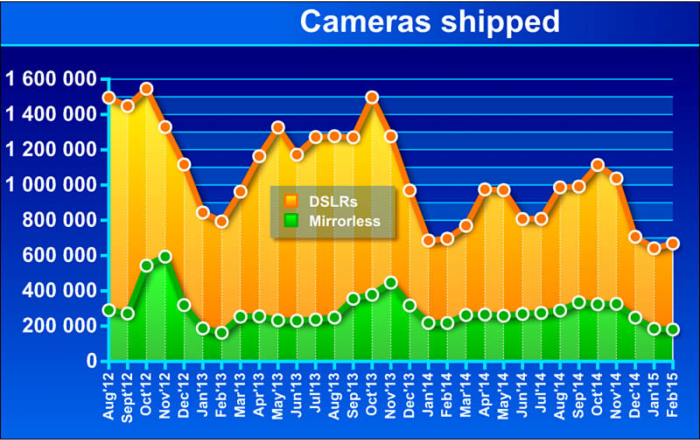
Can it go worse? Of course it can! CIPA posted the new February camera shipment data and they ave been put on graphs by Personal View. 2014 was a terrible year for the industry and 2015 started even worse. I have no clue when this fall will end if we will ever see some recovery again. Seems like interchangeable camera systems will become a niche and remain so for the time being. Don’t know what could change the trend. Is there some kind of tech or innovation you have in mind that maybe could bring back “life” to the industry?
185 Responses
Phone cameras keep getting better with every new phone release. Of course interchangeable camera systems will become a niche. However, what’s going to happen first is that Canikon is going to start releasing mirrorless cameras of normal size, which will sell like crazy. Panasonic and Olympus have about 3 years left before they become irrelevant (again). Maybe Olympus will come out with a normal-sized E-7 before they leave the camera business; that would be nice. The camera would probably sell more than all their u4/3 flagships combined.
I for one actually look forward to when interchangeable cameras becomes a niche product (again, since it used to be this, (exept of course that the manufactures will have less money to invest in product development, which could be a problem). Today everybody is a damn photographer, bying a dslr, using it only with the kit lens, when they actually could use their phone and take better pictures, witch in turn has made everybody tired of people taking pictures everywhere. I long for that time when only a few actually walked around with a camera (and others used instamatic or similar point and shoot). Then you were something special. Hm, maybe the only cameras except cell phone cameras should be professional medium format cameras 🙂 Leave the real cameras for the professionals!
I keep reading articles about major photojournalists using their phones on assignment. Times are a changing and it’s going to get ugly the next few years for companies. I just hope true cameras don’t become so niche they are unaffordable.
People are bickering on about mirrorless vs DSLR as if dropping a mirror is going to save the photo industry. I don’t believe any amount of new tech will bring the industry back to The high it had recently. It is over. The masses have spoken and their new image capturing device is a phone. What companies need to find now is what is going to keep current dedicated camera users and bring Them new ones.
Yes, sort of. If a 22mm lens works for the coverage needs, photojournalism is a very low quality bar to get over. Indeed, the requirements for the publication’s Web site tend to be higher than for the paper itself. So if you can get over the Web bar, you’re home. However, PJs don’t generally get to change their distance to the subject, they’re often herded into specific areas. And that 22mm lens starts to work against them, as does lighting. Do they need a D4s or 1Dx? No. But the smartphone might not be enough.
Well, I keep reading a lot of photo journalists getting sacked, so that the papers can save on staff cost, letting the writing journalist take their own images usually with a cellphone, so I agree to an extent. But this is for the more simpler task. I think I have yet to see/read about an exclusive photo journalism just using a cellphone…. Like someone said above, I think that camera makers have had sort of a golden age when everybody was buying a bulky dslr, using the kit lens and really not caring. All those people will probably stop using cameras, especially ones where you can change the lenses, and everything will go back to what is was in the 60, 70 and 80s: People interested in photography will buy “real” cameras, whereas the general public will be content and get great images using their cellphones (like people used cheap point and shoot film cams earlier). I think interchangeable lens cameras will be for hobbyists and professionals (in what form I do not quite know) I remember traveling with my dad in the early 80s, and he was almost the only one with a “proper” camera, Nikon FE2 with a couple of lenses… This will of course be hard for all the camera makers out there, and I guess the price will also rise even more unfortunately…
Agree with you there. Pros, dedicated hobbyists and possibly students. That is all that will be left. I honestly don’t believe there can be any way these companies will get back that point and shoot crowd, or that person that went out and bought an entry level DSLR because they thought it would take amazing photos on it’s own. No way, They need to start catering to people who have a passion for photography. If they want to sell to the masses they will need to come out with a phone. simple as that.
If Olympus would release a E-7, I would be the first one buying it. I’m still using my E-3, the E-M1 is way too small and teeny-weeny in my opinion.
Have you actually tried one with the grip (HLD-7)? Maybe you have very large hands or you haven’t really tried the E-M1 & just talking without experience.
I have tried one for one Day (Olympus “Test&Wow” Testkit), but without HLD-7.
In addition to the very small form factor, I also missed the upper LCD Infodisplay.
The mainstream consumer will stick to smart phones as their primary shooter. Occasionally the consumer will purchase something from the mirrorless/dslr market that will quickly collect dust. The mirrorless/dslr market will converge and that’s what the prosumer/professionals will use and sales of such will continue to get worse as smart phone sales continue to rise.
I think people would stop buying once they have a decent camera/lens selection. They rather go out and shoot more than be a collector. Yahoo news: 4 Billionaires are Extremely Worried that America’s Next Big Financial Crisis is Coming Soon
http://thecrux.com/dyncontent/psibookmf_next-big-financial-crisis-coming-soon/?cid=MKT015071&eid=MKT035893&snaid=&step=start
Right. What I call Last Camera Syndrome. Was true in film, too. Basically, everyone gets to a point where the cost of the gain in a new iteration isn’t justified to them. See all the “too expensive” comments, above ;~).
Well, the January-February data seem to be the worst every year, so there is not much to read from these data. If anything, it looks like the bottom has been reached and that the marked is on the way up — especially if we combine the Jan-Feb data with past yearly trends. It is, of course, still possible that the development is worse in 2015 than in 2014. Improvements in smartphone cameras may cause such a development — together with a poor economy. On the other hand, there are some signs of improved economy in USA. And the advanced cameras are also improving. So perhaps this will be an ok year.
See my reply above. The weak Jan/Feb data is coming after weak Q4 data. Dealers aren’t reordering product because they didn’t sell out at Christmas.
The camera way of making pictures is history. Nowadays even Ikea catalog images were made by CGI. Why 2D when you can have 3D? Why still image when you can have animation and video? Time to know when you’re obsolete and move on.
And while that will be the case in some professional studios, the majority of amateur and professional photographers will continue to shoot stills in a classical way.
The problem for the industry is that the cameras are so good and have enough features to offer for the photographic task, that the need to replace the tools vanishes.
The industry is the victim of its own success.
People will replace it if its cheap enough. Otherwise they will wait until it breaks or a new task comes along that needs different equipment.
True. I just upgraded my e-m5 to an e-m5II because of four things: 1. The possibility to shoot tethered by connecting it to my computer or wireless to my ipad. 2. The high res mode that actually of me is a great addition since I do a lot of product photography in the studio 3. The wi-fi function (because I also like to transfer some images to the phone for fast emailing to clients and such (and because the eye-fi card in my e-m5 was really bad) 4. Faster mechanical shutter and a really fast electronic shutter, thats is also silent (so now I can use a short dof without ND-filters, and take images without anyone noticing). For me these improvements is massive, and really worth an upgrade even if the sensor is the same. And also, the sensor is really good enough for most people and for most work (except maybe sports and low light work) But I guess for an amateur, or for someone who does not need the things I need, of course the upgrade seems really minor, and you can take the same images as with the previous model. SO its hard for many to justify an upgrade, and hard for a lot of people to see the improvements.
Wow. That’s a new one.
Taking photos is obsolete because we can take 24 a second? Taking photos is obsolete because you can synthesize photos? Sense, you make none.
Yes…people like to have CGI of their life experiences. It better to take days and months creating CGI images of your family gatherings. Pictures of your kids in 1/500 of a second? Heck no…I’d rather do huge amounts of work on a computer using CGI to make fake images of the kids.
Well, I think Panasonic showed interesting idea with the CM1. What about smartphones with interchangeable lens?
My thought too. Oly’s approach with the AIR is may be something that might work.
Like the Sony one Olympus got the idea from?
Yeah, keep hoping.
I think you need to plot that graph against the price of oil. This isn’t the best time to say the sky is falling.
What about $$$-volume chart instead of sold units chart? That would include lenses also. May be things are somewhat better that it seems to be.
Okay. 2013 versus 2014:
$$$ DSLR: 556m -> 486m
$$$ mirrorless: 122m -> 137m
$$$ lenses: 503m -> 448m
And this argues AGAINST all those folks who are saying that cameras are too expensive, by the way. The average cost of mirrorless has gone up, probably because of the Sony A7 cameras and things like the GH5 and E-M1 and X-T1.
In US dollars, the average shipped price of DSLR was US$417, mirrorless US$360, lenses US$190 (note that these are costs to the subsidiaries, who mark them up).
“And this argues AGAINST all those folks who are saying that cameras are too expensive, by the way.”
I’m one of those. Owning a DSLR since 2008, my personal price perception has changed. But.
Several times I had to witness as normal consumers pick a camera. Price was the first criteria. And not only as “affordable” vs “expensive” argument. Not once I was provides with arguments that more expensive camera is worse: theft target/fear of simply losing during travel, requires extra care to protect the investment, not something you can give your kids even for few minutes. In other words: the normal domestic concerns. Something gearheads here tend to forget completely. (Size/IQ were interchangeably the second/thirds criteria.)
In other words, ILC still didn’t get into the price territory where consumer can lose the camera (or have it stolen, or broken by the kids) and not regret it much, since one can simply walk into the shop and buy a replacement. Which is basically the same treatment, we as consumers, apply to the portable devices.
Cameras were and remain way too expensive. ILC kit even for $500 is pretty expensive by average consumer standards. Photographers on the forums keep measurabating with the price/performance ratios, which misses the point completely.
ILC are too expensive. P&S have always lagged. No wonder people pick the built-in camera of their phone: it is cheap, it is with you all the time and compared to the P&S is a major step-up.
And with a market like that, it can only get worse.
Not to mention that most people that need better quality than their smartphone (which are getting better and better every year) already have a camera and don’t feel the need to buy a new one.
It’s really only enthusiasts that feel the need to upgrade, and frankly, most of the time they probably don’t actually need that, they just want a new toy to play.
I agree with you, especially as regards mirrorless cameras. When m4/3 was announced, Panasonic showed projected sales figures for mirrorless being several times the market for all DSLRs. But this was based on the assumption that mirrorless cameras would be a peg lower in cost to DSLRs, and this was necessary for this volume of sales. However, when mirrorless cameras with introduced there was also a boom in premium priced small cameras, including fixed lens compacts. This meant that mirrorless cameras never dropped below early adapter prices and actually rose i.e. they were priced at a premium. The envisaged mass market in mirrorless cameras will only occur when they are a peg lower in price than the equivalent DSLR, and yet the opposite is true. An equivalent mirrorless cam, is more than a DSLR that can do the same type of thing.
Your comment about ILCs being too expensive is worth exploring. The reason that ILCs cost so much is likely down to 2 things:
1. The cost of designing and developing reliable precision-engineering capable of turning out mechanisms and optics of sufficient quality to match market needs and expectations.
2. The impact of having a relatively small [and shrinking] market across which the cost of the R&D can be apportioned. Say the Oly 40-150mm f2.8 Pro cost US$25MM to design and develop and then another $25 million to build the robotics to manufacture, then Olympus have to recover $50 Million before they can break even on the lens. They will take that cost and spread it over their projected sales volumes. So if the predict that they will sell 500,000 units, that’s $100 on top of the cost-to-manufacture price – just to recover the cost of developing the lens.
[Very sorry if I am stating something you already know here…]
So I think the issue for anyone in the camera market today is that we are entering a perfect storm. Firstly, the quality of “cheap” and “low end” gear has become “good enough” for all but the serious amateur or professional. This means that the sales volumes of professional gear isn’t so much shrinking as disappearing. Secondly, the cost of engineering in the quality that top-end users now expect is increasing enormously, because we are already at the bleeding edge of materials science and pushing hard.
What to do?
Well, the big camera manufacturers hit on an obvious [but with hind-sight, stupid] solution. Instead of continuing to push the boundaries of optics, weight, size and so on, they instead tried to do more and more with software. All hardware development seemed to boil down to the MegaPixel wars… That proved to be a little foolish for 2 reasons – first because there has been no appreciable improvement in quality [my 10MP Canon EOS40D takes *way* better pictures than my 18MP 7D]- second because where you do see a difference, it is usually just because the sensor now shows up existing lenses as a bit soft – and that just annoys the enthusiasts.
If we accept that regardless of the technology used [film or sensor for that matter] the larger the capture area, the better the image, then the answer has to be putting the largest and best-quality sensor in a reasonably-sized body. [As small and light as is possible whilst allowing adults with average-sized digits to use it].
It’s a long time ago, but I remember my Minolta 7000 Dynax as being a cracking piece of kit. Auto-focus, good lenses and a very small package. Physically it’s roughly the same size as my OM-D EM-1. And there’s the issue. The Minolta could fit a full 35mm roll of film; my M43 sensor, good as it is, remains a fraction of the size. IQ is compromised.
Don’t get me wrong, I *love* my M43 gear and will continue using it until a clear improvement comes along. But for me that would be something like the FF Sony but with broader support and a better range of glass.
How to get there?
The answer for those of us who are true M43 fans will be a tough sell, because it would likely involve moving away from our beloved M43 format to a “next gen” alternative… You only need to look at this:-
http://cameraimagesensor.com/size/#83,11,a
[ a comparison of the M43 sensor to full-frame, size wise ] to realise how relevant this is. The FF sensor has roughly 4 times the surface area…
If Olympus were willing to develop something that is the size of my EM-1 with a full-frame sensor, I’d be there in a heart-beat. I’d gladly sell all my existing gear to get that level of quality.
I took us on such a lengthy detour [sorry] because I’m pretty sure that most of the people reading this post will disagree with my suggested way forward. And that’s the point. Put yourself in the position of Olympus and/or Panasonic and you realise that they have no easy road forward.
Basically, the [enthusiast] market wants better quality, lower cost, smaller size and more features, and all that on dwindling sales volumes.
Aint gonna happen.
Let’s see the glass from your precious Minolta. Than we can chat about size.
Sadly long since gone… Might be.able to find some specifications on the web though. Will look…
Well, finding detailed specifications of the Minolta lenses from 1984 are proving hard to find. Here
https://www.youtube.com/watch?v=PHCxa5qj984
is a good view of the 7000 with the kit lens – and here
http://www.mir.com.my/rb/photography/hardwares/classics/maxxum7k/index7.htm
are images of sample 50mm lenses ranging from f1.4 out to f2.8, along with dimensions and weights. If we consider i.e. the Panasonic Summilux 25mm f1.5 as equivalent to the above f2.8, then subtract 30 years, this looks like broadly equivalent size to me. Granted, imperfect, but not far off…
But to be honest, I think you’re missing the point, which is: do we [well, do Olympus] have the technology to make us a camera that is the same size and weight as the OM-D EM-1, with a full-frame 35mm sensor and optics of the same quality as their current lens family. I think they do.
I took the discussion in this direction only because I sense that we are may hit the IQ limits of an M43 system before that of a similarly-sized full-frame. Nothing more.
I’m not disrespecting M43 in any sense – I’ve long abandoned my EOS7D in favour of the EM-1, a camera that’s better in every respect save continuous AF. But I do wonder, if there is a “practical limit” in the standard, then it’s the sensor size.
Oh, and the Panasonic 25mm? According to DPReview
http://www.dpreview.com/products/panasonic/lenses/panasonic_25_1p4
It’s 63mm dia, 55mm deep and weighs 200g. The Minolta f2.8 50mm is 68.5mm x 59.5mm and weighs 310g… I can’t tell you without further checking, but I’m suspecting that the Minolta’s extra weight comes from an all-metal construction. The Panny uses a metal mount, but I think the barrel is a high density plastic. Mine is out on loan, so I can’t check!
Answer is easy:
It is to complex or makes no fun to share pic from a camera. Much easier with an celphone. Basta!
I completely agree! Cell phones also provide good enough quality for most occasions for the average Joe and with social media functionality being neglected in the majority of ILCs I’m not surprised at all. Mirrorless seem to have less of a drop though.
The problem is that currently it is impossible to get photo directly from camera to phone automatically or pushing a button in review. You need to enable Wi-Fi and start a app etc. That is to difficult. Automatic transfer via Bluetooth or Wi-Fi and edit on phone without extras would be needed.
Think about it. Take photos with camera, take phone from pocket and launch wanted social app, tap “add” and browse latest photos directly as taken with phone.
That would be a killer function.
Sorry, but who needs that?
Sounds like Eye-Fi.
Nonsense. Image sharing is also an overhyped thing, and the results are rarely something an enthusiast photographer would accept anyway. For casual photography of private events or the moment, where the camera is not available, the smartphone is the right tool, as was the compact camera before. The system camera, however, (together with some derivatives such as bridge cameras), with stay as the tool for professional and ambitious photography, simply because the smartphone has – as a photographic tool – terrible ergonomics and handling and not capable enough lenses.
The problem of the photo industry is that it could not get significantly enough more people to show interest for ambitious photography, so that the amount of enthusiast photographers stays a similar levels as before the DSLR bubble rose.
The imaging industry should campaign more for ambitious photography a an entertaining and satisfying activity than being fixed to technical achievements, which give not much in terms of improvement of an image’s impact.
If you are correct, ILC sales will continue to drop. The generally agreed upon baseline of so-called enthusiast photographers is a replacement market of 4-6m units a year (last year’s ILC shipments were 13.8m units). Add in some new users, and maybe we get to 8m units/year potential.
There is the potential for the sales of intechangeable lens cameras to fall a lot more. I’m not saying it will happen, just that it could. The whole boom, originally in DSLRs, was something of a mystery, not least of all to the Camera industry. A very large proportion of the people buying them didn’t really know how to use them, had no real need for a DSLR and at most bought a few kit lenses with them. A lot of system cameras simply don’t get used very much, and then only for snapshots.
The actual proportion of real enthusiast photographers, and professionals is quite low, compared to the amount of people buying system cameras. Undoubtedly it’s an aspirational thing, and it’s probably true of much “expert” kit for many interests or hobbies. People are inspired to do things they admire, they buy the kit to do it, and then never find the time or enthusiasm to learn how to use it.
The interchangeable camera bubble, as in many of these specialist kit markets, has the potential to burst because the proportion of people really using and needing them, is always much smaller than that of people aspiring to learn to use them in an expert way. These aspirations are like fashions and fads. Aspiring to take top quality photos is something that could fall, or grow much more.
Is there some kind of tech or innovation you have in mind that maybe could bring back “life” to the industry?
well how about creating a demand?, when everyone thinks a smartphone can rival dslr quality or they dont give a shit no wonder the masses are not interested.
The problem is not the camera itself but the software around it. For most users it is simply too cumbersome to take the picture out of the camera edit the pics on the computer and then share it with friends and family.
The complete work flow will have to be changed to compete with smart phones.
That being said, 10 years from now I believe many smart phone users will regret taking that somewhat blurry picture on their kids wishing that they had a proper camera instead. Some pictures are meant to last a long time.
Bingo. What I’ve been writing now for 10+ years.
Yep. All we (I, they, you) need is some software to do something with those raw files in camera, we already have art filters, but really, add some better but still very simple editing software (contrast, lighten, darken, color, tweak) – done editing: upload / send / share / e-mail the (jpg-) result.
It’s hardly any worse than the same Jan-Feb period last year, and not much lower even than 2013 at the same time. Personally I find $1000 iPhones too expensive, not ILC’s.
Early 2013 was a bit of an anomaly. Makers stuffed the channels in late 2012 with an enormous number of mirrorless cameras relative to previous demand hoping that the trend was really way upwards. They didn’t sell, and they cut back production almost immediately for awhile before returning to the 250k/mo range that seems to be mirrorless’s heartbeat. But as I noted on my site, the interesting trend is that Christmas period shipments for 2012 to 2014 have been a trend downward. Given that’s the big buying period, it does not bode well. Far fewer mirrorless cameras were shipping into stores Oct/Dec of 2014 than 2013. If sales were robust, then Jan/Feb numbers wouldn’t be so low as the stock would need replenishing.
Yes, US$1000 phones are expensive. They’re even more expensive when you consider that here in the US the average cell phone bill is about US$75/mo. On a two-year replacement cycle, that means you’re paying US$1800+ for a phone. But phones are a bit different than cameras. First, their costs are often buried in plans. Second, you pay over time for them, not all upfront. Cameras don’t have either of those things to help disguise their actual cost.
Did anyone already state that the reason is the amount of people that see themselves as somewhat serious photographers just isn’t sufficient enough to keep the industry growing? If not, then that’s my statement for today. It’s not the price, just the need to own a real camera isn’t really there for many smart phone buyers. And if they ever thought they did need one, then it may now be lying around somewhere. There is still some growth visible though, if you observe the layer of dust it’s gathering.
So how is marketing talk or sensor tech or AF speed or low light capability going to help to convince people they need another camera, or another lens?
“It’s not the price, just the need to own a real camera isn’t really there for many smart phone buyers.”
How can you – or anybody – know that it is not price? The price of a decent digital camera never reached the “affordable” range. (I hope you are not trying to call a P&S “decent”.)
No manufacturer really stepped up to produce $100-200 ILC camera. Every manufacturer tried very hard to avoid starting the “race to the bottom”. And then the smartphones have happened. One day the Japanese clique had total control over camera market – next day they are in free fall.
It’s just my theory. We also don’t know it is the price. Trying to go low enough to see when customers will buy, may not be profitable enough. This could also have consequences for any future developments.
Okay, let’s take your strawman. Assume that Company X introduced an ILC for US$200 that was equivalent of, oh, say the OM-10. Yes, that might get a number of people to buy it, but why would they then upgrade to something else?
It really doesn’t make a difference at what price you buy, the current iteration cycles simply don’t make for repeat buying. People buy what I call their Last Camera and then are done. FWIW, smartphones will hit this same wall in the not to distant future. Indeed, I’ve not upgraded from my iPhone 5 at this point, because the cost/gain analysis isn’t good enough. And that’s the problem with cameras: the cost of a new camera versus the gain you get is out of balance. Back when we were going from early 3mp sensors to 6mp to 12mp there were tangible and visible gains. These days, try getting someone to show you the difference between a 24mp and 36mp image. Heck, throw in 16mp, too.
I have asked the sales in shop. The best selling item is GoPro. The hints is obvious that lower the price of camera or with interchangeble lens features won’t help the sales but the trend of easy film making or shooting photos without seeing(lol) is growing. $499 USD is still a little hit cheaper than iphone 6.
GoPro is a hype that will not stay forever. The GoPro concept is hardly useful for ambitious photography. I would compare the GoPro with the current selfie trend, which will eventually also turn back to the lower attention it deserves.
It is still too early to draw the conclusion. However, the key to success of every gadget is ease of use. The manufacturers try hard to make to camera small and easier to control, but it can just get close to smartphones without seamless sharing through network. That’s why we still find smartphones growing better than cameras. What GoPro can do is that it is certainly easy to use on both photo taking and video shooting comparing with DSLR or ILC, which need technique of serious composition and require precises focusing. Indeed, not just GoPro keeps growing. Other brands like Sony, Kodak, Panasonic or Canon also try to emerge to this market. Just don’t mention the uncountable MIC clone in mainland China which the price is just as low as $50 USD! I think that cameras can survive easier if the manufacturers dare to combine 4G network directly.
This brings complete justice in terms of the Olympus refusal to make a DSLR with the new sensor and stabilization. They completely ignored the requests of the many thousands of loyal Olympus owners. They even refused to make a normally priced pdaf-enabled mirrorless. Instead they offered the e-m1 with an extremely incapable sensor (in ISO-terms) for an exorbitant price!? Much higher than the price of cameras like Pentax K-3 or even the FF Sony 7. An owner of about fifteen 43 and m43 lenses and of seven 43 and m43 bodies, I was forced to take the road of partial migration. I got the Pentax K-30 almost new for a funny price, got some 4 lenses already, and am looking very much forward to the Pentax FF. And I am happy with Pentax. You fully deserve the above statistics, Olympus!
Yawn. I thought you got over this. Olympus has the right long term strategy, don’t worry. Huge DSLR monsters will be dead, sooner or later, that is for sure. They will become the niche for some special use cases. Olympus is prepared with excellent lenses, and continuing innovations.
Your phrase about the E-M1 having an extremely incapable sensor speaks for itself regarding your incapable judgements.
“Olympus is prepared with excellent lenses”. Not quite. In the 14mm – 60mm prime range Panasonic offers much better quality and value. Instead of the exorbitantly expensive EM-1, 12-40 and 40-150, I can use magnificent, higher-specs and reasonably priced primes, e.g., Leica 25, Sigma 60, Sigma 150, with three E-PM2s that are better in ISO terms than EM-1, all the three less expensive than one E-M1, and at sizes and weights lower than two E-M1s plus 12-40 and 40-150. Not to mention price …
The EM1 is heavier and wider than that huge new Nikon D5500 monster.
Cherrypicker alert! We always get one in here comparing a top of the line m43 to a plastic consumer DSLR and saying it’s the same size or heavier. These cherrypickers totally ignore that there are smaller m43 bodies and they totally ignore that once you attach equivalent lenses the DSLR becomes much larger. Yes, the EM1 is the same size as the D5500…it’s also weather-sealed, has a magnesium alloy chassis. If it’s too big, there ARE smaller m43 bodies…..
So the fact that your over-the-top blanket statement was debunked means the one who debunked your statement is in the wrong and not you. Got it.
You certainly are obtuse…
Only a few fools would buy this. I was one of those fools with the E-3 and E-5. If I were to buy a large camera, it would NOT have a small sensor. That is just plain stupid.
So you despise K-3 and are taking better pictures with m43? Happy guy!
I am so happy about this…. err wait.
it is not getting signficantly worse. It seems we are at the same level of a year ago (jan feb 14).
Also it seems DSLRs had a small uptick whereas ILCs did not.
Camera’s becoming a niche product doesn’t bother me too much. There seems to be a good chance that when this happens we get better thought out products and acalm market. One thing is sure: we will be able to get camera’s that get us better and better IQ. Whatever brand or system that is…I don’t care. if m43s fails it does so because it was not good enough I think. Since 2011 mFTs have missed the boat here and there:
– 2012: NEX7 shows most of us over here were right. A rangefinder cam was needed. mFTs became a follower here
– No larger sensor options. The closer you get to mobilephone IQ, the sooner you’re “out”. A cam with a larger sensor that also accepts the current lenses for instance.May be a 625 mm3 4:3 sensor.
– Panasonic is losing out. I had the EM10 in my hands. 600 euro, small and well layed out. Panny needs a G7. may be GX8 will be a combo of GX and G-series. whatever: way over due.
– Paansonic is focussingon lenses with a FL that can easily be obtained by mobile phones. They offer very goodprimes, but nothing special. Oly does better. A good 100-250 mm f4 or so indeed fills a niche that those users want to see filled. You can earn some money and at the same time let the systemstand out. 100-250 f4 means a very small lens compared to the compettion.
– MP count. Panny needs to make a 32 MPixel sensor based on the latest tech. at dpreview we see th GF7 and look at RAw at ISO6400. In the left lower corner in light bulb mode. That sensor (or better: the processor behind it) is getting significantly better IQ than the GH4. Just be daring and make a 32 MPixel sensor. If it is noisier etc put this in your midrange cams, where people are still more suseptive to MPixels. And the IQ will still be very good. Downsize and the noise is less.
In short: mFTs is lcking true innovations currently. Where they were a frontrunner clearly, with daring tactics. They have clearly lost their edge.
Unrealistic expectations from everyone. Do they really expect everyone to upgrade their cameras on a regular basis? Things will remain flat until the next big innovation comes along. Probably organic sensors will ignite the next upgrade wave.
If you want/need to gain marketshare upgrading is not gonna work,is it now? So there is a NEED to innovate. The idead below are examples of innovations/developments a person sees fit. Whether the exact examples are correct is doubtful, but you need to be different if you want to attract and audience.
Automobiles these days easily last 10 years or more. Do auto makers expect everyone to upgrade their cars on a regular basis? Of course they do.
And again, something like “organic sensor” is just a feature iteration, not an innovation. Even if that gave you another stop of dynamic range, it isn’t lack of dynamic range that is halting camera sales.
People do update their cars far more often than they need. Joe and Buffy Suburban lease a shiny new thing, the more bling the better, to demonstrate to their neighbors and peers that they “have made it.” But a camera 1. is small (does not demonstrate much); 2. requires work; 3. Is outside the mindset of most people, who might know that Canon and Nikon are used by photographers at the Olympics, but have no idea what Leica is. As long as it works, most casual photographers won’t bother to upgrade.
Which is one reason why I’ve written for decades now that the biggest failing of the camera companies is marketing. We buy/lease cars more often than we need to because of marketing, not so much product innovations. Your three points are dead on to that point: those are the perceptions, and camera company marketing hasn’t changed those perceptions.
Cars are not replaced as often as you think. The average car is being kept 6 years and that is expected to go up to 10 years. As for cameras. unless you’re a professional or a true enthusiast, you don’t carry a camera every day and everywhere you go. For the average person, a dedicated camera is something you bring out for special occasions. Such items don’t get replaced often. Once they have one that’s good enough it will stay with them for many years. The market is saturated with digital cameras and I think that it will remain flat as people will only replace them if they break or get really old.
The average age of a car in the UK is 7.5 years.
The average age of a car in the US is 11.5 years
There are some people who buy a new car every three or four years but they are very much in the minority.
Be careful. “Average Age” doesn’t equate to buying. Some people buy used, some people pass older cars down the family chain.
Well, I ‘upgrade’ my car every ten years or so. But then I only drive about 4000 km per year.
With the exception of 4K video and a few smaller bodies, the current generation of m4/3 cameras are pretty similar to cameras being sold a few years ago. It seems the m4/3 sensor has been maxed out. There have been minor improvements but nothing really significant.
My point is that there really isn’t anything that new that would cause someone to upgrade if they have a camera that is about 4 years old or so.
Also, most consumers and snapshooters know nothing about mirrorless cameras. They know that pros uses cameras that look just like the ones they can buy at Walmart, Target or Bestbuy so that’s what they buy when they are looking for a camera.
And let’s not forget smart phones. The image quality from a smartphone in many cases is good enough for the typical consumer. Honestly, there have been a handful of times when my X100 stayed home because my iPhone would give me images that were going to be good enough for the situation.
The comment below about software and workflow is an excellent point. Photo sharing is no longer gathering around a slide projector.
It’s not just a mirrorless issue, though – DSLRs have had it even worse than the mirrorless makers have.
If the manufacturers would not think in their odd and old marketing-world, the customer would
get what he wants, and what works in a well balanced way. The other thing is, that the customer
has “forgotten” the camera in daily-smartphone-zunami-all-3-minutes-a-new-suba-dupa-modell
( the same old wine in a newer body..:)) and he is in progress ( think about only one person has 10 “friends”–how many mathematics is, till one message is round?= in this short time his brain
is capurede by something ohter= maybee forgets his photographic… hunger?//) and if not and he is in a will to give money….he dose not geht it–not between 350 to 600 $..
This is the place where you must bring ( lx100 is near this border and maybe the only fat tini big
thing in last 7 years, realy a bringer for every cent you dash on the shopdesc..)( maye tini hdmi
output and a microphoen–but yes it would be to perfect…)-a good fine body-nowdays-4k and
who is first to kik down the old grave 8 bit? INTERN 10 BIT on the normal Codec ( pana/ sony/…)– the STARTER LENSE!– kill this pice of crapp! waht if the lense of LX-100 would be
a externe model-real to buy- 300,-$! to good for that?–
Sharing: IT IS AND WILL BE IN REALTIME on smartphone to smartphone–why to go out to
computer- photoshop-and reentry to sys? ONLY PRO-WORKERS = make mony = make a show!…. The fosile way the manufactures thiink ( and BRING NERDISH BULLSHIT========
2 selfie moni and other idiotica) but not waht i would se 2015 = 10 bit!!!
DO YOU COPPY PANA SONY and co? ITS MY DECIDI WHAT TO DO-NOT YOURS–
so stop seling cars with 3 wheels.. please not..and also stop producing in dif. sensor-sices.
-4/3th
-aps-c
– fullsensors… and hope the smartphones do not “think” the full backside of a smartphone is
SENSOR-SICE and the LENSE in front is a thin 0,0001nm LASER-FLAT of nothing else..
then a man with a camera ( build 2016) looks like my granpa with… okidoki..
buy by 🙂
*written with the upper left finger of my left hand-so sorry-if-the right was on another ddvice..
It is quit funny, but predictable, that the most innovative camera system, m4/3, will be accused of not being innovative enough.
m4/3 has arguably the best contrast based autofocus system, in some cameras combined with phase detected AF and lens data (Panasonic).
it has the best image stabilization capabilities around (Olympus), which works with all attached lenses
it has the best electronic view finders (E-M1, E-M5II), which can compete the best optical view finders pretty well
the m4/3 flagships are about the fastest cameras you can get (except some Canon and Nikon DSLR monsters – large and heavy)
Panasonic has made 4K video approachable to the masses in a quite small package (GH4)
Olympus introduced the HiRes sensor shift capability in a small camera – certainly an innovation
Olympus has introduced a lot of nice features, which hasn’t been in any camera before, using the potential of live view cameras: LiveBulb, LiveTime, and LiveComposite.
To call m4/3 as not being innovative is really weird.
The best EVF is in the Fuji X-T1. I agree with the rest of your statement.
The real problem with the sales drop is the rise of high mp smartphones (13, 16, 20mp) that are destroying both the compact camera sales (entry lvl and mid lvl) and the entry lvl system camera ones (dslr and mirrorless). In the past years those categories represented the bulk of camera sale…
https://photobyandrei.wordpress.com/
Minor feature enhancements to a product producing identical output to its predecessor two generations earlier, yet charging a higher price is not ‘innovation.’
However, minor feature enhancements, better output, and a lower price is the type of product “innovation” the market will snap up in droves. Or take any two of those three and you still have a story to tell.
Innovation of a feature is different than innovation of a product. Yes, Olympus has probably the best IS system out there. Yes, Panasonic is pushing 4K video over 1080P. But those are features. The product itself is still basically recognizable as your father’s 1990 SLR. Yet the world has changed. Your camera is not particularly good at communicating with the modern world, your camera is not programmable, your camera doesn’t even take advantage of technologies that have driven smartphones and other CES products forward.
Cameras cost too much. Lenses cost too much.
What do manufacturers do when they want to drop excess inventory? Drop the price. What happens? The item sells.
QED
All the whining about how expensive it is to make a camera has nothing to do with the end result. It costs too much, the residual value drops through the earth within a year. THis is not a law of nature, this is the marketing plan of the manufacturers. And it worked as long as consumers kept dumping their now worthless 18 month old cameras in favor of the new upgrade.
This model was never sustainable. A caveman could have seen this. The manufacturers should have had a plan B. What happens when consumers are tapped out. The obvious answer: drop prices.
Instead, every manufacturer in the world wants to pretend they are Leica selling a premium product. I’m sorry, but mass producers of consumer products are a little late trying to turn themselves into a lux brand. In fact, the effort is amateurish and laughable.
The camera companies have good designers, but idiots for product managers.
You guys: it’s a new game. Lower your prices. I know, I know, you still have the usual bloggers denying that they are overpriced. Too bad that’s not working out for you.
Let’s see, Fujifilm, Olympus, Panasonic, Pentax, Samsung would all lose MORE money. Sony would go back to losing money. Nikon would be near unprofitable. Canon would make a meager profit that shareholders get upset with. Yeah, that works.
Your analysis is not even MBA101 worthy. Basically you’re touting the old “if supply is greater than demand price must drop” mantra. But businesses aren’t there to just sell product, they’re there to make profits, as that’s the only way to sustain a business and reward shareholders.
The problem is demand. No one wants to buy the same old camera with a few more pixels, slightly better DR, a couple of new features. It doesn’t do enough more than the camera they have to justify purchasing.
Cameras are iterating the same model over and over. We really haven’t seen a camera maker do something truly innovative.
I would go as far as saying camera companies are giving enthusiasts too many features nowadays they don’t even want. If nikon made a basic all manual digital FE I bet it would kick A$$. Let’s get back to basics. De-evolution.
Most of those “features” aren’t really increasing price, though.
I agree, an FM3D type of camera would sell quite well, better than the Df, which did okay.
Would absolutely kick butt. Looking longingly at how compact full frame film cameras were. Who cares if feature bloat were shaved off.
I don’t even think it is about features increasing or decreasing price. I think it is about mega features and buttons galore decreasing enjoyment. Hitting buttons, sifting through menus, etc. I could be wrong but a person into photography might want to experience photography on a basic level. The process means a lot. When I pick up a camera that takes away from that process it kind of turns me off. Everyone is different though.
I am not sure if a back-to-basics camera would sell well. Many people claim they want dependable, basic machinery, but they do not end up buying the few choices that exist in the market. Remember, “basic” usually means the user has to think (consider manual transmission, manual focus, manual thermostat, etc.).
Based upon my surveys, I’d say that it’s almost certain that a camera on the level of the old FM3a would sell well. For a time. To the current camera audience. Would it refresh camera market growth? No.
They are already losing money and people are already not buying their product. They are already losing customers. The only way they are moving their product is by dropping the prices.
By your analysis, the only way companies can make more money is to raise prices even more. Nope, that will make them go broke even faster.
There is nothing magical about their current wish price points. They were decided in committee by product marketing. And no, we do not know the break even price points, so are unable to say that below this current magical price point the companies will go broke even faster.
In any event, it’s not the customer’s job to keep the companies solvent. If the company can’t make a product at the price the customer is willing to pay, the product won’t sell. Consumers have no duty to subsidize a company with a broken model.
The market is much wiser than the companies. If a company can’t price product to meet the market, the company goes broke or changes product mix. Your statement that the problem is one of demand is of course true, and is what I’ve been saying: The companies have not met the market demand price point.
Cameras should be dropping in price with foreign exchange rates, but the companies are keeping those profits.
Never having heard of a course called MBA 101, I’ll again offer proof:
When camera companies discount, product moves.
When camera companies keep prices too high, sales drop.
Works every time.
Apparently you haven’t actually read my analysis. My analysis has been and continues to be that the camera makers must stop the current iteration-only practice and reinvent the camera: communicating, programmable, and modular. People are seeing less and less value in modest incremental changes, yet they’re seeing dramatic gains in the thing that they’re using as their casual camera, the smartphone. The big gains from smartphones aren’t in image quality, they’re in convenience and to a lesser degree, fun. Stodgy old ILC cameras still use basically the same terrible workflow as film, only the user now has to do all the work.
Agree with that point, Thom. I think we only disagree on the pricing component of the product.
Thom, allow me make my point on pricing at a place where it coincides with your analysis re minor feature/product model proliferation.
Constant model churning is not cheap. It requires development cost, new material and component cost, packaging, documentation, training, testing, warehousing, product management; it cheapens the inventory value of the previous model maybe prematurely; shipment, delivery, marketing, etc.
To recover these costs as a result of constant churning, the product is priced high (I would say artificially too high).
The high price results in disappointing sales. So what do the manufacturers do? Obviously we need yet another model, let’s run up the costs again.
So chicken and egg it if you will. Model proliferation result in too high prices. Too high prices render sales that disappoint, so product marketing goes on its one-track mind: give me a new product. et cetera.
Solution: Extend life cycles. Reduce prices.
Your solution isn’t really a solution. Remember, the problem you have as a customer is different than the camera companies have.
Take Olympus and Panasonic. They HAVE extended product cycles. In some cases they’ve reduced prices. It’s not helping with their bottom line.
The simple matter is this: in MBA-speak, what happened is that inventory turns suddenly reversed direction. Yes, you can improve turns by lowering price, but if you were already squeezed in margin this isn’t an effective solution for any length of time.
Okay, so let’s say we turn the spigot down so that fewer product is going through. Oops. We built factories and infrastructure to support X and we really only need X/2. That means massive write downs short term, but it also means that should you survive that, you’re smaller than you were, which means that your capital available to innovate is less. You have to get extremely nimble.
If I’m right about what I’ve heard from Japan, Olympus is about to announce yet another massively disappointing year in terms of Imaging “profits.” They’ve done the extended product cycles, they’ve done the massive downsizing of infrastructure, they’ve done as much price reducing as they dare. Yet they’re still hemorrhaging money.
Iteration won’t do it. The camera industry needs to completely reinvent themselves and what a modern camera is. Serious cameras are completely disconnected from the biggest use and sharing of images, the Internet. One thing I’ve been noticing at workshops is that people shoot with their serious camera, but when they want to share something with the folks back home, out comes the phone. Really? Are you telling me that there’s no way a serious camera could ever post somewhere?
Camera makers simply aren’t reacting to the modern world. Simple as that. If they fix that, sales will rise again, regardless of price.
Ideally cameras would have the capabilities of 3G iPads (or cellular modem-equipped tablets more generally). Running the whole camera on Android (running on iOS is almost certainly not an option) doesn’t seem to have caught on. Maybe the camera makers efforts were too timid, more likely the many external controls and Android didn’t make the whole package a very good experience. Maybe the lack of cellular modems made that a ‘smartdevice’ without the constant internet access we are used to with smartphones. Note that even with iPhones, standard WiFi iPads cannot post to the cloud without activating tethering (and tethering puts the iPad into WiFi mode where it will burn through data quickly, whereas a cellular modem iPad will show more restraint while using the modem).
So, if pure Android (or iOS) is not an option, what about the playback part of a camera essentially running on Android? Together with cellular modems this might be a solution, alas, running two separate OSes (the standard camera one + Android) adds cost and some complexity to the user. A better solution might be something similar to Apple’s Carplay or Android Auto where (all) imaging apps and sharing apps project their screen to the camera’s screen from the phone. This still requires explicit support on a per app basis but a larger problem is the time lag which could make using the apps clunky. By not running apps on a separate device (but just the screen output and input), there is no need for cellular modems (which cost extra and more importantly require a separate cellular contract which most people would want to avoid).
A big problem is that most cameras (in particular ILCs) don’t handle as well as tablets or smartphones even if they had the same quality touch screens just because of the size, shape and weight of the camera (plus their screens are smaller than those of smartphones). However, if properly implemented, the playback part of the camera would essentially constantly be communicating with the smartphone and send all images to the phone (this requires support by Android and iOS, ie, the present concept of Carplay and Android Auto, where the car monitor is treated like nothing more than an external touch screen would need to be extended).
I’ve not been a fan of Android from the beginning. Besides the fact that it was built as a copy of something, it’s attempting to do everything for everything. Generally, such enterprises cater to least common denominator. If imaging is to be a “higher level” in cameras than in smartphones, you need a lot of things that aren’t built into Android, and you don’t need a lot of other things that are.
Samsung uses their own variation (co-developed with Intel) of a Linux-based system, which is what Android also is. There’s no reason why you can’t use a RT Linux as your base in a camera. The question becomes how many bloat layers do you want to put above the basic OS?
There’s nothing stopping camera companies from making programmable/communicating cameras other than their own software skills and their paternalistic attitude in trying to control everything (look at how Sony is doing Playmemories Apps versus Apple or Google or Microsoft or Blackberry, for example). But since they don’t see where the mobile world is going, and thus imaging, they aren’t doing it. I’m not sure they have the skill sets to do it, anyway. Japanese software stopped progressing when they gave in to Windows, basically.
There is nothing stopping Nokia stopping developing its own smartphone OS, except that they failed in the market. There is nothing stopping Palm and HP developing its own smartphone OS, except that they failed in the market. There is nothing stopping Blackberry developing its own modern smartphone OS, except that they failed in the market. There is nothing stopping Microsoft developing a modern smartphone OS, except that they are essentially still failing in the market.
If Microsoft cannot make, how could any camera maker make it? Even Blackberry has given in and made it possible to run Android apps on its devices. Certainly, a camera does not need nearly as many apps as a smartphone to successfully compete with the smartphone as the image taking device but it needs a breadth of image adjustment apps and a breadth of sharing apps (from Twitter over Instagram to Whatsapp). And image adjustment apps often are image-taking apps wells (as are the sharing apps).
Moreover, on top of apps a camera needs the same constant internet access and for the sake of completeness location tagging (ie, GPS + WiFi geolocation). If a camera maker can write an OS that attracts all those third-party apps, makes them function close enough to how they work on smartphones and get people to pay for another data contract, kudos to them. But if Microsoft has trouble achieving that, I doubt any camera maker can get anywhere near it. And of course, nobody wants to have one set of pictures on their camera and another set on their smartphone, which means on top of accessing the same Instagram account, images taken with either the camera or the smartphone should be shared automatically between the devices via ad-hoc WiFi.
And even if all of the above were possible, the smartphone will still have the advantage of being the camera you have always with you, the camera that you can put into action the quickest, and the camera that you are more likely to spend time with while interacting with social media. And we have not even started to think about how raw files should be handled.
So, my to-do list for the camera makers would start with:
1) Make linking your camera to a smartphone as easy as pairing a bluetooth keyboard (ie, set it up once and from thereon it is automatic, regardless of whether camera and smartphone are outside the range of WiFi networks or connected to an existing WiFi network).
2) Figure out a way that all jpegs generated by the camera show up automatically in the smartphone’s ‘camera roll’ (possibly best in a separate ‘folder’), bonus points for doing the same in the opposite direction.
3) Give the camera internet access (preferable via the smartphone to avoid another data contract).
4) Create a solution to run popular third-party imaging and messaging apps on the camera (my opinion is that something akin to Carplay would be the option most likely to succeed).
5) Piggy-back on whatever solutions exist to get images from the smartphone to the computer, bonus points if you can offer solution that goes beyond what is currently available on smartphones and get images from the camera as well as those taken on the smartphone onto the computer), ie, out-Apple Apple.
6) Create a raw converter/DAM on the computer that works with feature (5), includes the transfer of raw files once the camera is within WiFi range of your computer and for bonus points works with raws from any camera (ie, do what Phase One has done). And of course make it as attractive as Capture One (ie, do better than Photos by Apple). Thinking about it, why not work out a deal with Phase One, there is only limited competition between Phase One and the other camera makers (though Phase One might think the competition is too direct for FF cameras to agree to a deal). And somebody still needs to write a cloud connection for Capture One.
You’re blaming all those failures on the OS. To bad that wasn’t the reason why they failed. Moreover, you’re assuming the camera makers haven’t created OS’s. They have. They’re pretty much all based on one of two Real Time DOS variations that were popular in Japan in the 80’s and 90’s.
Which brings us to Nokia and Blackberry. The camera makers are in the same position those two companies were with their ORIGINAL OS’s when the iPhone appeared: you can’t get there from here, so you need to create a new OS. Better get it right ;~). In Nokia’s case, I don’t think they did. In Blackberry’s case, they did but they somehow got distracted by tablets, which wasn’t their forte. Their forte was a keyboarded OS, not touch.
I’m not sure where you think “communications” happens in an OS. In a truly modern OS that wants to live in the mobile word, this lies at a very low level. Back in the early 90’s when we built the Penpoint OS, it lived as a sub-class from the kernel, which was one reason why Penpoint was so communications capable. Everything we did with communications had kernel presence, not some layer on top of a layer on top of an application layer on top of a layer.
One reason why the camera makers would have trouble with third party apps is one of the those self-fulfilling nightmares: they don’t have enough customers. They don’t build enough app-enabled products to attract developers. In Microsoft’s case, this was a strategic fumble of mammoth proportions. By the time they finally got their act together, iOS had turned out to be the place where developers made the most money, and by significant margins over Android. Thus, a third-place OS wasn’t going to get their attention. Once your numbers are low while others’ are high, you can lose by not winning ;~).
Indeed, Sony is making this mistake right now. Playmemories Apps should be open to third party developers. They need to get into the iOS position before Canon/Nikon figure it out. Remember, Windows CE had a developer program before iPhone ;~). But the law of numbers always dictates the winner. Once iPhone had the numbers, the game was over, especially since Windows went through massive variations during that period that meant rewriting everything.
My point is that any camera OS with third-party app support won’t attract anywhere near the number of third-party app support needed to compete with smartphones in the convenience and variety of functionality area.
Even if all camera makers agreed on one OS (or at least at a set of APIs and minimum hardware specs) their numbers are simply too small. If I read this graph (http://www.dslrbodies.com/newsviews/can-you-live-on-less.html) correctly, there were about 45 million camera sales last year. That compares to roughly 1.2 billion smartphones, about 1 billion Android phones and about 200 million iPhones and about 75 million Windows (based on the first result Google threw up for me).
Any camera OS would start at zero; until they got any traction, camera sales would probably be down to 20 million and the biggest fish, Canon, might be at 10 million. And however good their OS and camera hardware might be, the potential for camera sales will always pale compared to that of smartphone sales. If you cannot beat them, join them.
To succeed, it requires evangelism, something I know just a little bit about, having been one for an OS at one time.
While on the one hand you have organizations that will always go for the biggest mass of users (e.g. Android at the moment), the smart developers go for the place where they can actually make a visible difference and more money. You can see this in just the “Internet image” realm, as well. We have the Facebooks and Snapchats of the world, for sure, but we also have the 500pix and other companies that cater to more serious imaging world. Then we have folk like Flickr that straddle the two realms.
Beyond that, everyone from Facebook on down has the problem of their own marketing to deal with. They need “stories” that make them appear to be more inclusive and better at fully serving all needs than the other organizations. Moreover, there’s always financial incentives. If I offered you more money than it would take to code your App, would you take it? ;~)
Basically, what I propose has always been as much a marketing problem as an engineering problem. The longer the camera companies DON’T get with this, the more they’ll be marginalized and unable to ever recover from it. It’s as if the HiFi industry insisted on having LPs as the primary content source when the rest of the world had moved on to digital. Oh, wait. That’s what happened. And their fate is the camera maker’s fate if they don’t get off their butts and address the modern world in some fashion.
As for your “any camera OS would start at zero” comment, be aware that the same was true of computer OS’s and phone OS’s. That didn’t stop Macintosh, didn’t stop Windows, didn’t stop Linux, didn’t stop iOS, didn’t stop Android, didn’t stop Blackberry, didn’t stop Windows (again). You may judge Windows Phone as a failure, but 75m is not a failure, it’s just third place. Right now, the camera makers aren’t in ANY place. They’re not in the race at all. Camera users have to go through hoops to take a camera image and get it to Facebook, while phone users don’t.
I suppose your argument is “just adopt Android.” But Android wasn’t designed for cameras. As a camera OS it comes with enormous bloatware and it doesn’t solve some of the core real time needs that sophisticated cameras have. And Android is really just a bunch of layers on top of Linux. So I’ll repeat: just find or build a good real time Linux and put only the necessary components on top.
Finally, I helped build an operating system that today would still be regarded as state-of-the-art if anyone were shipping it. Total cost of putting together that OS was less than US$50m. So I seriously hope you’re not saying that the camera companies can’t afford to build their own. And again, they already have, only it’s an 8.3 real time DOS variation that drastically needs updating.
How much did Blackberry spend on QNX and how far has it gotten them? How much did Microsoft spent on Windows Phone (7&8) if you include what they paid to and for Nokia, without which Windows Phone would have been dead in the water? Windows Phone might be selling 75 million units per year but overall the project is still deep in the red and that is unlikely to change anytime soon. If a camera maker can afford to spend as much as Microsoft, then they can create a competitive OS.
If there is one camera company that can afford to write a modern OS, it is Samsung. But even they have thrown in their lot (ie, Bada) with Tizen (which itself is the fruit of a decade of trying to create an alternative mobile OS based on Linux by half a dozen companies and organisations among them such titans as Intel). Note that the NX1 runs on Tizen but its app selection is still rather modest (the only ‘app’ seems to be a firmware update).
Asked differently, isn’t the NX1 exactly what you have been asking for?
Don’t know, and it kept both companies in the business. In fact, it will be the only thing that keeps them in the phone business. They’d be out of it completely without that investment.
But you’re comparing what is now a mature market (smartphones) against a market (cameras) in which only one competitor, Samsung NX, has a modern, mature OS sitting underneath their cameras that could even come close to supporting what we’re talking about. The camera companies are never going to take on the smartphone companies. The camera companies want to be the company that people graduate to when they outgrow the camera in their phone. That spot, frankly, is wide open for the taking right now. Only no one is taking it, they’re all just kludging iterations on their archaic OS that don’t really solve the problems that need solving.
I think we can argue that Microsoft would still be in business without Windows Phone. And while Blackberry is still in business, they have multiple times asked to bought by someone, I think it is still rather questionable whether they can survive on their own.
And both QNX and Tizen are examples of using OSes that already were established in some markets (QNX) or that are a more or less an open standard (Tizen). Tizen might become successful as an embedded OS but to attract apps, it needs to be a user-facing success. Even BB10 has an Android compatibility layer because it cannot attract anywhere near the necessary volume of third-party apps. Maybe Tizen is better suited for cameras than Android but it still means adopting a third-party OS. Even if all or almost all camera makers would adopt Tizen and an Android Play-like app store, would it attract more apps than BB10?
The fact that we have Carplay and Android Auto shows that car manufacturers have trouble creating an OS that attracts things like podcast clients or any third-party apps to begin with (and QNX is an example that car manufacturers already did better than DOS).
Okay. But you’re conflating what companies do with what they should do, which isn’t necessarily the same.
Camera makers have a problem. A big problem. They have no response to date, and it’s now probable that they won’t have a response in time to change their fate. In essence, they’re going to have gone from a niche market to mass market and back to niche market (for the second time) because they really don’t understand the mass market needs.
If the camera makers want to remain proprietary–which they do–picking Android or equivalent would be a huge mistake.
But we’re barking up the big tree when the sapling hasn’t even been addressed: which camera maker has anything more than a slightly flaky and mostly nascent iOS and Android app for the phone itself? Heck, which camera maker has anything more than a slightly flaky and mostly nascent Windows or Macintosh application that talks to their cameras?
Any way I look at it, the camera companies are failing at software. In a world were software is more important than ever.
It seems that we agree that the first step, the sapling, is getting cameras connected to phones and getting images from the camera into the phone. It’s not the real solution, but they have to start somewhere.
But what do you think about Tizen? Samsung seems to be fine using it for their own cameras despite Tizen not being proprietary. Though most likely there is significant custom work in the version of Tizen used in the NX cameras. And Samsung might see Tizen as partly their OS (they folded their Bada into it), not least since other big partners, Intel and Linux organisations, are not competitors in the camera business. And Tizen in the NX1 seems to have still some rough edges.
Do you think other camera makers adopting Tizen might be the most likely way to succeed for them towards what you think they should do?
Okay, here’s the other problem with Android and Tizen: they require open source disclosures that essentially enable competitors. Samsung has to publish much of their source code for the NX cameras. While that isn’t a complete implementation in itself, it does give a competitor a head start on how to solve problems.
Personally, I wouldn’t use Linux based solutions for that very reason. Anything I do is going to be transparent and easily duplicated by a competitor. You also, as Android has shown, can get into versioning issues that are labyrinthine at best.
There’s no easy answer when it comes to an OS. I’ve gone through this exercise (of choosing whether to build or “buy”) twice in my career. To pick Android/Tizen, you had better be far faster and nimble than your competitors.
Isn’t there a middle way to be found? Apple uses many open-source elements of UNIX and publishes the source code for their core OS (for OS X) in the form of Darwin.
Sure. Apple’s approach is one.
Perhaps it’s my Go Penpoint bias and experience, but I’m a little concerned that we’re continuing to build more and more layers and complexity on top what are now 50+ year old OS frameworks. The notion of doing a trim, clean, uncomplicated modern OS seems to have disappeared in favor of these “pile on” approaches.
As to your list:
1. Technically, NFC does that. Assuming, of course, you have an NFC-enabled phone. This, however, is not the major hassle with the camera/smartphone connection. The major hassle is that this is just a pipe. It is not an intelligent pipe, and thus you end up with YAA (yet another app) on the smartphone end trying to apply manual intelligence to what’s coming down the pipe. Samsung gets this “righter” than anyone else at the moment, and they don’t get it right.
2. Nope. Still wrong, though this should be a feature that can be enabled. The problem is still the same: the pipe transferred the data, but the user still has to go to the other end of the pipe and do something with it. Wrong, wrong, wrong.
3. Getting closer. But, no, we probably don’t want Internet access on the camera, as both Nikon and Samsung have found out with their Android cameras. This is the same as #2, only you don’t have to walk to the other end of the pipe to do something. But you still have to do something manually.
4. This is the answer. It requires programmability of cameras. Why? Because you don’t want to hard code Facebook, Twitter, Instagram, Snapchat, et.al. into the camera as the camera manufacturer. First, think how slow the Japanese are to even get OS updates to their software and how fast the Internet companies change what they’re doing and introduce new APIs and features. Second, you don’t want to do that work in the first place: you want the company whose service that is doing the work, just as they do for Apple and Google. Third, you can’t anticipate the next Snapchat. You’re always reacting long after the fact. We’ll know the camera makers have it right when a new Internet imaging service of some kind DEBUTS on a camera at the same time as on a smartphone.
5. Probably no. The workflow of the serious shooter who uses Lightroom, et.al., is different and has different needs. If the camera were truly programmable, Adobe could build LR-aware tagging/keywording and other features into an App for the camera. Note also that the smartphone WiFi connection is different than the computer WiFi connection. We have the old AdHoc versus Infrastructure issue to deal with, which even the high-end solutions on the Canon/Nikon pro cameras doesn’t quite get right.
6. “Connection Aware” is a mantra that every camera designer should have as Job 1 (or 2, maybe). But let us software developers figure out what actually happens when the camera reports being connected.
(4) is meaningless without (3), and (3) won’t be realistic without (1). And (4) without (2) is also a half-finished solution. I usually carry a RX100 and an iPhone, if I have a bit more time (or need/want a longer lens or better low-light performance), I use the RX100. But if I want to show somebody an image, I prefer my iPhone, not least because it has a larger and better screen. Having only part of my photos on the RX100 and part on my iPhone not a solution, it would be like having two iPhones that don’t talk to each other. Thus the RX100 could have (4) and I still would want (2). And since (2) is easier to pull off than (4), I’d say tackle that first.
(5) and (6) are more ambitious and difficult goals, but once you have (2), you already have most of (5).
Be careful of terms. WiFi is not necessarily “Internet Access.” WiFi can enable Internet Access if there’s an Internet source available to the thing supplying the WiFi, but it’s not a given, which is why I worded what I did the way I did.
NFC is not the only way to negotiate intelligent and automatic WiFi connections. So no, 1 is not required to do 3 or 4. Likewise, having something in the “camera roll” is not required to move images around. You might want to do so in the iOS world now that Apple has iCloud Photos active, but it’s not specifically required. A lot of programmers try to use that as a shortcut, but then they’re at the whim of Apple (and Google) downstream, which is not good.
Moreover, you seem to think that using the phone will be the only answer. I don’t. Indeed, for serious cameras, the computer is the device that camera makers really need to target, especially raw shooters.
(A) I’m not sure where I should have implied that WiFi equals internet access. I thought my point was pretty clear that for apps to be meaningful (as in providing the convenience and variety of features that smartphones offer), your camera needs the same internet accessibility as your smartphone. Obviously, while within the range of a WiFi network, that will be used for it (as do smartphones), and while outside the range, a cellular connection will be used (and tethering to the smartphone the user already has is probably preferable for most people than paying for second data contract). Thus my step (1).
(B) First step: level the playing field. In short, to negate the advantages of the smartphone, the camera has to achieve the same capabilities as the smartphone. That means that if you want to email a photo, you should be able to do so from the camera or the phone, regardless whether the photo was taken with the camera or the phone. You can only achieve that if the phone and the camera talk with each other, thus my step (1).
(C) Second step: make the camera better than the smartphone (in terms of ‘workflow’). As I already said, offering better functionality for getting photos from the camera and smartphone to the computer would give the camera an advantage (“bonus points if you can offer solution that goes beyond what is currently available on smartphones and get images from the camera as well as those taken on the smartphone onto the computer”).
(D) Yes, offering a solution for raw shooters is the ultimate goal. But isn’t it the case that the overwhelming majority of those that switched from using a standalone camera to smartphones for taking images in the last couple of years were already shooting jpeg in the first place? Or were willing to take the quality hit for the convenience gained?
a. I’ve advocated something more sophisticated than what you suggest from the beginning of my comments on this. Why? Because serious camera images have the possibility of tying up huge amounts of your data plan if you allow them to just automatically go via the phone’s cellular connection. I advocate user control over whether something is instantaneous to the Internet (your suggestion) or deferred until conditions met (e.g. WiFi or wired connection detected).
b. No, we’re not trying to “negate” the advantages of a smartphone. We’re trying to make a camera play in the modern world where smartphones are one part of someone’s daily life. Yes, you should be able to dictate where an image goes FROM the camera. But see (a). As for “when” the camera and phone talk, this needs to be much more nuanced and automated than “tap camera against phone (NFC).” The reason why everyone is doing NFC has to do with AdHoc WiFi versus Infrastructure WiFi. Solving one does not solve both ;~).
c. I’ve advocated this for over a decade. To some degree, a few products that have incorporated better photography-centric workflow have played off some of my suggestions. But the problem is that they can only do this on the computer itself, as the camera is just dirt dumb and continues to be dumb.
d. Not sure of that stat, and not sure if it matters. The camera makers HAVE to create a solution that works for serious shooters, which includes raw shooters. Anything less and they just continue to look archaic.
a. iPhones only upload images to the cloud while on WiFi by default. This problem already has its solutions. And this is yet another reason to let the phone and camera talk with each other directly as a first step instead of connecting the camera directly to the cloud.
d. If only 10% of all cameras are used in raw mode, then offering a solution for raws only improves the situation for 10% of your customers and for the remaining 90% the current trend of camera sales will continue. Sure, those 10% are you best-paying customers, but can you survive on them alone?
a. I’m not sure that’s true. Esp. now with iCloud Photos. But even if it is, WHICH WiFi is important. I’m not moving things on most public WiFi, for example, but I want it to happen every time when my private network is detected.
d. The problem is that your best customers are already getting your worst experience ;~). Pretty soon you don’t have any best customers and you’re racing to the bottom with everyone else.
For Photo Stream it reads on the iPhone: “Automatically upload new photos and send them to all of your iCloud devices when connected to WiFi.”
Googling for Apple + “iCloud Photo Library” + WiFi yields as the first result: “When you turn on iCloud Photo Library on your iOS device or Mac, your photos and videos will upload after you connect to the Internet with Wi-Fi and your battery is charged.”
And why don’t you want things to move on public WiFi? If it is for security reasons, then you probably shouldn’t connect to the WiFi network in the first place (or immediately enable a VPN connection). If it is because the public WiFi might charge you for the data, you have many problems with this kind of public WiFi as a lot of data on iOS start flowing when on WiFi (incl. backups, app updates, podcasts, etc.).
I dont shoot with Samsung but I hear from their users everyday that sharing is much greener on their side. So how well is their sale report? I dont think average Joe says to himself: Wow I can post my picture to FB with NX500 as easy as I do with my iPhone, lets pay as much as I paid for my iPhone and get this 10x bulkier thing!
Yes, Samsung has the sharing thing down better than any other camera maker so far, though they could improve it far more. In the US, Samsung is often the third-place mirrorless vendor in most months. They sell more cameras than people think.
I have to agree with FCameron. The QE under Abenomics was supposed to make Japanese exports more price competitive, but many of the camera manufacturers think this just means higher margins without doing anything more. If they’re not going to drop prices, at least they should improve quality control and customer service. Meanwhile the yen has fallen about 50% against the USD in 3 years and many buyers realize they’re getting ripped off.
Case in point: there is now a $650-700 difference between the Japanese and the U.S. versions of the Nikon D750 or the Olympus E-M1/12-40mm due to the currency exchange, which is a 30-33% price difference. Rather than offering anything additional for U.S. buyers, Nikon and Olympus simply clamped down on their warranty programs to exclude gray market products.
Not only that, but companies force retailers to sell only at a price product management in its far off ivory towers see fit.
Retailers see customers every day. They know what customers want, what comparable price points are, what budgets are, what combinations of products sell. Product management sees that two or three times removed, through a glass darkly, relying on its business intelligence reports and analytics but never actually talking to consumers.
30 years ago retailers were free to set final price to meet demand, and that price could be far below the draconian Manufacturers Suggested Retail Price.
Rely on your retailers. Let them figure out what is necessary to make the sale. They know the final mile of product delivery better than you do. Everyone benefits.
Drop the draconian price fixing, and free up both your retailers and consumers.
Customers ALWAYS want lower prices. Show me one that doesn’t. This is one reason why we tend to always see races to the bottom in any highly competitive product area. There’s always a company that wants to increase their market share in a growing market and thus will undercut price.
But frankly, prices adjusted for inflation have come down dramatically. Compare a US$500 camera of 1995 to one of today. The current one is far more capable, has more features, is more reliable, and simply has better performance across the board. Yet inflation says it should be much more expensive. Customers are really bad judges of historical inflation trends. Most consumer electronics have never been so cheap.
OK, let’s compare a 1977 top of the line Full Frame Nikon F2 Photomic, discounted from New York. All metal, clockwork shutter, mechanical film advance, mechanical linkages for aperture. $335. Pick an online inflation calculator, it comes to about $1300 in 2015.
Pick a Full Frame Nikon FE2 body from 1984: $250 discounted New York. About $565 today.
Pick a Full Frame Minolta SRT-101 with 50 & 135 and flash and do-dads in 1971: $220. Top of the line, all metal and mechanical. Or pick a Full Frame Olympus OM1 from the same era at the same price. That’s about $1275 today.
To translate to today: Reduce material costs by dumping metal components, reduce assembly costs by going all electronic for timing and linkages, and for mirrorless reduce complex mirror mechanism costs and final lens design costs by fixing lens aberrations in software. Computerization should REDUCE mechanical costs.
Cameras are too expensive today, especially adjusting for inflation.
Right. None of those cameras had autofocus. None had sophisticated metering systems. None had “infinite film” inside. None had rechargeable batteries (and charger). None connected to your computer. Most didn’t have 100% viewfinder. None did 1/8000 second, and most had somewhat inaccurate shutters. None had the ability to display the image you just took instantly. None were user customizable with menus. None had programmable buttons. None had built-in flash. The list goes on.
Autofocus reduced lens manufacturing costs (focusing helicoids, mechanical lenses, engraving aperture, stop down linkages), so should translate in cheaper lenses.
Infinite film is not a camera cost, since film is not a camera cost, but a media cost.
Connecting to computer- how is that an additional cost? One time cost for firmware development and a chip and a port?
Some had 100% viewfinder then and some did not, just like today.
Shutters were inaccurate, but electronic timing of shutters reduces costs greatly compared to mechanical shutters with their complex clockwork and mechanical linkages and escapements, so that is a cost savings in manufacturing. True, mechanical shutters would mainly go up to 1/2000, so higher shutter speeds at lower cost to manufacture.
Etc.
No one is denying there are additional features today. The point is that the incremental cost of such features, netted against the manufacturing cost reductions cited, does not translate to cameras today costing twice as much and more over the cost of inflation.
>Autofocus reduced costs.
No. It increased them. Lens needs motor (or camera does). Autofocus sensors needed. Sophisticated and fast CPU capable of dealing with that data is needed. The list goes on quite a bit, actually.
>Infinite film is not a cost.
You’re just proving my point. My point is that consumers don’t correctly evaluate “costs.” So let’s calculate their costs on a per picture basis. Oh, film is a cost that continues, and thus drives usage down. Digital doesn’t have to be an ongoing cost (imagine a camera like the Leica T where you don’t even need a card), and correctly connected to where the user wants their photos, could drive usage up.
I think if you offered my kids, or wife a Canon 1DX for $50 they would pass. Their cell phones are good enough for them (and most likely 80% of the population).
Yes, that’s probably true. But you have to ask WHY it is true. It’s not because of image quality, obviously. It’s because of size/weight and inconvenience.
You’re missing a point. Abenomics isn’t about making things better for foreign customers as much as it is about returning profitability to Japanese companies. Yes, it may result in price competitiveness overseas, but how much of that a company gives to the customer versus what they keep is up to the company. We’ve got struggling companies here, even Canon. They’re going to keep as much of the gain as they can.
But I don’t think that price solves the camera company’s problem, anyway. All it would do is temporarily reset the problem. If dropping price 50% (which isn’t going to happen worldwide, it’s only the dollar/yen that has been so dramatic in change) results in 2x the sales, that 2x is only temporary. Almost immediately, the same malaise would set in as people essentially get into Last Camera Syndrome. Put another way, drop prices by 50% and keep iterating as they have been, and you just have the same problem at a lower price.
My original point boils down to the fact is the price difference has a very real impact on consumer buying decisions due to the rise of gray market sales on eBay. While professionals and institutions who make money off photography and deduct gear as expenses are going to pay extra for the warranty, the average enthusiast doing a Google price search sees a 30-33% price difference between a new U.S. item and a new import and perceives the U.S. item as overpriced because they are exactly the same minus warranty. The camera companies are stubbornly sticking to their fixed UPP prices, but buyers speak with their wallets.
And those gray market products were dumped by the camera makers in the first place to get their sales numbers up without driving their costs up. One bulk sale without further support (e.g. warranty). It’s an artificial prop they’ve used for decades. But it’s a faux rabbit to chase regarding whether the industry is doing okay or not. If everyone bought gray at those prices instead of new at manufacturer prices, it wouldn’t change a damned thing about where the industry is and how sales are going.
The game has changed. People have realised that there are alternatives. What we are seeing is a market adjustment where standalone camera sales will be significantly smaller. Only people who actually need the performance or certain aspects of ILCs will continue to buy one. To get a proper figure for photography sales you need to include camera phones into the equation, or at least some proportion. Stop considering cameras and phones separately. Pushing the price down on cameras will not help. That would mean lower quality products, worse IQ. You want bleedin’ edge tech and better IQ for less money? Doh. There has to be an acceptance that the dedicated ILC market will be much smaller and then build from there. Eventually it will level out at its natural point. Probably niche and priced as they are now.
If you read a lot of reviews for the iPhone one of the key reasons they mention for why Apple dominates is their camera and the seamless way it works in the phone versus competitors. Camera Phones are definitely eating into the market and fit a lot of consumers needs.
Yep, that’s part of it. Though its probably more accurate to say ILCs were the wrong choice for many people but were the only thing being peddled.
A lot of people will say that the cameras are “correctly” priced but if that was the case why do prices drop 20-30% after 6 months or so and a year or so later they are down 50% in the used market. The Used Market (eBay/Amazon) is the free market price for these cameras. The manufacturers try to keep the sticker price high but they just sit there on the shelf. Meanwhile you see a continual drop in the price of the camera body to its real price.
Lenses hold their prices much better showing that there is real value there seen by the consumer. It takes a lot longer for lens prices to drop. Maybe manufacturers should be dropping camera body prices to be more at the level of market prices and focusing on lens development as their “profit centers”.
I think there are two issues:
For the majority of family photography, smart phones are good enough, and make it even easier to share the results. This covers a lot of the overall market. Yes, there are landscape, wildlife, macro, fashion,… etc. photographers… but if that’s 25% of the overall market, I’d been impressed.
Then the usability of cameras still is stuck in the 90s, and the majority of people using cameras are males over 40. The expectation that someone needs to read manuals to use a device does not hold water in a younger audience.
While there is some room for improvement, MFT is under pressure from smaller systems (and bigger formats even more so).
Competent hybrid capabilities and picture quality, Picture Quality, PICTURE QUALITY! In other words, improved dynamic range and low light performance. IMO, more of what Sony has started with the A7s, but with all sensor sizes (MFT to FF).
Oh, and for the MFT cameras, I think they should really resist the ongoing MP wars (with the exception of what Olympus has done with their EM5 MkII). Smaller pixels doesn’t help with the above.
Until there is a pressing need on the video side, IMO, MFT cameras should be 12MP (really how often do you NEED more?), which will support full sensor 4K video readout, with maybe a bit left over (4.2K readout) for some additional digital stabilization. Dropping from 16MP to 12MP automatically gives a 25% improvement in ISO performance (more in video since it will have a full sensor width readout unlike the GH4’s increased crop because it uses the inner ~8MP for the 4K video).
MFT is doomed with worse image quality…
“Dropping from 16MP to 12MP automatically gives a 25% improvement in ISO performance…”
But you can easily do that by downsampling in post if you don’t need the resolution. But if you do need the resolution, there’s almost no penalty to having the additional megapixels.
The disadvantages of smaller pixels are considerably overstated. The ISO performance of the A7r is actually better than that of the A7 (when viewed at the same size). The A7s is obviously entirely different, but the niche of people that regularly shoot at greater than ISO 12,800 (where real benefits start to be visible) is very, very small.
First, and I should have noted this above, the GH series is a video first, pictures second camera. Not that they are bad at pics, but they are best at video.
The GX series appears to be Panasonic’s picture first cameras. If we were talking about them, I’d agree with you 100%!.
However, since the GH4 is a 4K, video first camera AND since it crops to the inner ~4K x 2K pixels (losing about another third of a stop), more than 12 MP doesn’t make any sense… for THIS camera series. Also, if, at a higher mp count, the camera would have to do odd-multiple pixel binning (unless you want to a ridiculous 48 mp sensor or some type of crop), creating moiré and/or aliasing problems.
Dropping to a 12 mp sensor gives you at least a half stop boost in light performance with a same generation sensor from the start. Combined with at least a Sony A7s level sensor, we’d probably get at least a 2 stop improvement in performance. Add another stop for a total of 3 stops improvement with the estimated improvement of the organic sensor technology sand we have a winner! 🙂
On a related note, reducing pixel site size increasing the amount of sensor area used to separate the sites (think screen door). This further decreases the total light hitting the light sensitive areas of the sensor. In addition, smaller pixel sites are more sensitive to heat induced noise.
IMO, as you may have already guessed, unless we see a passing need for more than 4K video, in the GH series, 4K video points strongly to a 12 mp sensor as being optimal (4:3 sensor). At 6K video, a 27 mp sensor (6K x 4.5K) makes sense, but we won’t “need” that for a few GH camera generations (3-4?). 8K would require a 48 mp sensor (8K x 6K).
Fair point, with respect to video.
Re: “screen door” effects, I would say that is probably why we are seeing more and more backside illuminated sensors, helping manufacturers to push higher and higher MP counts without reducing the effective photosite fill factor. See the 20MP 1″ sensors from Sony (and Aptina, though their performance is underwhelming) and the 28MP APS-C sensor from Samsung. Presumably we will see a BSI 4/3″ sensor at some point in the next couple of years, unless organic actually happens.
drop the initial camera prices if you want target masses
…hobby/enthusiasts already bought the cameras of their choice and normaly will upgrade with new sensor only
Exactly.
At launch the pricing strategy is more or less already defined by product management: A high price point at launch to milk the loyalists; skim price down in 9 months to induce the eager holdouts; skim it down after 12 months and offer price-off offers or bundles to bring in the next set of interested parties; in 18 months remainder it off.
Each skim point reduces residual value for early adopters even more. After three or four successive product launches, and seeing this strategy, the early adopters whose recent purchases are now worth 20 cents on the dollar feel even more like suckers, and decide to just sit this one out for a while.
(Yes, the bloggers will say this is just the way things are in the electronic world. It’s not. This is what product marketing has conditioned us to believe, to accept).
Solution: Price the product fairly at launch. Price it at its 18 month point right at launch, and sit and collect steady state.
Because otherwise what you have taught now jaded consumers is just to sit and wait a few months, or skip entire generations of product, or shop elsewhere, or- horrors- just be content with what they have and get off the buy buy buy merry-go-round altogether.
+100
I used to be one of the early adopter people years ago, until I really started noticing how quickly prices dropped out. Now even if its a product I really want I tend to wait for at least 6-8 months before buying and then I get one used. When I buy an iPad I wait until a new iPad is announced and then get the last generation iPad from Apple refurbished on their site for 30%+ off the old sticker price.
Tech companies in general overprice their products initially. Maybe it is a way to keep consumers from buying too much initially and hurting supply (i.e. factories aren’t set up yet to take a ton of demand so price it high to limit purchases) but its very foolish to buy anything in the first 6 months especially knowing that a year from now you’d be better off throwing the device in the trash than dealing with trying to sell it used for 80% off your purchase price.
As an early adopter, I have to disagree. Take cell phones as an example. On average, I have a cell phone for about three years. The first year my phone a super-awesome phone everyone is gawking at. The second year it is average, and the third year I keep it mostly out of habit. Obviously I pay a huge premium for having an awesome phone the first year. This premium is all but spent up by the end of that year. Was it worth it? Perhaps not. But the tech companies do make their money by creating more awesome tech every year, and of course they charge more for their latest and greatest. There is nothing wrong with saving some $$£ by waiting a year, but if you do have cash why wait?
This is why I’m on the late middle/end-of-lifecycle buying plan for bodies. (Good) lenses are an entirely different story, though. Those typically keep their MSRP for years and only dip down if they are about to be replaced by a MKII. I never feel bad about buying a Panaleica when it first hits, and probably wouldn’t feel bad about paying full price for Oly PRO if I were an Oly shooter. Bodies are probably where they make the most money and keep the most interest going, so I agree – lower initial pricing would probably help boost the numbers.
Why do early adopters feel even more like suckers? Because they paid more to have it when they wanted? Are they inferior to you in having thought that the launch price was going remain the same forever or might they just have the means and desire to purchase at a premium or not care about residual value? I think you may have mistakenly assumed that all early adopters alike and I’m not sure where you get the idea for a “fair price” other than from supply and demand, which is NOT constant? Also, what do you do with the 18-month price point on the old product when the replacement is released, given that the 18-month price point on the new product should probably be the same since it is merely an incremental improvement over the older one, but still just the same relative standard for the time?
Nobody wants mirrorless……. shame…
specifically small sensor mirrorless like m43, while Sony’s a600 and A7 camera are selling like hot cakes
The problem isn’t the system as of course a dedicated ILC outperforms a smartphone camera. The problem is social medias current resolution. The highest use of cameras in society is social media and that drives the market. So when a social media site that works as easy as Instagram and as easy to post to from your camera that accepts much higher resolution photos then you will have the demand. Why? Because currently Instagram is a 640*480 picture. That of course is way below the resolution even a smartphone can deliver. If people could see that quality side by side on their iPads with a high res photo then that would create demand. So there needs to be social media that has much higher resoltioon pictures available and it has to be easy for people to post to from the camera itself or very easy camera to smartphone upload posting perhaps.
Most consumers aren’t viewing photos on their iPads , computers or slide projectors! They are viewing them on the phones! My kids (and wife) almost never view photos on anything other than their phones unless I hand them a print or photo book. So they don’t need more resolution from social media.
At the end the major trends of the market shift cannot be really counteracted by manufacturers or marketers like Canon-Nikon-Sony and others recent actors. Even Leica has understood that fact and had transformed their traditional picture taker customer base into a niche market of collectors. Yes there will be some kind of short-time fluctuations but on a long run you can bet of a steady decline until we will reach a new bottom level of long term users.
My suggestion is waiting for the very good deals (Like 2 weeks ago for an brand New Olympus OM-D E-M5/ M.14-42 & M.40-150 for $CAN776 !!! from Olympus Canada) and get a very competent product for half the original pricing. And do beautiful pictures too…
For sure some manufacturers will disappear or phase out their production like Minolta-Konica group but that is part of the deal in playing with an open market.
Photography is a democratic practice of visual expression and the “quality” debate cannot be a substitute of the importance of delivering the “message” (picture) by using the modern ways to do so. Traditional camera manufacturers have simply missed that boat and I doubt they were able of not doing it.
Well put. The market for ILCs will never ‘recover’ because that market has gone forever. Turning cameras into smart devices will not help. It would be useful but only to the people who would buy the ILC anyway. Eventually the slide will bottom out and organisations will adjust to this new level. Or not and fail. But photography has never ever been bigger its just the medium that has changed. If a camera maker wants a piece of that pie they should get a deal on with a phone maker. HTC surely need some camera help. Though that market too is probably reaching saturation.
In the first years the digital cameras pernamently got really better. But now there they are so good that most people are satisfied with a model for a few years . I have an E-M5 and it will still be a good camera in three years. The new E-M5II has improvements which are important only for few people.
It is the same thing like TVs, Computers or other technological achivements. Everybody has got them and now they are so good that nobody needs a new TV, a new computer or a new digital camera every year. Except of some freaks but they cannot save the volume of sales.
This is my opinion.
I agree, cameras are so good right now that the issues most people have are minor. What this means is while everyone might complain that they want to get a new camera when it comes down to it they are pretty comfortable with what they have so dumping $1,000+ on a new camera is hard to justify.
There will always be early adopters that buy everything that comes out but they are not the majority of consumers (anymore). The shine on new gadgets (even phones) has worn off over the last 2-3 years so people just don’t care to update every year for pretty much the same thing they already have.
Totally agree! I only updated to e-m5II because i needed wifi, tethering and the high res mode for product photography (and I liked the faster shutterspeed and silent electronic shutter) but for image quality I would be more then happy with e-m5 for the foreseeable future. The same actually goes for cellphones and computers. I used to change phone every year, now I just do it if it becomes annoyingly slow and for the computers same thing about 2 years. Now I have had both my imac and macbook pro for about 5 years, and still do not feel the need to buy a new one (ok, I have updated the hardrive to an ssd-disc in both for about 150US each and it actually felt like a new comuter) and I feel it will be good enough for all I do (some graphic design-work and small simple movie work. The minor upgrades will notmake that much difference for me. Its really good enough for a long time. Of course there will be generation shifts when things change a lot, but this is quite far apart. So I think this will be a problem for a lot of technology (did I mentioned I have han my tv for roughly 7 years. Why should I buy a new one? Its flat, nice image and so on 🙂
“Is there some kind of tech or innovation you have in mind that maybe could bring back “life” to the industry?”
Put Android on it – with access to apps like Facebook, Twitter, Instragram right from the camera
The added lag of having Android on a camera probably wouldn’t be worth the hassle. Not to mention that then your camera would really get outdated quickly. Just look at smartphones (Android or iPhone) if you have a top of the line (flagship) smartphone from 2 years ago the phone moves at a crawl today, apps have updated and the old phone can’t handle it so everything is laggy.
Do you really want to add that to your camera? I’d much prefer that the camera have Wifi (or something else if there is something faster than Wifi) so that you can transfer you image to another device easily and manage your apps from there. Not to mention then you would also need a cell phone contract for your camera to access the Facebook, Twitter, Instagram apps on the go (if you are using a hotspot from your phone for you camera, then might as well just send the photos to your phone)
m43 is doing even worse. GX7 couldn’t compare to a6000. EM10, EM1 EM5 not as popular as A7 A7r A7S…
The A6000 was popular because it was cheap.
You’ll probably find Olympus sold more OM-Ds than Sony sold A7s. Because they’re cheaper.
Good! Finally the companies will really need to innovate. Last years was just evolution, and camera makers were caught by revolutions mainly in Smartphone and social media area. Me as a consumer I am looking forward what the companies will come up to convince us getting some new gear.
The industry is pursuing image quality, speed, low-light etc. while the consumers care about sharing and convenience. Convenience-wise, the game is already lost but it can be improved.
February numbers followed the typical trend for February numbers? GASP! If the March numbers lack their usual bump it might be something to talk about or if the fall numbers stay flat again.
Open hardware, free software.
The “need to innovate” suggestion comes around with such regularity that you should believe the camera makers are at fault for the precarious market. The problems with this view are numerous. The Sony one-inch has done so well, first, that you would have to call it an innovative winner on every account. Second, sensor technology is mature and has practically nowhere to go except toward carbon, and the race is on. Third, gimmicks and doodads do not fuel a replacement cycle or conquest sales. Fourth, the general public does not give a crap about image quality. All the heat is in the middle because it serves two groups of people: those whose finances reach a limit, and others who already have big stuff but do not wish to drag it around all the time. The bottom is dead and gone, and the top will continue to cool because it is fairly saturated. The thing to watch is carbon. While it remains to be seen, the promise suggests an even bigger boost to the middle. If it is really good, carbon WILL fuel a replacement cycle.
The only innovative product outside of cameraphones in the last 5 years I can think of is go-pro. That’s helped create a new market whereas the 1″ sensor has just helped prop up an ever decreasing existing one.
carbon ?
What are you talking about ?
In any case, current crisis is only the beginning of the major physical constaints crisis we are entering.
Basically for things like oil, but not only, the situation :
https://iiscn.files.wordpress.com/2013/05/jlliquidsworld.jpg
Yes, carbon pixels. All our current sensors used silicon photodiodes. Fuji and Panasonic are collaborating on a carbon-based photodiode fabrication solution. Sony Semiconductors is working on carbon nanotubes. Farther out, a carbon layer material called Graphene promises even greater sensitivity at smaller pixel sizes. That means sensitivity like today’s crop of full frame sensors, with higher densities than are currently possible. Silicon is hitting a wall. Carbon means more megapixels and less noise. That would qualify as a revolutionary technology. If it pans out merely as evolutionary to start with, carbon at least moves the photodiode wall.
whatever
The issue is that even inexpensive cameras are astoundingly good, and therefore, so much “more than adequate” that there is no real need to update to get better IQ. Continued evolutionary sensor progress has made it so that new, smaller format sensors are (nearly) as good as middle aged next size class up sensors. 1″ competes with M43. M43 can challenge APSC. APSC can challenge FF. And now, FF high resolution can keep medium format from gaining the hold they had in the days of film.
People always talk about cell phones. But people who only shoot with cell phones never were going to buy an enthusiast or pro level camera anyway. They’ve killed the point and shoot market. But photographers will always want a high quality, dedicated tool. That’s why so many manufacturers are putting all of their efforts into higher end products.
But until some radical, revolutionary imaging breakthrough occurs (like the mythical “organic sensor”), sales will continue to slow and slow and slow. Because today’s cameras as so good that we can keep shooting them forever. The limitation is us, not the gear. Even if/when that breakthrough comes, it will need to be something so desirable that it motivates us to buy it, even when most of us won’t need it.
In a world in which more and more of the wealth is being concentrated in the hands of fewer and fewer people, this is exactly the kind of result you’d expect. The same thing is happening in the photo business as in the restaurant business, the travel business, the apparel business, anything that runs on discretionary income: the ultra-luxury segment is booming (Lenny Kravitz Leica, anyone?) while the lower segments are being squeezed. People adjust their aspirations accordingly; people who once might have wanted to buy a “good camera” to take pictures of their kids, trips, etc., now make do with their phones, and upgrade by buying apps or filters…
I normally just watch the updates daily here, but could not resist commenting on this one, especially as I have seen this graph a few times before and it always tells the same story. dSLR outsells mirrorless. In my view, the reason is this:
When you consider mirrorless the bulk of it is the m43 format with some APSC and tiny fraction of FF. There is, in my opinion, a serious “conceptual defect” when it comes to m43 format. The “m” in the m43 was meant to mean “micro”, but in trying to close the gap in IQ + Handling between m43 and APSC dSLRs, m43 cameras are also bulking up. This detracts from the very concept of m43. Today if I had to choose between an OMD EM5/EM1 camera and a Nikon D5500, I would spring for the latter. The difference in size is PRACTICALLY marginal; the difference in price is huge. I said “practically”. What that means is, once a camera is beyond being pocketable even in say, a coat, then the size of the camera stops being a factor in my purchase decision, upto an extent. So … if I had to choose between a RX100 and an EM1, I would have to think over it. RX100 = lesser IQ but pocketable. EM1 = higher IQ, not pocketable. Now if it was EM1/EM5/EM10/Panasonic GH series vs Nikon D5500, I dont see any benefit in the mirrorless cameras for reasons stated above. Now if you say EM10 vs D810, well yes, now the size difference is significant.
For both m43 and APSC mirrorless: A camera body is complete and functional only with a lens mounted. It is here that most mirrorless cameras loose their claimed size advantage. Yes, the dimensions are certainly smaller, but no practical benefit is gained out of it. The benefit stays on paper.
I personally find the fixed retracting zoom lens cameras with larger sensors (RX100 series, G1X 1/2, G7X, LX100) much more interesting as these cameras offer unique and distinct features when compared to dSLRs.
That’s my take anyway. The proof of the pudding is in its eating, and the pudding is there in the form of the colorful graph for all to see.
Regards
Rajorshi
Just to comment : If you buy the e-m5 it will be a lot smaller then the Nikon 5500 if you factor in the lenses. This is where you make the most savings on size/weight. Of course, you can also buy larger lenses for m43 (the 12-40 and 40-150 pro comes to mind) but this is the beauty if the system in my opinion: I can choose if I want to go big (e-m1 with 40-150 pro) or really small (GM1 with 20mm). I can even do the same thing with my e-m5II: Use only the body with a small pancake lens, or add the battery grip and a larger lens for secure handling (and looking a bit more profesional when I do work, since still people think bigger is better 🙂 Also, I really do not agree that when a camera stops being pocketable, the size factor does not matter as much. For me, its is very important not to lug around a large cam, both because of weight, but also that it is to large and obvious. Hard to be stealth-shooting with a large cam. Just my 2c.
But there are no long nature shooting lenses in MFT. None what so ever. The beauty of the d5500 is there are no limits. It will shoot what ever you want to shoot. MFT still has a very long ways to go to be used in every situation.
You are wrong. Where are the wide or fast primes for APS-C format or pro level zooms or tilt-shift lenses specifically made for APS-C? Don’t tell me you can use 24 PC-E since it stops being wide when put on a crop body.
Currently, the APS-C system in both Canon and Nikon universe has more limitations than the MFT. That is not so for the FF bodies, but they represent a significantly smaller amount of sales even for C & N.
They reason that N & C still sell better is because they are N & C. When you ask a newbie entering into the world of photography, he/she has only heard that the pros and the best shoot N & C and most likely some of his/her friends that brought them into the holy already shoot N & C. And that’s how it perpetuates.
Sony, Olympus and Fuji could throw out the best body in the world, it still wouldn’t significantly alter the ratio of sales.
If N & C brought serious mirrorless in, they would sell like hotcakes, but why invest in such a risk when the product you already have is selling itself.
Might be the case. Also I do not think they are perfect for low light work. But there are few products that work for everything. For instance, is the 5500 weather sealed? But now my comment was focusing on the size advantage (or not) and I did not agree that its roughly the same size as a d5500. Especially when you factor in lenses (when/if a nature lens becomes available, it will for sure be much smaller then aps-c or full frame versions). Are there more versatile cameras? In some areas, but there will always be some positives and some drawbacks and for me, the positives of the m43 format far outweights (pun intended) the negatives.
Buy a RX100 and a D810, everyone is happy.
There is a deep missunderstanding of most readers here. You are not able to read that statistics correct.
DSLR Market is decreasing, DSLR companies are suffering and loosing market share.
Compare it always to the numbers 1-2 years before. Compared to Feb./2013 DSLR-market lost > -20%. DSLM won a little +% but did not meet expectations.
Overall DSLR producers are loosing market share. DSLM is winning a little more.
The problem is not dslr vs mirrorless.
The problem is cameraphone vs cameras (whatever they are).
Compact cameras are already dead. The same is going to happen for dslr and mirrorless: only pro and amateur photographers will use it.
The trend nowadays is not printing images, but just share and see them using smartphone. So quality vs availablity (the phone is always with us) + easyness of visualization and share is a lost battle
Mirrorless camera sales are stabilizing, while DSLR sales continue to drop!!!
Why is nearly nobody here able to read that graphs correct? Admin was talking in his headline about overall camera market. In detail DSLR is going down – DSLM is slightly coming up in a shrinking market!
If you cannot read graphs, I recommend to read that text http://camyx.com/news/2015/02/digital-camera-shipments-2014-cipa-report/
The reason nikon and Canon sell better is because they are still and will remain the best bang for the buck. More lenses, more lighting, more options, better availability, better interaction with pros, more third party gadgets, the list goes on. What does MFt offer that is better? Size In very limited circumstances.
And when it comes to a battle of size the cell phone wins.
I think one of the key problems is that most of the ILC market is mainly older males with lots of disposable income. And that is very much a shrinking market. The next generation will not see the allure in ILC’s the way their parents or grand parents did. Add to the mix the fact that cameras really are good enough now, it’s trouble for the market. And I don’t think it’s fixable, at least to the former glory days. Same ith desktop and laptop computers.
The smart phone crowd ALWAYS has it with them. It is the social contact/information source they find they cannot be without. I can’t imagine not having one again. The point is, other than a wallet (also being replaced by a smart phone) and keys, its the one thing they will always carry. Not a camera. Not even if it talks to facebook easily. Oh, that would boost sales a bit, nice feature, but not enough to drive sales sky high.
Truth is, ILC camera owners are mostly older geeks with money, or working photographers. In its infancy and early formative years the market grew strong. Now between and older market, good enough, and being displaced by more desirable technology (phones), the market will settle to a point similar to the 80’s and 90’s, with the same basic user group.
Unles some realy disruptive tech comes around. And I don’t think its in sight.
Think you are right. It is a question of mortality and know how.
Youngsters do no more see cars or cameras as a status symbol. Nor do they know how to use cameras and make good fotos.
Good fotography as a hobby is like collecting stamps. A rapid shrinking user group and market. Old fashioned –
The demands in image quality are less high due to internet publishing and that meets with encreasing power of smartphone cameras.
We few dinosaurs with system cameras will have to pay more and more for an exclusiv hobby.