









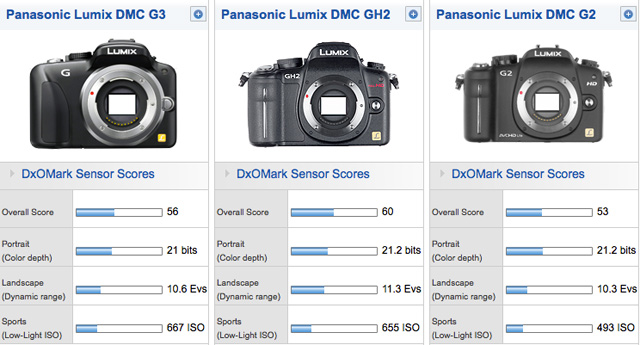
That was fast! You can already see the G3 sensor performance test results at DxOmark (Click here). Overall the Gh2 is still a bit better (reminder, we are talking about the RAW sensor performance). But at high ISO the G3 beats the GH2 with a very small advantage!
Obviously the GH2 is a much better camera when it comes to handling and video quality! But the G3 is really a nice camera if you consider that it is considerably cheaper. If you don’t want to wait to much before to get the G3 you should preorder now by clicking those direct links:
In US: Amazon, Adorama, J&R.
In Europe: Amazon UK, Amazon DE.
And as I told you yesterday US readers can finally buy the GH2 because it is in Stock!
Right now eight black GH2+14-42mm kits are in Stock at Amazon US (Click here).
Two silver GH2- 14-42mm kits are in Stock at Amazon US (Click here).
And all GH2 kits will be in Stock on May 31 at J&R (Click here).
56 Responses
Not “low ISO” – exactly the opposite. That test measures high ISO.
Also, the difference can be attributed to a simple margin of error.
AHHHHH! You have the right to blame me for the whole day now 🙁
Low light means high iso isn’t it?
+1
Hmm, rumors are distracting me all the time now…
You need that vacation, seriously.
Yes, I know 🙁
The only thing that this proves is that the Panasonic sensor are still wayyyy behind the competition and NO the size difference is not really the main reason
The best thing that could happen to Olympus m4/3rds is a sensor made by Sony or kodak
Harold
Why do people persist in believing that Kodak would produce better 4/3rds sensors than Panasonic? Kodak have consistently produced the noisiest sensors relative to pixel density of any manufacturer – the high ISO performance of the early Kodak sensored Oly is vastly inferior to the Panny sensored ones, even though they had a lower pixel density.
The problem of the kodak sensor is its important read noise. Doing maths, this impact both DR and high iso values. Anyway, I always been very satisfied by the way the colors were rendered on my Olympus E-500. That’s the Kodak sensor’s strength. Unfortunately, The Kodak CCD technology can’t match both present and futures developments of m43 products.
Pfft.. actually they can. When did you last saw Kodak CCD in m4/3 camera?
Take M9, make 1/4 crop and you have possibility of 4/3 Kodak CCD. They can bump it up, cause 4/3 has bit more clever design than Leica M, so I guess 8-10 mpix is real. Is it enough? Well depends.
If you want great colors and perfect low ISO, then its for you. For high ISO, not so much, it would be limited to ISO 1600. Though G3 actually doesnt have more than ISO 1600, rest is SW gain.
Only problem is, that Kodak doesnt produce CCDs anymore. 😀
So I would leave it to Sony or Samsung.
Btw. as far as colors/low ISO/resolution goes, CCD is king.
Except the Olympus E400, all kodak CCD sensors are “full frame” (not the size, the technology) and thus can’t enable liveview. That’s more than a problem for m43 cameras…
Yeah… I’m beginning to get tired with these shitty sensors… Love my GF1 but… Well I’m really beginning to wonder about a camera like the Pentax K5 and a bunch of pancakes…
I evaluated that for a while…but as it appears, Pentax AF is all over the place (and the major manufacturers have also their share of PDAF issues)…And IF theres something i love about my GF1, is how sharp pics look…being an important part of that the CDAF technology…
always the same poor dinamic range …
aaah…so after the dumb pixelcount race we have the even more dumb high-iso race.
Have a look at the dynamic range instead, which with 10.6Ev is really poor nowadays. Apparently, marketers never heard about dynamic range…
…
What will be the primary marketing requirement of the G5 in 2013? A built in Ice dispenser, producing 3.4cubes/minutes (compared to only 2.1cubes/minutes of G4)?
Or 30 new scenery programs, including “children falling from chair” and “watching TV”?
Or the upcoming “no button at all” user experience, which enables a new approach opening exciting opportunities for creative photography? It will all be done via speech recognition. I.e. “take picture of kid remove red eye use scenery ‘children with playstation'”.
I really excited seeing what comes next! ISO 12000 is OK, but market now needs ISO24000, Noise can be easily removed by shrinking image dimensions to 320×160 pixels, followed by a smooth advanced algorithm (TM) upscale to 20e6 pixels.
But I do not buy. I live.
Now here is a conclusion
we had g1, with all its faults especially when it comes to low light performance it was a nice camera. Later that gh1 exactly same g1 with video shooting.. Then came gf1, g2, g10, gf2, gh2 now g3.
Can someone please telle me which of these are an upgrade ??
Still very bad DR. Still bad High ISO performance. (I saw lots of people really liked G3 High Iso photos. well guess what, you are wrong, just a lot of software corrections which are leaving almost no sharpness)
I bought G1 the week it came out. Now 3 years passed. I am looking today’s m4/3 cameras comparing them to 1st Gen. m4/3 . I am looking 3 years old DSLRs and comparing them today’s DSLRs.
I hate to say this but if m4/3 keeps developing like this it will be death soon.
DxO always spoils our thoughts about 4/3 sensor performance :D. But high ISO are pretty well handled over G2 sensor, so one day, they finally catch best APS-C sensor performance (DR).
Sorry admin the title of this item doesn’t match the topic.
Later on you say it on your own:”But at high ISO the G3 beats the GH2 with a very small advantage!”
-> Just 1.7% better that’s nothing!
The main topic is that the G3 has remarkable less dynamik range then the GH2, with nearly the same sensor resolution. Why couldn’t Panasonic improve this with the newer sensor in the G3? This is one of the biggest disadvantages of m4/3.
In general the high ISO comparation is more or less silly because of the different internal noise-reduction-mechanisms.
BAD news!
the overall score of panasonic sensors gets lower and lower with each generation:
GH1: 63.6
GH2: 60
G3 : 56
:(!
This only proves that panasonic neglected High quality for megapixel(marketing) wars with sony
PANA: 2X CROP SENSOR DOSNT HAVE TO HAVE THE SAME MP AS APS-C!!!
Tell that to mass consumers…
DR numbers are pretty dismall. 🙁
Yet I wonder how the other numbers are possible after what I’ve seen in direct image comparisons with APSC sensor cameras on dpreview…
And yet, the G3 appears capable of taking stunning pictures (if the user is capable). I’ll choose pictures over this numerology any day, and I’ll vote with my money, not just my comments.
+1
I can’t see how that slight difference in the ISO results means anything. I have a GH2 and a Nikon D7000, I don’t know what the numbers are on these two cameras but the GH2 sensor is every bit as good as the D7000… to my eye. Personally, I perfer the GH2 to the D7000. If the G3 has the same or close to the same sensor as the GH2, then it is a very good sensor. No, it’s not full-frame iso quality but then again, it doesn’t cost as much. If you must shoot in the dark, spend a few thousands more and buy a pro camera.
isn t it much more suprising and interesting that the good old gh 1 beats them both in every aspect?
how is this test workin? do they take care about a certain time factor, so that old cameras still have good notes?
Understanding DxO numbers is a bit tricky and many people get confused about them. But my own reading is:
The low ISO performance is not great, but I guess it’s good enough for most people. Unless you print very large size and want to have very clean shadows, you won’t notice at all.
The high ISO performance is very good. Extremely good. Taking into account the sensor size it matches (if not beats) any other camera out there.
About DR, what they are really measuring is noise. The DR of the sensor is fine, and at high ISO it shows little noise.
Honestly, this sensor is very good and no one should not buy the camera because of sensor concerns. With fast, high quality lenses, it can do anything.
“About DR, what they are really measuring is noise. The DR of the sensor is fine, and at high ISO it shows little noise.”
DR (dynamik range) means normaly the range from the brightest to the darkest part which doesn’t get white or black.
In my opinion the m4/3 sensor are really bad in the bright parts of the picture. The highlights turn very fast in undefined white aereas.
Zonkie, what do u mean by “About DR, what they are really measuring is noise.”
Arent they measuring the actual DR?
Exactly. Their dynamic range measurement has little to do with “real world” DR. The measurement is just another way of measuring noise. Actually, to know the high ISO performance of a camera compared to another you should look at both the S/N ratio and the DR and the “real world” noise would be about half way in between both measurements.
As an example, compare the Nikon D7000 and the Pentax 645D. In S/N at ISO 1600 the Pentax is noticeably better. But in DR it is the Nikon that’s clearly better. Now go to dpreview and compare the raw images at ISO 1600 and you will see that they are comparable in noise performance (with maybe an advantage to the Nikon even after resizing the Pentax file to the same size).
Dynamic range in the real world is mostly just a myth. It’s all about noise and correct exposure. You really don’t want to have images with a real dynamic range of 11 f-stops. They would look like shit. Like those multi-frame high dynamic range images from some Sony cameras. If someone gave you a JPEG with such a high dynamic range the first thing you’d do is to reduce it by increasing the contrast.
So the sensor of the G3 is fine, IMHO. But you do need fast glass to take advantage of it. About 1 f-stop faster than APS-C systems, and 2 f-stops faster than full-frame systems. And that’s what’s now really missing.
Thanks for posting this useful link to DXO.
Many posters have mentioned to pay less attention to the DXO numbers but rather compare the SNR and DR curves etc. Whle the G3 sensor definitely closer to the D5100 Sony 16mp sensor at high end but not at the low end ISO. What I want to know is are these figures only theoretical of what the sensor is capable of delivering or what is actually delivered with a lens and with what lens?
The reason I ask is from the graphs the G3 sensor appears to be about 0.5 stop behind the D5100 at higher ISOs in most respects but much lower at the low end in DR yet when comparing high ISO pictures on either DPR or Imaging Resources comparometers, the G3 looks to be about a stop sharper and better resolution at ISO 1600 or is this only with the JPEG processing? However I detect that while the G3 resolution looks better in comparisons there is an exception and that is in the red colors? Is Pany enhanced resolution software also playing a part in the sharpness seen?
I am inclined to judge more from the pictures than necessarily only from the DXO data.
I believe that the only thing you can measure is the SNR. Dynamic Range can be estimated in many ways but it’s only the number of stops between noisy shadows and blown highlights, which of course depends on human decisions like metering and EV correction i.e. selecting a range of brightness.
Ideally one would underexpose, if there was no shadow noise. Using more pixels increases resolution (information) more than noise, but that can be seen only at average sensiitivity, say 600 ISO. Noise at base ISO will increase, unless it is properly denoised.
Probably a HDR with no noise at base ISO would require less Megapixels, and a sweeter tone curve, which is not what consumer expect. Therefore it will be interesting to see what Oly will do, since it seems very aware of the – photographic – problem.
At the end of the day, these m43 sensors may not be technically as good as APS-C sensors, but they still are leaps and bounds better than scanned negatives/slides were in the film days (and I’ve scanned a lot of film for sure).
These sensors are fine for what the m43 system gives us over APS-C DSLRs
Human nature is to always want better, and that’s all fine and good, but folks need to evaluate on the quality of the images as used, not pixel peeping at 100% an worrying over noise in shadows that will never show up on a printed image.
Perspective is everything.
Very good points John. I have recently been scanning some film and have been going through the frustration. Its all about the end use that we all tend to forget about.
The thing that M43 has over APS-C DSLRs is size – especially lens size. The new lens offerings from Oly and Panasonic are encouraging. If I buy into a system like M43 then quality lenses will last. And hopefully there will continue to be improvements in sensor tech so that one day DXO numbers will nearly match APS-C to keep all of those DXO fans happy as well!
I do not trust Dxo results. First, they claims to analyze sensors performances. But that’s not true. They only analyze the raws data files. It made sense few years ago when sensors were CCD (although there is almost 1 EV difference, both in iso and DR, between Dxo for Leica M8 and theoretical performance given the official kodak sensor specification…). But now, with CMOS sensor and increasing electronic and software treatment it is unclear how raw is raw (i.e how much the raw data has already been processed).
What does it matter whether it’s processed or not (all are “processed” to a certain extent)? You can only get RAWs out of the camera (and JPEGs), so “pure” sensor performance doesn’t mean anything unless it’s reflected in RAW performance.
this is just, as they call, measurebation.
nobody will buy your photos because of the DXO numbers. I will still judge from my eye, as photos will be looked at by humans anyway 😀
Agree, picture quality and DXO scores are not always related. This measure is however a testimony to Panasonic’s engineers who are still not managing to attain a better score than the Canon 350. Anybody remember that model?
But the GH1 Still beats all 3 for image quality.. Hopefully the GH3 will step up and finally beat out the GH1’s image quality..
GH2 has significantly better image quality than GH1
All they need to do is add the AF from the GH2 to the GH1 and all will be well!
The GH2 Does Not have significantly better IQ at all, unless you mean it has a higher max ISO sensitivity.
It’s possible that they can improve GH1 AF with a firmware update, but it’s not likely that they can get it to GH2 level without then new sensor (and electronics).
On IQ: I have great respect for DXO measurements, but they don’t tell the whole story. If you ever tried both cameras then you wouldn’t doubt that the GH2 has been improved. That’s also what most serious reviews say. Read dpreviews conclusion: http://www.dpreview.com/reviews/PanasonicDMCGH2/page21.asp
GH2 has much better IQ than the GH1 as it doesn’t suffer from fixed pattern noise. (I have a GH2 and I had a GH1 which I got rid of precisely because of that issue.)
This deficiency is a great example of why DXO is only a crude measure of performance …
Even when shooting RAW? Does it matter at what ISO? Just curious, I don’t have a MFT camera (yet, thinking about a GH1 + 14-140mm as an “über point-and-shoot”).
Everyone I have talked to who has owned both cameras instructed me NOT to upgrade to the GH2 based on image quality. Features and video YES, image Quality No.. Maybe its a wash, more pixels can help with cropping for sure. But if im going to drop some $$ it better be a HUGE step up..
I would agree that it is not worth the $$ to upgrade as any improvement is only vary slight, though I never owned a GH1 ( I borrowed 1 for a month while travelling, which inspired me to buy a GH2 when I returned). But i would say that IQ seems slightly better, but i never pay a huge amount of attention to measureabators and i am willing to concede that any improvement i see may be all in me ‘ead guv 🙂
Very interesting. G3 shows not the good low-ISO performances below ISO800, but it shows nearly same result on high sensitivity above ISO800 especially in DR. G3’s Low-ISO DR is not so good, but IT BEATS GH2 above the ISO800.
So, This G3 sensor is far from high reputation from DxO test(for it’s low-ISO performance is not so good), but For G3 owners, they will frequently use ISO range between 800 and 1600. G3 shows good performance (compared to 2/3stop bigger and less densely pixeled NEX-5’s sensor) here. If you use high sensitivity many times, G3 is good choice.
Since we don’t have the ability to record video in a raw format, these DxO scores are useless for assessing that aspect of these cameras’ performance. The GH2 has a much more powerful processor than a GH1 and that shows in the improved quality of its video. Just sayin’…
Nobody thinks about that
the GH1 is simply far not as better in RAW than GH2 as the DxO mark measurement would indicate. This is a fact, not something has to be discussed.
So, guys, either the GH1 is overmeasured or the GH2/G3 is undermeasured.
The question is: WHY?
DXO don’t care about extra pixels.
When I looked on the DxO page (G3 sensor review) I found this statement: “It is worth noting that Micro Four Thirds sensors are smaller than APS-C or Full Frame sensors. Their smaller size means less light is captured.”
Strange, but when I use film and measure the light with an exposure meter and get a reading of, say, 1/60 sec @ f11 @ ISO 100, I can use these settings for correct exposure on a 35mm camera (with an image area of 24 x 36mm), or on a 6 x 7 rollfilm camera (56 x 69mm), or even on a 6 x17 panoramic model (56 x 168mm), etc. In each case the intensity of light on the film is the same. Surely the whole point of a standard is standardization – hence the ASA/ISO system was developed for any photographic format. So I could even take those meter readings and set them manually on a micro43 digital camera and get correct exposure.
If the exposure, the intensity of light, is the same in each case, thinking of a smaller format as one “cut out” of a larger one will clearly tell us that in one sense smaller sensors do capture less light (in total), but in another sense (photographically) all sensors capture the same. So let’s be clear in our terminology and not give the impression the laws of physics have changed, or that small sensors are somehow disadvantaged by their size. When you try to reduce everything to measurements you make a lot of unnecessary problems for yourself. You can’t reduce everything to measurements, there are so many other factors involved. As one example – however much “better” the larger camera is, if it’s barred by the “bouncers”, the smaller, “inferior”, camera will always get better results just by being there!
Some photographers used to say “a good big ‘un will always beat a good little ‘un” (talking specifically of formats). Perhaps true in one way, but the little camera can get places and do things that big brother can’t!
I hope I like the G3. I had sort of planned on buying the GH2 but video means little to me, just occasional use for memories. I have had the G1 since it came out, same for GF1 with EVF. I come from a 5D but i don’t shoot commericially anymore and I just feel I can be happy “enough” for prints up to 13 x 17, maybe 16 x 20. I am a bit concerned about size/ergonomics but think if I’m not reasonably happy with G3 I’ll live with it (and previous cameras including 5D) until GH3–or something better arrives. I ‘ve decided compromises are more reasonable at times and sometimes good enough is —-well—good enough.
What feature or performance trait of the GH2 is worth spending $300 more than the G3 price (besides actually being available)? I’m not trying to enrage GH2 owners. I’m really asking.
For me, since I bought the GH2 primarily for video, 60fps sensor output.
(In addition to true 1080i and 720P60 I would expect the fast output to improve focussing speed and electronic viewfinder responsiveness for both video and stills).
The Panasonic GH2 definitely has less noise then the G3. Check all the test images. The GH2 is build better and ergonomically superior the G3. Also the larger sensor gives you a higher resolution when you decide to crop or use a format different from 4:3 like a square.