Panasonic “equivalent” products are all smaller. True, the range is not the same for the standard and tele zooms, and the UWA zoom is f4, but for the sake of portability, I think I’ll stay with Panasonic for zoom lenses. Also, using Lumix stabilized lenses is fine on both Olympus and Panasonic bodies. We can’t really say the same of Olympus zooms (especially the 40-150mm, for which stabilization is a must).
I wish the 40-150mm could be smaller. I figured 100mm tele end on Lumix = 10 cm lens lenght, so 150 mm = 15 cm. I was wrong.
I’m with you on the 40-150mm. It’s only marginally shorter than the 4/3 50-200 (but we don’t yet know the weight difference, and of course the 40-150 will focus much faster).
Panasonic needs to expand their X series of pro zooms by adding a constant aperture wide angle and super telephoto editions. How about a 100-300mm f/4? That would be a lot more usable and would cover a more complete focal length range than Olympus’s offering.
To add to that, I’d rather see Panasonic create a 6-12mm f/4 than a 7-14mm f/2.8. The extra focal range would be more useful than the extra stop of light since deeper depth of field is usually required for landscapes. Come on Panny, let’s see more pro zoom lenses!
The 4/3 7-14mm lens w/ adapter to micro-4/3 is about 13.8 cm long.
The 4/3 50-200mm lens w/ adapter is about 17.4 cm long
So if you’ve got some good 4/3 glass in your closet, you’re saving just a bit of size with the new 7-14 and 40-150mm lenses. Oh, and getting faster glass and *much* faster focusing.
well, if you wanna compare the size of those two lenses. You have to consider their diameters too.
I think people who wanna buy this lens can accept the size of this lens, and will enjoy it with F2.8@150mm, internal zoom, dust and water proof and better autofocus..
Anyway, if you don’t like it, you can but 35-100mm/F2.8 from Panasonic, or if you think that lens is also too big, you can buy a new 35-100mm/F3.5-5.6.
The worst part about these lenses is that they will surely cost a fortune. I am curious as to how much better the image quality will be compared to their cheaper equivalents. But I guess that’s what the reviews will be for. Too bad we will have to wait until 2015 to find out.
A sad state of affairs for a long time user. Whatever happened to the ‘pancake mentality’? I sure like where we started with m4/3 a lot more than where we’re going…
Ok, fair point. But all I’m saying is that m4/3 has seemingly given up on maintaining, let along pushing the envelope, with focusing on its small size advantage. Aside from kit lenses, Panasonic’s 12mm F2.5 was the last pancake prime lens released. I was under the impression that m4/3 was going to focus on tiny walk around lenses. I was clearly wrong. Maybe I’m the minority here, but this just seems like the wrong format choice for those interested in a 600mm (equiv.) lenses.
I think you may be mistaken on the “intended focus” of the format, but also you are mistaken with your statement “that m4/3 has seemingly given up on maintaining, let along pushing the envelope, with focusing on its small size advantage.”: surely the Panasonic GM1, the two pancake zooms (one from each company), and other excellent (and tiny) primes are evidence of a clear focus on small size?
But the format doesn’t solely have to focus on small size, it is allowed to offer something for everyone. And I also doubt if you have really compared “big” lenses between formats. EG, Nikon’s 600mm F4 (described as “a relatively lightweight super telephoto prime lens” by DPReview), weighs over 11 pounds (over 5kg)! I doubt if this Olympus 300/4.0 will weigh half that.
It’s the equivalency factor that makes micro four thirds (to me) exactly the right format choice for those interested in a 600mm (equiv.) lens.
Seriously, consider this: I carry, in a small bag (Hadley Digital), an E-M1, 12-50 zoom, 75-300 zoom, 20/1.7, 45/1.8 and accessories. This is a bag that could just fit a typical DSLR body and an average zoom.
The lenses in the header photo above could fit in a Hadley Pro, along with an E-M1 and accessories…yet the above mentioned Nikon 600.4.0 wouldn’t even fit in that bag by itself!
There are two things an intelligent buyer should do when researching the m43 system:
-compare equivalent systems, taking into account costs, weights and focal length equivalencies
-do some printing, before deciding the IQ of m43 isn’t up to the task they have at hand.
A 4/300 M43 lens compares to a 8/600 in the 135 world. Nothing good or bad per se, but the price must be way smaller, because we are talking worlds apart. I may even buy a M43 camera, if a proper 4/300 comes out.
However. make the price 2 grand or more, claim that it equates to a 4/600 and it is a super bargain and write “pro” on it… Guess: I will keep the good money, as I have done so far with M43.
Then you’ll never buy anything. Have you ever used a telephoto lens for it’s intended purpose? There is more to photography than a shallow DOF.
Do you even stop to consider what you will use a 600mm equiv lens for? Let me lead you by the nose…
Consider a bird, 30m away, in a tree. You have two systems, a FF DSLR with a 600mm F4.0, and an E-M1 with a 300mm F4.0 (yep, this scenario is in the future).
You photograph this co-operative bird with each system, with each lens wide open at f4.0. Ignoring the difference in the “T” values of each lens, your ISO and shutter speed will match. So, the only significant difference in those images will be the DOF. “YES!” you exclaim, my point exactly! Good for you… the DOF for the FF system will be 0.59m, for the m43 sensor 1.19m (funny, the 2x factor works here too). What does this mean? It means there are a few less branches in the tree in focus with the FF system…
What does it cost to have those few branches out of focus?
Let’s assume you want to compare small bodied FF systems from Nikon and Canon, with the E-M1 and the upcoming 300/4.0 (assume, pessimistically, 1.5kg/$2000 for this lens).
-Canon EOS 6D/ EF600/4.0 IS II USM/ 4.69KG/ $14,618
-Nikon D610/ AFS Nikkor 600/4.0 ED VR/ 6.75kg/ $11,395
-Olympus E-M1/ 300/4.0/ 1.99kg/ $3,399
I know which system I would chose…I’d rather have those few extra branches in focus, thanks. Especially if the bird wanted to hop to the next branch, think you would be handholding those FF systems?
A m43 300/4 may be equivalent to a FF 600/8 in terms of field of view _and_ DOF, but shallow DOF isn’t normally a requirement/priority for someone shooting at 600 on FF, whereas a bright aperture and lighter weight is. If we were talking about a portrait lens then DOF equivalency is important, but it’s not for a birdwatching lens.
Huh?
Whats the problem? Oly recently released a tiny pancake zoom. Also all the small pancakes are still available.
The real advantage is when these lenses are available you really have the choice if you want to go small or big.
m43 is exactly the right system if you’re into wildlife/birding etc that needs those 60mm equiv lenses. The thing is that follow focus is behind the speed of a pro Nikon or Canon. But they (m43) are catching up fast. The E-M1 is allready very good in this area and I think with the next iteration they could already be the equals of the likes of 1D(x), D4.
If the Sony would approach the 1 system more serious, it would be a very big competitior to m43 in this area.
35mmFF has it’s use but in even more smaller niche area’s. The main stream will be the smaller formats, it’s history repeating.
Tokina makes one! Sort of…
Their 300mm f6.3 mirror lens. It’s about 3″ x 3″ and 300g. Native M4/3 mount. Manual focus, chipped, so you get EXIF data and it will auto-trigger focus assist on my GX7. Fun lens, cheap $199 at B&H, not great optically, but extremely compact and lots of fun.
As an owner of one of their SHG 4/3 line lenses, I welcome this. If the quality is like the original 4/3 then it’s definitely worth the price for me. SHG does not disappoint!
Yeah, we’re human too ;-). Just Viezevure is an idiot that can’t understand that there are actualy pro’s using m43 as their main system.
That’s just the mindset of a wannabee.
There might be one or two, especially if Olympus pays them. I am fully prepared to accept that; however, the rest is just hype and gadget freaks at play. Amusing.
There are not many pros here, neither decent hobbyists 🙂 More like 70% marketing nerds and 20% gadget geeks. The rest take the piss, like me LOL
Did Oly learn NOTHING from 4/3 !? I dearly love m4/3 but this strategy is simply wrong. they’re going the same route as with their DSLRs vs APS-C (smaller sensor+barely smaller HQ fast zooms + humongous prices VS bigger sensor + barely larger zooms + reasonable prices), Olympus cannot get rid of their corporate mentality and is driving m43 into a niche, they need to capture the entry level market with new and attractive (features+ low price) Pen cameras.
It looks like Oly did learn from 4/3. Instead of producing lenses that cannot be handheld (300mm f2.8, 90-250 f2.8), they went with something a little slower like the 300mm f4 or something a little shorter like the 40-150mm f2.8 (instead of 50-200mm). This is a good balance between being handheld while still being fast and long enough for it’s intended purpose.
For those of you complaining about size…give me a break. This offers an option to those that want it. It’s all relative in terms of what your needs are and what the market can offer. In that case, size this up against any other 300mm full frame f4. I think the Olympus will come out ahead. Let’s wait and see before making any judgements.
But is that enough of an argument though ? we saw this same strategy used with 4/3 and look where that ended. There’s nothing wrong with offering pro grade gear but neglecting the mass market will get us nowhere. M43 has the best potential to become the standard mirrorless system but promoting itself solely to Pros based on a failed argument is doomed to fail again. m43 should not follow 4/3 strategy. Olympus should seriously rethink their strategy, m43 is not just about OMDs and $1000+ lenses, there’s no way they’ll have any succes against the competition that way. I’m glad we’re getting these pro lenses and the OMD are superb cameras, but so were the E-X/XX/XXX cameras and HG/SHG lenses. These lenses are small compared to FF glass, but just the fact that we’ve come to compare them to FF glass sounds desperate and unreasonable size and price-wise.
I see your point but please do not forget Olympus is not the only one making m43 lenses. Sigma, Panasonic and a few others are all making lenses for m43 system so I guess what Olympus is missing could be an opportunity for others. I personally think it is great that Olympus is making the pro lenses because they are the only one I know offering up to 5 years warranty for a fee. Panasonic doesn’t do that unless you buy warranty from Squaretrade etc and Sigma warranty is 3 years if I am not mistaken.
Have you already forgotten the 14-42mm EZ Lens, if what you want is small then by all means get one of those and what ever else Olympus produce in that series of lens. Please do not complain on behalf of those of us who would like the quality we will get from these PRO Lenses.
I can only add, that after a recent trip to Venice I was well impressed with the images I obtained from my ‘M1 with 12-40mm, quality which I can only say I dreamt of with ‘P2 with 14-42mm and got close to with ‘M5 and 12-50mm lens. Do I complain about the cost and size of the ‘M1 and 12-40mm combo, no I do not; I thank Olympus for giving us these products. Long may they do so.
Currently there are SEVEN 14-42mm lenses! Plus the 12-32mm and 14-45mm.
THREE superzooms.
THREE or FOUR mid-range zooms.
THREE long zooms.
ALL are consumer grade. None are very expensive.
To fill out and legitimize the system, we need a few high quality long lenses. Next we need some ultra-wide primes and long macro lenses.
The good thing is that you could choose to buy them, or NOT.
Or buy and adapt used manual lenses. That works … and it’s CHEAP!
I agree. Especially with the new mirrorless systems from Sony and Fuji, one of the main advantages of m43, size, is eroding really quickly. Add to that the overall similarity of prices and it doesn’t look great.
No it isn’t. One word defeats your view entirely – lenses.
Have a look at my post above showing a comparison in size between reasonably equivalent FF and M4/3 lenses. A 1,600g difference in weight and a correspondingly large difference in size also.
Don’t see it. I am obviously speaking about APS-C cameras and the lens size difference, while still there to an extent, is almost negligible.
The new Sony mirrorless you mentioned, isn’t that the A7, which is FF – not APS-C?
Ah, no, I meant that the Fuji X and NEX systems came after m43. The a7/r I don’t consider as a direct competitor, because of the sensor and the size of the lenses. I simply mean that m43 has more serious competition than before and should act accordingly. I think they can do even better than what they are doing now, but of course that’s just my opinion and is entirely debatable.
I took the time to check your post above – it is wrong, as usual. Since you appear to be schooling people here, I won’t bother telling you why.
I’m confused. If you want small, there’s the incredibly brilliant Panny 45-175 or Olympus 40-150 consumer grade zooms. Not to mention the soon to be released 35-100 consumer zoom from Panasonic for the GM1. We already have enough cheap zooms.
Instead of buying another camera body and system, we have the choice of some nice glass and Olympus gets some of the missing profit margins back.
Don’t forget the excellent (for the size/price) Panasonic 45-150mm which is better than the lenses you mention. And it’s not much bigger than the 14-45mm!
The system has desperately needed high quality, longer lenses for quite some time. A 2x teleconverter is LONG overdue!
This is the internet… No matter what is released, there WILL be complaints!
These lenses are more than welcome. I don’t understand why some people is worried and complain about this offer. The system already has cheaper alternatives when talking about zooms, and offering a better glass and IQ output (without relying on incamera correction) is something that I need.
A small pancake zoom is nice to have (not for me) but people have different needs.
And let’s not forget that price will always be too high 😉
For my education, please explain “(without relying on in camera correction) is something that I need” why this is a need since I personally don’t care how the IQ is delivered to me.
I prefer to rely on a good if not great bunch of glass, knowing that the best quality is already there, in raw, and I only need to apply minor changes in PP (i.e. adding micro contrast or little sharpening the image). A jpeg file can work for many people but I need and prefer a good raw file.
I know most of readers here prefer a small camera with a small pancake 12-5000mm zoom 😉 but I prefer a bunch of good primes in my bag, and usually my camera is in my hand or in my bag, not in a pouch so I don’t need it to be too tiny.
It’s all about compromise, but I prefer quality.
I just bought the E-M1 to replace my E5, and the announcement of the 300mm f4 was what put me over the edge. Sure, a tiny system is nice, but a complete system is nicer. I don’t know what everyone’s complaining about, if you don’t need it, don’t buy it. What would you have rather seen instead of it? The rest of the range was pretty much covered.
Another complaint seems to be price. Do you all think it’s going to be more expensive because it’s big? I’m sure if they manage to produce a high quality pancake 300mm f4 it would use some really expensive alien technology and it would cost millions. You can’t have it all, you don’t need it all, now stop complaining and be happy for me, they’re making the lens I always wanted.
You are absolutely right Swinta and ambercool! I can not understand why some people are whining about size, price or weight of these lenses. There are already some great lenses from Panasonic and Olympus out there, which are smaller and more portable (and optically pretty good but not stellar). It makes absolutely sense to produce some high quality zoom lenses. I am a pro photographer and I ditched my Nikon D4 almost 2 years ago and bought the Olympus E-M5 (and last year the E-M1). I am more a prime lens shooter, but sometimes a good zoom lens can be helpful too. I am also willing to pay 2k per lens, provided that the lenses are superb (and I am sure they will be).
Maybe people complain because Olympus was marketing m43 as a way to make the lenses much smaller and cheaper than FF? And they cost similar as FF lenses (even though should be considerably easier to produce) the fast tele lenses make them hard to use on most m43 bodies. So the declared advantage has not materialized as much in this area. M43 is more for slow zooms and primes that are of high quality, competitive prices and small size.
I don’t think that they are necessarily easier to produce : the smaller the sensor is, the higher the resolution has to be, because the pixel size is much smaller.
Dont judge my arguments when you cannot judge yours properly. I dont know why are you comparing two different focal legths… If you want to point out something, you should compare it to a lens of the same focal length but in FF size. I am not going to bother searching. Lets leave this… I agree with the rest of your post.
I said that m43 is good in slow zooms (because they are very small – fitting nicely all m43 bodies – and almost all of them nicely sharp when stopped down) and primes (which are all fast and small up to your mentioned 75mm). When we come to fast tele zooms it is a different story and many might wonder why not to pick a big body APSC or FF DSLR when they want to shoot with fast tele lenses often. Mirrorless cameras in total have biggest advantage in shorter FL.
—
It is hard to compare mirrorless m43 and FF lenses in the same focal length as there are not many yet on the market but obviously FF mirrorless can be very small too. http://camerasize.com/compact/#482.346,487.395,213.279,ha,t
We will see what the manufacturers come up with next.
Are these the first pictures of the 300mm f/4 and 7-14mm or did I miss them? Looks quite huge, but okay when the 7-14mm is really a f/2.8 that would be fully okay.
Polarisers create uneven effects in the sky when shooting ultra wide, but are still useful when shooting foliage and/or water (reduces glare and improves saturation).
Also, a lot of people (including myself) really like shooting ultrawide with ND filters.
About half of my photos with the 12/2.0 are taken with filters.
Sony has nailed it with their 10-18mm ultrawide lens, which weighs only 225g, takes filters, and zooms out to 15mm (full-frame equivalent). Other camera manufacturers are also introducing ultrawides with filter rings, including Fuji with its 10-24.
For me, lack of a filter ring is a dealbreaker with any ultrawide lens.
Maybe it has rear mount filters, we do not know for sure yet.
Yes, I agree you will have strange effects with polarizers and UWA. I like more ND filters for low shutter speeds (water and clouds) and ND grad for the sky. At 7 mm it can produces heavy vignetting but I’d like to have it, let’s say from 9 mm to 14 mm !
The Panasonic 100-300mm is 126mm long (spec from Lenstip), aka 41mm shorter and the Panasonic 35-100mm is 99.9mm aka 67mm longer. That is quite big. I think that I may rather go for the Panasonic 35-100mm, although the Olympus one looks better it is a little too big for my E-M5. Mmm… I’ll wait for comparative results.
I think you are right. To me, it looks similar to the 40-150. But the lens on the dpreview image IS in fact smaller. It looks as if it is constructed to extend on zooming now, instead of being larger to begin with and not-extending (mock-up). But where is the tripod collar?
I think you are right. To me, it looks similar to the 40-150. But the
lens on the dpreview image IS in fact smaller. It looks as if it is
constructed to extend on zooming now, instead of being larger to begin
with and not-extending (mock-up). But where is the tripod collar?
I just wanted to add to the list of complaints. WOOT! Seriously though, that 7-14 is calling to me. I will get that unless they happen to announce a 7mm prime. Yeah love dem primes.
I wonder whether the 300/f4 can replace the 300/f2.8 in terms of quality. PRO against Top PRO – only words? I would guess that the 300/f4 only weighs half of the 3.290g that the 300/f2.8 brings to the scale
Just had a quick look on camerasize – a canon 600 f4 is 16cm diameter, 44cm long and 3.9kilos. The biggest nikon I could find was a 500 sigma lens at 12x34cm. That’s a BIG difference to the 300 above which is most importantly faster – From what I can gather shallow DOF isn’t high on the list for nature photographers whereas low light ability is.
i beg to differ in my industry – from working with a number of sports photographers, a good percentage, whilst having full frames at their disposal, prefer cropped framers for a few reasons. 1. They get the added tele range by default and 2. A larger frame results in a shallower depth of field and in addition, a larger percentage of missed AF shots. They prefer the forgiveness of cropped frame. For them, full frame is fine, as long as the subject is mostly stationary. Which is most cases for them, is not the case…
2cm longer than the Pentax 300mm DA. Nothing new in the world of optics, the extra length just compensate the shorter mount of the m43. This lens is not specially big, but when you move to telephoto, there is no gain no short mount flange in the optical design.
yes, but optically still a 300mm f4. My point was merely to say that we can’t expect m43 telephoto lens to be smaller thanks to short mount flange, quite the opposite.
You are right that in the tele range, two lenses of the same optical focal length, formula, and aperture would be the same size regardless of the sensor/film size. However, having lugged around an R8 with 280/2.8 apo with 2x apo-teleconverter (560/5.6 combined, but the lens really was a T3.4, so I got 560/6.8; this kit was 4-5kg altogether), I would say sensor crop factor offers a tremendous weight/size advantage. I can fit the Panny 100-300/4-5.6 in my purse, and take it everywhere; can’t do that with a 200-600 for any format, any aperture. I will be able to do the same with the 300/4; I can barely lift a 600/4 these days.
I also get increased DOF without risking blur, which is very desirable at this FL.
yep, totally fine with that.
It’s just that some people complain that mft 300 f4 is as big as aps-c or even FF DSLR 300 f4 lenses.
No point to complain here. Of course the crop factor advantage is still valid and the gain is huge in size to get the same framing
I would have bought the Panny 100-300 despite its quite poor aperture at 300 BUT ALL the tests I read quoted very poor quality at 200-300mm.
So I use my APO-LANTHAR 4/180 (450 gramm)and Nikon IF-ED 4,5/300 (975 gramm) with adapter, both do indeed have outstanding quality. Theµ4/3 adapter adds 100 gramm more however.
I’m quite intersred in the future Olympus 4/300mm BUT how heavy will it be? surely OVER 1 Kg ! 4/300 is 4/300 is 4/300, the front lens is AT LEAST 75mm of course, more probably even more, say 80mm to prevent vignetting, and all 4/300mm I know are 1000 to 1200 gramm.
A 4/250mm would have been enough and would have permitted a 72mm filter. And a weight of say 750 gramm.
Marc
Of course yes. mft lens are same size but can be sharp at wide open. By exemple, 42.5/1.2 has same size as others system lens but atleast, it’s sharp at wide open.
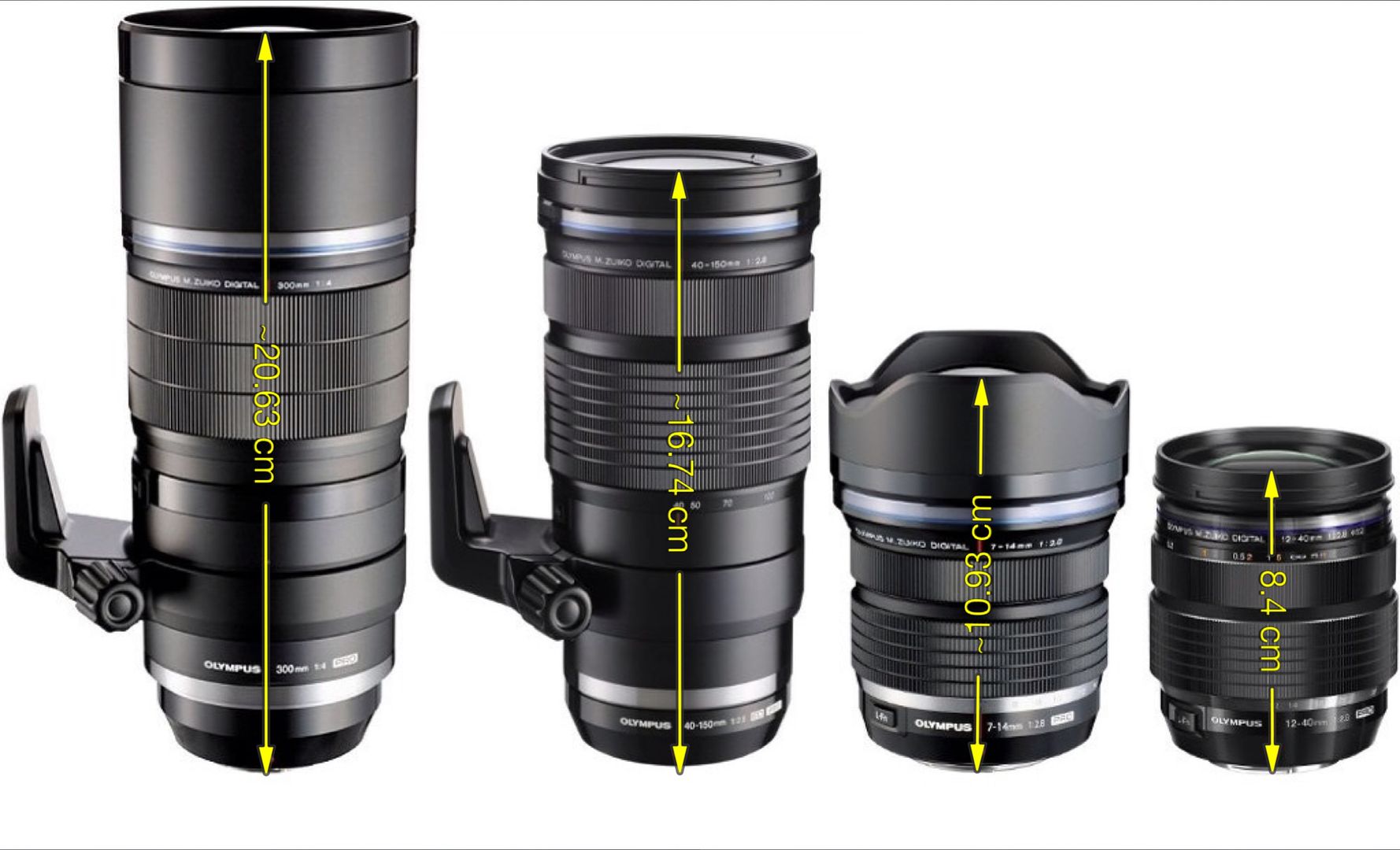
OMG what a reactions…, puff. I always thought photographers could think first before posting anything. Ever used a Canon/Nikon 300mm/f2.8, or Sigma 120-300/f2.8(great lens) with a full sensor body?? A lot of people here seem to get nuts over these ‘large’ lenses. 20.63cm for a 300(600)mm/f4 lens. That is pretty small and light. I believe these are internal focus also. I am a full-time photographer for my living. I sold all Canon stuff, including the big white lenses. Great gear, no doubt but in no way innovative at this moment. Is MFT perfect? No it isn’t, but none of my clients ever! mentioned or asked about my gear. They just look at the pics!! I can’t wait for the 40-150mm/f2.8. Thats 300mm/f2.8 and only16.74cm long. So before complaining about size/weight… go out a day in nature or city with a full-frame sensor camera + 300mm/f2.8. Good luck!
I think these lenses are too large. There is no advantage over APS-C or even “FF” lenses. I can just as well get/stay with traditional DSLRs
Examples:
– There is a (old) Sigma 50-150/2.8. Its shorter (14cm) and covers a bigger APS-C Sensor
– The excellent Pentax 300/4 is only 18.4cm long and even covers a “FF” sensor!
I have no doubt, though, that the Zuikos will -once more- be optically outstanding (and accordingly expensive).
But the real advantage (for me) of the m43 system lies in little gems like the Pana 12-32, and some small primes, with accordingly small cameras (E-M10, GM1, etc).
These are very odd comparisons. 150mm on an APSC camera would only be 225mm on APSC, and 300mm on APSC would be 450mm as compared to 300mm and 600mm… SO there is indeed a reach and framing advantage. Even if you choose to crop from the higher res APSC sensors you lose all IQ advantage (and may even end up worse off) could very well suffer from great AF issues as slight mis focus after cropping is exacerbated.
One other thing, there were lots of people who would compare older Canon and Nikon film lens designs to 43rds optics and talk about size differences… Well now that all these older optics are being redesigned for digital they are ALL significantly larger and much much more expensive.
The full frame coverage is irrelevant for size at this focal length. The Hassy 300/4.5 is still less than 20cm and I would assume that they didn’t even try to make it small.
Again: the length of a tele lens is dependant of the thickness of the body.
As the hassy-body is fairly thick, the length of long teles are cut by the amount of the body thckness.
Comparing lengths of long lenses doesnt make any sense if you change the size of the sensor.
They are 600mm lenses only two inches long (even since several centuries), if the lens is to be put on an old camera whose body can extend as long as the focal length!
Thus it is wrong to say that flat bodies allow shorter lens lengths, exactly the contrary is true.
Take any 4/3 lens and put it on the adapter to make a µ4/3 lens of it: it will be exactly 20mm longer (and 150 g heavyier …).
Marc
A tele-lens like a 300mm will always be LONGER if the body is thinner! The pentax FF has a 45mm thick body, µ4/3 is only 18mm (or 20mm?); THAT makes the lens of µ4/3 longer! Take some lenses available for Nikon or Canon APS (same body-thickness as FF) AND for µ4/3 like some Sigma (2,8/60mm fpr example); the µ4/3 is longer!
The inconvenient of µ4/3 ist just the … small bodies which are a nuisance to use quickly with hands of grown-up male photographers. The advantage is that many lenses are 4x smaller and yes I love my Olympus 9/18 and 1,8/45mm (70 and 115 gram!) but the GX7 is still a bit too small to be of convenient use. FF digital cameras on the other hand are a bit too … heavy (compared with the good old Nikon FE and a lot of others SLR weighing 550-600 gram like old Leica Ms). The weight of a body, on the other hand, is not such an inconvenient because you usually take ONE – and 3 to 5 lenses when going on tour.
But holding a camera is still better if the body is say in the region of 550-600 gram, with a lens no more than 100-200 gram. The worst is a supertiny superlightweight body with some heavy lens!
Yes some Fujis are indeed very fine to use, alas they have few lenses.
For me (Concert and theaterphotographer) there is some other point that made me jump from old leica M3 ( build since 1954) directly into Panasonic GX7: The ability to be absolutely noiseless. No Olympus does offer that, and the new M1 ist still twice as loud as the M5! (because the shutter is travelling 2x faster to acieve this 1/8000 no one really needs).
Marc
I absolutely LOVE the griping here from internet professionals. As others have mentioned, don’t want any of these lenses dont buy them. I mean seriously what is a step down from a 300mm f4 lens? A 300mm f5.6 and we have that in Panasonics Zoom… WHat is a step down from a 7-14 f2.8? A 7-14 f4… oh… that exists as well… WHat is a step down from a 40-150 f2.8… a 40-150 f4 and we have a 40-150 f3.5-5.6…
We do actually have a lot of options, pricing could be a little cheaper, just a little, but if you hold off Olympus always offers some deals and rebates eventually… Just dont expect a brand new lens with a new design in a new mount to be cheap.
When it comes to IQ, this is ALL dependent on DoF, I cant believe how many people dont understand this. If you want the better IQ from a larger sensor system then you must exchange NOISE for DoF. So Shoot a 600mm f4 vs this 300mm f4 and you will have the same ISO and shutterspeed, better noise performance and shallower DoF. The moment you CANNOT exchange DoF for noise, then you are shooting your 600mm at f8, upping the ISO to maintain shutterspeed and you now have pictures that look an awful lot like m43rds pictures… however they may very well exhibit more noise, and have less DR and worse Colour Fidelity.
So here is the D610 vs the E-M10 at ISO 800. you can just about see the IQ difference in the shadow noise. This obviously gets more pronounced up the ISO chain. Then there is a series of IQ comparisons showing the 2 stop difference in noise and why it is so silly to buy a nice big expensive FF camera and slap on a slow lens.
These comparisons are great. Really, looking at the images, the OM-D’s do great at hi ISO. You might get a couple more stops of usable ISO numbers on *some* full frame cameras, but on many it’s not that significant and at lower ISO’s there may be much less of a difference. There’s a difference, but it’s not night and day.
for the price of these lenses, how many of y’all Re going to invest in any of them? Reading these comments sounds like this is great, when it’s really Not!
“Pro” lenses for pros? Highly unlikely. How many pros shoot with M43?
-How many shoot sports, professionally? Not many, I’m sure of it.
-Wildlife? With these lenses and a four thirds sensor? -No. The 7 would still kick any M43 cameras ass in sports and wildlife.
Olympus is going back to their old ways and wants to fill their warehouses with even MORE lenses that will not sell! This is crazy… It’s like they’re doing this on purpose in order to get brought out!
fanboys are praising these lenses, but if they are at a premium, wait till you see the numbers… get that box of tissues ready, it’s gonna be a lot of tears…
It seems you are the one who is quite mis-informed. Let me count the ways…
Just because they are using a pro designation doesnt mean only professionals will buy it. In fact I would imagine the humble enthusiast makes up most of the lens sales for all manufacturers.
You ask how many photographers shoot sports with m43rds… Well have you heard of the chicken and the egg? Sports photographers couldn’t shoot m43rds without these lenses… But even so, we could probably agree that sports photographers are not the legions you seem to think they are. And “pro” wild-life photographers… they are becoming as close to extinction as the animals they shoot… But enthusiast wildlife photographers are probably doing just fine.
Onto your third comment, Olympus has actually approached m43rds from a completely different direction as 43rds. 43rds began as a professional format with Olympus releasing expensive large lenses one after another, possibly with the goal of creating a halo effect with a number of professionals using their system. m43rds on the other hand began as an enthusiast system with Olympus producing a myriad of consumer and pedestrian lenses to start. This builds grassroots users that grow within the system, hence over time Olympus has produces enthusiast bodies and lenses (and called them pro)… and by all accounts, they seem to be selling rather well.
Onto your last point, the 12-40 came in cheaper than the 12-35, and at $999 one could believe the 40-150 f2.8 may very well come in around the $1400 mark. Not bad for a weathersealed lens ranging from 80-300mm and is the 12-40 is anything to go by, superb performance… I would imagine that not just myself, but many others will be very grateful for the lens.
Last I checked, Olympus is sitting on a ton of these, but the Four Thirds versions…
Their PEN series hasn’t been selling for over three years.
M43 has been losing market share the past two years.
And you’re telling me that the “humble enthusiasts” will support these lenses? Why didnt they support four thirds?
I’ll tell you why, PRICE.
Olympus is going down the same road as they did with four thirds. Please tell me how are they going to sell these again?
Last I checked, photogs brought into M43 for the small size and primes, not HUGE, expensive telephoto lenses!
we’ll just wait and see…
And may i add, look at the size of Panasonic’s 12-35, 35-100 and 45-150, or whatever… Two are waterproof, all have built in stabilization and all 3 are smaller than those equivalent lenses above. A enthusiast would go for those in my opinion.
Sorry, 45-150 is not a 2.8. The aperture and focal length dictate the lens diameter (I think you know, but just for the others focal length divided by f-stop gives you the aperture diameter.). So take the 300mm/4.0 lens for example. A similar FOV lens on FF is a 600mm/4.0. Now look at the prizes and size and weight for this kind of gear. Ridiculous. And performance wise, the Panasonic 45-150 is not great. Including resistance against flare, CA corrections … increases the number of elements. You can turn it as you like. A m43 system always leads to smaller lenses compared to larger formats when similar design goals are met and prizes are usually less than comparable FF gear. Image quality is good enough, too, unless you print A0-like posters. Did you know that
the 2005 Wildlife Photographer of the Year competition included prized prints, at 40×60″, shot with a Nikon D1H (I think 2.7MP)? m43 now is way better than this. But larger camera sensor hide errors better (at least my experience with FF, I care less about exposure as I have more leeway afterwards in LR).
I agree with most of what you say except a 300mm m43 lens is not the same as a 600mm FF lens.. It is simply inaccurate, it is still a 300mm lens it is just cropped, you can crop down a high MP ff sensor image with a 300mm lens and it doesn’t make the lens the same as a 600mm one..
Again, some serious issues with your logic.
1. how do you know how many lenses Olympus has in their warehouse?
2. How do you know how many pen cameras are being sold? Are you suggesting through your hyperbole that they haven’t sold one, sole more or less than say the A3000 from Sony, or the G6 from Panasonic?
3. The loss of market share could have nothing to do with the lenses they release this year. For all you know they could have lost the market share because these lenses were missing.
4. YOu speak as if small lenses were not available… Again, odd thinking. There are very small, small and reasonable sized lenses in this system. Dont want a 300mm f4, buy the 300mm f5.6 available int he panasonic zoom, or the 300mm f6.3 int he Olympus zoom. Wand a small 40- 150, buy the olympus or panasonic models… Primes?
I dont have to wait and see how little logic your bring to your arguments. The biggest threat to m43rds is the same threat to all camera companies, the Cameras in people phones.
I understand the need for the 300/4 and 40-150/2.8, they are not huge considering they are tele and you just can’t avoid being bigger.. They will probably be insane quality too, so they will have a smaller market than a consumer lens but should sell..
What I don’t get is the 7-14mm f2.8 as compared to the panasonic f4 version which is significantly smaller.. would enough people really want 2.8 and the added size (significant) to justify the R&D and production costs????
The lens weight actually is more important to me than the length, in terms of how much I have to carry when out taking pictures.
7-14 is the most interesting to me. I like the weathersealing and might have a use for 2.8 in night or indoor photography. However, I doubt I would get it without a lens thread. This is needed to use nuetral density filters to lengthen exposures. And polarizers work fine on a wide lens on an overcast day to cut glare and saturate colors.










135 Responses
Panasonic “equivalent” products are all smaller. True, the range is not the same for the standard and tele zooms, and the UWA zoom is f4, but for the sake of portability, I think I’ll stay with Panasonic for zoom lenses. Also, using Lumix stabilized lenses is fine on both Olympus and Panasonic bodies. We can’t really say the same of Olympus zooms (especially the 40-150mm, for which stabilization is a must).
I wish the 40-150mm could be smaller. I figured 100mm tele end on Lumix = 10 cm lens lenght, so 150 mm = 15 cm. I was wrong.
I’m with you on the 40-150mm. It’s only marginally shorter than the 4/3 50-200 (but we don’t yet know the weight difference, and of course the 40-150 will focus much faster).
Panasonic needs to expand their X series of pro zooms by adding a constant aperture wide angle and super telephoto editions. How about a 100-300mm f/4? That would be a lot more usable and would cover a more complete focal length range than Olympus’s offering.
To add to that, I’d rather see Panasonic create a 6-12mm f/4 than a 7-14mm f/2.8. The extra focal range would be more useful than the extra stop of light since deeper depth of field is usually required for landscapes. Come on Panny, let’s see more pro zoom lenses!
For comparison…
The 4/3 7-14mm lens w/ adapter to micro-4/3 is about 13.8 cm long.
The 4/3 50-200mm lens w/ adapter is about 17.4 cm long
So if you’ve got some good 4/3 glass in your closet, you’re saving just a bit of size with the new 7-14 and 40-150mm lenses. Oh, and getting faster glass and *much* faster focusing.
50-200mm is not internal zoom. It’s quite big, when you zoom at 200mm. (and so ugly looking)
Has the 40-150 internal zoom?
That would be great.
Yesssss It is
True, but this doesn’t buy you anything w.r.t. the space either takes up in a camera bag.
well, if you wanna compare the size of those two lenses. You have to consider their diameters too.
I think people who wanna buy this lens can accept the size of this lens, and will enjoy it with F2.8@150mm, internal zoom, dust and water proof and better autofocus..
Anyway, if you don’t like it, you can but 35-100mm/F2.8 from Panasonic, or if you think that lens is also too big, you can buy a new 35-100mm/F3.5-5.6.
The 300/4 looks so tasty! I had forgotten that it was announced. Anyone remember when it was coming, and how much it would cost?
Unfortunately, if we can believe the rumors 😉 , we’ll have to wait until 2015 for the 300mm and the 7-14mm f2.8! Bummer.
The worst part about these lenses is that they will surely cost a fortune. I am curious as to how much better the image quality will be compared to their cheaper equivalents. But I guess that’s what the reviews will be for. Too bad we will have to wait until 2015 to find out.
A clue might be in the difference in IQ between the 12-50mm f 3.5/6.3 and the Pro 12-40mm F2.8 – ie. quite considerable!
You get what you pay for – or conversely – no tiky, no washy!
So it’s really pro, it’s not just something stupid they wrote on it, right? Hmmm worth a thought, it matches my name.
Well, although they look big, I see I could fit all of them plus an E-M1 in a Hadley Pro… not a bad load for a “pro” set-up!
APS-C Size !!!……………….
Troll size as well.
A sad state of affairs for a long time user. Whatever happened to the ‘pancake mentality’? I sure like where we started with m4/3 a lot more than where we’re going…
How do you build a 300/f4.0 pancake?
Ok, fair point. But all I’m saying is that m4/3 has seemingly given up on maintaining, let along pushing the envelope, with focusing on its small size advantage. Aside from kit lenses, Panasonic’s 12mm F2.5 was the last pancake prime lens released. I was under the impression that m4/3 was going to focus on tiny walk around lenses. I was clearly wrong. Maybe I’m the minority here, but this just seems like the wrong format choice for those interested in a 600mm (equiv.) lenses.
I think you may be mistaken on the “intended focus” of the format, but also you are mistaken with your statement “that m4/3 has seemingly given up on maintaining, let along pushing the envelope, with focusing on its small size advantage.”: surely the Panasonic GM1, the two pancake zooms (one from each company), and other excellent (and tiny) primes are evidence of a clear focus on small size?
But the format doesn’t solely have to focus on small size, it is allowed to offer something for everyone. And I also doubt if you have really compared “big” lenses between formats. EG, Nikon’s 600mm F4 (described as “a relatively lightweight super telephoto prime lens” by DPReview), weighs over 11 pounds (over 5kg)! I doubt if this Olympus 300/4.0 will weigh half that.
It’s the equivalency factor that makes micro four thirds (to me) exactly the right format choice for those interested in a 600mm (equiv.) lens.
Seriously, consider this: I carry, in a small bag (Hadley Digital), an E-M1, 12-50 zoom, 75-300 zoom, 20/1.7, 45/1.8 and accessories. This is a bag that could just fit a typical DSLR body and an average zoom.
The lenses in the header photo above could fit in a Hadley Pro, along with an E-M1 and accessories…yet the above mentioned Nikon 600.4.0 wouldn’t even fit in that bag by itself!
There are two things an intelligent buyer should do when researching the m43 system:
-compare equivalent systems, taking into account costs, weights and focal length equivalencies
-do some printing, before deciding the IQ of m43 isn’t up to the task they have at hand.
A 4/300 M43 lens compares to a 8/600 in the 135 world. Nothing good or bad per se, but the price must be way smaller, because we are talking worlds apart. I may even buy a M43 camera, if a proper 4/300 comes out.
However. make the price 2 grand or more, claim that it equates to a 4/600 and it is a super bargain and write “pro” on it… Guess: I will keep the good money, as I have done so far with M43.
Then you’ll never buy anything. Have you ever used a telephoto lens for it’s intended purpose? There is more to photography than a shallow DOF.
Do you even stop to consider what you will use a 600mm equiv lens for? Let me lead you by the nose…
Consider a bird, 30m away, in a tree. You have two systems, a FF DSLR with a 600mm F4.0, and an E-M1 with a 300mm F4.0 (yep, this scenario is in the future).
You photograph this co-operative bird with each system, with each lens wide open at f4.0. Ignoring the difference in the “T” values of each lens, your ISO and shutter speed will match. So, the only significant difference in those images will be the DOF. “YES!” you exclaim, my point exactly! Good for you… the DOF for the FF system will be 0.59m, for the m43 sensor 1.19m (funny, the 2x factor works here too). What does this mean? It means there are a few less branches in the tree in focus with the FF system…
What does it cost to have those few branches out of focus?
Let’s assume you want to compare small bodied FF systems from Nikon and Canon, with the E-M1 and the upcoming 300/4.0 (assume, pessimistically, 1.5kg/$2000 for this lens).
-Canon EOS 6D/ EF600/4.0 IS II USM/ 4.69KG/ $14,618
-Nikon D610/ AFS Nikkor 600/4.0 ED VR/ 6.75kg/ $11,395
-Olympus E-M1/ 300/4.0/ 1.99kg/ $3,399
I know which system I would chose…I’d rather have those few extra branches in focus, thanks. Especially if the bird wanted to hop to the next branch, think you would be handholding those FF systems?
A m43 300/4 may be equivalent to a FF 600/8 in terms of field of view _and_ DOF, but shallow DOF isn’t normally a requirement/priority for someone shooting at 600 on FF, whereas a bright aperture and lighter weight is. If we were talking about a portrait lens then DOF equivalency is important, but it’s not for a birdwatching lens.
Huh?
Whats the problem? Oly recently released a tiny pancake zoom. Also all the small pancakes are still available.
The real advantage is when these lenses are available you really have the choice if you want to go small or big.
m43 is exactly the right system if you’re into wildlife/birding etc that needs those 60mm equiv lenses. The thing is that follow focus is behind the speed of a pro Nikon or Canon. But they (m43) are catching up fast. The E-M1 is allready very good in this area and I think with the next iteration they could already be the equals of the likes of 1D(x), D4.
If the Sony would approach the 1 system more serious, it would be a very big competitior to m43 in this area.
35mmFF has it’s use but in even more smaller niche area’s. The main stream will be the smaller formats, it’s history repeating.
60=600 ofcourse
Tokina makes one! Sort of…
Their 300mm f6.3 mirror lens. It’s about 3″ x 3″ and 300g. Native M4/3 mount. Manual focus, chipped, so you get EXIF data and it will auto-trigger focus assist on my GX7. Fun lens, cheap $199 at B&H, not great optically, but extremely compact and lots of fun.
As an owner of one of their SHG 4/3 line lenses, I welcome this. If the quality is like the original 4/3 then it’s definitely worth the price for me. SHG does not disappoint!
“Pro” lens plus tiny sensor makes an amateur combo.
Why super professional like you waste time here? Have nothing better to do than look like burro’s behind?
Yes, it’s amazing that “Pros” spend their busy hours arguing on camera forums.
Yeah, we’re human too ;-). Just Viezevure is an idiot that can’t understand that there are actualy pro’s using m43 as their main system.
That’s just the mindset of a wannabee.
There might be one or two, especially if Olympus pays them. I am fully prepared to accept that; however, the rest is just hype and gadget freaks at play. Amusing.
There are not many pros here, neither decent hobbyists 🙂 More like 70% marketing nerds and 20% gadget geeks. The rest take the piss, like me LOL
Funny you should mention a donkey’s arse, because just about everything you utter reminds me of what comes out of one.
It take donkey arse to recognize another donkey arse. You expert!
People who have to have larger sensors are obviously making up for a lack of size somewhere else…
Was that their camera bags?
Lipstick and a feather boa? 😉
BIG sensor, tiny brain, eh, Seizure?
Don’t worry, nobody is going to buy this junk. If someone does, everyone will make fun of them.
Did Oly learn NOTHING from 4/3 !? I dearly love m4/3 but this strategy is simply wrong. they’re going the same route as with their DSLRs vs APS-C (smaller sensor+barely smaller HQ fast zooms + humongous prices VS bigger sensor + barely larger zooms + reasonable prices), Olympus cannot get rid of their corporate mentality and is driving m43 into a niche, they need to capture the entry level market with new and attractive (features+ low price) Pen cameras.
They offered many options with their 4/3rds lineup. You don’t have to buy SHG glass.
Their main problem is their horrendously inadequate and insufficient advertising
It looks like Oly did learn from 4/3. Instead of producing lenses that cannot be handheld (300mm f2.8, 90-250 f2.8), they went with something a little slower like the 300mm f4 or something a little shorter like the 40-150mm f2.8 (instead of 50-200mm). This is a good balance between being handheld while still being fast and long enough for it’s intended purpose.
For those of you complaining about size…give me a break. This offers an option to those that want it. It’s all relative in terms of what your needs are and what the market can offer. In that case, size this up against any other 300mm full frame f4. I think the Olympus will come out ahead. Let’s wait and see before making any judgements.
But is that enough of an argument though ? we saw this same strategy used with 4/3 and look where that ended. There’s nothing wrong with offering pro grade gear but neglecting the mass market will get us nowhere. M43 has the best potential to become the standard mirrorless system but promoting itself solely to Pros based on a failed argument is doomed to fail again. m43 should not follow 4/3 strategy. Olympus should seriously rethink their strategy, m43 is not just about OMDs and $1000+ lenses, there’s no way they’ll have any succes against the competition that way. I’m glad we’re getting these pro lenses and the OMD are superb cameras, but so were the E-X/XX/XXX cameras and HG/SHG lenses. These lenses are small compared to FF glass, but just the fact that we’ve come to compare them to FF glass sounds desperate and unreasonable size and price-wise.
I see your point but please do not forget Olympus is not the only one making m43 lenses. Sigma, Panasonic and a few others are all making lenses for m43 system so I guess what Olympus is missing could be an opportunity for others. I personally think it is great that Olympus is making the pro lenses because they are the only one I know offering up to 5 years warranty for a fee. Panasonic doesn’t do that unless you buy warranty from Squaretrade etc and Sigma warranty is 3 years if I am not mistaken.
Have you already forgotten the 14-42mm EZ Lens, if what you want is small then by all means get one of those and what ever else Olympus produce in that series of lens. Please do not complain on behalf of those of us who would like the quality we will get from these PRO Lenses.
I can only add, that after a recent trip to Venice I was well impressed with the images I obtained from my ‘M1 with 12-40mm, quality which I can only say I dreamt of with ‘P2 with 14-42mm and got close to with ‘M5 and 12-50mm lens. Do I complain about the cost and size of the ‘M1 and 12-40mm combo, no I do not; I thank Olympus for giving us these products. Long may they do so.
What are you talking about?
Currently there are SEVEN 14-42mm lenses! Plus the 12-32mm and 14-45mm.
THREE superzooms.
THREE or FOUR mid-range zooms.
THREE long zooms.
ALL are consumer grade. None are very expensive.
To fill out and legitimize the system, we need a few high quality long lenses. Next we need some ultra-wide primes and long macro lenses.
The good thing is that you could choose to buy them, or NOT.
Or buy and adapt used manual lenses. That works … and it’s CHEAP!
Seven 14-42 lenses sounds more like a problem, not a solution.
I agree. Especially with the new mirrorless systems from Sony and Fuji, one of the main advantages of m43, size, is eroding really quickly. Add to that the overall similarity of prices and it doesn’t look great.
No it isn’t. One word defeats your view entirely – lenses.
Have a look at my post above showing a comparison in size between reasonably equivalent FF and M4/3 lenses. A 1,600g difference in weight and a correspondingly large difference in size also.
Don’t see it. I am obviously speaking about APS-C cameras and the lens size difference, while still there to an extent, is almost negligible.
The new Sony mirrorless you mentioned, isn’t that the A7, which is FF – not APS-C?
Ah, no, I meant that the Fuji X and NEX systems came after m43. The a7/r I don’t consider as a direct competitor, because of the sensor and the size of the lenses. I simply mean that m43 has more serious competition than before and should act accordingly. I think they can do even better than what they are doing now, but of course that’s just my opinion and is entirely debatable.
I took the time to check your post above – it is wrong, as usual. Since you appear to be schooling people here, I won’t bother telling you why.
I’m confused. If you want small, there’s the incredibly brilliant Panny 45-175 or Olympus 40-150 consumer grade zooms. Not to mention the soon to be released 35-100 consumer zoom from Panasonic for the GM1. We already have enough cheap zooms.
Instead of buying another camera body and system, we have the choice of some nice glass and Olympus gets some of the missing profit margins back.
Don’t forget the excellent (for the size/price) Panasonic 45-150mm which is better than the lenses you mention. And it’s not much bigger than the 14-45mm!
The system has desperately needed high quality, longer lenses for quite some time. A 2x teleconverter is LONG overdue!
This is the internet… No matter what is released, there WILL be complaints!
Hope the sensors can kee up with the lenses. In the past we had brilliant lenses that were let down by bad sensors.
Yeah. In the past.
These lenses are more than welcome. I don’t understand why some people is worried and complain about this offer. The system already has cheaper alternatives when talking about zooms, and offering a better glass and IQ output (without relying on incamera correction) is something that I need.
A small pancake zoom is nice to have (not for me) but people have different needs.
And let’s not forget that price will always be too high 😉
For my education, please explain “(without relying on in camera correction) is something that I need” why this is a need since I personally don’t care how the IQ is delivered to me.
I prefer to rely on a good if not great bunch of glass, knowing that the best quality is already there, in raw, and I only need to apply minor changes in PP (i.e. adding micro contrast or little sharpening the image). A jpeg file can work for many people but I need and prefer a good raw file.
I know most of readers here prefer a small camera with a small pancake 12-5000mm zoom 😉 but I prefer a bunch of good primes in my bag, and usually my camera is in my hand or in my bag, not in a pouch so I don’t need it to be too tiny.
It’s all about compromise, but I prefer quality.
I just bought the E-M1 to replace my E5, and the announcement of the 300mm f4 was what put me over the edge. Sure, a tiny system is nice, but a complete system is nicer. I don’t know what everyone’s complaining about, if you don’t need it, don’t buy it. What would you have rather seen instead of it? The rest of the range was pretty much covered.
Another complaint seems to be price. Do you all think it’s going to be more expensive because it’s big? I’m sure if they manage to produce a high quality pancake 300mm f4 it would use some really expensive alien technology and it would cost millions. You can’t have it all, you don’t need it all, now stop complaining and be happy for me, they’re making the lens I always wanted.
Word! I want the 300mm too. I’m willing to spend 2k on it because I trust Oly quality.
You are absolutely right Swinta and ambercool! I can not understand why some people are whining about size, price or weight of these lenses. There are already some great lenses from Panasonic and Olympus out there, which are smaller and more portable (and optically pretty good but not stellar). It makes absolutely sense to produce some high quality zoom lenses. I am a pro photographer and I ditched my Nikon D4 almost 2 years ago and bought the Olympus E-M5 (and last year the E-M1). I am more a prime lens shooter, but sometimes a good zoom lens can be helpful too. I am also willing to pay 2k per lens, provided that the lenses are superb (and I am sure they will be).
Maybe people complain because Olympus was marketing m43 as a way to make the lenses much smaller and cheaper than FF? And they cost similar as FF lenses (even though should be considerably easier to produce) the fast tele lenses make them hard to use on most m43 bodies. So the declared advantage has not materialized as much in this area. M43 is more for slow zooms and primes that are of high quality, competitive prices and small size.
I don’t think that they are necessarily easier to produce : the smaller the sensor is, the higher the resolution has to be, because the pixel size is much smaller.
You jest.
OM (FF) Zuiko 180mm F2
http://i1351.photobucket.com/albums/p794/An0nemu5/Forum/E-M5180mmf2_zps0944de10.jpg
Zuiko 75mm F1.8 (150mm equiv)
http://i1351.photobucket.com/albums/p794/An0nemu5/Forum/75mmflippedH_zps45ce9211.jpg
Cost wise, when I inquired last century, I believe the 180mm F2 retail cost in Australia was about €11,600. The 75mm f1.8 is €849 on Amazon UK
The 180/2 weighs 1,900g while the 75/1.8 weighs 304g
Your argument has the water retaining qualities of a siev.
Dont judge my arguments when you cannot judge yours properly. I dont know why are you comparing two different focal legths… If you want to point out something, you should compare it to a lens of the same focal length but in FF size. I am not going to bother searching. Lets leave this… I agree with the rest of your post.
I said that m43 is good in slow zooms (because they are very small – fitting nicely all m43 bodies – and almost all of them nicely sharp when stopped down) and primes (which are all fast and small up to your mentioned 75mm). When we come to fast tele zooms it is a different story and many might wonder why not to pick a big body APSC or FF DSLR when they want to shoot with fast tele lenses often. Mirrorless cameras in total have biggest advantage in shorter FL.
—
It is hard to compare mirrorless m43 and FF lenses in the same focal length as there are not many yet on the market but obviously FF mirrorless can be very small too.
http://camerasize.com/compact/#482.346,487.395,213.279,ha,t
We will see what the manufacturers come up with next.
Agreed. I’ve no issue with criticisms, but some of them… you know they’ve got their priorities screwed up.
Are these the first pictures of the 300mm f/4 and 7-14mm or did I miss them? Looks quite huge, but okay when the 7-14mm is really a f/2.8 that would be fully okay.
Arf, the 7-14 seems not to have filter thread like the panny…too bad
A very few, if any ultrawide (7mm on 43, 10mm on APS-C, 14mm on FF) have threads. It would have to be really big to cover the extreme wide angle.
Isn’t there an issue of filters distorting or in the case of polarizers, uneven coverage over such wide angles? I’ve seen references to that.
The 7mm covers about 114 degrees! That’s a lot!
Polarisers create uneven effects in the sky when shooting ultra wide, but are still useful when shooting foliage and/or water (reduces glare and improves saturation).
Also, a lot of people (including myself) really like shooting ultrawide with ND filters.
About half of my photos with the 12/2.0 are taken with filters.
Sony has nailed it with their 10-18mm ultrawide lens, which weighs only 225g, takes filters, and zooms out to 15mm (full-frame equivalent). Other camera manufacturers are also introducing ultrawides with filter rings, including Fuji with its 10-24.
For me, lack of a filter ring is a dealbreaker with any ultrawide lens.
Maybe it has rear mount filters, we do not know for sure yet.
Yes, I agree you will have strange effects with polarizers and UWA. I like more ND filters for low shutter speeds (water and clouds) and ND grad for the sky. At 7 mm it can produces heavy vignetting but I’d like to have it, let’s say from 9 mm to 14 mm !
Thanks for the comparison! 🙂
I would love to see Panasonic 100-300 compared to new Oly 40-150 in size.
Still hope for m43 TC 1.4x and 2x
Also will the 40-150 extend while zooming?
The Panasonic 100-300mm is 126mm long (spec from Lenstip), aka 41mm shorter and the Panasonic 35-100mm is 99.9mm aka 67mm longer. That is quite big. I think that I may rather go for the Panasonic 35-100mm, although the Olympus one looks better it is a little too big for my E-M5. Mmm… I’ll wait for comparative results.
Looks like there is another pro zoom coming, or the 40-150 design has impresively evolved from the mock up?
http://4.static.img-dpreview.com/files/articles/3168945932/olympusinterview2.jpg
Isn’t that just twice the 12-40?
I think you are right. To me, it looks similar to the 40-150. But the lens on the dpreview image IS in fact smaller. It looks as if it is constructed to extend on zooming now, instead of being larger to begin with and not-extending (mock-up). But where is the tripod collar?
I think you are right. To me, it looks similar to the 40-150. But the
lens on the dpreview image IS in fact smaller. It looks as if it is
constructed to extend on zooming now, instead of being larger to begin
with and not-extending (mock-up). But where is the tripod collar?
Yes, that is the 12-40. The angle makes it look stretched.
Will they make Silver editions?
I just wanted to add to the list of complaints. WOOT! Seriously though, that 7-14 is calling to me. I will get that unless they happen to announce a 7mm prime. Yeah love dem primes.
the 300/4 is not really big. it’s only about 20cm and it’s 600mm equi. 24×36. That’s so great. And is it x1.4 ?
I wonder whether the 300/f4 can replace the 300/f2.8 in terms of quality. PRO against Top PRO – only words? I would guess that the 300/f4 only weighs half of the 3.290g that the 300/f2.8 brings to the scale
For those complaining about size, go FF :
http://camerasize.com/compact/#482.412,378.253,380.17,ha,t
P.S. I know that if I want to shoot at 600mm it won’t be with my nikon D600 🙂 🙂 🙂
I have the pana 35-100mm f2.8 awesome lens but I can’t wait the 40-150mm f2.8 wooooww
Just had a quick look on camerasize – a canon 600 f4 is 16cm diameter, 44cm long and 3.9kilos. The biggest nikon I could find was a 500 sigma lens at 12x34cm. That’s a BIG difference to the 300 above which is most importantly faster – From what I can gather shallow DOF isn’t high on the list for nature photographers whereas low light ability is.
How big is the Olympus F2/300? I thought so.
Again, apples must be compared to apples.
Amateurs complain about size, pro’s don’t – the clue is in the Pro designation 😉
With the lens that big, a “Pro” would rather use Full Frame.
Four Thirds is rearing it’s ugly head…
Huhhhhh?????? You sure you know what you’re talking about..
i beg to differ in my industry – from working with a number of sports photographers, a good percentage, whilst having full frames at their disposal, prefer cropped framers for a few reasons. 1. They get the added tele range by default and 2. A larger frame results in a shallower depth of field and in addition, a larger percentage of missed AF shots. They prefer the forgiveness of cropped frame. For them, full frame is fine, as long as the subject is mostly stationary. Which is most cases for them, is not the case…
2cm longer than the Pentax 300mm DA. Nothing new in the world of optics, the extra length just compensate the shorter mount of the m43. This lens is not specially big, but when you move to telephoto, there is no gain no short mount flange in the optical design.
same size but 600mm (mft) vs 450mm (aps-c)
yes, but optically still a 300mm f4. My point was merely to say that we can’t expect m43 telephoto lens to be smaller thanks to short mount flange, quite the opposite.
and neither being of smaller diameter thanks to smaller sensor as it is the aperture that dictates the diam of the front element for telephotos.
You are right that in the tele range, two lenses of the same optical focal length, formula, and aperture would be the same size regardless of the sensor/film size. However, having lugged around an R8 with 280/2.8 apo with 2x apo-teleconverter (560/5.6 combined, but the lens really was a T3.4, so I got 560/6.8; this kit was 4-5kg altogether), I would say sensor crop factor offers a tremendous weight/size advantage. I can fit the Panny 100-300/4-5.6 in my purse, and take it everywhere; can’t do that with a 200-600 for any format, any aperture. I will be able to do the same with the 300/4; I can barely lift a 600/4 these days.
I also get increased DOF without risking blur, which is very desirable at this FL.
yep, totally fine with that.
It’s just that some people complain that mft 300 f4 is as big as aps-c or even FF DSLR 300 f4 lenses.
No point to complain here. Of course the crop factor advantage is still valid and the gain is huge in size to get the same framing
I would have bought the Panny 100-300 despite its quite poor aperture at 300 BUT ALL the tests I read quoted very poor quality at 200-300mm.
So I use my APO-LANTHAR 4/180 (450 gramm)and Nikon IF-ED 4,5/300 (975 gramm) with adapter, both do indeed have outstanding quality. Theµ4/3 adapter adds 100 gramm more however.
I’m quite intersred in the future Olympus 4/300mm BUT how heavy will it be? surely OVER 1 Kg ! 4/300 is 4/300 is 4/300, the front lens is AT LEAST 75mm of course, more probably even more, say 80mm to prevent vignetting, and all 4/300mm I know are 1000 to 1200 gramm.
A 4/250mm would have been enough and would have permitted a 72mm filter. And a weight of say 750 gramm.
Marc
Of course yes. mft lens are same size but can be sharp at wide open. By exemple, 42.5/1.2 has same size as others system lens but atleast, it’s sharp at wide open.
serge can stic his finger 450cm deep in his ashooole…. wouw..
this is guiness books of worldrecords 2014..
does anyboy do something with this lenses?
-fotos?
-film?
nope…so waht
OMG what a reactions…, puff. I always thought photographers could think first before posting anything. Ever used a Canon/Nikon 300mm/f2.8, or Sigma 120-300/f2.8(great lens) with a full sensor body?? A lot of people here seem to get nuts over these ‘large’ lenses. 20.63cm for a 300(600)mm/f4 lens. That is pretty small and light. I believe these are internal focus also. I am a full-time photographer for my living. I sold all Canon stuff, including the big white lenses. Great gear, no doubt but in no way innovative at this moment. Is MFT perfect? No it isn’t, but none of my clients ever! mentioned or asked about my gear. They just look at the pics!! I can’t wait for the 40-150mm/f2.8. Thats 300mm/f2.8 and only16.74cm long. So before complaining about size/weight… go out a day in nature or city with a full-frame sensor camera + 300mm/f2.8. Good luck!
i agree with you. 20cm for 600mm with AF, that’s so great.
I think these lenses are too large. There is no advantage over APS-C or even “FF” lenses. I can just as well get/stay with traditional DSLRs
Examples:
– There is a (old) Sigma 50-150/2.8. Its shorter (14cm) and covers a bigger APS-C Sensor
– The excellent Pentax 300/4 is only 18.4cm long and even covers a “FF” sensor!
I have no doubt, though, that the Zuikos will -once more- be optically outstanding (and accordingly expensive).
But the real advantage (for me) of the m43 system lies in little gems like the Pana 12-32, and some small primes, with accordingly small cameras (E-M10, GM1, etc).
These are very odd comparisons. 150mm on an APSC camera would only be 225mm on APSC, and 300mm on APSC would be 450mm as compared to 300mm and 600mm… SO there is indeed a reach and framing advantage. Even if you choose to crop from the higher res APSC sensors you lose all IQ advantage (and may even end up worse off) could very well suffer from great AF issues as slight mis focus after cropping is exacerbated.
One other thing, there were lots of people who would compare older Canon and Nikon film lens designs to 43rds optics and talk about size differences… Well now that all these older optics are being redesigned for digital they are ALL significantly larger and much much more expensive.
The full frame coverage is irrelevant for size at this focal length. The Hassy 300/4.5 is still less than 20cm and I would assume that they didn’t even try to make it small.
Again: the length of a tele lens is dependant of the thickness of the body.
As the hassy-body is fairly thick, the length of long teles are cut by the amount of the body thckness.
Comparing lengths of long lenses doesnt make any sense if you change the size of the sensor.
They are 600mm lenses only two inches long (even since several centuries), if the lens is to be put on an old camera whose body can extend as long as the focal length!
Thus it is wrong to say that flat bodies allow shorter lens lengths, exactly the contrary is true.
Take any 4/3 lens and put it on the adapter to make a µ4/3 lens of it: it will be exactly 20mm longer (and 150 g heavyier …).
Marc
A tele-lens like a 300mm will always be LONGER if the body is thinner! The pentax FF has a 45mm thick body, µ4/3 is only 18mm (or 20mm?); THAT makes the lens of µ4/3 longer! Take some lenses available for Nikon or Canon APS (same body-thickness as FF) AND for µ4/3 like some Sigma (2,8/60mm fpr example); the µ4/3 is longer!
The inconvenient of µ4/3 ist just the … small bodies which are a nuisance to use quickly with hands of grown-up male photographers. The advantage is that many lenses are 4x smaller and yes I love my Olympus 9/18 and 1,8/45mm (70 and 115 gram!) but the GX7 is still a bit too small to be of convenient use. FF digital cameras on the other hand are a bit too … heavy (compared with the good old Nikon FE and a lot of others SLR weighing 550-600 gram like old Leica Ms). The weight of a body, on the other hand, is not such an inconvenient because you usually take ONE – and 3 to 5 lenses when going on tour.
But holding a camera is still better if the body is say in the region of 550-600 gram, with a lens no more than 100-200 gram. The worst is a supertiny superlightweight body with some heavy lens!
Yes some Fujis are indeed very fine to use, alas they have few lenses.
For me (Concert and theaterphotographer) there is some other point that made me jump from old leica M3 ( build since 1954) directly into Panasonic GX7: The ability to be absolutely noiseless. No Olympus does offer that, and the new M1 ist still twice as loud as the M5! (because the shutter is travelling 2x faster to acieve this 1/8000 no one really needs).
Marc
I absolutely LOVE the griping here from internet professionals. As others have mentioned, don’t want any of these lenses dont buy them. I mean seriously what is a step down from a 300mm f4 lens? A 300mm f5.6 and we have that in Panasonics Zoom… WHat is a step down from a 7-14 f2.8? A 7-14 f4… oh… that exists as well… WHat is a step down from a 40-150 f2.8… a 40-150 f4 and we have a 40-150 f3.5-5.6…
We do actually have a lot of options, pricing could be a little cheaper, just a little, but if you hold off Olympus always offers some deals and rebates eventually… Just dont expect a brand new lens with a new design in a new mount to be cheap.
When it comes to IQ, this is ALL dependent on DoF, I cant believe how many people dont understand this. If you want the better IQ from a larger sensor system then you must exchange NOISE for DoF. So Shoot a 600mm f4 vs this 300mm f4 and you will have the same ISO and shutterspeed, better noise performance and shallower DoF. The moment you CANNOT exchange DoF for noise, then you are shooting your 600mm at f8, upping the ISO to maintain shutterspeed and you now have pictures that look an awful lot like m43rds pictures… however they may very well exhibit more noise, and have less DR and worse Colour Fidelity.
So here is the D610 vs the E-M10 at ISO 800. you can just about see the IQ difference in the shadow noise. This obviously gets more pronounced up the ISO chain. Then there is a series of IQ comparisons showing the 2 stop difference in noise and why it is so silly to buy a nice big expensive FF camera and slap on a slow lens.
These comparisons are great. Really, looking at the images, the OM-D’s do great at hi ISO. You might get a couple more stops of usable ISO numbers on *some* full frame cameras, but on many it’s not that significant and at lower ISO’s there may be much less of a difference. There’s a difference, but it’s not night and day.
All you people complaining about the size of these lenses: just get a Nikkor 600mm f/4 and stop your bitching already.
Delusional…
for the price of these lenses, how many of y’all Re going to invest in any of them? Reading these comments sounds like this is great, when it’s really Not!
“Pro” lenses for pros? Highly unlikely. How many pros shoot with M43?
-How many shoot sports, professionally? Not many, I’m sure of it.
-Wildlife? With these lenses and a four thirds sensor? -No. The 7 would still kick any M43 cameras ass in sports and wildlife.
Olympus is going back to their old ways and wants to fill their warehouses with even MORE lenses that will not sell! This is crazy… It’s like they’re doing this on purpose in order to get brought out!
fanboys are praising these lenses, but if they are at a premium, wait till you see the numbers… get that box of tissues ready, it’s gonna be a lot of tears…
It seems you are the one who is quite mis-informed. Let me count the ways…
Just because they are using a pro designation doesnt mean only professionals will buy it. In fact I would imagine the humble enthusiast makes up most of the lens sales for all manufacturers.
You ask how many photographers shoot sports with m43rds… Well have you heard of the chicken and the egg? Sports photographers couldn’t shoot m43rds without these lenses… But even so, we could probably agree that sports photographers are not the legions you seem to think they are. And “pro” wild-life photographers… they are becoming as close to extinction as the animals they shoot… But enthusiast wildlife photographers are probably doing just fine.
Onto your third comment, Olympus has actually approached m43rds from a completely different direction as 43rds. 43rds began as a professional format with Olympus releasing expensive large lenses one after another, possibly with the goal of creating a halo effect with a number of professionals using their system. m43rds on the other hand began as an enthusiast system with Olympus producing a myriad of consumer and pedestrian lenses to start. This builds grassroots users that grow within the system, hence over time Olympus has produces enthusiast bodies and lenses (and called them pro)… and by all accounts, they seem to be selling rather well.
Onto your last point, the 12-40 came in cheaper than the 12-35, and at $999 one could believe the 40-150 f2.8 may very well come in around the $1400 mark. Not bad for a weathersealed lens ranging from 80-300mm and is the 12-40 is anything to go by, superb performance… I would imagine that not just myself, but many others will be very grateful for the lens.
Tears… naw.
Last I checked, Olympus is sitting on a ton of these, but the Four Thirds versions…
Their PEN series hasn’t been selling for over three years.
M43 has been losing market share the past two years.
And you’re telling me that the “humble enthusiasts” will support these lenses? Why didnt they support four thirds?
I’ll tell you why, PRICE.
Olympus is going down the same road as they did with four thirds. Please tell me how are they going to sell these again?
Last I checked, photogs brought into M43 for the small size and primes, not HUGE, expensive telephoto lenses!
we’ll just wait and see…
And may i add, look at the size of Panasonic’s 12-35, 35-100 and 45-150, or whatever… Two are waterproof, all have built in stabilization and all 3 are smaller than those equivalent lenses above. A enthusiast would go for those in my opinion.
Sorry, 45-150 is not a 2.8. The aperture and focal length dictate the lens diameter (I think you know, but just for the others focal length divided by f-stop gives you the aperture diameter.). So take the 300mm/4.0 lens for example. A similar FOV lens on FF is a 600mm/4.0. Now look at the prizes and size and weight for this kind of gear. Ridiculous. And performance wise, the Panasonic 45-150 is not great. Including resistance against flare, CA corrections … increases the number of elements. You can turn it as you like. A m43 system always leads to smaller lenses compared to larger formats when similar design goals are met and prizes are usually less than comparable FF gear. Image quality is good enough, too, unless you print A0-like posters. Did you know that
the 2005 Wildlife Photographer of the Year competition included prized prints, at 40×60″, shot with a Nikon D1H (I think 2.7MP)? m43 now is way better than this. But larger camera sensor hide errors better (at least my experience with FF, I care less about exposure as I have more leeway afterwards in LR).
I agree with most of what you say except a 300mm m43 lens is not the same as a 600mm FF lens.. It is simply inaccurate, it is still a 300mm lens it is just cropped, you can crop down a high MP ff sensor image with a 300mm lens and it doesn’t make the lens the same as a 600mm one..
Again, some serious issues with your logic.
1. how do you know how many lenses Olympus has in their warehouse?
2. How do you know how many pen cameras are being sold? Are you suggesting through your hyperbole that they haven’t sold one, sole more or less than say the A3000 from Sony, or the G6 from Panasonic?
3. The loss of market share could have nothing to do with the lenses they release this year. For all you know they could have lost the market share because these lenses were missing.
4. YOu speak as if small lenses were not available… Again, odd thinking. There are very small, small and reasonable sized lenses in this system. Dont want a 300mm f4, buy the 300mm f5.6 available int he panasonic zoom, or the 300mm f6.3 int he Olympus zoom. Wand a small 40- 150, buy the olympus or panasonic models… Primes?
I dont have to wait and see how little logic your bring to your arguments. The biggest threat to m43rds is the same threat to all camera companies, the Cameras in people phones.
The pictures are fine but what is the goal lengths? Looks like the far right is the 12-40? What’s the rest?
Focal not goal
12-40, then the 7-14 ultrawide, then the 40-150, then the 300 on the left.
I understand the need for the 300/4 and 40-150/2.8, they are not huge considering they are tele and you just can’t avoid being bigger.. They will probably be insane quality too, so they will have a smaller market than a consumer lens but should sell..
What I don’t get is the 7-14mm f2.8 as compared to the panasonic f4 version which is significantly smaller.. would enough people really want 2.8 and the added size (significant) to justify the R&D and production costs????
Uh, YES! A 7-14mm f2.8 that is weather sealed is what I have been waiting for!!
The weather sealed OK makes sense but you need 2.8 at 7mm for what exactly? Just curious not trolling?
Every stop helps for pulling in more light! And, if the weather is bad, it’s probably going to be darker out….
Going to get the 300mm and the 7-14 for sure, don’t know about 40-150, may try it, sure wished it was a f/2 instead of f/2.8…
I would like to see a … bigger body for my fat hands.. The main reason why as a pro I really like to work with m43 is the speed of the lens.
The lens weight actually is more important to me than the length, in terms of how much I have to carry when out taking pictures.
7-14 is the most interesting to me. I like the weathersealing and might have a use for 2.8 in night or indoor photography. However, I doubt I would get it without a lens thread. This is needed to use nuetral density filters to lengthen exposures. And polarizers work fine on a wide lens on an overcast day to cut glare and saturate colors.
It would be SO much nicer if the 7-14mm 2.8 had been 6-12mm instead (perhaps 3.5 instead of 2.8), that would really set it apart!