









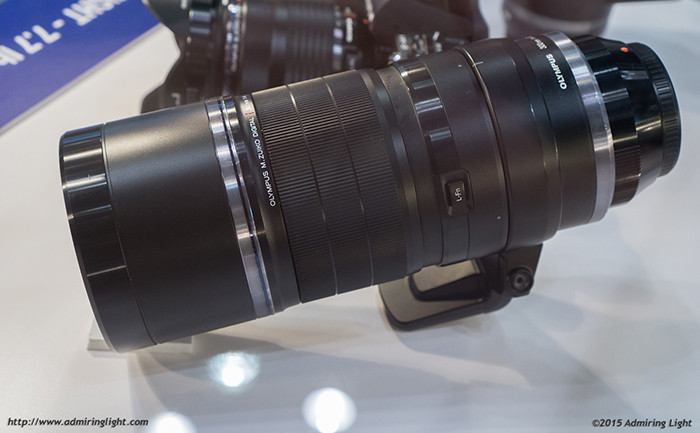
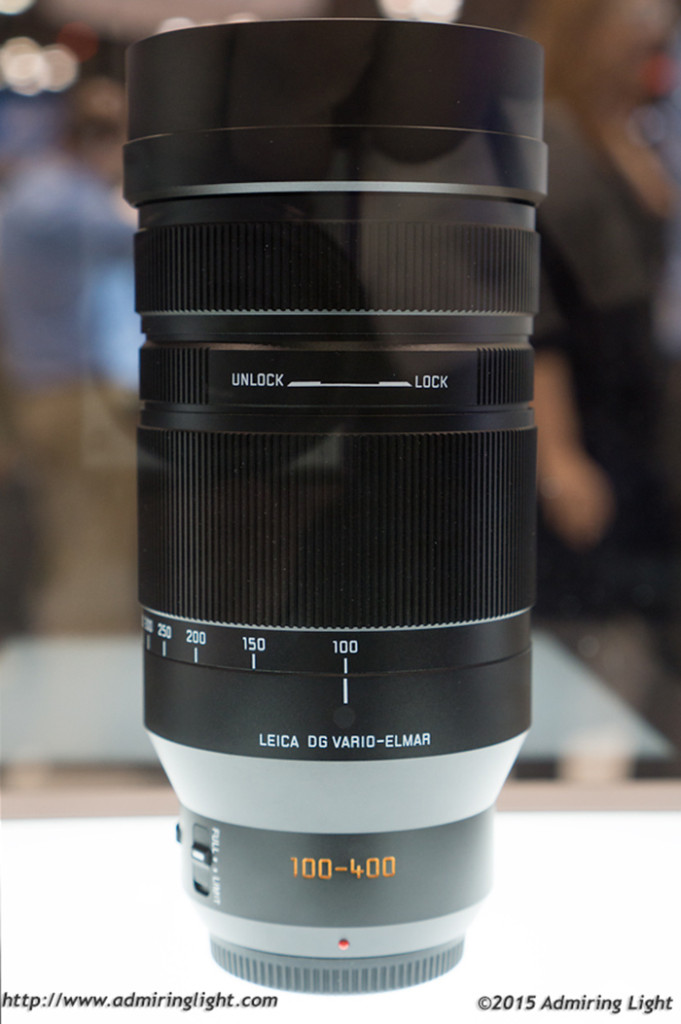
Our dear friend from Admiringlight posted new pictures of the Olympus and Panasonic prototype lenses displayed at the Photoplus show! Both lenses have a huge “I want it!” factor 🙂
Both lenses will be announced in very early 2016. Price around or over $2,000! Time to save money…
85 Responses
The article says maybe fefore year end for the 300, and April 2016 at best for the 100 400, we will see …
Holey moly yummy yummy
I still can’t work out how the 300 is going to fit the lens hood, I still want it though 🙂
Why ? Isn’t the lens hood retracted in the above pic ?
I don’t think so, from other shots that show the front element this seems to be the lens without a hoodie
No!
Don’t people know the lens already?
http://www.dailycameranews.com/wp-content/uploads/2015/03/olympus-300mm-f4-pro-lens-release-date.png
That is the structure by Olympus.
It doesn’t have a lenshood.
And it will very likely not need one because ZERO coatings and everything. as prime it is easier to design for reflect less. Like other Olympus PRO lenses the reflections are far less visible than with other manufacturers has with hoods.
But no hood can help if you are shooting so the sun is in the frame!
Sarcasm ??
The hood might still be the last plastic ring sliding forward, and this lens for sure will have a hood.
Of course the production version will have a hood, sliding or bayonet. Olympus AR coatings are no more magic than others, and all supertelephotos have substantial hoods available. These also protect from rain drops and front element damage.
It could be that the black shiny end piece is a detacheable cover for the hood bayonet (in the same way as in the zuiko 45 f1.8.
Oly 300mm 2000$ or more? No way – it would get raped by the 100-400!
Even the Nikon f/4 PF (Phasen-Fresnel) is only 2000$
I agree that $2000 would be too expensive for the 300mm f/4, but we don’t know yet what the 100-400 will cost… the Leica name won’t allow it to become cheap, either. And then the 100-400 is only f/6.3 at 400mm. When extended with the MC-14 converter, the 300mm f/4 is even longer and still faster (420mm f/5.6), which is a significant advantage for a supertele lens even if it doesn’t look that much. While, on the other hand, being a zoom will make the 100-400 more versatile.
The admiring light post hints at $1500 $1700 for the 100-400
That would indeed sound much more sensible. Although I have my doubts when I remember my FT “Leica” 14-150mm f/3.5-5.6 superzoom used to be listed at €1499…
Olympus will overprice the 300, then drop the price a few hundred in two to three months. As it has in the past.
F/6.3 vs f/5.6 = 0.3EV difference….. a nothing in reality. Because you can zoom back 100-400mm range that you can’t do with Zuiko!
Zooms rarely are best at their ends, but take 5% from the end and it is better. But teleconverters neither are improving image quality, so you have that limit too.
Zooms can often be sharper than primes between the ends, so you have that benefit there. But if you need that constant f/4 at 30mm, Panasonic can be at best only a f/4.7 or rounded to f/4.8 at 300mm, nothing bad really.
And we need to remember Zoom always wins a prime in shooting situations as with teles to get same magnification change as Zoom goes from 250mm to 300mm you need to change your distance with 300mm prime by a 1/6th. So if you are from the subject a 12m away (bird), you need to move a 2m backwards. If the distance is a 50m (horse races) then you need to move 8.3m backwards.
300mm vs Zoom 400mm is 33% more, meaning if you want same cropping you need to move from 12m distance to 4m forward. If at 50m distance then you need to move almost 17m forward.
You can attach a teleconverter, but how long it takes from you do that?
Compare times it takes to:
1) Zoom from 250mm to 300mm or 300mm to 400mm
2) move backward 2m or 8.3mm or forward 4m or 17m
3) pickup the teleconverter, unmount the lens, unmount the caps, mount the teleconverter, mount the lens.
I don’t see a 600mm Phase-Fresnel, just 300mm, half the focal length of the mZuiko. Easily matched by 40-150mm f2.8 PRO zoom,$1300
B&H prices:
Nikkor 600mm, f4.0, flourite $12,300
NIkon, 600mm, f4.0, ED, $9400
Canon 600mm, f4.0, flourite $11,500
It’s 300 not 600, the format does not change the focal length. If it says 300 on the barrel, it’s 300. Period.
I know the inability to read numbers on the lens seems to be an Olympus user issue. Tell me mark if you mounted the Nikon 300mm PF on your 2x crop factor mFT camera what effective focal length would you be getting ?
He looks like a FF troll.
I don’t know what kind of screwy math you use, but focal length is NOT absolute. APS-C and FourThirds are crop formats, so the RELEVANT fact is focal reach, which is directly related to angle of view, 3.4° horizontal in this case. FourThirds gets there with 300mm and APS-C at about 400mm. It takes 600mm on FF to reach as far, one of the selling points of the crop formats. Very long reach is comparatively inexpensive. Indeed, ridiculously long reach is tempting in small sensor superzoom cameras that only do well in daylight, if nature photography and such is not your main focus. The only thing left is to decide how much money you are willing to throw at the problem. If you want to use that 300mm full frame lens and crop in post, you have to accept 1/4 resolution shots. 36pmx / 4 = 9mpx, for example. The crop format wins with 16mpx or 20mpx. The only way to beat the long reach AND have higher resolution with 24mpx sensor or more, is to fork over the $10,000.
Focal length IS absolute. Really. Field of view is dependant on the sensor size as you stated. But the Zuiko is still a 300 mm by construction and thus costs a similar price to manufacture (of course the fact that it has better optical resolution has some factor in the price. I’m totally buying the Zuiko but it’s doesn’t make sense to compare it to 600 mm lenses when discussing prices. Sensor tech and resolution advance over time but the laws regarding optics and focal length stay the same.
It makes absolute sense to compare prices and results! There is no point to argue further. Nikon’s low-cost 300mm cannot do on full-frame, what the mZuiko 300mm can do on FourThirds. Engineer me a full function adapter, and then we have a conversation. I don’t care how much it costs anyone to produce a lens. I care about how much it costs me to acquire the stuff I can use. End.
Of course you should compare prices and results… how else would you choose a lens.
So if i put the Nikon 600mm on a D7200 i have 900mm F4 with 24MP and
better high ISO than the M43. So where are the 2 lenses equivalent?
The whole idea of one lens being 300mm THEREFORE it should cost the same as another 300mm lens and have similar production cost just doesn’t hold up even a little. There are a wide range of costs for many lenses of the same focal length on many different and even the same platform, you can’t ignore the fact that your argument is that of someone barely scratching the surface. My car is black and has 4 wheels and a stereo just like a Mercedes… same production costs.
I’m not saying it should cost the same, of course it’s a newer design than the Canon 300 f4 for example and has a different number of elements etc. But as we don’t know the price for sure yet, it makes a lot more sense to compare it to another 300 f4 like the Nikkor 300 than to a 600 f4. After all, that’s what it has compete with in the end. It propably makes more sense to compare the production costs of your car to a mercedes rather than to a semi truck.
sorry to tell you: you have been brainwashed.
Focal length is a physical parameter just like aperture.
And it is 300mm focal length and an aperture of 4
Comparing to 600mm full frame lens? Fine: make it f/8
oh, and the 300mm FT lens needs to resolve twice as high as the 600mm full frame.
Put a 300mm on an 7D2 and you can get exactly the same pixel per pixel picture with croping. Sure, the olympus 300mm will be superior to the old 300mm canon, but will it be 1000$ better?
It’s been widely reported the the Olympus 300mm f/4 Pro will cost less than $2000…… So what …you guys come here with incorrect information to whinge about something that you are never going to buy anyway? Bad form, no? 🙂
prime shooter? get Oly 300
prefer zooms? go for PanaLeica 100-400
no way to lose with this duo. except for you wallet of course.
I’m a prime shooter, but for long telephoto, give me a zoom!
I’ve tried bird and critter shooting with my adapted Nikon 300mm f4.5 ED IF and it’s a real pain finding those crafty beasties that aren’t sitting out in the open. The 100-300mm really makes it easy to find at 100mm, then zoom to 300mm for the shot.
Can’t wait to get my paws on the 100-400mm! Especially if it will be a marked improvement in image quality over the 100-300mm.
I agree. I like the sharpness of primes (I have four), but I also hate futzing around to find the target. Location is easy on a zoom. The complaint of slightly diminished sharpness at the long end of a zoom may not be totally fair, because the when you count take homes, you get bupkis nada when you cannot find your subject quickly. It is another one of those very minor trade-offs. At the moment I am still saving for the 40-150mm PRO and the teleconverter, which for less deep pockets is probably as far a reach as I can spot for. Here is the shameless pitch: if you are saving for the PRO lens, you should not avoid the cheapie 40-150mm. I am embarrassed how many good shots I get out of it. It is called “stuck in a pinch, and great” when you would otherwise miss the shot.
The Panasonic version of a 40-150 is also surpringly good. That’s what I use on an oly body, where af is maybe not as good as it could be with an oly lens.
Orly? Well that was insightful.
Three comments.
1. For wildlife photography, I would rather not have a supertele lens with a glossy exterior that glitters and reflects light like the M.Zuiko 300mm f/4 seems to.
2. While reaching or exceeding $2000 unfortunately seems to have become standard for 400mm zooms in general, everywhere else I would at least get f/5.6 at the long end of the zoom range. For me, the Leica name doesn’t really make up for that.
3. While the 300mm f/4 will probably be an excellent lens, I won’t pay $2000 for it, not even if that will include the MC-14 converter that I would have to buy anyway. But even if it was cheaper, I would be hesitant to buy, because as a prime lens it it would not really be able to fully replace my ZD 50-200mm f/2.8-3.5.
And because I’m not inclined to ever carry two or three super-telephoto solutions in my bag, I’ll probably stick to the 50-200 plus converters for quite some time to come.
If its the same finish as the 7-14 and 12-40, it doesn’t relly glitter and reflect that much.
Ok, it’s probably the booth’s lighting then…
…..zzzzzzzzzzzzz…….zzzzzzzzzzzz……..
Thanks for your thoughtful reply, very much appreciated!
Sid gets butt hurt when you explain how his next investment sucks.
I am buying the Olympus…but I am surprised how sexy the Leica Zoom looks!…too bad its only f/6.3. 🙁
f6.3 at 400, maybe less then f5 at 300? Not a bad trade-off for a zoom.
Lucky if it is f5.6 at 300mm.
Yes. The aperture tends to drop dramatically in the long end in superzooms like this, there’s little hope it will be anything better than 5.6 at 300 mm.
For a lens in this price range, for this format…it’s just too slow for me at the long end, which is where most of the use will occur. I have a Nocticron which is incredible….but I am going for the Oly on this one…I already have the 1.4x….so the price should be about the same….
I was saving money, but I spent it on World Series tix. Starting again from 0. That 100-400…
So the Zuiko might be available around or after christmas?? Awesome.
If the rumors are true that the Oly 300 will have IS, that will make this a much harder choice for me, being a Panny shooter. Better reach and still faster than the 100-400 with the TC might just seal the deal. Of course price and actual results will tell the tale.
Although zooms are always more convenient, the other thing to think of is the aperture differences. f4.0 is awesome at long length. f6.3 is merely par. You should always remember that it is nearly always true on a zoom, that 90% of the brighter aperture disappears in the first 25% of the range. What that means very likely, is that beyond 141mm, the aperture will be f5.6 or worse. The old rule that says, “the longer the focal length the faster your shutter” should be, remains in effect. At long focal lengths you should get used to using a tripod anyway. The faster aperture helps when your subject has a mind of its own with regard to holding still.
Wonder why my 100-300 mm el cheapo panny can be f4 to f5.6 (and f5.6 at 300 mm) while this very expensive lens will be a let won at that point. I can’t say it won’t happen, I can say that would be seriously limitting and hard to believe.
Not for me…12-35, 35-100 f2.8 are in the bag. Only logical addition here is the 100-400 alos far more versatile! But like always, that is me. The very good pointis Oly with IS and let’s hope it is good. Second point: the m43 system gains two very likely professional lenses. And in this way they keep a clear distance between them and other mirrorless while bridging the gap with DSLR lens line-ups.
The tripod collar on 300mm f4 looks like the same as 40-150mm…. which is a bad design.
How so? Inquiring photographers want to know…
What I found out on 40-150mm is after loosening the tripod collar, the ends of the tripod collar won’t separate from each other like the one on Nikon AF-S 70-200mm f/4G. So, the lens has to be unmounted from camera every time for the collar to be pulled out or put in.
Not sure if there’s a specific reason for the design, but Nikon’s design seems more convenient.
It’s a one piece design for the sake of simplicity and maybe to save weight and money. To be honest I’ve never missed an opening collar on my ZD 50-200 – when shooting handheld I just support the collar with my palm or turn it upside down, out of the way. When do you open it? Of course it’s obligatory in a lens where impossible to remove/install it any other way.
My tripod collar works just fine????….To tell you the truth…the kit is so small on my OMD’s …I rarely use a tripod..but I have….and its all good. Am I missing something?I LOVE the retractable hood, too… Olympus=Innovation!!!! 🙂
Don’t worry, I have the fantastic lens too. I’m comparing its tripod collar to Nikon’s.
Oh…I am not aware of the Nikon design. It does sound like an improvement…I have Canon FF and the collars are basically the same as the Oly. They are not really bad designs, they do there job very well…but I see your point now. :-)…thanks…I learned something.
A retractable hood is a great OLD feature that would be great to resurrect for a lot of modern lenses!
My Olympus OM 135mm f2.8 has a retractable hood, as do my Nikon 200mm f4 IF macro and Nikon 300mm f4.5 ED IF lenses. All are 1980s vintage, I guess.
Your right Jeff that was a great feature. I think Olympus used the retractable hood on many of there medium and telephoto lens. Still use them on my M1 and E-5.
Yes…but the particular design of the the hood on the Oly 40-150mm is very different than any of the 80’s lenses. It’s pretty cool…and very functional, fast and smooth. First time I am aware of this design.
Innovation != Invention
Innovation == taking something from other markets products and adding it to own to improve it.
The thing in Olympus is the lock mechanism. Olympus had as well those retractable hoods at 70’s
Will the 100-400 work (IS, focus) with the Olympus cameras?
No reason to think it won’t.
Panasonic IS always works on Olympus bodies. What you have to decide, until Olympus has the dual IS algorithm down pat, is which IS to use. It is always easy to turn the lens- based IS off and let the body handle it, but on the very long end of this lens, it might make more sense to turn the in-body IS off. (I wish we could use an alternate term, sensor plane image stabilization.)
What happens when both pany lens stabilization and Oly IBIS are turned on?
Bad things happen.
I think the latest Olympus bodies will switch off the sensor IS if the lens IS is selected.
There are Panasonic cameras like the GX8 with dual IS but believe that uses special algorithms to enable both to work together.
The Olympus lens was announced back in 2013. It’s takes three years to develop a lens and bring it to market does this make sense. I truly hope this lens does well for Olympus but like many the money I had over a year ago is gone. Uncle Oly should develop a 150mm f2.0 prime to match its 300mm. If anyone owns the 4/3 150 you know how good that one is.
still waiting for the Panasonic 150 mm prime…
yes a reasonably size 150mm ( maybe max aperture 3.5) from Olympus or Panasonic is really missing from the M4/3 lens line up
Oh yeah. I had the money for this lens and long ago gave up on it. Sony mirrorless is doing 90% of what I used my OMDs to do. Unless these long lenses are outstanding and can be had for decent prices I don’t see the value proposition in the OMDs
What is the decent price on the Zeiss 600mm for Sony FF? Sigma has a FF 500mm for $5000. On one hand, I do think the Sony FF body does make a value proposition against the Nikon FF body, but I do not think the full lens subscription will make a difference in the total cost of a Sony system unless the manufacturer finds a way to sell the Zeiss top end at 50% off. Even then, the mZuiko PRO offerings will remain a value proposition. Are you saying that a partial lens system on the Sony mirrorless is comparatively affordable? I can agree with that. I continue to eyeball the A7R-II all the time. There is much to like and I think Sony will iron out the ergo and technical things sooner rather than later. Their people are good listeners. At present, I am only hitting one wall on RARE days. With an OM-D and six lenses I still lack the light gathering power of the 40-150mm f2.8 PRO lens. (The cheapie is does a great deal of well-lit work…) With four primes I am otherwise hitting NO walls. I can print any size I like. I am only into the system at $3000 so far, and that IS a value proposition.
I sometimes wonder. Do Panasonic and Olympus divvy up and horse trade? As in, let’s not do the same expensive projects. We do the zoom this time, you do the prime? You would expect them to do many similar high-volume lenses, but not the low-volume.
Glorious ?? They are lenses !! They may be great but GLORIOUS !! Idiot!
Glorious: Having a striking beauty or splendor that evokes feelings of delighted admiration.
That definition works fine for us. Why don’t you check the dictionary next time, idiot.
Having a striking beauty or splendor that evokes feelings of delighted admiration.
That definition works fine for us?
And you speak on behalf of ??? You glorious idiot !!
no focus limit switch on the olympus pro tele? useless lens.
It is in software in camera. Focus to distance A, press a focus limiter Fn, focus distance B and press again and camera doesn’t focus outside of that distance range you configured it to do.
And as a prime, it is ultra fast to focus so it doesn’t need a physical limiter like canon/Nikon cameras do as they hunt a lot!
Which camera is that?
It would be nice to have a digital distance scale too!
Useless comment…….
Olympus “glorious” lenses. Now a full stop too slow! Coming to you in three years. Or more.. Pre pre order now!
If that 300/4 (FF-equivalent 600/8) is priced at $2000, it would make no sense. FF 150-600/5-6.3 lenses from Tamron and Sigma, zooms and effectively faster, are about $1000. Olympus should start to respect pecking order and price their wares competitively already.
The only equivalent difference is depth of field, which is a poperty of the sensor size..An f4 lens still gathers f4 light for the sensor size the lens was made for. If you’re birding with this lens f4 light gatherin with f8 dof is a bonus.
No it does not gather “f4 light”, it gathers light at f4 intensity at 1/4th of the area of FF sensor, making its total amount equivalent to f8 on FF sensor. That is why you can use FF camera at f/8 and 4 times higher ISO at the same exposure time to get the same noise level as m43 camera at f/4 (assuming sensor tech is the same of course).
Get a life. Really. You come across as a big ugly green grumpy monster with no friends.