









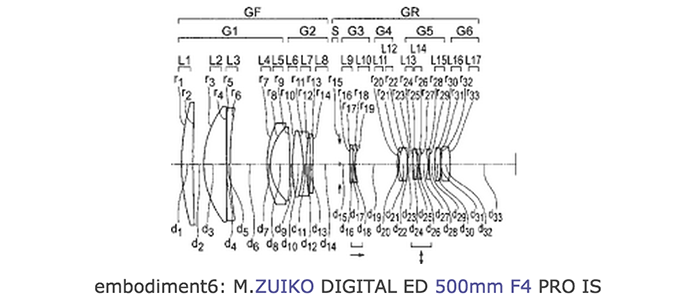
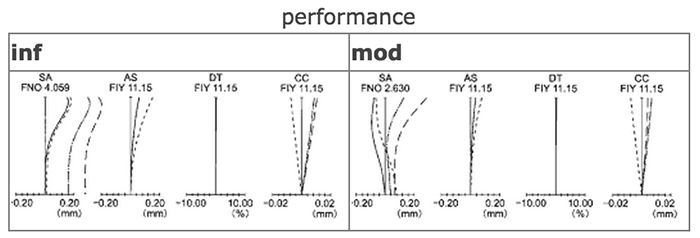
Egami spotted a new Olympus patent disclosing the specs and design of the new 500mm f/4.0 IS Micro Four Thirds lens. Translated lens specs:
- Patent Publication No. 2015-108811
- Published 2015.6.11
- Filing date 2013.10.22
- Example 6
- Focal length f = 499.265 325.022mm
- Fno. 4.059 2.630
- Angle of view 2ω = 2.6 °
- Image height Y = 11.15mm
- FB 66.633mm
- Total length 337.887mm
I think that’s a lens Olympus should really bring to the mass market. Now let’s see what 43rumors readers would do if they could buy the lens:
[poll id=”281″]
120 Responses
With a MC14 you would have a 700/5.6 🙂
I am using since about 5 years a Sigma Big Ma(50-500 occasionally with the 1.4 tele converter for birds and Nature photography on my E-M1 and E-M5 with quite gooud results.A 500 f4 would be a dream come true!!
Albert E
http://i133.photobucket.com/albums/q73/ALBERTO_084/Gen%204/P3150002-%2011_zps3i1yctph.jpg
Can we just get the 300mm f/4 in our hands first!!!!! 🙂
No .
Since 500mm is available in future , what is the point of 300mm ?
For birding , 500mm is more ideal than 300mm .
They both have their place, different subjects and or distances. You might even want both.
I would if I could only afford it, but then there would be the issue of having a heavy kit with it all. 😉 Truly, if you’re into that type of photography you could quite likely be running two bodies with complimentary lenses to cover the situation (which is what I like to do when I can with my gear using E-M5 & E-M1).
Oh yes ! 500mm mass market for sure… What about 500mm as kit lens.
If this lens ever comes out in flesh, it will be a low volume seller.
While probably prohibitively expensive for most of us, if they do manage to get this lens to the market, along with an E-M1 m2 with improved PDAF and tracking, this could be a birder’s and safari’s dream. Especially with the MC14 (the drawing shows more than enough distance between the last lens element and the sensor), that would mean an eq. FOV of a 1400 mm lens on FF, while the whole package would stay under (337+22) 36 cms and probably 1.5-2 kgs!
For comparison: the Canon 800 f5.6 L (with a 1.6x crop body, 1280 mm FF-eq.FOV) is $12k, 461 mm and 4.5 kgs.
So while this would be good for Olympus to specialize and carve out a niche market for m4/3, for the most of us, we’d be better served by say a good budget 9 mm f2.8 prime, a better IQ 17 mm f1.8 (or f1.4), a cheaper alternative (say f2.8) in the 75-100 mm range, and a more moderately priced, good IQ, but lighter and more compact alternative to the 12-40, say a 12-50 or 12-60 f2.8-4. I hope they are not forgetting these as well while they are bringing out all these nice, but expensive pro lenses.
There are people who do spend a lot of money for very long lenses in the CaNikon world simply to shoot birds and wildlife. As FM states, if the E-M1 II can improve phase detect or some other C-AF focus, along with this lens would be very attractive to that group. I do hope they do build it; its not something I would probably buy, but I’d definitely rent it for special trips like Yellowstone.
Someone commented that the scaling doesn’t work as lenses get longer, that may be true to an extent, but if you compare a 500mm f4 for FF and MFT, the diameter of the lens should be half the width on all the elements (roughly). That translates to a lot less mass in both the barrel and the optics, and the motors can be smaller too. I’m not sure what the math works out to be but you could be looking at 1/3 the weight, perhaps in the 3 lb range. Also smaller lenses are less expensive. That’s without the exotic glass that Canon and Nikon are using, imagine if that kind of glass were used. 🙂
The math is really simple. 500/4=125mm. That is the entry pupil needed no matter if the sensor is 4/3 or FF. As the front element group is the most heavy weight savings in the smaller elements closer to the camera doesn’t make such a big difference.
Definitely not as much as 1kg or more as a 1/3 reduction would be.
Also do not forget that long lenses for mirrorless cameras need to be longer than for DSLRs because of the shorter flange distance adding weight as well.
“Someone commented that the scaling doesn’t work as lenses get longer, that may be true to an extent, but if you compare a 500mm f4 for FF and MFT, the diameter of the lens should be half the width on all the elements (roughly).”
That’s only true if you’re talking about equivalent focal lengths. A ture 500mm f/4 lens needs, at least, a 125mm inlet pupil whether it’s designed for m43, FF, or an iphone. Just look at the Olympus 300 f/2.8 compared to its FF equivalents for a perfect example.
No matter if I will buy this lens or not, it is very refreshing to see that we finally get super telephoto lenses for a mirrorless system. Neither Sony nor Fuji has such an offer. Mirrorless is good enough or superior for all general photography like landscape or portrait, but now we will finally get into sports & wildlife as well. If only we would get a good phase detect autofocus! 500 mm is probably a bit steep for me (I shoot indoor sports), but I consider the 300 when it finally comes out.
Maybe because the Sony and Fuji users don’t need it.
Maybe they use their cameras for photojournalism, street, fashion, etc.. maybe they rely on the big boys for stuff like wildlife.
Point is, it’s a niche lens. One that won’t bring new users to the table, just one to satisfy m43 users. It’s like asking for a tilt-shift lens…. How many are going to really buy one of those?
Fujifilm started with a rangefinder look, which was successful for them. How many zoom lenses does Leica make? How many tilt-shift lenses? Last I checked, the Majority of those users use Primes Only.
M43 Superior? Lol, on what, size? That’s not even true anymore. If it’s not FF or MF, then it’s all a compromise.
Agree it’s a niche lens, but sports shooters are possible new users — 1) their stuff is limited to 2 page spread if they are really lucky so m4/3 is plenty good enough, 2) they don’t enjoy hauling around the weight they now have to carry, 3) fast distribution is critical so modest file sizes are a plus. Once Olympus decides to go with in-lens stabilization for the 300, why not do a few other superteles? Just a question of price vs. market demand
B.S.
MF itself is a compromise.
Every format is a compromise.
Engineering is all about compromises, and so is optical engineering.
And it will cost like a city car…
This is the way to go Olympus!
Yes , Optics all the way .
But please make the 12mm & 50mm F1.0 lenses first before this one .
Totally agree!
A 12mm f1.0 lens will be roughly the same size as the Zeiss 24mm f2 lens which weighs 555 grams… thats 120grams heavier than a Nocticron. Quite a beastly lens. It would also cost easily as much too ($1,200+). I doubt f1.0 AF glass is in the near future for m43’s.
No, I couldn’t justify it to the minister of finance. Not a hope.
Minister of finance = wife?
Why yes, I would buy it – assuming it was under £300 – but I find that highly unlikely. Silly question without a price tag next to it. Still, more prime telephotos are only a good thing.
Under £300? It isn’t highly unlikely, it is just impossible…
eq. 1000mm, f/4, IS, PRO series… I’m sure you wouldn’t want to know the price…
If you are going to relate it to FF it would be a 1000mm lens with f8 equivalence on DOF. But having the f4 for the purpose of exposure would be really beneficial.
I’ll take one please, just put it on my tab.
I doubt it’ll be out before 2022 at the current pace things are developed, so I have some time to save up.
M43 will be dead by then.
You too if you keep saying this…
Useless. 150-450mm f/4 thank you and with the TC14 support. Faaast super telephoto zoom with very usable zoom range!
Bahahaha… You got $10K to burn, I take it?
The Nikon 200-400 f/4 is already $7000, and you want more lens?
YES! Where are the long zooms? I’d take f/4-f/5.6 if they could keep the size and price reasonable. Where is Tamron? If they made something like this with comparable quality/price as there 150-600 – I suspect MANY would go for it.
This I agree with.
I think most non-pros crave reach, not speed, and the speed is what ends up driving up the cost, weight, and size disproportionately.
Yes, a 150-450 f4 would be much more useful. 1000mm on full frame is often too long. a 300-900 equivalent, useable with the 1.4 TC would be just ideal especially with the increased DOF that comes with M43.
The depth of field equivalent to f8 on full frame…..I am not sure that would endear it to the wildlife nuts, but it would be fascinating to see it all the same.
I do feel that they have to solve the continuous AF performance first though, to make it worthwhile.
Take a DOF calculator and look up the figures. There is no such thing as too much DOF in practical supertele photography, in some cases this will rather be still too shallow. What we “wildlife nuts” need is telephoto reach, wide enough apertures for fast enough shutter speeds, image quality without the need to stop down, and, if possible, a not-too-big and not-too-heavy package. Shallow DOF comes automatically through the huge focal lengths, whether we want it or not.
I did. f4 on the E-M5 gives same DOF as f8 on 1Dx
But it also depends on what you are shooting. The change in DOF comes when you are handling an uncropped image and the need to magnify the MFT image more when printing MFT and FF to the same size.
If you are focal length limited (as is often the case with birds, for example) the image of the bird is the same size on both sensors which means you crop both (you will crop the FF image more because there is more extraneous stuff) in which case the DOF is not affected.
You tried an f8 1000mm lens and needed thinner DoF at that focal length? Let me guess, there was this cute finch 100 feet away and you wanted just the tip of its beak in focus.
Exactly the same DoF as a 500mm F4 would have on Full frame.
However, it would have the field of view of a 1000mm(and DoF F8 equivalent).
Nice. Finally Olympus has found out that, beside ultra-compact but slow lenses in the lower focal-length range and macro, super-telephoto is the one aspect where the small sensor really has advantages. This is going to become interesting.
Yes I would buy this 500mm lens but when is available ?
2020 ???
Why, is the current IQ not enough for you?
Than why don’t you use FF instead?
If it is, do you think the IQ will degenerate over time?
There’s always Fujifilm, Sony and even Samsung with APS-C. No need for full frame.
Why would anyone promote APS-C and a bunch of companies using their own proprietary mounts? MFT makes a lot more sense, I can buy cameras and lenses from multiple manufacturers. On the film side we now also have camera manufacturers like JVC and Blackmagic, in addition to Panasonic and Olympus, that make active mount cameras with AF for mft lenses.
“Why would anyone promote APS-C and a bunch of companies using their own proprietary mounts? MFT makes a lot more sense”
Does it anymore? If it did, why is it losing mirrorless marketshare, year after year to Sony/Fujifilm/Samsung??
“MFT makes a lot more sense, I can buy cameras and lenses from multiple manufacturers.”
UM, You can do the Exact same thing with Sony and Fujifilm, WITH Better Results.
M43 may have started this Mirrorless trend, but they sure won’t be a leader in it. Sony is making a killing in the states, with barely any lens selection and Fujifilm is right behind them.
Who in their right mind would buy a EM5 mkII, over a Fuji XT-10, with better image quality, similar lens selection, with Prime focal lengths and similar or even lower prices?
Of course it will. Everyone knows that all photographs taken before 2012 are awful and should be destroyed because they weren’t taken with a new sensor.
Everyone knows the trade off and benefits of FF over M43. Use whatever make you happy. if switching does, do it! Just don’t become a FF troll and drop by here ok? Just kidding.
Dear Mister Monomaniac,
Whether you stay with m43 or not is really really really not our business, and we really really really don’t care if you move to Fujifilm, Pentax or even Hasselblad… Just go where the “sensor tech” is good enough for you and stop whining.
PS : I still wonder why you “need” such a “breakthrough in sensor tech” that much… want to take pictures through clothes ? X-Ray ? Pixel-peeping on wall-sized prints ?
I take that back.
I’m just a moron fanboy…
And Yun… don’t forget to pay me $1 for trolling with others’ names… you can get fund from Panasonic right…?
I’m not Yun, you idiot…
And the troll here is you…
Don’t mind the fanboys, Yun…
They don’t understand humor…
Oh, sorry… It’s a running gag, then ? very funny…
I’m a GX8 fanboy by the way… aka pana loser…
Oh, Yun. The collective I.Q. of the MFT user group will surely go up once you abandon us for greener pastures.
Yun, you are a bit of a cry-baby, but I will say I am impressed you are willing to stick around 5 MORE YEARS to wait it out! 🙂
Now pay me $10 please… it’s overdue…
Ignore me…
I was drunk when I wrote the comment above…
Canon will take a massive hit in their super-tele lineup if this lens happens. 4 lbs vs. 10 lbs, half the size, longer reach (1000mm vs 800mm) and faster f-stop. Will probably also be less than half the price (around $3-4K).
A 500mm f/4 lens is going to be more or less the same size regardless of the format. Seeing as how Olympus doesn’t use single crystal fluorite elements, you can expect an Olympus version to be significantly heavier than the Canon, probably around 9lb like the Nikkor. Finally, expecting this lens to come in at around $3-4K is hilariously naive.
“A 500mm f/4 lens is going to be more or less the same size regardless of the format”
But a 1000 mm full frame eq on a MFT is tiny compared to the full frame Canon/Nikon.
Stick a 2X teleconverter on the FF 500 f/4 and you have identical FOV, DOF, and (more or less) SNR.
Teleconverters can be used on MFT as well you know. Which kind of makes this a matter of DOF.
Ok, that has almost nothing to do with what’s being discussed though. Tron was earlier implying that there would be a huge difference in size and price between this lens and the nearest FF equivalents (800 5.6). The truth is that telephoto lenses don’t scale with format size the way that many people seem to expect, so a 500mm f/4 lens will be roughly the same size regardless of format. The end result is simply that there’s no free lunch in the telephoto range.
“…a 500mm f/4 lens will be roughly the same size regardless of format.”
Sure, but to get the equiv reach on a MFT, the lens (or lens + teleconverter) is going to be much smaller.
You can say the 500 mm will be big regardless of format, but the MFT body can use a 250 mm to get the same FOV. You say that a 2x converter + a 500 mm be used on a FF to get a 1000 mm eq FOV, but on a MFT a 2x teleconverter + a 250 mm can be used for the same FOV.
So it’s just a matter of DOF. Wide open at these focal lengths, DOF is pretty thin regardless. How blurred can a background get? That’s the free lunch on MFT.
“So it’s just a matter of DOF. Wide open at these focal lengths, DOF is pretty thin regardless. How blurred can a background get? That’s the free lunch on MFT.”
It’s not just DOF but, and more importantly, SNR. There’s no escaping the governing physics here, and thus no free lunch.
Lose the size argument, go to SNR. Fair enough.
Are you serious? I don’t think you understand what free lunch means. If you say you can get a “free lunch” by giving up DOF control and SNR, then you’re not really getting a free lunch, are you? Again, there’s no escaping the fact that for telephoto lenses where the size of the lens is governed by the size of the inlet pupil, you’re going to need the same size lens to get a given image regardless of the sensor size.
You’re willfully ignoring the primary reason for a teleohoto – reach (if you disagree you wouldnt have brought up teleconverters), and still maintain the irrelevant fact that a 500 f/4 is going to be big regardless of format. Not sure what your argument is now. First it’s size, then it’s DOF, now its SNR. There’s always a tradeoff, sure. You got that.
Will is obviously just hanging on in the hopes that some people think the whole argument makes sense. Bottom line is if you want reach, MFT is the way to go, but up until now, neither Panasonic nor Olympus seems to have understood this strength. Looks like they are finally catching on.
If reach was all that mattered then you’d be skipping m43’s big bulky lenses and going straight for something like a Coolpix P900. But reach doesn’t exist in isolation like you’re both implying, we want reach and IQ. Requiring both at the same time is why there’s no free lunch as IQ is linked to light gathering ability/lens size which doesn’t scale with sensor size for telephoto lenses. You can both stick your fingers in your ears all you want, but that doesn’t change the physics.
I fully agree with Will.
However, for most photographers it is about compromise. When choosing 4/3 or m4/3, size is often one of the priorities (and is linked with reach) while obviously SNR is down-prioritized since the sensor is 1/4 the area. Everyone just has to realize what is important for him/her and then be happy that there is a system that fits.
My argument has been completely consistent this entire time. I was originally responding to Tron’s statement:
“Canon will take a massive hit in their super-tele lineup if this lens happens. 4 lbs vs. 10 lbs, half the size, longer reach (1000mm vs 800mm) and faster f-stop. Will probably also be less than half the price (around $3-4K).”
A 500mm f/4 for m43 will be much heavier than 4lbs (probably closer to 9lb since Olympus doesn’t use Fluorite elements in their lenses) and much more expensive than $3-4K. In addition, claiming it has a faster f-stop is certainly true, but is also cancelled out by the SNR differences due to the different formats.
“You’re willfully ignoring the primary reason for a teleohoto – reach (if you disagree you wouldnt have brought up teleconverters)”
If reach was all that you cared about then you’d ignore m43 in favor of something like a Coolpix P900, but I suspect what you really want is reach and IQ. For that combination, there is no free lunch.
Like I told the other poster, you can stick your fingers in your ears all you want, but that doesn’t change the physics.
Physics dictate that for an equivalent FOV, the MFT sensor requires a shorter focal length, and thus a smaller lens. You did a round about way of arguing against that. Of course SNR is compromised. That’s a global issue with the system, though one that is not easily quantified as sensors vary widely within formats, let alone between them.
Physics also dictates that as the focal length increases, the focal plane becomes more isolated, and thus the FF vs MFT “equivalency” argument becomes somewhat irrelevant or at least subjective, since at 500 mm wide open on either format, the background is going to be blurry as f.
Your coolpix note is just as irrelevant because the lens quality is not on par with Canon and Olympus’ pro offerings.
“Physics dictate that for an equivalent FOV, the MFT sensor requires a shorter focal length, and thus a smaller lens. You did a round about way of arguing against that. Of course SNR is compromised. That’s a global issue with the system, though one that is not easily quantified as sensors vary widely within formats, let alone between them.”
For a given f-number with the same field of view, the smaller format will certainly require a smaller lens, but you’re not able to make the same image so you’re trading size and weight for DoF control and light gathering ability. If you want the same DoF and light gathering ability for a smaller format, you need a larger aperture which, at least at the telephoto end, brings the size of the lens right back into line with the larger format. No free lunch.
“Physics also dictates that as the focal length increases, the focal plane becomes more isolated, and thus the FF vs MFT “equivalency” argument becomes somewhat irrelevant or at least subjective, since at 500 mm wide open on either format, the background is going to be blurry as f.”
The DoF advantage certainly becomes less of a selling point, at least for some scenarios, but the light gathering advantage is always there.
“Your coolpix note is just as irrelevant because the lens quality is not on par with Canon and Olympus’ pro offerings.”
It’s all just a matter of degrees. I assume that for your intended use, you find the loss in image quality going to m43 from FF is more than offset by the reduction in size; I would actually agree with you, I use m43 pretty much exclusively for travel at the moment. But that said, I’m sure you’d have no trouble finding people who feel the same way comparing something like a P900 to m43.
“For a given f-number with the same field of view, the smaller format will certainly require a smaller lens, but you’re not able to make the same image…”
… if you are either shooting in 2x lower light and/or can actually tell the difference in DOF/background blur between MFT and FF at 1000 mm FF eq + wide open (hint, lens characteristic will have a greater impact on bokeh in this scenario).
Will is absolutely right. A 500mm/4 will be similarly sized. You get different reach of course. However don’t forget pixel count, too. Future FF sensors will go to very high MP with probably similar sized pixels as for m43. Then you have a four times larger sensor for larger S/N ratio or you can crop to similar FOV and S/N ratio if desired. Even more true with higher MP APSC bodies. I would take the option of larger DOF control and S/N ratio whenever possible, as I find myself often in situations where higher ISOs are necessary. Not a strong domain with m43. Nevertheless, I can imagine this lens to be of high quality. But how many will buy it?
“A 500mm/4 will be similarly sized. You get different reach of course.”
Pretty much a summary of this discussion.
That’s great about “future FF sensors”. Can’t wait. I guess you assume future MFT sensor pixel density will hold at 16 mpx while FF keeps improving (…my god, the FF bias is thick).
We already have 50MP, right? 28MP APSC. Do you really think 64MP isn’t around the corner, delivering m43 pixel density with similar pixel level S/N ratio? With a 5Ds and Canon 800/5.6 you already can crop for APSC mode with 22MPix and 1200 FOV. If you crop for 12.5 MPix with a 500/4 you get the 1000mm FOV already right now. You simply have more options with FF, in terms of DOF control and S/N ratio, but you have to carry more weight and bulk on average. It is for the user to decide which suits him best.
“pixel level S/N ratio”
What the hell is a “pixel level S/N ratio”? Signal to noise has nothing to do with pixel density. Ask the Sony a7s.
As far as the actual reality of pixel density goes, I’d say the current tech (45-50 mpx) is probably all the pixels photography will ever need. 24 is good enough for 99.9% of photography applications.
“You simply have more options with FF”
….when you get the gusto and initiative to carry around a large cat around you neck. “Hey, I’m HF and I’m carrying around a 6 pound animal around my neck so I can crop to APS-C and get that sweet FOV”
“pixel level S/N ratio”
What the fk is a “pixel level S/N ratio”? Signal to noise has nothing to do with pixel density. Ask the Sony a7s. If that’s what you meant. Who knows? Now it appears you’re just making things up.
As far as the actual reality of pixel density goes, I’d say the current tech (45-50 mpx) is probably all the pixels photography will ever need. 24 is good enough for 99.9% of photography applications.
“You simply have more options with FF” ….when you get the gusto and initiative to carry around a large cat around you neck. “Hey, I’m HF and I’m carrying around a 6 pound animal around my neck so I can crop to APS-C and get that sweet FOV”
You can pick an arbitrary area and define S/N for it. If this area is the size of a pixel, you get S/N ratio at pixel level. So you usually have larger pixels in a FF camera gathering more light unless stopped down for equivalence (http://www.dpreview.com/articles/5365920428/the-effect-of-pixel-and-sensor-sizes-on-noise). S/N ratio is further dependent on read noise . In order for read noise at a given spatial scale to be independent of pixel size, read noise per pixel must decrease in proportion to pixel spacing. Is this the case? Why did we use micro lenses to mitigate the effect of wiring to not loose any light? If read noise doesn’t scale appropriately, S/N ratio surely depends on pixel density and not only on area and incoming photons (unless shot noise dominated). I personally don’t need 50+ MP, but I am sure we see it. For many it is still worth carrying more weight to have more options.
The Canon 500mm F4 weighs over 7 lbs and costs $9000. With a 2X converter you will lose two f stops and get a softer image. The required image circle for mFT is 1/4 that of full frame, if you don’t think that will equip to a smaller lens package then you’re simply in denial or trolling hard. You can add a 1.4 converter to the Oly, keep a sharp image and reach 1400mm equiv. Good luck comparing the shorter, $180,000 Canon 1200mm F5.6 to that footprint. http://www.bhphotovideo.com/c/used/116642/?gclid=COXwy5nPqMYCFdgTgQodSA8JgQ
“The required image circle for mFT is 1/4 that of full frame, if you don’t think that will equip to a smaller lens package then you’re simply in denial or trolling hard.”
This is only because you don’t understand the physics of lens design. For lenses in the telephoto range, the dominating influence on the size of the lens is going to be the inlet pupil size, which is the same whether you’re designing the lens for an iphone or medium format. Just look at the upcoming 300mm F/4 PRO, it’s almost identical in size the Canon and Nikkor version (not counting the new fresnel lens based Nikkor version which is much shorter). You can also look back and compare the 600mm f/4 lenses for medium format with their 35mm counterparts of the same era, you’ll find they’re almost the exact same size.
Heck, the Oly 4/3 300/2.8 is bigger, heavier and more expensive than Canikon’s, and doesn’t have IS.
You may get a theoretical image degradation – I don’t know how long ago it is since you sed a tc on a Canon 500mm by the new 2x tc with the MkII lens still gives excellent publishable images. Sure, a pixel peeper may be able to point out some anomalies at 100% but here in the real world it won’t matter a damn.
If you look at the figures about the lens it says “Total length 337.887mm”, so it looks that you are right about the size.
2x teleconverters almost always degrade the picture. I’d much rather have the 500mm Oly, thanks… Plus with 2x, you lose two stops of light, so it would be F8, borderline useless for focusing…
Put the Nikon 1.25x TC on the Nikon 800 mm f/5.6 and you get something close that is optically still very good. And you can even stop it down a tiny bit from f/7 to f/8.
“A 500mm f/4 lens is going to be more or less the same size regardless of the format”
No it isn’t.
“No it isn’t.”
Try looking up how the size of the Olympus 300 f/2.8 and/or the upcoming 300 f/4 Pro lenses compare to their FF equivalents if you don’t believe me.
Lol!
I take it you found out you’re completely wrong and can’t come up with any other response?
I just supplied the pic… Stig won’t reply… The truth Quiets them….
http://brianhirschfeldphotography.com/wp-content/uploads/2013/10/A-DSC_3438-1024×681.jpg
Here ya go…
Only the front element would have to be more or less the same size (and even that can be a little smaller for smaller format for any given vignetting target).
The bigger point here is that a FF camera would need a 1000mm. If you want the same f-stop at F4, it would be the size of a small car, and cost about that too 😉 Since in all likelyhood you would end up with a slower 1000mm lens, the faster mft version will regain some ground in light sensitivity as the faster aperture compensates for smaller sensor size. Now, I haven’t made the calculations, but obviously you could get away with a somewhat shorter lens and crop if you have a high Megapixel FF system, so something to keep in mind. I hope Olympus or Panasonic comes with a special hi res mft sensor in some camera soon. If Nokia can squeeze 42MP into my camera phone, surely it can be fit on a mft sensor. Yes, the light sensitivity would not be great, but for daytime shooting, it would probably be very good.
“a 1000mm. If you want the same f-stop at F4, it would be the size of a small car, and cost about that too ;)”
Only if that small car is a Bugatti. Even 1200 f/5.6 is $120,000, ONLY f/5.6. 🙂
ive shot whith a old nikkor 500 f4 AI at a zoo recently, the weight is actually not that bad,or cumbersome, unlike the nikon 200-400 f4.
though the lack of IS, i needed a monopod for stability.
Nice, how did the Nikkor hold up on the m43 sensor?
i would say: decent. Its a bit like the 14-42 kitlens in terms of sharpness.
here is a example on my flickr page :-> flic.kr/p/tEpkSE
If you cheat by comparing apples vs. oranges, 4/3 sensor versus full frame, then it may seem so.
But what about comparing like against like? 4/3 16MP vs. APS-C cropped to size of 4/3 sensor? For exemple Nikon D7200 in 1.3x crop use 15.3MP of the 24MP large sensor.
As a M4/3 500/4 lens would be about same size as the current Canon and Nikon 500/4 lenses there is almost no advantage for M4/3. UNLESS E-M1 MII is coming with a new 24MP sensor!
Until then M4/3 have no reach advantage over APS-C DSLRs.
What happened to the “Hell No” option?
Your poll needs another option:
• Looks great but won’t possibly be able to afford it
And another one – “patent does not mean real product will be made
Ignore this lens… Panasonic is going to introduce the FZ300 with 1″ sensor and 27-800mm f/2.8-5.6 lens… 🙂
FZ300 will not have 1″ sensor as it is most likely the FZ200 successor rather than FZ1000
We’ll see….
Maybe FZ1000 successor might have LX100 sensor… who knows…
Only if they create a separate line for larger sensor fixed lens superzoom cameras. I doubt that they will abandon 1″ and 1/2.3 lines, because those seem to be selling realy well.
Wide aperture super telephoto is important to a complete camera system. Canon EF 800 f5.6 = $13,000. EF 1200 f5.6 = $120,000
Yes it will be expensive, but a guaranteed bargain by comparison. Bring it on!
Gimmie gimmie gimmie gimmie gimmie.
Let’s just ask ourselves where in hell is the 300mm f4.0 before we jump into the future.
Someone must have been reading my notice yesterday about the use of heavy long lenses in Z.A. !
If many of the Canikon owners in Z.A should switch to a much easier and more convenient format camera (read m4/3) … then i think 300 times the 500mm lens would be easily sold over there !
Harry • a day ago
Ive just came back from South Africa and Namibia …..I did not see one tourist with an m4/3 camera . !
A lot of people looked surprised when showing my “little” E-M5 and the 40-150 F/4 !
There is so much to gain for m4/3 in this Canikon “huge lenses” country !
Because every photographer out there is fat up with this heavy equipment .
The 300mm would be the best one for all the animal photographers .
After coming out of the 300mm F4 they should put together OLY/PANA ..effort for advertising in Z.A…not by paper but by “hands on” in the National Parks like Etosha or Kruger !
Most of the tourists have bought a last moment DSLR just before going ….to have a proper camera …also on that on that side is a lot to gain by Oly/Pana ..!
So Advise to Pana/Oly is to go for hands on advertising ….. or make special days with m4/3 users and public !
With lower prices for lenses for the users with help the public to go to the m4/3 side !
Looks like something they calculated during the development of the 300/4, decided not to build it, so now they patent it.
4.0/500mm for m43 would cost dearly. Because it is a niche lens. The financial risk of releasing such lens is just too great. Thus, personally, I do not think OIy would do it. FT2 at best.
You never know. After all, they did make some huge f2 lenses for 4/3.
But those f2 zooms were still “standard” lenses, IOW covering the standard range of FLs.
There were no rectilinear WA for 43. No tele above 300mm. No tilt or shift or tilt/shift.
Now Google up the Zuiko OM lens catalog and realize how really poor the lens catalog for 43/m43 is.
I’ll never buy it… But hell yes manufacture it!
Hmm… A lens patent is a reserved right to build a particular lens. I think Olympus WILL make it, but not until after carbon-technology boosts sensor tech to the next level. Perhaps the timing will coincide to make a good old one-two punch.
Considering the amount the amount of voters that voted yes for the 300m f/4 .
The 500 mm f/4 does give a higher score ? 58% .! Not bad at all !
Are you considering to buy the 300mm f/4.0 PRO lens?
Hell yes! (46%, 1,413 Votes)
No. (37%, 1,140 Votes)
Dont’ know it yet. (18%, 551 Votes)
Total Voters: 3,104
I tried a Vivitar 500mm f/8 T-mount mirror lens on my E-M5. Even with the great stabilization, it was very hard to take pictures. A tripod (or possibly a monopod) seems to be necessary.