










Panasonic announced that they will reduce nine percent of the global workforce due to restructuring efforts. 35,000 people will loose their job. Engadget said: “The cuts will come over two years. The news comes as Panasonic reported a ¥40.7 billion ($499 million) loss for quarter, largely on account of a ¥61 billion ($748 million) restructuring cost. Panny says that its bottom line was also affected by a strong Yen, stiff competition in television sales, and the recent earthquake and tsunami.”
That’s a terrible news for all the workers and maybe for Panasonic too. If you have to cut 9% of your employees means that something isn’t working very well inside your company. A wonder what kind of influence this will have on the Digital Imaging division and the future Micro Four Thirds products strategy.
UPDATE: Photoscala published the financial results from Panasonic. The bad news is that Panasonic had a 10% turnover drop on digital camera sales. The last quarter had the worst result since two years. See the image below (Image courtesy: Photoscala)
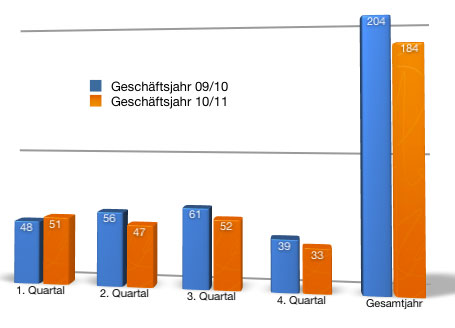
Doesn’t look good at all.
30 Responses
Panasonic is in a very competitive markets
Televisions/cameras are a low profit products – i believe companies like samsung and Sony are just bigger then panasonic
In fact difference not so big.
As of 12/2010 Panas’ total assets 100 bln while sony’s 161 bln
No fresh data for Samsung but as of 12/2008 there was 83 bln so currently we may suppose in the same range too
I do believe their problem not completely inside the company but in too many freshly issued unbacked USD in the whole world. They have to accomodate to new realities and do it really fast but it’s not easy for a company being too large.
100 to 161 not so big difference??? Well, tell your boss you don’t mind earning 100.000 instead of 161.000, or maybe you don’t mind to pay 1.600 for something that could be bought for 1.000… After all, “difference not so big”.
I mean that’s values of the same order of magnitude – not like 100 against 1000 nor even 100 against 30.
Nobody can suppose assets of two different corporations to be exactly equal, but they may be of the same order of magnitude.
There is no reason to believe that this restructuring will have any effect on the Panasonic product range. This type of thing happens all the time and often the strategy is to get all the lower profit manufacturing work done in the lowest labour cost companies thus improving profitability and increasing the share price. For example, Sony used to manufacture televisions in Wales, UK, but the workforces there were cut and the work transferred overseas.
“If you have to cut 9% of your employees means that something isn’t working very well inside your company.”
Admin, that’s a fairly irresponsible statement there. Although the statement is true because with a company this big, there’s always something not working well, you’re implying a lot of negatives that might not be true.
The reduction might be attributed to economy, earthquake, dollar value, few products being produced, workforce efficiency, et cetera.
Engadget has already corrected the 35K to 17K.
http://abcnews.go.com/Technology/wireStory?id=13475817
Still sucks, but to a lesser degree.
Weird, I figure they should hire several thousand people to help manufacture more of the GH2. This would help relieve the one person who is putting them together by hand at a rate of 2 per day…
http://www.marketwatch.com/story/panasonic-to-cut-40000-workers-reports-2011-04-27
it didnt sound bad.
Pana have follow Nokia foot step.
I think perhaps the earthquake and tsunami will have woken up the company to the harsh reality of their economic situation. It probably won’t be the only Japanese company to go along this road in the next few months.
I feel for the workers who will be laid off.
I’m surprised it took this long to get around to those mostly consolidation cuts (acquisition of Sanyo). But I doubt it will haven any tangible impact on Panasonic digital cameras. Unfortunately. Because that’s a group that’s not executing at the level they should be.
Panasonics inability to deliver GH2 is a hugh problem. I WAS interested in purchasing several GH2 – but not anymore ! Their inability to deliver now does not make me confident that the furture will be any better.
Also the fact that there are NO DEALERS in Southern California doesn’t inspire confidence either.
Panasonic’s US camera operations are beyond belief. They’re actually an insult to customers, and you’re not the first person (or fiftieth for that matter) who I’ve heard say the same thing.
I fail to see how you can be a global competitor when you fail as badly as Panasonic does to serve the largest single camera marketplace in the world.
Panasonic’s failings are MANAGEMENT failings for the most part. Perhaps some day they’ll get some top management that actually knows what to do.
Maybe you don’t care that they manufacture in Japan & power has been somewhat disrupted since the start of the earth quake disaster & continuing plus the spreading nuclear contamination.
Panasonic’s inability to deliver product in the US existed for almost two years prior to the earthquake. It is NOT a production problem.
Similar hopeless distribution in Australia.. We have stock but only I think becuase no one will buy their cameras here at the prices they ask.. Compact stuff is OK but even before the Aussie $ got so high vs the US it was still FAR FAR cheaper to buy Panasonic products from America and pay for UPS Express shipping.. I bought my G2 a while back now, but it was 1/3 of the local street price, even after factoring in shipping.. Other brands are often cheaper online but not by anywhere near that margin…
Very few stores (except specialist camera stores) bother to stock any Panasonic EVIL cameras.. Sony, Pentax and Olympus are there as are Canon and Nikon of course, but Panasonic? at most stores none to be seen..
VERY precisely thirty-five people, eh?
it might come as a surprise to you, doug, but in some countries the coma is used for decimal fractions and the period for digit grouping.
Depending on the country, both a period or a comma can both indicate that it’s 35 thousand.
Now europeans will go to watch TV and than to bed. Americans are waking up and reading the blog. That’s why I edited the title and changed the point in a comma 😉
Just display it as 35k.
Admin, you may want to correct your numbers in the title and message body.
Core problem. Excellent products and engineers. Horrible Marketing, manufacturing and distribution. Anyone ever purchased from the Panasonic Direct website will agree. Too bad. I hope this doesn’t thwart innovation in future GH-X. Look at how successful Canon is. And their flagship 5D hasn’t been refreshed in over 3 years.
This seems hard to believe to me, I work retail, and in our particular dept everybody loves panasonic everything, even the customers come in looking specifically for it. Cameras, phones, microwaves, panasonic outsells it’s competition in all of those.
Frustrating. I would love to buy GH2, but can’t find one in stock anywhere.
Would they profit from enabling or supporting hacking the “good old new” GH1 themselves, so at least they get some money from some equipment that is already/still in the stores?
If they encourage sales of the GH1, this will probably also result in more m43 lenses being sold.
It is not surprising for its sales drop. Its conservative approach to new models of camera and lenses are the major reason. The inability to response to users request is one of the fatal problem of the company. Everyone wants product with better design and ergonomics in operation and more lenses of choice (especially the fast ones). Also, its continuity on megapixel race on its compact DC products by sacrificing picture quality resulting in high noise is also another issue. I wonder whether Panasonic knows what exactly a photographer wants, while it has rich history on audio-visual only.
Just FYI, it’s spelled “losing”.
No surprise here. Economies around the world are still retracting from the global recession, and companies have little choice but to respond with major cuts. The wars, natural disasters, climate change and unrealistic expectations add to the problems. Those of us who can afford new cameras are lucky to get them.