









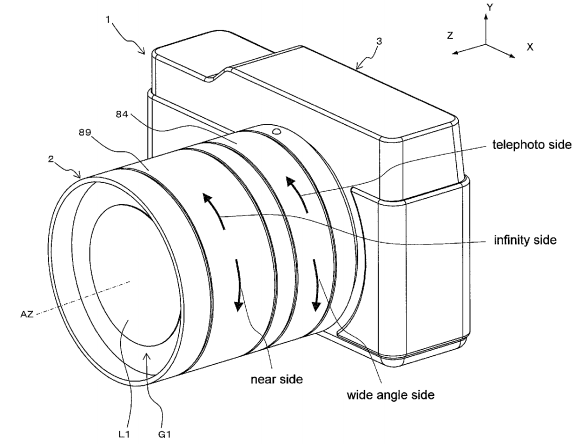
 I just found that very exciting new Panasonic patent. The United States Patent Application number is 20110103789 (Click here to read the full patent). The first thing I noticed is that the patent is extremely new. The filling date is 01/10/2011 and the publication date is 05/05/2011. The patent itself talks about a new adapter that adds contrast autofocus function to lenses not designed for Micro Four Thirds. But the real cool thing is that the patent shows a [shoplink 21906 ebay]Panasonic L1 (Click here to see it on eBay)[/shoplink] styled Micro Four Thirds body! It has a built-in Viewfinder. That’s exactly a camera I would love to see for real!
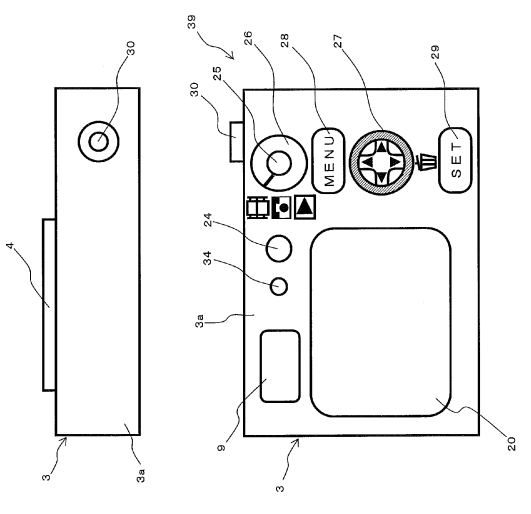
We are talking about a patent only so maybe Panasonic has no plan to make a mirrorless LC1. But the fact that they used that design and the fact that the patent is very new is reason enough to make us dream a bit!
P.S.: Imagine if the latest two rumors we posted on 43rumors would become true. Olympus designing their owns sensors, and Panasonic having a rangefinder styled mirrorless camera. That would push Micro Four Thirds in a new higher dimension 🙂
Links to the Panasonic L1 at Amazon (Click here) and [shoplink 21906 ebay]eBay (Click here)[/shoplink].
33 Responses
why they didnt do it in the beginning? (L1 MFT)
For patent news, make sure to check for the original Japanese application date (top right of the PDF): 11 September 2008. So I think this patent describes the bog-standard 4/3-m4/3 adapter – nothing new.
Hi Simon! Fact is that this is a MicroFourThirds camera that diesn’t exist now!
Sure, they may have considered this form factor at the time (and perhaps they still do). Or they wanted to protect their G1/GF1 designs separately and used an old/generic body for the pictures in the patent.
I agree that a m4/3 L1 would be nice, but I don’t think this patent makes it any more likely than it was yesterday.
Exactly, this is an adapter-patent and you shouldn’t try to read anything at all about the camera from that sketch.
+1 for frosti!!!
Everything on this site seems to just be a hopeful tease…with no realization. The only actual improvement with any Micro 4/3 cameras..that we can hold in our hands (well perhaps…if you can get one) is the GH2..which again is more of a video camera.
Fuji has shown Olympus and Panasonic what they need to do?????? Small rangefinder-style camera with fast glass and great image quality…. So what is the problem?
+1 for Bob. Thats what I am waiting for. Oly model with EVF in top corner.
I owned a Contax G2 and all of the Zeiss glass for it. For a film camera it was heaven.
It had small size, incredible lenses and my feeling was it trumped Leica because it had quick, reliable auto focus and cost a lot less than the German benchmark. (ok…so they didn’t make an autofocus Nocti for it…but you can’t have everything!!! LOL).
I have been looking for a digital camera to measure up to that Contax system..and it just hasn’t materialized. Too bad Contax couldn’t carry through with Japanese electronics and German glass. Contax got it ALL right with that film camera!!!!!! 🙁
1.) The GH2 is not more of a video camera. Its improvement over its predecessor are beneficial equally if not more to photographers than videographers. Please don’t spread this commonly heard but false statement.
2.) The L1 design wasn’t chosen at the beginning, because it does not have nay advantage over a GH2 design. The “hump” is there to incorporate a large and high quality EVF into the body and to keep the “shoulders” of the body low, which is preferable (because of better ergonomics) over a design where the top plate is level and higher. A build-in VF will be positioned above an LCD so that bodies with build-in finders are likely to be higher than bodies without finder. The L1 wasn’t a very light-weight and compact camera. That a GH2 design is rejected by some has mostly esthetic reasons, nothing more.
3.) What has Fuji shown to Olympus and Panasonic? That Fuji is able to produce a limited camera at an extraordinary price (thus being like a Leica)? The design is just retro, stolen from Leica, nothing really original. Some more realistic reviewers identified usability quibbles, which the first m4/3 cameras from Olympus and Panasonic never had. It isn’t understandable, why the hybrid view finder should represent such a sensation, because it apparently as severe limitations in comparison (paralax, focusing accuracy). Had m4/3 started with a niche design such as the X100, m4/3 would already be doomed.
A friend of mine had one, and I lusted like you could not possibly imagine after that camera. When Micro Four Thirds came out, that was what I thought Olympus and Panasonic would make- certainly not a rangefinder, but a compact camera with very fast high quality glass.
It never panned out that way. Look at the size of a FAST prime on the Contax, then look at the lenses for micro four thirds. Zeiss had to cover the full 135 image area, and yet their lenses are tiny. Where’s my tiny fast glass?
Where’s my high quality candid shooter?
Nathan…I agree…and yeah…now that you mention it…those Zeiss lenses were REALLY small!
Mahler…I disagree with a lot of what you said. The GH2 IS as expensive as the X100???? Duh. um…the Leica is $7000 for a body only …no lens. So how does the X100 even come close to that????????????????????????? Duh 2.
The improvements for still photos on the GH2 are vastly improved focusing and faster frame rate.
More pixels..but no “real” improvement in high ISO images or image quality. A little improvement…not enough to compete with most of its mirrorless competition.
What I said is all correct…..if something significant doesn’t happen soon with this format…it will not be around very long.
The X100 is with its fixed lens design in comparison to the GH2 as an interchangeable lens camera a very limited camera and as such – for what it does – totally overpriced. (Add to this the discovered usability issues, which show that Fuji’s design department needs more practical experience). Sure, Leica is more expensive (you also pay for the mythos, which the Fuji still has to earn, and the Leica is an interchageable lens camera), but full frame on the other hand. Nevertheless, both of them are high-priced niche products.
To maintain that the GH2 shows no improvements important for still photographers is simply ignoring the facts. The IQ is much more constistent across the ISO range, which IS an achievement for the small sensor. Add to this the much better EVF and the better control layout, then you have lots of arguments in favor of the GH2. In comparison to the improvements of the PEN iterations, the progress at the Lumix G series is much more noticable.
I don’t understand even, what all the fuss about the X100 is here about. The X100 is not a system camera. It is just not comparable with any m4/3 system. The X100 is an expensive niche compact with a large sensor (Sigma DPx category) – nothing more or less. The design is debatable, for my taste too much of a Leica copy.
The goal of m4/3 is to provide a camera system in a small package and not to serve the compacts with large sensor market. (If it does also, because it also has fast and good primes, well enough, so you can catch both markets with one system). The m4/3 makers should direct its design decisions along the requirements of a camera system and nothing else. If Fuji has shown that it can do a shiny compact with a fixed lens, fine so what? Not much impact for m4/3 and certainly no model for it or to justify statements that Olympus and Panasonic should have done at the beginning, what Fuji shows now (most notbaly the omission of interchangeable lenses). Fuji could have done better, with rejecting the hybdrid view finder and instead develop a system with high quality interchangeable prime lenses in a X100 design.
If a hybrid view finder cannot cope with a focal range from 7 (14) mm to 300 (600) mm than don’t put it in any m4/3 system. Current EVFs are fine and will get even better. Olympus and Panasonic should concentrate their development efforts to make a better m4/3 camera system (more and better lenses!), instead of poking around with retro style stuff of view finder alternatives, where solutions for their purpose already exists.
I didn’t say that the GH2 had no improvements. DUH 3! Can you read?
The image quality on the X100 is worth the price of admission …even if it has a fixed lens. Actually open your eyes and look at the Fuji compared to the GH2 at ISO 1600.
The GH2 produces junk at that ISO. The Fuji produces art. Its just a fact jack.
I own Panasonic…but the truth is the truth.
++1
Absolutely!
It’s funny how the GH2 stirs up such dismay for some. So much of this negativity revolves around the SLR design rather than any logical arguments against it. I do not use the word “style” because there’s solid logic and a form-follows-function aesthetic at work. It’s obviously not for everyone.
Things I don’t like I don’t buy. I don’t waste time or energy ragging on them…
Except maybe Windows. 😉 But that’s just an old MacThing that’s hard to shake. 😉
Okay, the GH2 may not be as pretty as some of the Kawaii Kameras produced by others, but I see it as a tool with many strengths, some weaknesses, but overall excellent, extremely flexible and a genuine pleasure to use.
Yes, the GH2 is the largest (only marginally) and most expensive M4/3 camera, but given the wide array and high level of it’s many abilities what’s there to dislike? The “hump”? JPEG colors? Is that all you got?
I was at B&H yesterday looking at the GF2 and LX5 and got into a discussion with a few people including a sales guy, who was fixated on Panasonic’s “bad color”. I pulled out a small grey card and he walked away in a huff.
so hoooooot…
still no G3 leak dear admin ?
No leak yet. Just bits of info.
G3 pictures leak long overdue as admin told us about what it would look like in general terms ie DSLR look like NX10 way back end of January when camera was ready except for maybe sensor production and only news since is when it will be released and price? We know the big news is the new sensor but why keep us guessing on the body design unless there is actually little change after all? Pany exec have said they think rangefinder style will account for over 75% of m4/3 market so why have they not taken this opportunity to make an all new body?
If I remember right, GF2 images weren’t leaked until the day before the announcement. How these large companies keep secrets, I have no idea. Good for them, it’s not good to announce products early and give competition advance time to respond. But it’s good excitement for us :). Keep up the good work, admin, without you we’d have no rumors/leaks to rant and rave about.
Using a special adapter to give contrast detect focus seems rather complicated – presumably this would allow for rapid changes in focus in either direction to determine which way to adjust the focus. But it would need to be for each type of lens and it would require you to introduce new optical elements.
I’ve often wondered why they don’t vibrate the sensor in the z direction to achieve this. You could do this at (at say ~ 15Hz) and look at the focus at each end of the vibration cycle (at say 30Hz – using the image grab used for real-time display). Depending on which successive frame is sharper in the required point, you’d know which way to focus. Then you just stop the vibration to take the shot. In video mode you might even get away with a continuous small vibration and use the difference between frames to keep the focus.
As for IBIS this would add to the bulk of the sensor unit but for higher end cameras this would be worth it for faster focussing.
I’m still hoping for an updated L1. A L1 with modern sensor that is all I’m hoping for. Yes, I know it is hoping against all odds.
Contrast detection-based AF is easy enough if you can find a way to motorize the focus mechanism in the lens. Should be feasible with lenses which rely on physical transmission from the body, such as Nikon’s AF glass. Focusing self-motorized and manual focus lenses would require a cumbersome external lever, not just a an adapter (unless the lens AF motor can be accessed electronically through reverse engineering, in a similar way to the current autofocusing of 4/3 lenses on m4/3 bodies).
Considering that in the market at the time, the L-1 was a failure, I doubt it would convince Panasonic to come out with the successor. IMHO, part of the problem was price — like the E-330, the L-1 was priced higher than the market would bear. I’ve always joked that Panasonic had hung around with Leica too much, and thought it could get those types of prices. Only offering the camera with the 14-50mm lens bundled only compounded things.
Panasonic tried to sell it in one of the big box stores (CompUSA if memory serves), and a niche camera like that generally will not sell in that type of environment.
Beyond price, at least in the USA market, you had a failure of marketing. They never really touted how the camera harkened back to the retro styling, probably missing the film shooters, etc. that might want a digital camera that had controls that were similar.
Like Olympus, Panasonic marketing often times seems to think the audience will just get the new features, and not actually tout its features. Both the E-330 and L-1 were ahead of the curve in terms of live view, but because they didn’t present why somebody would want it, it wasn’t until either Canon or Nikon added it, that it took off.
My view of what the L-1 was designed for was the older Japanese salaryman who has always dreamed of a Leica, but could never afford it, and was looking for something digital that was reminded him of Leica. However, companies don’t always seem to be content with building niche products, they want something that will hit a home run.
You know it is kind of boring if every product is mostly the same ticky tacky, and products don’t stand out. In terms of DSLRs, everybody but Canon and Nikon is a niche player, and all of the other companies seem to keep trying to be the next alternative (and failing) by producing similar products. They really should think of ways to make each different, so that the customer has a reason to buy the alternative product.
Admin – The most revealing news contained in this patent is not the 2 year old camera sketches you have highlighted or even the converter but maybe the detailed sketches of the innards of Panys new superzoom the 12-50 or 75mm/f2.5-3.3 as detailed in figures 5-8? This very compact new lens design is unlike that of any existing zoom lens and seems to fit the discription. Please lens design experts what do you think based on the size of the lens elements shown?
Just go to the patent link and PDF pictures to see these figures.
I think you mean that lens: http://www.amazon.com/Panasonic-Vario-Elmar-14-50mm-F3-8-5-6-L-RS014050/?tag=rumors0a-20
It’s the Pana-Leica zoom for Four Thirds.
Why would they bother to show the details of a 4 year old 4/3rds lens design in this new patent application? Seems strange hence my assumption it is the new fast zoom many are waiting for? Manufactures time these lens patent details just shortly before the lens is to be released?
Remains that too small 4/3 sensor compared with an APS-C sensor.
I think all of you have to read the patent first!!!
It describes many possible things that may or may not come to reality. The first is that this new adapter adds Contrast AF to old lenses and has an adjustment to change the flange back distance. This could allow for old 4/3rds lenses to be used on a new M4/3 camera with contrast AF or 3rd party lenses with out AF. Also the adapter seems to have built in Apeture, so Canon EF lenses may now be used? As described in the patent the user can MF to a point and the adapter fixes the focus (similar to a Pentax adapter that was made in the past).
Second through out the patent it talks about decreaseing the flange back distance of the camera. Now its not explained if this is in regards to 4/3rds OR M4/3rds. Its possible that they have a crazy thin camera with a new mount distance that the adapter compensates for. OR what is possible is that telephoto lenses which normally need to be really long (physically) can be shrunk down (changing there flange distance) so we can have a pocketable 500mm or 300mm lens! Since lens diagrams are provide this may be more likely than a shift from the 20mm distance of M43rds. These lenses may actually be new and look to be shorter telephotos.
I think the diagram of the camera is just artistic with little info. The real news seems to be this AF adapter than can possible be used with Any lens and allow for crazy small telephoto lenses.
Bateman – thank you for your informative and interesting comment. No like others, I did not read the long patent discription. However I noted the figures referred to the telephoto end and one figure actually showed 100mm and 200mm markings or discriptions on this zoom lens or in other words would cover up to effective 400mm range and we can assume the wide angle range to be about 14mm??? If also a fast lens as the large front element might suggest this lens would be very attractive indeed.
Sorry my error the notation was 100 only, I tried to correct my previous post but the clock ran out while in process of reposting.
Yes – I think you are right – looking in detail the adaptor really does nothing more for the focussing than allow the lens to focus ‘beyond’ infinity – so that a maximum in contrast can be found. I guess this is one critical limitation with many of the older lenses intended for phase contrast focussing – or lenses with a hard stop at infinity.
I had thought that the adaptor was actively involved in the focus – but I don’t think so.
BTW, technically, what you are referring to is a publication of a patent application. The number you provided is the publication # not the application number. A patent publication is not a patent. Panasonic may or may not be able to obtain the rights they are seeking.
– Peter
If figure 6 of this patent application are to scale then in its collapsed form at wide angle setting this lens would be 2.9″ diameter by 3″ long and have a 62mm front filter using the 4/3 lens mount as basis of size. When extended to the tele end the lens would be about 4 inches long. The area of the lenses appears to be 3X that of existing 14-42 kit lens so 1 stop faster and wider quite possible? My prediction this is the 12-50/f2.5-3.3 lens we have been waiting for? This lens would not be excessively bulky on any of the existing m4/3 cameras out there with possible exception of the GF2 and with this new design not nearly as big as most are assuming?
I hope they also build a telephoto zoom lens using the same principals of this design. This design as shown in the patent application seems to validate the recent rumors of Pany developing smaller collapsible lenses in the works.