









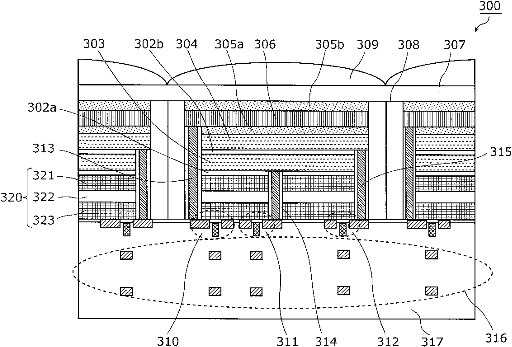
The japanese website Egami discovered a new Panasonic patent which discloses a “3 layer sensor” that works like the current Foveon sensor from Sigma (Click here to read more about the Foveon sensor on Wikipedia). The new sensor will improve the color reproduction and image sharpness. It also has Back-side Illumination. The Patent No.2010-153658 has been published 2010/07/08 and filled 2008/12/25. We don’t expect Panasonic to announce any camera with that new sensor in 2010.
Source: http://egami.blog.so-net.ne.jp/2010-07-19-english
P.S.: Sigma is the only manufactorer that released cameras with such a tecnology
20 Responses
Well, getting rid of AA filter is what 4/3 sensor needs to be something special compared to an APS-C. In the other side Sigma never did it right with Foveon, and no other manufacturer bother with it (3CCD is another concept). Maybe new approach with Panasonic patent can figure it out (Live MOS sensors are surprisingly good considering their size, just more dynamic range (about 2EV) and better high ISO performance would be great).
Addition to my post: There are photographers which love their DPs (Sigma) for their slide-film-like output and I respect their choice.
My prediction:
Further confirmation that these companies have reached the limit to what they can do with the current technology. After panasonic implements the gapless sensor across their range of cameras, the race between the big manufacturers will be on to introduce the 3 layer patent. Canon will be slower to announce gapless in order to protect 5D Mark II and T2i sales.
I think Sony and Canon already have patents filed that describe the beginnings of such a sensor.
Is LX5 sensor gapless?
I welcome the fact that Panasonic is at least thinking about this type of technology improvement. I do agree that eventually we’ll run into the limits for the materials used to build sensors, so we need to either change materials or change the implementation/build of the sensors.
@MK: from the diagrams on the LX5 sensor, it’s not quite gapless, but it’s much less gapless than the previous microlens design in the LX3. I’m hoping to see that same microlens implementation, with a reduced AA filter, in the GH2.
As an aside, the thing I don’t like about layered sensors like the Foveon is their greatly reduced resolution. The resolution quoted is ‘effective resolution’, but the actual image sizes are only about 4.6MP on a 14MP camera. I realize that the megapixel wars are over, but I think at a minimum we’d want something on the order of 6-8MP for those larger prints. I love the colors out of the Foveon sensors, but if I can only enlarge them to 8×10, then I’m not sure what I could do with them.
Megapixel wars is more slow, and is in change, look on Nikon D300 and D300s, so D3 and D3s. and all 12 mp.
So also to Canon G10 and G11 so go down from 14.7 mp. to 10.1mp. and EOS 300D so start on 6mp. and now one 18 mp. sensor on EOS 550D.
I read a review on the Foveon based Sigma SLR a few years ago (I think it was from Pop Photo) where they said the resolution was comparable to a 10MP sensor-not a 4.6MP-as spanky says. My memory might be slightly off, but I’m pretty sure I’m in the ball park. I think what makes it confusing is that the Sigma/Foveon sensor is a 4.6MP sensor x3 (layers) which adds up to apx. a 14MP sensor; but it really is more like a 10MP sensor in actual use. It’s a shame the Foveon idea didn’t progress, because it seems to be a fundamentally better design. Maybe now with Panasonic and others getting around to it, the promise of the original Foveon design will come to fruition.
Megapixels aren’t everything, and there are some inefficiencies to Foveon’s design which are forced by the fact that the Foveon is old technology and has not been so much as revised in years. It’s not progressing, so the individual photosites are relatively huge.
I would expect anybody serious about tech would find a way to make similar ideas into better tech with combinations of cutting edge technology, similar to this Panasonic patent. Here, they’re doing compound microlenses, back illumination, and current photolithography practices.
Sigma may market the Foveon, but it’s not their product- they bought the company and it hasn’t produced any new products since then.
Foveon must have written themselves a crap patent application if Panasonic can work around it this easily. You’d think the key inventive idea the Foveon application teaches, stacking sensors and relying on the penetration gradient of various wavelengths, would be enough to exclude anyone else from the field.
I have cropped a 12MP image down to 3megabytes and printed over 40″ long. I wouldn’t worry about smaller MP as i would lens sharpness and clarity, color reproduction, when printing big.
Ordinary Bayer sensors also have 3 photosites per pixel, so Sigma is still fudging the numbers pretty highly when they say they have 14 megapixels. If you simply multiply horizontal resolution by vertical resolution, the Sigma only produces 4.6 million colored pixels, same as any other 4.6 megapixel sensor.
Overall, that should be enough. That’s good enough for an 8X10 portrait to look good.
Bayer sensor pictures at 14 MP will look more detailed, however- just barely.
You really have to quadruple the number of megapixels in order to see significantly more detail. You can verify this with a piece of graph paper. Draw an image with squares on graph paper. To more closely approximate the actual scene, you don’t see much difference until each square is divided into four subpixels. Even 2x the resolution is so similar it’s hardly worth quibbling about.
I’d be happy with my Olympus even if it had half the pixels, if it got more dynamic range as a result.
Many thing we can talk by the, the but the is difference, the is three difference colours sensors in a won pixel area, so file is three time big but them need not interpolarisation, for right colours and right area to also.
Not like interpolarisation and Bayer mosaic filter use.
Although I agree with the concept of not focusing too much on MP, when shooting wildlife and having it on a 15″ monitor as screen saver, there are times when even 600mm is not enough to get what I want, so MP is still of importance when it comes to cropping.
@Nathan- ordinary Bayer sensors *do not have* three photosites per pixel. They have one, of one of the 3 primary CFA colors. Red green or blue. So effectively for example, for a 12 megapixel Bayer you actually have about 3.5+ megaphotosites of red and blue, and 4.6+ of green.
MK says: Canon will be slower to announce gapless in order to protect 5D Mark II and T2i sales.
MK, Canon’s had gapless tech for a long time, they were actually first as far as I can tell with thier 50D, at least they marketed it first. Panasonics late to the game if you consider the 50D was announced 2 years ago.
Actually spanky, about their design on the so called gapless sensor:
Although not physically gapless, it is an improvement on than that with 2 sets of lenses using a condensing lens above much like the very latest Canon designs
Nathan.
Bayer Filtered Image Sensors have one actual photosite per pixel. They record one actual colour point and the other points are derived according to the filter pattern.
For example in an RGB array, each photosite is filtered to record only one of three colors (RGB). The data from each photosite cannot fully determine RGB color on its own. To obtain a full color image a demosaicing algorithm is used to interpolate a set of complete red, green, and blue values to create the colour of each pixel.
The bad thing about Bayer Filters is the interpolation creates colour artefacts along edges in the image and this is why an anti alias filter is used to smooth out those unnatural artefacts… Unfortunately is also softens the image.
Bayer Filter Image Sensors are dated technology and should eventually be replaced by multi-layer sensor arrays.
There are always trade offs between quality and cost in the electronic industry.
For example, do you really think that CMOS Image Sensors are better than CCD?
The reason manufactuers are concentrating their efforts on developing CMOS is cost savings.
You can make a CMOS Image Sensor on a standard semi conductor assembly line.
CCDs aremore complex and require more machinary and therefore more expensive to make…
Anyway if this Panasonic patent was filed on 25 December 2008.
They should have a working prototype that could possibly find it’s way into the Olympus E-3 replacement.
About the pixel count of Bayer & Foveon sensors:
“Let us first start with the most basic observation: 14 megapixel simply means that a sensor has 14 million photosites, which are the sites on the sensor that measure light of a particular colour (usually, red, green, and blue). This figure has the same meaning for both Foveon and Bayer sensors.” ( http://www.13thmonkey.org/~boris/photos/Foveon/foveon-vs-bayer.html )
“For example, the dimensions of the photosite array in the sensor in the Sigma SD10 camera are 2268 × 1512, and the camera produces a native file size of those dimensions (times three color layers). This amounts to approximately 3.4 million three-color pixels. However, it has been advertised as a 10.2 MP camera by taking account of the fact that each photosite contains stacked red, green, and blue color sensing photodiodes, or pixel sensors (2268 × 1512 × 3). By comparison, the dimensions of the photosite array in the 10.2 MP Bayer sensor in the Nikon D200 camera are 3872 × 2592, but there is only one photodiode, or one pixel sensor, at each site. The cameras have equal numbers of photodiodes, and produce similar RAW data file sizes, but the Bayer filter camera produces a larger native file size via demosaicing.” ( http://en.wikipedia.org/wiki/Foveon_X3_sensor#Comparison_to_Bayer_filter_sensors_.E2.80.93_operational_differences )
Any updates on this?
second the updates, i want!