









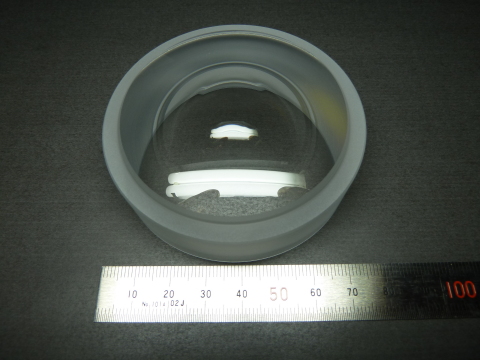
Panasonic once again proves it is leading company within the optical industry. And I hope we wills ee that kind of lens on a real MFT lens soon 🙂
Here is the full press text to learn why that’s a special lens:
“Panasonic Corporation today announced that it has developed the industry’s largest*1 glass-molded aspheric lens measuring 75 mm in diameter that can be used for interchangeable lenses for cameras and projectors whose size and resolution have been increasingly reduced and enhanced, respectively. The shipping of samples of this large-diameter aspheric lens will start from February 13, 2015. We will also commence with external sales of these lenses.
*1: In the category of glass-molded aspheric lenses. As of February 13, 2015, according Panasonic’s data
Interchangeable lenses for cameras and projectors are required to be small with a high resolution, in addition to conforming to the trend of having a large diameter and wide angle. There have been growing needs for large-diameter aspheric lenses that help reduce the number of parts involved.
We have developed the industry’s largest*1 glass-molded aspheric lens/mirror with a diameter of 75 mm by taking full advantage of our engineering capabilities and production expertise that have been refined through development and production of LUMIX digital cameras and other products. We have also established mass production technology for preventing cloudiness and cracks and for maintaining shape precision in the process of molding large-diameter lenses. This lens enables a reduction in the number of parts by about 25% compared with comparable conventional products.
These lenses have the following features.
- Developing the industry’s largest*1 glass-molded aspheric lens/mirror measuring 75 mm in diameter
Capable of reducing the total length by 30% compared with interchangeable spherical lenses of the same performance - Ensuring thermal resistance and minimizing thermal expansion through the use of glass materials
Achieving thermal resistance (250°C or higher) and low thermal expansion (about 1/10 that of plastics) that cannot be attained using plastic materials - Achieving high reliability and high refractive index of varying degrees by using our proprietary mass production technologies and production expertise
Achieving high processing precision and high refractive index of varying degrees by using in-house developed molds and molding/measurement equipment as well as proprietary expertise
The lens has been used in ET-D75LE90, an optional lens commercialized in November 2014 for our ultra-high-brightness projectors, to achieve short-throw wide-angle projection. We will start shipping samples of this large-diameter aspheric lens as a key device that meets the needs of our corporate customers.
The latest product enhances our lineup of aspheric lenses ranging from 1 mm (for endoscopes) to 75 mm in diameter. We will expand our business-use lens operations to various industries based on the latest large-diameter glass-molded aspheric lens in order to increase sales.”
59 Responses
Toss that on a 25mm lens and let the light shine through
This is GREAT news! Smaller AND shorter lenses!
Now is the perfect time to create a APS-C or FF system, with a smaller than average lens system!
Panasonic needs a better sensor for these lenses, unless the fabled organic sensor is around the corner.
go caps yourself
Apart from use in special laboratory conditions, Panasonic’s proprietary LMOS (similar to NMOS) is less noisy than CMOS and likely to remain that way. Biasing the sensor reduces stray electrons. Seeing as Panasonic is rather bigger than Sony and don’t have Olympus’s infamous money problems, they do have the wherewithal and then some to develop new sensors even without help from Fujifilm.
So it strikes me as odd that Leica have their sensors made by a belgian company (see “CCDgate”)
As sensors improve less and less people need large sensors.
Every time technology progresses the challenge has always come from smaller rather than larger.
Just like people in the 1950s proclaiming that these small 35mm camera would never replace their Rolleiflex, as film emulsions got better and better..
And twenty years before that people using Speed Graphics claiming that Rolleflexes would never replace their cameras.
And in twenty years time m43 users will be claiming that the superzooms with 1″ or smaller sensors that will be better than current FF cameras, will never replace their cameras.
Meanwhile most camera buyers will have a concept of ‘good enough’ and sales will prove otherwise.
That looks like a perfect element for a 9 mm f/0.25 lens
My dream m43 lens is a 12-200 zoom. It’s now one step closer 😉
Wide ranging zooms always have compromises. Practical limit for a good zoom is about X3 e.g. 12-35, 14-42, 35-100, 50-150 etc.
The limit is 4x, after that quality goes down. Example 12-40mm and 40-150mm Pro that are 3.3x and 3.75x and beats every zoom Panasonic has done (or Zeiss, canon or Nikon).
Going over 4x is difficult but not impossible if small optical quality drop can be accepted, or even corrected with software.
Making generalizations like that is kind of silly, really.
The Panasonic Leica 14-150 achieves resolution similar to the Olympus 45/1.8, at least when tested on the earlier 12MP sensors (I can’t find any tests of the 14-150 on new 16MP M4/3 sensor).
Sure it’s a little larger and heavier (535g) by M4/3 standards, but it was optically very, very good despite being an 10.5x zoom.
This is a completely new and brilliant strategy, and one can nothing but applaud Panasonic for it: creating really huge lens elements in order to be able to create smaller lenses! Er, wait…
Hmmm – 75mm front element for a 150/2 OIS . . . .
It will be great! I hope without OIS to be cheaper and lighter. And useless on Olympus cameras.
OIS is far from useless on Olympus especially above 100mm focal length and faster shutter speeds where there is an increasingly significant advantage to using optical stabilisation as opposed to body-sensor stabilisation.
Non-stabilised lenses are pretty useless on Panasonic cameras above about 50mm however the intelligent systems will allow such lenses to be hand-held with a much slower shutter than they would on film SLR (1/focal.length)
I own the panasonic 100-300 OIS and a E-M10 (not the best IBIS on Olympus camera), and IBIS is far away better than OIS on that lens! At least one stop / one stop and half better at 300mm against OIS. With an E-M5 or the new E-M5II i could increase at least to two stop in difference.
I have not got single OIS from Panasonic that would be better that Olympus IBIS. It was on old 2-axis time when the case was there but since 3-axis not (last 7 years). Take Any Panasonic lens and switch between IBIS and OIS and IBIS wins every time by few stops and not being so radical in movements + roll benefits too for IBIS.
E-M5 mark 2 will be even greater as it has even more sensitive IBIS gyros.
OIS fans just want to wet themselfs with dream that isn’t true.
200 f2 or 180 f2 would be better, as the zuiko 4/3 150 f2 is already amazing. And I hope no OIS too!
Uh, a 200/2 would require a 100mm front element and the 180/2 a 90mm front element, so Pany won’t be making that any time soon with an aspherical front element.
No, the front element needs to be bigger, the aperture is that needs to be a 100mm on 200mm f/2. Front element is then about 50-200% larger from that.
The aperture is the ratio ruler, not front the front element.
Like if we take the 7.5mm f/3.5 as example, aperture is at widest only about 2.15mm size, by front element is about 3cm (30mm) and it is then 14 times larger than aperture. If the front element would be the ratio, it then would be a 7.5mm f/0.25 and that is impossible.
Example 2: Olympus 17mm f/2.8 has front element size of a 2cm (20mm) and again it would be around 17mm f/0.8 then, but the aperture diameter in lens is about 6mm.
This is the thing, if we get 400mm f/2.8, it means the aperture must be 142mm so the middle part of lens where aperture is, is about 150mm (15cm) by diameter, while the front element would be then at least around 23cm.
not quite, for light gathering a 100mm f2 lens can have exactly a 50mm front element.
Its because of the angle of view. The angle you want to capture has to fit inside your lens. Otherwise the picture shows dark corners. These dark corners are the insides of the lens itself.
ultrawide/fisheye lenses have extremely wide angles and need a much bigger front element in order to fit the whole image on the sensor.
and the further the distance between front of the lens and the sensor the bigger the element has to be to.
The difference between the panasonic 14mm f2.5 and the samyang 14mm f2.8 is huge! even though they have the same parameters.
Thats because the samyang lens is bigger(longer) and requires a greater distance to the sensor.
With telelenses the angle is so narrow that it is inposseble to see the “inside” of a lens or even the lens hood. The front element of these lenses are almost equal to the mathematical apperture size (eg 100mm)
Front elements of telephoto lenses do not have to be aspherical. Actually, often such elements have a negative effect on “bokeh”.
Panasonic aiming to develop Leica S lenses?
I want a fast 17mm…
Admin, you should edit the headline; it’s a little confusing. It is not the “largest 1 glass-molded aspheric lens”. The number “1” is simply a footnote reference for legal cover about the claim; it lost its super-script format in your copy & paste.
In any case, what this means is that Panasonic now has the tooling and molding machines to expand the capabilities, so their engineers can incorporate such elements into future designs. I believe they already have reported the largest production capacity and the finest surface control in the industry for mass-produced glass aspheric elements (as opposed to plastic); now they have added larger mold size. The fact that they mentioned ILC lenses is a good sign, even though the first introduction is for video projection.
Actually, Panasonic is trying to make a Crystal Ball…they hope to look into it to see if they can get a gander at Olympus’s next exciting innovation! 🙂
Was about to write same, as Olympus has better optics than Panasonic in camera and medical industry, even on 4K/high speed video cameras Olympus is ahead of Panasonic.
Olympus is the company that has made even better optics than Zeiss, but problem is that so few really know what Olympus really has done.
But luck to Panasonic as projectors lenses being 30% shorter sounds interesting.
for long long time fanboy: still think olympus make best everything,
lens better than all lens producer,better than panasonic,better than Zeiss,
better than Leica,
camera also better than canon,nikon,sony,pextax..ect.
but Olympus still underdog camera system company,
really?
I have an EM-1 and use Panasonic and Olympus lenses on it. They both have great lenses and Olympus ins’t better then Panasonic or the other way around.
In fact, if you look at lenses on the roughly same focal length, Panasonic lenses are often better optically. But the good thing is, they compliment each other very well in the system.
I just posted that for a laugh! I use both Olympu and Panasonic lenses as well.
I just wish that both manufacturers would go the extra mile and make each lens fully compatible with the other manufacturer. That would strengthen the system as a whole and just be good for everyone, customers and manufacturers!
If you compare same focal lengths, Olympus is better, like 12-40mm is better than 12-35mm and 40-150mm is better than 35-100mm, even Olympus 1235-100 f/2 is far superior to Panasonic one.
No, they are very comparable in terms of performance, and the panasonic lenses are on the market much longer(which make it even more impressive).
You could also say that Olympus is lagging behind(not talking about 4/3 lenses, because most of them are useless on most m43 body’s).
The 35-100mm is also much smaller then the Oly 40-150mm F2.8 and just as good in terms of optical performance(read comparisons).
Panasonic 20mm is also better and cheaper then the Oly 17mm. Pana 25mm is much faster(f1.4) then the Oly 25mm(and is on the market much longer). Pana 42.5mm is much better then the Oly 45mm(although of course much more expensive). Oly doesn’t even have a decent m43 wide angle zoom(7-14mm), Panasonic has.
The Only Olympus lens that does really shine is the 75mm.
Do you have a link to these better 4K/High speed video cameras Olympus has?
And I have yet to see Olympus glass out selling Panasonic lenses. The Panasonic 25mm, 20mm and a few zoom lenses are always on top of the mirror less sales ranking at amazon.
http://www.amazon.com/gp/most-wished-for/photo/499248/ref=zg_mw_nav_p_1_p#1
There’s only one Olympus lens on the whole list, and it’s at no. 98.
Olympus had 4K videos over 10 years ago (2003) and it was for Olympics, medical and industry use. They just sold high speed camera department that made Olympus cameras that could capture over a million frames per second, for industry and sports use.
And it giant prices or sales that rules optical quality but just lenses itself where in tests Olympus beats Panasonic.
Olympus has made lots of stuff for optics, where most people don’t even know as Olympus doesn’t market them self as widely (until now again with OM-D).
17.5mm F1.4 please
F1.2 please, shouldnt be that big
$19,000
That’s how much the projector lens that uses this costs.
You mean the projector that use this lens costs?
I believe it is to movie theaters and big presentation projectors where this can be used, where lenses are already big and heavy alone.
Nope, I mean the lens itself: http://www.bhphotovideo.com/c/product/1096586-REG/panasonic_et_d75le90_ultra_short_throw_lens_for.html
sorry,for my stupid,what is glass-molded?
glass or non-glass?
mold -> mean like foot-print on sand,
or this use glass as foot-print then lens material is not glass?
this glass is casted into shape rather than pollished.
polising aspheric surfaces is verry complecated and expensive. if you can mould it in one step it saves a lot of costs.
same process as plastic parts, machine injects the material into a hollow shape
thanks
It’s not only cheaper because of savings on grinding and polishing, but also uses much less optical glass – a smaller blank is hot-pressed into shape, rather than a
larger blank being ground away. In the case of deeply curved elements typically found on extreme WA lenses this is a big difference.
But there must still be some sort of polishing after molding…no?
Yes, you can’t polish the whole shape from single piece of glass, whyntheynare in two in same group. But after mold the surface is always polished, not even laser does as smooth surface as polishing. But instead two elements (2+2 surfaces) you just have two surfaces in single element.
The trick is to make the mould surface so smooth there is no need for polishing afterwards. Is hard because of the tight tolerances, they are less than the wavelength of light (arround 420 nanometers)
for comparison: Thats about 200 times ess than the thickness of a dollar bill.
To make them so precise aint cheap, but the lenses can be mass produced and dont need polishing afterwards.
Panasonic recently patented a way to make the moulds so smooth there is no “onion ring bokeh” commonly found in lenses with aspheric surfaces.
if you want to read more, this article explains a lot:
http://www.imaging-resource.com/news/2014/05/02/the-end-of-onion-ring-bokeh-panasonic-beats-the-curse-of-aspheric-lenses
Thanks for the link. I didn’t know the Panasonic 42.5mm f/1.2 DG Nocticron used this method…but the price of the lens certainly doesn’t reflect the cost savings!
I agree, but I imagine the R&D wasn’t cheap either. Eventually that investment would be recouped and lenses made with this process should cost less to buy than a similar lens made with conventional means while being smaller/lighter.
The 42.5mm does use the more refined mould. Panasonic used the standard mould process for many cheap lenses like the 14-42 and 14mm.
The cost savings by the non refined mould made mass production aspheric lenses possible. I think Leica lenses like the 50mm f2 ASPH may use the old polishing technique for the aspheric element.
though i am not certain.Those leica lenses are “a little” bit more expensive the than the panasonic 42.5mm
But dont forget the high price may not be caused by the aspheric elements. Leica is known for overpricing stuff, the 42.5mm may be overpriced too.
It’s made from glass that is moulded, rather than ground and polished.
Also it’s ‘mould’ not ‘mold’ which is the nasty stuff that can grow inside lenses and ruin them. Addressed to the the article in general and not you.
Mold is the American spelling, mould is the British. This is true whether we are talking about fungus or about fabrication. It probably would be better to have the distinction vs. spelling that you explained, but unfortunately that isn’t the case in either version of English.
There are two points:
1. It is molded rather than ground & polished. Grinding aspheric elements is possible under machine control, but it is expensive and slow compared to a production molding process. So it’s an achievement to make molding tools that can handle a wider variety of jobs.
2. It is molded from glass rather than plastic resin. This is harder to do but provides superior optical performance through choice of optical properties. You can buy aspheric plastic magnifiers made of larger elements today, and some camera lenses even have plastic-molded elements, but glass (of specific formulation) is still the more desirable material by far.
>”And I hope we wills ee that kind of lens on a real MFT lens soon”
A 75 mm front element? That wouldn’t be a MICRO four-thirds lens 😛
Perhaps more interesting to FF / MF, or the projectors and medical mentioned in the press release.
150/2 ?
The MICRO 4/3 means only the bajonet, not anything else.
Good news , let’s wait for such lens to come out .
It’s time to look back to the undone chapter , the Organic Sensor Tech .
This would be greatest achievement in 2015 , if Pana can accomplished such mission .
Panasonic 300mm f1.7 here we come!!!!!!!!!!
I’d like to seem them do that, and another in the other direction. 5mm F/1.4 non fisheye 🙂
That’s what I’m hoping for 🙂
That ‘1’ shouldn’t be in your article title – the 1 in the Panasonic text you copy-pasted is a footnote marker, not part of the name of the product.