









Preorders:
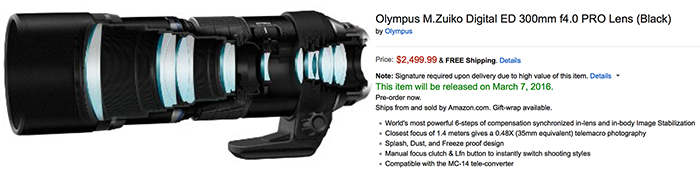
300mm f/4.0 PRO lens at Amazon, Adorama, BHphoto, GetOlympus. In EU at Amazon DE. WexUK.
Olympus 77mm PRO ZERO Protection Filter at BHphoto.
TG-870 compact ar Amazon, Adorama, BHphoto, GetOlympus.
Note: 5% reward ($125) on the lens sold by Adorama!
Full reviews:
Review by Peter Baumgarten. Test by Warren Fleming. Review by Imaging Resource. Review by Mirrorlessons. Russian review at Kroupski.
Hands-on and previews:
Hands-on at Dpreview.
Image samples:
Dpreview.
Videos:
First impression by Peter Baumgarten
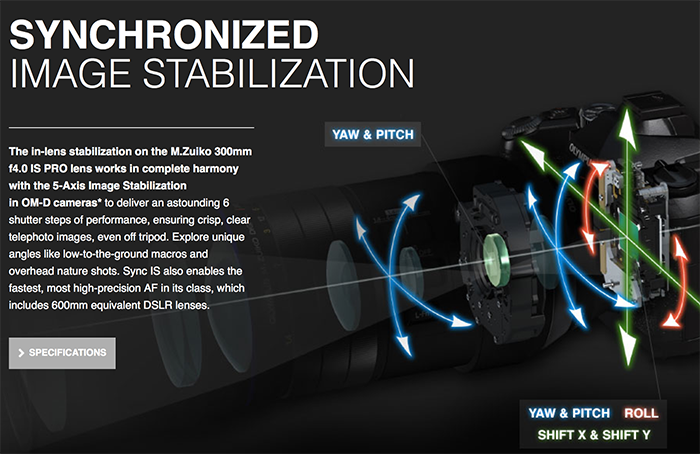
5 axis Sync Image Stabilization (Olympus)
Review by Mirrorlessons.
4K video samples by Mirrorlessons.
Press text:
Full press text at 43rumors. Japanese text at DC.watch. Spanish at Quesabesde.
lens added at the Matching Simulation tool
50 Responses
Man that video sucked. Did he record it in an echo chamber or was it just shot with an old funky camera. I’m not sure I would have approved it if I worked for Oly, he didn’t make it sound exciting at all. I’m sure some will love this, but it’s out of my price range.
Considering that you can’t even afford a shirt I’d say it’s out of your price range 😉 Just kidding. The lens will be loved by those who need it I’m sure
Agreed. Saw a review of the Panasonic 100-400mm it was fantastic. It’s not encouraging for such a beautiful piece of art, the 300mm to be so poorly promoted in an otherwise boring, video. – Factually correct but zero presentation style.
Impressive review in SLR/Imagining Resource for the Oly 300mm even with the 1.4 tele converter. My GAS is building up again. Gotta stop coming to 43 rumors and start going out taking photos. 🙂
3300 Canadian loonies!
NZ$4371 direct
I tell you Olympus just keeps innovating in the micro 4/3rds camera space. Love it!
This thing is bleeding expensive, but at least we now know the absolute maximum Olympus might charge for m4/3 products. The 300/2.8 was (is) by far the priciest thing ever made for 4/3.
Priciest thing made for MICRO 4/3, yes. But not the priciest lens ever made for 4/3. Olympus made several pro-quality lenses for their older 4/3 format DSLR E-series cameras–the Zuiko ED 300mm F/2.8 currently priced at $6,999, the Zuiko ED 90-250mm f/2.8 at $5,999, and the Zuiko ED 35-100 f/2.0 and Zuiko ED 150mm F/2.0 both currently priced at $2,499.
Please read my comment carefully.
Oops, that’s what I get for very little sleep and reading late! I “read” 300/4…
I’m leaving the comment so that anyone complaining about the price can appreciate the fact that this thing isn’t costing anywhere near what the 300/2.8 did/does!! (Granted I wish the new 300/4 was actually a f/2.8…wonder what that would’ve been priced at?….)
Meh. Back in about 1995, in Australia, I inquired about the price of the OM Zuiko 180mm f2, new. It was about $18,000 Australian dollars.
I temporarily lost the power of speech so was unable to inquire about the price of the 250mm f2. At a guess I would suspect about $25,000.
Great review by Mirrorlessons: Not fawning over it like some would and a very objective and a balanced view of using it on a GX8 and an E-M1. It’d be good to see him review the 100-400 as well for comparison.
Looks like we had too many posts about this lens before, I was expecting 200 comments at this point. Meanwhile at dpreview the same crazy discussion is in full speed. IT’S A 300mm LENS PERIOD
Crazy is a good word.
The REASON we have and use lenses of different focal lengths is because of the different angles of view the lenses render. The angle of view is what determines the perspective and framing, not what focal length the lens happens to be.
If you have four photographers, each with a camera with a different sized sensor, all standing in approximately the same spot and all have the same objective when it comes to framing the same subject, each of them will choose a lens with a different focal length to achieve the same angle of view required to achieve their aim.
You don’t use the focal length of a lens to frame a subject you use its angle of view. The angle of view is the primary criteria, the focal length is subordinate
Absolutely spot on. Once you’ve chosen a particular camera system, framing the shot is what matters and not the actual focal length!
All of that talk about effective focal length is just a waste of time. For manufacturing and physical lens discussions and cost…its a 300mm lens. Anything else said is just stupid.
It says 300mm right on the side of the barrel.
I agree. For certain purposes it makes some sense to mention equivalent focal length, but since larger sensor cameras often have more pixels, that is not really true either. Haven’t done the calculation but say a Canon 5DS has 50.6MP, while GX8, the highest MP camera for m43 has 20.3. Clearly cropping in post on the Canon will eliminate some of the advantage of the crop factor the m43 has if they both have a 300mm lens.
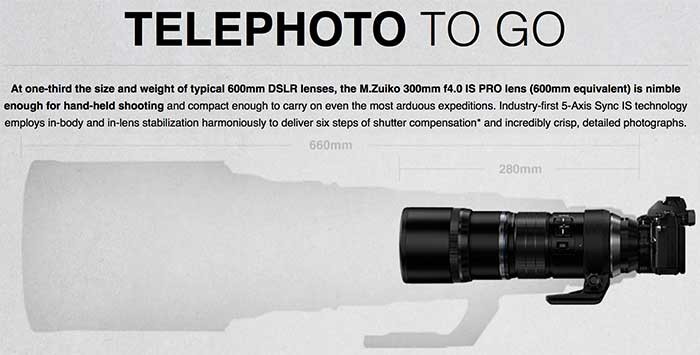
Secondly, it certainly is no big feat to keep the 300mm the size/weight that Olympus has, and saying it is a shrunk down 600mm makes no sense. Also, the pricing should be much closer for a 300mm regardless of the system you put it on. The Olympus is over a $1000 more than an equivalent Canon. If m43 had a 30-50MP sensor I could perhaps see a reason it would cost a bit more as the lens would have to resolve much higher than on a Canon FF, but otherwise..
Look at the SLR Gear Review!
It is flat with the TC 1.4
http://slrgear.com/reviews/showproduct.php/product/1840
“In our testing, the Olympus 300mm ƒ/4 Pro’s image stabilization using the E-M1 v4.0 was fantastic.”
I haven’t seen a Canon lens that’s this good by measurements.
What about shutter shock blurred images?
http://slrgear.com/reviews/showproduct.php/product/1840
This review clearly shows blurred images unless full electronic shutter is used at 1/125th sec.
Based on my tests on GH4, you need at least 1/2000th of sec to avoid shutter shock at 100mm, so I wouldn’t want to shoot this lens below 1/4000th, which at f4 would give a lot of high iso noise. I’d quite like to be able to shoot at 1/250th without worrying my image will be slightly blurred due to shutter vibration.
Does IBIS negate shutter shock? I don’t have an EM5ii to test.
Do Oly expect only electronic shutter to be used with this new lens (rhetorical?).
Will Pana give us EFCS like Sony do; if not I wouldn’t buy another m43 body or long lens.
The problem with shutter shock is that it’s such a sudden high frequency vibration of the system at the exact moment the shutter is open that the OIS can’t prevent a slight blur of the image. If you pixel peep it looks terrible, but at normal web resolution it’s hard to see the blur.
but why buy a 3500€ Combo (300mm + camera) to view at “normal web resolution”
those results should be pixel sharp anyway!!
The shutter shock illustrated at Imaging Resource (the SLRGear test) is with all image stabilization off, and the camera and lens on a heavy studio tripod.
http://slrgear.com/reviews/showproduct.php?product=1840
shutter shock on the GH4 it makes no difference IOS on or off, tripod or handheld. At 40mm to 100mm you need at least 1/1000 sec. In fact I try to shoot every lens over 1/1000th on the GH4 because I don’t trust it.
Hopefully this lens will be great a lower shutter speeds on the EM1 but I won’t buy it until I’ve tested for myself
Many years ago when people shot with film, a well regarded Japanese wildlife photographer said the conventional-wisdom that you should use a tripod to ensure critical sharpness at normal shutter speeds was wrong.
He said you should only use a tripod to support and steady the weight of the lens and that you should still hold the camera body and lens as you would normally without the tripod, the reason being that he had found through experience that the human body tended to dampen and absorb the high-frequency vibrations caused by the mirror, shutter and aperture mechanisms.
Over 30 years ago I switched from a Pentax system to an Olympus OM system because of shutter shock. On my Pentax MX even with the mirror locked up and using the self-timer, if I balanced a coin on it, the coin would fly off due to shuttershock. But not on the OM-1 and 2 I switched to.
However all that changed with magnified live view, which of course Olympus introduced, and EFCS, which first appeared on the Canon 40D which I got just after it came out. In silent shooting mode on the 40D, these is absolutely no noise or vibration before the exposure ends. It radically changed what sort of macro photographs I could get. Magnified live view lets you see if the subject is perfectly still in a way impossible even with a viewfinder magnifier.
In other words, what that Japanese photographer said, no longer applies with the right equipment.
OM cameras would also stop down the aperture as well as lock up the mirror when using the self timer. The aperture mechanism was likely as great a source of vibration as the mirror. No idea whether Pentax did that also.
I mentioned the Japanese photographer because you stated the use of a heavy tripod in conjunction with the shutter shock
I want to see SLRGEAR reproduce this shooting the lens hand-held, with IS engaged and same shutter speed.
So if you have to pixel peep to see it, is it really a problem?
Or am I being a heretical realist?
Looking at most of the reviews of this lens and noting the shutter speeds they used to achieve the test images, I would have to say your 1/4000th nonsense is incomprehensible hysteria.
I’d like to see the test raw files with meta data.
I think EM5ii/GX8 are better than GH4 and hopefully be able to shoot at lower shutter speeds.
Shutter shock is a problem on the GH4 and to avoid need to shoot over 1/1000th or below 1/30th. I wouldn’t plan to shoot this new lens with a GH4.
Yes, I noticed this and left a comment about it at Imaging Resource. It is a big problem and a major deal breaker with me. Although I did ask and make the point that the E-M5 mkII may be better as it was designed for electronic first curtain shutter, rather than having it retro-fitted with firmware.
If I got this lens, one of it’s purposes would be for natural light close up work on a tripod, so the fact that shutter shock is likely to occur, even with anti-shock between 1/30s-1/320s is a big problem because these are common shutter speeds I use. Having to use the silent full electronic shutter would be a problem as I understand there is a drop in image quality and the colour is at a lower bit depth.
My experience with EFCS has been on Canon bodies, which is implemented on in live view silent shooting mode. At least with my 40D and 70D there is no apparent shutter shock at all with this, and nothing appears to move until the exposure is finished. You can hear something before the exposure with my 600D, but I haven’t experienced shutter shock. As long as the subject is still, gauged using magnified live view, I can be 100% certain of a sharp image on a tripod at any shutter speed. This is a bit of a deal breaker for me, as it is very important form me to be able to get reliably sharp images on a tripod at any shutter speed, and to be able to do maximum tonal adjustments in PP as I have limited control over the lighting.
That’s interesting, so the EM5ii has hardware EFCS as opposed to the firmware in EM1. So EM5ii should be much better. I was basing experience on EM1 which doesn’t have effective EFCS. Sounds like I need an EM5ii for piece of mind shooting and keep the GH4 for video!
Would you please post an image taken with your E-M1 with the ineffective EFCS that clearly demonstrates the shutter shock problem – with the exif intact please.
The slrgear test shows pretty clearly that the EM1 EFCS is not effective with quite a lot of blur with EFCS on or off.
Maybe they have an axe to grind and used an EM1 to expose the problem, rather than EM5ii.
I’ve got examples I can post also, EM1 with pan35-100 at 1/125th, looks not as bad as the slrgear test but still a visible slight blur.
Please post an example.
Just looked at he SLR Gear discussion on shuttershock. IThat information is truly depressing. Am I to understand that every image I have taken with my EM1 is not sharp? Shuttershock has nothing to do with the lens?
Not sure if you’re being ironic…
It’s only noticeable on longer telephoto lenses, it’s like camera shake, the longer the lens the more amplified.
Some lenses due to their structure and focal length are more prone to blur, others not so. Wider and normal lenses it doesn’t usually show. But it’s easy to check, just view an in focus area of your image at 100% and see if there’s any blur of the pixels
Shutter shock has been an issue with all cameras not just m43. It’s become a problem because of the new very high density sensors, and m43 has one of the highest density.
EFCS is the solution.
No…I was not being ironic. (I got rid of my EP5 because of the issue)
This makes no sense to me. If the shutter shocks the sensor…it shocks the sensor. I have a little trouble understanding how the lens enters into the picture. Its shutter shock…not lens shock?
This info makes me feel that everytime I pick up my camera I have no reasonable expectation that I will have a sharp image without a giant sheet that tells me which lens is prone, at what shutter speeds…etc..etc…etc….oh…wait…the moment, that light and everything else is gone.
Of course you cannot know until you get on a computer….and then …well…its waaaaaaaaaay too late.
It’s VERY unsettling information.
ITS SUCKS!
🙂
Kudos to SLR Gear for taking the time to present the issue responsibly.
Why the GX1 is in the mix is just silly. (I actually understand why for the the results on their website to be consistent), but mechanically that is a very old camera.
It’s lens focal length dependant. The vibration of the shutter instantly travels through the body and the lens elements causing very slight movements relative to the projected image on the sensor, hence a slight blur, amplified by long zooms and certain lens structures. It’s not a problem with most lenses on the EM1.
It’s only certain long telephoto zooms/body combos that cause the problem.
We’re only talking about it here in relation to the 300mm lens!
I can assure you that EM1 with your Oly lenses will not have any problems.
Again, it’s only in discussion here in relation to the new 300mm lens
OK…perhaps I am overreacting. I was getting shutter shock with my EP5 with a 17mm lens. I have read and understand (I think…LOL) all of the info and have my EM1 and EM5II set on the best modes…but basically what I am reading here…if I am going to spend $2600 (or almost $3000 with the 1.4x, which will only make things worse) I have to shoot in silent mode…or I risk having unsharp shots. Am I getting this correctly. …but if I shoot in silent mode…I am not utilizing my sensor to the utmost. Do I have that right. …and if this is the case ….WHY is Olympus not telling us that? Why do we have to hear it from the most excellent SLRGear website. If their info is correct…I am wasting my time with $4000+ gear in my hands if I do not have a modern body with Silent mode. That should be a warning on the 300mm box like they have on cigarette packs.!!!!!!!!!!!!!!
Not trying to beat you up…it just is unsettling information. Photography is complicated enough…with so many things taking us away from the prize…taking the photo. LOL!
SLRgear is getting good results with the EM1 on Sllent (heart?LOL) mode. Correct? …so the EM5II would be the most reliable …but the EM1 is OK with the current firmware? right?
(good discussion BTW).
I don’t know about your Olympus camera, but for the Panasonic I have seen testing of silent mode vs regular, and there is no quality difference in the picture between the two. The silent mode can cause a jello effect if you shoot something with movement though.
The correct abbreviation for SS is SBS.
There are three possible
sources of mechanical vibration that can blur an image. The first is
the photographer. Most blurred photos are a result of an unsteady hand
and non-gentle activation of the shutter. Having to tap the rear screen
of a phone – pure genius.
The second source is physical movement
of shutter components and the third is physical operation of the
aperture diaphragm in the lens. This is the only one that could likely
be lens-dependent.
With SLRs you have a fourth, being movement of the mirror mechanism.
I tend not to get SBS when using my E-M1. It seems to be more prone to happen to Trolls, for some reason.
Gee…thanks for the kindergarden discussion.
Jay John is not a troll dude. We are discussing real, carefully documented results from a VERY reputable website.
You can blow it off and act like the big expert…but I would call you a fool.
Shutter Shock (however YOU want to say it)…is an issue…has been for years)..and apparently it is a significant issue with this lens & up-to-date cameras… and needs to be carefully attended to so that the photographer gets the best results possible for all the time and money he has put into his efforts.
“I have a little trouble understanding how the lens enters into the picture. Its shutter shock…not lens shock?”
Its still shutter shock. The unsteady hand bullshit is just condescending.
If you have the right shutter speed and know what you are doing you can move your hands, your head and do a dance…you will have no blur.
Get real.
We are talking about a mechanical issue in these modern cameras that is causing a problem. I have been shooting for 45 years. I know my apertures, shutter speeds, etc..etc…etc…
Everything you read about shutter shock…says this for that camera, that for this camera…oh wait…do you have this firmware???
It just all adds a REAL uncertainty when someone who knows what they are doing goes out to shoot. It is uncomfortable and disconcerting…and not at all well documented or openly discussed by the manufacturers.
I know what I am doing with a camera and lens in my hand…but there is just no absolute info that one can rely on. It makes apertures, shutter speeds, focal lengths, sensor size, technique etc.etc.etc. easy in comparison ….
It really sucks. I want to go out and create images..I do not want to sit around testing my $1000 camera and $2600 lens to see if it works the way it is supposed to.
What I would like to see is a detail release about shuttershock from Olympus regarding this lens. We get all of this marketing bull and a giant pricetag …they should be forthcoming with that information for this lens on all of their camera bodies. Funny. I do not see that any of that in the “launch” information from the marketers and salesmen.
How do you know it isn’t vibrations caused by the physical actuation of the aperture mechanism in the lens – which by definition wouldn’t be ‘shutter-shock’
I found the review at Mirrorlessons by Mathieu Gassquet excellent and informative. There are good samples and video, and Mathieu is honest about his limited experience with wildlife and football photography, but nevertheless got some good sample images.
ianfleming wildlife pics are good presentation of this lens