








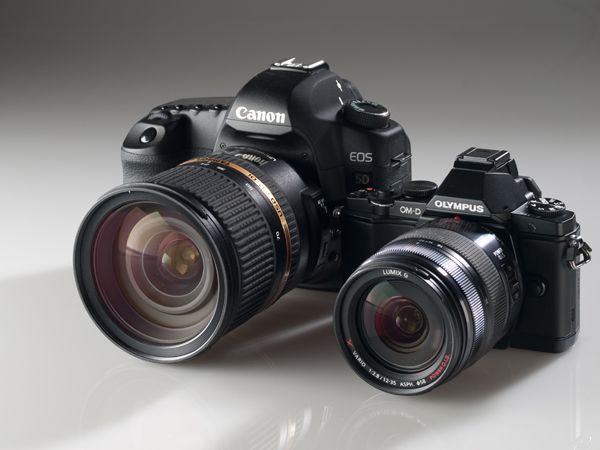
A great image of the E-M5 with Panasonic 12-35mm X lens compared with the Canon 5DmarkIII and Tamron 24-70mm. (via DSLRmagazine).
Olympus will allow the publishing of 75mm f/1.8 reviews and image samples from next Monday only. That’s why we didn’t see any full review until now (although Cyberphoto Sweden posted some images anyway).
Meantime the Panasonic 12-35mm lens is in Stock for the first time via Hong Kong reseller at Amazon US (Click here).
UPDATE: One silver E-M5 body is in Stock at Amazon right now (Click here).
—-
Panasonic 12-35mm X lens preorders at Amazon, BHphoto, Adorama, Amazon Germany, Amazon UK, Fotohanskeuzekamp, Amazon Japan and Digitalrev.
Olympus 75mm preorder and price check at Amazon, Adorama, BHphoto, Amazon Germany and Amazon UK.
53 Responses
Can’t help it, the Olypmus is by far the better looking camera.
It is, and that shot is a great size comparison.
I get sweaty just by seeing the Canon…
The Panasonic should be compared against the Oly 14-54 and 12-60. Similar brightness at 12-35mm, similar specific size per 1mm of zoom range. The only significant difference so far is specific cost which is 3-4x more than the Olympi (per 1 mm).
What the f… are you talking about??
Go take a cold shower and report back with more sense.
What the FACTS am I talking about? Yeah, facts indeed 🙂
The Panasonic lens is actually the largest of the three in terms of specific volume and weight per 1 mm of its zoom range. If these longer Olympus lenses were made to Panasonic standard, they would be larger and heavier than they really are. The Panasonic lens is only smaller because of its drastically shorter zoom range, but it’s less space efficient.
No seriously, what the-f are you babbling about.
The panasonic lens is measured per 1mm of your brain. There is not a lot of it so thats why it’s a small lens.
I have no idea why would you make such calculations, but you are forgetting that:
1. the Panasonic has optical stabilization
2. you need adapters to use the Oly lenses on a m43 body
3. the Panasonic is a constant 2.8 aperture
Is it really important that the Panasonic is f/2.8 at 35mm, and the 14-54 is about f/3.1 at 35mm?
In terms that it affects his calculations, yes. For photography purposes, no.
The calculation is about Panasonic’s 3-4x specific price premium having little to do with its perceived miniaturization, which is hardly there at all.
The need for adapters to mount the Olys on m43 is not quite relevant as I am comparing internal space efficiency of the lenses. The choice of Oly lenses is pretty arbitrary – any other, sufficiently similar lens would do.
Optical stabilization and the somewhat dimmer longer end of Oly’s are important indeed, so even though the Panasonic is the largest and heaviest of the three in specific terms by a small margin, I’m not claiming the comparison I’m making is all-encompassing.
And yet that error is pretty small to explain the whopping 3-4x specific price bump, isn’t it? Must be something else – probably extraordinary optical quality.
Ah, ok. But then you are basing the price on quantity of raw material only. Still doesn’t make much sense. They price it according to what people will pay for it.
Not just raw materials but whatever stands behind the prices of Oly lenses, including any raw materials, labor, capital costs and competitive net profit. Because in free markets consumer goods (non-luxury) prices approach the sum of those things. That’s why prices of some m43 lenses fall through the roof after the novelty wears off. While Panasonic does indeed set the price “according to what people will pay”, people will generally only pay competitively justified prices, so Panasonic simply has no other choice than to comply or stop production 🙂 That’s why most people pay less than the purely opportunistic MSRP prices. I’m trying to guess how much of this lens’ price is competitively justified and how much is purely opportunistic due to a temporary inadequacy of competition. That’s why I took issue with it being very vocally touted by Panasonic as “compact” as if it were its competitive advantage. It doesn’t seem to be. It is compact mostly because it is restricted rather than advanced.
Ah, now I get it 🙂
Umm…the 12-60 starts at 2.8 and ends at 4.0. Not comparable.
I own both. They are BOTH great cameras for different reasons. I am waiting on the new Canon 24-70mm f/2.8 II…as soon as it comes out I will own one…I am passing on the Tamron. Also passing on the Pany 14-35mm, for now….Maybe in a year or so when the price drops. …but I can wait for the 75mm to ship….I already bought a B&W filter for that bad boy…bring it on!!!!!
BLI….you know what made me sweaty…looking at the 100 ISO files from the Canon last week, for the first time. I had a 5DII ….and my mouth is still hanging open….but the Oly is so much more fun!!!!!!!!!! LOL!
Woah!!!…the second photo from the Oly 75mm f/1.8 has no redeeming art value whatsoever ….but DAMN….it that bokehlicious….or WHAT???????
OOTEN DER FER VEFENKERFER!!!!!!!!!
+++++ wow is the word! and no kidding on both points!
You don’t like the gas station shot? WTF were they thinking with THAT one?
Can’t wait to read some reviews and see some real images ….
I never thought I would say this…but the brick wall photo would be preferable. 🙂
this photo remind why i bought m43 system in the first place: for the size and weight with reasonably good image quality.
For that photo to be a valid comparison, you would need either a Canon 24-70 f/5.6 lens or a M43 12-35 f/1.4. Yes, the E-M5 set is smaller, but you won’t be able to achieve anywhere near the speed or image quality. This doesn’t mean the E-M5 doesn’t have it’s place- I’m thinking seriously about getting one myself. I love the small size, weather sealing, IBIS, new Olympus primes, even the EVF could be good for manual focus (way better than the viewfinder on a Digital Rebel, anyway). But to pretend that f/2.8 on a full-frame camera and f/2.8 on a four-thirds sensor is the same thing is ridiculous.
When it comes to depth of field, no it’s not the same. To think that shallow depth of field is the end all be all of image quality? Now that’s ridiculous.
Very well said. To many ppl are hung upbon DOF as being the end all and be all. The Omd Em5 has closed the Gap when it comes to Aps-C Sensors in High Iso. Em5 has The best IBIS and ia weathersealed and its AF is blazing fast. For most ppl, availible light is what most ppl are shooting. I cant say that more than 30% are shooting night time images. Daylight Images, are hardly different between cameras. A good PP style, you can achieve amazing results from.P&S all the way to FF.
“…won’t be able to get to achieve anywhere near the speed or image quality”
Eh? The Canon has higher resolution, but most tests have indicated that the OMD is trailing on the heals of the 5Dmkii and the D700 wrt ISO performance. One statement was that the OMD at ISO 2000 had comparable quality as to the D700 at ISO 3200. To me, that indicates a performance that is rather close.
Speed?? What do you mean by speed?? The OMD has decent AF speed, 9fps max shooting speed, etc. It could have been faster from turning it on until it is ready to fire. But overall, I doubt it is far behind the Canon — maybe even beating it in some area.
“to pretend that f/2.8 on a full-frame camera and f/2.8 on a four-thirds sensor is the same thing is ridiculous”
Perhaps. But pretending that f/2.8 on FF is the same as f/1.4 on four-thirds is far more ridiculous: then you have to narrow-mindedly focus on DOF and toss in some quasi-science about needing more time to gather fotons in the four thirds sensor, while at the same time hiding the implied need to change the ISO scale, etc. F/2.8 on FF is, for all practical purposes except DOF, equal to f/2.8 on four-thirds with the accepted ISO scales: if your FF needs f/2.8 and exposure time of 1/60 s at ISO 200 to get correct exposure, then so does the OMD. And, yes: the DOF on the FF will get narrower. But I am aware of that, and STILL I prefer the much lighter/smaller OMD.
The Olympus and all micro 4/3 cameras look like toys compared to the bigger Canons. It’s quite sad. I know the big thing with this m43 sensor is smaller sized bodies but I want something with the GH2’s capabilities in a large, more professional body. Too much to ask? As of now they look like small plastic toys.
If you want a large body, you don’t want micro 4/3. The word “micro” is not just a marketing ploy, although it works well as that, too.
There sure is marketing ploy to fool people that putting lens mount to various digicompact designs we’ve had for decade suddenly makes them advanced high end system bodies.
Then make a hole in a bloody big cardboard box. Paint it black and put a gold chain on it.
Put a GH2 inside put the chain round your neck and off you go.
Try to look as intelligent as you normally do while taking pictures.
And yet a camera like the Canon EOS 5D Mark II is plastic, and the E-M5 is magnesium alloy. As far as what they look like, that’s a matter of personal opinion. I own the E-M5, and I’ve owned larger DSLRs, and the E-M5 is the most solid looking and feeling camera I’ve ever owned. I definitely appreciate the smaller size and weight after a five mile hike with all my gear. My bag used to weigh almost 30 pounds, now it weighs less than 10, and I’m giving up very little in terms of image quality.
Now thats the truth…
mmmm you stupid. The canon has à magnesium body with plastic and rubber outside. Its way more solid then Oly with its magnesium only body and fragile is.
The 60D is plastic. It is a good idea to know the facts before making comments like that.
MMMM you…… joe was talking about the 5d Mark 2
> My bag used to weigh almost 30 pounds, now it weighs less than 10, and I’m giving up very little in terms of image quality.
And how much of that weight difference comes the from body?
Very little for huge trade off in ergonomics. Nearly all of it comes from optics because quality zooms for 35mm film/sensor weight a lot.
4/3 mirror mount’s very long flange back distance for sensor size made ultra wide angles extreme retrofocus designs but optically very high quality for superzoom Pana Leica D 14-150mm is 1.2lbs, dropping mirror away allowed lot less extreme retrofocus design in Lumix G 7-14mm for nice UW zoom and we’ll have plenty of margin to that 10 pounds to add some tele lens and actually good ergonomics body.
Body with high end ergonomics wouldn’t even have to be much heavier than current digicompact+retro mixes when designed purely for ergonomics instead of fashion gimmicks.
That’s about as intelligent as saying that a Porsche looks as a toy compared to a tractor just because the tractor is bigger. Oh, wait: the Porsche IS in many ways a toy. But it can take you to places a tractor never can.
I know it’s absurd to participate in this thread but I can’t help it…
Surely it’s the tractor which can take you places a Porsche never can, not the other way around? Certainly it will take longer to get there in the tractor, unless the traffic jams are really bad or course…
Hard to imagine one is four times better than the other. Can take a beating as well.
Yes a pity, but the EOS will probably catch up with the next version release!
I like the way you think. That’s exactly what I would say trying to be sarcastic.
Admin
BTW Amateur Photographer has reported Sony closed deal with Oly.
http://www.amateurphotographer.co.uk/photo-news/538868/olympus-tie-up-with-sony-a-done-deal-reports-claim
It does not report a closed deal. It reports discussions which may or may not result in an investment by Sony.
Wow look at the size difrence its amazing bla bla bla. Look at the picture quality of THE superb canon and iphone quality of the Oly. These camera can not be compared its just ridiculos.
Trolling isn’t even subtle nowadays.
Lol, you’re very funny !
When relatively compared side by side, the Canon really shows its ugliness.
Quick photo analysis:
* filter box – useless, shot at 1/40 on a Panasonic body and blurry
* sign
– f/1.8 and f/2 – reasonably sharp, but horrible amounts of longitudinal CA even on low-contrast edges
– f/2.8 – sharper, contrast and microcontrast improve, LCA is almost gone
– f/11 (mislabeled as f/8!) – diffraction kicks on, (micro)contrast is down again
More detailed comparisons are impossible to do, since Panasonic does absolutely horrible things in their JPEG engine. Small round objects (flowers) become square-ish and there’s lots of double edges even inside the acceptable DOF area. WTF, Panasonic?
As usual, potential buyers need to wait for Optyczne/Lenstip and image samples from raw files. The amount of LCA before f/2.8 is very worrying, however, since that’s not something you can easily fix.
Jeeze, who knew?
I thought it was just an incredibly boring image.
It was very boring, but it did tell a tale, and one which doesn’t seem very promising.
Open the f/1.8 or f/2 photos, zoom in, go to the top right, and then scroll down.
The trees have purple and cyan (the latter is less visible due to the sky color) outlines, yet they’re not on a contrasty background.
There’s more purple and cyan on the lamp post. The rivets look absolutely awful, and they’re oval (remember Oly saying they were aiming for great bokeh with nice circles?). More LCA all around the bus stop.
Bokeh gets really hectic, swirly and smeared on the bottom right.
Going to the bottom middle, there’s red (!) LCA around the yellow dandelions.
The Kakel sign doesn’t show cracks wide open, and it does at f/2.8 (not a DOF issue, but a microcontrast issue).
Overall, doesn’t seem too promising, and not something I’d personally put in the category of any SHG glass, like Oly implied.
Boooo, I think you’re using way too strong words here.
Any CA in the extreme corners at F1.8 is barely visible at 100%, only if you zoom in to say 400% or so. But there are limits to pixel peeping, isn’t it? Resize to a smaller pic, and it will most certainly be invisible. And this applies only to the hardest contrast details, like the dark spruce tops and the shady side of the lamp post against the white clouds/light sky.
As for the rivets (which are screws btw) on the bus shed, they all have a pronounced arc-shaped reflection from the sun on their left hand side (see i.e the F4 picture). These reflections will of course not be rendered as full circles in the OOF bokeh.
For the bokeh in the lower right, this area is not enough OOF to become smooth and soft, and in addition it holds lots of busy contrast details like straws and stems, so this is also a pretty normal rendering.
The alleged red LCA on the bottom flowers, is more likely OOF orange/reddish color from the shady underside of the flowers (zoom in on F4). Those flowers are buttercups btw, not dandelions 😉
The “Kakel & Design” sign does clearly show surface imperfections in the F1.8 sample as well. But here it admittedly shows some red CA between the letters in the word “design”, that is gone at F4. That said, these tightly spaced b/w letters is a worst case scenario for any lens. Given the brightness for the 75/1.8, physical laws are kinda forced into play here, so one has to expect minor flaws at such an aperture…
All in all I believe this is a superb lens. But if it holds SHG standards remains to bee seen. Personally I doubt that, as the SHGs are really something else, excelling in absolutely every aspect, whereas m4/3 lenses seems most often to be balanced between size and optical compromises, resulting in a dependency of in-cam post processing for CA and distortion/vignetting removal. Moreover, the 75/1.8 isn’t sealed either, and I find it’s champagne silver finish not very appeasing. Not for a black camera anyway…
I love that picture. Both are awesome cameras.
That Swedish site also has samples of the Pana 12-35 at several FL’s and f-stops.
By the way: that picture shows a Canon 5D Mark II not the Mark III…(Admin?)