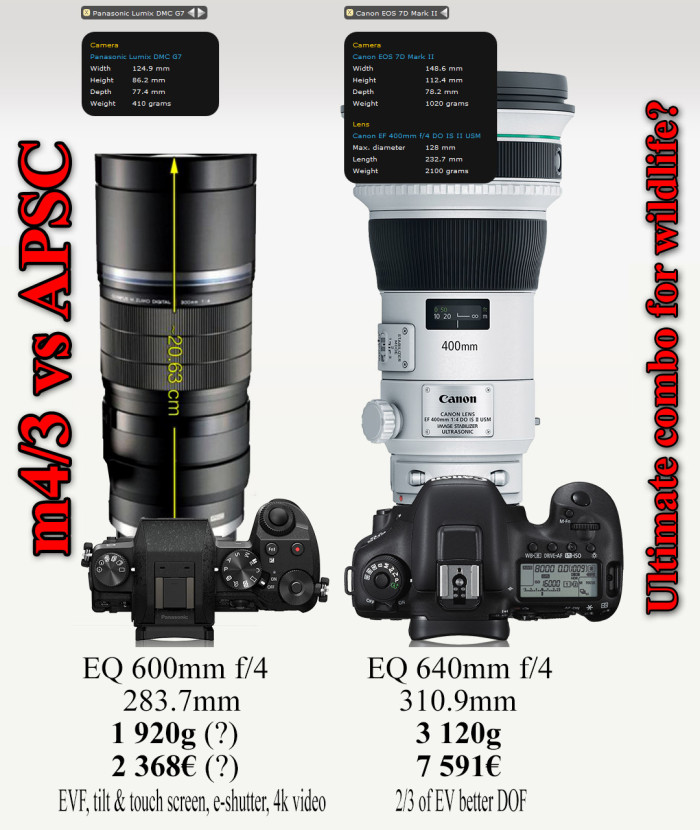
Sm.art.graphicstudio sent me this comparison between the soon ot be released new Olympus 300mm MFT lens and the [shoplink 56759 ebay]7500 Euro expensive Canon 400mm lens[/shoplink].
Better comparison would be with Nikon D7200 and Nikon 300/4E. 24mpix cropped to m43 are not that far from 16mpix, has the same picture noise at high ISO and the same “reach” (AoV).
Yes, and same DOF when cropped. I really hope their guess for the 2368 € price is way off, I’m hoping for something around the previously hinted 1800 €
I agree that price is important. I am still very interested in the 300mm f4 with a m4/3 camera. But as I have a Canon system I will have to weigh up the pros and cons of the Canon 100-400mm f4.5-5.6L IS II, which is a superb lens and falling in price.
I also understand that the D7200 has a crop mode, that crops all images to near 4/3 size. In other words the angle of view, and the resolution is nearly the same.
Unfortunately m43 is losing its lens size advantage at telephoto lenses. The comparison shows there is less than 10% difference in lens length even though m43 sensor is 4 times smaller in area and there is no mirror in-between.
But 62% (estimated) difference in weight, and that’s what you feel when carrying it. Believe me, 1200g makes a difference when you’re lugging it around all day. Also, total ‘pack size’ (amount of space it takes up in a case) is still much smaller, meaning you can carry all your gear in a much smaller bag.
Meanwhile, I’m trying to figure out what the graphist means by “2/3 of EV better DOF.” I assume he means less DOF… but less isn’t always better, especially if you like in-focus pictures…
Ok, but some information is missing. Like roughly 1 ev more dr and better noise performance and better autofocus for apsc cameras like Nikon D7200 and Canon 7D….
Depends on ISO, or whether you mean S/N ratio or DR. From ISO 800 on the DR is pretty much the same. And if you do some wildlife in the morning or evening when the animals are coming out where I live, ISO800 is quite common.
It depends on ISO. At base ISO or close Canon cameras (not only APS-C but even FF!) currently trail m43 sensors. Surprising, but true. Just showcases how bad the read noise on current Canon cameras is.
It is basically the same thing according to DxO – they have a special threshold in SNR in shadows to determine DR. Please note that they report SNR at 18% also, but it is just SNR at specific subject brightness, not all possible SNR values.
And there it is just barely a second to 5D Mk3 at ISO 3200 but just about 1/3-1/2 of a stop. While it is leading more like a 1-1.5 stops the other Canons.
And E-M1 wins 7D Mk2 and D7200 in C-AF and S-AF 😀 You need D3/D4 or Canon 1D X level camera to get on level or beat E-M1 in C-AF, but yet lose in S-AF 😀
So sorry!
Typical nonsense. You are one of the hardest m43 fanboys I ever met. I owned an EM1. And no, there is a difference, especially at higher ISO favouring the larger sensor. Why is that so difficult to accept? M43 has other strengths.
Whilst I appreciate the comparison of a 300mm m4/3 lens to a 400mm lens on APS-C, because this is far more realistic than FF equivalents, it is still an unrealistic comparison. Comparing the G7 to the 7D mkII is not realistic. The 7D mkII is a super tough weather-sealed camera with one of the most advanced AF systems of any camera and will produce the type of focus tracking at 10fps no mirrorless camera is capable off. A better comparison would be between the 70D, which is lighter, has a flip out screen and touchscreen.
A more realistic comparison would use the Canon 100-400mm f4.5-5.6L IS II. The 400mm f4 DO II would still be a 400mm f4 on m4/3 and is a top of the line professional lens, with top draw performance.
No, there is nothing realistic about comparing a a zoom to a prime lens. The field of view of a 400mm f4 would not be the same on M4/3 as it would on FF, so no, that wouldn’t be a valid comparison.
Yes there is. The new Canon 100-400mm f4.5-5.6L IS II is at least as good if not better wide open than their 300mm f4 and 400mm f5.6 primes. I am talking about what real world shooters with long lenses will look at. Very few people considering the Olympus 300mm f4, would also be considering the 400mm f4 DO II. But far, far more people weighing up the Olympus 300mm f4 with other options, would also be considering the Canon 100-400mm f4.5-5.6L IS II. This is because it is the class leader in terms of an affordable, but portable lens in this category.
I fear you don’t seem to understand much about the sort of photographer who uses this sort of lens.
Sounds like you’ve not used any of the m43 cameras before. If that is the case, you might want to. While I will concede that the C-AF in the mirrorless cameras may not be the best application for everything, it is definitely usable in the majority of the situations.
Then factor in size, weight and price and you have a very compelling alternative to the Canikon offerings.
Yes, the weight and equivalent focal length advantages are why I am considering the Olympus 300mm f4. However, you also need to understand that for this type of lens i.e. for wildlife, birds and sports, that C-AF is major consideration.
I do understand that but many people, including myself, have successfully used mirrorless cameras for these applications for clients including birds in flight, baseball, soccer/futbol, polo, motorsports, equestrian.
C-AF makes live comfortable in those area’s. But it seems many don’t even have the skills any more to do an event without it.
C-AF is nice when you just want to gun away like an idiot, but a great shot can also be achieved by careful planning even with MF.
IMO C-AF is highly overrated.
Only when you want so show sequences you need it for every shot needs to be in focus of a series.
I would also add that in this particular comparison, the OVF is also a plus. Tilt screen is also not really practical in a tripod less situation with that kind of lenses.
Actually to get the same dept of field on APS-C you need to close the aperture with less then a stop (~ 3/4 of a stop). The two stops difference is between M4/3 and FF cameras. But most of the time, wildlife and landscape shooter rave for more dept of field not the other way around. 🙂
Not sure what wildlife photographers you’re talking about. Most of us argue for less depth of field in order to isolate distant subjects from distracting backgrounds.
Difficult to discuss n the abstract but, when shooting with long lenses, 99% of the time you want more not less DOF. You know this. You’re just being difficult. How many times have you seen a wildlife shot ruined by too much DOF? Too little DOF?
You claim to know what I know ;~). You don’t. What I know is this: with telephoto lenses it’s rare that I’m asking for more DOF in wildlife photography and common that I’m asking for less. The answers to your questions are: many, rarely. I’d be surprised if you could find a wildlife pro that would disagree with that.
The only reason why you’d need more DOF has to do with scene setting (animal in scene). But it’s rare that you’d attempt to do that with a really long telephoto. Pros like Andy Biggs have actually moved to medium format with shorter lenses to do that kind of work well. Moreover, this often requires that you change your perspective (get closer to the subject).
Your comments and criticism tell me that you don’t understand depth in a two dimensional medium. The common over applied myth is “hyperfocal distance” focus, the ultimate in lots of DOF. But our brains actually don’t work that way. Lack of detail (out of focus) is actually a depth cue that gives a third dimension to an image. When you go for deep DOF you flatten the image when it hangs on the wall.
Just to clarify this. This might be the case for bigger wildlife at more of a distance, but with birds close-up and filling the frame you often do need more DOF. What’s more you can often achieve a completely OOF background, even at smaller apertures.
I’m not necessarily disputing the points you are making, because obviously at longer distances it can help to have less DOF, to prevent a nervous background. All I’m say is that it isn’t necessarily wildlife in general, but it depends on the size of the wildlife, what distance you are from it and how close the background is.
Maybe. First good debate point so far. But your point is why I wrote that I’m more often looking for less DOF than more DOF. It’s not that there aren’t times when I’m looking for more DOF, it’s just that the case is more rare than the other.
I’ll remind everyone that the word used in the original post is “ultimate.” Ultimate has to serve all purposes.
As I said I agree with your points. This is where 400mm f2.8 or 600mm f4 on larger formats comes into their own. But everything is a compromise. These lenses are massively expensive, very heavy and hard to carry in the hand for long distances. When you see something, the best camera and lens you have got is the one you have in your hand at the ready. This is why even with FF or APS-C, photographers with these lenses will carry a 300mm f4, 400mm f5.6, or a something to 400mm f5.6 zoom (plus of course the 150-600mm zooms and the new Nikon 200-500mm f5.6). Often with a crop body to extend reach.
To me this is where the Olympus 300mm f4 or the upcoming PL 100-400mm f6.3 come in. This is what they are really competing with. In other words the more portable and affordable options. These are used not just by wildlife photographers per se, but by birders, natural history enthusiasts who want to capture what they see. They want compromises over price and portability. So whilst an 800mm f5.6, a 600mm f4 or a 200-400mm f4 might be great, they are too heavy or expensive for many purposes. It’s also all about pixel density and equivalent focal length for reach. Compromises are acceptable.
This is the niche these lenses belong to, and m4/3 does have an advantage here. I agree with your points about the D7200 and 300 f4 PF Nikon weight combination, even though I’m a Canon user. The Nikon 200-500mm 5.6 is a good example to. It’s high performing, and aggressively priced to compete with the Tamron and Sigma 150-600mm options. Olympus and Panasonic must understand this. The 300mm f4 and PL 100-400mm will be competing with better value options, or options that weigh not much more or even less. There is a good niche for these m4/3 options, but they have got to be aggressively priced to appeal to this niche in general, and not merely to pre-existing m4/3 users who want a long lens option.
“I’d be surprised if you could find a wildlife pro that would disagree with that.”
I wouldn’t.
>Thom HOGAN wrote:
> it’s rare that I’m asking for more DOF in wildlife photography and
> common that I’m asking for less
That’s because you take safari pics from Jeep, in all available comfort and you never get close “enough”. Go and bite dust, crawl closer, through bushes, marshes, get frostbites while doing it, get personal with your subject, try to take a portait… and you will find you don’t have enough DOF.
Minimal DOF is just simply not “alpha & omega” of wildlife photography. Go check this year’s winner on “BBC wildlife photographer of the year” – Don Gutoski:
Everything you lament against: No minimal DOF on subject, subject perpendicular to camera – it’s what you would call a “refference” shot. But it got first prize on most important wildlife photo competition. And deservedly so.
But what do I know, I just do nature photography…
Have a nice day. Yeti
Wow you guys have thin skin.
I never said minimal DOF is the only way to shoot. I wrote several times it’s more common to use that than the opposite, and the shot you show here is an example of that, actually. His position, as well, allows him to isolate the subject. But how deep is that DOF? A foot? (Difficult to tell because he appears to have processed out the foreground and background and it’s a smallish image that I’m looking at.
Since background wasn’t any issue in this type of shot you referenced, I can’t take it to support or oppose your point of view. Only because it won a price, it is not a proof of more DOF is better or not. Situation dependent, dependent on distance, etc. etc. I personally didn’t like this shot much. Nevertheless, I, personally, would always prefer to have the minimum DOF possible to get the shot I want (and this is how I understand T.H. here), for good separation, lower ISO,… A big and expensive FF lens gives me all possibilities, but I literally need to pay the price in money and size/weight. For many pros it is worth it. Not long from now, the internet will be flooded with similar shots with similar DOF, from all these larger DOF Oly/Canon/Nikon/Panasonic tele lenses. A way to separate yourself from the crowd is more easy with a fast lens, difficult with excellent photos.
Andy is a friend but I can’t say I’ve discussed this with him. That said, I think he’d agree with me in the context of long lenses. Shallow DOF is not only an issue with macro photography, unless of course you think every wildlife shot needs to be a portrait of a certain type, which strikes me as sophomoric.
Maybe the wildlife photographers who try to bury focus errors in DOF.
EDIT: Didn’t see that Thom had already made this point.
You get enough subject isolation with a 300mm f/4 lens anyway. If you don’t agree you can always shoot with a FF camera and an equivalent lens but most of the people won’t because those are costing you an arm and a leg + a slave to carry it. 🙂
“Enough” is not a word in my vocabulary. If my goal is to take the world’s best wildlife photos, I’m not satisfied with enough, ever.
Moreover, the way you get better at something is to stop settling for “enough.” Plus then there’s the smartphones, which are nibbling away at the “enough” crowd from the bottom. If you don’t think that there won’t be smartphones that have telephoto capabilities built in within the next few years, you’re in denial. Will that be “enough” for you? ;~)
Finally, I’ll point out the word “ultimate” in the original post. Suddenly everyone is arguing “good enough” to me rather than “ultimate.” Which is it?
World’s best photos never have world’s best DOF.
World’s best photos have just “enough” DOF.
Maybe you should adopt “enough” into your vocabulary, to take – if not best, at least good enough photos…
No, enough is not the right word. The best photos have the correct DOF for what the photographer intended. Correct, not enough. While that sounds pendandic, when you get to the levels where you’ve got National Geographic photo editors examining your every choice and hounding you on every thing you missed–and that happens to the very best shooters in the world–you want precision, and “enough” is definitely not about precision.
Oh c’mon. NG of course has great photos, but they definitely value content more than the form. And they are certainly not nitpickers as you are trying to portrait them.
If content merits, they will take instagram quality photo anyday (if nothing better is available), instead of a zero message, perfectly framed photo with ideal DOF. And that is OK with me.
That said, I have seen photos presented to them for American edition story, and was deeply dissapointed by their choice. But that is just me again. I don’t claim they are bad editors.
Not to mention their foreign language editions. NG HQ is just presented with a story (in foreign language), short summary (in english) and pictures. In most cases I have seen, they just give it a go (at least in my country).
If you take into account the size, weight and price, “good enough” + creativity helps you create wonderful images. A few weeks ago you wrote a very good article about (well not exactly that title but you got the idea) what makes a great photographer and a little less subject isolation is definitely not stopping anyone from taking great shots. 🙂
Please don’t get me wrong, I’m not saying a Nikon D5 or Canon 1DX mk2 + a 600/800mm pro lens wouldn’t yield better results than a micro 4/3 camera + this lens but (and there is always a but), how many can carry all that equipment that and above all, how many can afford it.
The best wildlife is shot with shorter lenses and includes the environment. Blurry backgrounds are boring. They look like stuffed animals in the studio.
Okay. I don’t disagree with that at all. However this post is not about shorter lenses, it’s about the “ultimate” telephoto combo. At 600mm equivalent you’re typically isolating in your composition.
You isolate at 600mm because you have little choice. You gave an example of a having both head and butt within DOF range. You don’t get that at 600mm f8 unless you’re shooting mice from 40 feet.
In the film days, I’ve heard too many pros complaining about not having
enough DOF because they had to shoot wide open to get a decent shutter
speed. I did too. People use 600/4 for reach, not thin DOF.
The obvious point that, at these focal lengths, more DOF is better than less DOF does seem to get lost. Thanks for the reminder.
Not necessary. You might want to have your complete target in focus, not only the eyes…
Generally, you want the head in focus. If the animal is parallel to you, DOF isn’t an issue. If the animal is perpendicular to you, focus determines the depth cues in the image. Put too much DOF into that and you start to violate perspective cues.
What too many photographers don’t pay attention to is what they want their image’s viewers’ eyes to do. If the head and butt are in focus on an animal nearly perpendicular to me, I’m not moving the viewers’ eyes to where I want them. What you’re describing is more of what I’d call a “reference shot.”
“De gustibus non est disputandum” said Romans. “Not everybody has same taste as Thom Hogan” would be rough translation 🙂
Obviously a lot of people likes “refference” shots (want more DOF). That’s why we have now got focus stacking & bracketing on Olympus cameras :-).
And I regulary take shots, desiring more DOF, since most of my targeted objects hardly ever take position perpendicular to my cameras sensor.
Yeah, that’s why all of us landscape shooters use iPhones.
Yeah, and since all lenses have a fixed aperture that cannot be closed down, one has to use smaller sensor sizes to get a larger DOF.
Oh, or do you mean that you can get the same DOF on m43 with a lower ISO? Well, if you continue to believe that noise predominately (at least at moderate ISO) stems from the sensor and not from the random nature of light itself …
Do get the math right the difference between 4/3 and the idealized aps-c 1.5x is 2/3 of a stop most aps-c are slightly smaller (1.54x) and Canon is (1.6x)… and the the calculation via the image diagonal take the area it get’s closer to 1/2 a stop….
Hahahah. I’m a m43 fan but seriously… Why leave out the key dslr advantage where m43 can’t touch… PDAF that works flawlessly at those telephoto ranges vs. poor focus lock at 400mm on m43/…
I smile when I see comments like this. You have a point but IMO it’s more limited than you’re making it out to be. Having shot with the Canon 1D in its various releases, starting with the 1 D II, I don’t find a world of difference between the tracking on the m43 assuming you have a similar maximum aperture. At f/8 they both suck and at f/2.8 they are both great (the Canon exceptional). The other downside of PDAF, rarely mentioned, is that the AF can just go off sometimes. Randomly you can get severe back or front focus. Recognizing that the AF for m43 is generally superior for stationary objects, it does seem to me that the Canon was better at picking a subject out from the background.
Huh? What 400mm on m43, there are none currently, so you have exactly zero data. And E-M1 has PDAF, and better PDAF than any DSLR because it is on sensor, it does not missfocus due to focusing sensor and mirror misalignments.
I shoot both too (5D MkIII here)….ahhhh…but there is nothing like that file after I lugged all that stuff about….There is no comparison there…”yeah, but” all you want… MFT does not hold up to that nor does the tracking focus. MFT has its pluses, too…no doubt…. Both systems are great for different reasons.
Yes, E-M1 wins as it offers better image quality than 5D.
And E-M1 even wins 7D Mk II on C-AF performance and even in tracking mode.
But hey, lug your gear as much you want, you are just spending less time on the gym!
Are you using the old tripe that a smaller sensor is noisier because it has smaller pixels and not because it is a smaller sensor? And that a smaller sensor/smaller pixels is/are noisier but that it is impossible to predict how much noisier it is using simple physics?
Or are you playing the nitpicking game in saying that the m43 300 mm f/4 lens has a FF equivalent f-stop of f/8 and the Canon 400 mm f/5.6 lens (used on Canon APS-C) has a FF equivalent f-stop of f/9?
Or are you just throwing in some wild statements that can’t be refuted because there is no way of knowing what you actually mean?
When stopping down to achieve equivalent DOF, the ISO must be raised two stops to compare with m43, negating IQ advantage.
“negating IQ advantage”, ie, resulting in the same IQ.
Only size and weight? LOL! Sorry but 5D Mk II is legacy camera!
E-M1 wins it in many other areas like:
– EVF (Real View of Exposure/Brightness, Art filters, Ultra-low/Ultra-bright light vision, White Balance change, different view grids) that is much bigger and 100% view.
– Better and faster C-AF and S-AF
– More AF points, on larger frame area.
– Faster sequential shooting (9-11fps vs 6fps)
– Far bigger RAW buffer size (41 RAW vs 14 RAW)
– Faster Buffer Clearing time
– Battery grip support on-the-fly battery swapping (infinite timelapse period for days).
– Far more custom buttons (and better layout)
– LiveTime, LiveBulb, LiveComposite modes
– WiFi with remote shooting support for stills and video
– Face Detection and Eye detection Auto-Focus system
– Better modern lens availability
– Better shooting possibilities (size, weight, features) to get the shot (5D will miss the shots)
– Better build (weather sealing, sturdiness)
– Wider dynamic range and better SNR
– More accurate colors and skintones (best of the industry)
– Far better auto-WB (best of the industry)
– Gathers 2 stops more light for same DOF
– Better lighting possibilities with the flashes (Canon has better support for flashes)
Shouldn’t do these comparisons because they are flawed. What isn’t is the DOF ADVANTAGE of M43. When using a tele I’ll take all I can get for wildlife. M43 for the win.
With FF, whatever focal length we’re using, I can always stop down until I get the same DOF, up the ISO the same number of stops, and still get no worse image quality. So, when DOF is needed, (M)FT indeed has no disadvantage anymore, but it still has no advantage, either.
Not sure what the point of the comparison is. Nikon D7200 with 300mm f/4 = 1430g, so less than the m4/3 camera. Also only 143mm long. Many would say that would be a better “ultimate combo for wildlife”?
You can isolate a factor or two and declare a “winner” for almost any camera out there right now. The issue isn’t one or two factors, it’s the overall balance and aspects of the camera/lens. Some are going to find certain features/performance more desirable, but most amateur and even enthusiast photographers are more generalists than specialists, so it’s the balance of things that tends to be more important.
The Olympus weight estimate is totally made up, though. It’s a strange assumption that it will weigh 1500g.
Realistically, the more valid comparison is not with the 400mm f4, but with the 400mm f5.6 which “only” weighs 1.3 kg.
Granted, you give up any image quality benefit (and then some) of the APS-C sensor if you use the f5.6 lens in any situation where you are light-limited (be it via ISO or shutter speed), but it’s still a more apples-to-apples comparison in a lot of ways.
Why not put a nikon 1 or a pentax Q with “equivalent” lens to compare ?
Probably because it wouldn’t make sense. Nor does it make sense to compare the olympus 2000$ 300f/4 with 7000$ canon 400 f/4 just by physical aspect and price
For me, I could care less what a FF or APS-C equivalent setup is…because I’ll never own one of them. I’m fully invested in m4/3 and that’s what works for me. These comparisons are rather useless…besides that photorendering looks terrible.
What I find more interesting is the fact that EF lenses can be fully functional on an E-M1 body nowadays, when adapted with a Metabones adapter, with or without focal reducer optics. There is a recent thread in the German “DSLR-Forum” where some people report promising results with an affordable EF 400mm f/5.6 L lens, both in AF performance and image quality…
I am tired of all of these misleading equivilant numbers for the focal length of the lens and not the aperture. If the Olympus 300mm f/4 is equal to 600mm in full frame thaen that f number would be 8 not 4. The lenses are good but you have to add the crop factor to the f number as well. The owner of this forum should know that and at least post that in captions.
f/4 in light intensity, f/8 in total light. And since ‘shot noise’ is determined by total light that is generally the number that matters. Light intensity would matter if you kept the magnification factor between sensor and print/monitor the same, ie, displayed the image from the m43 sensor at a quarter of the size of the FF image.
For simplicity, assume the two sensors have the same number of pixels and ignore the differences in aspect ratio (eg, 16 MP, almost all current m43 cameras, Nikon D4(s) and Df). Pixel size is 3.7 x 3.7 μm for m43 and 7.2 x 7.2 μm for FF. Again to make things easier, assume the m43 sensor had 3.6 x 3.6 μm pixels.
For a light intensity of, eg,10’000 photons per second per square μm, 1/100 s exposure will direct an average of 1296 photons to each pixel on the m43 sensor. Using the same light intensity, ie, same f-stop, an average of 5184 photons will reach the FF pixel. If you decreased the light intensity on the FF sensor by two stops, ie, a factor of four, to 2500 photons per second per square μm, you get an average of 1296 photons per pixel and thus, given the same number of pixels for both sensors, the same number of photons or said differently the same total light.
So you believe that photon shot noise will be different between two pixels depending on whether you integrate a higher photon flux over a smaller area vs a lower photon flux over a larger area? Where photon shot noise is the variation in the number of photons reaching individual pixels (assuming a monochrome subject area).
“assume the two sensors have the same number of pixels” – but they are not, so no.
For quite a number of camera-to-camera comparisons they are. We had 12, 16 and now 20 MP m43 cameras. There are a number of FF cameras with those resolutions, even ones that are currently sold (Nikon D4, Sony A7S, Canon 6D). And the same example I presented for m43 vs FF can be applied to m43 vs APS-C, where we find even more 12, 16 and 20 MP models.
But regardless, how much noise you see in the final image depends on how many photons were used to provide the luminance value for single screen pixel (or by extension if we use the same screen size for our comparisons for the whole image). Whether that is a one-to-one mapping (possible for some current and several recent cameras with 5K screens) or a 4-to-1 ratio, eg, if you had a 6 MP screen and a 24 MP camera.
Thus when you compare a 16 MP m43 sensor with, eg, a 24 MP FF sensor, you simply have to do the same exercise I did in my previous post and take the area covered by 1.5 pixels on the FF sensor to calculate the number of photons hitting the area on the FF sensor that is later used to calculate the luminance value of the screen pixel if you had a 16 MP display.
Not necessarily the case at all. You’re running an experiment in your head but only controlling the variables you want. Which means doesn’t actually show what you might think in your head it does. So, no, a 2015 micro 4/3 sensor is not noisier than a 2005 FF sensor. Ohhhh snap.
Why would I compare a 2015 sensor with a 2005 sensor? Because you can’t get your head around of how to apply the concept of counting photons for sensors with different pixel count? But even then, the Nikon D4s has 2014 16 MP FF sensor and can be used as an example.
Here is another example, I have a 1920 x 1200 monitor. A 4:3 image viewed fullscreen would fill a 1600 x 1200 area. Starting with a 16 MP m43 sensor, 8.3 sensor pixels would provide the information for one screen pixel. Do the same with 24 MP FF sensor (and keeping the diagonal on the monitor the same) you get a 1664 x 1109 area and 13 sensor pixels would provide the luminance information for one screen pixel.
If you do the math using a photon flux 4x as high on the m43 sensor and the sensor’s pixel size, you get again the same number of photons hitting the sensor area on the m43 sensor that will provide the luminance information for one screen pixel as you get with the FF sensor.
I really don’t understand what your point is, why you believe noise is function of photon flux (exposure as in shutter speed and f-stop) and not one of photon count over either the whole sensor or a given fraction of the sensor area.
Yes, I agree that you really don’t understand!
So, you think by refusing to explain your position, I cannot refute it and you thus win the argument?
Then take a D4/D4s or downsize to 16MP.
Same f-stop, 4-times the light on a FF sensor. You don’t agree with that?
Great answer, but what was the question.
Reading to answers to El Aura gives me the impression, that you disagree with this statement I wrote above.
If you are going to multiply the focal length, then you are multiplying the magnification.
But if you once are multiplying the focal length, then you need to divide the aperture by same ratio and not multiply it.
First, if you compare to APS lens than your multiply factor isn’t 2. Second, you should educate yourself how to distinguish between aperture and DOF. I’m tired of such comments like yours.
Same here but there really is something to long tele photographs. I´m more of a 24-90mm kind of guy but my mother sees the world from 70-300mm 😉 And if I had some impressive animals in my area I maybe would fall in love with wild life photography too. Imagine wearing camouflage clothing and getting close to bears, eagles, tigers, monkeys and “stuff” 🙂
Yeah I’m sick and tired of these comparisons. Of course M43 will be lighter and smaller, duh. So what? If that’s a factor for you, then it’s a plus. But as a M43 shooter, I’m not under any illusion that the image quality or noise floor is anywhere near full-frame. It’s not. However, it fit’s my budget and the value proposition is very good, and the image quality? For the money it’s exceptional. If you have $1000 burning a hole in your pocket, there’s no better camera than an EM1 or EM5 MkII.
Indeed. Putting a full-frame lens on an APS-C camera is nuts. Part of the point is, neither of Canon or Nikon wishes the internal conflict to issue pro-grade glass for an APS-C image circle. As you say, we surrender 6400 ISO and 36 megapixel prowess because of the huge amount of very pleasing work we can do, without them. I am very happy to play in the high-grade enthusiast lane because the coverage is very high and the cost argument is persuasive. What I can afford to do, is a lot more with the system I have than a budget full frame and one lens at the same price point.
The problem with Canon is that they simply don’t have the lens lineup for APS-C. So you’re either buying these ridiculous expensive full frame behemoths or you have crap 70-300mm zooms.
I will never buy full frame cameras or lenses, due to cost and size. Out of what’s left over, there isn’t really a whole lot of choice.










126 Responses
Better comparison would be with Nikon D7200 and Nikon 300/4E. 24mpix cropped to m43 are not that far from 16mpix, has the same picture noise at high ISO and the same “reach” (AoV).
Yes, and same DOF when cropped. I really hope their guess for the 2368 € price is way off, I’m hoping for something around the previously hinted 1800 €
I agree that price is important. I am still very interested in the 300mm f4 with a m4/3 camera. But as I have a Canon system I will have to weigh up the pros and cons of the Canon 100-400mm f4.5-5.6L IS II, which is a superb lens and falling in price.
I also understand that the D7200 has a crop mode, that crops all images to near 4/3 size. In other words the angle of view, and the resolution is nearly the same.
Unfortunately m43 is losing its lens size advantage at telephoto lenses. The comparison shows there is less than 10% difference in lens length even though m43 sensor is 4 times smaller in area and there is no mirror in-between.
But 62% (estimated) difference in weight, and that’s what you feel when carrying it. Believe me, 1200g makes a difference when you’re lugging it around all day. Also, total ‘pack size’ (amount of space it takes up in a case) is still much smaller, meaning you can carry all your gear in a much smaller bag.
Meanwhile, I’m trying to figure out what the graphist means by “2/3 of EV better DOF.” I assume he means less DOF… but less isn’t always better, especially if you like in-focus pictures…
So a 4/3 sensor is 4 times smaller than a APS-C? When did that happend? 331,5 mm2 against 224,9 mm2 Is hardly 4 times smaller!
Canon EF 400mm f/4 DO IS USM Lens is for Full-Frame Sensor, not only APS-C.
Ok, but some information is missing. Like roughly 1 ev more dr and better noise performance and better autofocus for apsc cameras like Nikon D7200 and Canon 7D….
A Canon 7D mkII will not have a full stop on a newer m43’s camera. A D7200 definitely will though.
Depends on ISO, or whether you mean S/N ratio or DR. From ISO 800 on the DR is pretty much the same. And if you do some wildlife in the morning or evening when the animals are coming out where I live, ISO800 is quite common.
It depends on ISO. At base ISO or close Canon cameras (not only APS-C but even FF!) currently trail m43 sensors. Surprising, but true. Just showcases how bad the read noise on current Canon cameras is.
You are talking of what, DR or S/N ratio? http://www.dxomark.com/Cameras/Compare/Side-by-side/Canon-EOS-6D-versus-Olympus-OM-D-E-M1___836_909 S/N surely not. DR at lower ISO yes.
It is basically the same thing according to DxO – they have a special threshold in SNR in shadows to determine DR. Please note that they report SNR at 18% also, but it is just SNR at specific subject brightness, not all possible SNR values.
http://www.dpreview.com/reviews/image-comparison?attr18=daylight&attr13_0=oly_em1&attr13_1=canon_eos5dmkii&attr13_2=canon_eos5dmkiii&attr13_3=canon_eos7dii&attr15_0=jpeg&attr15_1=jpeg&attr15_2=jpeg&attr15_3=jpeg&attr16_0=200&attr16_1=200&attr16_2=200&attr16_3=200&normalization=full&widget=1&x=0.7687912877644617&y=0.883799868382189
E-M1 is winning all Canon bodies there.
http://www.dpreview.com/reviews/image-comparison?attr18=daylight&attr13_0=oly_em1&attr13_1=canon_eos5dmkii&attr13_2=canon_eos5dmkiii&attr13_3=canon_eos7dii&attr15_0=jpeg&attr15_1=jpeg&attr15_2=jpeg&attr15_3=jpeg&attr16_0=3200&attr16_1=3200&attr16_2=3200&attr16_3=3200&normalization=full&widget=1&x=0.907970202386446&y=0.7886876046076596
And there it is just barely a second to 5D Mk3 at ISO 3200 but just about 1/3-1/2 of a stop. While it is leading more like a 1-1.5 stops the other Canons.
And E-M1 wins 7D Mk2 and D7200 in C-AF and S-AF 😀 You need D3/D4 or Canon 1D X level camera to get on level or beat E-M1 in C-AF, but yet lose in S-AF 😀
So sorry!
Typical nonsense. You are one of the hardest m43 fanboys I ever met. I owned an EM1. And no, there is a difference, especially at higher ISO favouring the larger sensor. Why is that so difficult to accept? M43 has other strengths.
Whilst I appreciate the comparison of a 300mm m4/3 lens to a 400mm lens on APS-C, because this is far more realistic than FF equivalents, it is still an unrealistic comparison. Comparing the G7 to the 7D mkII is not realistic. The 7D mkII is a super tough weather-sealed camera with one of the most advanced AF systems of any camera and will produce the type of focus tracking at 10fps no mirrorless camera is capable off. A better comparison would be between the 70D, which is lighter, has a flip out screen and touchscreen.
A more realistic comparison would use the Canon 100-400mm f4.5-5.6L IS II. The 400mm f4 DO II would still be a 400mm f4 on m4/3 and is a top of the line professional lens, with top draw performance.
No, there is nothing realistic about comparing a a zoom to a prime lens. The field of view of a 400mm f4 would not be the same on M4/3 as it would on FF, so no, that wouldn’t be a valid comparison.
Yes there is. The new Canon 100-400mm f4.5-5.6L IS II is at least as good if not better wide open than their 300mm f4 and 400mm f5.6 primes. I am talking about what real world shooters with long lenses will look at. Very few people considering the Olympus 300mm f4, would also be considering the 400mm f4 DO II. But far, far more people weighing up the Olympus 300mm f4 with other options, would also be considering the Canon 100-400mm f4.5-5.6L IS II. This is because it is the class leader in terms of an affordable, but portable lens in this category.
I fear you don’t seem to understand much about the sort of photographer who uses this sort of lens.
Sounds like you’ve not used any of the m43 cameras before. If that is the case, you might want to. While I will concede that the C-AF in the mirrorless cameras may not be the best application for everything, it is definitely usable in the majority of the situations.
Then factor in size, weight and price and you have a very compelling alternative to the Canikon offerings.
Yes, the weight and equivalent focal length advantages are why I am considering the Olympus 300mm f4. However, you also need to understand that for this type of lens i.e. for wildlife, birds and sports, that C-AF is major consideration.
I do understand that but many people, including myself, have successfully used mirrorless cameras for these applications for clients including birds in flight, baseball, soccer/futbol, polo, motorsports, equestrian.
C-AF makes live comfortable in those area’s. But it seems many don’t even have the skills any more to do an event without it.
C-AF is nice when you just want to gun away like an idiot, but a great shot can also be achieved by careful planning even with MF.
IMO C-AF is highly overrated.
Only when you want so show sequences you need it for every shot needs to be in focus of a series.
I would also add that in this particular comparison, the OVF is also a plus. Tilt screen is also not really practical in a tripod less situation with that kind of lenses.
To get the equivalent to a f/4 look on a m4/3, you need to be about f8 on aps/c no?
Why comparing 2 lens when the sensor is not the same size?
To achieve the equivalent deep of field look of f4 on a APS/C you would need such lens in M43 that the price and weight may be very similar.
Actually to get the same dept of field on APS-C you need to close the aperture with less then a stop (~ 3/4 of a stop). The two stops difference is between M4/3 and FF cameras. But most of the time, wildlife and landscape shooter rave for more dept of field not the other way around. 🙂
It’s even less it’s between 1/2 and 2/3 stops depending wether you take the image diagonal or area and the aps-c size…
Not sure what wildlife photographers you’re talking about. Most of us argue for less depth of field in order to isolate distant subjects from distracting backgrounds.
Difficult to discuss n the abstract but, when shooting with long lenses, 99% of the time you want more not less DOF. You know this. You’re just being difficult. How many times have you seen a wildlife shot ruined by too much DOF? Too little DOF?
You claim to know what I know ;~). You don’t. What I know is this: with telephoto lenses it’s rare that I’m asking for more DOF in wildlife photography and common that I’m asking for less. The answers to your questions are: many, rarely. I’d be surprised if you could find a wildlife pro that would disagree with that.
The only reason why you’d need more DOF has to do with scene setting (animal in scene). But it’s rare that you’d attempt to do that with a really long telephoto. Pros like Andy Biggs have actually moved to medium format with shorter lenses to do that kind of work well. Moreover, this often requires that you change your perspective (get closer to the subject).
Your comments and criticism tell me that you don’t understand depth in a two dimensional medium. The common over applied myth is “hyperfocal distance” focus, the ultimate in lots of DOF. But our brains actually don’t work that way. Lack of detail (out of focus) is actually a depth cue that gives a third dimension to an image. When you go for deep DOF you flatten the image when it hangs on the wall.
Just to clarify this. This might be the case for bigger wildlife at more of a distance, but with birds close-up and filling the frame you often do need more DOF. What’s more you can often achieve a completely OOF background, even at smaller apertures.
I’m not necessarily disputing the points you are making, because obviously at longer distances it can help to have less DOF, to prevent a nervous background. All I’m say is that it isn’t necessarily wildlife in general, but it depends on the size of the wildlife, what distance you are from it and how close the background is.
Maybe. First good debate point so far. But your point is why I wrote that I’m more often looking for less DOF than more DOF. It’s not that there aren’t times when I’m looking for more DOF, it’s just that the case is more rare than the other.
I’ll remind everyone that the word used in the original post is “ultimate.” Ultimate has to serve all purposes.
As I said I agree with your points. This is where 400mm f2.8 or 600mm f4 on larger formats comes into their own. But everything is a compromise. These lenses are massively expensive, very heavy and hard to carry in the hand for long distances. When you see something, the best camera and lens you have got is the one you have in your hand at the ready. This is why even with FF or APS-C, photographers with these lenses will carry a 300mm f4, 400mm f5.6, or a something to 400mm f5.6 zoom (plus of course the 150-600mm zooms and the new Nikon 200-500mm f5.6). Often with a crop body to extend reach.
To me this is where the Olympus 300mm f4 or the upcoming PL 100-400mm f6.3 come in. This is what they are really competing with. In other words the more portable and affordable options. These are used not just by wildlife photographers per se, but by birders, natural history enthusiasts who want to capture what they see. They want compromises over price and portability. So whilst an 800mm f5.6, a 600mm f4 or a 200-400mm f4 might be great, they are too heavy or expensive for many purposes. It’s also all about pixel density and equivalent focal length for reach. Compromises are acceptable.
This is the niche these lenses belong to, and m4/3 does have an advantage here. I agree with your points about the D7200 and 300 f4 PF Nikon weight combination, even though I’m a Canon user. The Nikon 200-500mm 5.6 is a good example to. It’s high performing, and aggressively priced to compete with the Tamron and Sigma 150-600mm options. Olympus and Panasonic must understand this. The 300mm f4 and PL 100-400mm will be competing with better value options, or options that weigh not much more or even less. There is a good niche for these m4/3 options, but they have got to be aggressively priced to appeal to this niche in general, and not merely to pre-existing m4/3 users who want a long lens option.
“I’d be surprised if you could find a wildlife pro that would disagree with that.”
I wouldn’t.
>Thom HOGAN wrote:
> it’s rare that I’m asking for more DOF in wildlife photography and
> common that I’m asking for less
That’s because you take safari pics from Jeep, in all available comfort and you never get close “enough”. Go and bite dust, crawl closer, through bushes, marshes, get frostbites while doing it, get personal with your subject, try to take a portait… and you will find you don’t have enough DOF.
Minimal DOF is just simply not “alpha & omega” of wildlife photography. Go check this year’s winner on “BBC wildlife photographer of the year” – Don Gutoski:
http://www.nhm.ac.uk/visit/wpy/gallery/2015/images/mammals/4965/a-tale-of-two-foxes.html
Everything you lament against: No minimal DOF on subject, subject perpendicular to camera – it’s what you would call a “refference” shot. But it got first prize on most important wildlife photo competition. And deservedly so.
But what do I know, I just do nature photography…
Have a nice day. Yeti
Wow you guys have thin skin.
I never said minimal DOF is the only way to shoot. I wrote several times it’s more common to use that than the opposite, and the shot you show here is an example of that, actually. His position, as well, allows him to isolate the subject. But how deep is that DOF? A foot? (Difficult to tell because he appears to have processed out the foreground and background and it’s a smallish image that I’m looking at.
Since background wasn’t any issue in this type of shot you referenced, I can’t take it to support or oppose your point of view. Only because it won a price, it is not a proof of more DOF is better or not. Situation dependent, dependent on distance, etc. etc. I personally didn’t like this shot much. Nevertheless, I, personally, would always prefer to have the minimum DOF possible to get the shot I want (and this is how I understand T.H. here), for good separation, lower ISO,… A big and expensive FF lens gives me all possibilities, but I literally need to pay the price in money and size/weight. For many pros it is worth it. Not long from now, the internet will be flooded with similar shots with similar DOF, from all these larger DOF Oly/Canon/Nikon/Panasonic tele lenses. A way to separate yourself from the crowd is more easy with a fast lens, difficult with excellent photos.
Andy is a friend but I can’t say I’ve discussed this with him. That said, I think he’d agree with me in the context of long lenses. Shallow DOF is not only an issue with macro photography, unless of course you think every wildlife shot needs to be a portrait of a certain type, which strikes me as sophomoric.
Maybe the wildlife photographers who try to bury focus errors in DOF.
EDIT: Didn’t see that Thom had already made this point.
You get enough subject isolation with a 300mm f/4 lens anyway. If you don’t agree you can always shoot with a FF camera and an equivalent lens but most of the people won’t because those are costing you an arm and a leg + a slave to carry it. 🙂
“Enough” is not a word in my vocabulary. If my goal is to take the world’s best wildlife photos, I’m not satisfied with enough, ever.
Moreover, the way you get better at something is to stop settling for “enough.” Plus then there’s the smartphones, which are nibbling away at the “enough” crowd from the bottom. If you don’t think that there won’t be smartphones that have telephoto capabilities built in within the next few years, you’re in denial. Will that be “enough” for you? ;~)
Finally, I’ll point out the word “ultimate” in the original post. Suddenly everyone is arguing “good enough” to me rather than “ultimate.” Which is it?
World’s best photos never have world’s best DOF.
World’s best photos have just “enough” DOF.
Maybe you should adopt “enough” into your vocabulary, to take – if not best, at least good enough photos…
No, enough is not the right word. The best photos have the correct DOF for what the photographer intended. Correct, not enough. While that sounds pendandic, when you get to the levels where you’ve got National Geographic photo editors examining your every choice and hounding you on every thing you missed–and that happens to the very best shooters in the world–you want precision, and “enough” is definitely not about precision.
Oh c’mon. NG of course has great photos, but they definitely value content more than the form. And they are certainly not nitpickers as you are trying to portrait them.
If content merits, they will take instagram quality photo anyday (if nothing better is available), instead of a zero message, perfectly framed photo with ideal DOF. And that is OK with me.
That said, I have seen photos presented to them for American edition story, and was deeply dissapointed by their choice. But that is just me again. I don’t claim they are bad editors.
Not to mention their foreign language editions. NG HQ is just presented with a story (in foreign language), short summary (in english) and pictures. In most cases I have seen, they just give it a go (at least in my country).
If you take into account the size, weight and price, “good enough” + creativity helps you create wonderful images. A few weeks ago you wrote a very good article about (well not exactly that title but you got the idea) what makes a great photographer and a little less subject isolation is definitely not stopping anyone from taking great shots. 🙂
Please don’t get me wrong, I’m not saying a Nikon D5 or Canon 1DX mk2 + a 600/800mm pro lens wouldn’t yield better results than a micro 4/3 camera + this lens but (and there is always a but), how many can carry all that equipment that and above all, how many can afford it.
The best wildlife is shot with shorter lenses and includes the environment. Blurry backgrounds are boring. They look like stuffed animals in the studio.
Okay. I don’t disagree with that at all. However this post is not about shorter lenses, it’s about the “ultimate” telephoto combo. At 600mm equivalent you’re typically isolating in your composition.
You isolate at 600mm because you have little choice. You gave an example of a having both head and butt within DOF range. You don’t get that at 600mm f8 unless you’re shooting mice from 40 feet.
In the film days, I’ve heard too many pros complaining about not having
enough DOF because they had to shoot wide open to get a decent shutter
speed. I did too. People use 600/4 for reach, not thin DOF.
The obvious point that, at these focal lengths, more DOF is better than less DOF does seem to get lost. Thanks for the reminder.
The reason why you need “more DOF” is that you didn’t nail the focus ;~).
No doubt. LOL
Not necessary. You might want to have your complete target in focus, not only the eyes…
Generally, you want the head in focus. If the animal is parallel to you, DOF isn’t an issue. If the animal is perpendicular to you, focus determines the depth cues in the image. Put too much DOF into that and you start to violate perspective cues.
What too many photographers don’t pay attention to is what they want their image’s viewers’ eyes to do. If the head and butt are in focus on an animal nearly perpendicular to me, I’m not moving the viewers’ eyes to where I want them. What you’re describing is more of what I’d call a “reference shot.”
“De gustibus non est disputandum” said Romans. “Not everybody has same taste as Thom Hogan” would be rough translation 🙂
Obviously a lot of people likes “refference” shots (want more DOF). That’s why we have now got focus stacking & bracketing on Olympus cameras :-).
And I regulary take shots, desiring more DOF, since most of my targeted objects hardly ever take position perpendicular to my cameras sensor.
Yeah, that’s why all of us landscape shooters use iPhones.
Yeah, and since all lenses have a fixed aperture that cannot be closed down, one has to use smaller sensor sizes to get a larger DOF.
Oh, or do you mean that you can get the same DOF on m43 with a lower ISO? Well, if you continue to believe that noise predominately (at least at moderate ISO) stems from the sensor and not from the random nature of light itself …
You are correct but you omitted the size, weight and price differences. 🙂
Fortunately, Canon also offers a f/5.6 400 mm lens if you don’t need the shallow DOF of their f/4 (or even their f/2.8) lens.
And how much does it cost, measure and weights?
$1200 (according to DPreview/Amazon), 257 mm, 1250 g
There is one area where smaller sensors have a clear advantage for telephoto lenses, even after controlling for DOF: lens length
“To get the equivalent to a f/4 look on a m4/3, you need to be about f8 on aps/c no?”
Absolutely not, about f/5 on APS-C. Or the same f/4 on 4/3 crop of APS-C sensor and the same FL.
Do get the math right the difference between 4/3 and the idealized aps-c 1.5x is 2/3 of a stop most aps-c are slightly smaller (1.54x) and Canon is (1.6x)… and the the calculation via the image diagonal take the area it get’s closer to 1/2 a stop….
Hahahah. I’m a m43 fan but seriously… Why leave out the key dslr advantage where m43 can’t touch… PDAF that works flawlessly at those telephoto ranges vs. poor focus lock at 400mm on m43/…
I smile when I see comments like this. You have a point but IMO it’s more limited than you’re making it out to be. Having shot with the Canon 1D in its various releases, starting with the 1 D II, I don’t find a world of difference between the tracking on the m43 assuming you have a similar maximum aperture. At f/8 they both suck and at f/2.8 they are both great (the Canon exceptional). The other downside of PDAF, rarely mentioned, is that the AF can just go off sometimes. Randomly you can get severe back or front focus. Recognizing that the AF for m43 is generally superior for stationary objects, it does seem to me that the Canon was better at picking a subject out from the background.
“vs. poor focus lock at 400mm on m43/”
Huh? What 400mm on m43, there are none currently, so you have exactly zero data. And E-M1 has PDAF, and better PDAF than any DSLR because it is on sensor, it does not missfocus due to focusing sensor and mirror misalignments.
I own EM-1 and 5d MK II. The only advantage of M4/3 over DSLR is the body/lens weight and size, that’s all.
Yup. The “only” advantage is size and weight. Works for me, which is why I’m a former Canon shooter. LOL
I shoot both too (5D MkIII here)….ahhhh…but there is nothing like that file after I lugged all that stuff about….There is no comparison there…”yeah, but” all you want… MFT does not hold up to that nor does the tracking focus. MFT has its pluses, too…no doubt…. Both systems are great for different reasons.
Yes, E-M1 wins as it offers better image quality than 5D.
And E-M1 even wins 7D Mk II on C-AF performance and even in tracking mode.
But hey, lug your gear as much you want, you are just spending less time on the gym!
You don´t know what you´re talking about.
How about twice the reach and 4x the DOF?
Yeah, since all lenses have a fixed aperture that cannot be closed down, one has to use smaller sensor sizes to get a larger DOF.
And here your thinking is flawed. The m43 will be better usable in lower light situations!
Are you using the old tripe that a smaller sensor is noisier because it has smaller pixels and not because it is a smaller sensor? And that a smaller sensor/smaller pixels is/are noisier but that it is impossible to predict how much noisier it is using simple physics?
Or are you playing the nitpicking game in saying that the m43 300 mm f/4 lens has a FF equivalent f-stop of f/8 and the Canon 400 mm f/5.6 lens (used on Canon APS-C) has a FF equivalent f-stop of f/9?
Or are you just throwing in some wild statements that can’t be refuted because there is no way of knowing what you actually mean?
When stopping down to achieve equivalent DOF, the ISO must be raised two stops to compare with m43, negating IQ advantage.
“negating IQ advantage”, ie, resulting in the same IQ.
Only size and weight? LOL! Sorry but 5D Mk II is legacy camera!
E-M1 wins it in many other areas like:
– EVF (Real View of Exposure/Brightness, Art filters, Ultra-low/Ultra-bright light vision, White Balance change, different view grids) that is much bigger and 100% view.
– Better and faster C-AF and S-AF
– More AF points, on larger frame area.
– Faster sequential shooting (9-11fps vs 6fps)
– Far bigger RAW buffer size (41 RAW vs 14 RAW)
– Faster Buffer Clearing time
– Battery grip support on-the-fly battery swapping (infinite timelapse period for days).
– Far more custom buttons (and better layout)
– LiveTime, LiveBulb, LiveComposite modes
– WiFi with remote shooting support for stills and video
– Face Detection and Eye detection Auto-Focus system
– Better modern lens availability
– Better shooting possibilities (size, weight, features) to get the shot (5D will miss the shots)
– Better build (weather sealing, sturdiness)
– Wider dynamic range and better SNR
– More accurate colors and skintones (best of the industry)
– Far better auto-WB (best of the industry)
– Gathers 2 stops more light for same DOF
– Better lighting possibilities with the flashes (Canon has better support for flashes)
Those just for start.
Wow, you memory all of these features?
Shouldn’t do these comparisons because they are flawed. What isn’t is the DOF ADVANTAGE of M43. When using a tele I’ll take all I can get for wildlife. M43 for the win.
But yeah, not an even comparison.
There is no such advantage.
Wrong.
There is a HUGE advantage with m43 long tele because the DOF is minimal at these focal lengths.
With FF, whatever focal length we’re using, I can always stop down until I get the same DOF, up the ISO the same number of stops, and still get no worse image quality. So, when DOF is needed, (M)FT indeed has no disadvantage anymore, but it still has no advantage, either.
What’s that supposed to prove exactly? It’s a FF lens, so it will be heavy and expensive. Hardly surprising.
Not sure what the point of the comparison is. Nikon D7200 with 300mm f/4 = 1430g, so less than the m4/3 camera. Also only 143mm long. Many would say that would be a better “ultimate combo for wildlife”?
You can isolate a factor or two and declare a “winner” for almost any camera out there right now. The issue isn’t one or two factors, it’s the overall balance and aspects of the camera/lens. Some are going to find certain features/performance more desirable, but most amateur and even enthusiast photographers are more generalists than specialists, so it’s the balance of things that tends to be more important.
The Olympus weight estimate is totally made up, though. It’s a strange assumption that it will weigh 1500g.
Realistically, the more valid comparison is not with the 400mm f4, but with the 400mm f5.6 which “only” weighs 1.3 kg.
Granted, you give up any image quality benefit (and then some) of the APS-C sensor if you use the f5.6 lens in any situation where you are light-limited (be it via ISO or shutter speed), but it’s still a more apples-to-apples comparison in a lot of ways.
Stop confusing the issue with rationality, Thom! You know that’s not how internet fora work :-).
You are supposed to be an expert and still you compare a known weight of the Nikon stuff to what someone is guessing? How stupid is that?
Why not put a nikon 1 or a pentax Q with “equivalent” lens to compare ?
Probably because it wouldn’t make sense. Nor does it make sense to compare the olympus 2000$ 300f/4 with 7000$ canon 400 f/4 just by physical aspect and price
For me, I could care less what a FF or APS-C equivalent setup is…because I’ll never own one of them. I’m fully invested in m4/3 and that’s what works for me. These comparisons are rather useless…besides that photorendering looks terrible.
What I find more interesting is the fact that EF lenses can be fully functional on an E-M1 body nowadays, when adapted with a Metabones adapter, with or without focal reducer optics. There is a recent thread in the German “DSLR-Forum” where some people report promising results with an affordable EF 400mm f/5.6 L lens, both in AF performance and image quality…
link please?
http://forum.fourthirdsphoto.com/threads/77136-Metabones-Smart-Adapter
http://www.metabones.com/products/details/MB_EF-m43-BT2
http://www.metabones.com/products/details/MB_SPEF-M43-BT4
Try with a Nikon 1 and 300/4 PF.
I am tired of all of these misleading equivilant numbers for the focal length of the lens and not the aperture. If the Olympus 300mm f/4 is equal to 600mm in full frame thaen that f number would be 8 not 4. The lenses are good but you have to add the crop factor to the f number as well. The owner of this forum should know that and at least post that in captions.
I am tired too: f4.0 light, f8.0 dof in FF
Which is a plus not a negative!
f/4 in light intensity, f/8 in total light. And since ‘shot noise’ is determined by total light that is generally the number that matters. Light intensity would matter if you kept the magnification factor between sensor and print/monitor the same, ie, displayed the image from the m43 sensor at a quarter of the size of the FF image.
Only if the total light is hitting a sensor the same size. But it isn’t so no.
For simplicity, assume the two sensors have the same number of pixels and ignore the differences in aspect ratio (eg, 16 MP, almost all current m43 cameras, Nikon D4(s) and Df). Pixel size is 3.7 x 3.7 μm for m43 and 7.2 x 7.2 μm for FF. Again to make things easier, assume the m43 sensor had 3.6 x 3.6 μm pixels.
For a light intensity of, eg,10’000 photons per second per square μm, 1/100 s exposure will direct an average of 1296 photons to each pixel on the m43 sensor. Using the same light intensity, ie, same f-stop, an average of 5184 photons will reach the FF pixel. If you decreased the light intensity on the FF sensor by two stops, ie, a factor of four, to 2500 photons per second per square μm, you get an average of 1296 photons per pixel and thus, given the same number of pixels for both sensors, the same number of photons or said differently the same total light.
So you believe that photon shot noise will be different between two pixels depending on whether you integrate a higher photon flux over a smaller area vs a lower photon flux over a larger area? Where photon shot noise is the variation in the number of photons reaching individual pixels (assuming a monochrome subject area).
“assume the two sensors have the same number of pixels” – but they are not, so no.
For quite a number of camera-to-camera comparisons they are. We had 12, 16 and now 20 MP m43 cameras. There are a number of FF cameras with those resolutions, even ones that are currently sold (Nikon D4, Sony A7S, Canon 6D). And the same example I presented for m43 vs FF can be applied to m43 vs APS-C, where we find even more 12, 16 and 20 MP models.
But regardless, how much noise you see in the final image depends on how many photons were used to provide the luminance value for single screen pixel (or by extension if we use the same screen size for our comparisons for the whole image). Whether that is a one-to-one mapping (possible for some current and several recent cameras with 5K screens) or a 4-to-1 ratio, eg, if you had a 6 MP screen and a 24 MP camera.
Thus when you compare a 16 MP m43 sensor with, eg, a 24 MP FF sensor, you simply have to do the same exercise I did in my previous post and take the area covered by 1.5 pixels on the FF sensor to calculate the number of photons hitting the area on the FF sensor that is later used to calculate the luminance value of the screen pixel if you had a 16 MP display.
Not necessarily the case at all. You’re running an experiment in your head but only controlling the variables you want. Which means doesn’t actually show what you might think in your head it does. So, no, a 2015 micro 4/3 sensor is not noisier than a 2005 FF sensor. Ohhhh snap.
Why would I compare a 2015 sensor with a 2005 sensor? Because you can’t get your head around of how to apply the concept of counting photons for sensors with different pixel count? But even then, the Nikon D4s has 2014 16 MP FF sensor and can be used as an example.
Here is another example, I have a 1920 x 1200 monitor. A 4:3 image viewed fullscreen would fill a 1600 x 1200 area. Starting with a 16 MP m43 sensor, 8.3 sensor pixels would provide the information for one screen pixel. Do the same with 24 MP FF sensor (and keeping the diagonal on the monitor the same) you get a 1664 x 1109 area and 13 sensor pixels would provide the luminance information for one screen pixel.
If you do the math using a photon flux 4x as high on the m43 sensor and the sensor’s pixel size, you get again the same number of photons hitting the sensor area on the m43 sensor that will provide the luminance information for one screen pixel as you get with the FF sensor.
I really don’t understand what your point is, why you believe noise is function of photon flux (exposure as in shutter speed and f-stop) and not one of photon count over either the whole sensor or a given fraction of the sensor area.
Yes, I agree that you really don’t understand!
So, you think by refusing to explain your position, I cannot refute it and you thus win the argument?
Then take a D4/D4s or downsize to 16MP.
Same f-stop, 4-times the light on a FF sensor. You don’t agree with that?
Great answer, but what was the question.
Reading to answers to El Aura gives me the impression, that you disagree with this statement I wrote above.
If you are going to multiply the focal length, then you are multiplying the magnification.
But if you once are multiplying the focal length, then you need to divide the aperture by same ratio and not multiply it.
First, if you compare to APS lens than your multiply factor isn’t 2. Second, you should educate yourself how to distinguish between aperture and DOF. I’m tired of such comments like yours.
Then Panasonic 100-400mm must be horribly f8-12.6? Get real, aperture is not DOF.
I feel somehow lucky for not being interested in bird photography or stalking people from far away.. 🙂
Same here but there really is something to long tele photographs. I´m more of a 24-90mm kind of guy but my mother sees the world from 70-300mm 😉 And if I had some impressive animals in my area I maybe would fall in love with wild life photography too. Imagine wearing camouflage clothing and getting close to bears, eagles, tigers, monkeys and “stuff” 🙂
Nikon D610 (850g) + TC20EIII (330g) + Nikon 300mm f/4 E PF VR (750g) = 1930g. Also same as Olympus in term DOF
And how much $?
You don’t even need the TC or FF camera, just use APS-C and crop a little.
The Nikon 300/4 with TC20 is as sharp as a native 300? Never seen such a TC before, I need to jump ship!
Yeah I’m sick and tired of these comparisons. Of course M43 will be lighter and smaller, duh. So what? If that’s a factor for you, then it’s a plus. But as a M43 shooter, I’m not under any illusion that the image quality or noise floor is anywhere near full-frame. It’s not. However, it fit’s my budget and the value proposition is very good, and the image quality? For the money it’s exceptional. If you have $1000 burning a hole in your pocket, there’s no better camera than an EM1 or EM5 MkII.
Excellent comment!
I like the “I’m not under any illusion…”
I like the fact that you recognise the system for what it is and most importantly, what it does for you.
?
Yup! We have to embrace a system and its good/bad. Nothing is perfect… a simple concept sensor nerds will never understand.
Indeed. Putting a full-frame lens on an APS-C camera is nuts. Part of the point is, neither of Canon or Nikon wishes the internal conflict to issue pro-grade glass for an APS-C image circle. As you say, we surrender 6400 ISO and 36 megapixel prowess because of the huge amount of very pleasing work we can do, without them. I am very happy to play in the high-grade enthusiast lane because the coverage is very high and the cost argument is persuasive. What I can afford to do, is a lot more with the system I have than a budget full frame and one lens at the same price point.
That olympus lens is huge! Too big for me.
The problem with Canon is that they simply don’t have the lens lineup for APS-C. So you’re either buying these ridiculous expensive full frame behemoths or you have crap 70-300mm zooms.
I will never buy full frame cameras or lenses, due to cost and size. Out of what’s left over, there isn’t really a whole lot of choice.