








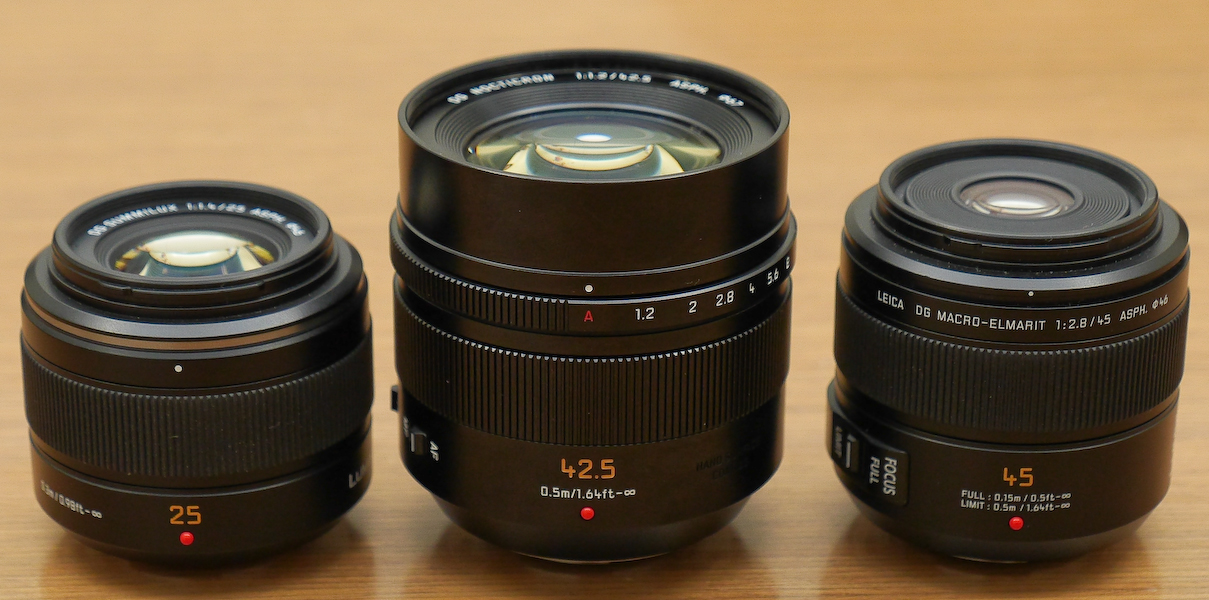
In less than one month the new Nocticron 42,mm f/1.2 lens will ship at Amazon (March 20) and BHphoto (mid March). And if you want to learn more about the lens DC.watch (google translation here) interviewed the team who designed the Panasonic Leica Nocticron lens. Focus is definitely on blur characteristics but there are also other interesting tidbits:
– Panasonic designed the lens and Leica approved it.
– If there is a demand Panasonic will do a Leica branded zoom lens too.
– During the development Panasonic also considered to make it faster (f/1.0) but the size was too big.
– Curiosity: When asked about a f/0.7 aperture Panasonic said that would be possible but very difficult to make
– If there is a demand for it Panasonic will make more lenses with aperture ring.
And Photoreview (Click here) tested the lens and writes:
For photographers who really need this performance level from a very fast lens that provides excellent depth-of-field control the asking price would probably justify the investment.
It is also among the most solidly built lenses available for the M4/3 system and comes with effective stabilisation, a pleasant-to-use aperture ring and a deep cylindrical lens hood made of sturdy metal. All contribute to making it decent value for your dollars.
111 Responses
I would like to see more lenses with an aperture ring, I would like more of my lenses to have one.
I think sooner or later they will update 25mm with apperture ring
and F1.2 (or F1.0, if it’s not too big)
I hope so. And I’d also like to see an X version of the 100-300. F4 would be nice. It will be large, yes, but still significantly smaller and lighter than a FF equivalent. Please Panasonic?
They should have persuaded Olympus to support the aperture ring right from the beginning when they designed the first lenses for FT, instead of giving it up for consumer grade lenses already back then. Now, with MFT, aperture rings still don’t work on Olympus bodies, and most MFT lenses don’t have one at all. Such a feature ought to be implemented more consistently than that…
ADMIN: Panasonic is “Nocticron”, not “Nokton” (=Voigtlander)
i would like to see Aperture Ring AND Distance scale for Manual Focus on the lenses.
Yes, Leica approved the receipt of Panasonic’s payment. But nonetheless, those Leica branded Panasonic lenses are excellent.
Just a matter of finding this lens at the best price – just an awesome lens – but price a bit steep – not really a super high price for FF users and Leica users but for MFT users a bit steep – if it was around $1000 or even $1200 I would have bought it already but I am waiting for now – hopefully it will come down to around $1000-1200 – a japan model at least
I think some are thinking that a MFT/M43 lens lets in less light as sensor is smaller – but that is not the case – yes shallow DOF is not the same as a FF – but light gathering is a true F1.2 –
as this is a longer focal length or 85mm it will give better shallow DOF then say M43 25mm F1.2
Just awesome to have this lens – I am very happy to see the new M43 lenses both from Olympus and Panasonic – just super glass and small ( in comparison with FF glass )
So please Panasonic, lower the price a bit – it is a bit out of reach for so many –
I agree Jón…the price is just to steep for “me” to justify for my extensive MFT kit, I have all of the best AF primes pretty much at this point…(I maintain a full FF kit as well). I kind of doubt that this lens will drop in price much anytime in the near future, if ever. It is a benchmark lens for the system.. I will just have to grab my 5dIII & 85mm f/1.2L when I need the bokeh of all bokehs (LOL!), and suffer with the size and weight. This P/L looks drool-worthy in its own right though!
What are you saying? You can buy 85mm F1.8 lenses for FF for 350 bucks. They have shallower depth of field and proper autofocus, too; and the larger sensor takes nicer pictures. Really, think this over before you throw away your money.
The fact is, FF lenses are CHEAPER – at least the equivalent ones.
Suckers here ignore it, but it is plain.
This is true but there are two compromises:
1. You’re right those lenses are a lot cheaper but still require adapters. If you get a good cheap adapter, then you loose AF vs a genuine m43 lens. But if you buy a Metabones with AF leads or a speed booster, then your still paying almost as much.
2. Lens performance is sketchy. I’m saying this from experience. It makes a world of difference when one buys lenses optimized for a specific camera system.
Yeah, and they are also much bigger and generally less sharp especially full open.
Who told you? Donald Duck? Or some internet “expert”? Thought so.
JGW: put FF lenses on FF cameras please. You will be amazed how a 28-85 3.5/5.6 zoom matches the size of a 14-150 F2.8, is way cheaper and takes better or equiv pictures.
Dude, instead of just trolling, just look at image quality of recent M43 camera’s and compare them to something recent and similarly prized from Nikon/Canon and you will see that it holds it own very well.
For example pick a d610 24-85 kit and compare it to a E-M1 12-40 kit.
Both cost about the same, and just like (almost?)all relatively cheap kit lenses from Nikon/Canon it’s very soft wide open. You can upscale E-M1 pictures to 24MP and have sharper results then the Nikon produces.
Not saying the D610 is a bad camera..it’s actually an very good camera(lens is not so good). But me personally would rather carry a light, fast and silent camera with small but excellent lenses with me then a big, heavy and loud(shutter!) one.
Not really man, not quite. Nikon 610 + cheapest zoom is neither much bigger nor much heavier then Oly “pro” cam and “pro” zoom, and optically close if not superior. And you can still upgrade to better lenses. It’s also fast and “pro” built – although there is no “pro” written on, regrettably.
Yes, the shutter is quieter…
Light, fast and silent? Have you tried Nikon 1?
Yes I tried Nikon1. Nice camera, maybe I’ll buy the water proof one some day. But as of now the system is doesn’t have the number of high quality lenses as m43 does, and as far as size/weight goes the Panasonic GM1 is smaller then every Nikon 1 system member.
As for size and weight comparison….
Olympus EM-1 + 12-40 F2.8 PRO = 824 grams
Nikon d610 + 24-85 3.5-4.5 VR = 1315 grams
With the above Olympus camers+lens combination you’ll have a camera which is lighter, smaller, has better image stabilization(higher sharp picture rate), faster AF, produces better IQ images, is completely weather sealed and frost capable, and has more modern functionality like WiFi(remote control with life view).
Nikon would be a little better with CAF(sports) but not by much. Nikon would have a slightly shallower DoF if that’s what you’ll want(on the wide end).
Of course you can put a better lens on the Nikon, but then it would be even more expensive and heavier.
Getting a little jealous are you?
We are all very jealous. The Nikon combo vomits on the Oly one on all accounts; it is a little heavier but it gathers (on average) twice the light (its aperture is bigger than 5.6). You are comparing apples and turds, but go on, don’t let us stop you.
Mark is going to buy a compact camera coz all the same crap applies, and he gets even more of all. Brilliant huh?
Taking a compact is better then leaving a humongous mirrored brick at home because it’s to big.
I feel sensors never take better pictures regardless of size. Photographers take better pictures. The concept that larger sensor = better images is purely a marketing gimmick from camera manufactures in my opinion.
But if your talking about raw IQ, sensor size is only one factor that determines high IQ. Other factors include pixel pitch, image processing, and how refined the image processor’s programming may be, and the design of the sensor itself. Size means nothing. Absolutely nothing.
For example:
Compare Sigma’s DP cameras with small Foveon sensors producing IQ identical to Nikon’s D700 because, according to Sigma, their proprietary image processing called the TRUE II(Three-layer Responsive Ultimate Engine II) can make better use of the light/data coming in.
Now their new DP line has a TRUE III processor that takes the same sensor, but now produces a 36MP full frame equivalent pictures.
http://www.mirrorlessrumors.com/updated-sigma-announced-the-new-sigma-dp-quattro
Second Example:
A professional photographer can show an APS-C sensor produces better sharpness and nearly identical DOF and bokeh to the Canon 5DMk3. In his own words:
“From a purely aesthetic point of view I would have no problem only using the Fuji X-E2 in the studio either with natural or studio lights. The results are virtually indistinguishable from a full frame camera and 16Mp is plenty for 95% of all real world applications.”
http://andrewvanbeek.com/fuji-x-lenses-and-full-frame/
Sensor size does not matter. Bigger sensors unfortunately do not take better pictures. Better photographers make better pictures in my opinion.
Many of your points are very valid, but then, we both know that they only tell part of the story, don’t we?
All other things being equal, a full frame sensor will allow for bigger enlargements, more detail at the same enlargement size — and, with most FF sensors — greater bit depth which equates to improved tonal gradation. Then there’s low noise performance and the ability to crop more aggressively…
Like I said, only a part of the story.
The current crop of M4/3 sensors are very good, no question about it, likely with IQ good enough for 80-90% of photographer’s needs (amateur OR professional), and offer their own advantages over FF. I would argue that the best of M4/3 sensors are fully comparable with APS-C sensors at equivalent megapixel counts.
But to arbitrarily write that sensor size doesn’t matter is patently false.
(btw: Good as the Fuji X-Trans sensors are in many respects, they come with their own set of issues…)
Well you’re absolutely correct, there is no such thing as a perfect camera and each camera system has their own set of issues. I sold my Sony A7 because my Olympus E-M5’s high ISO performed much better, to my dismay. However the A7’s ISO grain was more pleasing and uniform to me than my E-M5’s harsher high ISO. Yet seeing considerable grain at 1600 ISO is unacceptable to me. This has nothing to do with the sensors, but how sophisticated Sony’s Bionz X processor was compared to Olympus’ TruPic VI. Sony did quite poorly for full frame, at least to me.
My A7 also recorded more data in RAW photos than my E-M5 so I was able to get about one more uniform stop in HDR than my E-M5. This was negligible since I never have issues over exposing or under exposing my photos.
This is because sensor size does not matter at all in my experience. Megapixel count also matters little. How is it that Ansel Adams, one of most prolific photographers of all time, was able to make some the best photographs in the 1940’s with no Photoshop, no elaborate gear and 7 megapixel Canon camera? Because sensor size and megapixel count means nothing. Nothing at all. I’m sorry but it’s my personal belief that better photographers make better pictures, not bigger sensors.
Ansel used super huge sensors, 645 or bigger. Even better, he used super huge film.
It’s cool you construed this theory that sensor size does not matter: it’s exactly the opposite of mine, which comes from years of experience. Having said that, I believe those Sonys have quite a few bugs to fix. These bugs may have misled you into building up your theory.
Well your experience my be different than mine and that’s fine. But you are correct, even though you casually dismissed the A7’s poor performance as “bugs”, my experience with full frame cameras has certainly dismayed my opinion of full frame in general since I see no significant benefit over m43.
In fact I prefer not to loose all the benefits I have grown accustomed to using m43.
This is a load of bullshit I am afraid. You don’t know yourself, so you quote other people, who probably don’t know either.
Stop quoting other people and try it out for yourself, you will learn a thing or two.
Why should you trust anybody’s opinion on something you can easily see for yourself? Go out and try, and until then, keep it shut, and your wallet too 🙂
I’m not sure where you’re unjustified rage is coming from but in my experience with Canon, Sony, Olympus and Panasonic, these are the opinions I have developed based on my personal shooting style.
I have tried the following:
1. Canon 100D
2. Canon 5D Mark 1
3. Canon 5D Mark 2
4. Sony A7
5. Olympus E-M5
6. Panasonic GH3
I was kind enough to provide actual photos to show you what I was talking about. And based on my experience and shooting style I prefer the m43 system. I am not a sports photographer. If I was then I would require a 5DMk3 or the upcoming GH4. Quibbling about sensor size is an amateur argument because no real photographer equates better images to sensor size and megapixel count unfortunately. As I made mention before, how is it that Ansel Adams, one of most prolific photographers of all time, was able to make some the best photographs in the 1940’s with no Photoshop, no elaborate gear on a 7 megapixel Canon camera? Because sensor size and megapixel count means nothing. Nothing at all. I’m sorry but it’s my personal belief that better photographers make better pictures, not bigger sensors. That’s my opinion. Take it however you want.
As far as lenses go, it’s interesting to see things come full circle.
People are now calling for aperture rings and distance scales on electronic lenses.
Aside from mechanical manual focus, one of the biggest reasons I prefer manual lenses is that they have aperture rings. Using them is simple, direct and intuitive. It’ll be nice to see them reappear on electronic lenses.
I do like the aperture ring on the lens. I have an old 25mm/1.4 lens (4/3 version). I can change the aperture and speed shutter at the same time, even when I use GX1 (which have only 1 dial). really like it.
The only problem with the old 25mm/1.4 is “Focus speed”. Its image quality is amazing but Its AF speed is really badddd.
If Panasonic have a new 25mm F1.2 (or F1.0) with a great image quality, I will buy it for sure.
(or maybe 17.5mm F1.2)
actually the 42.5 Noct is almost identical in height ,weight and size with the F1.4/25 Leica D summilux,.
I’ll be the Nth person to chime in saying that I love aperture rings on my lenses. I won’t pretend that I’m particularly good with manual lenses, but I enjoy using them. In fact, I just realized that of the 4-5 lenses I use on a regular basis, only 1 has a auto-focus! (And it’s mediocre AF at that, being the otherwise superb 20mm/1.7, haha)
Why do the apertures open and close all the time on the m4/3 lenses while focusing?
live view
Why your pupils dilate and contract under changing light?
To me, aperture rings are an outdated remnant of the past. Not very useful, not very ergonomic, especially if a lot of lenses you use, don’t have them. I have no idea why Panasonic came up with this, as all its other lenses don’t have aperture rings.
Aperture rings distract from composition, because instead of holding your lens steady with your left hand (perhaps at most having adjusted zoom), they now have to poke around and deal with aperture adjustment as well. It is a lot easier to use just your right thumb or index finger with a wheel on the right side of your camera. You can do that blindly while looking through the finder and just keep your equipment steady with your left hand.
So, please, no more lenses with aperture rings. We now have electronic contacts and aperture can be controlled by other means!
“Aperture rings distract from composition”
I have to tell you that I really disagree with your comment. Do you have the same problem when using zoom the zoom lens or manual focus ring? If not,why you have the problem with just an aperture ring. For me, I always instantly choose the aperture I want when I see the subject and before I lift the camera up to the position I see the LCD or EVF for do the composition. Although I want to change the aperture later, it’s not a big deal. I can do it without the problem (distract from composition)
If you really have that problem when shooting, it’s because your lack of experience.
PS.I do like the aperture ring on the lens. I have an old 25mm/1.4 lens (4/3 version). I can change the aperture and speed shutter at the same time, even when I use GX1 (which have only 1 dial). really like it.
Lack of experience? You don’t know me. I do photography since 1978. My Canon FD lenses all had aperture rings. And based on THAT experience, I tell you, that aperture rings are anachronistic and more modern designs to change aperture are more ergonomic. The worst thing is – and that is what Panasonic does – to have lenses with and without aperture rings arbitrarily in the same lens system.
I prefer aperture rings with digital option personally. It essentially frees up one of the dials for ISO, WB, or exposure comp. so one of your dials aren’t used up for aperture control.
My only experience with one is my m43 Voigtlander 25mm f/0.95. I suppose I really like it because it’s the only lens I have that has an aperture ring. I’m definitely getting the 42.5mm f/1.2 with autofocus.
Agreed.
Aperture rings should stay on lens barrels where God intended them to be.
if you said that you do photography since 1978, but you still have the problem with that problem. It means that you’ve learn nothing from those years of experience.
For your information. If you don’t want to use the aperture ring on the lens, you can use the dial to change the aperture value instead. And Fuji also has the aperture rings on their lenses.
I think you can set the aperture ring to to work without using the aperture ring. In other words, this aperture ring use is not required to change aperture.
yeah. I really don’t know why he has the problem with the aperture ring on the lens.
The Panasonic lens looks stunning in it’s quality. Lightening fast auto focus in this category and the first world class f1.2 prime with image stabilization.
I can’t wait to get this 42.5mm 1.2 image stabilized prime with super fast auto focus on the new Panasonic GH4 shooting 4k and 96fps. There’s no other system like it in this price range.
Not that it matters one bit with regards to quality, which sounds very high regardless, but Leica’s involvement was “approving” and not designing the lens? A straight up licensing deal, albeit, attaching a “trademark of quality” brand to a high quality product. But I can’t but feel a little nostalgically sad that Leica wasn’t actually involved somehow… Looking forward to shooting with this lens none-the-less
The “approving” process depended on how much Panasonic was prepared to pay.
I was just reading the review of the Photoreview site and i was really suprised when i read the following lines:
” You might think an f/1.2 maximum aperture is fast – and it is on a
camera with a 36 x 24 mm sensor. However, on a M4/3 camera, the crop
factor of 2x causes the focal length to be equivalent to 85mm in 35mm
format, while the maximum aperture admits as much light as an f/2.4
setting on the ‘full frame’ camera. It’s still pretty fast, although not
as fast as the impression created by the specifications.”
Wow! Notice the comment about the light capabilities of the lens in comparison with FF? What’s wrong with these people? Am i supposed to trust any of their reviews?
It is correct to compare a 25mm F1.2 lens for M43 to a 50mm F2.8 lens for 135: they have the same field of view and depth of field, so they produce the same image. The 135 system can be easily set to higher ISO than M43 without the image falling apart.
For example, F2.8 zooms for M43, which are extra expensive, compare to cheap 5.6 zooms for 135. These comparisons make many M43 lenses look overpriced.
However, a smaller sensor still has its cards to play:
1) if the lens + body is really tiny
2) with long teles (where a super shallow DOF is not required, which is often, and the subject is slow, coz M43 cannot focus like DSLRs yet)
3) with macro lenses (same as long teles, minus the focus problem)
There are no payable long teles or 90-100 mm macro lenses in the M43 lineup, as far as I know.
In general, I would look at Canon or Nikon for serious as well as small cameras. The Nikon 1 is terrific and really small, minus dumb usability.
A 42.5mm f1.2 lens has the same characteristics regardless of the system. It’s not like a 2.4 anything. The Panasonic has similar background blur and light gathering to the Canon 50mm 1.2.
You don’t say the Canon 50mm 1.2 has a 2.1x “crop factor” compared to Medium Format do you?
Compared to Medium Format the Canon 50mm f1.2 is a 105mm f2.5. Does that mean it’s really like a f2.5 lens?
You can calculate the potential to blur the background by dividing the focal length by the aperture. So the Canon 50mm 1.2 would be 41.6 and the Panasonic 42.5mm 1.2 would be 35.4. For practical purposes that’s going to be pretty close.
The Canon 85mm 1.2 comes in at 70.8 but beyond a certain point there’s not a huge practical difference between any of these super fast lenses. Not a lot of portraits and even less video is shot at 85mm 1.2 wide open.
I can’t wait to get this 42.5mm 1.2 image stabilized prime with super fast auto focus on the new Panasonic GH4 shooting 4k and 96fps. The Canon 50mm 1.2 is a dinosaur by comparison.
It’s not the same picture, as exposure is different. If ISO 800 were chosen on the m43 camera you would need to use ISO 3200 on FF. 1.2 stays 1.2 regardless of the system (shutter speeds are equal). It’s right, however, that you have the possibility to change ISO more easily on FF cameras but that, too, comes with increased noise at higher ISO values.
The good zooms on m43 are not expensive when compared to equivalent 2.8 zooms on FF, they are small and lightweight (compared to FF), too.
I didn’t see a FF 2.8 lens focusing to 25cm at all focal lengths, being lightweight and very sharp across the frame, freeze- and waterproof like the 12-40.
I want FF for shallow depth of field and more dynamic range. MFT offers great portability and more than good enough image quality for 90% of my shooting. The new Pana lens gives us a great additional option. We don’t need to buy or use it. But people always complain: if there weren’t a lens like this they would argue (m43 is crippled, doesn’t provide options …) and if there is they are not satisfied, too (too large, too expensive…).
HF, read it again, it’s spot on: ISO 800 on a M43 is no better than ISO 3200 on 135 – yes, even Canon, I am afraid DXO is a load of bullshit.
And yes, those 2.8 zooms for M43 are way overpriced. Let alone that they break LOL.
“bdale”: if you want to make any sense with your “blur ratio”, you must account for the sensor size. Otherwise, it’s just the usual forum drivel man. And yes, one could say that a 1.2/50 lens behaves like a 2.4/100 on MF. There is nothing wrong with it, people do it sometimes. Good luck with your 2.4/85 at that crazy price! And it’s not even small, LOL.
“ISO 800 on a M43 is no better than ISO 3200 on 135” >> JOKE OF THE DAY…. hahahaha…
I know, I know, you have a mirrored brick… And feel the need to justify it with this equivalence bullshit again…
Just try and see for yourself, you gadget imbecile
EM5 iso 800 vs 5D2 iso 3200….
http://www.imaging-resource.com/IMCOMP/COMPS01.HTM
don’t forget to share your findings… moron…!
The Canon is better, what a surprise. Are you going to be fired now?
The E-M5 clearly has better ISO performance. But the 5DMk2 has a more uniform grain. Almost film-ish.
?? Don’t know what you really mean. I didn’t say ISO 800 on m43 is better than 3200 on FF. I have both and can say both are really close when shot at those settings. I just referred to your comparison which is not exact. If you compare, be more specific otherwise comparisons make no sense and people don’t know what you really mean. Why all the rant to DxO? They test scientifically and give the best possible performance of a sensor (neglecting the real life issues and lenses) or optical benches for lenses. That’s a valid thing. Sensorgen does similar things and provides similar findings.
As to the zooms: So far there is 2 in 10000 which broke (or people claim to broke, no offence here, maybe it’s true)? Let’s wait for better statistics, first. They are not over prized, as I don’t know any FF equivalents providing similar parameters for less money. If its DOF you are referring to, I don’t care, I want a 2.8 light gathering capability and small minimum focus distance.
Stop right there HF, you are hopeless. Physics will take her revenge on you, with crappy cameras and pictures and an empty wallet. Enjoy.
LOL. A very thoughtful and substantial comment.
Please give us 17mm 1.4 or 1.2 or even 20mm 1.4 would be nice but all these with an aperture ring included. I really love my college’s Fuji 23mm 1.4 …
Every lens should have aperture control ring. Set aperture where aperture located. Also free up dial on body for other use. No aperture dial on lens only because easy and cheap for manufacturer.
Amen
I’d also like to see the shutter speed dial on the lens mount collar, as it was with the OM-series of film camera bodies. It was fast and efficient there.
Sounds like a great idea. And since the ring is bigger you can use 1/3 stop increments instead of the full stops.
Panasonic refuses to add Ibis to it’s camera’s. Why it does not give us more OIS primes like the 25mm?
Panasonic is adding ibis now.
In the GX7 yes, but it does not work for where it is really needed : for Video. I hope they will add it in the G7 and that it works for video. I no need 4k like in the GH4 but I really like IBIS. And I never record longer clips then 1 minute, so if heat is a problem, limit the IBIS to just a shorter recording time.
Why are you placing hopes in G7. Doesn’t Olympus EM offers what you just asked for?
I need 25p and 50p, olympus only has 30p. This because I have other cameras that use 25p already, I do not want to mix it with 30p. For 3 years I am hoping that Panasonic is coming with video IBIS or Olympus is coming with other frame rates, but every time I am disappointed. I have the Pana 20mm and oly 45mm lens, especially the 45mm is useless for handheld video and the 20mm difficult. Even with my oly 9-18 lens I wished it was stabilized by IBIS.
I hope you can realize now that high-end video capabilities don’t mix well with IBIS. It’s all about compromise. Want the badly hyped IBIS? Get Olympus.
If Olympus can make 30p it should be easy to implement 25p. I no need 4k and I think most people will not need it. My computer has already a hard time with Full-HD, and my harddisks fill up fast with HD clips and it already takes a long time to copy and backup it all.
Why is it not possible? A good engineer will find a solution.
To me, “hand held video” and “very specific needs” is a weird sounding combination, I have to admit.
m43 is about having a small system. Why buy a m43 camera and then add a heavy tripod or external stabelizer system for which you need a car to transport it. With IBIS handheld video is very well possible.
Is 25p a very specific need? It is a very basic need and olympus is very silly not adding it this simplest of features.
m43 can be used in a small package, which is not to say it is all about that. It isn’t. One would be hard pressed to explain anything bigger than GM1. I am not thinking about GH4, but AG AF… But most importantly, lets not make it a slippery slope: no one is telling you that you should bloat a rig to look like some sort of Robo Cop surrounded by an army of projectors 😉
Pushing the minimalism envelope, you can use just the camera hand held, including the built in sound, not even an external microphone… This is fine for casual clips at parties or bootlegs, etc. As I say, I just have a hard time figuring any key situation where 25p in a minimalistic uncontrolled environment makes a world of difference.
In Europe and Asia (except Japan) I can only buy Panasonic camera’s with 25p. If I want to make a video with both Panasonic and Olympus cameras I have to mix 25p and 30p. I have a few terabyte of 25p video clips, I no want to mix it with 30p.
I am not a professional, I do it for hobby. I think the Panasonic GH line is now kidnapped by professionals who want a cheap professional camera.
I am a traveler with just a small bag, that cannot take all the stuff for professional video. I want a small camera with built in IBIS, i do not want anything complicated. And such a camera is easy to built in 2014.
Tell me a good reason why Olympus does not give the option of 25p, which is the easiest feature to built in a camera.
And Panasonic refuses IBIS because it wants to protect its OIS lens sales.
maybe because you link handheld with amatuer style?
i think its more about how to use it rather then to define it non high end or not. Like videographers who are able to make great footage with e-m5 despite its limitations in framerate setings. You might be suffering from staring at specs only rather then trying to use if less works too.
The 45mm works quite well for me in handheld videomode. for handheld model videographing clipstyle I use the same technique as in “the undiscovered country” scene where Spock is about to interrogate a fellow Vulcan crewmember. Very effective and subtle .
To get the video performance of a GH camera the sensor needs sufficient heat dissipation. That’s not possible on when it’s put on an IBIS.
I need GH2 or even better G6 video performance, no need 4k and GH4. Sony A77 is a 3 year old model that has IBIS and 1080/60p and a bigger sensor. So why is Panasonic and olympus not capable of doing it?
>”…considered to make it faster (f/1.0) but the size was too big.”
I’d imagine that the size of something in the 30-35mm range wouldn’t be too much bigger. And I would’ve actually considered buying one even at $1,600 since there’s no similar Voigtlander lens (or native m4/3 lens, for that matter) in that focal range.
The Ibelux 40mm f/0.75 is quite longer, maybe also due to the choice of glass design?
The Photoreview article shows that this lens was sharper on the OM-5 than the GX7. Why would that be?
Plus, despite saying that in-camera correction was turned off, CA measurements were in favor of the GX7, especially at f/1.2. Odd.
Put the price down to a reasonable level and you will really find out if there is a demand for this lens, Panasonic. Fuji can do theirs for $999. You are profiteering, pure and simple. I hope sales are awful.
Unfortunately there is no such thing as a hyper prime, with autofocus, with stabilization, with premium build materials anywhere on earth that’s cheaper than $1,400.00
Compare this to Canon’s EF-L 50mm 1.2 at $1,600.00 and the Panny/Leica still looks (kinda) reasonable, still cheaper and is not made of plastic.
Compare this to the Fuji 56mm f/1.2 you mentioned, made a few compromises to get the price down. The Fuji glass still doesn’t perform as sharp as the Panny/Leica, it doesn’t have a premium all metal build, image stabilization, and according to Will Crockett, is a pain to use in real world applications because it’s AF is not as fast or accurate as most premium m43 lenses.
Unfortunately a premium lens with all the bells and whistles will inevitably have a premium asking price. It sucks but this is actually a middle-of-the-road asking price. I say just wait about 8 months until someone sells it used on eBay or Amazon.
Well said JGW. Everyone wants a $1600 lens for $1000, but actually all they will get is a $1000 lens. Like the Fuji for example.
You summed it up brilliantly.
The trouble is, you need something in the Canon 1.2/50 price range to match a 2.4/85, which costs a fraction. This is where M43 makes no sense.
While photogs won’t touch this with a bargepole, metrosexual nerds might buy this stuff if they think it is cool enough. My question is, how are they going to make it cool?
Good point. However I’m not sure any generic Canon 85mm f/2.4 will match the build quality, image quality or AF speed of the Panny/Leica 42.5mm f/1.2. I don’t know for sure, but based on the sample pictures taken, it’s a much sweeter shooter, smoother unique signiature bokeh, less light falloff, sharper image across the frame at f/1.2, significantly less vignetting, better correction of barrel distortion…all of which are problems that plague FF cameras/lenses.
But at the core what we are really talking about is f/1.2. Any lens with this insane an F-stop is going to be very expensive. So to be fair, a hypothetical Canon EF-L 85mm f/1.2 would still be (I’m guessing, nothing factual) $1,600.00 or more. And that Canon would still be made of high quality plastic. This is where m43 makes sense. Premium build, blazing fast AF, image stabilization, hyper prime F-stop, less than half the size and it’s all still a few hundred less than a less-than-comprable full frame lens.
The 85 is way more than 1600, and you are right: superfast lenses are always expensive. They are absurdly expensive, and often optically compromised; and this is where the small sensor has its main weakness: “want OOF? Pay extra. But surely, you can’t charge that much with that crippled sensor… Yes I can, it’s PRO”. So the purchase argument must be something else than optics; a hip factor springs to mind, but I can’t see any traces of it.
I did not know that 35mm lenses are plagued by problems, it’s funny I never noticed after so many years. Another lie to try and sell the unsellable? 🙂
Well I’m only speaking from my experience. And after my last sour experience of my most recent full frame purchase I think I’ll stick with m43 for quite some time.
If you think small sensors are some how “crippled” then perhaps you should stick with medium format. But in my view, arguing that sensor size = better images is false and purely a marketing gimmick to get non-professional consumers to buy cameras. Better photographers make better images, not bigger sensors.
Just ask yourself, how is it that Ansel Adams took some of the greatest photographs in the 1940’s with minimal gear and a 7 megapixel camera (later he used a 12 megapixel)? We have over 60 years of improvements where I think it’s safe to assume most bridge cameras are more advanced than Ansel Adam’s Canon. Therefore, the potential is there for anyone to make the same prolific photographs with the m43 system with the myriad of high quality lenses available to m43 users. Especially the Panny/Leica 42.5mm f/1.2.
That’s because, based on my experience and opinion, sensor size and megapixel count means nothing. Absolutely nada. Better photographers make better images, not bigger sensors.
I’d like to see some comparisons before jumping to conclusions. The FujiFilm combination might not be all that expensive for the image quality, but is the image quality better or vice versa?
Maybe the cost is $999 for the lens and $600 for the Leica name. 😉 That seems about right.
Relative to Fuji, it sounds pricey. But next to Canon, it looks like a bargain. And the little Oly looks like a steal.
The price will drop, eventually. I’m curious to see how the rendering and bokeh compare to the Voigtlander. Having used and loved the Canon 85 1.2, I’ve got serious lust for the Panny in spite of the price. Maybe even partially because of it. Creating that kind of exclusivity is a marketing move. Focusing on the very high end might be a profitable way to go. It seems to be working for Oly and the EM1.
That Photo Review article on the Noct has some curious factual errors that undermines one’s faith in their findings.
This comment curiously omits any examples of factual errors in the article. No reason to abandon faith for heretical murmurings…
They claim that f/1.2 on m43 gathers the same amount of light as 2.4 on FF.
I find it hilarious that reviewers are now using the DoF argument for equivalence letting people know that an f1.2 lens behaves like an F2.4 lens on FF… What they always fail to mention is with that you have an expensive FF camera whose sensor behaves like a $400 E-PM2.
this dof equivalence is important for those who shoot wideopen most of the time. If you worked with 24×36 then you can decide if 2.4 is still acceptable the way it renders oof or not in 85 mm. I think many will agree that its still enough.
Watch closely for new product introductions from Panasonic. Panasonic invited a few of us photo retailers for a special preview and high level meeting in Los Angeles for the next two days. Look for additional posts from this meeting in the next few days.
That’s what I’ve been waiting for.
If you really want more control of DOF, it would be wiser to just go full frame. Get a Sony a7 and vintage 85mm prime and eat your heart out for less than the price of this. This is alot of money to pay for a limited small sensor system.
This 42.5/1.2 is indeed expensive but reasonable compared to other similarly fast lenses. If I were to get one, it would be for its brightness/speed. Nailing focus with an FF 85/1.2 would be a PITA in the same dim situation where I’d use this 42/1.2 at it’s widest aperture.
this is true, I shot with both nikkor 85 f/1.4 & Canon L 85 f/1.2 in the past. While the Canon is the ultimate OOF renderer it nails focus not as effective as MFT lenses do. The Nikkor was a huge disappointment in this regard, but could prob also been caused by front or back focus issue of the pdaf system used.
As a user who would shot in house video with m43 system (GH3) for promo and interview, beside the advantage of GH2/3 superior video engine over other system in similar price point, and lighter gear allow lighter setup for Steadicam (think 2 pounds of gear + 2 pounds of counter weight, instead of possibility 4+4 pounds on FF), the DOF in M43 system for me, hit the sweet spot for video, it could shallow enough to make a difference in visual, but not too shallow that the subject need to be absolute stay still to prevent out of focus.
Just recently I did a interview shot, A cam for medium shot and B cam for close up. B cam was using a Olympus 45mm F1.8 at the subject 45 degree. At F1.8 (F3.6 at FF), her left eye is in focus but the right eye is already a bit out of focus.
Or in another shot I have to take a close up of 4 name cards on the table. I’ve to close the aperture to F6 to get enough DOF. Also, imagine the light require for F12 in FF.
Very good comment! I fully agree with you, choose your gear for the type of work you’re making. Sadly most consumers don’t get that. Shallow DOF has never been a selling point for M43, due to the law of physics. But instead of seeing that as a con, one could turn that around and find a use for it, like you did sir.
Actually, shallow DOF can achieved very nicely using M43. For example, Shane Carruth used a GH2 to shoot all of the Upstream Colour movie, which relies heavily on very shallow DOF to engage the audience with the 2 main characters. I doubt Shane has the metaphysical powers required to bend the laws of physics.
Of course it is achiveable. But you cannot deny the fact that with a larger sensor you will have more control over DOF. The point i’m making here isn’t about whether shallow DOF is good or bad. What I’m saying is know the capability of your gear, and those apparent cons of your gear may not seems so much as cons once you know how to turn them around for your own gain. And best of all work around them like who you mentioned, Shane Carruth.
he just knows to choose the right FL to get the right cinematic feeling imo, has little to do with phyics 🙂
Slightly disappointed that the bokeh from the Nocticron can’t really match M.ZuikoDigital ED 75mm F1.8 .
Still waiting for official price before considering to get it .
the 75mm’s advantage is the stronger tele lenght. 42.5 is still practical for indoor scenarios while 75 is not. And watch your “wanna buy list”…its getting tooo long I am afraid.