









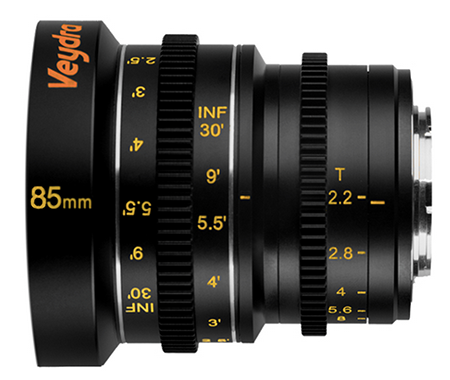
Veydra announced the new 85mm T/2.2 MFT Cine lens. This is the official description text from Vedyra:
The Veydra Mini Prime 85mm T2.2 is a telephoto focal length for Micro 4/3 cameras. Equivalent to the field of view for a 170mm lens in Full Frame 35mm stills format, this lens is perfect for detail, portrait and longer shots where a tight field of view is required.
Purpose built for cinema acquisition applications, all Veydra lenses feature constant volume focus, 0.8 cinema pitch gears on the iris/focus rings, constant T-Stop, and common front diameter for quick lens changes in a production environment.
All Veydra lenses exceed 4K resolution and are constructed of the finest grade aluminum and optical glass elements with multi-coating for color consistency.
Veydra lenses are designed with quality and value in mind. All Veydra products are priced at the absolute minimum retail price to help you achieve your creative vision.
This is already their sixth(!) MFT Cine lens and most of them will ship soon. Check out their shopping site at veydra.com/product-category/optics/
–
found via Newsshooter.
89 Responses
900 bucks seems like a lot. But video guys have to pay a lot for their stuff.
No, we don’t! We can successfully use photographic lenses for the job.
Sure you can, but using photography objectives without focus and aperture rings, identical sizes, ring notch pitch, and even focus distance scale it isn’t so easy. Go and try to do movie with focus by wire objective instead with cinema objective and you know quickly why there are different objective lines for cinema use.
The price is high but actually competitive with the Oly 75mm.
I’m still not convinced how useful these primes are without stabilisation.
With cinema objectives you don’t use any stabilization as you have steadycam or other rig to do whole stabilization for you.
get a e-m5 mark2 instead of a gh-4 and every lens is stabilised.
9 times out of 10 a videographer would be using a tripod or some sort of rig.
Or a steadicam rig
I guess that would be some sort of rig…
Veydra lenses are a relative bargin compared to other cine primes. They appear to offer a lot of bang for buck.
JB
Do you know the lenses from Samyang? They are much cheaper and very good, too!
Agree, + man can use a Speed Booster on them too.
http://www.ukdigital.co.uk/samyang-vdslr-set1-micro-four-thirds-mft-mount.html
Yes, there are those. But do you notice anything between those?
Samyang objectives are different sizes, you need to twiddle with rig to get them mounted correctly.
Different m4/3 cinematographers have different needs, so some gets Samyang, some get Zeiss and some get new Veydra.
The issue with Samyang lenses is that they are designed for 135 35mm cameras.
MFT sensors are smaller, so the lens image circle isn’t optimised for the sensor size you’re using.
It also makes it harder to get wider lenses like the Veydra 12mm T2.2 when you’r dumb adapting a 135 lens.
JB
John,
Have you ever used any of these lenses before, or used a beta version of the 12mm prime? What’s your initial take on the quality of these lenses, the bokeh they produce, and their accuracy?
Thank you.
I’d love to try them, but haven’t yet. I wasn’t brave enough to back the kickstarter, but I think they are very promising.
JB
Thanks for your input. I agree with their potential but I’d like to see some screen grabs directly from the video files (along with reviews later in the year) instead of the Vimeo compressed video, although that doesn’t look half bad either.
I haven’t used them, but i really like the idea of them…namely m4/3 specific primes, rather than 135 35mm format lenses simply adapted to m/43 mount.
The only thing that worried me was that there are no lines on the distance markings on the lens, but they tell me that’s what the silver line is for, so you can make your own.
Bargain for flash pan money men like you brawley maybe……
Guess what..
I rent most of the lenses I use in cinema applications because I can’t afford 250K for a set of master primes.
I can afford a set of Veydra primes though and that’s maybe what you’re not understanding…
JB
Those distance markers are absolute rubbish.
If you’re going to claim to make a cine lens at least look at the design of a few proper ones first.
Instead of making the lenses shimmable, which adds to the cost, they made the focus ring adjustable. I haven’t tested them yet,. but you should be able to get the witness marks fairly accurate. The fine silver line on the lens is designed for you to put your own witness marks on so you can make them accurate yourself.
JB
All the designs, from 12 to 85mm share the same housing. I wonder what implications this uniformity has in terms of optical quality.
None. When you are not limited by size, like m4/3 objectives are usually (= people whine if the objective isn’t smallest and lightest as possible) then you can make bigger ones little easier.
The most important thing in cinematography is that you have objectives that you can easily swap without requiring to change any other rig part or setting. That focus and aperture changes with same distance etc.
LOL, If you normally use video lenses with follow focus and everything, the whole system is big, several cm and grams in plus dos not make any difference, only the extra cost does!
When you have the focus rings at different position, different sizes and have different pitch, then you start having problems.
I didn’t say that cinema objectives problem is weight, but that many m4/3 user whine if they even see a objective that is bigger or heavier than their Panasonic 20mm. They just start screaming “m4/3 is about small size and weight!!”.
Also is a drama when a lens costs more than 299 euros/dollars! 🙂
And if it’s manual, let the had wringing and crying begin!
If you think those lenses are so cheep, buy them all. 🙂
If you look at other manufactures you’ll see, that all m4/3 lenses are very expensive in comparison. What makes a lens more expensive is the amount of glass or the greed of the company.
Really? Maybe you should break out your calculator and start adding up some cine primes 😉
For what? I have all the lenses I need, most of them from F mount adapted with SB.
Those lenses are way to expensive for what they offer. F/2 for almost 1000$… what a joke.
Yes I forget, m43’s users are generally idiots. ‘I don’t need it nor understand it therefore it’s no good’. The joke is you.
I should mention that some of us here left Canon because we had enough 720p video resolution and low DR. Canon evolved in a big joke regarding video.
Your trolling is obvious….Viezuvure I guess :).
What has Canon got to do with anything?
Well, I buy what I need first, and then if I’m curious about something, knowing that I can still selling it back to someone.
I really doubt it’s so simple to determine the cost of a lens, as you point out.
I would consider the quality of glass, the build quality, the image quality delivered, the R&D costs, the place from where the company takes components, the place where the lens is built, how much it’s distribuited, the initial higher price for early adopters.
And I don’t mention the Company’s decisions taken by sell departments.
As my boss says: “you can’t spill out blood from a wall” 🙂 Everything has a cost, but usually you can’t have everything for free: if it costs less there’s usually a good reason for that. Or two.
Me, nor you, can’t say anything about these cine lenses yet. I can already tell you that I won’t buy them nor try them, because I’m not interested in video making.
But: is it that bad to have another choice? Or are people really wishing for a Communist era of photography, where everyone must use the same camera and lenses?!
Well, you are right it’s good to have options from where to choose and agree that there are many other cost factors in making a lens besides glass, but generally the most expensive part of a lens are the optics.
It’s a known fact that a good FF lens is harder to make than a APSC or m43 equivalent. It’s harder to make big glass pure, that’s way MF lenses have lower resolution than FF equivalence and so on.
Those primes are as hard to make as an f4 FF lens. Manufactures tray to milk us premium for a steeples aperture and a manual focus ring with tooth.
I have nothing against them, they cam make anything and try to sell it as high as they like and I also have the right to express my opinions about them.
I think it’s not a rule that a FF lens is harder to make than a m43 lens, considering the pixel density of m43 sensors.
While it’s easier to produce a longer focal prime, in m43 it’s harder to make a super wide.
If someone can show it with some technical data I would be grateful.
There are several articles on this theme, tray a goggle search for the answer.
In short, the bigger the glass element is the harder to make it pure will be.
That’s why it’s so cheep to produce good f/2 lenses for smart phones, the optic element is small.
I forgot: stating that a Samyang lens is better than this, without having tested the Veydra, is not a good, serious opinion.
You are of course free to write what you want, but don’t expect to be taken seriously. Chances are that you are labeled like a troll who simply bashes a product without reason..
For example, you could have written that the Samyang lenses have a better price, and someone could only have replied that perhaps the Veydra higher price reflects also its better quality. Something nobody here can know yet. 😉
I assume a f/1,4 lens stopped down at f2 is sharper than a native f2 lens. But as you say, I may be wrong. 🙂
I don’t think it’s a rule either. Just an example: my NoktoR 50mm f0.95 sucks at f0.95. Stop it down to f1.4 and things go better. Compare it to my NoktoN 50mm f1.5 M mount. This latter rocks at f1.5.
I can tell you that my MZuiko12mm realy shines at its native f2.0.
And that my Voigtländer 17.5mm f0.95mm puts my MZuiko17mm f1.8 to shame at each aperture (fairly comparing the two at f1.8)
Last Friday I was at my fav local shop, asking for the Em5II and killing some time with friends photogs. I told the owner of the shop that one of my friends was not that happy of the Samyang fisheye she bought, and he simply replied that you get what you pay for.
This does not means at all that Samyang is not a good Company (the new 85mm is really good in my opinion), but for sure it has not been a good Company with that product for my friend.
A good example. My statement may be a bit harsh, but I still think they are way to expensive especially for f/2 lenses. I hope I’m wrong and they have stellar optics etc. We shall wait and see.
In my opinion this format needs better priced optics to attract new users.
That’s true: while I understand the price of new cameras (great quality and new tech), I think that some primes are a little bit pricey (MZuiko25mm is not worth its cost in my opinion)
You see, our opinions collide in the end.
I do a lot of video and I’m not so interested in native m4/3 lenses but I do own several Panasonic pro lenses with AF for taking stills.
Both Nikon and Canon have a couple of very affordable lenses like the 50mm f/1,8, a basic kit lens or something under 100$. I’m not personality interested in those kind of lenses but newcomers maybe.
It’s possible we will see such low cost lenses form Kodak (a Chinese enterprise who bought the name and produces m4/3 cameras). A couple of weeks ago I saw a deal on Amazon: a Kodak with two lenses for 300+$. A very good price indeed.
Let’s wait a year or two and 25mm (349€) is like 45mm is now (149€), as it gets lots of sales like the 45mm does as well. Like how many remembers the price of the 45mm at the time it was released? 399€.
So if the 25mm continues to be so successful, its price will drop below 300€ fairly soon.
You mean the Samyang 7.5mm f/3.5 Fisheye objective?
That is the best fisheye you can buy as it doesn’t have any distortions (Coma, Chroma etc). Only “flaws” in it are that it is f/3.5 instead f/2.8 or lower, it is manual focus only (and no digital pins to write EXIF data about focal length and aperture) and it is so small that you forget it around places.
http://www.lenstip.com/317.7-Lens_review-Samyang_7.5_mm_f_3.5_UMC_Fish-eye_MFT_Coma__astigmatism_and_bokeh.html
Would I buy other Samyang objectices? Not without testing. That fisheye I bought blindly for price and features as I needed those on that day. And I am happy how blind bought can turn out to be so great.
Of course if your friend has another Samyang objectives, it doesn’t make that m4/3 one other than best ones 😉
High level for Olympus to beat it.
Way too expensive. And only f2.2? Seriously, get the Samyang 85/1.4 for a fraction of that money…
T2.2, not f/2.2
More likely it means it is f/2 as it is T2.2.
And Samyang doesn’t have focus and iris rings with correct pitch like these do.
What is the problem when some photographers doesn’t get that there are cinematographers who need own kind objectives instead photography objectives?
Samyang also produces video lenses at very good prices. We are not stupid in paying more for less, you know…
You don’t get same features with Samyang, you would know it if you would not be stupid.
For your needs Samyang fits probably very well, but for someone else Vyadra fits far better. And they are ready to pay.
I think you should watch you language please, I don’t recall insulting you or anything.
I have very high doubts that those Vyadra are better than Samyang lenses.
What does the T (instead of an f/X) refer to ?
http://en.wikipedia.org/wiki/F-number#T-stop
I love it thaty they are making video lenses that are all the same.
I can imagine this unified aproach will be most welcome to video guys.
Prices aren’t that high. Its not like you need toupgrade these to inslode a new feature any time soon for video.
No thanks……chinese quality…..LOL
$900 for poor chinese crap
Strangely on kickstarter cinema users fell over themselves to buy a whole set of them for themselves..
They are cheap for what they are…cinema primes optimised for a m4/3 sensor.
JB
How are they “optimised”?
They are designed to project an image circle for m4/3.
As far as I know, they are the ONLY cine lenses that are designed to work with m4/3. Others such as the Samyangs or the Zeiss CP2’s which do have m4/3 mounts, are 135 35mm format lenses.
The samyangs for example are designed to project a 135 35mm image circle. That means the heck of a lot of extra light bouncing around in the gate of the camera which reduced contrast and cause additional flare (especially on the m4/3 pocket camera)
This means they can make a more telecentric lens design as well, and makes it easer for the lens maker to correct because they’re on’t covering a smaller image size.
JB
Great explanation, thank you.
Although i haven’t noticed much issue with my adapted lenses i’m using via adapter (they are few CZ EF mount lenses). Maybe more controlled test is neded.
At a guess I would say image circle and mount. 🙂
The are cheap for what they are, but the Rokinons are cheaper and sharper. Who wants cheap, anyway? Good for a backup set maybe….
they are cheap compared to any other cine lens that covers their focal length and features…
Go price a set of Zeiss CP2s….
JB
I don’t need to price them; I know how much lenses cost and, generally speaking, they are all relatively inexpensive compared to the overall budget. That’s right, they are all, for the most part, relatively cheap. And, frankly, anyone who is looking to save a few dollars at the expense of IQ is looking at it the wrong way. If the money is an issue, then one has to seriously come to grips with the fact that fundraising skills are one the basic skills.
When I buy something, (or rent) one of the factors is repair turnaround, spare parts, track record under all conditions and of of course the look and feel. So for me, the lens lottery is not an option–but I hope everyone who bought a ticket wins something valuable. Hopefully, they won’t use the same approach to the rest of their movie.
And under no conditions would I buy a lens that is soft wide open. Got too many of those, and ppl have figured out how to make them sharp.
Ty NO. If i want some manual focus action i will get used like new Zeiss Macro-Planar 100 f2, and get some stunning photos with it for the same money, or even less expensive Zuiko 90 f2, which is also a fantastic lens.
‘get some stunning photos’ – you understand these are cine lenses right?
Oh yea, just click that record button and get some stunning video, w/e.
Yep, that’s all it takes 😉
You understand that photos are routinely taken from 4K video, right?
Which doesn’t have a 300 degree focus ring, nor do they even have a follow focus gear, and will be enormous in size compared to this.
JB
I heard, not so expensive Cine conversion can be made to Zeiss. Even saw few on ebay.
It’s still a 135 35mm format lens, being used on a smaller sensor.
if you did a whole set then they won’t all be matching size like these are, and as easy to work with for a focus puller.
They aren’t for everyone, and if you don’t see the value of them and the ease of se for a focus puller then you won’t understand why they are a viable option.
For the same reason people think Zeiss CP2’s are expensive when they are pretty much the least expensive “cine” primes out there
JB
You would even consider cine lenses for still photography?
Obviously, some here do not appreciate the uniformity of T-stop, filter size, aperture and focus ring sizes and pitches and color of coatings. If you don’t need that, there is always an assortment of Rokinon/Samyang, Voightlander and SLR Magic cine lenses you can get to cover 12 to 85mm range for the same money or cheaper, some of them would have brighter T-stops. 🙂 You just going to work harder with them, and that brightness is not needed when your exposures are 1/24s or 1/60s (at 360 degrees, which is better than 180 degrees on digital IMHO, smoother), you’ll have to use ND filters even with T2.2.
Video guys here, please tell (teach) for which scenes would you use 85mm (170mm-eq in 4:3, more like 200mm-eq for video formats, even longer on Blackmagic) on m43 in 16:9 or Cinema formats? Documentary applications (like sports) where you cannot set your own distances?
Subject walking towards camera. Compression enables the subject to maintain their size in frame over a much greater distance. Compression, subject isolation, roll off. Why do you use a longer lens for anything? (and please don’t tell me ‘to get closer’).
Another example is trying to make two subjects look closer together while conversing.
Thanks, makes sense.
This is why (!) 85mm vs 135mm on 135 format…. I would never use a 50mm this close and honestly I much prefer 135 and above… the 85 is borderline. That’s the reason I rock the 75 Zuiko, to get a flattering look
Wow. Suddenly everyone’s a racist optics expert. Will one of you (without resorting to trolling behind an anonymous ID) clarify how you know it’s crap, just because it’s Chinese and you can read some specs?
As for all you “I hate this because I can’t afford it/refuse to buy it/don’t have a use for it” people you really need to learn how to shut you if you have nothing to say.
I have no need for this lens. That would make it a waste of money – for me. If I needed it, I’d consider it. As for quality, I haven’t tried it and therefore have no opinion on this lens worth uttering. Douchebags however, I’ve met a few in my time.
…sent from their no-parts-made-in-China computers or phones.
Well I backed the full set, a lot of people don t get it because they probably don t work as professional .
I had a contax zeiss set with speedbooster before and some rare vintage cine lenses .But when you have to work fast and light none of the previous lenses are able to do the job properly.
These set is suppose to be color/aperture matched , that mean less cost in post production as the clip will be uniform .Also for someone who use a lot of filtration matched filter size is great . On top of that the lenses design is telecentric , so very reduced breathing , they are also full metal build.
Go find an another set of lenses that does that , where every lenses don t cost at least 4k usd each.
Also the rokinon are rehoused cheap photo lenses , some are ok , some poor under f5.
Go look here http://provideocoalition.com/Awi/story/first-look-veydra-mini-primes-for-micro-four-thirds
The idea that ppl “don’t get it” is ridiculous. Some ppl get it, some ppl don’t get it. Some ppl have a different opinion. What is impossible to tell over the internet is who really knows what, of course, it is also impossible to tell if the lenses are any good without using them day in and day out for reasonable length of time, which is why we all look forward to field reports. Which is also why I didn’t order them in advance. I have no problem waiting–theirs can’t or don’t want to wait, which is totally OK with me.
If the 50mm is better than my Olly 45 prime–which I doubt, but let’s see–well, I’ll consider trading up. No biggie. For some ppl, “getting it” means small & light with amazing IQ. Other ppl have different priorities.
Some of those Rokinon lenses are totally jaw dropping, amazingly sharp. I don’t see that they are “cheap”. If the Rokinon IQ beats these lenses in real world tests, it will not surprise me in the least. They beat just about everybody else.
As for the review you link to, it’s a lousy review. The review obviously tries to downplay the bad points of the lenses–soft wide open, mechanical problems and color matching. Problems are blamed on “hastily assembled prototypes”. That’s just BS, the actual lenses are way more likely to have problems than the review copies. Anyone who sends out a bad review copy is likely to get a bad review, except in this case, where the reviewer clearly was willing to excuse the problems.
That’s OK–we will see real reviews when the real lenses come out, and let’s hope they are good! If they are soft wide open, I will not buy one. I have dozens of lenses that are soft wide open, and, nowadays, “soft wide open” simply means a design error. Even a budget company can sort this out.
I’m willing to bet that the cheaper Rokinon 50mm cine lens is a better lens. We will know soon enough.
Well a suppose that the final product are as good as the protype you can already see here the difference here, https://vimeo.com/112637687
Also I m sorry but your olly 45 is in no way a cine prime , go rack the focus or the aperture with it .
And let s be honest all lenses are soft wide open if you go over t2.8 .
Cheers !
Actually, you could not be more wrong. Many of the new designs for lenses, even the sub 200 designs for Sony, for example, but also for many of the other mounts, are stunningly sharp wide open. You can rent a few and try them out, or simply look on for example SLR gear. And why is this important? Because if you want that shallow DOF, you will just get mush. You can rack the focus all day, but it will never actually be in focus. Ironic, isn’t it?
They’re not ultra fast either like some other m4/3 lenses, so they especially should not be very soft when wide open!
Perhaps, the people who don’t get it are making video, not films?
You mean, like film? I sill have some film in the fridge.
If these lenses approach the quality of the Zeiss CP2’s it will be a remarkable achievement for their respective price. The only real concern I have looking over the available test footage is the chromatic aberration visible in some of the higher contrast shots I’ve viewed. It’s not tremendously bad, but it is there and not indicative of what I would consider to be a premium cinema lens. Perhaps it won’t be an issue on the newest production copies. We shall see.
If these cinema objectives does fill their promise of 4K capability, then there is nothing else required from sharpness in those. Then it is about contrast and bokeh style (aperture blades shape) and couple other small things.
I guess 10mm has to be next. Which is essential for Blackmagic cameras, and would greatly benefit even full-size 4/3. I wonder if they would be able to fit 10mm T2.2 into the same body? If not, maybe it would make sense to cover just 16:9 crop of 4/3 sensor with high quality (very low vignetting etc) and let 4/3 corners be of somewhat lower quality? Of course there is SLR Magic 10mm T2.1…