









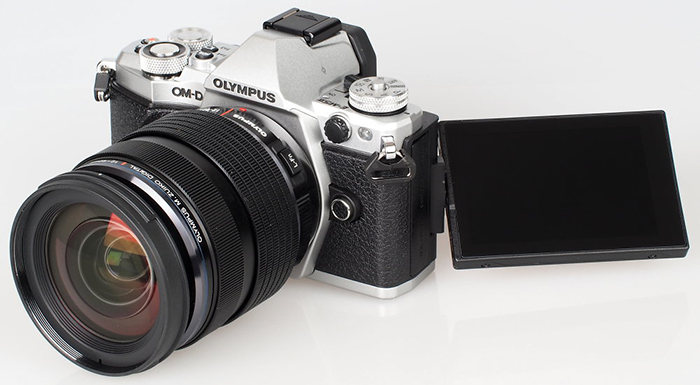
Image courtesy: ePhotozine.
ePhotozine (Click here) writes:
The O-MD E-M5 Mark II is, without doubt, a worthy successor to the E-M5, and surpasses all of my expectations, providing excellent image quality in a well-built and stylish compact system camera. All that’s left is for me is to pull my bank card out of my wallet so I can buy it, once I’ve decided whether to go for the black or the silver version! Something that hasn’t happened since the original E-M5, some three years ago…
Engadget (Click here) writes:
Olympus has made it clear that the E-M5 Mark II isn’t meant to replace its flagship E-M1 camera, but rather act as an entryway to its Micro Four Thirds platform. With that reasoning in mind, I have no doubt the E-M5 Mark II is worth buying; I’m just not sure why anyone wouldn’t spend the extra $300 for the even better overall package that is the E-M1.
ThePhoBlographer (Click here) writes:
The Olympus OMD EM5 Mk II is a wonderful camera. It deserves all the praises and wonderful awards that you can possibly give it. Wifi, great image quality, a high resolution image mode to add to the future proofing, crazy fast AF, great lenses, a nice feel, weather sealing, focus peaking that works well, what more could a photographer seriously ask for?
There is also a Full interview with Olympus Product Manager Richard Pelkowski here:
E-M5II store links:
E-M5II in Black at Amazon, Adorama, BHphoto and GetOlympus.
E-M5II in Silver at Amazon, Adorama, BHphoto and GetOlympus.
E-M5II In Europe at AmazonUK, Jessops, WexUK, Namencolor.
42 Responses
It has the same sensor as the E-PM2?
I see no (big) difference between the E-PM2, E-M5 E-M1 in terms of image quality. And Yes I see – Everything else is better… but not so important … for opening my wallet.
It’s not only image quality. For me it’s usability (e-m1). And for that the new e-m5 II is better than the older e-m5 which is better than an e-pm2. I’ve owned a e-pm1, as well.
That’s a good thing, because it means that Olympus doesn’t put inferior sensors in their cheaper models just for the sake of differentiation. There is no reason why entry-level buyers or people on a budget should be forced to settle for worse IQ.
The models are instead differentiated by body style, control layout, build quality and features.
OK but this does not convince me to buy a new body = loss to Olympus. It’s all about IQ – photographing landscapes, stars, etc
E-PM2 is worth € 210 and E-M5II 1100 euros !!! big difference deserves better IQ.
I’m waiting for another body with a new chip (16-24 Mpix and better ISO RD). Next think: I’m waiting very long for 300mm/4 – so maybe in year 2 years i’ll buy new body and lens toghther 🙂
I’m sure lots of people are like you, but there are also lots of people who are prepared to pay more for a more robust camera body, better ergonomics, weather sealing, faster AF, more features and so on. Even if the IQ is the same.
Personally, I’m happy with the IQ of the current generation of cameras, so even better IQ is not a top priority for me. I’d rather pay for other improvements instead. But I understand what you’re saying, and people have different needs and requirements.
I understand being impatient for new sensors, but every new model can’t have a next gen sensor. I’m just glad they don’t always hold back the good stuff for the high priced models.
Its all a game of leapfrog. The best new aps-c sensors come out and pass the m4/3 sensors, but when they start to age and the new m4/3 generation comes out, it will jump past at least some of the aps-c available at the time. Sure, equal tech the larger sensor should be slightly better, but at any given time that may not be the case.
If it makes you feel better, go pick up an e-pm1 on ebay for $80-100. At least then you will feel like the new models are an IQ upgrade! 😛
Actually it’s not all about IQ. Not when the IQ reaches a certain point.
That’s the same as saying cars are all about the speed when they all go fast enough for most of us now.
Designr, handling, robustness, features and build quality are all as important and for many people can be reasons for buying.
After all I’d bet that nearly everybody who bought a Panny GM1 or GM5 wouldn’t say the IQ was the main reason for buying it.
You won’t buy anything, cheapskate. All talk and no substance. There are many just like you that spout your troll nonsense here.
It seems like a cool camera if you are new to the m43 space (perfect first camera) but if you have a camera from the last 3-years I’m not sure why you’d buy it unless the money is burning a hole in your pocket.
Lots of new features, silent mode and quiet shutter may be my favorite features. And the machined dials.
Swivel LCD is pretty cool too, and better IBIS.
Agree. Tiny camera powered bounce /swivel flash is nice too.
Sure I like those things to, Silent mode, quiet shutter, subjectively slightly better video and stabilization tend to get you thinking but not too much if you already have an E-M1. New dials are good and nostalgic design are eye candy for those that like it.
The fact that photo IQ, video is only on par with an E-M5 and low light is very poor on the E-M1 is just a shame and seems like a do it all camera and none of them really well. I agree with EOSHD, effectively why do I need two cameras if you have the E-M1?
Things can always get better, but Em5ii is very solid overall performer. 1/16000 shutter great for wide open outdoor portraits in very sunny situations. Definitely not making em1 owners upgrade, but very tempting for owners of Em5 or earlier m43 cameras. I was using GF1 after selling my GH2 and Ep1, so this was a pretty substantial upgrade for me. I don’t anticipating another upgrade for another few years unless EM1 II knocks it out of the park. Em5ii will still have high value until that is announced, so no regrets on being an early adopter.
If E-M1 or EM5 II is not a worthy upgrade from E-PM2 for you, than neither will be E-M1 successor or whatever Olympus comes up with for next generation of their cameras.
If the only thing you are after is IQ, than I really don’t understand what are you waiting for? Entry-level non Canon APS-C DSLR will deliver better IQ right now. No need to wait for anything. Heck, even if you’d rather skip the mirror, there’s a super cheap A3000, with bigger sensor and more megapixels. And you can have that for pennies, compared to what E-M1 or E-M5 II costs.
Looks SO good in silver.
Unlike so many cameras it does what it’s supposed to do. Every single feature seems to work without unexpected hiccups. I had the chance to use the Fuji X-T1 for a few days and my feelings were the opposite. It doesn’t feel right to begin with and then I experienced difficulties in getting good exposures and focus. The famous Fuji jpegs are not that good either (to my eyes). Colour balance is flat and the highlights clip too easily too often.
WOW. You are a SERIOUS M43 Fanboy!!!
Really? It doesn’t feel right to begin with? What doesn’t? The grip? The Manual controls? What? The Quick Menu?
Good Exposure and Focus? Seriously, If you can’t get good exposure and focus with a Fujifilm camera, with it’s Manual controls, then perhaps you should skip Mirrorless altogether and go with a point and shoot. No disrespect, I am dead serious. in fact, the only edge I’d give to M43, is Focus speed and Touch screens.
On top of all that, you get a Better, Larger sensor, Comparable lens selection, with even better build Quality and Prices are comparable.
Heck, I just picked up the Fuji 35mm 1.4 and its Smaller than my Panny/leica 25mm! -Better Build, and the pics are Stunning!!! I’ve said that I won’t sell my P/L25mm, but after I do a real-world comparison, I just might put it on eBay.
It’s a matter of experience and expectations. Just a few thoughts:
1. The X-T1 feels lighter than it should. Makes holding it less steady (and with many lenses it lacks stabilization).
2. Metering was inconsistent. The viewfinder renders brightness quite well, but exposure compensation is a pain because you have to use two fingers to adjust it (and remove your eye from the viewfinder).
3. AF is OK as long as the subject is not darker than the background.
4. A larger sensor? true, but the difference is not significant enough for me to justify the above quirks.
5. The lenses are very nice, but good ones are not really small (which is why I chose mirrorless in the first place).
6. I really like the exposure controls (except for the EV compensation dial). They just make sense.
There is only one BAD REVIEW on the Mark II: from EosHD. They writhe that the video quality is still mediocre, despite the high bitrates. So is it worth to finally with form Pana to only for video? The 5-axis IBIS is very tempting.
A firmware upgrade in video resolution would be more than welcome. They could downsample a bit better. Otherwise, video is very good. EODHD review sounds very whiny, but I’m okay with it if it ends up with a firmware update. People take that opinionated review as The Truth. Scientific examples of the problems would be much more beneficial.
For continuous shooting the E-M5 II is a nice upgrade from the EM5. Unlimited 5 fps RAW shooting, but it looks like you need a UHS-II SD card to get that speed. A comparison test of UHS-II and UHS-I cards in the E-M5 II showed that only UHS-II enabled the faster write speed. http://www.cameramemoryspeed.com/olympus-e-m5-ii/sd-card-comparison/
Good to see Mr. Muttonchops again! Keep rockin’ it!
Olympus has already admitted that this camera is unusually (not their words, mine) transitional in that coming up will be sensory shift for not only tripod shots. Why would I upgrade from an em5, which had the same sensor and same basic capabilities?
Likely the next E-M1 Mark II will have hand-held sensor shift, they aren’t talking about the next E-M5 model. Based on this video the E-M5 Mark ‘x’ platform is the launch of new features. Since it already has this feature, then another model presumably the flagship will have handheld.
Now, can they improve this feature on the E-M5 Mark II through firmware? I’m sure they can do it but as we know and now we hear from Olympus, depends on market timing and if they want to do it even if technically possible.
I don’t like the way Richard Pelkowski is dodging all the technical questions. At the end, there is not much new information coming out of this long interview. Compared to interviews with Panasonic’s Matt Frazer, this is actually a waste of time. Matt has to be stoped by the interviewer if he gets into technical questions and why things are this way and not that way. Richard just don’t know when it is getting interesting.
I would like to get more info about the multishot finctions. Why there is 64MP Raw and 40MP jpeg. Is it is possible to improve 16MP IQ by taking 4 shots or is it better to take one longer exposure, lower ISO and the mechanical shutter.
Probably it’s because Matt is technical trainer (used to train people and to explain technical things) while Richard seems to be a marketing guy.
You didn’t then watch the interview as He answered all of those, why 40Mpix instead 64Mpix etc.
Actually, I watched it, because I was interested.
At 5:40 he says he learned a little bit more about all that by talking to the DPReview-people.
At 6:40 he says about taking 4 pictures to improve 16MP color quality – I don’t know but it might be possible (took him a minute to do so).
At 8:00 the question is, why there is a different size between Raw and JPEG and what raw converters are supposed to do with it. The answer is just what was already mentioned in the question: There is just enough data in the file to produce 40MP. He says nothing about why there is a different size and what rawconverters should do about it.
At 10:00 the question ist that the ISO is suprisingly restricted to 1600 on multishot and if it might be possible to improve ISO by doing multishot and average the results. The answer is, it might be but the only thing he really knows is, that it is not implementet.
My gues on this question is, that the EM5II seems to be resticted to ISO 1600 on electronical shutter just like other cameras (GH3 for example). The high ISO performance is better with mechanical shutter. So if you have time for multishot, you should get much better results by using mechanical shutter, lower ISO and a longer exposure. I would like to get this confirmed by someone who knows.
He talks a lot but he passes every time when it gets interesting.
Not surprising, the EM-5 is a great camera, and the new model is still a great camera with a few minor feature upgrades. We don’t need web bloggers who make money when people buy the camera from their web site (or in some cases get undisclosed free trips to Bermuda from manufacturers) to tell us that.
Since there is no real world difference in image quality between the EM-5 and the EM-5II (not to mention between the EM-1 and the EM-10), there’s not a real compelling reason to either ‘upgrade,’ or to pay so much more for the newer model (The original EM-5 can be had used in nice shape for almost a quarter of the price of the EM-5II- put that another way, the II is almost four times as expensive as a used original. That’s a huge gap).
That the EM-5II is a nice- no, great- camera was never in question. What was always in question was whether the consumer was willing to pay that much more for the same results.
The brand new just released EM-5II is in ready supply languishing on dealer shelves, unlike the original that was sold out for months at launch. On the Amazon mirrorless rankings, the brand new II is being outsold by no fewer than five different and older Sony mirrorless models, and a Samsung. This is a huge miss on pricing, and I fear sales will suffer as a result.
My guess would be that they did not go crazy in production on this camera and expected lackluster sales. As there is no improvement in image quality it shouldn’t be expected to generate large sales figures. There will be early adopters and gadget geeks that will buy whatever comes out but those are a small number of people. Once that burns out the rest of the consumer market sits back and waits for the price to come down.
If Oly was smart they kept production numbers down so that they do not need to do fire sales 6 months from now. They’ll be able to hold prices high and deplete existing inventories over the next two years until we finally see an update in image quality with a new sensor.
The jpeg engine is definitely improved. Cleaner files with less of the random color blotchiness that I personally hated on the first em5.
Video from the EM5ii has ugly MOIRE and ALIASING. Completely unusable.
Surely Olympus aren’t seriously trying to flog this as a video camera.
Another ridiculous and mindless comment about a camera you do not own and have never used. Go away, troll. You must be related to MrALLCRAP.
I pre-ordered/purchased it for the 5 axis, hoping it would be a nice compact stabilised addition to m43 filming. I tested it shooting a few clips along side the superb GH4.
The EM5ii video quality is the worst I’ve seen for ugly moire and aliasing. Everything in focus is prone to moire. It’s worse than the first generation DSLR video. Worse than the D800, previously the worst video camera for moire I’d ever seen. The moire was clearly evident in every shot that had in-focus patterns e.g. fabric, architecture, distant waves on the sea etc. Footage was unusable.
Olympus shoot an EM5ii promo video with shallow depth of field and carefully avoid shots with moire and aliasing. In the real world, real jobs, everything in focus will moire. There’s even moire in the sample stills, presume due to the lack of AA filter in the desperate attempt to make the image look sharper.
The reviews are a joke. Just because it has 24p ALL-i it’s suddenly a video camera? They don’t mention the video quality is worse than the crappiest 5 year old DSLR.
Stills camera fine. But Olympus, don’t suggest that this is in any way a serious video camera.
I have the em5ii and practically, the only thing they need to fix video wise is the resolution (better 1080). But given that most videos go to you tube or video, probably not that big of a deal either.
I saw the Olympus product manager interview a few days back.
The take-away I got was that Olympus sees E-M5 Mark XX will be the test ground for new features moving forward and these features will roll down or up to other models. The E-M1 is still somehow the flagship and they will provide several firmware updates this year. A new model will come out at least more than a year from now which we know. They could bring better video and 5 Axis video (vs 3Axis) if they want but a lot depends on market conditions and timing???
So to me, they are evaluating whether or not they ‘need’ to make changes to the E-M1 depending on the market and those new rumored features may not show up. This will be a problem as competitors drop new models.
What do you mean “the E-M1 is still somehow the flagship”? I will just give you one of several reasons. It’s called PDAF, and the ability to use the original and excellent Oly 43 lenses.
Yeah but who cares about those two features? Unless you already have 43rds glass, why would you bother buying good but crazy expensive non-native system glass with especially the new M43 Pro stuff is cheaper, smaller, and just as good? PDAF is great, but not a must have for the majority of shooters, and it’s not like the M1 is a speed demon anyway in the grand scheme of things. I’m pretty sure the EM5II will cannibalise EM1 sales in the next 12 months. I mean, the EM1 isn’t even on my radar – the 5II is the camera I want to own.
I also don’t think that PDAF is significantly faster for m43 lenses so if (like me) you only have m43 lenses then there isn’t all that much benefit
Anyone who isn’t completely content with the still somewhat limited Micro Four Thirds lens lineup, both in focal length/aperture bandwidth and in image quality. It’s not just those who already own FT lenses, you can still buy them new, and there are quite a few excellent ones which cannot be replaced with any of the existing Micro Four Thirds lenses. Right, that won’t be a “majority of shooters”, but then again the “majority of shooters” isn’t interested in any of the OM-D cameras in the first place.
That is of limited appeal to the small group who have higher end FT glass . Much of which though very good is often huge and heavy given the sensor size not forgetting very expensive. Unless you already own the glass from previous FT use it is simply not an attraction for most mFT shooters with size and weight being amongst the top if not the very top reason for going for mFT .
The difference in lens size and weight plus the adapter goes against everything mFT does best!
FT glass is not something that can only be attractive to people who already have it – it is, of course, not the lower focal-length lenses for which there already are MFT alternatives which are attractive.
There are quite a few lenses which simply are not available with MFT mount, and if they were, they wouldn’t be so much more compact, either.
If I didn’t have one, I would still go and buy a 50-200mm f/2.8-3.5 for my E-M1 right away, and the good thing is, you still can buy them new, just like the excellent 150mm f/2, 35-100mm f/2, 90-250mm f/2.8 or 300mm f/2.8 lenses. Oh, and the Panasonic/Leica 14-150mm f/3.5-5.6 is still the only existing superzoom lens that I would call ‘good’ beside the Canon 28-300mm f/3.5-5.6 L (which is really huge, for that matter), and, for the time being, I’ll stick to it regardless of how much more compact the existing MFT superzooms are..