









Image courtesy: Personal View.
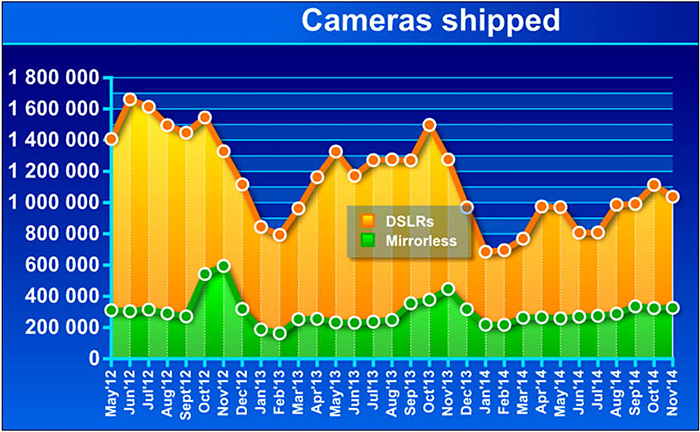
The current digital system camera market keeps remaining pretty lame this year. Sales are way below the previous year. The last CIPA shipment data for October and November confirms the tendency. DSLR sales are lower than 12 months ago while mirrorless sales remain constant. You can see the full graph analysys at Personal-view.
I am now wondering if sales will keep falling don in 2015 or if we finally will manage to stop the negative trend…
93 Responses
Let us hope all the camera makers cut the prices drastically to sell the cameras and also reduce the sheer number of models with same sensor!
Price cuts means smaller profit margins, which means that the manufacturers will try to cut costs in manufacturing to drive up the margins. A race to the bottom is not a good thing.
price isn’t why camera’s aren’t selling
And how does fewer models help the sales? Quite the opposite really… People will choose the one model that fits them the most and frankly I will be without a new camera at least for the next 3 years since the E-M5II has the f*d up swivel screen and the other models aren’t for my taste either (unlike the current E-M5). We need even more models to choose from. =)
Well, perhaps camera manufacturers should do what car manufacturers do: create a basic model and offer the user the chance of opting for the features they like: swivel or tilting screen, low or high-MP sensor, many buttons or just four or five buttons for multi-function menues…
I expect opposite to happen regarding prices (and it already is to a degree). Manufacturers will concentrate their efforts on high end gear aimed at high end users (pros and enthusiasts). Or novelty/special use. The entry-level market will probably shrink to the point where it will no longer be a viable option, so there will be less iteration there as well, it will just be old camera models on sales and such. I actually do not expect canikon to release updates to their 1200D and D3300 at all. Those will probably be the last of their line.
Sony seems desperate to gain as much market share as possible before inevitable market implosion, so they are the only ones trying aggressive pricing. I’m not convinced that will help them much in the end.
Current selfie cam trend may prolong the death of entry-level, but with more and more smartphones sporting zoom lenses, it’s gonna be harder and harder to convince people to buy a camera.
That DSLR sales would eventually start declinig was inevitable, because sooner or later the market gets saturated. People don’t update their cameras as often as the manufacturers would like, because the perceived benefits of each new camera generation become smaller and smaller.
What is disappointing, though, is that mirrorless hasn’t really taken off, instead settling into a flatline. Since the lost DSLR volume isn’t showing up as increased mirrorless volume, as many had hoped, this means that the market is contracting. It will probably continue to do so over the coming years.
The mirrorless market has flatlined because Canon and Nikon are squeezing their low-end garbage into the market for a half or a third of the cost of a mirrorless camera and people buying that crap don’t know, don’t care or don’t need anything better.
See my comment above: even if your comment is true–and I don’t disagree, by the way–the market for ILC cameras is simply getting smaller every day.
Just wait until the C-AF performance is fully on DSLR level or beyond…
When the first sports pros will switch to MILC, the landslide will be on. And in consideration of the GH4’s performance I’d say it won’t take too long until we have reached this point in time.
It won’t change much. The low-end users are leaking away from cameras and towards mobile devices. The high-end users, who might care about such performance improvements, are too few to really create new growth for the camera market. We will just have to accept that the market will settle at a much smaller size that mainly consists of enthusiasts and professionals.
Unless the camera makers come up with some new ideas that make people want to buy a compact camera or entry-level ILC to go along with their smartphone. Good luck with that, I say!
Let’s put a exclamation point on this ;~)!
Mirrorless is part of a category: interchangeable lens cameras. That category has gone from 20.1m to 17m to probably 13m units in three years with no signs of the decline relenting (just the opposite, actually). Making better mirrorless cameras is only going to steal from DSLRs best case, as there is no evidence that it grows the category.
You can back a winner only to have the Olympics drop the sport entirely ;~).
Well Thom, from my point of view, this is seeing things to simple. Yes, there is a decline regarding the entire industry. And yes, the market is saturated to a big extent and so, a return of the sales figures of former years is not to be expected. If i have got a very good DSLR, why should I purchase a new one. Just for a gimmick here and there?
An MILC, however, with all its advantages and a competitive C-AF system is something completely new and will make many people switch – that’s someting I’m absolutely convinced of.
I know that this won’t change the situation as a whole and over the lomg term but for two or three yrears, this could result in a massive sales-figure increase.
All the sports photographers I know would love it if they could achieve the same results with half the weight. that’s for sure.
And as we know, everybody wants to have what the pros have. That’s why CaNikon supports them to the max and that’s why I expect the landslide to happen as soon as the pros start switching.
Actually, I see things more complex than you do ;~).
Let’s take an industry you might be familiar with as a consumer: automobiles. This is the traditional “mature industry” mostly driven by replacement. It does not show a catastrophic decline. The only times it has have been economically motivated (e.g. 2007/2008).
This is the “hope” of the camera industry. They keep saying that it’s the economic downturn that’s hurt them more than anything. This, unfortunately, flies in the face of evidence. The camera industry is unique in the severity of it’s post peak performance compared to other consumer products that would be considered non-essential. In fact, it’s WORSE than the decline in MP3 players from peak, and it’s pretty clear that many of us simply started using our smartphones as our MP3 player.
MILCs have been available for five years in high quantity. They peaked in sales three years ago ;~). If they truly were the answer to growth in ILC sales, we’d have seen that already. The bottom line is relatively simple: ILC sales are on the decline, mostly due to DSLR sales collapse.
When you talk about “sports photographers would love something half the weight,” sure, they would, but not if they have to give up something else. As it turns out, a full frame Sony A7 that could focus as fast as a Canon 1Dx or Nikon D4s would NOT be half the weight. Why? Because we’d still need a 300mm+ lens for most sports. And that lens needs to be longer and faster than 70-200mm f/4, which is the current extent of the FE lens lineup.
But even if sports photographers did replace their aging DSLRs with mirrorless, that’s only REPLACEMENT sales. The problem for the camera industry is very, very simple: replacement sales run only about 4-5m units a year in ILCs, and new customer sales are disappearing. That latter is extremely important, because you can’t increase replacement sales without getting more customers replacing things ;~).
Back to autos: what automobile sales have going for them is that they’re highly correlated to population. Population grows, sales grow. Digital cameras didn’t actually show that correlation, nor do they today. So if you stop attracting new customers with product, you stop growing.
Wel,
first of all we have to accept, that the mad sales figures in the recent past were caused by the fact that there was a full brak in the development of photography. From analogue to digital accompanied by a rapid development of new features. And whie most f the cameras in the analogue era were kept and used for a long time, the rapid development in the early years of the digital era ‘forced’ the people to replace their cameras quicker than quick if they wanted to benefit from the technological progress.
Now, with the technology having reached such a high level, expecting that the sales figures would remain on this highj level would be pure stupidity.
And why should we already have seen that the MILCs would be the answer when E-M1, GH4 and possibly the NX1 are the first MILCs that have got to challenge the DSLRs even in their last bastion, the C-AF. Had you switched to an E-M5 or the likes ig sports had been your main subject?
Apart from that, there is no declaion in the MILC sales, there is a slight but cosistent raise. Far more healthy than a sudden explosion, leading to a suden decline.
Well, and why please shoud a sports photographer wish to keep on shooting sport with an FF camera if he can do so just as good with an µFT equipment. But that’s another discussion.
Anyway, I am full aware that this only would be replacement sales. But the message would be clear.
I for instance have got to E-M5s, an E-M1 and a GH4. I have taken a lot of portraits and other pics of my step daughter and she really loves the pics. Now I wanted to give my step daughter one of my E-M5s as a gift. You know what she told me? “No thank you, I want a 70D because only DSLRs can take really good pictures.” And she not even wants to learn what aperture and exposure time mean. Those who don’t know what it’s all about are a kind of brainwashed: DSLR = good, anything else = useless. This is the point and this definitely will change when the guys at the football pitch or racetrack suddenly are shooting mirrorless cameras. I’m ready to make a bet with you regarding this point.
The technology has to be there, the pros will follow – and then, the masses wil go the same way.
By the way: the claim that car sales are correlated to population growth doesn’t apply to the European market and it also doesn’t to the Asian. I don’t know about the US but I assume that it also isn’t correct there.
One other thing related to cars: German car dealers grow mostly due to the asian market. Local dealers (Fiat, some French) have big problems because of this. VW sold 35% of all cars in China (2013). Western Europa sales where the lowest since 1993. But the same thing applies here as for cameras: connectivity concepts are the key to future success. („State of the Automotive Industry 2013” by Oliver Wyman)
No, not right. The correct statement is “DSLR sales [or better still ILC sales] would eventually peak, because eventually the market gets saturated.” What happens AFTER peak depends upon a lot of things. Steep declines over time indicate that the public is “over” the product entirely. That’s where we are today. Compare to the personal computer market: it peaked, but went first into a shallow growth (population driven; everyone needs a computer ;~), then into a shallow drop (replacement not needed as often).
Sales should be expected to be down though because there hasn’t been many major technology updates. When new sensors get announced with major updates there should be a spike in sales. Other than that people just use what they already have.
The peaks tells us how many idiot pixel peepers there are, while steady level means how many photographers there are.
Only problem is that the ONLY steady level in cameras has been mirrorless cameras for the past three years. Everything else has been downward. Severely downward. Compacts down 33%+ multiple years. DSLRs now down 25% and looking like it’ll be multiple years.
Not true. If a technology is still viable but isn’t getting any major updates, you get what is called a mature product curve. This is characterized by either a flat or slight decline in sales over time. If a technology is no longer wanted by the public, regardless of updates, you get the kind of catastrophic curve we see with cameras, where the decline is as severe as the upswing. That kind of curve is more indicative of fad than on-going opportunity. What the public is currently saying is that cameras as we know them have come and now are going. The majority of the market sees no reason to continue to use such products. We’ve seen that type of curve before. LPs, for instance. Heck, High Fidelity products in general. Convenience trumped quality, just as it is now with smartphones versus cameras.
Yeah..its lame…but not as lame as all of the “experts” that are going to weigh-in here! 🙂
looks like November is by far the best month, seeing how low is this Nov 14 is not encouraging as it s going to drop sharply until march 15
Smartphones are kicking camera makers in the rear. Many low end cameras take worse quality photos than an Iphone. If makers can not make a camera better than an Iphone they need to fail.
Well, Canon and Nikon have recently done nothing to create some kind of innovation.
Mirrorless cameras are now very good for the amateur-high-end market, but still lacking for the entry-level / second body / convenient camera market. The Pana GF7 and the Fuji X-A2 show a lack of imagination and consideration for the actuall camera-buyers (as opposed to the selfie crowd, which will never buy a camera anymore) that is buffling and actually scary.
Older CIPA data shows the peak sales of film interchangeable lens camera were 4.4 million units per year. It’s unlikely volume will fall to that level, world population has grown significantly plus digital has lower operating costs, but 10 -12 million is not out of the picture.
True, but in the film era cellphones could not take pictures. I know many users who had a film camera and now use only the Iphone. As a matter of fact, if the situation doesn’t change we could go even under that film-days number.
I agree smartphones have killed P/S sales, but so far impact on users who want interchangeable lenses is minimal. We are talking DSLR + MILC here.
Not true.
The impact is minimal on photographers who care about and take advantage of different lenses.
OTOH the impact has completely wiped away the entry-level market, i.e. the users who were just buying the basic DSLR kit, not caring about buying new lenses anymore.
That market is gone for good, and judging from the GF7 and similar cameras the Japanese makers have yet to figure it out.
Yes, world population has grown significantly, but the part of the population that can actually afford to buy cameras hasn’t grown quite so much.
That would be true if the household saturation rate for the product stayed the same. There is clear evidence now that digital cameras oversaturated and that plenty of households have just walked away from purchasing them.
Within the community that monitors and analyzes the camera companies for investment groups, there was recently a paper published that predicts that the replacement rate for ILCs is probably 5-6m units a year. I think it’s smaller than that if ILCs continue to be designed the way they currently are, higher than that if the camera makers would recognize what has to change. But even at 6m replacement units a year, just to maintain the current level of sales, camera makers would have to find nearly 8m NEW buyers each year. That’s the real problem.
Replacement ILC sales will settle wherever it settles. That number will be lower than current sales (always has been, even in the film days). The problem for camera makers is that new users just aren’t coming. And it’s the bigger part of their problem.
Strange interpretation. I do see an increase of DSLR sales in the last months and a very low increase in mirrorless. A of course not at the peak level, but increasing nevertheless.
I always increase in the second half of the year, and October is usually the peak. This year’s October, by far the best month of the year, was very lame compare to last years, when, besides, also other months were good. If you see the graph the sales always go down in December and after Xmas. If 2015 starts following this trend, December-January-February may be the lowest peak ever in the digital era.
I meant “It always increases”…
You are doing same mistake as any academic person is doing: YOU CAN’T EXPECT GROWTH ALL THE TIME AND LIKE PREVIOUS YEARS!
If you don’t have savings, plans and preparations for downcomings, you never get successful and you are never loyal to your workers and you are never being loyal to!
But you are missing the fact that the total camera sales diminishes steadily from year to year. Sure, you can’t expect constant growth, but what we see now is a contraction of the entire camera market!
“you can’t expect growth all the time like previous years”.
Sure, true, pity the previous years were considered a downfall and a market / financial disaster for all camera makers.
So, emh, as a matter of fact, we all expected growth after years and years of market contraction, especially for mirrorless cameras. The fact that there is no growth means, to put it simply, that the market will never be the same as it was 6-7 years ago.
There was a very good presentation at PMA this year about the shape of the digital camera market sales curve from inception to present and why it is what it is (disclosure: I agree with the presenter).
What we’re seeing does not follow “normal” maturing product market curves. It’s what we call a catastrophic curve, as the decline after peak is far steeper than typical replacement cycles for a maturing product would suggest it should be. We’re not talking about a small percentage drop. We’re talking about as steep a drop as the ride up was, with 25%+ year-to-year-to-year-to-year declines now. This type of curve indicates that the public has made steps entirely away from the market, that they aren’t replacing the product regularly, and that the product isn’t important to them any more.
And yes, I’m an academic, complete with PhD work in New Technology Economics and Management. But I never make the mistake of thinking that growth is a given, let alone always the same. Nor do any of the other academics I know. So I’d have to say that you’re making a mistake about characterizing academics.
Ill help with the sales if only Olympus delivers on the new E-M5.
Most of the few enthusiasts for Photography will probably go to fullformat. As they are willing to pay very high prices for an exclusive powerfull product.
m43 has a good setup for foto + video. That will remain a market to survive.
yeah but depth of view is not easy to manage on FF when you want a nice background blurr but both nose/ears sharp
Yeah it’s really difficult to spin that aperture dial…
then you loose some blurr 😉
Very easy: it’s called “stopping down”. For FF (35mm photography) it was invented roughly 100 years ago.
Nonsense. Everyone, who wants a smaller and lighter equipment will move to a smaller sensor. That Sony was able to shrink a FF body to E-M5 size and be able to construct some small standard primes (rather slow, though), does not mean much. As logj as you go for faster and more non-standard focal lengths with zooms or primes, the FF size and weight disadvantage becomes evident.
I suggest you look at the history of photography.
As the quality has improved the size of the imaging area has shrunk.
It shows no signs of reversing with FF (less than 10% of DSLR sales) now occupying the same area that medium format used to in the film days.
I fully expect APSC and M43 to eventually become the new medium format and 1″ to become the new APSC within 10 -15 years.
It always takes time for interchangeable lens cameras as people have built up systems but for most people 1″ sensors are now good enough.
Eventually most people (apart from specialists) will abandon their changeable lenses and use superzoom 1″ or smaller sensors like the Panasonic FZ1000 and will be capturing frames from 8k video by then.
You may well be right on the superzoom satisfying the majority of the market. CIPA study shows on average owners of interchangeable lens cameras have 1.6 lenses. I.e. most people buy kit zoom and maybe a telephoto and that’s all.
Only if FF gets much smaller. Small with very good quality is always going to be a seller.
Sony EF has no pancake lenses, not even on the roadmap.
They are in no rush to broaden the FF appeal.
That what tells me that even Sony wants FF to stay exclusive and relatively (to APS-C, to compacts) expensive.
I still have a strong hope for Asia. OTH it seems evident that it has become an enthusiast market, so one should be thankful for camera companies for being there at all.
As others, I am unconvinced to upgrade this year from my E-M5. At the end of its life I might buy an A7 series for fun with legacy lenses, so that doesn’t mean giving real money to the companies. In mirrorless they are really counting on the sale of lenses, so those will be pampered.
See here my blog:
http://amalric2014.blogspot.it/2015/01/the-dilemma.html
Yes, bar the fact that smatphones are ubiquitous also in Asia, and e.g. 1) the photo market in China is not growing as expected (Iphones, OTOH, sell much more than expected, and now China is the 1st market in the world for Apple), and 2) in Japan the market is in contraction, and even here mirrorless cameras grow much less than expected.
Because of their culture India and China are good candidates to learn Photography with real cameras.
Like you? Have you got enough “culture”?
There is absolutely no reason why anyone should expect camera sales to rise. The world is in a complete economic funk and I think it will only get worse thanks to that idiot Putin trying to start a war and the Greeks about to sow the seeds of the eventual breakup of the Euro.
Well…..it is good thing you do not mention the U.S. sub-prime financial crisis which wiped out most of the worlds wealth and also not to mention IRAQ and Afghanistan wars.
No lets blame it on the Greeks….
Greece is claimed to be the cradle of the modern, Western civilization, so yes, they started it!
“wiped out most of the worlds wealth”
not for everyone, just for the peasants.
Bloody greeks, can’t they just shut up and save our banks ;-).Democracy should not be left in the hands of voters, ECB / bundesbank shoud decide what s right, they know better
“Democracy should not be left in the hands of voters”
Amen to that! True words!
You’re kidding right? ECB made it worse for the Greeks, not better.
I did not ‘blame’ the Greeks for anything. They are in an invidious situation and in my opinion the Euro experiment is a complete failure and it needs to be undone – the sooner the better. Blame the stupid idealists who formed the Euro.
I am well aware the US kicked things off. Their greed usually does. They were the inventors of junk bonds that caused problems years before the sub prime disaster – another of their great financial inventions.
Ireland also has a totally unrealistic burden of debt that can’t be repaid thanks to the Germans. You have to almost laugh at the term ‘bailout’ when the interest rate is 6% when the prevailing rate is 1%. That’s not a bailout it’s egregious profiteering.
What most people seem to forget: the EU is established in the first place for peace. We have a history of too many wars in EU countries. Most people from outside of the EU might only know WW1 and WW2. In fact, these were short ones compared to the 80 years oof war we had with Spain. The EU should improve the political bond between the members. So economically, the EU and the euro might not be a huge success, I hope the greek will overcome their problems and stay within the EU. Learning to live in peace and respect within the EU is more important than money.
Europe, not EU
EU is going to bring us wars
No, it was established in the first place for trade and commerce. It grew out of the so called European Coal and Steel Community.
The common currency was a bad afterthought that never should have seen the light of day.
Tell that to ill, underfed Greek children. And I did not know Spain had 80 years of war.
Greece has received 176 billion euros in bailout money. A relatively minor amount of money for the EU. Italy is the country to worry about though they may start growing again this year,
I have polar opposite views to you on the EU and would want the UK to join the euro (which is still a much stronger currency than the £ ) simply because it is backed by Germany and France (who both have larger economies than the UK) plus many other strong European countries.
The world is splitting into large currency and trading blocks and the UK cannot afford to remain outside them long term.
The EU has made mistakes in being over ambitious and is now paying the price but on many measures (healthcare, welfare, disposable income) EU citizens from Northern European countries are better off than UK citizens and the primary purpose of Government is to look after its citizens. The alternative (US model) that prioritises opportunities over equality is the wrong way to go in my view and the wealthiest and best places to live in the world are those countries where the difference between the poorest and wealthiest is the smallest (see Scandinavian countries).
We’ll just have to disagree, though not about Italy. My opposition is to the Euro in practical terms. It can’t work from a purely economic point of view. The UK is doing relatively well because they printed lot’s of £ to lower its value – precisely what Ireland, Greece, Portugal, Spain, Italy and Cyprus need, but can’t do.
Most of those well off northern Europeans aren’t in the wretched Euro, or even EU in some instances – namely those Scandinavian countries you mentioned. Those countries that ddn’t join the Euro are in general doing far better off than those that did.
You got it all backwards pal… Are you Charlie?
Actually much of the world economically is in pretty good shape.
US has an economy that’s been growing strongly for a couple of years, UK has economic growth higher than their long term average (catching up admittedly), China is still growing at around 7.5% which is still incredibly high by Western standards, India, Singapore and much of Asia (excluding Japan) are all growing strongly.
South America still has very high growth in some countries like Brazil.
The Eurozone is struggling still with anaemic growth in some countries and falling in others, Russia is a bit of a basket case and Japan has gone 25 years with low or non-existent growth.
Australia is struggling a bit due to commodity prices but is still doing reasonably well.
I’ll leave out Africa which has some terrible failures (the ones we hear about on the news) but also some incredible success stories (the ones we don’t hear about).
So, there’s actually a lot of economic success stories out there at the moment.
South America? Venezuella has 1000 % inflation, Argentina is borked – as usual. The latest GDP growth forecast for Brazil is 0.13% for 2015 – the fourth consecutive decline in a row. India and China are doing well, but the world as a whole is stagnating IMO – because of the EU and the Euro. The US is doing well but probably won’t after their stock market implodes.
Have a look at car sales in the EU… Increases in many of the largest economies last year, highest sales in the UK for the last ten years.
And the 4th, 5th and 7th most popular car brands in the UK are Audi, BMW and Mercedes respectively.
European stock markets have hit record levels in many countries recently.
Are you trying to tell me that people can’t afford a camera yet can quite easily afford new cars, often prestige brands ?
Brazil is by far the most populous country in South America and contains over half the South American total population. I was wrong that it did well last year but has had decent growth overall in recent years. Likewise Argentina so not sure where you get your ‘as usual’ comment as the UK would kill for their growth rate average over the last few years.
India, China and most of Asia are doing well. Along with the US, Canada and UK. So a significant proportion of the major camera markets.
The reason that camera sales are poor has nothing to do with the economies and is down to them offering nothing new over what the consumer currently has.
Smartphones (many very expensive) have taken off over the last few years despite a recession because they do offer new features.
In a few years that market will also collapse like the camera market as the market will be saturated and consumers will be happy with what they’ve got and will only replace them when worn out.
> because of the EU and the Euro.
EU is actually doing relatively well. Unlike the most of the world, EU simply does not try to paint the economic news in rosy colors.
And unlike some other developed regions, EU is set to profit from the falling oil prices this year.
The only problem in EU, is that we continuously fail to kick the UK out of the union. The islanders definitely do not belong to EU and apparently do not want to stay in EU. And yet.
> The US is doing well but probably won’t after their stock market implodes.
Again?…
Putin is trying to start a war?!
Is he constantly drone killing civilians?
Is he illegally bombing other countries?
Oh but guess who does all that and nobody seems to care…
What a bullshit.
Yes
No – because he doesn’t have any
Yes
Drones? – his troops fired a SAM at a civillian airliner killing 298 civillians. On the ground his troops are using tanks and Grad rockets – 30 dead in Mariupol only a couple days ago. BS indeed
Who told you it was Putin? Uncle Sam News? The New York Times? The BBC? It must be true then…
No, it was those independent media outlets in Russia – you know, the ones which tell us about those 9000+ Russian troops who have so generously volunteered their free time to go to the Ukraine and build orphanages and do charity work. I must say it was very generous of the Russian military to let all these volunteers take trucks, tanks, Grad rocket launchers and so many other weapons and so much ammunition with them.
What’s that song – ‘Georgia on my mind’
More like “nothing in your mind”.
I thought that Russia had no ‘independent media’, due to evil Putin. Except when it is necessary to quote them, of course.
The propagandising about Russia / Putin in the Western media has been really poor. Surprising given the century of expertise in selling product to the public that they don’t need.
(Oh, and even NATO put the blame on Georgia — Saakashvilli — for starting that conflict that dragged Russia in.)
I was being sarcastic. The latest being the FSB surrounding and raiding the Tatar TV station in the Crimea: http://www.rferl.org/content/armed-masked-men-aurround-crimjean-tatar-television-company/26813560.html
The journalist will probably have fatal accidents like the hundreds in Russia proper.
Putin came to power on the laurels of victory in the Chechen war. Kill count in the war was above 100K – and mostly civilians, because Chechen war was a tempest in a teapot. But they needed both victims and terrorists. So they have created them.
He and his entourage stays in power by cooking up different conflicts, military or economic. Because as experience of USSR had showed, propaganda alone is not enough to keep population obedient. You have to keep them hating somebody else, so they will not turn against their own gov’t.
That’s why inside Russia, all the news are “we, with few friend countries, and the whole world is ganged up against poor us!”
Anybody who sides with Putin effectively sides with a genocidal psychopath.
So you’re saying the sales of ALL other things are going down, too? Are you sure?
I mentioned not rising, I didn’t say anything about falling or declining. Not all classes of consumer purchases are in a funk. iPhone 6s are selling extremely well, for example. It might have something to do with utility. Cars, and phones are the sort of thing people use every day. Some people would consider them verging on necessities so might be more prepared to commit to expenditure on such items.
Cameras in general would have far less daily utility for most people who aren’t deriving an income from their use so I think a lot of people who might otherwise be inclined to buy them or trade up in a more buoyant economic climate are possibly not doing so.
There is also the camera phone phenomena which has meant a considerable proportion of the population are finding they satisfy their photography requirements.
These are NOT sales numbers, they are cameras shipped to warehouses numbers. And sometimes (often) these numbers have little to do with actual sales. How often have we seen Fire Sales to empty the warehouses (Nikon, Olympus, etc).
BTW Amazon still has NEW Nikon D3100 for sale (Announced Aug 19, 2010). This is a good example of over-shipping and under-selling, but Nikon’s CIPA numbers looked good.
Of course they are shipment numbers, but those are correlated to sales. When sales go up or down, so do shipments. It is sales at retail that determines the volume of shipments into distribution, so shipment data is a pretty good proxy for sales numbers.
And there is no such thing as Nikon’s CIPA numbers. The manufacturers report anonymously to CIPA, so nobody knows how the shipment numbers breaks out between the different manufacturers.
Nikon is the one camera company that reports it’s quarterly sales numbers in the CIPA categories publicly, and thus can be directly compared to CIPA.
I’m not surprised. The steps in development get smaller, current cameras are well-engineered and so the people can wait for the “next big thing” – maybe the EM5 II?
It’s a bit of an odd chart above because sales in Europe are on the up and Europe is a bigger market than America, a bigger market than Asia and Japan combined. One suggests the chart above is for the American market alone, do look at the other charts.
Not sure what you mean by “sales are up” in Europe. This is straight CIPA information of units shipped by camera makers. For the year to date:
Europe DSLRs: 63% of last year
America DSLRs: 75% of last year
Asia DSLRs: 94% of last year
Europe mirrorless: 108% of last year
America mirrorless: 120% of last year
Asia mirrorless: 100% of last year
Those are the numbers. They are reflected in the above graph, which is worldwide.
Does Asia includes the India?
It would have been interesting to see China and India data in isolation.
Ask and ye shall receive: http://www.cipa.jp/stats/documents/common/cr700.pdf
Thank! If I’m reading the numbers correctly – Wow. Even in the growing markets sales are shrinking. That is really surprising. I heard that esp in China mobile phone cameras became a real camera replacement, since they are so (relatively) cheap and affordable. (From some Samsung interview: question why they make so many phone models, led to an answer about special editions for Asia and why the phones there often have better camera specs. In China a phone with weak camera simply has no chance.)
The camera companies are in denial. They constantly talk about how new markets will give them growth, then the numbers tell the truth, which they seem to ignore.
Simply put, cameras need reinvention as fun, convenient, connected, programmable devices in the modern world.
Going by the rough chart, a couple takeaways:
Year over year DSLR shipments from Oct 2013 to Oct 2014 are UP, whereas YoY numbers of mirrorless in the same period are down.
DSLR shipments from summer 2014 to Fall 2014 are UP some 33% (800k to 1 million), whereas mirrorless shipments in the same period are up maybe a few per cent.
Mirrorless shipments are down about 40% from just two years ago, so much for the interweb meme of mirrorless being merely ‘flat.’
I gather no joy from these grim numbers, and have no pony in the race. This is sad news all around.
Not gonna happen. Most people don’t need or want a ILC, and those that do already have one. Any camera bought in the last 3 years or thereabouts will last them a long time. The cameras are that good so the eventual need to upgrade has gone down a lot.
What’s left is a very much smaller enthusiast and professional market that’s never going to be enough to make up the large sales numbers that have been driving the heady heights of the 2000s.
This is just how it happens in most cycles of growth and maturation. Another example is the computer industry. If not for netbooks, then tablets, there’d have been no growth in this area at all. While you might argue that mirrorless might do the same for cameras, there’s a difference, and the difference is that computers are kind of more essential than cameras.