









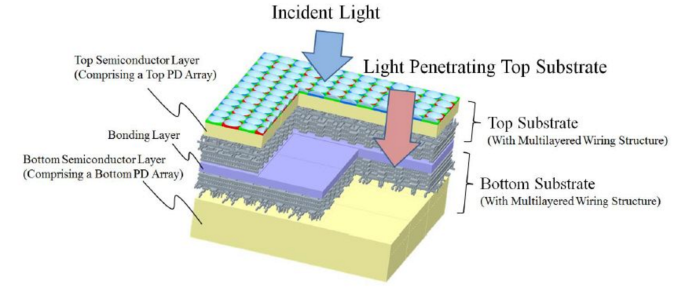
Nikkei Technology published some new info about the Olympus Visible+Infrared Stacked Sensor development:
“The laminated image sensor is made by combining (1) an image sensor equipped with an RGB color filter for visible light (top layer) and (2) a near-infrared image sensor (bottom layer). Each layer functions as an independent sensor and independently outputs video signals.
The visible-light image sensor is a backside-illuminated type, and its light-receiving layer (made of semiconductor) is as thin as 3μm. Each pixel measures 3.8 x 3.8μm, and the number of pixels is 4,224 x 240.”
This shows that Olympus is not merely relying on third-party sensors. They are also actively working on their own tech. And maybe the day will come we will see an Olympus MFT camera with Olympus sensor inside (no Panasonic and no Sony).
–
via Image Sensor World.
41 Responses
I really like to see a new m4/3 sensor with something innovative in 2016 – FSI or micro color splitter technology. Dont tell me that Panasonic relies on Sony sensor for the upcoming GH5.
Not possible in 2016 , maybe in 2017 .
As for GH5 , I believe the current GX8 20MP sensor is more than enough for GH5 .
After all it just a video cam , nothing special , not entitle the best sensor tech from Pana .
pany show 2 organic& 1 single photon detect sensors on ISSCC2016.
organic so far, i hope on others tech.
Oly make lots of scientific and bio-tech equipment where being able to switch between a visible light and IR fed from the same sensor would be a boon. Identifying areas if infection or cancerous tissue during internal examination for instance. We may never find this sort of sensor in cameras we would use.
UV is far more useful
lots of tech doesn’t guarantee they use on image sensor.
no new sensor today,sony made exmor for long time and minor change to stack sensor(no significant betterIQ).
pany sensor made by join partner.(no patent bundle on sensor).
and canon bla bla bla.
Can’t believe such sensor patent come from a company that still using that long time
overdue 5 years old 16MP sensor .
Big doubt Oly can deliver the stuff in the future ? .
Never trust Oly in sensor tech simply because it will never going to happen .
Read AlanG’s comment above. Get this, Olympus just doesn’t do M4/3’s cameras but do a lot medical & industrial gear too. This sensor is most likely for the latter use.
Admin seems to be possessed by the idea, that something made by Olympus HAD to be superior.
Thing is: looking at Olympus and Panasonic, one of them can make (really good) sensor and the other not (or is only talking theory)
People doesnt seem to understand that Olympus has own R&D department for sensors, lenses and for everything in imagery. They just will negotiate others to make the manufacturing based Olympus designs if others agree.
The bulk of Olympus’ revenue is from its medical business where they do produce sensors. I’d be willing to bet this is destined for something other than a m43 camera.
is this something revolutionary or just a copy of already existing technology ? thanks.
I doubt it is anything revolutionary.
I have heard about the same/similar concept to to reduce the thickness of the sensors, which is important for the medical applications.
Though there were also articles about reconstructing some color information from the IR signals: different materials/colored surfaces reflect the IR differently. But as I have understood it, was still highly experimental and not proven.
@Dummy… you honor your alias for sure.
You, Yun and Zuikocron simply have no idea about the imaging business!!!
Looks like a cheese sandwich to me,. Heavy on the yellow American……
“This shows that Olympus is not merely relying on third-party sensors. They are also actively working on their own tech.”
Oly was/is developing sensors for a very long time. In fact, the LiveMOS technology (the one used by all 4/3 and m43 sensors) was developed by Olympus and only manufactured by Panasonic.
Lots of fab-less companies develop their own sensors for their own requirements. Biggest example is the Nikon. The Sony was manufacturing their sensors – but the design/etc were Nikons. (If anybody still remember the time: the time when Sony sensors sucked.) Then the Nikon merged their sensor R&D with Sony’s and we got the now famous “Sony sensors” which are in fact combination of Nikon and Sony know-how and expertise. But few years ago, Nikon again restarted the sensor R&D to be more independent from Sony. Yet, Nikon is still fab-less: for manufacturing they have to go another company.
There is less info about the Oly’s sensor R&D, beside the fact that they are almost exclusively develop designs for their medical division.
Little known fact: Nikon makes most of the wafer processing equipment for Sony, all of their photolithography equipment is made by Nikon.
Canon is also a huge supplier of photolithography equipment.
This is for a side scan sensor (aka push broom scanner), not a normal image capture device.
That would explain these dimensions.
Of course, and there’d be little impetus for a still camera with IR capability anyway, although maybe somebody still makes video cameras with night-vision IR like in the old Sony camcorder days.
But the point of this article was that Olympus is still actively developing sensor technology, not that this particular sensor was intended for consumer applications.
I was thinking this technology could be used for something like: http://www.thephoblographer.com/2015/08/03/the-fujifilm-x-t1-ir-shoots-infrared-images/#.VnqkJlKrH_Y
You are right, and was discounting that camera’s existence even though I knew it existed. Heck, I’ve actually considered buying a modified m43 camera that has the IR filter removed for work, for use in near-IR imaging.
What I probably should have said is that I at least can’t think of many good reasons for a consumer still photographer to have any interest in an SLR-alike near-IR still camera.
But the reality is, just because I can’t think of them doesn’t mean they don’t exist. One example that’s already on the market is weatherproof trail cameras that you use to photograph animals at night using light they can’t see. There are probably others I can’t think of.
Since this sensor must have a cost in light sensitivity for the non-IR side of it, I imagine it wouldn’t be appealing to higher-end camera buyers, but there’s probably a niche market like for that Fuji camera.
What makes me think this particular sensor really is just for industrial purposes is the fact that it would actually be quite easy to make a manual dual-purpose camera with nearly no loss in light-gathering ability and no fancy sensor. Because all modern camera sensors are actually very sensitive in IR, you could just skip the IR filter and either have an internal filter that could mechanically pop down if the camera body had enough space (the old Sony Handicams work exactly like this), or force people to use a front-element IR filter if they want normal photos.
Fuji obviously thought it was worth building a camera the latter way–that they could sell enough to make a profit on the small modification–but if there was a significant market other companies would probably be doing the same thing.
I think the problem is indeed that it’s a small market, and this small market is divided into IR customers, each with their preferred wavelengths, UV customers, visible + UV + IR customers.
I had an e-pl5 IR converted with an 695 nm filter, not for anything scientific, just because I like the look of IR B&W. Far more convenient than having to decide what filters to use on which lens with every shoot. So even though a special IR edition m43 camera would be interesting, I’m not too sure if I would really buy it.
Just a little math: “the number of pixels is 4,224 x 240”, so either a typo or a 1Mp sensor… (This 0,224 pixel is really intriguing!)
That, and the IR-aspect indicate this sensor has nothing to do with photography but probably is designed for their medical equipment.
I don’t know the size of…. OK wait. 4224 x 3.8μm = 16.0512mm on the long side, and 0.912 on the short side, so that’s small. And extremely panoramic. A 17.3 mm × 13.0 mm sensor area, can take 14 of these (without breaking them). Could be an interesting camera.
There must be a mistake. A sensor with 4224 x 240? Probably not. More likely, 4224 x 2400 would have an aspect of 16:9 and a resolution of 10 megapixels. If you scale up that pixel cell size to FourThirds, you still only get 16 megapixels. What could be the use of that near-infrared layer? Only thing that comes to mind is an auto-focus adaptation. What kind of substrate is transparent? Or does it mean the top substrate has holes?
No, it’s probably exactly what it said.
This isn’t a consumer sensor; I assume it’s a “sweep” type sensor for medical or industrial applications in which combining IR and visible light would be valuable. It only needs a little bit of horizontal resolution because either things are moving past it or it’s moving past things.
The point of the article isn’t that this particular sensor design would make it to a consumer camera; it’s that Olympus is still actively developing sensors of some kind, and therefore might some day in the future also develop a consumer camera sensor.
Using depth sensor to create images w better subject isolation has become commonplace among the new crops of cellphone. This is an image from the new HTC:
http://o.aolcdn.com/hss/storage/adam/550b75372f39cf7379d0f40e3e72d1c4/IMAG0023_1.jpg
Am sure this feature will show up on MLI cameras.
Is that like adding a gaussian blur? Not a bad image if I do say so myself. The transition from the bottom bush to the OOF areas is a bit abrupt but that’s about it.
It’s more like focus stacking–the system can work on layers that are parallel to the focus plane, to apply different effects. Traditional gaussian utilizes only the 2D information such as distancs to the segmented areas of interest.
Capturing ‘depth maps’ is something I would like to see in future cameras. The ability to enhance the scene based on distance in the post is very useful.
HTC does this in-camera, not through PP. Recently Sony released the uncompressed raw file, it’s in 16bit w 2 empty bits. I suspect Sony is thinking ahead and will include the depth info (or even light field) down the road.
Another look at the DOF capability from HTC w the depth info:
http://cdn2.pcadvisor.co.uk/cmsdata/reviews/3508319/HTC_One_M8_refocus.jpg
I know about HTC. They make use of the depth data in their apps. However, I would like to see it and a bigger sensor camera, like 43s.
Nice picture… But we all know this will probably never get made, or its for medical applications. Olympus will continue to buy sensors from Panasonic and Sony, because it’s cheaper to do so. What if the EM1 uses a 16mp Sony sensor? I’m sure there will be few complaints…
I’d like them to work on their color science a bit more. I prefer warmer tones- but other than that- I think the system is near perfect.
Can’t you adjust the camera to make the images a touch warmer? If you are shooting RAW adjust your import settings.
Yes, but I personally can’t seem to get the greens and yellows the way I like them. They have this ting to them. I usually move the individual sliders down but then they look flat. Moving the WB slider over doesn’t exactly fix it.
This is where you can make a camera profile for that camera that can be applied to all images imported into LR. Also you can use the camera Calibration setting to adjust a representative image to your liking and then save that as a preset. The Camera Calibration allows you to adjust the flavor of individual colors to your liking.
I made custom profiles for my cameras and use it on import. I notice that in some cases the Adobe profile is more pleasing. That is the crux of color, we want pleasing, not necessarily accurate.
This is interesting….http://www.latimes.com/business/la-fi-olympus-superbug-outbreaks-20151221-story.html
That’s bad.