









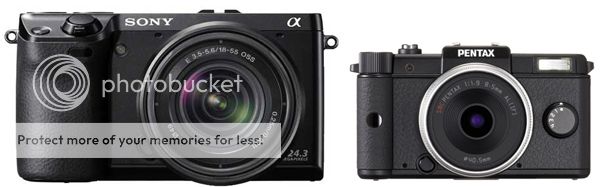
When testing “non m43 cameras” many reviewers like to compare it with the mother of all mirrorless systems, Micro Four Thirds 🙂
Let’s start with Pentaxforums (Click here) that posted an incredibly long and detailed Pentax Q review. They included many comparisons with the [shoplink 23567]Olympus E-PL3[/shoplink]: “The new sensor technology employed in the Q has raised the cap for the image quality possible from a small sensor, but size still matters, and the Q cannot produce the same resolution and low noise as the 8 times larger sensor of our four thirds camera, the Olympus E-PL3. We chose to compare the Q to a four thirds system camera since the price is about the same and this is the closest interchangeable lens competitor in sensor size.”
Steve Huff (Click here) wrote a full NEX-7 review and compared the camera with the [shoplink 23568]Olympus E-P3[/shoplink]: “The 7 has a larger APS-C sensor, the E-P3 has a smaller 4/3 sensor. In all fairness the E-P3 is more fun to shoot and provides results that you just can not complain about. It has a cool factor and some serious mojo even with its limitations and I own it and am keeping it. BUT the NEX-7 is more serious with more potential. NEX has to win this if we are taking body to body. Lenses, Oly wins but then again“.
While I am not a big fan of the [shoplink 26437]Pentax Q[/shoplink], I have to admit the [shoplink 25396]NEX-7[/shoplink] looks very promising. Anyway, the limit of the NEX system are the quality, range and size of the lenses and the future NEX lens roadmap isn’t really appealing me. I hope Olympus and Panasonic will soon understand the potential of a camera like the NEX-7! It was on the bestseller list of Amazon US (Click here) for weeks until preorders have been stopped because of the terrible flood in Thailand that stopped the NEX-7 production. The Pentax is quite popular in Japan but not so in the rest of the world.
70 Responses
The Pentax Q is much better than one think for first – for sure no joke!! There is only a leack of lenses. Performance is excellent!
A m4/3 (Olympus) with all the features & design of the Sony Next (&Pentax Q) would be very fantastic.
But in a way I think they are not able to. Sorry.
i looked at a pentax q yesterday in a store. i have tiny hands and am small for a european, but man it´s way too small.
i really cant see it being used by anyone but the japanese girl cliques, as it´s too small for anything but novelty.
but look at the specs! and it is as small like other compacts, so …
i agree the specs are good.
but its when it comes to changing the lenses and focusing manually, it became a real pain to use. i gave up and looked at the olypus mini and gf3, which are a better size
The m4/3 system really needs a flagship camera at similar level as NEX-7! Panasonic as manufacturer almost certainly has ambitions to grow towards higher end of camera market. I believe it is only a matter of time until it releases a camera with APS-C or FF sensor.
Olympus are in severe problems with its management. Luckily it is other people that does product planning and development. Olympus also is in strong need of a high end camera, though maybe not with the same long time ambitions as Pana.
18 – 20 Mpix
Fully usable 1600 ASA
DR improvement with 2 steps
Fast and reliable AF
Improved quality exposure measuring
Swivel LCD HQ
Built in EVF – at least as good as Nex-7
Simple to use like a Leica M9 – no silly stuff in a multitude of menues – point and shoot people will not buy this ant way.
PanOly need to bring this quite soon – otherwise they will not have any customers for all new and planned HQ lenses. If not it will be like Oly 4/3 lenses: Many excellent and expensive lenses are there, but nobody buys the cameras = no sale of the lenses.
Panasonic has already a competent flagship: the GH2. That camera is now 1 year old, and of course cannot compete in every aspect with the NEX-7. However, with respect to ergonomics and usability, the GH2 still wins. Why? The GH2 has dedicated labeled controls (switches!), which gives you an idea about the state of the camera all time, not only when it is switched on. The NEX-7 doesn’t have dedicated controls, everything is “soft” control, thus, the camera tells you about its state only after it is switched on. This is a major flaw in the NEX-7 usability.
You can bet that Panasonic finds the right answer (i.e. new VF technology), but I hope that they would not simply copy the NEX-7 and keep the GH2 form factor.
The Pentax Q is no competitor. That system is simply too small to evolve to something similar m4/3 is today. To work every day with such a flimsy camera is no option. As soon the hype is over, that system will be forgotten. (Same fate as the Pentax Auto 110).
+1
And there is no chance Panasonic will start a new system based on a larger sensor. Micro 4/3 has all the advantages of “right size” from the aspects of everyday stills IQ, leading edge video quality, portability and function.
Agreed – the GH2 also still wins on video quality, despite being a year older, and the Autofocus is faster and more reliable in lower light, again, despite being a year older.
It will be interesting to see what their next ‘serious’ camera (GH3 maybe) is like, as if it is improved in every area over the GH2, it will be a very, very good camera.
GH2
Lest we get to far ahead of ourselves, here, remember that Sony also needs a camera like the NEX-7.
Only hardcore fans and followers like us will pit current Olympus & Panasonic hardware with what other manufactures expect to sell in the future, yet it’s the common masses who actually drive the majority of sales.
The Olympus e-p3 doesn’t have a “bad” sensor. Yeah, it’s noise ceiling isn’t that high, but with that light anti-aliasing filter, it’s very sharp!
Geez, why are we even talking about the M9 here? That’s an eight-to-nine thousand dollar camera.
The NEX-7? That’s well over a grand, with no great native lenses to speak of.
TODAY, you can buy an Olympus e-p3, f2.0 12mm, f1.8 45mm, f1.7 20mm (panasonic lens) and maybe even an Oly 40mm – 140mm, stick it in a tiny bag with an extra battery and walk out of the house with a camera system that currently does the *best* job in the world in balancing, quality, versatility, ergonomics and speed.
I was mentioning the simplicity in using M9 – has little to do with price!
people seem to forget that pentax q is smallar than a average mobile phone, it has nothing to do with other mirrorless systems imo, it’s really tiny, around 50% – 60% smaller than an E-P3, so such comparisons are pointless, as always check your next store for a real life test, instead of watching product pictures in the internet
for the size the Q is just amazing, would i buy one? NO, would the girl next door buy one? most probably yes.
If it was around 1/2 the price I’d consider buying it for my daughter. Like the K1000 in it’s day, it looks like a nice camera for young people to get started with … but not at those prices.
While Nex 7 certainly seems like a very nice camera, it simply lacks lenses to be a compeling choice.
It’s only relatively interesting lens is 24mm 1.8, but that lens is extremely expensive for what it is and with Nex 7 body it costs over 2k making it very pricey for a 35mm equivalent.
It’s also pretty big setup not really exploiting the advantage of mirrorless at all.
Besides the kit lens and horrible 16mm, there’s 30 and 50mm prime which are to be relesed and 30mm is way too short for macro and too slow for a general prime lens and 50mm while apparently nice lens has got the most uninteresting angle of view of any lens I can think of.
It’s not a portrait lens being 20mm or so too short and not wide enough for general photography.
This is why I think m43 is still a better mirrorless system – no doubt Nex 7 has some major advantage over most current m43 bodies, but lacking a good lens lineup, it’s lenses being DSLR sized is not something most people are looking for in a mirrorless camera.
Here’s an interesting truth – while APS sensors will deliver better performance and always outperform 43rds sized sensors of the same generation, (m)43rds lenses outperform APS sized lenses in optical and especially size and aperture department.
NEX lens solution:
Voigtländer & Leica M mount to NEX adaptor
Going manual-focus on the NEX-7 does not make it a worthy competitor. The fast glass available from Olympus has autofocus, and it focuses very quickly. One of the reasons to use fast glass is for low light, and with low light, you need to focus as well- and this is where the NEX lens selection really reveals a lack of depth.
In a couple of years, if Sony takes NEX seriously, there will be enough lenses for me to justify a switch, because I really do like what they’re doing with their camera bodies, but for right now, it’s too limited a system.
I need (NEED) a 40mm equiv at f1.x, a 50mm equiv at f1.8 or f1.2, and an 85mm at f2 or faster. I rarely shoot telephoto beyond 200mm equivalent, so I won’t need a super-fast telephoto because I NEVER shoot at that focal length range in the dark.
I wish I could move to the NEX-7, but they aren’t ready for me yet.
Attaching a bunch of 1000 dollar manual focus lenses does NOT put them in Olympus’ ballpark.
> It’s also pretty big setup not really exploiting the advantage of mirrorless at all.
That’s what my opinion was for quite some time: NEX is more competition to the DSLRs.
All in all, it is quite comparable to the Sony’s SLT line – just different body ergonomics and feature set.
> (m)43rds lenses outperform APS sized lenses in optical and especially size and aperture department.
I was led to believe (have no hands on experience) that Samsung’s NX system is quite comparable in lens department to the m43: they even have collapsible zoom 20-50mm. Sadly Samsung lags in body design.
A shame that in the world of Mr Huff, only Sony and Olympus seem to exist as options anyone might consider in a MILC.
+1. Although I think you forgot SLRmagic. 😉
Not really, He’s also reviewed the Ricoh GXR to great praises, said great things about the Pentax Q & K Series, etc. He seems to not like the Panasonic cameras, but I think that’s (at the most basic level) because he like metal cameras and not plastic. I think he likes Leica cameras too, but I’m not sure. 🙂
I can only imagine all those people pre-ordering the NEX-7 are quite happy with the lens range as it is. The lack of a super-wide zoom makes it a non-starter for me. The idea of buying a super-wide zoom made for an APS-C slr and mounting it on an adaptor completely defeats the object of having a mirror-less camera.
Presumably the NEX is seen by many people as a lightweight second camera and they will use their slr if they need a super-wide or telephoto lens. The Alpha A65 or A77 are better choices as system cameras than the NEX anyway and have a reasonable range of lenses already.
I would prefer Panasonic concentrated on trying to develop the best sensor they can to put in the GH3 next year, rather than trying to compete with the NEX-7. I think Olympus can continue to contribute with some nice lenses, but I don’t see any strategy at work in their camera range and find it disappointing that after around 3 years, they haven’t launched a camera with built in EVF.
Oly and Pana are losing their lead. I am a big fan of m43, but this NEX-7 is starting to sway me. As most agree, the lenses are the only thing holding me back. However, it’s evident that Sony is listening to their customers (enthusiasts). It’s only a matter of time before they have the lenses. Oly/Pana should have had a camera like this a year ago!
next year (Spring) Sony will bring a couple of new lenses – than it is descision time!!! also for oly/pana… top or flop!!!
Berneck regarding NEX7..”the lenses are the only thing holding me back.” Well since the lenses are 1/2 of the equation…that is a REALLY good reason to be held back.
How can Sony miss the “lens” part of the equation?:
It is beyond me. Even Steve Huff says..the Sony “Zeiss Branded” lens in not super sharp. HUH? Let me tell you…I have a 21mm Zeiss 2.8 ZE for my Canon 5D Mark II. It is one of THE sharpest lenses EVER produced. Period. How can Sony botch their opportunity to make a “compact” , sharp lens with German branding????? (better yet …how could Zeiss approve it?)
How can Panasonic miss the “body” part of the equation?
Why does Panasonic refuse to make a MFT body with built-in Rangefinder-like viewfinder we all keep asking for. And why don’t they produce it with an “ALL NEW” sensor that has better high ISO performance, fast focusing, fuller dynamic range, and fast frame rate? Certainly the company has the capability. MFT has an incredible auto-fucus lens selection and the lenses are getting better-and-better and smaller -and-smaller. I think if they could produce this camera body, NEX is a sidebar. Most people do not need 24 megapixels. Not at all.
Steve Huff said it’s not super sharp as a Leica but still pretty sharp.
Where does Panasonic miss the body part? They have the GH2 with much better and more analogish controls than any digital “rangefinder” on the market, especially when compared to the NEX-7.
It is sad, that the RF fanboys cannot get over the “hump”. They miss a very ergonomic camera.
And don’t worry, Panasonic will address this “shortcoming” probably soon (2012).
Are lenses really a big of an issue as some make it out to be? I suppose if you require AF the lenses selection leaves a lot to be desired, but when you factor in Sony’s wonderful focus peaking and the 1.5x crop factor I can happily use manual focus lenses for most everything I do.
However, even AF lenses will have me covered soon enough. The Zeiss 24mm and the 50mm f/1.8 are both good lenses. Sony will also soon have a high grade f/2.8 standard zoom available as well as an ultrawide zoom. Yes, their lenses are larger than m4/3’s lenses, but they are at least light weight, so they won’t be a bother to carry around in a messenger pack (which is what I have to do with my m4/3’s cameras already).
I think you make the case against NEX very well!!!-
1. AF matters to the vast majority of buyers. Legacy lenses are a minority interest and many don’t make the grade.
2. The Zeiss lenses are good but are twice the size and weight of MFT equivalents.
3. ….you forgot to mention the good NEX lenses are two-three times the price of the MFT equivalents
the whole packeage makes it- but still pana& oly are back in technologie- behind sony!!!
1) I wouldn’t be so sure of that, yes, AF is important, but it seems there is a ton of interest in the NEX-7 for the sole purpose of adapting M-Mount glass. As far as AF users go, obviously one big block of that demographic is entry level users. Sony already has them covered with the 18-55mm, 55-210mm, 50mm, 30mm macro, and 18-200mm. I rarely ever see entry level users shooting with anything other than a kit lens or superzoom.
2) The Zeiss 24mm/1.8 is 63 x 65.5mm and weighs 225g. The Panasonic 25mm/1.4 is 63 x 54.5 mm and weighs 200g. The Panasonic 20mm is obviously smaller, but we’re talking about a totally different kind of lens there. Sony is aware they need more pancakes and have said they are working on it. They will come in time.
3) The Sony 16mm/2.8 and the Sony 50mm/1.8 are cheaper than the Panasonic 14mm/2.5 and the Olympus 45mm/1.8. The Olympus 12mm/2 is also close in price to the Zeiss 24mm/1.8 (both are over priced IMO). All in all I’d say the lens pricing is similar on each system.
In short, it’s not a cut and dry case. I love m4/3’s, especially the Olympus bodies, but depending on the user you could make a case either way. I recommend m4/3’s to family/friends wanting faster AF for their kids, but if they’re just looking for a travel/landscape camera I now tell them to at least test out NEX before buying.
Pentax Q: So small that you can’t even hold it. It’s a complete joke. The size is roughly two matchboxes. Make it pink and sell it to the early teens. It’s not good for anything else, seriously.
NEX-7: Really, really bad build quality, uncomfortable grip, camera is hard to hold, bad and big lenses, has a really nice built-in EVF with focus peaking, sensor regression, drive space eater. Rangefinder spirit, two dials are great to have.
E-P3: Sensor lagging by two generations (but photos incredibly sharp), great JPEG engine for lazy people, very good build quality, uncomfortable grip, camera is hard to hold, has four or five good lenses (all of them are primes, and the Panaleica 25, a standard, isn’t available in every country). Extremely high probability of being obsolete in favor of nano 4/3 (and then pico 4/3) in a couple of years.
Overall, the comparison is between a tiny toy, a small toy and a small toy.
However, the NEX-7 is the most serious toy of them all, due to a built-in EVF with focus peaking, which is just awesome to use with old glass. m4/3 has nothing like that, sadly, and if you’re a fanboy who thinks it’s not necessary, you haven’t used focus peaking and are talking out of your behind.
(Disclaimer: I’m a tall man with big hands. Take the “hard to hold” and “uncomfortable” with a grain of salt, although my regular-sized wife really struggled with all those cameras as well.)
I was at B&H today looking at the NEX-5N when a Sony rep walked up with a NEX-7. I got chance to play around with it for about 10 minutes and I must say it’s impressive.
I had my GH2 with me, so was able to compare a bit. The NEX-7 is thinner and less chunky. Yes, the smaller size makes it feel a bit undersized, but the build quality felt quite good. The control dials work well and are customizable. The EVF is extremely nice and the resolution difference is noticeable, with colors looking richer and the image clearer/sharper than the GH2. There are no touch controls and the interface is bit strange, but usable. Manual exposure and focus are very good.
Overall, the bar has been raised and Panasonic had better step up to match it. Olympus seems to have it’s head buried somewhere, so I don’t hold much hope for them to get it together.
You have described the problems of the NEX-7: strange interface, only soft controls. This is the main thing one has to decide, if a GH2 suits better than a NEX.
Panasonic will catch up with technology easily. They were the first, who introduced large, high res EVFs. So they follow with the next generation of camera bodies. One always is ahead of the other. No reasons to change systems.
Cannot get why always the Oly E–P3 (as MFT example) is compared to NEX, Pentax Q, Nikon 1 etc. when speaking about image quality – and not the slightly better G3/GH2?
I think it is because those cameras look more like traditional dSLRs. It’s painfully obvious that people want a rangefinder type body with a built in EVF…
YESS !!!!!!!!!!!!!!
I find the shape of the GH2 to be far superior to the bar of soap design of the rangefinder body-type. It’s much easier to grasp and use.
Agree.
Just because a few cry out here, it isn’t obvious that so many want rangefinder. Some want, many don’t care, some want DSLR.
I don’t care about rangefinder styling. Overall size and ergonomics are more important to me. Having used rangefinders extensively, I find them easy to use, but if it isn’t going to be a real rangefinder, I don’t know whether that body shape is definitely superior. Once you grip the camera, a rangefinder doesn’t feel that much different from an SLR. It LOOKS a lot different, and the viewfinder is off to the side. Other than that, there’s not a lot of ergonomic difference.
I guess if I had my preference, since I have a bit of a nose, and since my nose smudges the screen on an SLR, I’d prefer if the viewfinder was off-center by quite a bit. It is comfortable there, and with mirrorless and EVF, there wouldn’t be the parallax problem that is inherent to rangefinders.
Soft controls are fine, as long as there are two control wheels- one for aperture, one for exposure compensation. That’s how I’d use it, since those two controls are the ones I use with the control wheels on my E-30 and 5D. Shooting RAW, I don’t need that much in the way of white balance controls, except that there must be a quick way to do a manual white balance off a grey card.
I think it is because those cameras look more like traditional dSLRs. It’s painfully obvious that people want a rangefinder type body with a built in EVF
Do you think the cell phone and m43 form factor will merge together?
http://gizmodo.com/5845043/the-panasonic-lumix-phone-101p-might-not-suck-at-being-a-camera-or-a-phone
Shouldn’t we as prosumers push for that? Imagine you simply keep a m43 phone body on a belt holster with general purpose pancake lens and 2nd collapsible pancake lens in your pocket.
I think recent improvements in m43 bodies and lenses strikes the BEST BALANCE between cell phone photography and pro FF DSLR photography.
I have a cell phone, and DON’T want to lug big pro gear around, especially in places that are off limits to pro photography/video without permit.
Based on the collapsable Panasonic pancake style lenses and ETC mode on the GH2, I get awesome video and photos in places I wouldn’t otherwise.
Not totally sure about that(!), but between my iPhone 4s and the GH cameras, I have the bases covered nicely.
I shoot as much video as photos, and to me panasonic still beats the other formats in video. Even with the new nex supporting acvhd 2.0, still doesnt look better than gh2.
This is why I can’t understand why people don’t see the real strengths of the mirrorless system. It has nothing to do with miniaturization. The real strength of mirrorless is high-quality live view, versatility of lens-adaptation, and video autofocus. If panasonic were to grasp that and put a truly high-quality sensor behind an m4/3 mount with a big, robust, bulky and full-featured camera body, that would sell more than anything else. Americans think bigger is better. It’s only the Japanese that appreciate smallness.
Bulky can’t ever be a good adjective in my opinion. If you’re after bulky cameras, just buy a dslr! why get into m43 to demand a bulky camera? Makes no sense…the “m” in m43 is for “micro” after all, not “macho”, lol
For me it’s all about ergonomics and lenses. Even the Q has enough ‘image quality’ for my needs. I recently picked up film again, after a decade or so. It gives you a whole new perspective on things. It seems that photography has gone a long way in the past few years, but really – nothing has changed. I’m sorry, but if you need clean ISO3200 you don’t know what you’re doing.
“I’m sorry, but if you need clean ISO3200 you don’t know what you’re doing.”
Well, I guess that’s right, unless you intend to shoot indoors in low light without a flash and you can’t afford f1.2, f.95 or similar lenses.
Just sayin’…
Not even that – I’ve done tests with my EP1 and an F1.4 – and when walking around at night and trying to get shots without tripod I find ISO 6400 and I.S. is not fast enough! – so I would say F1.4 lens and ISO 25k (without IS) is the point a camera becomes a true and reliabe substatute for the eye! – so to keep lens costs/sizes down we want to aim for F2.8 lenses and a 100k ISO in an ideal world!!!
Its nothing to do with “how good you are” – the camera simpely can not deliver good images while working fast in very dark conditions. Currently ISO 1600 (most I use on EP1 begrudginly) and F1.4 is JUST about adequit for normal house lighting indoors at night… and a flash is no good at distance!
I would put the other way around.
Clean ISO3200 and above is recent in history. It brings new possibilities. One has to know why and when he needs it, let alone if he really needs it.
Just one extreme example. Last winter game in Vancouver, ISO3200 was not enough for some of the shots taken there. We are talking about professionals that were using f/2.8 tele optics on monopods.
A more down to earth example : you want to expose to the right, to the limit of overblown highlights. High ISO sure is convenient!
Again, down to earth. A 2.8/400 L with a 7D is a terrific set-up for birding. Last time I checked, it is. For someone like me having a GH2, such will remain a terrific set-up on paper. I’d settle for the 100-300 as a compromise. Now, those 2 stops of light lost at the tele end, maybe I don’t really need them, but I would not mind ISO 3200..
From personal experience I agree high ISO is really useful with the excellent 100-300. However, it is the only (niche) instance where this is the case. Sneye has a point – if you rely on high ISO as much as many posters infer, you probably should try to get better light rather than pump the ISO.
Of course. Its all case by case and I am not suggesting that high ISO has become bread and butter.
With proper knowledge, no other excuses are needed.
Oh. Street shooters, a common [or improvised] breed among m43 shooters, are probably those needing high ISO the most [arguably for wrong reasons] I will say this [to their defense] that when capturing the moment, getting better light is not always easy.
With street work, timing and point of view are everything. Motion blur, grit and blown highlights are the least of your worries in that genre. Actually, the more the better.
Back in the days of film, those motion blurs, grits and blown highlights were not exactly an option: you had to live with them (at least in that genre, in harsh conditions). F8 and be there or just try a quick focus at 1.4/50 on a 35mm rangefinder…
Now, it is possible to do without, which does not mean that its not desirable anymore. However, to say “The more the better” tend to suggest that the style has not evolved over the years. I’m not quite sure about that. In fact, having motion blur, noise and everything should be a matter of taste, it depends on what you are looking for and on how you define the style. Its about capturing the moment…
Were I do agree whole-fully with you is that proper gear is no substitute for lack of skills and savoir-faire. Furthermore, lack of such gear (clear ISO 3200+ for instance) should not be a cause of forum whining, much less a reason not to take great photos and that, no matter how great photographer one thinks he is. Maybe not exactly the photos one wants in that or that extreme condition, but certainly some keepers..
Shoot something that’s moving indoors in mediocre light, and you’ll find high ISOs useful. Go shoot an indoor basketball game at your local high school. Even at f3.5 on a nice lens in the 200-300mm range, you’re going to be wanting to freeze the action a little better than 1600 gives you.
I’m sorry, you may be new to photography, or you may have just not come out of your daylight-soaked comfort zone yet, but there really are some reasons to take photos where light is at a premium.
It’s true that nobody needs ISO higher than 800 in a studio, but where you can’t control the light (flash only goes out to about 12 feet) and something is moving, and you have to stop down to get multiple people in focus, if you can’t use ISO 6400, you’re screwed. Yeah, you were screwed with film, too, but the scenario I’ve given is real-world.
More scenarios needing clean(ish) ISO 6400:
A rain-soaked night in the city, shooting people walking after the rain.
Stars (you really can’t just increase the exposure time, they move)
Plays
Concerts
Night games, indoor sports of any kind
Birds ANY TIME
Wildlife that likes to come out in the evening, for example desert life
Romantic candle-lit scenes
Auto races, air races where speed is greater than 100 miles per hour
Any shot not in broad daylight where focal length (or equivalent) is greater than 300mm
Anything indoors at night (people do a lot of things indoors at night, you’ll find)
Ice skating (this one is particularly problematic- ice skaters move FAST)
And finally
If ISO 6400 is usable, imagine how great ISO1600 is for all of those shots not covered, where a fast shutter would come in handy.
THAT is why we want cleaner ISO 6400.
Furthermore, the NEX7 and Q especially are ugly as sin!
At least for the Pentax Q: +10
Sorry, wrong placement.
You and Snakeye are making good points. As a streetshooter I need more DR than high ISO. I shoot in the daytime – having no light is the worse condition at all – no light sculpting bodies or buildings.
I can see that the High ISO fad started with the need of shooting toddlers after work but it will never do interesting photography except for the parents.
NEX 7 I can see doing well for landscape, but the 16mm has bad bad eges. It would be interesting to see how the CV 12mm does with it, but wides aready have problems with m4/3 because of short distance to flange, how more so in APS.
In this precise sense m4/3 might be the best choice, the ‘Big Kahuna’ (TOP). Checking the G3, its 16Mpx might be all I need in the future. Resolution wise it is impressive, and we now have the lenses to match its low AA filter.
I’d rather have Oly’s ergonomics though, and warmly expect a faux rangefinder for Spring. I don’t really need more than good 3200 ISO, and only in exceptional cases, so to me half of the appeal of the NEX 7 is wasted – for the price I could get 2 entry level dSLR with excellent performance and a size which is not really bigger.
Really, if your camera never disappoints you, if you never miss a shot because of motion blur, if you never fail to completely freeze a face, you’ve never shot a graduation, a basketball game, an orchestra, or a party. You’ve never shot street scenes at night, never gotten stars to show up as bright pinpoints on a black sky, and never, ever needed to stop down your aperture for any reason. You’re going commando, running your iris wide open, never wanting or needing additional depth of field. All of your images have the creamy look of a wide aperture portrait- and that’s neat for a newbie but eventually, you’re going to want to take a look at f8 through f16 and maybe shoot a scene with both interesting foreground and background details.
No, your camera is at your eye. You’re the badass photographer, and every shot comes out amazing.
Or, you’re running your mouth about the shots you get right, and conveniently ignoring the ones you just couldn’t make work. Is every lens wide enough for you and long enough for you at the same time? Is every aperture completely usable to you in every situation?
Well, if you had better sensitivity, at least the aperture could be a creative control with less compromise.
Oh, don’t worry- we can beg them for both higher dynamic range AND more sensitivity. The one thing we’re NOT asking for is 30 megapixels.
(people who need that have to just suck it up and take out a )
Love playing the drums to jazz. Brings me to a different state of mind unlike other genre’s. Does anyone play any instruments? Listening to Cole Porter or Art Blakely brings music to a different level. Does anyone here know the art of music or any form of art?
Given the high prices I am surprised to see people with Pentax Q on the street, so I think it does have it niche
Consider that 99% of the pictures are watched on a screen. consider that 80% of the pictures are not croped very much. consider that the features of the pentx q are phenomenal… so…
Regarding the Steve Huff NEX-7 “review”: I haven’t read a more uncritical, biased, blindfolded “review” since a long time. Everything is SUPER, UBER, FANTASTIC, GREAT, AMAZING, THANK YOU SONY (in the review also in capital letters) that someone really has to wonder, if Mr. Huff is on the payroll of Sony.
To me, there are two good things about the NEX-7: IQ until 1600 to 3200 ISO, and the high res OLED view finder. The rest is, well, typical NEX, but not rangefinder.
Mr. Huff gives the impression, that this camera is everything the rangefinder friends were seeking. But by looking carefully to the control layout and thinking what it means, that layout has not much to do with traditional rangefinder operation (leaving the name giving rangefinder view finder asside).
This camera has almost (except shutter and on/off switch) no dedicated controls! Everything is menu or screen driven. This camera tells you nothing about its state, until you switch it on. Typical NEX, just two dials more. They call that “Tri-Navigation”. Every button is “soft”, context driven, no label, configurable. But … is such kind of configuritis really helpful? I don’t think so.
I prefer a dedicated PASM selector, AF control switches, operation mode switches, where you can understand from the labeling, in which state they are. In that sense the X100 is the “anti NEX-7” and even the GH2 (the one with the “hump”) is in that sense more “rangefinderish” than the NEX-7. But Steve Huff through his phenomenal “enthusiasm” want us believe the opposite.
Sony has truely invented a new camera category, which I call “fake rangefinder”.
The NEX-7 is certainly an attractive camera, but not because it is the ideal rangefinder. People should carefully think, if all this soft controlled stuff is really preferable.
Ultimately, cameras like the Olympus PENs and the GH2 are also highly configurable, but not at the expense of dedicated controls. So, the NEX-7 is more like a GF3 than a X100 😉 .
Exactly. Sony can sure make something look sleek, but it all comes down to performance and usability. And that’s where they fail at. Dials with no markings? Looks good…
someone starts a camera site on the internet. they review a couple of things, blog a couple of things. then SONY one of the largest electronics comanies in the world contacts them and send them their latest unreleased camera.
The reviewer´s review then becomes biased, because he didnt have to buy it, he feels that sony is ever so kind sending him the camera, is worried that if he writes a bad review he wont get to review another model, etc.
i would never trust anyones review who didnt´purchase the product. they cannont share the same feelings as a purchaser, no matter how impartial they try to be. even being impartial doesnt help, as when you buy something, you naturally become partial to it cos it cost you so much money.
I agree with the idea that the NEX 7 should be compared with DSLR, or maybe G3/GH2, not the EP3. The reason is price and size. Yes you can get quality lenses for the NEX, but they are much more expensive and much larger than the EP3 (or G3/GH2). So why compare them? Just because they are mirrorless? That’s a bit arbitrary IMO. Put NEX 7 with quality lens on the table next to a EP3 with quality lense and we are talking roughly twice the price and maybe more than twice the size.
Quality video, silent shutter, better DR, better high ISO (on the 5N), more controls (sorry but 99% of the time I don’t need labels on my controls), in built EVF, better in-cam panorama and HDR… There’s a ton if things better on the NEX 7, and I wish m43 would get them (don’t like style of GH2).
But the NEX 7 with quality AF lense is huge so it doesn’t suit what I want, plus is twice the price of EP3 with quality lens. So direct comparisons seem a bit distorted IMO.
I dunno, Nic. We seem pretty happy to compare the m43 camera bodies like the EP3 with DSLRs or with the Pentax Q system or the new Nikon mirrorless bodies when the comparisons are in our favor. Why are the comparisons distorted when the competition comes out better?
The NEX lenses are bigger, yes – but the body is smaller – a draw in my opinion. As for cost, the differences are in the same ballpark as you would consider when comparing comparable DSLRs.
Seems to me like these cameras are after *exactly* the same market segment – so the comparisons are completely valid.
Just my $.02
We’ll see. NEX 7 may attract a lot more DLSR users that EP3 ever will.
Not sure that a lot do compare Pen with DSLR, or mainly to show how different they are.
But yeah, similar people are interested. Day to day though, how you would see these cameras used could be quite different. NEX 7 with the big Zeiss is not discreet.
Panny’s sensor strategy is simple – the next big advance is reserved for their flagship, the GH3, just as it was for the GH2. You will not see a next-gen sensor appear in a lower-end camera until after the GH3 launches.