








[shoplink 25320 ebay]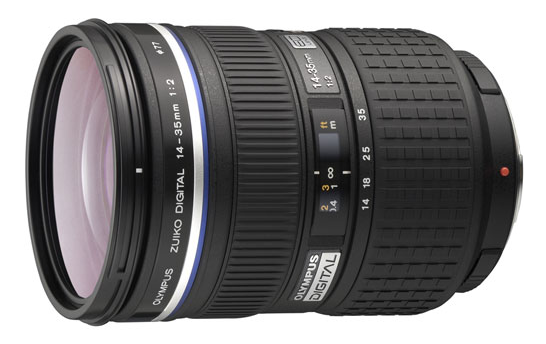 [/shoplink]
Image on top: The [shoplink 25320 ebay]Four Thirds Olympus 12-35mm f/2.0 lens[/shoplink].
Many times we read on forums and websites about the possibility that Olympus may use larger sensors on future Four Thirds cameras. But would current FT lenses cover a larger circle?
Lloyd Chambers (Click here) tested the [shoplink 25320 ebay]Olympus SHG 14-35mm f/2 ED[/shoplink] on the Nikon D800 and proved that the image circle is 23mm while the MFT diagonal 21.3mm. SO no, there is no chance FT lenses would work on larger sensor cameras. Lloyd seems to be surprised because he speculated that the image circle would be much larger: “based on the fact that the performance of the SHG lenses is so outstanding, even compared to Leica M glass.”
I bet many here would love to get some of these super FT lenses in a more smaller and native MFT package!
—-
14-35mm f/2.0 on [shoplink 25320 ebay]eBay (Click here)[/shoplink]
35-100mm f/2.0 on [shoplink 25119 ebay]eBay (Click here)[/shoplink].
103 Responses
Yes, but it could cover APS-C sensor! Just overlay his image with http://www.dpreview.com/learn/Articles/Glossary/Camera_System/images/sensorsizes.jpg . Possible joy for NEX owners 😉 – a 21-52mm F2 zoom!
“23mm while the MFT diagonal 21.3mm”
The spare 1.7mm would not allow coverage for an APS sensor which has a diagonal {Sony, Nikon, and Pentax} of 29mm ,it couldn’t be simpler than that.
Plus any larger or more rectangular sensor would show the truth about those magical Olympus lenses. Namely the performance is boosted by the small sensor and by the 4×3 ratio which in effect reduces greatly the extremes edges of the sensor used. Cropping a 3×2 sensor to 4×3 is by far the easiest way to improve the performance of every lens you own. With, the major bonus that the Oly fanboys would stfu . Think I am talking BS , download any RAW file from any camera with the worst rated lenses and then crop the image to the largest 4×3 ratio crop you can fit in the frame now see the advantage . It is the extreme corners that influence the results from FF lenses,
With the high MP monsters like the D800 you would still have a 32mp file. The BS from Oly fans is straight up annoying
What a load of old cods wallop.The image circle is not made to fit anything other than a 43 sensor. All your waffle about corners is utter rubbish in this blog. Because 4/3 and m43 users have known that for years. That is why the format came about, it was designed that way.
I use many format lenses on my 4/3 and m43 because the sensor picks up the sweet spot of the lens. I use Olly lenses also because they are smaller and most often better than apsc and 135 offerings for my needs.
Taking your line I should cry because my 135 and m43 lenses make a mess of an image on my 6×7 MF. But unlike you I do not expect them to perform on a bigger sensor.
You clearly do not understand 4/3 or m43.
Actually, what Lloyd proved is that the masking at the rear of the 4/3 lenses precludes covering sensors larger than 4/3. Most of us suspect that the actual image circle is bigger (image circles are not rectangular ;~). What you’re seeing in his example is the rear portion of the lens construction masking the image circle. This is sometimes present in lenses, especially wide angle ones. Some of the Nikon DX lenses also have physical disruption of the full image circle.
So the real answer here is: existing 4/3 lenses can’t cover more than 4/3. The 4/3 lens designs probably could cover a larger sensor if the internal baffling were changed. How much larger a sensor is not known.
That’s the point I made earlier. The baffles on 4/3 lenses were advertised as a feature of these lenses. You have to suspect that some of these lenses might even provide almost full frame coverage if the baffles weren’t present.
The baffles are in 4/3 lenses for a reason. To reduce stray light in the camera during exposure (and not to screw the peope, trying to fit these lenses on bigger sensors). This way image contrast is better. Even if you would remove the baffles, sharpness would definitely suffer on the periphery (Byebye image quality).
C’mon guys, why can’t you believe Olympus, when they say lenses are designed for 4/3 sensors.
I don’t really understand this McGyver mentality of people, trying to prove they can fit things, which are not designed to fit. Sure these bigger sensor cameras have lenses of at least similar quality than Olympus (if you are interested in photography that is) or you can use Olympus cameras if you can’t live without these lenses.
If you are interested in mechanical tinkering, you should be better served elsewhere… including RedBull competitions…
I think you have completely missed the point. No one is actually trying to McGyver a lens to fit it to a Nikon camera. This was tested to see if existing 4/3 lenses could work on a larger sensor size. This helps in evaluating whether or not there is any credence to the rumors of Olympus looking at larger sized sensors.
If Olympus could keep the same lens designs and size, with a bigger sensor… maybe there’s some truth to the rumors.
On the other hand, if a larger format also means starting over from scratch with their lenses… I seriously doubt that it will happen. This test just served to eliminate or disprove one of the factors of such a decision.
So with this test you have proved what Olympus is telling us all the time. OK, I have nothing against sceptics.
I have seen a soft drink bottle (from USA), labeled ” WARNING ! If opened bottle is placed horizontally, the liqid will spill”. Will you challenge this statement too?
????
Some people were trying to suggest that 4/3 lenses could work on a larger image circle. This tester tried an experiment which proved they wouldn’t cover FF.
It seems to me that this was the best way TO disprove something. A story about soft drink bottles is interesting (though not particularly relevant), but it doesn’t carry quite the same weight as an actual test.
+1
@Fish almost has it.
One of the reasons why people are looking at this has to do with statements made recently by Olympus executives. Olympus apparently is at least looking at other sensor size options. So the immediate question is this: how would they do that? The possible answers are three:
1. Go back to full 35mm frame (means expensive cameras). To do this they’d have to resurrect the old Zuiko lenses, but they were all designed prior to digital, and many would need redesign.
2. Start from scratch. This gives them flexibility to pick sensor size based upon economics, but it means that they need to design yet another set of lenses.
3. Use existing parts. If the 4/3 lens designs could cover APS sensors with a change in internal baffling/cams, this is a much less intensive design problem than both #1 and #2 when it comes to lenses.
The hypothesis underlying all this speculation is this: any new sensor size from Olympus would require a full set of new lenses. Despite my articles noting that Canon and Nikon have gotten away without doing that for DX/APS, they had existing lenses that worked to fill gaps (not well, in my opinion, but well enough apparently). Olympus won’t have that, so would be running from behind until such time as they can get a full lens line available.
Olympus has put themselves in a tricky spot. m4/3 is doing well for them and most of the reason they still have an imaging division. The question they’re facing is whether they can make it their ONLY foray in interchangeable lens cameras. The growth numbers say no, that m4/3, like the rest of mirrorless, will peak lower than DSLRs. Thus, they, like the rest of the camera companies are looking for where they can add growth. Can they move some existing users up from m4/3 to something else, for example, while continuing to pull new people into m4/3?
4/3 is problematic. From an image quality standpoint, 4/3 can’t offer anything better than m4/3 unless they cripple m4/3. The OM-D and the recent primes say they they’re not going to do that. Thus, trying to resurrect 4/3 probably doesn’t make a lot of sense. Sure, a state-of-the-art E6 might have some saleability, but anything lower than that runs into the OM-D. Meanwhile, two of their primary competitors (Canon/Sony) are already APS and Nikon has patents showing they might do a DX mirrorless, and both Canon and Nikon have filled out a relatively strong full frame DSLR line. So the possibilities aren’t endless for Olympus, and each has problems:
1. Full frame. Flies in the face of the duopoly that owns it. Sony hasn’t shown that they can get any leverage here, how would Olympus be different? (Simple answer: OM4d, a small, light full frame choice).
2. APS. Puts them squarely in the same most competitive league as Canon, Nikon, Pentax, Samsung, and Sony. Without any lenses (see above ;~). Means they have to run faster and better than the best in the business.
3. Other sensor size. There are no other established sensor sizes bigger than 4/3 that make sense. The current sensor sizes are about a stop apart in terms of image quality. Trying to slice that by half steps probably is slicing too small. Moreover, we’re back at the same lens problem.
I’ve long argued that to beat the Canikon duopoly there is only one choice: complete disruption. You have to change the game. To a large degree m4/3 did that, and it’s part of the reason why Olympus is still with us as a competitor. But it was an easy disruption to counter competitively, and it’s now surrounded by other options, so Olympus has to stay on top of execution to continue their success (to their credit, they have). But it wasn’t a big enough disruption to change the dynamics of overall market share: Olympus is back to where they peaked and growing market share slowly.
You can disrupt in three primary ways:
1. Change the definition of “camera.”
2. Change the distribution and sales.
3. Change the company/customer relationship.
I’ve long argued that the key to #1 is communicating, programmable, modular. And like m4/3 did, you have to make sure that you open those things up to other players so that you build a strong ecosystem around your disruption. We’re starting to see everyone add communicating, but not in any particularly defined way. We’ve seen Nikon, Samsung, and Sony add programmable, but only for their own intern-level programmers and mostly as “features for sale” or “point people to proprietary cloud offerings.” We’ve seen Ricoh add modular, but in a weird, non-economic way. This game is still open for someone to do the right thing, the right way, and with the right openness.
Other than Canon/Nikon/Sony, here in the US there really aren’t any strong distribution players. Olympus probably comes the closest, but they’ve lost a lot of their dealers (and pissed quite a few of them off with some of their practices), and they no longer have the scale to play game as it’s being played by Canikony. There’s the Dell model that hasn’t been played in cameras yet, and it adds about 15% to the margin, which is a lot to work with. Done right, it also requires that you do the last disruption: connect with customers directly and completely.
I don’t know what Olympus is going to do, but the reason why all of us who analyze the camera market look at things like lens coverage when executives make statements about looking at possibilities is to try to figure out what is easily possible versus what is difficult or impossible. My personal take is that 4/3 doesn’t really give them a lever to anything. Even if they could do a quick redesign of lenses and come up with an APS sensor system, that’s running the wrong direction, right into the lion’s mouth.
Thom, many good points and I agree with the general story.
With regards to ‘DSLR’ versus ‘mirrorless’ there are however a few things to keep in mind:
– most mirrorless systems are not yet technically capable to do all the things an ‘advanced’ DSLR does, especially when it comes to continuous focus. Those systems that do come close currently lack lenses and/or bodies of sufficient quality and performance.
– the current mirrorless systems from both Canon and Nikon are crafted to not compete in any significant way with their DSLRs.
Hence I think it is not correct to judge where mirrorless will peak compared to DSLRs based on current implementations, as all of the mirrorless systems either have functional or system completeness limitations that are not inherent to the concept of a mirrorless system.
Interesting analysis by Thom, but I have to agree with bart that it’s not possible to know were mirrorless will peak based on current models. One breakthrough (in continous focus/focus tracking) is all that’s needed to make mirrorless competitive all the way up to professional dSLRs, at least for many people.
So I’m not sure if mFT is restricted to a certain market share, a lot of people value compactness and mFT offer IQ that’s good enough for most uses and fairly competitive with APS-C. The main reason I see today for reccommending a crop-dSLR is af-performance and if that problem is solved then I believe mFT could take much bigger market share.
and other tests have it differently
one wouldnt expect a 43 lens to cover a FF sensor
but they would cover APSC, the question is how big an APSC
43 Kit lens on a Pentax 1.5x
http://i194.photobucket.com/albums/z179/realink_album/review/102682289.jpg
Another test by Jay Turberville using 40mm deep boxes, take a look
(Image is the property of Jay Turberville)
http://i194.photobucket.com/albums/z179/realink_album/review/ZD_circle_survey_zpsf45a5af4.jpg
oh and the baffles thing
somebody explain why a lens supposedly limited in image circle by having baffles has a round image circle. BZZZZZZZZZZZZZZZ
Not sure what you’re getting at…
Of course the small sensor and 4:3 aspect ratio help with image quality – this was one of the fundamental aspects of the Four Thirds system from the beginning. All of the Oly ‘fanboys’ know this, it’s probably why they’re fanboys.
There is nothing in the (m)4/3 standard about the aspect ratio*. There is only the image circle diameter. Therefore native (non-cropped) 3:2 and 16:9 ratios as used by some panasonic cameras are legit. In each case the corners of the image extend to the circle boundaries. Any arguments about the quality of 4/3 being boosted by the ratio are rubbish.
*4/3 as in 4/3 inch plumbicon image tube, ca 4/3 inch on the outside diameter of the tube.
>> “Cropping a 3×2 sensor to 4×3 is by far the easiest way to improve the performance of every lens you own. With, the major bonus that the Oly fanboys would stfu . Think I am talking BS…”
You *are* talking BS! 🙂 Perhaps you are right in that creating good lenses is easier with the 43 format than with the 32 format. But if so, that just proves that Oly/Pana are *smarter* than the other companies! You try to make it sound as if the 43 format is *cheating*, and that it is unfair to compare the high quality 43 lenses to those of other formats. But this idea is what is BS. There is nothing wrong in tuning the various parameters of a system to make the whole of it as good as possible. This idea (which is key in the m43 pholosophy) has nothing to do with being a fanboy. Quite the opposite — one has to be utterly “one-eyed” to *not* agree with this.
THe guy is right about the 4×3 crop instead of. 3×2 ratio making a huge difference in the edges. IT is very effective evn truly poor lenses like some of the Nex options give far better results when cropped to 4×3 ratio. Claiming amazing corner performance on 4×3 when they do not use the extreme edges of the image circle is a bit silly. I checked his D800 claim ( I thought he was talking BS ) and it is true you can still get 32mp in a 4×3 ratio and get far better corners.
I even tried with the Nex 7 with the poor / crap kit lens and the 16mm by downloading raw samples and it is true the edge performance is very significantly better.I am a mFT user and I am delighted with the results , but it is interesting to see what happens when you compare images with both having the same crop ratio. I suppose that’s why they chose the ratio in the first place
But you’re not comparing images with the same ‘crop’, because Four Thirds images at 4:3 are NOT cropped. That’s just their native aspect ratio. When shooting 4:3 on a (Micro) Four Thirds camera, you are using the extreme corners, but the ratio just means that less of the outer parts of the image circle are used.
Comparing this to a 3:2 format cropped to 4:3 is silly, but then it IS a crop – ie. you’re taking an image that uses the full image circle and and then cutting off the sides, so what you are left with is just using the centre.
🙂 ha,ha,ha
why dont u try to use ur Nikon DX lenses on a Pentax 645D or any other medium format camera… just to take a laugh 🙂
Is not a Olympus,Panasonic or Sony fault if Canon and Nikon are manufauting lenses almost the same way as 10-15 years ago and with worst results.
Not trying to be rude but are you retarded? Like, honest question.
For some unknown reason OLympus has a disproportionate number of borderline nut job fans. It is sad for the rest of us Olympus users as the make us all look like dicks.
Rumours websites have a disproportionate number of dicks, 99% of the readers and commenters here are camera owners and so far removed from photography its sickening. Most have only been shooting a few years. It’s obvious.
Actual photographers only ever talk about gear as it DIRECTLY pertains to a photograph. This site is awesome for finding deals and even getting the odd rumour. Unfortunately the discussion is mind-numbing at best and the authors just feed the fire for page-views.
There is nothing in the (m)4/3 standard about the aspect ratio*. There is only the image circle diameter. Therefore native (non-cropped) 3:2 and 16:9 ratios as used by some panasonic cameras are legit. In each case the corners of the image extend to the circle boundaries. Any arguments about the quality of 4/3 being boosted by the ratio are rubbish.
*4/3 as in 4/3 inch plumbicon image tube, ca 4/3 inch on the outside diameter of the tube.
FT is dead. m4/3 is the future. Oly should be more serious about developing this SHG for m4/3 version.
I don´t understand why he slaped this lens on the FF sensor (and not on the aps-C or aps-H) and he clearly says that “Olympus SHG lenses have no potential to cover a sensor larger than Four Thirds / Micro Four Thirds.”
Me too.
In fact I cannot understand the point of this test. Why did he try to prove this? Oly will not make larger FT sensor, of course.
Oly have stated they are investigating a larger sensor for the next 43 camera. No size was mentioned. (it could be square and marginally bigger by a few rows of pixels)
To find out if the key lenses would support a larger sensor Lloyd tried his experiment.
One thing I noticed is that focus was way out which means he may have got the flange distance wrong, that in turn may have an effect on image circle as taken and measured by him.
Yes, slightly different ‘projection’ distance typically results in (slightly) different magnification.
Where? Where did Oly say this, officially or publicly? Where did anyone other than an internet rumor say this?
Oly will not make a larger sensor for 4/3.
Someone’s uncle was told by someone else’s aunt who knew someone who spoke to some one who knew someone at Oly. So. Its not far off the truth and got FT2.
Lord, what else do you want. You are here, 43 Rumors.
Who the hell is Lloyd Chambers?
He’s Lord Hardwick’s cousin, thrice-removed.
Ah yes, we met at a cotillion a fortnight ago. Strapping lad, that Lloyd.
His farther knew Lloyd George…..
Typo: ‘Father’.
I thought you were trying to spell a pronunciation out phonetically…
and this is what I wanted to ask second.. who the hell is this guy? what a stupid test, wrong flange distance to the sensor, not the best senzor for the test picked and it all looks like he invented hot water.. bravo
Yes, that ‘I invented hot water’ attitude of Lloyd is not doing him much favours.
We are quickly approaching the age of a unified body—a system capable of accepting variable mount lenses.
Oly has to get back into the game of full-frame. One camera to rule them all!
The age of the unified body? Seems less likely than ever IMO.
Exactly! “Larger” doesn’t mean necessarily mean full frame! To me APS-C would be more than sufficient! And if inside the new camera there was a sensor like in Fuji X-pro1 I would be in heaven…hmm… we’ll see 🙂
These were/are AMAZING lenses. It is frustrating for the owners of this glass to have this quality of lens and be unable to have a modern sensor that allows full function of the lenses. I just looked up the above lens and compared the test results to the new Panasonic 12-35mm f/2.8.
It isnt’t even close. The Olympus is far superior AND it’s an f/2.0!!!!!!!!!
Now I understand the frustration for the owners of this glass. It is still selling at full price too???
You would hope that the Olympus would be significantly better, it’s more than double the price.
The 12-60mm F2.8-4.0 performs better than the 12-35 as well tho, at half the price.
Um sorry?? B&H prices as of today…
ZD 12-60/f2.8-4 SWD – $999
Lumix G 12-35/f2.8 – $1099
That’s $100 difference, which is a bloody long way from ‘half the price’…
I bought my 12-60 new for $799. It also has an extra 25 mm focal range. Considering optical correction versus a whole lot of software correction, and price, I find the 12-60 vastly more interesting than the 12-35. Of course, the 12-60 sucks on a m4/3 body due to AF lacking AF perormance, so it’s not a very good combination at this point, if AF matters.
What? Panny 12-35 is absolutely a gem. It’s the best lens ever made.
LOL! …it is a good lens…
Yeah, it’s just not nearly as weatherproof as it’s being advertised to be. Or were you being sarcastic?
The Zuiko 14-35/2.0 (as is evident from the photo, not 12-35/2.0) is known to be a super quality lens, even wide open. I seriously doubt that the Pana 12-35/2.8 is better, BUT the Pana is (i) smaller, (ii) lighter, (iii) much cheaper (if the Pana lens can be described as “cheap”), (iv) more suitable for m43.
Some of it is becoming much more affordable. Olympus has manufacturer-refurb’d 150mm f/2 lenses for fairly low prices now.
Olympus should get the Sony E-M5 sensor in a new DSLR as soon as possible. It doesn’t have to be all that different from the E-5 – the new sensor would make it a worthwhile upgrade for existing E-System shooters.
Olympus, regrettably…will not be making another 4/3’s camera. The higher-ups have alluded to an MFT camera that will “better” accommodate the 4/3s lenses…but to what degree at this point is unknown. Olympus has to spend their money in a direction that gets them the most return. Making a 4/3 camera at this point in time, sadly will not do that. Hell…but $75 lens-shade premiums and $300 additional for some black paint on a lens will!!! 🙂 (love and own their products…but that can leave a bad taste in one’s mouth).
This is hardly surprising as most 4/3 lenses have baffles to restrict the image circle. In other words it isn’t just a matter of whether the lenses can cover that image circle, but the baffles which prevent a wider image circle.
Just because a lens projects an image circle that is larger than the format it covers doesn’t mean the available extra coverage is useful, since the lens is not corrected all the way to the edge of the image circle.
Glad you said that it needed saying.
The image circle of the lens must be bigger than the usable diagonal of the sensor. As there is deterioration towards the outside of the image circle, then either the image will show softness, fall off, distortion or other unwanted attributes. So the manufacturer makes the lens a bigger circle to have most of the problem outside the sensor limits or the manufacture spend a fortune on special optics to correct (minimise in reality) the problems, or they are corrected (well masked) by software.
The reality is a square format (round is not nice) is the most efficient sensor for any lens. 3×2 and wider are not so good. If we look back on the 35mm film, using double movie size was a mistake, it should have been a square based on the 35mm film (126 comes to mind). Then all this hassle of 3×2 images side problems would not be spoken about as it would have been unknown. (ok, the 4 corners might be a bit off but not all down the sides)
Exactly, not to mention, in order to be able to support in-body image stabilization you actually need a slightly bigger image circle, else you’ll just be moving the sensor partially out of the image circle when compensating for camera movement.
Would this be true if the Olympus FT lens would be mounted on a mirrorless system?
If the lens can be closer to the sensor, the sensor can be bigger right??
No.
Putting it closer to the sensor will just result in not being able to focus on nearby objects, or (depending on how much closer to the sensor you put it) not being able to achieve focus at all. The lens will however be able to focus way beyond infinity.
This is actually the reverse of what extension tubes are based on, they put the lens further away from the sensor, resulting in not being able to focus on far away objects, but being able to focus on nearby objects.
With regards to lens to sensor distance and magnification, this is something you can easily verify with a simple magnifying glass. Larger projection distance allows for bigger magnification from the same objective lens, so putting the sensor further away from the lens would help covering a larger sensor, but at the expense of being able to focus to infinity.
I don’t want to address all 43rds lenses, but the 11-22 (a wonderful lens BTW) is absolute mush in the far far corners and this is not due to vignetting from some internal baffles.
its because the 43 lenses are all telecentric back end design, very parralel exit light to the sensor – not much spread and negating the need for microlenses to accomodate acute light angles on the sensor!
Jim is right. Olympus designers spent a lot of time explaining this when the system was introduced.
The same designers that think silver is a normal color and the marketing people that feel charging an extra $300 for the black 12MM VS the silver is going to keep customers. My OMD was my first and last Olympus purchase, I will not support a company that uses these sleazy pricing techniques. Seems the new strategy is to release all lenses in silver and then charge a premium for black.
Yes, it was one of the points for design, some others here should find out about the system before suggesting 135 sensors and such.
The E-M5 does not handle Oly/Zuiko 4/3 lenses well … auto focus is off in my experience. Does anyone know whether the Panasonic GH3 with 4/3 adapter has accurate auto focus with Oly/Zuiko 4/3 (as distinct from m4/3) lenses?
Thanks, John H
I use the 14-42mm, 9-18mm and 12-60 4/3 lenses on my EM5, the 12-60 is slow to focus the others being a bit faster but the quality is not a problem. I use the 4/3 14-42 often because its better than the m43 14-42. I have no doubts that the SHG lenses would be far better, but I live in a world where I use money for food and petrol before SHG lenses (unfortunately). Samples.
14-42mm ED on EM5 at darling harbour + imagination http://www.flickr.com/photos/54912595@N02/8107074808/in/photostream
and Grandson snaphot. http://www.flickr.com/photos/54912595@N02/8107412726/in/photostream
This is example m4/3 lens should have with the similiar aperature .
I agree the Pana 12-35 is a good lens but just not fast enough .
M4/3 lenses have to be fast , very fast in order to excel .
Since Pana can’t come out with it , it’s Zuiko’s turn to realize it .
That should be 14-35 not 12-35 lol
What is all the clamor for Olympus to use an aps-c or “full frame” sensor? There is no magic sensor size- they just provide different choices and different compromises.
If you want a full frame camera- go buy one! There are plenty of options to choose from- already existing in the form of real live cameras that you can buy today. Why do you want a company already strapped for cash and limited in resources to take on an entirely new direction and start fresh with another system that will take years to establish?
It doesn’t make sense. The only reason for it would be a sentimental attachment to the Olympus logo on the front of your gear. If you’re a fanboy, embrace it and admit it. If you’re not, and you want FF, go buy one.
Why get overexcited about larger sensor? want a larger sensor? get a NEX or Fuji!
Meanwhile in my dreams… If Oly were to release an AF 25mm f/1…
now THAT would draw people to m43
Not long ago was posted a comparison between m4/3 and 35mm sensor usong wide angle lenses and this showed that the oly 12mm f/2 lens was better than a canon 24mm lens on the 5DII. Tha point here is: m4/3 is pushing the limits of optical design to a point of excellence. superb lenses are being made and new camera bodies with better sensors and image processors and control capabilities are being made too. we are reaching a point where cameras are so capable that they are no longer a limitation to photographer´s vision. if u want 35mm go for it, if u want lighter, discreter and capable cameras, well, there are options.
“m4/3 is pushing the limits of optical design to a point of excellence.”
You need to stick “heavy software correction required” in there or you are propagating misinformation by omission.
> “heavy software correction required”
It’s: Heavy software corrections for softening image outside center.
Common thing for those m4/3 lenses able to reach highest resolution all around frame is that they use least amount of software corrections.
Stretching of image/its pixels done by geometric distortion correction is simply poison to resolution outside center.
That’s why Lumix G 12-35 has such resolution drop outside center and premium 12mm m.Zuiko can’t match 12-60mm.
And that’s why m4/3 is a no-go for me until my 12-60 focues well on a m4/3 body.
Covering a larger circle than is necessary just means that the lens is letting extra unneeded light into the camera. That light can only lower image quality by bouncing around & lowering contrast. No optical engineer would ever design a lens to cover a larger area than necessary for exactly that reason.
we all know that FF Nikon cameras can use Dx format lenses. So for example future FF Olympus can use these lenses with same way. Can use a 24MP sensor and use 10 MP of it with old lenses.
What can you put in a circle ? .. a square .. so perhaps using all the covered area with a square format .
I don’t see why anybody thought it was necessary to do this test.
If you look at the published Olympus MTF curves, for lenses such as the 12-60 or 14-35mm, it can be seen that at the minimum focal length, the performance is in decline at about 8-9mm from the centre of the frame. For the APS-C sensor used in Nikons (23.2*15.4mm) you would need an image circle of nearly 14mm: using an FT lens on such a sensor would lead to a large area of the frame having low contrast and resolution performance.
Of course you would expect the usable image circle area to increase as you stopped down, but what’s the point of using these expensive EHG lenses if you can’t use the full aperture.
Similarly, the MTF curves for the Olympus 300 mm f2.8 make one suspect that this particular lens could probably be used with larger image circles, but again, there is no point, as there are plenty of 300mm f2.8 lenses made for larger image circles, that are about the same size and weight as the Olympus lens, and often considerably cheaper.
I do not see the problem to use m43 lenses on possible mirrorless FF in the crop mode.
I suppose common sense logic would be enough to conclude that the Olympus lens is in a very different league compared to any full-frame-bound 14mm lens, judging by the looks alone…
And this is news?
It must be boring in the office today…
They should do a square sensor, and design the camera body accordingly. I’d love to have relatively compact camera based on a square sensor. And they could use a much simpler LCD panel viewfinder for on angle viewing. But the LCD must have good enough daylight viewing.
What!? An Internet Web Lens Engineer is shocked about something he knows nothing about? But Interneters are so smart! Color me flabby-gasted.
DA-HERP
This “test” is bullshit. He should have used body with proper flange focal distance, like 1.0 or 1.5 crop NEX.
Actually, all Olympus lenses have circle somewhat larger than 43 sensor, due to IBIS.
But…
>might actually have been engineered to cover more than a Four Thirds sensor
No sane optical designer would have done this! With others things equal (size, cost) increasing IQ in unused periphery degrades IQ in center
About can it cover APS-C or not. He measured a circle of 23 mm.
Let’s calculate (OCD – outer circle diameter):
Sony NEX APS-C – 23.5 x 15.6 mm, OCD = 28.2 mm
m43 – 17.3 x 13 mm, OCD = 21.6 mm
APS-C 4:3 crop – 20.8 x 15.6 mm, OCD = 26 mm
APS-C 1:1 crop – 15.6 x 15.6 mm, OCD = 22 mm.
to have a bigger sensor in 4/3 format to cover a diagonal of 23mm we calculate a sensor of 13.8 x 18.4 in a 1:1 format the dimension will change for 1:1 to 16.27 x 16.27 and in a 16/9 format will change to 11.3 x 20.9 mm.
A multi aspect sensor will probably be the best solution to gain surface.
If we calculate the gain in pixel with a dimension of 13.8 x 18.4mm in a sensor developed with same EM-5 technology we will have a 4900 x 3675 pixel equal to 18MP
just a little help for cropping 😉
Visual comparison 😉
https://picasaweb.google.com/106234918353279908904/M43?authkey=Gv1sRgCKG75Onvj7qkvwE#5801713385755679970
I once read that in order to have the same resolution of FF Oly 4/3 lenses needed to have twice the sharpness? Is it true IYO?
That would explain why only a superior optics maker could elect such a format.
When the debate about the 12 Mpx happened I remember one Oly designer saying: ‘if you need more, go FF!”
I also read that the old 4/3 lenses were designed to resolve 20 Mpx. It would be interesting to know if this holds true with the new sensors.
At any rate there is a degree of resolution that cannot be detected by the human eye.
There are also diminishing returns in DR. The more DR the less contrast you’ll see, like in HDR.
So the case for FF is weakening, not increasing with technological change. What is not weakening is the case for a lighter system. And that is the whole rationale for m4/3.
BTW some of the best lenses, like the PL 25mm have v. little or none FW correction, but so the new Sigmas.
As the surface of a 135format is about 4 times the on from a (m)4/3, the last m43 sensor at 16mpx will convert to a 64mpx on a 135.
When Nikon gots the D800 out, they said that you will need their best lenses to resolve it.
So, on an mtf the Zuiko can resolve more than others. But it is not the end of it. The things is you don’t need a lens as good as the Zuiko to get higher resolution like on the D800.
That’s also why my old OM Zuiko are ok on a (m)43, but are kings on 135. And anyway an old 24mm f2 is a really bad normal lens, but a good wide angle.
Amalric, yes, when comparing 2 systems where one has a ‘crop factor 2’ compared to the other, and the same number of pixels, you also require twice the resolution, but that is in ‘lines per inch’. So if (just for the case of the argument) the ‘large format’ system would require 100lpi to make full use of its sensor, the ‘smaller format’ would require 200lpi for the same result. Note that this concerns linear resolution.
As a consequence, a ‘full frame’ 135 format sensor with the same size pixels as a 16mp 4/3″ type sensor will have 2x2x16mp = 64mp. Why 2x2x16mp? because you double the resolution both horizontally and vertically.
Lenses that can resolve 16mp with a 4/3″ size image circle are plenty, lenses that can resolve 64mp with a 135 size image circle are extremely rare.
So.. in pixel count the difference is a factor 4, in linear resolution a factor 2.
Thank you bart. What I meant is that I see no advantage in going FF. That niche is already occupied by C&N, and we know that the limiting factor is size of lenses,
Sony’s attempt at FF mirrorless is interesting, but no one is betting that the size of lenses can be as diminutive as the new body.
So why Oly should leave a format where it has a comparative advantage for uncharted territory?
Would they be able to revive the OM series as Thom noted?
At any rate this thread shows that there is no advantage in trying to adapt 4/3 lenses else to m4/3.
Perhaps they could attempt FF mirrorless like Sony. After all it seems that people are getting smarter. If quality is excellent all one needs is a few primes to start with, like Fuji shows.
Yet I don’t see the advantage for us mean consumers: quality is just so good with cropped sensors. Why spend twice as much to get differences a human eye cannot detect?
Perhaps it’s just the effect of competition to drive the hype always higher…
Believe it or not (based on past discussions) but we seem to be totally in agreement 🙂
Olympus is about a decade late for making a ‘full frame’ move based on the OM system. They could have picked up where they left things in 1986 after the 707, but they didn’t, and I doubt that is a good way to go.
Thom is absolutely right about FourThirds not being able to provide any real advantages over its ‘micro’ cousin when looking at image quality, and once Olympus or Panasonic gets the ‘continuous AF’ part addressed sufficiently, I also don’t see how it would offer any functional advantages, with one rather fringe exception, EVFs don’t interact very well with ‘night vision’ currently. Not an unsolvable problem, but one that currently is not addressed.
Anyway, if Olympus is serious about reaching out to pro photographers and be successful, they’ll indeed have to come up with something that seriously disrupts that market, and better image quality won’t be it.
> Perhaps it’s just the effect of competition to drive the hype always higher…
Just like megapixel race of compacts… when they often struggle to produce even 10MP worth of real details because of diffraction and lens aberrations. (+ heavy NR needed by microscopic pixels)
Read the later post on the 70-200 usm and pany 35-100.
Start weeping cause you won’t stop for a long long time.
Just go elsewhere with your thick comments.
amalric. You just hit the nail on the head.
“quality is just so good with cropped sensors. Why spend twice as much to get differences a human eye cannot detect?” Yes, yes I keep saying this as well and I will say it again. Is the object to take pictures or diagnose a camera. If there were no labels on the images very few, very. very few here could tell what took what image in a series of A4 pictures taken by different cameras with different lenses. Yes its a valid test. No one here will take the same shot with different cameras and the same lens. (Or would they??) So the whole argument about format change is a pointless exercise. Your other paragraphs here are all very valid and important.
If one wants a real exercise then take on Olympus and Panasonic over their marketing, distribution and non advertising.
Using real people like PP, Robin Wong and others is great to show what a new product will do, but it only preaches to the converted on an international basis. World wide advertising with the same message is needed. Size would be a good constant theme, with one other changeable feature per advertisement.
It’s the curse of film to think that 135 is the natural format. One should ask Sony what they have in mind. Apparently 24 Mpx on an APS sensor – NEX 7 -were too much, but are OK with their new FF camera. There was even talk of a 50 Mpx camera.
The reason is that FF sensors are coming down in price, so there is a temptation to restart the Mpx race.Unfortunately it will need better, more expensive lenses. But companies always dream to increase their profit margins, while cropped mirrorless might undergo market saturation. So here comes the Sony RX-1. V good files, applause. One can see it as a Leica redux, a camera for journalists or higher income bracket.
You’ll need expensive Zeiss lenses to use the resolution, but everyone is happy because it still costs less than a Leica.
As said above, who will notice a difference between two A4 sized shots? I think that Leica’s resolution has been reached long ago by cropped sensors. However we are dealing with intangibles, perhaps files more amenable to extreme PP.
But the net result, is that you’ll have to change laptop and hard disks, for the most fleeting of benefits. Therefore as a mean consumer I must draw the line at some point in order to check the expense.
But there will be people drawn to FF, precisely because it is more expensive, because it sets them apart, like a Leica.
in a word………………………….B U N K
This can be said so many ways but there are facts out there that make this talk rubbish!
Somebody in 1022 fitted an Olympus kit lens to a pentax camera, prefocussed from a 43 body. Even wide open the lens had good coverage
[IMG]http://i194.photobucket.com/albums/z179/realink_album/review/102682289.jpg[/IMG]
Jay Turberville tried something else, he used cartons to make a lens projector a type of camera obscura. His conclusions were very different, and what is more he photographed his results from several lenses
I measureed the image circle differently and got 32 mm for the Zuiko at 25mm/infinity. The explanation below and pictures are at dpreview>forums>olympus 43>”can Olympus glass cover a frame bigger than 43″
I cannot post the link as some filter rejects the post with the url.
“I would like to know how Mr Chambers mounted the 14-35 Zuiko on his D800 and where do those baffles (rectangular shades limiting the image circle) come from.
I built a simple camera obscura (box , tape, sheet of paper), set the Zuiko to the same parameters (25mm, infinity focus) and took some pictures of the image projected on my paper screen (under a blanket).
No baffles. The image circle I got is ca 32 mm. Enough to cover the APS-C frame.
I did not measure how the diameter changes with the focal length.”
of course all this comes about due to the activity around the idea that 43 sensor size is going to increase in size, something that may or may not occur. And we have encountered these propositions before as from time to time they appear around the net, even from myself.
Does anyone remember the rather aggressive chap on DPR that suggested 43 didnt have much time left, that the sensor was going to be increased to twice that of 4/3rds ? This would be ‘like’ two sensors side by side making it 17.3mm high and 26mm wide which would make it 450 sq mm in area with a 31.2 mm diagonal.
I measureed the image circle diameter on my camera-obscura contraption for the two extreme f-lengths of the Zuiko (14-35mm/f2 SHG).
At f-length 14mm it is ca 28mm dia, at 35mm it is ca 30mm.
What Sony/Olympus could do is to pick up the standard Sony APS-C sensor 23,5 x 15.6 mm (diagonal/image circle diameter 28.2mm). Establish the new format (“FTmax”?) image circle at somewhere 26mm. Note that Canon’s APS-C image circle is 26.2mm. Within that image circle three “native”* ratios could be achieved: 4:3, 3:2 and 16:9. The last one especially attractive to film makers. Having a true super35mm frame on the FTmax would be a unique sellinig point to the film crowd.
That way the E7 could be a nice APS-C/FTmax/super35 camera utilizing the existing Zuiko SHG glass. The interesting part is how the MTFs would change from the current 10.8mm limiting distance from the image field center.
Adding another 2.2 mm each way of the diagonal might see some deterioration, but given the currently near-perfect MTF, the performance could be still better than that from any APS-C system.
As a side note for the filmamkers I once compared the performance of the Zuiko 14-35 with that of a pro film glass (Angenieux Optimo ) on the panasonic Af100. Olympus won.
*”native” that is not cropped from one 4:3 ratio sensor. The same way the oversized sensor of Panasonic GH2 can deliver three frames of the same diagonal but different ratios.
Diglloyd now rechecked and his findings are close to mine (+/- 1mm error by either of us). He used the same method as me-camera obscura. And now the limiting baffles are gone in his image. Baffling.
diglloyd.com/blog/2012/20121021_6-Olympus-SHG-lens-coverage.html
Perhaps the title of this 43 rumors article is not valid any longer?
APS-C is anything form 25mm (Sigma), 26mm (canon) to 28mm (others) and Zuiko SHG can definitely cover some.
I realized the weird rectangular shadow cast from the Zuiko onto the image circle in diglloyd’s initial test comes not from any internal baffles but simply from the lens hood.
Take it off and the full image circle shows. He actually did so in his follow-up correction tests.