









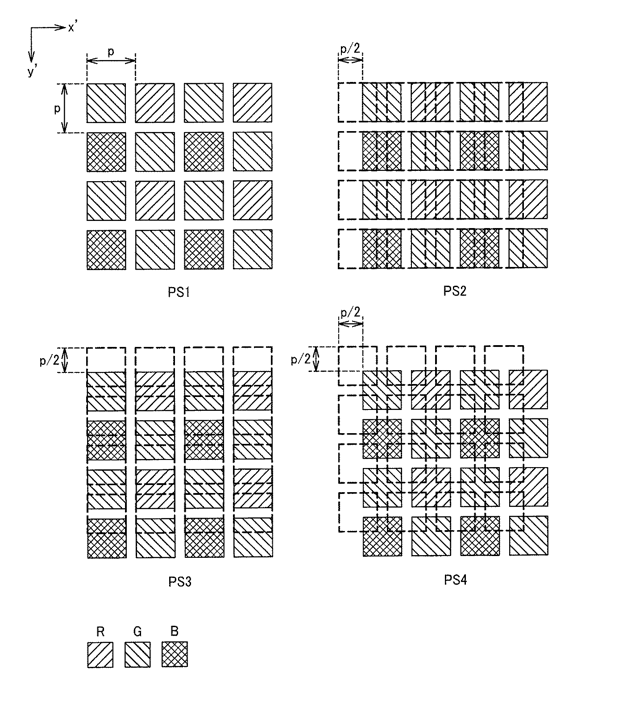
For those of you that speak Japanese there is a new Olympus patent No. 2013-187811 describing how the sensor shift tech works (Source: http://astamuse.com/ja/published/JP/No/2013187811).
The patent shows how the shifting creates high-definition images with 1/2 pixel shift and 4 frames.
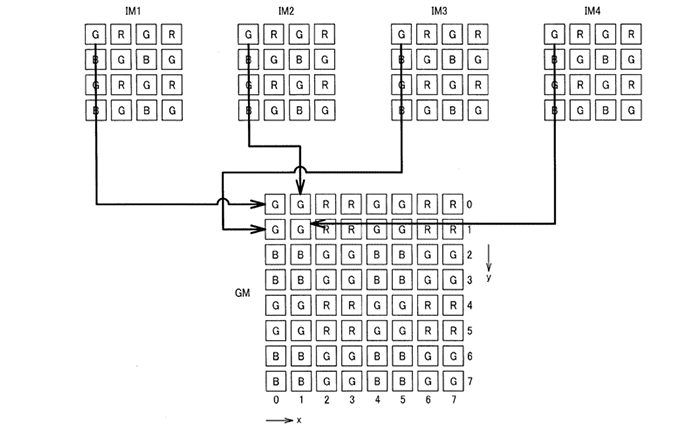
The E-M5markII will actually increase that to 8 frames (and 40MP resolution images). The sensor used will be the same as the one of the current E-M5 (16MP and no phase detection pixels). But the processor will be new and manage to create those 40MP images on the fly!
101 Responses
Like D810 and A7r, I hope E-M5mkII won’t have AA filter so that it will maximize the benefit of high resolution.
If you think about what Olympus are doing here and what an AA filter is for, you might be able to deduce whether your hope will be realised or not.
Agree!…. AA filter for high resolution is just a big joke.
Uh, 43rumors still alive, good news, HULK also back 🙂
For those that shoot animate objects this isnt so useful; or am I missing something?
As we are talking about half a pixel movement, it shouldn’t be an issue to shoot with this is in low-bursts, moving objects or maybe be like like high FPS now in Olympus bodies: first shot gets the upscale rest don’t (first shot gets IBIS, others don’t currently). But this is under the assumption that the processor and buffer are able to handle it….
Don’t understand how it could just now be a “new” patent if the E-M6 16mp camera is supposed to come out in as soon as another month or so.
There are two school of thoughts for patenting:
1) If R&D produces something or they theoretically believe something is possible, but the business side doesn’t want to invest more or believe it has a short-term impact on their product strategy, they patent it anyway.
2) If R&D produces something that the business side wants to use in the immediate future (within next 5 years or so), they don’t patent it and continue working on it under NDAs. Once it is near release, then patent it. Otherwise you kinda risk that your competition knows what you are up to and may try to R&D sideways with you a competitive product.
The E-M5 II (name is confirmed) was first “announced” that is coming in September and prototypes were released internally before that. Products are often hold back due to business reasons.
Very interesting, thank you.
not so good!
it seems like it’s going to increase the resolution by just doubling the single color pixels at each location. Given the half pixel shift, there’s a lot of overlapping on those pixels – so more pixels but not really an increase in detail – and color resolution will remain the same. In turn, the debayering will need to be more intense thus cancelling out extra detail – so at pixel level this would be worse quality than regular images!
resized to original size this would give some better sampling, less noise but no increase in color resolution.
I find this a missed opportunity – with shift of a full pixel, and proper selection of the color filter pattern, color resolution would be substantially increased (doubled), giving full RGB colors at each pixel – removing the need for debayering. No increase in resolution but a substantial increase in quality / clean-ness, and better than the half-pixel shift/resized as described here.
So possibly the better sampling / less noise would still hold true, as there would still be 4 samples per pixel.
I hope I’m wrong about this.
Have to google “debayering”… 🙂
Your arguments sound interesting.
I had a casio compact some years ago. In full resolution they allowed handheld night shots by splitting the long expore in several shorter underexposed fotos and summing up / stacking the results in one corrrect and sharp foto. Pixel shift by hand, so to say.
I could shoot in dark caves, where other DSLR Shootes in the group could not take any Foto. But colors were flat and not improved.
I was thinking the same as soon as I saw the diagram, but you must take into account that is a concept presentation for a patent fill.
If they are taking 8 samples they cannot limit themselves to half pixel shifts. I know for a fact that IBIS can compensate for much bigger displacements.
This would be like inventing the combustion engine and keep it just in trains.
In the Bayer territory, half pixels displacements will increase resolution while full pixel shifts will give much better color sampling, so I think this diagram is just half of the story. 😉
It will be interesting to see how quickly this is handled in hardware. Worst thing would be to see “Processing…” flash up in the LCD for several seconds after each shot.
Olympus: solving a problem that does not exist!
um….. there is a problem than higher mp count sensors are expensive and/or inferior in some aspects, or else we 43 would have had ~100 mp and resolution restricted only by lens (as 1/2.3″ cameras do)
Still somewhat better than decorating cameras with flashing LEDs.
That’s not true. The name of the game is to blanket the market with a single camera and cover as much as possible. If this pixel-shift technology works, it will fight off the 24mp based cameras going to the landscape photographers looking to print for decorating to homes. The pixel-shift technology will help the wedding photographers carry smaller systems—if I were still doing wedding coverage, the E-M5II would do most of the work—if not all of it.
Moire in macro and numerous other shots, springs to mind.
No, there IS a problem. The problem is that micro 4/3 has reached some sort of technical plateau at 16mp. I don’t really understand that limitation, but the market is leaving 16mp in a small ormat behind. Even 1″ is going higher density.
Recognizing the constraint, this is an attempt at an end run by using magical gimmicks to overcome it.
If there was not such a constraint, Olympus would be releasing 24mp AND magical gimmicks, to steal a march on the competition.
Looks a bit like what Fuji did with EXR sensors, but with a different technical solution…
Not optimistic about this Oly’s tech , still a new sensor is badly needed after 3 years time to convince for the upgrade .
i hear no details yet about the EVF. If it has the same magnifying factor as the E-m1 I would be interested and consider it as a valid reason for upgrade, though the original evf was already pretty good as well,but my eyesight would enjoy a bigger view
Whatever the EVF is ,
Trust me , this em5 m2 not worth of upgrade . Wait for the 88dB sensor , it should around the corner , likely within 2015 .
hey! such evf would be a usefull upgrade for me, not sure about an 88db as that wouldnt help my eyes.The things you want are more important, for a company to compete in the market, but less for me.
I have no news about the EVF yet but likely equal to EM1 standard .
If I bypass Oly place , I don’t mind to go there to see those doctors
be sure to borrow one of their test bodies if you do
2018
There are more limits for noticable higher resolution on a smal sensor. 20 MP would not even be realized.
16 MP can still be improved, like BSI, angled Microlenses for corners, organic sensor, …
and by that elektonic tricks of Oly… 🙂
But I agree. Enhancement of sensor technology for all pictures is a must have.
Come on .. .
You forgot the 1″ Exmor sensor that hit 20++ MP .
What else can pixelshift be used for?
– should be helpful for PDAF to find out and predict a direction of a vector
– internal stacking can be used for other elektronic tricks, light nightshots by series of short exposed handheld fotos matched to one foto in postprocessing
If lens sensor combination can’t differentiate between two hairs in one shot, then how would those other 8 shots fix that???
Ha, ha, ha, ha. Very poor effort – try harder.
I don’t understand your response, it’s a serious question and you obviously don’t have a good answer.
ehm let me try , if we make 8 shots, we can see at least 8 hairs on them?
I seriously cant wait to compare this to what I get out of my Mamiya 645. This is an exceptional technology for travel photographers. Great resolution & detail from a small travel-friendly body.
Recently sold my EM-5 I & already miss it.
I’ll have this badboy preordered from announcement.
“Exceptional technology”
Don’t put too much hopes on it cause it really hurt if things doesn’t turn out as expected
Yep like E-M1 with 4K
HULK will add: Exceptionally puny technology, HULK advise: become badboy yourself and carry Canikon masterpiece of photographic dominance. Do not desecrate yourself with shamefulness of of puny m43
If the use of this sensor shift technology requires both the subject that is being photographed and the camera itself to be stationary throughout the process, then it may not be as useful as it sounds even for landscape shots. It’s great for studio shots with camera on a tripod. Anywhere else there could be ghosting to deal with due to the movement of the subject or the camera itself (as minimal as it might be). If that’s the only new feature that the replacement of EM-5 is offering, I’m not buying it.
Yawn. Depressed people can be so negative. Doctor should prevent their camera buying in general 🙂
I suspect you won’t need a tripod as this will work hand-held using IBIS to stabilise during the process. As the IBIS in the E-M1 is good for 2+ hand-held exposures, and Olympus could well have improved on that since.
If IBIS of E-M5 is good enough for you, it will also be good enough in 4 or 8 pictures. All you have to do is to substitute your camera movement as ususal.
I still don’t see how anything useful can be made out of 8 exposures. Why 8? 4, with 1/2-pixel shifts, as in this patent, or 1.5-pixel shifts as more appropriate for Bayer pattern is obvious. And on 16-mpix sensor should produce 64mpix image already. By extension, 9 exposures with 1/3-pixel shifts is also possible, although both slow and unnecessary. But 8 exposures for only 40mpix? Sounds underwhelming.
You can expect improvements on noise and dynamic range, for example. Compare with the EXR technology by Fuji… http://en.wikipedia.org/wiki/Bayer_filter#Fujifilm_.22EXR.22_color_filter_array
8 makes sense.
4 half pixel shifts for increased resolution plus 4 full pixel shifts for increased color sampling.
Its half a pixel including the space to the next pixel. That allows the the original pixel to be used, It’s the cross in the middle. The corners of the pixel then get replaced by the shifted pixel. If the shift was half a pixel only they the original pixel would be overwritten completely. Effectively it is like a 1/3 shift of the actual pixel.
If the shift is HALF the pixel, the whole pixel cannot be overwrite by one pixel. But yes, assuming the space between pixels is negligible (as it is), every shift scheme overlaps pixels already sampled.
I am not sure I understand the critics. By what I remember of Photoacute the improvement in resolution and noise was dramatic with just a couple of images more. Colour was not improved, but if it is good from the start, what need?
The big question for me is the amount of movement the pixel shift can tolerate, but with 10 fps (or electronic shutter) should be better than old Photoacute, otherwise they would have been happy with 4 or even 2 images to average.
The vast majority of the contributors to this forum are extremely negative. It doesn’t matter what the news is.
its december,many get depressed mood then
Depend on what news .
We are all very positive type .
unless Admin spams Yun with another dozen of 40-150 pro review links.
Didn’t notice any complaints about the number of GH4 4k reviews. Funny, that….
Yeah, right.
Yun has been acting like a loser since his complaints never get approved.
Why are you trying to control what news Admin can post in her website? This is her own site.
Sigh.
Just make sure it can save the RAW 40MP file.
any idea how much MB such ORF file would take? 50 MB?
Will the final image be an ORF or saved only as a jpeg and have to use viewer 3 to save as a TIFF from the 8 original ORF files.
i would gamble for one ORF generated on the fly by a new TruPic chip..which prob implies it can handle a 4K video stream too?
is this a patent application or a published granted patent?
What I am curious on is how quick it will be between shots. If one click fires off all 8 shots, and the repositioning is in the ms range, this might work for portraits if you have enough constant light. By the same token, if you can set it to trigger with each press of the trigger, that would work for still life in studio with flashes. Really curious how this will work.
Yawn. Thank goodness for Sony.
http://www.sonyalpharumors.com/ off you go
It’s been widely noted that one needs to use a tripod and a $4000 lens to achieve the full detail from the high res sensors in D810 and A7r. Handheld or with lesser lenses, you may as well be using a 20MP sensor. The sensor shift approach might be game changing in this regard, since it can achieve a 40MP image using excellent MFT lenses like the Zuiko 75, 45, and 40-150, which cost a fraction of the cost of a Zeiss Otus.
No… Not even close, as usual with this poor, unfortunate system.
Even for here that is some dumb stuff ,the higher the mp count the better every lens you own performs. The handheld thing is nonsense , the mFT sensor has the same pixel density as a 64mp FF camera. Add in the almost inevitable shutter shock and vibrations through the lighter weight bodies and mFT is hardly the best choice for this. The Sony or Nikon guys can do a simple 4 shot burst with small movement between each shot and do the same only with 144mp on the 36mp cameras or “just” 96mp with the 24mp option
Shift in the sensor, I detect. Misread, rumor may have been.
first we had a hulk, and now this
Puzzled, am I. Clear is the patent.
With 40MP and a high-quality lens, digital zoom wouldn’t be nearly so offensive. I don’t need more than 10 MP in general, so a nice prime plus digital zoom could actually be a good solution. I wonder if they’ll support that directly or whether you’ll have to crop in post-processing?
I think you would be better served with a compact with good zoom lens.
I’m happy that the sensor stay the same and doesn’t gave pixel detection : if you look at DXO results the E-M1 is a little noisier than the E-M5 which is a rad sharper when mounting the same lenses.
What I hope however is to get the E-M1 EVF, which is bigger and better. If the IQ represents a real improvement and it comes with the best Olympus VF, then I will update. But I won’t if the EVF isn’t improved.
i hope it does have the same optic section as the E-M1 has
OLED EVF like the Fuji X-T1 would be nice…
This could be the holy grail of camera world.. manufacturers could DECREADE the megapixel count while INCREASING resolution!
i would like that lesser data/MP can only give benefits
Now they all need is perfecting Panasonic DFD technology, each pixel can calculate focus distance. Voila, you can control Depth of field with beautiful bokeh ( thinner DOF adjustment only i think?)
I think there was another who claimed about benefits for bookkechh, just keep the aperture open and you get the max if you really need it.
Nokia i think, but not quite the same.
There is another i forgot its name, with a funky looking shape camera ( i like it). Anyone?
But like i said, it’s not the same since they use a lot of pixels instead of each pixel *knows* its assigned subject distance.
i was just talking about another guy who said the same, not a company
ok
If this is all so simple, why don’t they just use an older, cheaper 12mp sensor, and use the magic pixel shift pixie dust to multiply it 50 fold, making a 600mp sensor?
If there are no drawbacks to 40mp, why stop there? If there is a newer than 4 year old 16mp sensor, why not use that?
Trying to understand the dog that did not bark here.
The problem is….. Wait for it….. The shutter speed!
You need a shot taken with a 1/30-1/60 shutter speed…. Now you can get one, but can you get one that has 4/8 times of that? NO!
This tech works only for stationary subjects, so example landscape photography at windy or high windy day doesn’t work with this.
But welcome the stationary photography… You can do product photography or similar easily with this as you anyways have camera tethered to computer.
This ain’t a magic bullet that solves low resolution but simply overrides its benefits in specific situations.
Maybe the dog was barking to the wrong tree
thiugh i like that idea, using a lower MP sensor to keep the shift procedure saving fast enough, as long as the trupic can give good results in standard single image or bursts output mode
There must be reasons why people create things in certain ways and they don’t usually tell you.
Then, listen to the dog, not the dolphin, child!!
Reason is very, very, obvious. Don’t you see it?
For example, changing the processes of chip fabrication is very expensive. It’s industrial. Not toy playing. Cost of continueing 16mp sensor is now next to nothing.
Listen to the HULK: Smash puny sensor…do it..free yourself from photographic punyness…
Carefully, we must proceed. More megapixels, the answer may not be.
carefully planned by superior forces in cameradom, M43 takes it up its puny sensor…
It looks like a fuzzy math sensor. Fuzzy may not mean clear photo.
This looks like an intersting way to make some really high res landscape photos. But I would have preffered a new better sensor.
Anyway, can anyone explain why they need 8 exposures to make a 40mp file, as I don’t really understand the math behind this? (In my head I sort of feel that 4 should be plenty….)
No, that’s HDR and it might be unwanted. Separate things.
The E-M5 will shoot up to 9 fps. So, does this mean the 8-frame composite will take almost a second, or will the shutter stay open during the shift (electronic shutter)?
I think the exposure is inessential. Say that the 8 shots must happen within a second. The E-M5 already has 10fps.
The first shot will determine the diaphragm and shutterspeed, of the others.
If I remember well IBIS has a latitude of 5 pixels. So a half pixel difference x 8 = 4 pixels, well within the latitude.
The firmware must integrate 8 sensor shifted images in a reasonable time, say like an Art Fiter. 8 images can provide a fantastic averaging, without even incurring the risk of handshake, or needing a tripod.
There is also the distinct possibility of making a wider dynamic range if the sensor shift is paired with varying exposure. It is possible that the 8 shots are needed to widen the range through exposure manipulation (this may also be required for overlay), for reference, also noise control.
Interesting article that theorizes that the pattern of cones in our eyes actually vibrates about 83 Hz to create a higher resolution image.
http://accidentalscientist.com/2014/12/why-movies-look-weird-at-48fps-and-games-are-better-at-60fps-and-the-uncanny-valley.html?
What is wrong with the old use a longer focal length { to capture more detail } take even a simple four shot grid { easy and quick with any camera } which will then give you 64mp to play with, stitch and crop to 40-50mp . I have done that many times with the 75mm it gives excellent results
nothing wrong just keep doing it that way if t makes you happy, its xmas after all
This is a smart move on Olympus part. They don’t control their destiny when it comes to sensor. Both Panasonic and Sony are competitors, probably unwilling to give them the best tech possible. Olympus has now more than ten years of IBIS engineering and know that going beyond 16MP on a 13x17mm sensor will make pixels too small.
The market seems to want higher pixel count cameras and with Sony releasing a 24MP with IBIS camera they also know that IBIS alone is not enough of a differentiator.
Now delivering 40MP on demand, and probably some intermediate pixel count too, give them a new differentiator. Especially that photographer might not always want a massive amount of pixels all the time as storage requirement and post processing time increase with file size.