








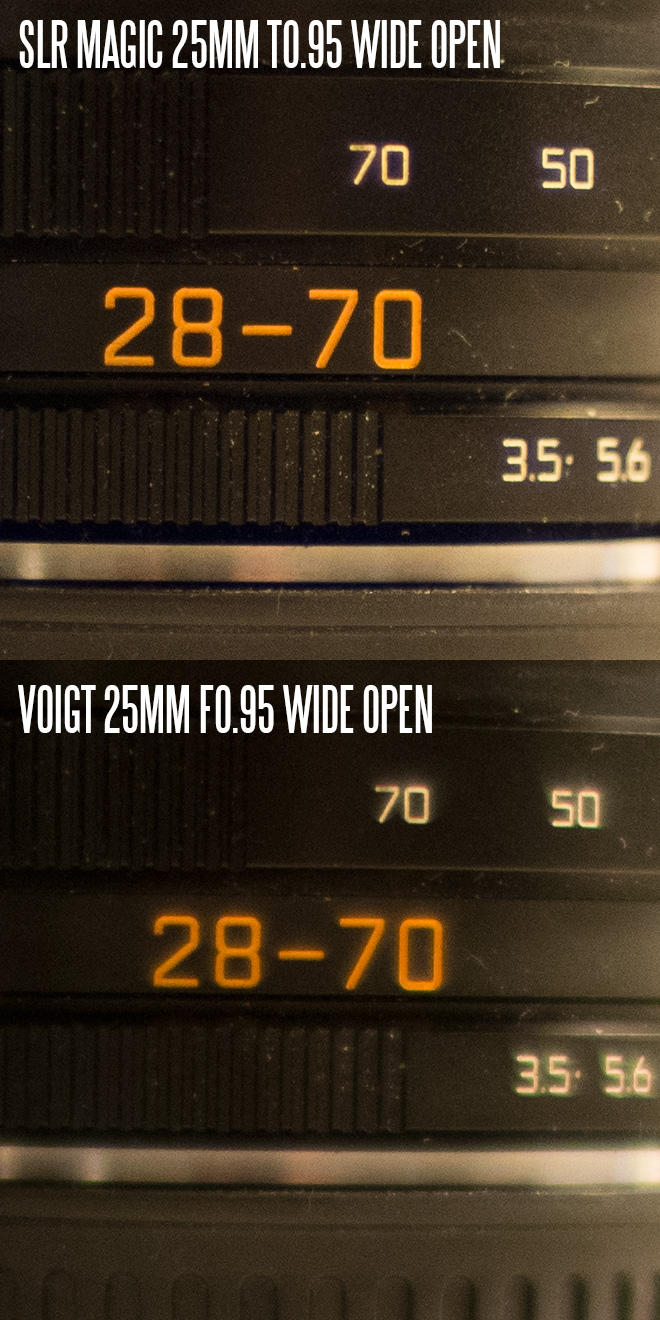
Andrew Reid tweeted the first image comparing the new SLR Magic 25mm f/0.95 vs the Nokton 25mm f/0.95. I have to say the results of the SLR Magic lens are stunning! I already posted a similar comparison back in May (Click here to read that article). But the lens used by Andrew is the final production version that should come on market in February for $799. But there will be a special rebate at launch and the real price will be $649. That’s $550 less than the Voigtlander Nokton lens!
—
Current SLRmagic lenses for Micro Four Thirds:
SLR Magic 12-36×50 ED Straight Spotting Scope lens (w/ hand grip) is now available on [shoplink 26994 ebay]eBay (Click here)[/shoplink].
SLR magic 11mm f/1.4 lens you can preorder on [shoplink 22154 ebay]eBay (Click here)[/shoplink].
Toy Lens 26mm f/1.4 lens on [shoplink 18603 ebay]eBay (Click here)[/shoplink].
SLR Magic 35mm f/1.7 MC lens on [shoplink 14881 ebay]eBay (Click here)[/shoplink].
Noktor SLRmagic 50mm on [shoplink 25691 ebay]eBay (Click here)[/shoplink]
78 Responses
just judging from this picture, the nokton’s glow is something appreciated by some portrait photographers too.
oops i was signed out, this was my comment 🙂
Yes, a friend told me that Voigtländer Nokton is a little soft, and it’s perfect for the fashion portraits he takes. I don’t take fashion photographs, but I use an SLR Nokton 50mm f0.95 for soft portraits. I used it also during last Venice Movie Awards, and a picture taken with it went inte the photo catalogue. So, being soft it’s not always a problem!
Glow can easily be added in post, detail and clarity… not so easy/possible.
I also like this softness. This ethereal look. It’s like magical dust, and it can be observed outdoors on very misty mornings.
If saw it first time from a set of Konica Hexanon 57mmF/1.2 pictures. I became so addicted to it that as soon as I bought one, I fitted it with a diffuser filter on top. It hardly leaves the thins. Even though MF, it’s still my favourite portrait lens.
The sharpness advantage of this lens over the Nokton is nothing short of amazing but for videographers (where sharpness might get lost in downsizing) what will make or break this lens will be bokeh.
I took a look at Admin’s test and the bokeh looks a lot nicer on the SLR Magic at f/0.95 but at f/1.4 I’m leaning more towards the Voigt.
I can photoshop glow and softness – i can’t photoshop extra clarity, detail and quality!
if you show me pictures samples with software glow effect, i can comment if its the same looks as the real deal. The glow is not present in the glass on purpose but its a an imperfection which turns out to be usefull to create a certain mood, especially in portraits.Depending on your skills, it is possible to get more detail out of raws. if not overdone, it might look good but has the typical digital looks.
jim, you like crisp, razor-sharp raw images. We get it.
But consider this: your photoshopped glow may instill as much horror to the eyes of others as an overzealous use of wavelet sharpening might to yours.
IMO, postprocessing either fake glow or fake IQ digitally always at least looks foreign, and usually looks bad.
First thing: I never tested/tried Voigtländer 25mm on my own. Having said so, both a friend and someone on the web were saying that it’s soft wide open. I didn’t buy it, since I already own great Pana/Leica 25mm f1.4, and didn’t want a “double” lens. Pana/Leica is a great lens. I’ve been told tha Voigtländer 25mm is less sharp than its broher 17.5mm, and this last is a lens I own, I use a lot during my night photo walks in Venice, and I can state that it’s sharp, at least as the SLR 25mm in this comparision shot. Yesterday night I tooksome pics just for fun from Rialto Bridge, I was next to some german tripods 😉 I set the white balance and shot handheld, while they were looking at me like an alien. Then I realized that the lens had still its ND filter on it. Yes, using fast primes is funny, and it’s worth a try.
I would love to see some shots across the full aperture range covering faces, places and different distances.
It looks good. But one rain drop does not grow enough grass to feed the cows. Need lots more pix yet.
This “portrait” stuff is total nonsense. Making a sharp image “soft” is trivial in post processing, but you’ll never get a sharp image from one that is soft to begin with.
It’s not a nonsense: a soft portrait has some kind of character, it can stand out from a bunch of “standard” portraits, but still you can like it or not. If you’re looking for a sharp picture, just do not use an extremely wide aperture.
Well, you can achieve that very same ethereal softness with a diffuser filter.
> If you’re looking for a sharp picture, just do not use an extremely wide aperture.
So what’s the point of expensive lens if it can’t be used fully open because of crappy performance?
“Character”… what a nice politically correct term for crappy optics.
If you dont want every miniscule skin blemish to show it can be a good thing with a less than razor sharp rendering, but I wouldnt exactly say soft. Then, stop down fot ultkmate sharpness. No post-processing necessary.
If you want soft images save a heap of cash and buy the cheapest lenses you can buy then you will have as much glow and softness as you want. It is because of folk like you guys that the lens makers get away with such crap and over pricing.There are numerous simple and effective ways to give a hackneyed soft focus look to a sharp lens , while a soft lens cannot be made sharp
A soft lens does not mean it has glow also. Even some of the Leica lenses have glow, and they are famed because of the looks it gives, combined with their trademark bokeh.
Andrew, Duarte, and Esa are correct.
No.
I agree that if you want a sharp image you need a high quality sharp lens.
Digital postprocessing for portraiture can NEVER emulate whatever optical flaws make a lens “with character” appealing. A diffuser similarly cannot reproduce the same look. It may provide a different look that is similarly soft, but physically the systems are not equivalent.
Technical details and pixel peeing are not the end-all determiner in value of a lens. Moreover, not a single statment above is a fact. All are opinions, and some based on poor understanding of technical details, so correctness isn’t even worth commenting on.
As far as I see the only person who has posted examples (Mr. Sartori) of the Nokton on this thread has posted some very nicely composed and processed images, which really nullifies many of these comments.
Correction: “a Nokton” since Marco is using the 17.5.
Thanks for the compliments about those three photos! I have always said that a perfect lens does not exist. And photographers should use their passion and eyes, not only “rules”. A soft lens can be used to take nice glowing portraits, or a misty fog in a wood, for example. What I love about those really fast lenses is that you can use them in dim light. Wide opened they suffer from some purple fringing (I think even Leica Noctilux suffers from it), and that’s why I shot with them in b&w. Most of times they don’t need any post processing. I can tell (because I own it) that SLR Hyperprime Noktor 50mm f0.95 really sucked on epl2. Steve Huff emailed me telling that that lens was a crap. Ok. I put it on an OMD and, even being soft, delivers good performances, and (that’s why I bought it) lets me take night portraits. Guess what, since then you can’t find a bad review about that lens anymore on the web. The most smart thing is to learn how to use the tools we have. A lens is soft? Try to turn it into a quality, a “character”, not letting it be just a flaw. Zuiko75mm is a lens made for portraits or neater events? I carry it with me and take landscape photos. We have tools, a brain and immagination. Thanks again!
depending on the lens, there is still enough sharpness retrievable, as the glow does not mean its really blurred. If you only want sharpness, then look for the appropiate lens.
That glowy softness comes from light rays which should form a point spreading all over the place because of optical deficiencies.
And because of among other things huge coma aberration there’s not much any sharpness to talk about outside center until stopped down to aperture of more usual lenses.
Only situation in which such fuzziness could be corrected by processing is when it has same point spread function across the frame in which case deconvolution could be used.
from a technical point of view i cannot argue about this, but from experience with a glowy lens like the Nokton 50 1.1 i can only conclude that sharpness still exists wideopen, despite the glow. I only used this lens wideopen, while knowing closing it down gives me more of it, but hey, how much do i need? 🙂 you can check a bunch of 1.1 portraits under my flickr url in my profile, just look for models Gaby,Myle and Annicke
if looking at Gaby, check the B&W ones , not the color ones as those are made with the ZD-35-100
Then again, if a spread function can’t be corrected via deconvolution, there’s a good chance that the same spread function is not shift invariant and thus can’t be emulated in post processing.
Certainly the optics may not be ideal, but if the same glow “filter” is reproducable in each Nokton lens, and there is a market for that glow then more power to Nokton.
There are many cases of photography products being exceedingly sharp with awkward bokeh (some old M voigtlander lenses come to mind), or being crap optically but being capable of some stunning pictures.
“or being crap optically but being capable of some stunning pictures.”
Suddenly the Helios 40-2 comes to my mind, after reading that 🙂
+100000
Quite impressive. Especially when you realize that the SLR Magic lens is T/0.95, not F/0.95 as the Voigtländer (I’m no expert, but my guess is that at such wide aperture the difference between T and F could be quite big, while at 2.8 they might be about the same).
I’m not an expert either, but I thing the difference is not that big: something like f0.95 and f.0.9. At that point I don’t think in dim light there’s a big difference. If used in daylight, I suggest an ND filter, but the DOF is so small that most of times your pics will have an artistic look. Some people may like it, other may not, as always..
I was checking about transmission in DXOmark.com. For example, the Canon 50mm F/1.2 has a 0.5 EV light loss wide open, or an equivalent of T/1.4. Meanwhile, the Canon 50mm F/1.8 has only 0.3 EV loss wide open, or an equivalent of T/2.
This means that at f/0.95 the light loss might be around 0.66 EV, which would make the SLR Magic 2/3 faster than the Nokton (the Nokton would be something like T/1.2 – T/1.3). And even then much sharper wide open.
Quite impressive, if confirmed.
I doubt that one can extrapolate the light loss to a different max aperture and a different brand (including construction, glass, coating, etc).
Yep, there are so many factors affecting to it that any accurate guesses are futile.
Though it’s sure that no lens has 100% light transmission and I would expect typical lenses to have some 20% minimum light loss.
Yes, I know it’s just guessing. But that Canon 50mm f1.2 is a high quality lens (L, in Canon talk). So it’s not like the Voigtländer can be way better. And the larget the aperture, the higher the transmission loss, so saying 2/3 EV loss is in the safe side.
The main point is that the comparison is not even fair for the SLR Magic, because in no case T0.95 will be the same as F0.95.
Here are three examples of Voigtländer Nokton 17.5mm f0.95 wide open.
I started a couple of weeks ago to post pics on Flickr, therefore I don’t have many at the moment.
http://www.flickr.com/photos/marcosartoriphoto/8318064720/in/photostream/lightbox/
http://www.flickr.com/photos/marcosartoriphoto/8296976068/in/photostream/lightbox/
http://www.flickr.com/photos/marcosartoriphoto/8391042389/in/photostream/lightbox/
love your B&W work….
Yep, me too!
Thanks Ulli, and thanks Admin! (Corrected the name, thanks! 😉 )
Marco,
Looked at your flickr site.
Beautiful work! Really great eye.
Do you work mostly in m43?
Cheers
Thank you for stopping by! Yes, I started with an epl2, thinking about “growing” and moving to DSLRs, but the most I used it, the most I realized what my needs are: fast glasses and portability, just to be always ready to shoot. Omd em5 has been a huge leap forward, with its Sony sensor, and at the moment I don’t see a valid body to substitute it. I prefer invest money in (good) lenses, but I admit the incoming fuji x100s is tempting me. In the meanwhile I ordered Zuiko17mm f1.8, because I feel that I can have fun with it, despite the not so good reviews around the web. Cone back visiting my Flickr, I usually post a pic every one or two days, so I’m not spamming! 😉
Fabulous stuff. A real pleasure to look at.
Marco, thanks for sharing some beautiful shots!
Thank you mr. Reese! Are you on Flickr too?
Well…the sharpness wide open and the intro price ( rumor?) sound intriguing!
Seems the SLR Magic lens is better wide open, but the Nokton improves considerably by f/1.2 and is very very good from f/1.4 on, except in the corners which take a long time to clear up. Will be interesting to see how the lenses compare across a range of apertures and also compare distortion, chromatic aberration, resistance to flare, etc.
Excellent, but there are still some unknowns, such as the size of the new lens, especially compared to the Nokton. Kudos to SLR Magic, although I’m disappointed they’re replicating the focal lengths of existing lenses. Why go for a 25, why not make a 20mm or a 15mm?
“the final production version should come on market in February for $799. But there will be a special rebate at launch and the real price will be $649. That’s $550 less than the Voigtlander Nokton lens!”
Nokton 25mm F0.95 is 890 USD on e-bay, that’s not 550 more than SLR Magic. It would be nice of them to sell their 25mm F0.95 for 340 USD or 260 EUR :).
…but…it’s” MAGIC”! …that should at least count for something? 🙂
At that price you will never find a modern 0.95. You can find a cheap OM 50mm f1.2 at around 400/450 euros, but it’s a different thing. Voigtländer has a 17.5mm so quite near to your wished 20mm.
No, no, I was just pointing out admin’s mistake. I’m aware of the prices of fast lenses.
Marco you ever tried the Nokton 50 f/1.1?…it has nice “funky” bokeh
Unfortunatly not: I’ve seen images around the web and I agree with your funky description. A thing I noticed on Nokton 17.5mm is that if you close it, bokeh has clearly a starry shape. Something too geometric for my taste.. So i’ll keep using it wide opened, or from f2.8 on, in case I need a sharp image corner to corner. In these days I’ll receive my new Zuiko17mm f1.8, let’s see if it’s that bad as many wrote.
Good debate for photographer
Thanks author
One thing no one has yet mentioned about the comparison images: the photos are extreme close-ups. In general a lens can be optimized for best performance in only one distance range, and other ranges are compromises (although tricks such as floating elements help reduce the difference.) So in testing a lens optimized for close distances vs an equally good lens optimized for infinity, your results will depend on which distance range you choose.
The example photo shows that of the two, the SLRMagic lens is a better choice if you want to make full-aperture photos of the engravings on lens barrels! But with subjects at other distances, who knows?
I wish they were making a 17.5 version as well.
Admin, I am not Sam, Your site has big security issues as I am auto logging in as him, I can see his email and name. This is not good!
It could be Java malware on your system, messing with your cookies.
You should keep the Java plugin/add-on/extension disabled in your browsers, unless absolutely needed for a specific site. And, then, disable it when you are through.
Regardless of java malware on his end (and I agree it’s a good idea to disable it at this point), he shouldn’t be able to retrieve sam’s email from the site, that’s obviously a server side problem.
Exactly, I should not have his info.
Admin the “sukiennong.vn” post is a hacker. Another name being a web site.
Yay for more choices of what appears to be at least some quality lens choices regardless of brand/price/T or F/size/weight.
Im about to pull the trigger on the Voigtlander 17.5mm but the SLR Magic 25mm looks interesting and is cheaper..
I would like to see how it compares to the Voigtlander 17.5mm before I make my purchase.
at that price, i’m definitely going to order one when preorders are up, hope they have a referral link for you admin 😉 you are definitely spreading the word for them!
http://www.amazon.com/Voigtlander-Nokton-17-5mm-Manual-Focus/dp/B007VHDUN4/ref=sr_1_30?ie=UTF8&qid=1358666187&sr=8-30&keywords=slr+magic
half the price of the Voightlander? are you kidding?
http://www.adorama.com/searchsite/default.aspx?searchinfo=25mm+0.95
sorry wrong url
Looks promising. I was starting to worry they’d make it double that price, to make up for the long developing process.
SLR Magic can be better, if you get lucky. They have some serious quality control issues.
How does this work? F/t stops were always explained to me as a fraction system that is understood and not labeled on the lens. For example, a f1.4 stop is really 1/1.4, a f2 stop is really 1/2, etc. To me 1/.95 is saying that it transmits more light than originally exists. Could this be an f1 and somehow also a t.95?
I can’t wait till February for the SLR Magic 25mm t0.95 … I want it NOW!
It’s funny how everyone runs to defend the Voightlander against the slr magic lens, sometimes photographers (or hobbyists rather, who’s really a proper photographer here anyway?) are such snobs really. I’m sure if this lens was made by some better known company people would be drooling all over it, I personally don’t give a crap about brands, if it’s good it’s good, period. You all behave as if you were shooting Leicas exclusively 24/7, why don’t you start enjoying photography and stop worrying about names and brands.
? what did we do???
Speaking for myself: I never took the defence of Cosina Voigtländer. First it’s not a trial and I’m not a lawyer. Second, it’s not even a competition. Third, more lenses, the better. I simply stated that the Voigty17.5mm I own is a great lens, not so soft open wide (sharper than both these samples above, as far as I can see), and really sharp stopped down, at f5.6 for example. I wrote that I know that it’s sharper and better than the slightly older Voigty25mm (therefore it could be on par or still better with the SLR 25mm, but I don’t care too much). Before buying and loving this lens, I bought (and still love) SLR Hyperprime Noktor 50mm f0.95. A lens that a lot of people found and considered crappy because of its cheap design, high price, and being a cine lens. Results were crappy, I admit it, on my old epl2, and because I needed to practice with it. On my OMD it works way better, thanks to the really good performances of Sony sensor. And in time I learned that its soft character/flaw can be turned in a plus, or at least a positive thing. Again, the more lenses, the better. Personally I don’t need it, since I have Panasonic/Leica 25mm f1.4, a Voigtländer 17.5mm and SLR 50mm.
@MarcoSartoriPhoto. I love your work. How does the Voigt 17.5mm work as an all around lens at that focal length.
I cant afford both the 25mm and the 17.5
Thank you efex! Are you on Flickr? About your question: 17.5mm is a lens I really really love. Being equivalent to a 35mm on a 135mm format it’s the classic “standard” lens for photojournalism. It’s perfect for street photography, you can easily use it for landscapes too. I know that it’s build quality is slightly better than Voigty25mm. I assure you it’s built like a tank. Gears move smoothly, and differently from the 25mm the aperture ring can rotate click by click (at each step) or freely, so you don’t hear anything if you’re taking a video.
A photographer I met spent beautiful words for his Voigtländer25mm though.
Personally I think 17.5mm has a slightly better quality and better performances.
It’s not a macro, but you can take photos at subjects 15cms away from the sensor: that means the flower will almost hit the lens. At f0.95 it’s like a painting.
I own Pana/Leica 25mm, and I love it, but I think I prefer he classic 17.5 lenght.
I use the 25mm when I feel lazy and I want an AF and a beautiful bokeh.
On both voigtländers, bokeh is “cat’s eye” shaped (or rugby ball) wide openen at f0.95. Stopped down at f1.1 to achieve more sharpness in the image, bokeh has a geometric shape, a 10 points star, or a decagon: but you notice it only zooming on the image. I have a photo taken in Venice, I will post it on Flickr maybe tomorrow.
If you’re more into portraits, 25mm would be better than 17.5mm.
I hope I could help!
I forgot to say this: undar day light I suggest an ND filter if you want to use it at f0.95. Pictures are good in the center (softer in 25mm) and soft towards the corners. Stop it down to 2.8 and it’s sharp. At f5.6 the lens is sharp as a blade, and you can use the hyperfocal technique, learning how far he subject is from you, and shooting without looking at it. Remember that these lenses are fully manual, and they’re not coupled with camera body. Therefore you have to rely on IBIS or in camera stabilisation, or on your steady hands (not a problem if you shoot at f0.95 of course).
Both suffer from purple fringing, but you can correct it with a click on Lightroom or avoid the problem shooting black&white. A tip: in dim light I suggest you to check and change white balance option on the camera, if you shoot in color.
Am I the only one who thinks that the double contour of the “6” in the lower right corner of the slr magic looks strange?
Looks normal to me. The lens is round and the 6 is further behind. It’s just in an out of focus plane due to shallower DOF compared the the Voight
The numbers 50, 3.5 and 5.6 looks sharper on the Voigt.