


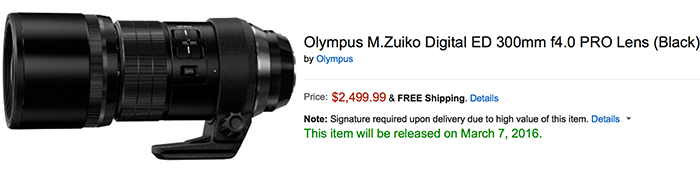
Hurray! You can now preorder the new Olympus 300mm f/4.0 PRO lens on Amazon US (Click here). Ships on March 7!
Thanks Riley for sharing this!







Hurray! You can now preorder the new Olympus 300mm f/4.0 PRO lens on Amazon US (Click here). Ships on March 7!
Thanks Riley for sharing this!
102 Responses
At Amazon the blurb says that the lens has “The Highest Resolution in Olympus History”
Question: the programmable Lens Function Button is only relevant to Olympus cameras, not Panasonic’s. Right?
Yeah, I believe that is correct about the L-Fn Button.
I wish Panasonic and Olympus would make efforts to integrate some of these brand-dedicated features on lenses to operate with both manufacturers camera bodies. Both companies agreed to be part of the MFT “System”. So, I think that they should have as a high priority a responsibility to that system. I would love to have the aperture rings on my Panny 15mm and Nocticron function on my Olympus bodies. C’mon guys …do the system owners right..It would benefit everyone and make the whole system more attractive in the end.
True … there are unfortunately more and more brand specific functions coming. Here are all compatibility issues at the top off my head:
– Pana aperture rings not working on Oly bodies (hard to believe, actually)
– Oly Lens Function button not working on Pana bodies
– Dual IS (probably) not working between brands
– Depth from Defocusing not working with Oly lenses (I assume you’d only need to create a profile for each lens, then load it into lens or body)
– external EVF are incompatible
Anything I missed?
Yes…some of the lens optical/performance issues between brands…
1. The chattering with Panny 25mm f/1.4 on Oly Bodies?
2. The flaring with Panny 7-14mm on Oly Bodies?
I do not know of any issues of optical/performance of Oly lenses on Panny bodies…but there may be some.
I think that CA correction on Panny’s bodies happens only with Panny’s lenses.
I believe there are issues either way (pany lens on oly body or vice versa), as the cameras and lenses have uv filter/coating that covers different wave lengths.
Yes:
– Continuous burst shooting speed (fps) drops to low values when stopping down a panasonic lens on an olympus body.
Do not think this is necessarily so. My Panasonic 20mm pancake focuses slow on my E-M1, and much faster on my GX1. My Panasonic 100-300mm however focuses very fast on my E-M1(faster then on GX1). CAF with tracking(burst) also works well on E-M1(GX1 is of course very limited in this regard). So it’s very lens dependent I would say.
It’s not about the focusing. The shutter blades of pana lenses open and close to selected aperture value between all sequential shots, when used on oly bodies. The more they need to move (from wide open f1.7 to f11 for instance) the slower the fps. Even in manual focus, you won’t reach 8 or 9 fps, unless shooting at max aperture, at f5.6 you can already notice the slower speeds, at f8 – f11 you’ll be lucky to reach 2 fps.
Ha! I’ve suspected the same thing, but I couldn’t find confirmation anywhere online. I sold my first Panasonic body for an Olympus body, then though “Hmm, did this 20mm always hunt for focus so badly..??” I’m thinking of getting a GX8 just so I can resurrect the trusty 20mm f1.7 that got me into M43 in the first place.
Agree, the openness and interoperability of the system is a big sales point for me, and it is good for both manufacturers. They should be more careful about these “brand-features”
It’s a false sense of an open system.
Ouch! The expensive price is confirmed. I feel for those who still have plenty of GAS for this lens. Bob, this lens got your name on it. My GAS fizzled out from my rear end once the price confirmed.
Yeah, that price is not for the faint of heart!
But you’re not faint hearted though? 😉
I’m trying to decide…my wife would answer in the affirmative however! 😉
I have been waiting for this lens FOREVER though, it will fill a major gap for me for wildlife shooting where I was never quite fully satisfied with the Oly 75-300. There is something appealing about being able to achieve the equivalent of 840mm together with the MC-14 1.4x teleconverter on a m4/3 platform
Your G.A.S sounds really bad! LOL!
You have diagnosed me correctly, doctor!
I feel you. LOL!
I’ve borrowed a Bigma (50-500) which I’ll be returning as I can get better results with the 75-300 & I probably could have had it or AU$700-$800 with my wife accepting that amount to spend, but I don’t think I have a single chance with the price the 300 f4 lens will be here in Australia.
Maybe the Panasonic 100-400 might be a possibility, but probably not.
I agree, hifinut . Like I mentioned before….I will wait quite some time and then perhaps buy the lens from Tokyo, S. Korea or Hong Kong. Just too pricey on intro for me. 🙁 I spent $1400 on the 40-150mm Kit with 1.4x in box, too. The most I will pay for this lens is $2000. I will sit back and enjoy the upcoming reviews and comparisons while I listen to some delightful tunes eminating from my tube amp. I think I will perhaps spend a little on some vintage Mullard tubes in the meantime! 🙂
I love valve amps too. My amp is a used BAT (Balanced Audio Technology) that has a triple tits 6C33 tubes. 🙂
Must be a Total Recall edition.
This is my feeling exactly. I am very interested in this lens, and I think it is likely I will eventually get it. However, I simply cannot justify this sort of premium pricing. Personally it means I will likely get the Canon 100-400mm f4.5-5.6 L IS II in the interim, as it’s premium has already worn off and you can get a better price now. Maybe in a year or two’s time when the silly premium price business has worn off I may have a think about moving to m4/3 for my main system and getting this. I’m sure we’re not the only photographers who have to justify how much we spend, and I don’t think it’s a very good strategy on Olympus’s part, as it is going to cause wilful obscurity.
The nature and bird enthusiast market is huge as you can see from all the binoculars and telescopes on sale for it. There is a big niche for portable and quality long lens cameras. Currently Canon and Nikon have the lions share. The Tamron 150-600mm and Sigma 150-600mm lenses are very popular, because you can now get great image quality without breaking the bank. Nikon have understood the need to aggressively price to get a slice of this sector with their new 200-500mm f5.6 (it’s under half the price of the Olympus 300mm f4 PRO, and has more reach). I just can’t understand a pricing strategy which will create wilful obscurity for Olympus m4/3 in this sector. It is a major mistake. With more aggressive pricing, Olympus could carve themselves out a significant share in this niche.
Honestly for me now, it is probably down to getting a 150-600 sigma plus an active canon to m43 adapter, or getting the 100-400 Leica. I’m sure the Olympus is a fantastic lens, but that price is very off putting for all but a very few..
It’s the same here. I actually currently have a Tamron 150-600mm which I use with a Canon 70D (I had money put aside for the Olympus 300mm f4, but couldn’t wait any longer). I could have bought nearly 2 of these outfits for the price of the Olympus 300mm f4 PRO. Yet I can produce images shot at 600mm, which after post processing, look razor sharp at 100% (the Tamron is slighter softer at 600mm (not soft) but they sharpen up well as long as you use f8 or above).
This is why I think Olympus’s pricing of this lens is a major mistake. Long lens users, especially for birds and nature photography now have so many choices, all of which are cheaper than the Olympus 300mm f4, and which in practise are just as capable. You could say with Pentax buy a 300mm f4 (fully weatherproof), a K-3 II body, and a 100mm macro for the price of the Olympus 300mm f4 PRO.
The 100-400mm Leica looks much better value. I think it is quite possible that it will be sharper than the Olympus 300mm f4 PRO at 420mm with the 1.4x converter.
Speaking of the 40-150, how would you rate it ?
The free shipping is such a perk for such a pricey lens.
After spending that much money, would someone wait 7 days for it to be delivered?
Oh my word what a fiasco this is. The worlds most expensive, heavy, 300mm f4 small sensor lens.
Maybe it’s the world’s sharpest?
We will see. Right now it feels like going to a MFT theater where the popcorn is 20 bucks because your a captured audience.
> most […] heavy
But you have big hands! Why are you complaining?!
GOOD GRACIOUS! (LOL!)
Again let’s introduce some reality into this comment.
In objective terms, yes it is a bit heavier than expected, and in my opinion it is too expensive for this type of lens.
However, it does appear to have a very robust tripod collar which accounts for some of the weight. Somewhat infamously the Nikon AF-S 300mm f4 lens had a notorious tripod foot which was shown to flex, and needed an after market tripod collar/foot for better stability.
Going by the advertising blurb in the Amazon feature Olympus is claiming it is their sharpest lens. Something a manufacturer would not say lightly as it will be a claim scrutinised in every test. Overall it would seem to be a very capable lens.
Although it is rather being over-hyped. The 600mm eqv. claim is fallacious as this is on FF. Both Nikon, Canon and Pentax provide excellent APS-C DSLRs, which are more likely what a photographer using a 300mm f4 for reach will be using. On APS-C a 300mm lens has a FF eqv of 450mm or 480mm, and a 400mm lens has an eqv of either 600mm or 640mm.
The other problem is that no matter how sharp the Olympus 300mm PRO proves to be, it is not going to really be noticeably sharper than the other 300mm f4 options in real world viewing. All 300mm f4 lenses are very sharp, and it would probably take a lot of pixel peeping to see the difference. Also in practical use issues such as atmospheric haze and dust, subject and lens movement, mean that absolute potential sharpness is only sometimes reached.
Overall it is absurd to call it a fiasco. Nevertheless I do think Olympus is making a serious strategic mistake with the pricing, as it will put off a lot of nature and bird photographers who would have considered moving to m4/3. I think Olympus would sell many more of these lenses if it was more realistically priced, and this would provide a greater return to them.
600mm equivalent FOV is not fallacious.
FF/35mm is the standard benchmark for relative sensor size, DOF and light gathering comparison, not APS-C.
It is fallacious. 35mm film or FF may have become an approximation for field of view. However, anyone using a longer Canon or Nikon lens for reach will either by using an APS-C DSLR, or cropping to APS-C or smaller proportion in post. The Nikon D7200 even allows for an extra 1.3X crop in camera, giving effectively m4/3 angle of view.
In other words, most real world photographers looking for maximum reach are using crop camera bodies.
Your opinion on usage/development scenarios regarding APS-C/cropping doesn’t change the FACT that MFT 300mm = FF/35m 600mm in terms of FOV.
Not debating your opinion.
However, 600mm is not fallacious, it is equally factual as is the 4x the sensor size or 2 stops more light.
One can’t cherry pick. Facts are facts.
Yeah the 600mm equiv. is a perfectly valid comparison for Oly to make (in terms of framing the shot). But SteB1 does make a good point about the equivalent AVAILABLE options, which APS-C is a big part of. M4/3 was crying out for these lenses 2 years ago, where it had a resolution and framing advantage over most other options, if not all. Now there are many more choices and most are cheaper than buying an E-M1 and the 300 f/4. (I have 225-900mm equivalent at 24mp with great image quality and excellent tracking AF and the system cost was about £2,300 – nearer £2,000 to buy now) However I’m still quite excited to see what people turn out with the new m4/3 lenses and it’s great that the system finally has most if not all bases covered. That’s the key to being a full system choice rather than a compromise, in my own opinion at least. In time I might even find myself using m4/3 for long lens wildlife again….maybe….. 🙂
“I think Olympus would sell many more of these lenses if it was more
realistically priced, and this would provide a greater return to them.”
Or in other words: they didn’t need to release “their sharpest lens ever”.
They should have releases a mere mediocre lens and for $1000-1500 (and let the price slide eventually below $1000).
No I am not saying that at all. What I am saying is that the economy of scale means that more profit could be made by selling far more lenses at a realistic and aggressive price which would get more sales.
It’s not just about how many of these lenses Olympus manages to sell to current m4/3 users. As Olympus’s advertising blurb implies, there is a potential large market niche for a more portable high quality long lens. However, it is not between 600mm f4 lenses and FF bodies, this is an entirely false comparison.
In the portable long lens options there are already competitors. I mean Canon 400mm f5.6 L, Canon 100-400mm f4.5-5.6 L IS II, Nikon 80-400mm VR, Nikon 200-500mm f5.6 VR, Tamron and Sigma 150-600mm zooms + other lenses with APS-C 1.5 and 1.6x crop bodies. Many of these lenses are not that much heavier, they are generally less expensive, and their bodies provide superior tracking focus, essential to many users of this type of combo.
In other words, there is potentially a whole new niche for Olympus to break into. Yes there are advantages with the Olympus option, but also disadvantages. If Olympus wants to get a decent new share of a whole new market, which would allow them to seel many more lenses and cameras, they need to price aggressively. Because if they don’t it will just be wilful obscurity, and a small volume of lenses to either well heeled or already existing m4/3 users.
You’re sounding Salty, but I agree with SteB1.
For M43, it IS too expensive. There are just as sharp lenses and better bodies image quality-wise for APS-C. heck, the new Panny/Leica is a better deal.
Panny pulled a lens Because Olympus was coming with something similar, Olympus should’ve Done the same with this lens, but Olympus didn’t.
So, then, the people who were already complained had another item about which to complain, even though they were never going to buy the product anyway.
With this price, they might as well add another 1000 to make it 2.8.. I mean, I can buy a sigma 300 2.8 for 3399 on Amazon…
My Panny 100-300 is looking pretty good right now!
The you have a different copy than I have, mine is unusable soft >200mm
Yes I do believe I have a good copy. IQ @ 300mm is pretty similar to my Canon 300mm F4 L-Series lens with a 1.4X tele converter.
I agree, my 100-300 is really bad I feel, though partially it is probably my inability to take pictures properly at that focal length (I hope..). At 300mm they stink compared to my Nocticron, but that is a very unfair comparison of course.
Great. Now I need extra spare 2500$ at the moment I tend to keep it for the Panasonic 100-400
There is more on Amazon than the possibility to preorder the lens: a complete description of the lens in several chapters with pictures
http://www.amazon.com/dp/B01950SVHY/
..
…
All the top concert halls, at least in the US, do now allow you bring in big camera gears like this. Funny this ads ignores such restriction.
They probably would allow Press photographers giving an assurance of silence.
real pros prob would select more appealing subjects, at least for advertising…
Thats why i smuggle in my small mFT-gear and take stealth pictures. These photo-restrictions seem to be largely outdated.
I sometimes take photos at La Fenice theater in Venice: the rule is that press can take photos only from the far side of the theater. In silent mode (or at least without disturbing the crowd and performers). That’s why a long tele is welcome.
Sometimes the artist might not want any photo to be taken, in that case the only way to do that is trying to be stealthy (not that easy, considering those always keeping an eye on the public).
….
Thanks.
Reading the description it weighs 27 pounds, 4.8 pounds, 1 pound (shipping weight) or 1.2kg.
Such a versatile lens.
1:0,48 magnification..somebody here was speculating that my figure of 1:2 close up was wrong…probably best lens in the world for tele shooting at butterflies
The new Nikon has same close-focus distance. I believe.
Right but due to the crop factor and lens resolution I suspect the Olympus will result in better final images.
People made the case for the 50mm f2 Not really being 1:1 as it relied on the crop final magnification… however that was merely a technicality as the lens functioned as a1:1 at similar display sizes.
I never got the 50mm f2 for my 4/3 system primarily because it only went to 1:2. I just got the 35mm f2.8 macro and the Sigma 105mm f2.8 for the 4/3 system. You must realise how important magnification is to modern macro photographers. I got a Canon body purely because of the Canon MP-E 65mm f2.8 1-5x lens because of it, and I now have 4 macro lenses for my Canon system.
Modern macro photographers are now photographing smaller things. Magnification is everything to modern macro photographers.
Wow, you are just so.. er… modern.
Thank goodness for Modern. I feel so sorry for Ancient macro photographers:
Olympus Zuiko ……20mm ƒ2.0 – ƒ16
6 Elements 4 Groups
9 degree angle of view
at highest magnification
used with auto bellows
or auto extention tube
magnifications 4.2X to 13.6X
Olympus Zuiko ……38mm ƒ2.8 – ƒ22
6 Elements 4 Groups
9 degree angle of view
at highest magnification used with auto bellows
or auto extention tube magnifications 1.7X to 6.7X
Again, at similar display sizes, such as a 16mp image output the 50mm acted as a 1:1, the 35mm f3.5 zuiko was a real 1:1 and the final magnification was like a 2:1
This bit seemed to confuse a lot of people, they claimed it had less magnification than a 1:1, but what they meant was it had less magnification than a 1:1 on m43rds (which behaved like 2:1 on a FF system). One reason the 60mm f2.8 m.zuiko is so good is this simple principal that as a 1:1 lens you get more magnification due to the crop.
I have the 35mm f3.5, the 50mm f2, the 50mm f3.5 (OM) and I had the sigma 43rds 105 macro, they are all superb macros… I will run a little test 🙂 which might be fun to put on DPR
No, it’s not any better than the newest Nikkor 300/4. Both focus from 1.4 meters, which is about x0.25 magnification. The figure in the description is just another case of applying crop factor where it does not belong.
I am a huge m43 proponent, but I agree that in terms of price of what you get, you cannot compare this to a 600mm. If you get an adapter (you can even get AF and IS with a Metabones canon adapter, though that adds money of course), you could run a canon 300mm f4, probably with very similar results on m43 as this Olympus, and that lens is, what, 1350 bucks on Amazon now? More than a $1000 cheaper. Even WITH the metabones adapter, it is still cheaper, plus you then a) have an adapter to add other canon lenses, and b) your lens could be used on a FF or APS-C canon body if you like in the future (or own multiple systems).
This pricing makes little sense to me, but I suspect they simply expect to sell too few, so they can’t afford to go much lower.
The biggest mistake by Olympus is the fact that they took TOO long to bring this lens to market. If this had been released a year ago they would have sold more because there was really nothing for it to compete with amongst MFT lenses and cameras. Now with the Pany 100-400 coming as well, they’ve missed their opportunity. They could’ve been selling these a year ago and slowly dropped prices to where they would be more competitive with the Pany lens being released now. I don’t think the two lenses compare apples-to-apples, but many people who would’ve gone with the 300mm at one time will be too tempted by the cheaper price of the other. I’m not sure what I’m going to do because I like the idea of using the 1.4x TC with it, and I’m going to hold onto hope that Olympus will release a 2.0x TC eventually which would make this too good to resist for me personally!
“1:0,48 magnification..somebody here was speculating that my figure of
1:2 close up was wrong…probably best lens in the world for tele
shooting at butterflies”
Let’s introduce some reality into these claims. The actual magnification is 0.24x, and the 0.48x figure is a 35mm film or FF eqv.
I just did some calculations based on the Canon 100-400mm f4.5-5.6 L IS II lens, and Canon APS-C cameras such as the 7D mkII and 70D. They have a sensor width of 22.4mm and m4/3 has a sensor width of 17.3mm. The published close focus magnification of the 100-400mm f4.5-5.6 L IS II is 0.31x. I used rounding up to 2 decimal points in my calculations. Please note that actual close focus is often slightly different than the manufacturers figure, probably due to manufacturing tolerances, rounding up etc.
With the Canon 100-400mm f4.5-5.6 L IS II on an Canon 1.6x crop APS-C figure, this will give a frame width of 72.4mm at closest focus. On the Olympus 300mm f4 PRO lens, at closest focus, the frame width would be 72.14mm. In other words, the frame width of the Olympus combo would be approx 1/4 of a mm narrower, which is not meaningful in real world terms.
As an experienced macro photographer I can tell you that this framing is not really tight enough to fill the frame with a small to medium sized butterfly, and you would have to crop with both combos.
When you shoot at butterflies you dont have to fill the frame : it is all close up work, not macro work.; but i have thta for very small butterflies 1:4 is not enough
Really?
What do you have to teach me about macro photography?
https://www.flickr.com/photos/steb1/
for exmaple that a disctrating,busy backgroung ruins avery butterlies close up like in your pictures ; because you do close ups, not macro when shooting at butterflies ..I haven’t seen a single shoot of yours with creamy background…
https://www.flickr.com/photos/53994120@N04/20194060023/in/dateposted-public/
https://www.flickr.com/photos/53994120@N04/20193962743/in/dateposted-public/
https://www.flickr.com/photos/53994120@N04/20444006671/in/dateposted-public/
https://www.flickr.com/photos/53994120@N04/20437142005/in/dateposted-public/
Hi Francesco
I’d suggest that you view my photos at all sizes and maximum resolution to see the difference. You will notice at full size they have lovely smooth backgrounds, no intrusive noise, and no sharpening artifacts.
Hi: butterflies ones’background is just full of leaves and branches; better shoot upwards that downwards and an articulating screen and long tele helps; crop factor too.
better shoot at butterflies at ground level, handheld..Just a prospective trick..More difficult to make with dslr then a stabilized mirrorless.Tripod is for studio work.; best of the best is on camera focus bracketing and stacking like in em5mark2.
Hey, just looking at both of your photos on Flickr, and you are BOTH talented photographers, and no matter how experienced or talented any of us are, we can ALL always learn something new!
Again, you appear not to have actually looked at my photographs properly. I have images where the background is completely out of focus and an even tone. There is more nature photography than just smooth backgrounds, and I note that a large proportion of your images actually have cluttered backgrounds.
The ability to get smooth out of focus background does not just depend on the equipment or method, it depends on the location. If you are shooting insects in the field in dense vegetation, you have no choice over the angle or background. Only in some habitat types with low vegetation can you get consistently oof backgrounds.
Also you do not appear to understand what I am illustrating. For instance with this photograph below, the Bell Heather in the background is there for a purpose, as it is the larval food plant of this butterfly, and it is the only site in this area of England where this species exists, because there is now a lack of this habitat. But as I say, if you view it at a large size it was meant to be viewed at, the background is smooth. You need to work on your post-processing skills.
https://farm1.staticflickr.com/617/22516034442_0b16ddb046_z.jpg
the first ones you linked have very disturbing background; furthermore you posted photos of tripod with dslr..you are just out of topic and blog
This is getting ridiculous. I tried not to make any criticisms of your photographs, which are not very good, and which have terrible post-processing i.e. they are grossly over-saturated, are horribly over-sharpened, and the plane of focus over misses the point of interest. It’s absurd that you think you can give me lessons on macro photography. I used to be the macro moderator on Juza Nature and do photo critiques.
The photos of a DSLR on a tripod are illustrating a light modification method, which can be used on any system. My macro light modification systems are used all around the world. Google “concave flash diffuser”. I didn’t merely invent it, I created the term. Please do not expect any more responses, as I am no longer responding to silly insults from someone who has little understanding of what constitutes a good macro photography.
You shoot at butterflies handheld from ground level, not with a tripod; olympus 300mm f4 pro gonna make this much better then other lens also thanks to best stabiliaztion system ; or you did not even know that you cant shoot downwards if you dont wwnt intrusive background?Obvisoulsy to make that with a dslr is much more difficult, if not impossible.
This really is the last time I respond to you. Firstly that picture of a DSLR on a tripod is of a rig that is always used handheld and never used on a tripod. I simply placed it on a tripod to photograph the rig. I just about never use flash rigs on tripods.
You really are demonstrating your inexperience as a macro photographer. Many of my butterfly shots were taken with my face on the ground (to avoid casting a shadow onto the butterfly), and with the camera actually resting on the ground. With these I’ve tended to use a 70mm macro. A short focal length is must better than from shooting from below, than a long lens. This is because you can get at steeper angle because of the shorter working distance.
From below, the subject would need to be very high off the ground to shoot with a long lens, unless you dig a big hole in the ground.
you decided to show us your “beautiful” pictures of butterflies that nobody asked for; really a pity the most recent 10 are infested with leaves and branches background, ; sorry I have no time to look for some of beautiful ones, that for sure you have been able to get beeing a photographer from long time as you said..
Come back when you learn to take and properly process macro photographs.
You show us first some butterflies pictures, that nobody asked for, with background infested with leaves and branches ,taken not from ground level, like is easier to achieve with a mirrorless rather with a dslr,that nobody asked for; come back in to your dslr cave.
PS. I didn’t link to individual photographs, I linked to my Photostream, which has many images taken with Olympus 4/3 DSLRs.
Your backgrounds are just full of incredible noise and sharpening artifacts. They look okay as thumbnails, but look closer and it is not so pretty.
Here’s a couple of photos of the first page of my Photostream, so people can see you are not telling the truth.
https://farm1.staticflickr.com/774/20502671139_3fd906831d_z.jpg
https://farm6.staticflickr.com/5663/20528680911_802006a2ef_z.jpg
You guys are too funny!
for exaaple that every busy background ruins entire shoot when shooting at butterflies, like in your pictures ; and thta when you shoot at buttrflies you are doing close ups, not macro 99% of times.
https://www.flickr.com/photos/53994120@N04/20194060023/in/dateposted-public/
https://www.flickr.com/photos/53994120@N04/20788528826/in/dateposted-public/
https://www.flickr.com/photos/53994120@N04/20444006671/in/dateposted-public/
https://www.flickr.com/photos/53994120@N04/20437142005/in/dateposted-public/
https://www.flickr.com/photos/53994120@N04/20277407462/in/dateposted-public/
Ouch!
Come holiday 2016, after weak sales, this lens will be bundled with the 1.4x for 2000.
Lesson here is don’t pay the early adopter fees. These Oly and Pana gears always drop.
I got bent over on the 40-150. It’s an amazing lens for what it is but I could have saved a few hundred dollars by waiting.
Whereas all other manufacturers gear prices do not drop and all other manufacturers don’t do temporary price reductions or offer rebates either.
Thanks for the insightful knowledge.
Why did you buy it then if you did not need it?
If you do not need a new car, you do not go out and buy the latest model… it’s called common sense.
Doubtful…The 40-150mm has not dropped drastically and is not being bundled in th USA..only overseas is the kit sold. I order the Kit from Asia for $1400 free shipping.
Olympus recently offered the 40-150 PRO for around $910, refurbished.
I’ve been waiting for a sub-1000 offer for over a year… I’ve seen em, but missed em. I would say it is holding its value.
It was a quickie. I have a Zuiko Digital 50-200mm 1:2.8-3.5, so arguably don’t much need for the newer lens.
The Panasonic Nocticron looks like a small, affordable lens in comparison.
How is the Nocticron at 300?
Even hotter.. PL 100-400mm for $1799!
http://www.amazon.com/Panasonic-H-RS100400-Lumix-Vario-Elmar-100-400mm/dp/B01A60SYDI/ref=sr_1_7
It seems that the Panasonic 100-400 is much cheaper ($1799 compared to $2499) than the Olympus. Furthermore it’s a zoom lens which makes it universally usable.
On the other hand I’m sure that the IQ of the Olympus will be much better and I already own the 1.4 converter.
Right now I think the Panasonic would be the better choice. But I guess I would sell it one day for a faster lens whereas the Olympus seems to be a lens for life, especially because I’m quite sure a 2.0 converter will come sooner or later…that would be awesome!
I think it totally depends on what you need, what you like to shoot, and how you like to shoot.
If you’re shooting a variety of subjects in daylight, the Panasonic is likely the more useful option.
If you’re shooting exclusively very small or distant subjects at dawn and dusk and are a very experienced telephoto user (maybe with a dot sight for your camera?) the Olympus is likely the more useful option.
Really, they seem like entirely different lenses for entirely different uses, as bizarre as that sounds, given that they are both very high-end supertelephotos.