









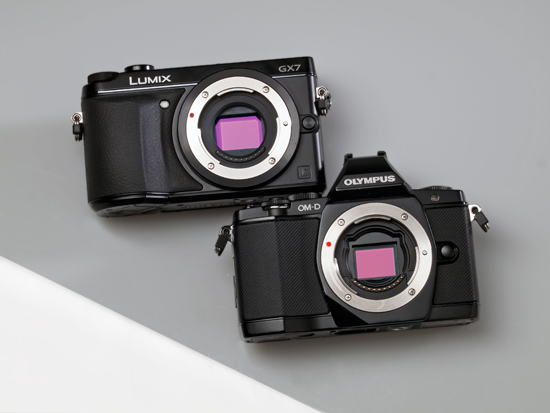
Image courtesy DSLRmagazine.
DSLRmagazine (google translation here) compared the new GX7 vs the E-M5. The tester writes that he expected a better result from the newer GX7 sensor. The image quality is more or less on par, the E-M5 has a better saturation and clarity, and the GX7 looks a tiny bit better at High ISO settings. They also discovered that the sensor size seems to be slightly different between the two cameras. The GX7 is a tiny bit more wide angle compared with the E-M5 (same lens used). Here is the GIF that proves it:
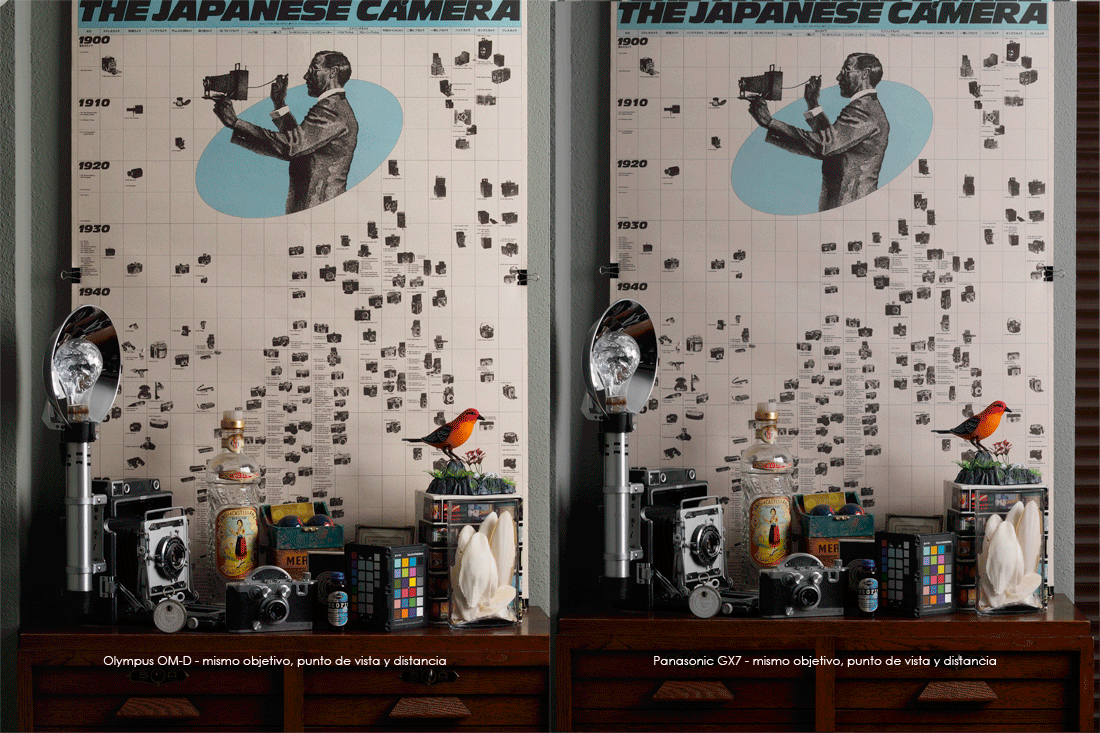
Do you know guys why it is so?
157 Responses
If, these photos are jpeg, the correction of distorsion is different on the two cameras.
Most likely the case. When I process my images in RAW, my 20mm and 25mm both look wider. The auto correction “steals” some width. Panasonic wont have the same correction parameters as Olympus.
GX7 is more wide angle, which means:
– bigger sensor
– more vignetting to be expected
Panasonic is good for doing that, and if you want it, add it back in Lr.
Unless Olympus zoom the image slightly digitaly as part of their image processing – i.e. allows more room for distortion correction without any chance of surround clipping visible? (althought it would seem a slightly distructively aggressive approach to image processing)???
At first I thought this could be correct that they have a different sensor size. But at closer look I think not. I think that the cameras where not set up exactly the same. It would be interesting to see the files in raw format including the exif data.
That should tell the whole story.
To me it looks like both cameras where not on exact the same position.
But maybe I am wrong.
Most likely you are, the responsible of these tests has been working in this kind of analisys along the last 40 years. Thus I think he knows how to set the cameras to avoid such a mistake, even more if he’s published that conclusion about the sensors in his magazine 😉 The tests of Valentín Sama are among the best you will find in internet about both cameras and lenses.
How would he account for the difference in positionn of the sensor relative to the tripod mount? plus both sides obviosly shift in the same direction
He’s been analysing the different sizes of sensors in digital cameras for 40 year ? What’s he doing still doing camera reviews then ? He’s gonna make a fortune when he goes public with that time machine of his. 😉
What kind of camera sensors was he analysing 40 years ago???
Besides the two images are obviously out if alignment which is a sign that he does not know what he is doign so I would not put any weight on this “analysis”.
Wideangle sensor? Please tell me more. And call me back, when zoom sensor will be available… 😉
…or macro sensor….:-)
GX7 seems really a good camera. I’d like to hear some opinions about its handling when mounting bigger and heavier lenses such Voigtländer17.5mm, and how effective is its IS with legacy lenses.
Are you planning to get the 42.5, too? Steve Huff has a pre-review video.
nice….first what came to my eyes is that the vf4 looks good on this combo ep5 & 42.5 …vf4 doesnt look big … and it looks natural
would say that the ep5 &vf4 is not so bad combination…starting to change my mind here … hopefully there will be ep5 price drop due to gx7 sales
Shin, I received the email about his post and the lens looks nice, but this time I think I’ll go for the Nocticron: 0.95 vs AF 1.2 is a hard match.
I would use it for night portraits, though lately I found myself using 45mm for street photography.
Artists are not always patient enough to wait for you nailing manually the focus..
I have Voigtländer 50mm T1.5 M mount, and I hope I can use it next week at Venice Movie Awards, but again, movie stars not always wait for you..
The new Panasonic is a disappointment. Image quality is not on par with the E-M5 and that camera is a year older. No need to switch or choose this one over the still truly excellent E-M5. Image stabilization is bettering the Olympus. I never liked the Panasonic colors and build quality either.
it means:
1. the most new and lastest Pan sensor is good, but still not very good compared with Sony heart ( EM5 sensor is nearly one year old).
2. pan’ sensor is for himself, so a bit bigger is better. Sony’ sensor sold to oly, maybe smaller can save money>? not sure lol?
The Sony-Sensor is 1,5 years old. 🙂
Is not meaning at thalk by Sony no this posted LOL, but maybe the first Sony sensor is in Sony CVC-2000 from the year 1965. 😛
The “age” of sensor matters only to DxO, because it fails to account for improved noise performance. (They always proudly tell how they remove the noise reduction applied in hardware.)
In semiconductor manufacturing, the process is tweaked and improved all the time. Every batch is analyzed so that next batch can be made better (and cheaper). Most of the IQ advances – number-wise – are thanks to this tweaking.
How do you know that? Can you point me in the direction of your source? I’d like to read more about it, and get a better understanding of how improvements are made. Thanks!
“Can you point me in the direction of your source?”
I can point you at myself. 🙂
I worked in semiconductor industry for about 2 years.
Otherwise, you simply have to follow the normal tech news channels. Occasionally one might get a report on manufacturing problem (some CPU/GPU/sensor gets delayed/too expensive) which delve a bit into the technicalities. (E.g. there were two articles before and after launch of GH2 which detailed Panasonic troubles with the sensor manufacturing and why there were so few GH2s in the beginning and why Panny couldn’t drop the price.)
A good starting point for self-education is:
http://en.wikipedia.org/wiki/Photolithography
This is the most commonly used process for manufacturing modern chips and CMOS sensors. Though the organic manufacturing process (look for “Fuji organic sensor”) might replace it in future at least for the image sensors.
Your question would require several years in tutoring and understanding on your side.
Suffice to say the answer lies in seeing what can be done with an existing sensor being refined. For that you need look no further than the ep1 through to the E5 using the old 12MP sensor as an example. The E5 was described as taking the best photograph in the world by a German magazine. The same sensor in earlier cameras never got such praise.
Did you not read it? They gave the edge to the gx7 at every turn.
loser….
another smart answer from the best of the best olytards.
It doesn’t really matter if Sony’s sensor is older or not, what matters is that this sensor is the best Olympus has and this is going to be inside the E-M1 as well.
In another words, by first tests in several sites, Panasonic’s sensor seems to the, overall, the best m4/3 sensor. This is one of the reasons why I thought Olympus would bring a new sensor for the top of the line E-M1 but Olympus usually does this, they use the same sensor in their whole line up, be it an PLx or E-Mx.
FROM THE MOUTH OF THE ACTUAL TESTER PEOPLE! will you still argue?
Complete nonsense, the Panasonic is not better at all. Look at the awful colors on this thing! I’d take the EM5 over this Panasonic anyday. Panasonic has made some nice lenses, but they can’t hold a candle to the Olympus camera bodies. Olympus’ cameras are build better, have better stabilization and deliver more pleasing images (colors and sharpness).
the second frame is more to the right but not wider in both directions. and you have to compare RAW, the jpeg is not as wide as RAW. maybe the GX7 looses less then OM-D. The very good olympus-jpeg looses a lot!
sorry for my horrible english!
Your English is fine. We understood what you meant, that’s all that counts.
both picture doesnt seem to be taken at the same position. The “wall bar” on the left is closer to the boarder than that of OMD. It’s not a fair comparison, what is this GIF proving?
Yeah it just looks like one pic is taken more to the left and the other more to the right… proves nothing for me.
Don’t look at the horizontal differences – the cameras were probably side-by-side. Look at the vertical difference.
That being said. Since there’s horizon difference, how can we be sure that the two cameras are place a the same spot for comparison?
There is a logo on top of most camera, showing on what plane the sensor is exactly inside the body.
Circled in red in this example :
http://fotoshutter.com/wp-content/uploads/2011/06/d40_topview.jpg
That’s what you need to know to do that kind of test.
furthermore…who cares…it’s sunny outside…I think I will go make some images…..
+1 going back outside now. Have a nice shooting!
+1 who the f@&*ck cares about sensor size anyway? Go take some pictures my dear pixel peepers. Fact is the Panasonic is a bit of a disappointment and Olympus still has the best camera bodies. It doesn’t matter, this happens. Enjoy the camera you have.
I dont think so, the test of DSLR Magazine are known for be very, very thorough. To place a camera next to the other to measure the sensor is a rookie mistake. You should take your time to read the articles and test from this website about MFT cameras and lenses, they are really good.
it depending what lens they used and what file format (RAW or JPG) they shot.
Probably slightly different implementations of in-camera distortion correction
+100. Not meaningful test at all except to allay any fears of a completely useless sensor.
I sure both cameras tested with IBIS stabilization.
2 axis GX7 vs. 5 axis OMD.
OMD is better, but i guess more cropped in case of 5 axis.
Studio test shots are usually shot using a tripod, in which case IBIS should have been turned off.
As I already said before, the author of the test, Valentín Sama, has been working on these kind of tests the last 40 years… You really think he shooted with the IBIS on using a tripod? Just because he writes in Spanish it doesn’t mean that he doesn’t know what is he doing. There are also very profesional and good experts beyond the English speaking world…
I don’t recall anyone saying anything about his not writing in English. Except you.
Don’t be so sensitive.
But the best speak English natively.
This means bigger sensor in order to increase the pixel size at expense of more problems in many areas.
Link? Something to back this up?
I dont expect a reply…
just another asshat voicing an opinion on something he knows nothing about
They’re certainly out in force today.
Since the image shifts to the right, the test is useless. Obviously the camera changed it’s position when the lenses were exchanged. And maybe the camera didn’t only shifted from the right to the left, but maybe also forward – as we know, there are 5 axes a camera can shift.
Since the image shifts to the right, the test is useless. Obviously the camera changed it’s position when the lenses were exchanged. And maybe the camera didn’t only shifted from the right to the left, but maybe also forward – as we know, there are 5 axes a camera can shift.
What? No. The cameras were in exactly the same position. The lens mounts on the EM5 and GX7 are not at the same height and center point (compared to the tripod mount), it’s why the image is also shifted. The cameras’ distance to the subject is identical, which is why it’s so interesting that the image has scaled the way it has. Someone is not following the m4/3 standard correctly.
Are you kidding? You mean on one of the cameras the lens is not aligned with the sensor?
Have you ever used a tripod?
What’s a tripod? 😉
Anyway, to do this test sensors should be on exactly the same position, or, easier to figure out, lenses should be on exactly the same position.
No the Tripod-Mount is not aligned with the Lens-Mount.
Just so happens you can see the tripod mount in the image above,
and clearly the E-M5 is slightly to the left.
Ok, that makes sense (differences in the position of the lens mount relative to the position of the tripoid mount) but what’s the point then to put these two images in a GIF? As many noted, image stabilization leads to some trimming of the image and I don’t think the difference is relevant. Rather, the left-right-up-down shift in the GIF creates the illusion of a pronounced difference.
Pana states the sensor is 16.84MP but only effective @ 16MP. Oly states E-M5 has effective 16.1MP.
It looks the same to me. Optical illusion as to how the sensor is mounted in the GX7 in addition to the larger overall pixel count? Dark vs light pink areas on the sensor?
If anything the E-M5 would be larger with the additional 100000 effective pixels. Also like others have pointed out their photo test looks odd. Can’t tell anything from that apart from the fact they are hopless at testing.
Am I reading this right? What sort of review is this anyway?
“If we look carefully animated gif, we see that between takes, made with the same goal, there is a horizontal offset, due to the different “height” of the lens mount on the camera body and therefore the anchor the tripod stand, worst that’s not relevant.
What is relevant is that the vertical proportion covered field is different, being higher in the GX7.
Ergo, the sensor in size / proportions, different.”
You guys should actually read the review. It explains everything. Basically the GX7 has a slightly larger sensor giving the end picture a slightly wider field of view.
I feel sorry for the elephant…
It’s not the sensor size but how many of the pixels you use. I’d assume the Oly uses less near the edge, perhaps for some electronic stabilisation in addition for the IBIS, perhaps to keep the viewable area under extreme IBIS movement a bit out of the vignetting of the lens. Perhaps that’s just how the sensor works.
Even if you could use the picture of the two cameras showing the sensors, just by measuring and comparing, you still don’t know what sensor area is used to read the information. So someone should put the two on a tripod and take a picture with each camera from the same position into the same direction.
Both cameras capture more data than save for the image correction. It’s most likely a difference in the algorithms or how they interpret the data.
Well we know that the em5 has a standard 43 crop, and we know the lenses were built to be small while covering this crop. Therefore, it seems unlikely any camera could achieve a wider crop with these lenses without technical problems.
It wouldn’t even be a good thing. The kit zooms are already too short.
WTF?
I mean…
WTF?
much more important then these details is the general impression of the pics, and a plus of clarity means more dynamic with the m5.
The gx7 might be a little bit more usable at iso3200 and above but to be honest I would not use more them iso1600 with mft or compacts.
Only the best dslr s or the fuji x are offering a quality which I would call usable at iso3200, so these diffences arent important in practise.
Unfortunate, but not too surprising. Since Sony came out with NEX, they were one generation ahead in terms of DR. They are basically using the same base technology, Sony just has more know-how. Until there’s a shift in sensor technology (organic maybe), we won’t see this big step by Pana. And even then Sony could be one step ahead.
I know there’s a lot of hate for DXO here, but at least the sensor rating give a pretty good overview of performance. E-P5 had 72 overall, GH2 had 60, and I expect the GX7 to be not higher than 68 overall, maybe with a slight advantage in high ISO.
Btw, I am pretty sure when the E-M5 came out people said it had usable ISO 3200.
But did you actually read it?? They said the dynamic range is about the same and the high iso is better.
No I didn’t read it. 😉 Just what I expect from the assorted reviews to date.
That’s impressive! Expectations up to points in DXO based on reviews you didn’t read? Even having read the reviews, I don’t feel that they are detailed enough to justify any expectation on the DXO score, except that it will most probably be not worse than the GH3’s, which already is on par with the E-M5 (and the E-PL5 up to measurement tolerances).
One should also notice that DXO has been around for a while now, permitting the vendors to optimize their sensors specifically for DXO performance, just like car manufacturers do “cycle beating”. Just like the latter yields cars which nominally achieve drastically better mileage while providing much smaller improvements in practical use, the co-evolution of products with a fixed file of benchmarks could also drive sensor vendors to design decisions that are not always aligned with actual user needs.
Nope, youre completely lost. Clarity has nothing to do with dynamic range, and mr43s are not compacts, by far. Fuji cheats on raw files, no in camera noise reduction for me thank you very much
> Do you know guys why it is so?
For IBIS to work, the camera must crop the picture since the sensor is moving up/down, left/right while stabilizing the picture. Olympus crops a bit more, which is needed because their IBIS is more effective and can compensate stronger movements. Panasonic crops less. There’s no difference in sensor size (and there can’t be, as that would require a different flange back distance and then it’s no longer mFT).
@Me: If the end result of the IBIS is more cropping, then how do you explain images on the OM-D always have the same 4608 x 3072 pixel dimension? It just makes no sense at all. That would mean if say I was shaking quite a bit when taking the picture, suddenly I’d end up with a 4200 x 2700 reduced size instead.
Maybe @Me realy think on digital IS, so little some E-330 had.
Who knows what’s going on in the build in computer dude? For all I know images of my cat might actually be images from the neighbors dog. It’s very mysterious what goes on inside these little camera boxes. Nothing like film. Take the Fuji cameras with their ‘magic’ x-Trans thingy. It’s just smart processing and you can see it when you take a close look at the super soft output of these models. That’s one of the reasons I will never buy a Fuji (the other one being the crappy build quality and the slow autofocus and the odd colors and…).
The sensor is moved so you don’t need to shift the readout area (electronic image stabilization).
Typically outer area of sensor isn’t used but covered by different masks to measure and optimize sensor data readout and processing.
With square pixel, exact 4:3 image ration and width and height a multiple of 8 one can change the height in steps by 24 (and width by 32).
If the Sony sensor in EM-5 is a little tight the image size has to be slightly reduced.
Btw, this measurement needs to be done very carefully:
– same lens
– same aperture
– same focus distance
– disabled distortion correction
– same lens axis to same point on object
– same distance object to sensor
As I already said before, the author of the test, Valentín Sama, has been working on these kind of tests the last 40 years… You really think he shooted with the IBIS on using a tripod? Just because he writes in Spanish it doesn’t mean that he doesn’t know what is he doing. There are also very profesional and good experts beyond the English speaking world…
So you are saying that this person is infallible? A modern day Jesus Christ?
Exactly, that’s what I’m saying. He’s god and I’m his prophet.
So why doesn’t he explain it then?
Eh, sounds like this guy is family ha, ha. I don’t care what language he speaks. Bullshit sounds the same in any language.
I can’t say if this test is valid or not, but there’s no reason why it shouldn’t be. It’s fairly common with slight variations in sensor sizes event though they are made for the same “standard”.
Thom Hogan has a table of Nikon dSLRs that include sensor sizes and if you look it up you’ll see that both APS-C and FF varies in real size.
http://www.bythom.com/currentdslr.htm
These variations doesn’t really matter and you wont notice the differences unless you make test shots like the ones in this article.
Different position of tripod screw?
Why the question mark. The image above it shows it. 🙂
THE EM5 IS STILL THE BEST CAMERA after more than a year. nuff said.
DID ANY ACTUALLY READ THE REVIEW???
Ah. You finally betrayed yourself. True Homer, also know as.. Mr. ALL CAPS we got you!
sincerely,
Sherlock H.
“”DID ANY ACTUALLY READ THE REVIEW???””
Unfortunately Olympus users are immune to reality and have a visual impairment that prevents them from reading anything that may suggest their cameras hand crafted by gods is inferior in anyway.
Don’t shout at us. Every good cam ever build will remain a good tool and produce good images. But what has been the best yesterday may not apply to today. And mainly our requirements and expectations change faster than technical evolution takes place.
+1 Kavat. And with the truly impressive 5-axis I see no reason to buy a gx7.
But, by all means, stick with IBIS, if that’s what you need to take great pics. I’ll be good with the GX7 with my P/L 25 and some OIS zooms..
This camera can come no sooner.
Mr ALLCAPS
Kinda ironic how that GX7 also has in-body stabilization, will be very useful for that 25/1.4 every so often. GX7 with that lens seems like a very desirable setup indeed. As good as an E-M5 with that same lens? better in a number of things, not as good in some other things. Having choice is nice isn’t it?
Some people here drink too much coffeine.. They shout so loud because hey feel small..
the lens mount sits higher on the OM-D it would seem. i have a shift similar when using the same lens on an OM-D and a G6 with both on the same tripod in a fixed position.
Teeny sensor vs Tiny sensor – corporations win, consumers lose…
how do corporations win if you don’t buy the product. your argument is stupid.
Here you are. Panasonic STILL lagging in image quality departement. Hardly a surprise…
I think RAW info is better on GX7 sensor, Panasonic has use large size on photon set and better micro lens, but this will only give better IQ in hight ISO, the need not give better DR for exsamle.
Amazing….despite the review saying otherwise
Actually someone above hit the nail on the head. IMHO it’s how the cameras do software distortion correction.
If I use DXO Optics Pro to process my GH3 files (e.g. from the 12-35) I get a noticeably wider FoV than the OOC JPEGs, but can get a lot of vignetting at the edge. I can see why Panasonic left this off so users get always good images, but it’s nice to have the option to see the whole FoV then crop as required.
I guess Olympus is a bit more conservative.
And here we go again with “mine is better than yours”. Wait, does anyone already has a GX7?!
I’m going out taking some pictures. 🙂
Lol….. M43 slowly going APSC size. Its just the logical step if you want to produce good quality pictures.
Sorry, but APS-C is crap.
I either use FF or m43 but not APS-C because according to the situation either of them is simply better than APS-C.
So you reckon 1.8mm in additional height gives magical qualities to an image?
That’s the sum total difference in height between the Canon APSc and the m43.
And the real magical Sigma is only 1mm taller than m43.
They are a lot, lot closer to m43 than 135.
But don’t let that spoil your illusions.
“So you reckon 1.8mm in additional height gives magical qualities to an image?”
Never saw anyone claiming magical qualities but facts are facts and the best APS sensor Nikon D7100? is ahead of the E-M5 in all areas 1.4steps better DR ,1.4 stops better color depth and .75 stops better high ISO.
Canon has the poorest APS sensor in the market.Nikon,Sony nex/alpha Pentax all outperform the best mFT cameras even the last gen Sony 16mp Senor outperforms the best mFT.
Even If they had the exact same sensor tech you would expect the Nikon APS to be approx .7 stops better than the same sensor tech on mFT by merit of its larger size.There are those who say this doesn’t matter and to most of us it doesn’t Including me.On the other hand to match the DOF and light gathering of the excellent Sigma 18-35mm F1.8 you would need a mFT 13.5-26.25 f1.2 lens wonder what Olympus would charge for that.
How it happens that I take nice photos with this tiny sensor then? And I’m not the only one? No sir, me, personally, I don’t need an APS-C sensor for my hobby/job/passion.
I tried and can use whenever I want Sony NEX7, Fuji X-E1, X100s, all good cameras btw, but they’re not mandatory to take nice photos.
+1 Because the quality of an image is not measured in stops
Light gathered by a lens does not magically change depending on the sensor size, that is just a load of BS. What does change is how much of that light actually gets used. The exact same is true when making a crop from a picture made with a larger sensor, that won’t magically change the light gathered by the lens either (and is actually the exact same thing).
when I started with cameras DOF was a measurement to show what was in focus not out of focus. A fast lens was to enable shooting in dark areas. Not for shaving or throat cutting.
The canon was mentioned not the nikon. As the canon is the bigger seller it is most appropriate.
And light gathering is about the receptor size not the total sensor size and what is done with it. A speed booster with the sigma lens will give the same results on m43. And the weight worry goes away.
You are one of the hang charts on the wall brigade. Try taking photos.
Well, these are all JPEGs. All in all, wehn we look at all tests they are very close. But in a bit more detail I think that JPEGs can explain a lot. Colours in the Oly always have been known to be punchy inspite of using the same sensors as panny. Now they are different. Panny could apply more noise reduction here and there…So this test, for a detailed analyses, seems useless. We simply need RAW.
It’s just beause the mount are not at the same place on both camera…
The GX7 has the tripod mount right under the optical axis, the OM-D has its tripod mount shifted about one inch to the right.
I thought this site was created to discuss rumors not make them up LOL who cares if they are slightly different. Too many variables to determine. I think its camera position or ibis making the difference.
slight difference, neglectable imho. good bodies, can work with both, so i dont care.
Illinois loser
I am from Lutjesbroek
All true, very reasonable. And right on cue, FF tries to cut you down and fails – as usual.
I just checked this gif (centered both frames up), in Photoshop and the Olympus frame seems to be 2% bigger. That’s why the shift.
I also tested several lenses with olympus and panasonic bodies.
Even when they used same sensor the effective resolution and view angle are slightly different.
For example panasonic body has 4000×3000, but olympus body has 4032×3024.
I don’t know why, but anyway view angle is not enough reason about sensor sizes. 🙂
What an embarrassment. This is the end of micro four thirds. (It barely even started, lets face it…)
if that’s not a troll, I don’t know what is.
Effective pixel count and even image processing can be the reason of that differences too. 🙂
The picture from E-M5 looks a bit warmer.
So, GX7 has larger sensor, and Panny wisely decided not to crop the images.
I do not see any problem.
It’s more of a good sign: potentially, Panny still working on new multi-aspect sensor.
Quite frankly, from sheer IQ comparison, at this point I expect hair-splitting difference. This is not to say one cannot rationalize one pick over the other, I just don’t think IQ ought to be the deciding factor.
Unless maybe straight out of the box jpeg engines rules. Even at that price bracket..
The sensors are not different sizes. According to both Olympus and Panasonic, the sensors in their respective cameras are both 17.3 x 13mm.
I wrote a small article about this on my camera ergonomics blog. I found the GH2 and G5, which use the same sensor, give a 2.5% greater angle of view with any lens than the GH3 which likely uses the same sensor as the EM5. It appears the Panasonic made sensors have a slightly larger effective size. The link is here http://cameraergonomics.blogspot.com.au/2013/04/lumix-gh3-review-part-5-field-of-view.html
It looks like the em5 has some kind of a frame around its sensor and the gx7 doesn’t. That’s why it appears larger
The sky is falling.
“Image quality” and Jpeg cropping are the least differences between those two cameras. Very different devices which different gestalts that should satisfy different photographers.
Still choosing a camera by its sensor performance? You are not really photographers, are you?
to me looks like m-5 is better than panasonic
Does m4/3 specify where the tripod mount should be located?
No it doesn’t, and there is a fair bit of variation between various m4/3 cameras in this.
We are lucky to have these two beautiful cameras in the m43 system. Looking forward to more info on the EM1. It too is sexy in is own rugged way.
Overall lower pricing would definitely entice me to replace my gf1 and gh2. The waiting game is on.
It may be a bit disappointing that the 1,5 year newer GX7 is more or less on par with the EM5 when it comes to IQ. (Differences are so small that in real world photo it is the same.)
Then we have usability where the GX7 has a swivel Adobe RGB EVF and the EM5 has the excellent 5-axis IS – both very strong advantages.
The deciding factor is then handling. Pana more straight forward interface (at least for me). How to hold and use as photo making machine? A very personal decision I think.
Sensor improvements tend to come with new production technology, then just minor adjsutments until new tech is available – and even then there are rarely huge differences. So same IQ as E-M5 (and G3) wouldn’t be surprising.
Pana themselves talk about 10% improvememnenst in some aeras, and that is barely measurable differences. Probably below margin of error in most tests.
Anyway, agree that it would be difficult to choose between E-M5 and GX7, they both looks like really good models. Viewfinders are on par IMO, I’d say DR of the viewfinder is more important than Adobe color space. I think you really have to compare side by side to spot any differences.
I certainly prefer the GX7 ergonomics, buttons and menues to the E-M5. Adding the grip to E-M5 helps, but also makes is bigger and heavier. The GX7 grip is a bit wide so the there isn’t much room for the fingers beteen grip and lens with larger lenses.
That 10% is not measured against Olympus’s sensor but against their own previous best sensor.
only infinit distance says something, perhaps that s tripod support position
Hmmm… If the GX7 is clearly better, I was going to jump on it right away… My E-PM1 developed some annoying, nobprohibitive problems, and I’m debating what to do.
Ah. These are all JPG comparisons, so it seems Panasonic has definitely caught up to Olympus on the JPEG engine.
Gotta wait for Raw comparisons, which might be a while…
Readers (and Admin), let’s see the new studio comparison raw test posted by DPrewiew, instead (http://www.dpreview.com/news/2013/08/14/panasonic-dmc-gx7-added-to-all-new-studio-comparison-database): after I saw that I think the sensor GX7 is completely different than the OMD/Sony (and GH3) one, at high ISO the noise on certain colors is better, worse on other. What do you think?
The GX7 and EM5 are two excellent cameras which compliment each other in many ways and provide choices. The GX7 body and that of the EM5 minus the EVF hump are very similar in size but Pany has managed to include the EVF and onboard flash. I would prefer the more compact GX7 for travel while others may prefer the EM5 for overall occasions. The EM5 does provide some weatherproofing but only one larger std lens with same while GX7 body is very well built according to reports and tight and less rubbery buttons.
If in fact as appears to be the case the sensors are different that is good as Pany’s is now an essentially equal in IQ. Pany puts some pixels to work to provide more video capability while Oly puts some pixels to work to provide 5 axis IBIS. While Pany now has optional 2 axis IBIS for none OIS lenses note should be made that for video EM5 only uses similar 3 axis IBIS plus electronic IS not 5 axis IBIS for video as most seem to assume. Choice is good, no need to try and tear down either camera just because of your own preference.
+1 : that is a nicely balanced comment, far above the ridiculous fanatism
The fact that Panny has caught up with Oly in jpeg appears as the main event
if you are arguing image quality of these two so vehemently then it seems to me it’s about your choice, subjectivity, whichever camera you like more.
Sorry to hear that Panny or Oly have not punched through with a significant improvement in their sensors but they are still pretty good.
The choice between these two cameras is not going to make you a better photographer or a lesser photog.
I’m used to Panny’s so I will probably get the Gx7, I sold my G3 and GH2 so…..here we go again 🙂
http://makeagif.com/i/_TtyFw
For those that can’t see that despite the difference in the position, there is a difference in sensor size, I aligned the center of the image and made another GIF, this time the difference is clear.
I did a quick math and it seems that GX7’s sensor is about 5.7% wider than E-M5’s.
if they are shooting with a wide, the difference between the tripod screw and the mount will make something different. So the best way to make a comparsion is to shoot a frame 10m + away.
In the spce, they are nearly the same size, so I can’t see any possibilty that GX7 is bigger than EM-5. however, one thing happened in the history of Olympus, the E-1 is a little bigger than the others.
This whole question is silly. They’re different parts; why should it be “curious” that their sizes are different, and why should it require elaborately invented explanations?
The m43 standard doesn’t seem to mandate any exact sensor size, witness the GH2’s “multi-aspect” sensor.
It looks like it’s a multi-aspect sensor like the GH2 is/was. Maybe they will bring back multi-aspect for the GH4. I’d like to see that.
The GX7 is the right direction for M4/3. The price of this is still a main concern when you know the big boys are making DSLRs at very low prices.
because they are idiots who cant even stand to their own standards…..
beside…. m43 is dead soosn anyway…..
That your brain size in microns.
To proof something the tester must put a lens (not the bodies) on a tripod. Put a manual focus prime on a tripod, then swap bodies. Also provide a file extracted from raw images without lens correction.
Well…
As many pointed out:
1 – the geometric correction in-camera.
2 – Different types of anti-shaking.
3 – Raws and jpg can have different informations buried inside.
Scientific tries need long thinking, experience, extended knowledge, method.
Our dear editor put on an effect title: the news behind it may seem poor but it is not, and worth investigating!
🙂
I agree with @Dummy00001 and can confirm (if needed) what he says about sensors. I add that the sensor is a PART of the machine that builds the image, and same sensors may end up in different results, different paths to achieve same results.
we, at http://www.officinepanottiche.com have a very technical approach at cameras, due to the peculiarity of our works. Of course what we look for in a camera is NOT what normal pros or amateurs are, and have all the reasons to. 😉